Access to the community for P: a s.21A deprivation of liberty hearing

By Anna (daughter of a P), 27th September 2022

This case concerned P, who is in a care home, but who must want to leave as this is an appeal made by him under Section 21A, challenging his deprivation of liberty.

I am particularly interested in Section 21A applications as my mother is a P in such a case, and it can be hard for families to understand the process involved. 

I deduced from what I heard in court that this was a Directions hearing to approve orders, including obtaining a Section 49 report[1].

The hearing was listed on the First Avenue House daily hearing list as follows: 

Tuesday 20th September 2022 3pm

DJ Eldergill 

First Avenue House (remote) 

COP 13978517 DJ -v- London Borough of Barnet

Section 21A Deprivation of Liberty 

Directions, 1 hour, Remote 

I knew from previous times that I should send an email to courtofprotectionhearings@justice.gov.uk to ask to observe and, if necessary, call 020 7421 8718 in the event of problems. 

The hearing proved fairly easy to access. I sent an email to the court asking to observe. I then received a reply asking me to confirm my reason for wanting to observe the hearing. I replied that I was a party to a Section 21A appeal involving my mother. I also stated that I was involved with the Open Justice Court of Protection Project

I didn’t receive a transparency order but I was sent an email asking me to confirm that I understood that I should not publish anything that might enable P to be identified, or where P or family members live, without the permission of the court (which I could ask for); that I would not record the hearing in any way, and finally that I would not to share position statements or other documents without the court’s permission (which I could ask for). Otherwise, I could be held in contempt of court. I wrote back to state that I understood, but also to confirm that I understood “record” to be by sound or video, as I would be making notes by hand. I didn’t hear back so I assumed that was OK (especially as I had done it before). I chased the link 10 minutes before the hearing. 

I received the MS Teams link only 5 minutes before and I think that this was because it was doubtful that the hearing was even going ahead.  

I joined the meeting, which was already attended by five people (including the clerk). The clerk opened the meeting and the hearing began when Judge Eldergill joined. He checked that the necessary people were present and stated that an observer was attending (me) and that I knew what the restrictions were. I think I heard that he asked if P was joining, but was told no. Everybody had their cameras on, except me. The judge then started the hearing. 

I gathered from what Judge Eldergill said at the start that the parties had been in some discussions before the hearing. The hearing would probably only last 10 minutes – I imagine that this was why there was no background to the case given to me as an observer, as it wouldn’t have been an appropriate use of time. The judge explained that he had read the Position Statements and the hearing could have been vacated but for the fact that he wanted a discussion about a particular point, which was access to the community for P. He then asked about this. 

Counsel representing the Local Authority (I assume, as it wasn’t clear who was who) explained that the care home has been in lockdown for two weeks due to COVID (implying that normally residents who were capable could leave the home to go into the local community). He explained further that P was sociable, but on his own terms.  He liked participating in musical events at the home and liked going into the garden. 

Judge Eldergill stated that P had mentioned wanting to be able to go to a restaurant (and there was also some mention of P being able to go to a bank). He referred to Paragraph X (of the Position Statement) which stated that the Home was concerned about P going out alone because he was at risk of absconding. However, the judge raised a point about the seemingly low likely risk of this happening, given that at another paragraph, it stated that P uses a Zimmer frame and so clearly has mobility issues. 

The solution suggested by the Home was that they should take P out and the Judge was concerned about care home staff time and how practical this suggestion was. He then asked whether there should be an amendment to the draft order to ask or require (I’m not sure which) staff to take P out. The Judge continued that the Court could attach conditions to the order re Section 21A and this would be the type of thing that would be attached (and so suitable wording should be agreed). 

Counsel for the Local Authority suggested something along the lines that “the Home will support P going into the community”. 

The Judge suggested that he wanted something more specific. 

Counsel for the Local Authority explained that the home was big, with its own café and a big garden. It was also very close to local amenities. 

The Judge proposed that a program of outings could be agreed which would take them through to the next hearing in December. 

Counsel representing P (I assumed) wanted the order to enable some flexibility but agreed that in principle it was a good idea to amend the order, outlining how P should have access to the community. 

The Judge then referred to the fact that P has been recorded as stating that the home “feels like a prison” and that he “was a prisoner”. So, he wanted to improve P’s situation in the time period before making a final decision (about the Section 21 A appeal).  It was agreed that the Court wants access to the community for P to be specified in the main order. 

At this point the judge asked if somebody could talk to P’s brothers about taking P out from time to time in order to reduce the pressure on the staff in the care home. He then went on to state that the background was a bit vague but that it seemed as though P might prefer to be in….  I didn’t quite catch the exact words but it was some sort of sheltered / supported accommodation (rather than a care home, I think, was the implication). Therefore, a point should be added to the order requesting the S49 report, to obtain information about whether P could become disorientated and therefore what the appropriate type of accommodation should be. 

The Judge then spoke to me directly to say that he was leaving the hearing and I should leave at the same time, to enable the parties to continue their discussions. 

My observations 

Although this was a short hearing, and technically about wording in an order, it established an important principle and was useful to me in various ways. 

First, as in my mother’s case, the Judge was clearly concerned that steps were taken straight away to improve the quality of life of P rather than waiting for another hearing. P wanted access to the community and the judge wanted to ensure that this could start happening as soon as possible. 

This raised another point about the practicalities of this happening, and how much time the care home staff would have to do this. As well as being concerned for P, the judge was concerned for the care home staff’s time too. I hadn’t fully appreciated before my mother’s case, now reinforced by this one, that the Court of Protection can make orders requiring Homes to take residents out into the community, as well as making other adjustments as appropriate.  How this can be organized and monitored to ensure it happens is another matter, as I have learned from my mother’s case. 

Second, it was interesting for me that the judge raised the possibility of the family going out with P. It sounds a reasonable request. However, I know from my experience that a lot already falls on families and it can be hard to draw a line between the State and the family providing support and care. Families are strange beasts and there can be many reasons why a family’s role can be limited. 

Third, the judge was concerned to support P’s autonomy. In this case P was quoted as saying that the care home is “like a prison” and this reflects the exact words my mother uses and it made me realise that it is an expression that Courts must hear all the time. My mother’s case is unique, as are all cases, but I’m learning that there are similarities that judges must come across frequently.  

Finally, I was struck again by the spirit of cooperation between the parties present, and Judge Eldergill doing his best to ensure that P’s wishes were at the heart of the discussions and accommodated in the best way possible. 

Anna is the daughter of a woman who is currently a P in a Court of Protection s.21A application.  She’s not using her real name because she wishes to protect her mother’s privacy, while also hoping that other families can benefit from reading about her family’s experience.  She hopes to blog in future about the hearings as the case progresses through the court.


[1] Through section 49 of the Mental Capacity Act 2005, the Court can order (most typically) the NHS body responsible for the area where P lives to produce a report even if it isn’t a party to the Court proceedings. A section 49 report is often considered as an alternative to a report by an independent expert. Whilst reports by independent experts can be obtained by the parties at private expert rates, no provision is made within section 49 in relation to fees or expenses incurred by the body directed to produce the report, and so the cost is therefore borne by the body directed to produce the report. See “What is a section 49 report?”

Medical treatment for people with learning disabilities: Telling Robert Bourn’s story and the challenges of ‘transparency’

By Celia Kitzinger, 21st September 2022

The BBC has a story it wants to tell in a forthcoming Panorama programme.  

It’s about Robert Bourn, a man with a learning disability who was diagnosed with cancer.  

The story is about the challenges in getting appropriate medical treatment for him – and the disparities in healthcare that mean that people with learning disabilities are often less likely to be treated.

But, until today, I couldn’t tell you whose story it was. When I first blogged about Robert and his mother Sharon, more than 18 months ago, when the case was last in court, I had to use pseudonyms.

Initially, I couldn’t name Robert, or his mother Sharon Bourn, because they were covered by an injunction preventing anyone from identifying Robert or any member of his family as involved in the Court of Protection[1].  

What’s in a name?  

In a  much-quoted passage from the Supreme Court case, Guardian News and Media Ltd & Ors, Re HM Treasury v Ahmed & Ors ([2010] UKSC 1), Lord Rodger says:  “What’s in a name?”  ‘A lot’, the press would answer. This is because stories about particular individuals are simply much more attractive to readers than stories about unidentified people. It is just human nature.” Without the names of the people involved, a story can become “austere, abstract … devoid of much of its human interest”.  In the criminal context,  “a report of a sensational trial without revealing the identity of the defendant would be a very much disembodied trial … On the other hand, if newspapers can identify the people concerned, they may be able to give a more vivid and compelling account which will stimulate discussion” (§64 & 65).

And so, in preparation for the Panorama programme, the BBC (represented by Claire Overman of Doughty Street Chambers) had made an application to vary the Transparency Order (issued by Lieven J, dated 27thJanuary 2021), so as to enable them to identify Robert Bourn, and his family, and the hospital at which Robert was treated[2] in their documentary. 

The BBC’s case was in court on 16th September 2022, before Mr Justice Nicholas Francis.

Counsel for the BBC described what the programme would be about:

… the BBC seeks to explore, through a number of case studies, the quality of care and life saving treatment options received by people with learning disabilities.  This is an under-reported topic that gives rise to important public interest concerns, not least given that ‘according to NHS figures, 1,200 people with a learning disability die from an avoidable cause every year’….” (from the BBC’s Position Statement)

Counsel for Robert Bourn (Parishil Patel KC of 39 Essex Chambers, instructed by Sharon Bourn as Robert’s litigation friend) described it like this:

The BBC ‘wishes to explore, through the telling of [Robert]’s and his family’s story’ issues of “crucial public importance, namely that their experience brings into sharp focus important questions concerning the equality of medical treatment, and in particular the impact of learning disabilities on a patient’s prospects of receiving live-saving treatment’.”  (from the Position Statement filed on behalf of Robert Bourn).

It’s important to be able to name Robert and his family (said the BBC) in order to tell his story in “a meaningful and identifiable way” – the same way that the other families in the programme, who’ve not been part of Court of Protection proceedings, can tell their stories as identifiable, named people.

An anonymised version of the story would lose much of its human impact, and is not in accordance with the family wishes….  The family’s Art. 10 rights do not simply encompass a right to tell that story, but also to tell it in the way they wish (that is, identifiably)…. One advantage of doing so is to allow the family’s story to resonate with the general public.” (from the BBC’s Position Statement)

Sharon Bourn, as litigation friend for her son, strongly supported the BBC’s application.

She agrees with the public issue of raising awareness of inequality of access to medical treatment for persons with learning disabilities.  She recognises the powerful impact of identifying Robert and the family in any reporting. She considers that Robert, if he could communicate his wishes, would agree.  Further, she explains how Robert benefitted from learning about Ian Shaw[3] who was in a similar position to Robert and whose story was reported by the BBC. Lastly, she does not consider that there would be any (detrimental) impact to Robert by his naming and broadcasting in the proposed programme.”  (from the Position Statement filed on behalf of Robert Bourn).

Since I am naming Robert Bourn and his mother, Sharon Bourn, in this blog post, it must already be evident that the judge gave permission for them to be publicly identified.  But this blog is not really about what the judge decided but about the judge’s reasoning in making the decisions he did about transparency, and the process by which he made his decisions.  

So, I’ll first give a brief account of Robert Bourn’s story, and why it’s an important story for the BBC to tell (and for all of us to hear), and then describe how the hearing unfolded.  I’ll explain how the judge came to the decision that Robert Bourn’s family could be identified, and why the judge did not permit identification of the treating clinicians, or the hospital in which Robert was treated. I’ll end with some “Reflections” on the hearing.

Robert Bourn’s story

Two years ago, in September 2020, Robert Bourn was diagnosed with testicular cancer.

He underwent surgical removal of his left testicle but by the end of the year it had become clear that the cancer had spread to his lymph nodes and he was diagnosed with “metastatic germ cell cancer”.  This type of cancer has a high cure rate, with chemotherapy.

Robert also has Fragile X Syndrome and a learning disability – along with “atypical severe autism, dysphagia and … limited verbal communication”.  Everyone agrees that Robert  doesn’t have capacity to make his own decisions about medical treatment (s. 3 Mental Capacity Act 2005).  This means that decisions have to be made for him in his best interests (s. 4 Mental Capacity Act 2005).

The initial response of his treating team, says his mother, was to say there were no treatment options. Comfort measures only were proposed and a palliative care referral was made.

In an earlier blog post, based on an interview with Robert’s mother, I quoted her description of what happened between her and the Robert’s doctor:

I asked the doctor, ‘So what’s next?’.  The doctor dropped his head and looked at the floor and said, ‘There’s nothing we can do’.  I said, ‘Pardon?’ – not as in I haven’t heard you, but please bloody explain yourself.  He kept looking at the floor and saying, ‘there’s nothing we can do’.  So, I said again, ‘What’s next?’ – meaning, what kind of treatment? He said, ‘He’s got twelve months’. To say I lost it is an understatement.  I was screaming, crying, punching the walls with my fists.  The learning disability nurse sat there like a rabbit in the headlights saying, ‘I’m so sorry’. Well, ‘Sorry isn’t what I want!’ I begged him, I put my hands before my face in the prayer position and I begged him to help my son and he kept saying ‘There’s nothing we can do’.  The day the doctor said he couldn’t do anything and my son had 12 months left to live, it was a case of we either accept it, or we do something about it. I’m not really one for saying, ‘Oh, okay we’ll do what you say’.  The Mama Bear instinct kicks in.  I wanted to see what else could be done.”

There are parallels between Robert Bourn’s story and that of other learning-disabled adults who’ve been refused treatment.

The BBC publicised Ian Shaw’s story in July 2017. As in Robert Bourn’s case, his doctors had decided not to treat his cancer: he also has “learning difficulties, autism and epilepsy”. According to one expert, It is difficult to escape the suspicion that this [i.e. Shaw’s learning disability and autism] has somehow influenced the doctors’ decision (Irene Tuffrey-Wijne, Professor of Intellectual Disability and Palliative Care). 

After seeing the BBC report, a psychiatrist, Dr Julian Wilson, asked to be put in touch with the family.

Knowing that testicular cancer is one of the most treatable cancers that there is, I was surprised that a decision had been made not to provide treatment and I wanted to understand what that was about…. My concern was that perhaps judgements were made about the quality of life that he has because of his severe learning disabilities and because of the physical impact of how the cancer has spread…  I’m also clearly aware that providing cancer treatment for someone with the problems that Ian has is a real challenge.  It is really difficult to give the best possible treatment to somebody in that situation, but my view is those challenges can be overcome.”

Following Dr Julian Wilson’s intervention, Ian Shaw received treatment and the BBC  reported in December 2017 that he was doing well. 

Sharon Bourn learned about Ian Shaw when someone posted these BBC reports on her social media page. She  remembers feeling “shocked” when she read the story: it was so similar to what was now happening to her own son and (via Kirsty Stuart, her solicitor at Irwin Mitchell) she made contact with Ian’s mother and got a second opinion (paid for by the Trust) from the doctor who’d treated Ian.  Finding Ian Shaw’s family, and getting solicitors involved, was “the light at the end of the tunnel”.  

It’s in part because she found Ian Shaw’s story so important in enabling her to advocate for her son that she wants now to be, like Ian Shaw’s mother, in a position to help others, which means making her story public and ensuring their family story (and name) is known.

Why Robert Bourn’s story is “of proper public interest”

The phrase “of proper public interest” is taken from an earlier Court of Protection case, PH v Brighton and Hove City Council [2021] EWCOP 63 (§29(i)).  That case, heard by HHJ Carolyn Hilder, concerned a (successful) application from the BBC to name Tony Hickmott, an autistic man with learning disabilities sectioned under the Mental Health Act in 2001 and detained in a specialist hospital for almost 20 years.  In that case, the applicants made the case that: “The wider public interest in highlighting Mr Hickmott’s case as an example of an endemic issue concerning inappropriate confinement of individuals with learning disabilities is a matter which needs to be publicly aired” (§18 PH v Brighton and Hove City Council [2021] EWCOP 63).  

Likewise, in this case, Robert Bourn’s story is an example of “endemic issues” that arise in relation to medical treatment decisions for people with learning disabilities, and this is “a matter which needs to be publicly aired”.  

There was no debate in court about this – the judge readily accepted (as did all parties) the public importance of Robert Bourn’s story and the need for it to be told. It seemed also to be accepted by all parties that identification of Robert and his family was necessary for the story to be told in ways that would most engage public interest.

My own research turned up the Confidential Inquiry into Premature Deaths of People with Learning Disabilities (CIPOLD) which found that nearly a quarter (22%) of people with intellectual disabilities were younger than 50 years when they died, compared with about 9% of the general population. 

Some of these deaths are described as “avoidable”, i.e. they wouldn’t have happened with good quality health care.  Avoidable deaths were much more common in people with intellectual disabilities (37%) than in the general population of England and Wales (13%).  

According to  Professor Irene Tuffrey-Wijne, author of “Living with Learning Disabilities: Dying with Cancer” there are “unconscious biases” which lead to health inequalities faced by people with learning disabilities. 

She says of Ian Shaw: “I’m sure doctors and nurses all want the best for their patients. Nobody will have looked at Ian and thought, consciously, ‘What’s the point of this man’s life? Letting him slip away is the kindest thing, surely.’ But there are undoubtedly unconscious biases, putting people with learning disabilities at risk.”

Her research finds: “delays and omissions of care, in particular delays and omissions of basic nursing care (for example, unmet nutrition needs) and delays and omissions of medical treatment (for example, treatment not given because of perceived inability to cope with or consent to treatment or because of staff assumptions about the patient’s quality of life).” (p. xvi, Scientific Summary)

The CIPOLD found that contributory factors to premature deaths included problems in advance care planning, failings in adherence to the Mental Capacity Act, living in inappropriate accommodation, failure to adjust care as needs changed and carers not feeling listened to. 

Two of the CIPOLD’s important recommendations are:  

7. People with learning disabilities to have access to the same investigations and treatments as anyone else, but acknowledging and accommodating that they may need to be delivered differently to achieve the same outcome.


15. All decisions that a person with learning disabilities is to receive palliative care only should be supported by the framework of the mental capacity act and the person referred to a specialist palliative care team.

CIPOLD

The Open Justice Court of Protection Project has reported on several other cases concerning serious medical treatment for learning disabled people. We covered the case of the teenager, William Verden,  who was initially not offered a kidney transplant, but received one after his mother advocated for him, leading to a Court of Protection ruling that a kidney transplant was in his best interests.  He is said to be doing well (“Autistic kidney-row teen’s transplant ‘a success’”). Our blogs include: “ Is a kidney transplant in his best interests?” and  “Listen to him, listen to his mother: The William Verden hearing”.  

There can be (as Dr Julian Wilson says) “challenges” in providing medical treatment to people who cannot understand what is happening or find it impossible to “co-operate” with medical procedures.  

There are some people with learning disabilities who communicate their resistance to  treatment, showing or saying that they do not want it (e.g. “Surgery for scoliosis when P indicates he doesn’t want it”; “Medical treatment, undue influence and delayed puberty: A baffling case“; “Capacity and elective caesarean”).  When we’re deemed to have capacity to make a medical decision – i.e. we can understand, retain and weigh the information relevant to the decision that needs to be made –  we can of course refuse treatment (even if we die as a result).  But when someone refuses treatment without understanding how it would help them, or what the consequences would be of not having treatment, then they are deemed not to have capacity to make the decision for themselves and that’s when others must make ‘best interests’ decisions on their behalf.  When these cases come to court, the judge often rules that treatment is in the person’s best interests, despite their expressed resistance to it.  (Similar issues arise in relation to people with mental health issues, e.g. “Endoscopic dilatation against P’s wishes?”)

In sum, Robert Bourn’s story is important because it has resonances with the stories of many other people with learning disabilities (and some with mental health issues) who, for a variety of reasons, do not receive the same high quality health care offered to other people. Robert Bourn, Ian Shaw, and William Verden are three people whose stories exemplify (as the BBC says) “an important public interest concern”.  

Use of their names and identities brings their stories to life in a way anonymised versions could not.  

The hearing on 16th September 2022

At the beginning of the hearing Mr Justice Francis, who had read the parties’ Position Statements and was (broadly) aware of what the BBC was requesting, said that he understood there was “a large measure of agreement” between the parties and commented that the application was “not that remarkable or dramatic anyway”.  

He was asked to consider whether the Transparency Order should or should not permit: (1) naming Robert Bourn and his family; (2) Naming the treating clinicians; and (3) Naming the hospital.

1. Naming Robert Bourn and his family

 It was pretty clear from the outset that the judge would give permission for the Bourn family to be named, as the BBC was requesting.  Nobody opposed this and the judge signalled early on that he understood the public interest in the case and was inclined to vary the Transparency Order in part because “this is a case with a happy outcome… it would be a very different case if we had a patient who was deteriorating or even dying …  this is not a case where publicity is likely to jeopardise any ongoing treatment”.

The judge also acknowledged that Sharon Bourn had been assisted by Ian Shaw’s story (“she was in contact with Shaw’s family and it was able to help her… and Mrs Bourn would wish to be able to help others?”) and that “the parties reached agreement about treatment, and if agreement had been reached without coming to court there would have been no reporting restriction”. 

These seemed salient considerations to him – whereas the BBC’s claim that “respect for Article 8 rights is baked into the editorial process” and the production team “will follow a ‘duty of care’ procedure” did not seem particularly to reassure him: “I can’t sit here and say ‘oh well, with the BBC it’s bound to be alright’, can I![4]

2. Naming the treating clinicians

On the day of this hearing, the  names of the treating clinicians were already publicly available, and had been for some time.  The previous judge,  Mrs Justice Lieven had included them in her judgment back in January 2021 and the judgment was on public websites such as BAILII.   That judgment still appears on BAILLII  (The Newcastle Upon Tyne Hospitals NHS Foundation Trust v Bourn (Rev1) [2021] EWCOP 11) but it’s now redacted and the names of the treating clinicians removed: they’re now Dr X and Dr Y.  

It’s pretty unusual for judges to make orders that information already in the public domain should be removed, but I have experienced this in an earlier case.  When I successfully challenged a Transparency Order preventing me from referring to P’s nationality, the judge – in an effort to avoid jigsaw identification – ordered that other information about P (specifically, the number of children he had fathered) should be redacted from a Court of Appeal judgment that had already be published on a public website (see He’s Polish: Challenging reporting restrictions).

It was counsel for the Trust who argued for the new restriction on naming the treating clinicians.  The BBC was not applying to name them and I think counsel for the mother was neutral on the matter.

In making a decision about naming clinicians, Mr Justice Francis, the judge in this case, referred explicitly to the fact that he had been the judge in the case of Charlie Gard – a sick baby whose life-support was withdrawn in Great Ormond Street Hospital.  This case  was reported very widely internationally (e.g. in this BBC report – and here’s the judgment).  

Francis J referred several times to the Charlie Gard case (sometimes by name, sometimes obliquely) in the context of abuse and “vilification” of clinicians.  It had clearly affected him deeply.  

Media reports at the time make clear how badly clinicians were affected by public hostility to them.  Under the headline “Charlie Gard: Death threats sent to Great Ormond Street staff”, the BBC reports that police had been called after families were “harassed” and “unacceptable behaviour” was recorded in the hospital.  The hospital was exposed to a “shocking and disgraceful tide of hostility and disturbance,” and “thousands of abusive messages have been sent to doctors and nurses whose life’s work is to care for sick children”.

In his judgment on the Charlie Gard case, Mr Justice Francis wrote: 

It has sadly come in to the public domain recently that some of the staff at that hospital have been subjected to serious threats and abuse. I made it clear before, and make it clear now, that I am completely satisfied that these fine parents have nothing whatever to do with those threats. Each and every man and woman working at Great Ormond Street Hospital is dedicated to the treatment of sick, very often desperately sick, children. These surgeons, physicians, doctors, nurses, ancillary staff, technicians and all others working there are dedicated to the pursuit of excellence in the treatment of sick children and it is in my judgment a disgrace that they should have been subjected to any form of abuse whatsoever and it is to be condemned.”

(Francis J, §16 Charlie Gard judgment). 

It seemed clear to me that the Charlie Gard case influenced his approach to today’s decisions.

He asked several times if the BBC was asking to name clinicians and was reassured that they were not – albeit (as counsel for the BBC reiterated) “the BBC wishes to put on record it doesn’t accept that responsible reporting would necessarily lead to violation of clinicians’ Art. 8 rights.  It accepts that sometimes this can be so, in particular cases where treatment issues raise strong feelings, but not as a general principle”.  

In response to this point, Francis J immediately referred to “hideous recent cases where people have been camping outside hospitals, chanting the names of nurses and consultants and making their lives an absolute misery”.  He said that “people who work for the NHS are entitled to be protected from that”.  Counsel for the BBC said (again) that they accepted this in particular cases, “but not as a general principle” and (again) that they were not seeking to name the Consultant Oncologist or Critical Care Consultant responsible for Robert Bourn’s treatment.

Counsel for Robert Bourn (Parishil Patel KC) raised the question of whether the clinicians could be named (notwithstanding the fact that the BBC was not actually seeking to name them) on the grounds that in fact the previous judicial decision (by Lieven J) had been that there was no reason to prevent anyone from naming them – although due to an oversight from counsel, this had not been reflected in a revised Transparency Order:  “You can go behind the judgment and keep the Transparency Order, even though that wasn’t the intention of the judge. Maybe that is the course you wish to take. But I’ve set out in my position statement that it is a matter for the court to determine if there is to be derogation from the open justice principle.”  

In his Position Statement, counsel for Robert Bourn points out that “whilst the BBC do not seek to vary the RRO” (the Reporting Restriction Order) to permit identification of Robert’s treating clinicians, “it is of course a matter for the court to determine whether any rights asserted by the clinicians are strictly necessary as to amount to a derogation of the open justice principle“. The Position Statement continues:

The court will have in mind that usually the restriction of reporting on their [the clinicians’] identity in any order is to ensure that P’s identity (and right to privacy) is not compromised. That is not a proper basis now upon which to continue the restriction (even if it were the case previously). Further, there does not appear to be any separate article 8 basis that would give rise to the need for continued restriction: see Charlie Gard [2017] EWHC 1909 and Alfie Evans [2018] EWCA Civ. 805.”

(§22 Position Statement on behalf of Robert Bourn)

The judge’s response was: “I have to make sure those working in these very difficult cases don’t face vilification in the media for doing their job”.

Parishil Patel KC said that this was of course accepted in cases such as Charlie Gard and Alfie Evans[5], but “the risk of harm must be based on some pretty clear evidence”.  No evidence of risk of harm had been presented to the court in this case.

Counsel for the Trust, Emma Sutton of Serjeants’ Inn claimed that naming clinicians “on the facts now” – given the “different landscape” of the Panorama programme (not anticipated at the time Lieven J made her judgment)  – would “inevitably cause them huge problems”.  

So you’re saying it’s obvious there’s a risk?” asked the judge.  “Absolutely”, she replied. “Whilst it is accepted that the BBC documentary does not set about to vilify clinicians, and is about open debate regarding whether those with learning disabilities are treated as second class citizens –the real risk is that it will become about specific clinicians, and that’s inappropriate, and not the objective which the BBC set out to achieve ”.  

She read out parts of a judgment in another case (Abbasi v Newcastle upon Tyne Hospitals NHS Foundation Trust [2021] EWHC 1699 (Fam)) heard by the President of the Family Court.  In Abbasi, the parents of two children who had died (while the case was under the jurisdiction of the High Court) sought permission to be released from the reporting restriction orders, so that they could speak publicly about their experiences and, in doing so, be free to identify NHS staff who were involved in caring for their children.  The applications were refused.  The trust had submitted witness statements about the risk of harm caused if the reporting restriction orders were to be relaxed.  Points they made, read out and commented on by Emma Sutton for the Trust (the same Trust, Newcastle upon Tyne Hospitals NHS Foundation Trust) included:

  • Naming staff will be detrimental to the hospital staff and the hospital’s ability to deliver care to children;
  • Concern as to the invasion of privacy into the private lives of staff;
  • Experience from other cases demonstrates that, once named, staff may become vulnerable to physical attacks and/or personal attacks in social or mainstream media;
  • The experience of previous cases and wider research indicates that publicity is likely to have an adverse impact on the mental health and wellbeing of staff;
  • The two hospitals concerned are busy regional/national centres for paediatric care and both are teaching hospitals. Any step which may significantly destabilise the staff is likely to have a detrimental impact upon the many children and families who depend on these hospitals to provide care for very sick children;

These (she said) “are generic points accepted by the President in relation to the same Trust” and they readily translate from paediatric care (in Abbasi)  to adult care (in relation to Robert Bourn).  

Counsel for the BBC repeated that the BBC was not seeking to name the treating clinicians.  

The judge called a short recess to read the Abbasi judgment.

3. Naming the Hospital

The only significant disagreement between the parties was about naming the hospital at which Robert Bourn was treated. The BBC wanted to name the hospital.  The Trust opposed it, on the grounds that naming the hospital could lead to identification of the individual clinicians involved in Robert’s care.

Parishil Patel KC reported that there were 27 clinicians and 17 medical oncologists in the Trust meaning “there is no risk of identifying particular clinicians if the hospital is named”. The judge asked how many oncologists were based in the particular hospital in which Robert Bourn was treated (given there are apparently 16 hospitals in the Trust) and nobody knew.

Judge: “I don’t want to be pedantic – well, perhaps it’s the job of the judge to be pedantic, but I don’t want to be difficult about this.  Everyone agrees the Trust can be named, but the BBC wants to name the hospital.  If there were only one treating clinician in that hospital you probably wouldn’t support me naming the hospital, because it would be naming the clinician, but if there were 17 it might be different. So, I need to know how many oncologists there are at that hospital, don’t I.”  

The judge suggested someone could “make a call right now” to find out and suspended the hearing: “as soon as you know the answer, get me back in”.

Ten minutes later, after recalling the judge, counsel for the Trust reported a number which meant (she said) “a real risk of jigsaw identification”.

Counsel for the BBC said “I still maintain it would take a very determined member of the public to locate the person and then to take action against them.”

Believe me”, said the judge, “there are plenty of very determined people out there.” He made comparison (again) to cases he was familiar with in the Family Division (including cases where people had sought to uncover the names of sexual abusers).  Given that the information is “publicly available on websites” and “it’s not about rummaging about in dark corridors”, he thought it “doesn’t take much of a genius” to identify the clinicians.  

There was some backward and forward on this: the websites don’t specify the oncologists’ specialities; nonetheless, said Emma Sutton, “my instructing solicitors were able very easily to identify them on the website”; could a phone call to the hospital uncover the information?; if Panorama indicated the gender of the consultants (as opposed to deploying “the grammatically irritating use of ‘they’” [Judge]) that would add to their identifiability… and so on.  

Parishil Patel KC reiterated that there was no evidence of risk to the clinicians to counter the Article 10 right to freedom of information (for the family, for the press, and for the public).

Judge: I don’t know what the programme is going to say. I infer there’s going to be some criticism, and that means I’ve got to consider whether the identity of the treating clinicians should be protected.

Counsel:  To put it a different way: is it necessary in order to avoid the risk of a person being targeted to restrict his or her identity. You have to ask if it’s strictly necessary.

Eventually the judge came up with what he described as a “compromise solution” – to make the more restrictive order (that the hospital can’t be named) at the moment, “and if, when the programme is more or less put together, they feel it just doesn’t work, I give them liberty to apply for a variation and at that later stage view the programme and it might be possible for me, or Mrs Justice Lieven, to vary the order”. 

Claire Overman (for the BBC) took instruction on that point (her client(s) from the BBC were seated in court behind her).  The subsequent exchange seemed to me quite awkward:

Overman: My client suggests perhaps the way forward is to include the hospital in the reporting restrictions, but with permission to the BBC to apply to vary that in future, but not with that conditional on showing the programme.

Judge:  You mean I might put it on You Tube?

Overman:  No.  We just think editorially that’s difficult.

Judge: We do have the ability to keep secrets up here on the bench. 

As Lord Hoffmann observed in Campbell v MGN Ltd [2004] 2 AC 457, 474 § 59, “judges are not newspaper editors” – nor are they documentary editors: the threat to journalistic independence posed by revealing a programme to a judge in advance of broadcasting it is clearly (as I heard it) the red flag issue for the BBC, which the judge in this exchange seemed not to grasp, being oriented instead to the need to keep the unfinished programme ‘secret’. 

Judgment

The hearing ended with a short oral judgment.

Oddly (to me) the judge began by saying that Robert Bourn’s story was “a good news story – he has recovered from his cancer: that’s the overwhelming part of this case we should all be concentrating on”.  I was a bit surprised to be told what aspect of the case I should be concentrating on – and I don’t suppose the BBC (or the family) much appreciated this, since the Panorama programme is obviously not going to concentrate on telling a heart-warming recovery story about Robert, but rather (as the BBC submission makes clear) to use his story as a case study to explore inequalities in health care.

The judge then referred to the Transparency Order made by Lieven J as being “in the usual terms” – by which I took him to mean, based on the template available on the judiciary website here.  In fact, this template refers explicitly to the identity of P and of P’s family members,  but not to clinicians’ identities, as the subject matter of the injunction.  I assume that the draft order presented to Lieven J at the last hearing did include clinicians (because she specifically said that it should not),  in which case the draft order was not in fact “in the usual terms”, and since it was not subsequently amended in line with Lieven J’s decision that clinicians can be identified, there no extant Transparency Order “in the usual terms”.

The judge then said that Lieven J “broke her order herself by referring to the names of the treating clinicians in her judgment”.  I believe this to be factually incorrect.  I was at the previous hearing and heard Lieven J say that she was “not inclined to anonymise the treating clinicians” and was “very unconvinced” that this was necessary. She did not break her own order.  She never made an order restricting the publication of clinicians’ names.

After the judgment, when counsel for the Trust was discussing the need to remove Lieven J’s judgment from public websites and amend it by redacting the clinicians’ names in the light of the decision the judge had just made, Prishil Patel KC alerted the judge to his error.  He said of Lieven J, “She didn’t make a mistake. She intended to name the clinicians”. The judge accepted this, remarking “You forgot to amend the TO” – which is, I believe, the accurate version.  

So, this point did get cleared up in the end, but only, it seems, after the judgement, when the judge accepted the correction.   During the course of the hearing, the judge seemed not to be fully aware of the fact that he was inclining towards a decision to impose more restrictive reporting requirements (in relation to the clinicians) than those decided on by Lieven J.

The judicial decisions were as follows:

1. Decision on naming the family

The judge accepted that “to give the full picture to the viewing public they [the BBC] need to personalise it” and decided in favour of  “Robert’s right to full unrestricted reporting”, which the family wholly support, removing the prohibition (imposed by Lieven J) on identification of Robert Bourn and his family.

2.  Decision on naming the clinicians

My impression, right from the beginning of the hearing, was that the judge was never going to allow the clinicians to be named. As the BBC was not asking to name the clinicians, this wasn’t specifically addressed in the judgment, but the judge’s view of the absolute necessity of protecting clinicians’ identity was apparent when he addressed the matter of naming the hospital at which Robert was treated.

3.  Decision on naming the hospital

The decision was that the hospital could not be named because it might lead to identification of the treating clinicians.

In accounting for this decision, the judge returned again to the case of Charlie Gard, referring to “the appalling conduct” of some members of the public in that case (and in the Alfie Evans case).  He commented “A number of my judicial colleagues were surprised when I restricted the identity of the clinicians treating Charlie Gard, because it was not common practice to do that then.  I’m not saying ‘well done me!’, but what a good thing that order was made.  It’s hard to know how the public is going to react….” (Judge).

He then relied on the Abbasi case (referred to him by Emma Sutton for the Trust) and read out two paragraphs from the judgment:

The manner in which social media may now be deployed to name and pillory an individual is well established and the experience of the clinicians treating child patients in cases which achieve publicity, such as those of Charlie Gard and Alfie Evans, demonstrate the highly adverse impact becoming the focus of a media storm may have on treating clinicians. The need for openness and transparency in these difficult, important and, often, controversial cases is critical but can, in the judgment of the court, be more than adequately met through the court’s judgments without the need for identifying those who have cared for M with devotion since September 2019.” 

(§62 Abbasi v Newcastle upon Tyne Hospitals NHS Foundation Trust [2021] EWHC 1699 (Fam))

Why should the law tolerate and support a situation in which conscientious and caring professionals, who have not been found to be at fault in any manner, are at risk of harassment and vilification simply for doing their job? In my view the law should not do so, and it is wrong that the law should require those for whom the protection of anonymity is sought in a case such as this to have to establish ‘compelling reasons’ before the court can provide that protection.”

 (§96 Abbasi v Newcastle upon Tyne Hospitals NHS Foundation Trust [2021] EWHC 1699 (Fam))

With regard to a “possible compromise”, the judge reiterated: “If, when the programme is in the latter stages of being concluded, those with editorial control say this simply doesn’t work without naming the hospital, I’m not ruling out the possibility that I would – or Mrs Justice Lieven would, if it came to her – amend the order to permit naming the hospital.  So, I invite those drafting the order to include that I give the applicant liberty to apply to vary the Transparency Order”. 

The judge ended the hearing by thanking Sharon Bourn for coming to court, and saying that he’d watch the Panorama programme when it is aired.

Reflections

I appreciate that, as an observer, I don’t have access to all the information that was taken into account by the court.  Although I have the Position Statements for all three parties (thank you to counsel for sending them), there’s a lot more information in the court bundle.

Nonetheless, the judge seemed to me to take a relatively cursory and ‘light touch’ approach to transparency issues, certainly compared with other hearings I’ve observed concerned with whether identification of P and/or hospitals and/or treating clinicians should be permitted or not. I have to say I expected more in-depth analysis, evaluation and balancing of the Art 8 and Art 10 issues involved in this case.

The judge’s decision to permit naming of family seemed pretty much a fait accompli right from the beginning of the hearing, presaged by his description of the request as “not that remarkable or dramatic anyway”.  It did strike me that he gave minimal consideration to what exactly Robert’s role would be in the Panorama programme (presumably he’ll be filmed, though I don’t think this was explicitly stated?) and to the effect on Robert.  

 A friend I discussed this with expressed serious concern about the invasion of Robert’s privacy: “if it were me” he said “I wouldn’t want to appear in a programme about my testicles”.  

The judge did check that “if Robert had capacity to consent to being named, he would do so?” (to which counsel for the BBC replied: “That’s the evidence of his mother, yes”). But as  I’ve said several times in the context of disputes about COVID-19 vaccination, I’m inclined to be sceptical of counter-factual claims about what a never-capacitous P would or would not decide if they did have capacity. Their putative wishes have a remarkable tendency to align with whatever position is taken by the person articulating them. (Check out the section on  “Refusing Covid vaccination for a person who has never had capacity to refuse for themselves” in “The politics of the pandemic in the Court of Protection”)

The relatively cursory consideration of Robert’s wishes and feelings about his forthcoming media appearance (and any details as to what it will involve) contrasts markedly with other hearings I’ve observed in which P was identified by name (e.g. “Waiving anonymity to promote care home visiting rights: Michelle Davies Part 1” and the William Verden case).

The question of whether or not the clinicians could be identified seemed to me to be driven by the judge’s evident concern to protect them from possible “vilification” without any evidence at all that this was a realistic risk.  I wondered why the treating clinicians had not submitted any evidence about the perceived risks to them of being named: in the absence of that, counsel for the Trust had to resort to concerns raised by different clinicians involved in an earlier case involving young children, which I don’t consider comparable.

The judge’s reiterated concerns with the (undoubtedly awful) experiences of clinicians in relation to Charlie Gard and Alfie Evans did not seem relevant to this particular, and very different, case.  The pro-life groups that orchestrated media campaigns and whipped up public outrage by using inflammatory language about “murder” in these two cases (and many others involving treatment withdrawal from babies and young children) have not been involved in Robert Bourn’s case.  

A better comparison is with the case of William Verden – who was also initially refused life-saving medical treatment (a kidney transplant) but subsequently received one after the Court of Protection ruled it was in his best interests to do so – and is apparently recovering well. Despite the fact that the hospital is named (the Royal Manchester Children’s Hospital) in media outlets, there have been no reports of “vilification” of staff, nor any witch hunt against those responsible for William’s care.

The judge’s remark to counsel for the BBC that he was “hardly likely to give you more than you’re asking for” (i.e. permission to name the clinicians, since the BBC were asking only to name the hospital) seemed to me problematic.  First, because  the previous judge had intended that the clinicians should be named and named them in her judgment. A decision to prevent naming of the clinicians reversed the previous judgment – admittedly (as counsel for the Trust said) in the new context of the Panorama programme and the huge exposure that entails: I don’t think the fact that he was reversing Lieven’s decision was fully addressed or the reasons for the divergent decisions properly explored.  Second, because there is something unattractive to me, as an advocate of open justice, in the proposition that a judge would limit his consideration of transparency to matters on which he is specifically petitioned, thereby permitting the least possible information to enter the public domain. If transparency is (as the Vice President says)  “central to the philosophy of the Court of Protection” then judges should surely take the initiative (as did Lieven J) in considering whether it is really necessary to restrict the publication of particular information.

I recognise the very significant concerns expressed by Francis J on the basis of his experience in the Charlie Gard case.  I think a different judge might well have made a different decision – or at least arrived at the same decision in a different way, giving more explicit consideration to Article 10 rights of freedom of information.  I was surprised –  and a bit disappointed – not so much with the outcomes of this hearing , but with the process by which those outcomes were reached. Neither the decision to allow the family to be named (at the cost of Robert’s right to privacy), nor the decision to forbid publication of the names of the treating clinicians (at the cost of the public’s right to know who they were) seem – to my mind – to have been sufficiently evidenced or robustly argued. I suspect the BBC will be back in court asking for a variation to permit naming the hospital.

Watching this hearing was a salutary experience, graphically illustrating both the challenges of transparency, and the importance of  “making disabled lives visible” both within and beyond the Court of Protection. 

Postscript: I’ve had to delay publication of this blog post for two days while waiting for Lieven J’s judgment naming the clinicians to be removed from public websites and redacted to remove their names.

Celia Kitzinger is co-director, with Gill Loomes-Quinn, of the Open Justice Court of Protection Project. She tweets @kitzingercelia


[1] For more information about so-called ‘Transparency Orders’, which are pretty much routine and automatic in the Court of Protection, see my blog post, “Transparency Orders: Reflections from a public observer”.  I have no record of actually ever having received a Transparency Order to cover the hearing on 27th January 2022, but the judge ran through it at the beginning of the hearing, emphasising that we should not identify P, or his family, or where they were living.

[2] To clarify: the BBC did not apply to name the treating clinicians – which was prohibited by the Transparency Order.  However, during the hearing before Lieven J (which I attended) Lieven J had in fact given permission for them to be named, and subsequently named them herself in her published judgment.  In court, she said she was “not inclined to anonymise the treating clinicians” and was “very unconvinced” that this was necessary (quoted from my contemporaneous notes on 27th January 2021). In the words of counsel for Sharon Bourn,  “the intention of the judge was that the clinicians should be named, and that the hospital should be named”.  However, a mistake was made (for which counsel took responsibility): the Transparency Order was not amended so as to reflect the judge’s decision.

[3] The url links inserted into quotations are mine and do not appear in the original documents.

[4] The judge could also reasonably have pointed out (but did not) that varying the Transparency Order to permit publication of the name of Robert Bourn and his family as requested by the BBC would mean that not just the BBC but anyone else who’d observed the hearings could now refer to the family by name – including (obviously) me. 

[5] On Alfie Evans: “….we cannot conclude this judgment without recording our dismay and concern at what we have been told have been the consequences of what has taken place at the hospital in recent days. These matters have not been the subject of any court determination. However, if true they are alarming. We were told that some members of the hospital staff could not get to the hospital because of road blockages; that staff, patients and family members were upset and frightened by what was taking place; that a group supporting the parents went into the Paediatric Intensive Care Unit to the concern of staff. If these events have taken place it is not difficult to see how they would impact negatively on the treatment being provided to patients at the hospital” (from §66 Alfie Evans judgment in the Court of Appeal)

A Respondent To A Deputy (Property And Financial Affairs) Application Asks For An Order That Will Ensure Payment Of Care Home Fees

By Georgina Baidoun – 12th September 2022

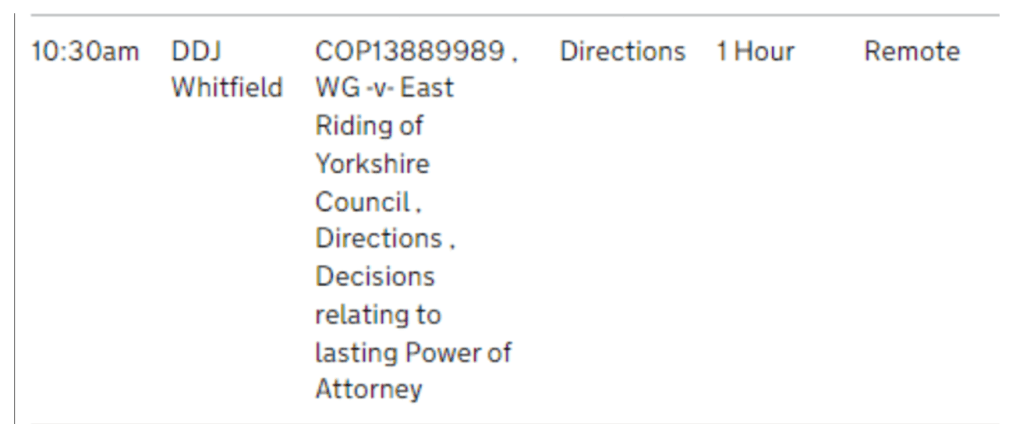
The Open Justice Court of Protection Project tweeted about this hearing (COP 13636992, before District Judge Thomas on 30 August 2022), reproducing the listing from CourtServe. It was listed as being about “(i) Whether a deputy should be appointed in respect of the property and financial affairs; (ii) Who that deputy should be.”

Image: Extract from Court of Protection Cause List from 30th August, 2022 giving details of the hearing set out in the paragraph above

I was beginning to wonder if I was going to be given access to the hearing when, ten minutes before it was due to begin, I got an email:

District Judge Thomas has made the following comments regarding your requests to observe the hearing:
“Please could you ask in respect of both observers in what capacity they are observing”

I responded:

Please tell Judge Thomas that I wish to observe because I have had personal experience as a COP Deputy which has led me to want to find out more about the area. I also attend the COP Users Group meetings. I have no connection with this particular case. Depending on its content, I might want to report it for the Open Justice Court of Protection Project.

I then heard nothing for a long time, possibly 30 minutes, and so was somewhat taken by surprise when I was sent the MS Teams link. The only other person on screen was the Judge because, as she explained, it had proved impossible for the applicant to get access through MS Teams (possibly the cause of the delay) and he was, therefore, attending by phone. The respondent had mistaken the time of the hearing and was not able to be present.

The applicant was applying to become the Court of Protection Deputy for P’s Property and Financial Affairs. I wasn’t able to work out who the respondent was but her position statement (not sent to me) seemed to relate to the interests of the care home and the relevant Local Authority, so I assumed she represented one of them.(The Judge has since advised me that she stated at the hearing that the Local Authority did not at this stage wish to be joined and therefore were not involved; so I still don’t know who the respondent was).The position statement was part of a bundle referred to by the Judge which the applicant said he had not seen. The Judge said she would send it to him after the hearing, which she decided should go ahead despite the difficulties.

The Judge explained to the applicant that an observer was present (the second one having presumably abandoned the effort) and I thought she said that there should be “no recording or publishing of anything”. I was asked to check this by the blog editor (Celia Kitzinger), which I did, and the Judge replied as follows:

The observer may report on the case as long as the identification of the parties is not disclosed. The hearing was by Teams. Therefore, it is a requirement that any participant to that hearing is told they may not record or publish any part of any recording (whether that be oral or visual) as to do so is a criminal offence – that was the direction that was given.

The hearing

The Judge set out some of the matters in the respondent’s position statement. There was no doubt that P lacked mental capacity to manage her property and financial affairs, having recently been assessed and failed to respond appropriately to any of the questions put to her. There appeared to be no way in which P’s wishes could be ascertained but she had written a will which named four beneficiaries, including the applicant. As I understood it, the respondent had ‘nothing against the proposed Deputy’ but wanted assurances about how he proposed to act before withdrawing her objections.

The first issue was that only one person, possibly someone representing the care home where P was living, had been notified of the hearing (Form COP28: Notice of Hearing), yet there appeared to be several other interested parties (presumably including the other beneficiaries of the will).

Another issue was the question of whether P should be joined as a party to the application through a ‘litigation friend’. But the Official Solicitor had refused to act on the grounds that there ‘wasn’t enough money’ and there appeared to be no-one else with sufficient impartiality.

The respondent also questioned why the applicant had come forward to make the application at this particular moment. The Local Authority was concerned to recover, possibly by selling P’s house, the care home fees that it was currently paying, and the respondent wanted to know how the applicant proposed to act in relation to this. The respondent was also concerned about miscellaneous expenses that the applicant had originally paid but had more recently refused to pay, something the applicant refuted. (This seemed to be a trifling matter which might have made more sense in context.)

The respondent was therefore asking that, should the applicant be successful, he should be given a more than usually detailed order for which she had provided a draft. She also wanted the applicant to:

  • Personally serve P with COP28: Notice of Hearing and explain to her what it was and who he was.
  • Serve the application to other interested parties.
  • File a statement showing his ability to act.
  • Give details of the security bond to be provided.
  • Provide details of P’s bank accounts and details of any money paid out of them (there was mention of a specific small sum of money, which I didn’t understand).
  • Explain why he was applying to be a Deputy after having apparently been estranged from P for a number of years and having recently subjected P to verbal abuse (the applicant strongly refuted these allegations).

The Judge determined the timetable for making progress. The applicant was to make his statement within a month, the respondent was given approximately 5 weeks to reply, and the next court hearing would take place on 15 November.

The applicant pointed out that he had no way of accessing P’s bank accounts and the Judge assured him that a Court Order would give him the necessary authority. He then said that, on receipt of the promised bundle and the Court Order, he would consult a solicitor.

My thoughts

There were three issues that caught my attention because I had been in the same situation myself when applying to be Court Deputy, Property and Financial Affairs, for my mother.

First, on applying to become a Deputy PFA you are required to give a detailed statement of assets (Form COP1A: Supporting Information). There must be many people in this applicant’s situation, and mine, for whom a major reason for the application is to get access to precisely this information, so how can it be obtained in advance? Even with a Court Order giving permission for third party access you still need to know which financial institutions to approach. The best hope of making progress is either through a known contact, such as an accountant, or by getting access to P’s home in the hope of finding the necessary records there. For me it was a case of piecing together historic information scattered all over the house and, even then, I wasn’t sure whether accounts were still active or had been closed. I was relieved to hear the applicant say he would be consulting a solicitor who will presumably be able to help with this.

Second, you are required to tell P about the application. In this case the Judge referred to the Notice of Hearing, so it wasn’t clear whether the earlier required Notification of Application had been completed. This uses Form COP20A: Certificate of Notification/Non-Notification of the person to whom the proceedings relate) for which the guidance notes say:

Only the court can dispense with the requirement for notification. The requirement for notification cannot be dispensed with just because the person does not or appears not to understand. You must attempt to notify the person in a way that is appropriate to their circumstances for example using simple language or visual aids.

This strikes me as being an impossible task in many circumstances, especially when dealing with those whose lack of capacity is the result of dementia in old age. Not many people welcome talking to others about the details of their finances, much less being told that their money is being taken out of their control, possibly by someone whom they no longer recognize. When the social worker attempted to notify my mother that I wanted to take over her finances, my mother flew into a rage, which is entirely what I would have predicted, and which was certainly in no-one’s best interests. I wondered whether the verbal abuse of which this applicant was accused might have come out of such a confrontation. It’s almost as though the process sets up seemingly insurmountable hurdles on purpose and yet most people applying for Deputyships must surely be doing so in good faith and because there is no alternative.

Finally, there seemed to be an idea that the applicant would not be a suitable Deputy because there was no evidence of recent contact between him and P. No-one challenged my application but, if they had, I would have been in a similar situation. I was greatly concerned with my mother’s best interests and believe that I did a faultless job in that respect, but I was also, like the applicant, a beneficiary of her will and make no secret of the fact that I was keen to take care of her assets not only for her sake but for mine and that of the other beneficiaries. It seems to me that a Property and Financial Affairs Deputy is often also going to be a beneficiary to the will and, in such cases, is never going to be entirely disinterested. It should be remembered that, while P is alive, the Deputy has to provide a detailed annual report of all expenditure to the Office of the Public Guardian. I can only see the respondent’s concern for repayment of care home fees as grounded in a suspicion that the applicant would not acknowledge that these fees were owed, but nothing of the sort was mentioned in court.

Georgina Baidoun was the lay Court of Protection Deputy for her mother’s Property and Financial Affairs until her mother died last year. Because of the difficulties she experienced with several applications to the Court, and with the Office of the Public Guardian in connection with her annual report, she has retained an interest in these areas, including attending recent Court of Protection Users Group meetings. She is keen to share her experiences in the hope that she can help others who have to engage with these institutions with very little help or guidance. She tweets as @GeorgeMKeynes

Photo by Scott Graham on Unsplash

Can P return to Ireland?

By Celia Kitzinger, 8th September 2022

Mrs H is an Irish national.  She moved to England from Ireland about six years ago to live with her daughter.  She was subsequently admitted to an assisted living facility in the same city as her daughter’s home, and then (when that broke down) to another care home in England.   She “adamantly” wishes to return to her native Ireland.

Mrs H has Alzheimer’s Disease (diagnosed after her move to England), as well as hypertension, heart failure, and hearing loss (she wears hearing aids).  She also has a skin condition – and is refusing treatment for it.  She’s been assessed as lacking capacity to make her own decisions about residence and care.

The court hearing was to oversee the process of investigating what care home options would be available to her in the Republic of Ireland, so that a best interests decision can be made on her behalf about a potential return.

The hearing (COP 13488785) was before His Honour Judge Paul Mitchell on 30th August 2022.

Transferring P from one country to another 

There have been several previous cases covered by bloggers on the Open Justice Court of Protection Project concerning best interests decisions about moving P across national boarders.  

Sometimes the wish to return to a country of birth is motivated – wholly or in part – by the desire to return to family.

In the blog post,  “Returning P to her family abroad during a global pandemic, aspiring barrister Ravina Bahra reports on a case in the Royal Courts of Justice.  Ms Doe hates her current placement and has been saying for more than a year that it’s a “horrid place” and that she wants to go back to Poland, her country of origin, to be with her family. This is “a wish on which she has never wavered”.  The case was heard at the end of January 2021, when the COVID-19 pandemic was causing major problems for international travel.  Mr Justice Hayden approved the application for her to move back to Poland, saying that he had “very little hesitation in coming to the conclusion that whilst the plan is not free from risk, it offers distinct and obvious advantages. It broadens [her] social horizons, it returns her to her family, it returns her to her homeland, and most importantly, it is consistent with her clearly and frequently stated wishes”. (The judgment is available as Re UR [2021] EWCOP 10).

In the blog post, “Should P go to live with her family in her country of birth?”, consultant psychologist Claire Martin describes a case concerning an 87 year old woman, living in her own flat following a successful s.21A application. She was articulate in court about her wish to move overseas to be with her family. 

In another case there was family dispute: one daughter had moved P to live with her in a European country, and another daughter was contesting this.  The hearings were reported over three blog posts (A mother abroad and a family dispute Part 1A mother abroad and a family dispute – Part 2 ; A mother abroad and a family dispute: Part 3) by social work academic Kirsty Regan and legal blogger Daniel Cloake aka @MouseInTheCourt).

Sometimes a family’s desire  to relocate P to a different country is motivated  by the “threat” of life-sustaining treatment withdrawal (e.g.  “At loggerheads”: Habitual residence, best interests and life-sustaining treatment”).  Even in these cases, family members may disagree, as did P’s family of origin and P’s wife in the case I blogged twice: “He’s Polish: Challenging reporting restrictions” and “Faith, Science and the objectivity of expert evidence”.

A transfer from Ireland to England (the reverse of the situation in the current case) lay at the heart of the hearing blogged by (then) PhD researcher Adam Tanner in From Prison in Ireland to Care Home in England

The fact patterns of these hearings were very different, but each of them raised complex inter-jurisdictional issues and the need for cooperation between health and social care authorities in different countries, as well as complicated arrangements for the actual transfer.

This hearing

It was intended to hold this hearing by MS Teams but this was stymied by an electricity failure in the judge’s locality about 12 minutes into the video call, before the hearing had really got going.  After the judge tried and failed to join the MS Teams hearing b first by video and then by phone, the video-call was ended and a telephone conference call set up.  (The hearing proper started about 40 minutes late as a result.)

Ben Conroy of Conroys Solicitors was representing Mrs H (via her Relevant Persons Representative) and Tim Pullen (of KGB Chambers) represented the Local Authorities.

Counsel for Mrs H gave a useful opening summary, explaining that the case had already been before the judge “on a number of occasions”, and that Mrs H is an Irish national currently deprived of her liberty under a standard authorisation that expires in January 2023.  She wishes to return to her native Ireland.  Section 21A proceedings began in June 2020 and “over the course of 18 months we have attempted to secure her return to Ireland or look at alternative accommodation options in England”.  

In many of the cases we’ve reported on before (see links above), P’s wish to return to their country of origin has been motivated by a desire to be with family.  In this case, no relatives were mentioned except for the daughter in England, to whose home Mrs H had moved on relocating from Ireland Ben Conroy said: “The daughter had a successful visit with Mrs H in the last few weeks, but we understand this was the first visit in over 6 months”.  So, Mrs H would be leaving family to return to her native land. 

Two potential nursing care homes have been identified – but neither is in the county to which Mrs H has specifically said she wishes to return, and where she used to live. There are no dementia-specialist units in that county.  The social worker is extending her search to see what can be located.

There’s also a difficulty with the Irish authorities.  According to counsel for the Local Authorities:  “The Irish Authorities appear to have viewed any suggestion that [Mrs H] return to Ireland negatively” (from position statement).  In court, counsel for Mrs H said that their approaches to care homes in Ireland “have fallen rather flat.  We need to- and I don’t mean this in a derogatory way – we need to ‘sell’ [Mrs H] to care homes. We’re working on a ‘pen portrait’ to do this, which we can sent to referrals identified as potentially meeting her needs.”  The judge subsequently referred to the pen portrait as “an attempt to (to use your phrase) ‘sell’ [Mrs H] as positively as one can to the care home”. 

As I understand it, the problem is that Mrs H can be aggressive and resistant to care. There have been “difficulties in managing her behaviour”.  She often feels “frustrated or upset” resulting in “verbal distress and threats of or actual harm to others”.  She’s been hitting members of staff with her walking stick (“a recurrent event”) – and the Occupational Therapist is looking into the possibility of a wheeler-walker to replace it.  I think I also heard reference to her having been banned from bars, pubs and shops. A couple of months ago the current care home served notice terminating her residence because of her behaviour, perceived as “detrimental to staff and other residents”.  They’ve not enforced the notice.

There’s been a focus on her problems, and her behaviour towards staff, which make it “extremely difficult to convince another home to take her”..  Four potential care homes in the county to which Mrs H wishes to move “very clearly came back and said they could not meet her needs” (Counsel for Mrs H). “Actually”, he added, “she’s an extremely likeable, cheerful, happy, chirpy lady”.  Moreover, “her wish to return to Ireland hasn’t waned in any shape or form”. 

Counsel for Mrs H also reported having “approached the Irish ambassador in the UK and there was no response – on five occasions, including sending hard copies in the post.  Nonetheless, I will approach the ambassador again to see what assistance can be offered, and invite him to the referral meeting

The judge said, “If you’re getting no joy from the Embassy, I wonder about approaching the Irish equivalent of the Health Board, and also the local services – bodies that would be intimately involved if a referral to Ireland is made […]. If Mrs H is an Irish citizen, she’s got a right to return. The issue is what support she needs, and what services need to be in place when she’s there.”  

The judge also suggested that “there’s a bit of a hint here, and I may be misunderstanding the problem, but of Ireland washing their hands of the situation. I may be being harsh”.

You’ve hit the nail on the head”, said counsel for Mrs H. 

There was some discussion as to whether or not there is any equivalent of DOLS in the Republic of Ireland, which would provide a legal framework requiring Mrs H to remain in any Irish care home to which she might be  transferred.  I understood not, and that a court order would be required, and also that Mrs H’s daughter would be likely to challenge any return of her mother to Ireland unless there is a provision equivalent to DOLS.   

Counsel for the local authorities described it as “a surprisingly difficult situation”, adding “you’d think it would be relatively easy for someone to return to their native country”.

I’m not sure what order the judge approved since I didn’t have sight of it, but I think it included an ongoing search for Irish care homes suitable for Mrs H, an in depth review of support provided at the current care home (because she is likely to remain there for some time), and also a search for supported living options in England (although there is some concern about whether that will work, or be in her best interests).  It seemed that, at the moment, a range of possible options are being explored in parallel.

It was agreed that the next hearing, with an update on all these matters, would be in mid-November – preferably as a video-hearing, assuming that works out next time!

As is so often the case with Court of Protection hearings, I’m impressed by the care and attention given to ascertaining and promoting the protected party’s wishes and feelings – and by the sheer amount of hard work that this entails from all the professionals involved.

Celia Kitzinger is co-director (with Gill Loomes-Quinn) of the Open Justice Court of Protection Project. She tweets @KitzingerCelia

Office of the Public Guardian steps in when attorneys don’t agree

By Georgina Baidoun, 5th September 2022

The Open Justice Court of Protection Project tweeted about this hearing (COP 13900828, before HHJ Lloyd-Jones on 24th August 2022), and reproduced the listing from CourtServe.  It was listed as being about “Discharge or conduct of deputy or attorney” and the application was by the Public Guardian.

from CourtServe

I have a particular interest in cases involving the Office of the Public Guardian (OPG), having had to answer to them when I was the Court of Protection Deputy for my mother’s Property and Financial Affairs. 

It was not clear from the listing whether this case concerned Deputies or Attorneys, or whether it concerned Property and Financial Affairs or Health and Welfare. It turned out to be Attorneys appointed under a Lasting Power of Attorney for Property and Financial Affairs.

This is the fourth case I have observed and each one has started differently. This was my first time using the Cloud Video Platform and I was worried it might not be as easy as Microsoft Teams but, using the recommended browser on my computer, there was no problem at all[i].

Also for the first time, the response to my request to observe was answered, in the affirmative, with questions from the Judge as to whether I had “any connection with the case and any particular reason for wanting to observe...”. I replied that I had no connection and that:

I have a general interest in matters concerning Deputies for Property and Financial Affairs having been one myself until my mother died last year. Most recently I have observed a couple of Deputy cases and written about them for the Open Justice Court of Protection blog. It is not my particular intention to write about this case.”

When the hearing began

The reason I had no particular intention to write about the case was that, at that point, I still had no idea what it was about. Before the Judge appeared on screen and the hearing officially started, two barristers were engaged in a conversation that I assume was a continuation of a meeting that had just taken place between the participants. Already I was in a guessing game as to what was going on!

When the Judge opened the hearing, she introduced the two observers and mentioned my connection to the Open Justice Court of Protection Project. She explained to the participants that  we were there to “observe the process” and had no personal interest. She reminded us that we had a “duty of confidentiality”, but there was no further detail and no Transparency Order was mentioned (nor have I since received one). She also offered no introduction or summary of the case, apparently making the assumption that the process could be understood without the content. It didn’t help that two of the respondents were labelled as ‘guests’ on the screen.

The hearing

This is what I think it was about. P had written a Lasting Power of Attorney naming his wife and three children as Attorneys for Property and Financial Affairs, either jointly or separately (see below). As one of the sons put it, his father had appointed them all because he wanted them to work together and it would be ‘shameful‘ if they couldn’t do that. P was now in a care home where they wanted him to be able to stay, but the relationship between the Attorneys had broken down over the expenses that P’s wife said she needed to maintain herself and the house that she had previously shared with P.

The OPG (the applicant) was represented by Marisa Lloyd of Parklane Plowden Chambers. P’s wife was represented by Natasha Dzameh of St John’s Chambers (the wife was present in court but did not participate). The children were not legally represented (i.e. they were litigants in person).

The Judge, much later in the hearing, referred to inappropriate complaints that had been made, presumably by members of P’s family, against the Office of the Public Guardian for not overseeing the work of the Attorneys. This is not part of the OPG’s role so it would appear that the only action they can take in such circumstances is to ask the Court of Protection to instruct or remove the Attorneys. The Judge said that P’s wife had originally asked that all four Attorneys be discharged and a professional Deputy be appointed instead, but that she had now said she was prepared to reconsider. The children did not want an ‘outside’ Deputy. 

The children said that the problem was that P’s wife had not been prepared to provide details of how P’s money was being used. Their father’s savings would have to part-fund his care home and they were concerned that his finances were not being well conducted. (This would suggest that the Attorneys were empowered to act separately and that P’s wife was in control of the finances) They appreciated that P’s wife needed an income but wanted it to be kept to a minimum to safeguard P’s own interests. 

The Judge proceeded to try to get agreement as to the way forward and decide on a timetable. P’s wife was required to produce details of her expenditure for the previous three months and make an assessment of future one-off house maintenance costs. Her barrister wanted time built in for her instructing solicitor (who would be on holiday) to work on these but the Judge did not accept that there was any need for the solicitor’s involvement in such a straightforward task. After the information had been provided, there would be 28 days to decide whether the Attorneys could agree and, if they couldn’t, another month for witness statements in preparation for a further hearing around the end of the year. The Judge reminded the participants that it was possible for them to reach agreement among themselves and inform the court right until the last minute (‘up to the court door’).

The Judge then summarized.

  • It was good that all acknowledged the need to work together to achieve what was in P’s best interests, which would include the interests of his wife.
  • There was a need for compromise.
  • There was a difficulty and potential conflict of interest in one of the Attorneys living in the house and benefitting from it but P would have thought of that when drawing up his LPA.
  • There would be a need to balance P’s interests against those of his wife as his assets depleted.

Costs

One of the sons raised the issue of costs incurred by P’s wife in the employment of a solicitor and barrister, whereas the children, trusting the court and believing they were doing the right thing, had not seen the need to employ professional legal representation. In his view, the employment of a solicitor had not been helpful and P’s wife should have been prepared to fulfil her responsibilities as an Attorney without seeking outside help.

The Judge said that costs would be determined at the final hearing when it would be decided whether they would come from P’s money or be borne by his wife. She had already said that a solicitor was not necessary to help put together details of expenditure and she added that this early mention of costs was ‘forewarning’ to P’s wife of the possibility that costs might have to come from her own pocket. This I understood because it had been very much to the fore in the last case on which I reported

Conclusion

I have made an LPA for Property and Affairs myself and was conscious at the time that they are not without their difficulties. In this case, there is a real possibility that, as P’s assets reduce, either he or his wife will have to move home and reduce their standard of living. With the best will in the world, I am not sure how this could or should be resolved, and family conflict seems almost unavoidable. In my case I have chosen to include a professional as an Attorney, accepting that this will come at a cost. 

Georgina Baidoun was the lay Court of Protection Deputy for her mother’s Property and Financial Affairs until her mother died last year. Because of the difficulties she experienced with several applications to the Court, and with the Office of the Public Guardian in connection with her annual report, she has retained an interest in these areas, including attending recent Court of Protection Users Group meetings. She is keen to share her experiences in the hope that she can help others who have to engage with these institutions with very little help or guidance. She tweets as @GeorgeMKeynes


[i] Editorial footnote: Some observers have experienced problems with Cloud Video Platform.  If you are observing a hearing using this platform (“CVP” in the listings) we strongly suggest reading the court’s own helpful guidance: How to join Cloud Video Platform (CVP) for a video hearing.  We’ve also put a link to this guidance on the home page of the Open Justice Court of Protection website (see point 4 under “How to access a hearing”. (CK)

Dietary Restrictions, aggression, and a placement in jeopardy (plus transparency matters)

By Celia Kitzinger, 2nd September 2022

The protected party (P) has been discharged to his own property with a care package after what the judge described as “a very long period” in hospital – but things aren’t going well.  

He’s “aggressive”.  He “shouts at the care staff on almost a continuous basis and is abusive, intimidating and threatening towards them”, including raising his fists, and using his wheelchair to block staff exits from rooms when they attempt to remove themselves.  Staff have even resorted to calling the police at night due to concerns about their own safety.  His “anti-social” behaviour has been displayed in public, and the police have asked to be notified when this happens.

Much of the problem seems to revolve around the “diet management plan” which means that P is denied food he wants to eat.  He’s “extremely unhappy” about the dietary restrictions in place and becomes “stressed and angry” when not provided with the food he asks for.

As a consequence of his behaviour, carers have resigned, agency staff are refusing to work with him, and P’s living arrangement is at risk of collapse.  

The hearing

The case (COP 13710521) was heard remotely via video before Her Honour Judge Catherine Howells sitting at Wrexham County Court on Friday 19th August 2022.

There were three barristers in court:  Mark Bradshaw of No. 5 Barristers Chambers representing P (via his litigation friend the Official Solicitor); Thomas Jones of 9 Gough Chambers,  representing Betsi Cadwaladr University Health Board; and Hannah Haines of  Nine St John Street, representing the Local Authority  – all with their instructing solicitors, one of whom, Rebecca Humphreys of Julie Burton Law, was formerly P’s Accredited Legal Representative (ALR) until things became complicated and the Official Solicitor took over as P’s litigation friend).  

The protected party, P, was also attending –  seated (generally calmly) in his wheelchair in his new home, obviously attentive and responsive to what was going on in court.  He’s a big, heavy-set (older) man and I could well imagine how intimidating he must be to staff if he’s aggressive towards them.  

I don’t know what diagnosis (or “impairment of, or … disturbance in the functioning of, the mind or brain” s. 2(1) Mental Capacity Act 2005) has caused him to be unable to make certain decisions for himself (I wish this information was routinely included in opening summaries) but the court had been sent a capacity assessment showing that he lacks capacity to make decisions about his diet.  He also lacks capacity to conduct these proceedings – hence the appointment of the Official Solicitor – and must have been deemed to lack capacity to make decisions about residence and care, since he has been deprived of his liberty under a standard authorisation.  He has been assessed as having capacity to manage his everyday finances and welfare benefits (more on this later).

HHJ Howells summarised the history of the case, saying that it began as a s.21A challenge (and I think it had been agreed that it was continuing as a s.16 health and welfare issue). 

Since August 2000, P has been deprived of his liberty in hospital.

Since I’ve been involved in the case,” she said, “there’s been active management, with hearings almost once a month, and it is to the credit of everyone involved that P has moved into his own home.  The hearing today was listed to check on his progress.”[1]

P had finally moved out of hospital and into his new property on 25th July 2022.

It was already apparent from the paperwork before the court that  (as counsel for the local authority, Hannah Haines put it), “things haven’t gone as smoothly as everyone hoped and anticipated”.  

The judge described the situation tactfully: “It’s not unexpected that after such a long period in hospital, things haven’t gone as smoothly as one might hope in terms of him moving into his own home [… ] So now he’s at home with a team of carers, it’s the responsibility of the court to ensure it can be sustained”.

The judge acknowledged P’s presence in court, said she’d met him previously in person when he was in hospital, and that it was “a real pleasure” to meet him again.  She addressed him directly to say “I’m still awaiting that photo of you having a cup of tea in your own home which you promised me”.  He smiled, apparently pleased to see the judge again, and responding positively to her warmth and engagement with him.

Counsel for the Local Authority: Hannah Haines

Counsel for the Local Authority said they were “disappointed” to be in the situation “where so many of the care team have left working for P, because they are finding his behaviour so challenging, both because of the way to speaks to them and because of the threatening behaviour.  We are now down to 3 out of the original 9 carers – though some left sooner and it wasn’t do with P specifically, they just had decided to leave for their own reasons.  Three carers seem to be left.  There are real issues in retaining even agency staff because of the challenging behaviour they’ve experienced from P when they’ve taken shifts and worked with him.  So, the very unfortunate reality is that the placement is left in a very perilous situation.

She said that 24 hour 2:1 care (as specified in his care plan) “simply isn’t possible”.  When P’s former ALR visited P recently, he was in bed because only one carer was present, and he’s been risk assessed as needing two carers to use the hoist to get him out of bed.

The manager of the care agency “has been assisting where she can, and taking on shifts as well when they don’t have enough carers available, but she can’t do that indefinitely as it’s not her role and she has other responsibilities”.

Counsel said that there are “not enough carers to provide even the most basic care to P and this placement simply isn’t going to be able to continue. We are looking at contingency options. The Local Authority is going to, unfortunately, have to come up with a crisis plan for if he’s left in a situation with insufficient carers to attend to his basic needs and he has to move somewhere else to ensure he’s cared for in a safe environment.

At this point the judge intervened to say “I can see P is becoming increasingly upset and finding it very difficult to listen to this”.  He seemed to be in tears.  The judge suggested that he was free to absent himself and to “return at any time”. He wheeled himself out of the room (returning – with the help of two carers, briefly visible on screen –  in a more composed state about ten minutes later).

Counsel said: “There had been some discussion about how frank the Local Authority should be. Everyone understands how much P wanted to leave hospital and go to this placement, and how much he’s invested in this placement, but we thought it important he should understand the situation”.

It had apparently not been easy to find the current placement: the judge reminded everyone that “we looked for many months for step-downs and alternatives and found no other placement available that could accommodate P”.

The issue of the diet management plan was then addressed.

Counsel for LA: One of the real triggers for P is around his diet.  Unfortunately, the dieticians who’ve devised the plan for P are currently away on leave, so it will be a few weeks before they can do any amended diet plan, or look at whether that’s even a possibility.  If matters surrounding the diet are really causing significant issues, then even a few steps to amend the diet plan may assist to calm the situation down.

Judge: Diet appears to be a significant trigger. It’s disappointing that those who might be able to address it aren’t available at the moment.  Obviously, if we can deal with that head-on, it might take some of the pressure off.

Counsel for LA: Yes. That was discussed at the pre-hearing discussion. Even leaving it another couple of weeks until the dieticians who know P best are back may unfortunately be too long to rectify the situation and keep this placement up and running.  We would be grateful if someone could make some tweaks on an interim basis.  We acknowledge, though, that diet is not the only issue.  There are district nursing issues – he isn’t willing to let some of the steps be taken to avoid deterioration to his legs and skin.

Judge:  When P was in hospital for the best part of two years, I don’t remember any unwillingness from P to have personal care and the like.  I’m just wondering what’s changed since he’s been in his own home. 

Counsel for LA: I don’t have the details. I understand from [name] that one of P’s behaviours, which is unwillingness to be turned at night (to try to relieve some of the pressure areas) was certainly present in hospital. It was those issues, and the breakdown in relationship with carers, that led to breakdown of skin, which led to the admission in August 2020. So, everyone is keen to avoid the same situation which led to admission from coming back around and repeating itself[2].  If I may highlight another aspect: he’s refused to have male carers, so restricting the pool of possible carers to only female carers.

Counsel for the Health Board: Thomas Jones

Counsel for the Health Board began by emphasising the importance of the weight management plan “that ensures his weight remains stable”.

The judge drew attention to the fact of P’s weight loss while still in hospital.  “It’s to his credit that he’s lost, well about a quarter of his body weight, 25 kilos”.

It is to his credit that he managed this while in hospital,” said counsel, “and important he sticks with it so he can lead the more active life he’s now leading, because now he is able to use his wheelchair”.

The judge affirmed (I think for P’s benefit, as he was now back in court) that P’s weight had caused him difficulties because “he couldn’t use his chair and couldn’t access the community.  He’s done so well in losing weight he can now use the wheelchair – and in fact he went to the cinema recently – the first time in 15 years he’s been able to do that!”.  While she was speaking, P nodded and smiled. He seemed to appreciate her praise.

Counsel for the Health Board: That is the reason for the possibly rigid position the Health Board is taking on his physical health, relating to his psychological well-being and his dignity.  There are exceptions to the plan that can be dealt with on an ad hoc basis.  Recently he enjoyed popcorn, which wasn’t something on the plan.

Judge:  I understand it was Skinny Popcorn – something I know about.  But it’s still tasty, and it does its job!

P:  (Smiles and laughs)

Concerned about the delay before the dieticians’ return and the formal review planned for 30th August,  the judge asked when the request was made to the diet management team to look at the issue. Counsel didn’t know, but it transpired that the diet had last been reviewed on 12th August and the Health Board was willing to make an undertaking today to send a member of the team to visit P with a view to “relaxing elements of the diet plan ahead of formal review on 30th August”.  

Counsel also referred to planned work with P from the behavioural support team, staff resilience training, and “direct work with P about the impact that his behaviours have on staff”.  There will also, he said, be a VARM meeting.

The judge asked to be reminded what VARM stands for (“Vulnerable Adults Risk Management”) and then confessed:  “I don’t need to be reminded – I don’t know what it means“).  

Counsel for P (via the Official Solicitor): Mark Bradshaw

Counsel for P reported that P’s wishes and feelings were to remain at his current home.  

Counsel for P: He accepts he’s shown anger – perhaps not that he’s been abusive.  He’s raised the possibility of a befriender, to give him a little time away from carers and have that privacy and time apart that he seeks.  Certainly, from what he’s said to [his Accredited Legal Representative], he is aware of the problems that his behaviours are causing – though of course, he’s been assessed as someone who lacks capacity to make decisions about care and residence, so I’m a little guarded in saying that.

Judge:  In the moment, he probably very much regrets any behaviour that has upset anybody, but it isn’t always easy for him to control that behaviour.  That’s the picture that’s been painted for me.

Counsel for P: Diet is perhaps not the whole issue, but it dominates P’s thoughts […] There may be scope to make small changes that, for P, could make a real difference to his day.  Of course, there may need to be a different balance struck when one considers his best interests globally – between diet and the need to manage his weight, and the impact that a move would have on him.  It may be that a slightly different approach to weight management may be necessary, as opposed to his losing his home.  We would invite the professionals to look at the bigger picture.  In saying that, I recognise that of course if his weight were to increase so that the wheelchair became no longer usable, the placement would be in jeopardy for that reason alone, so it is a question of looking at the bigger picture. 

Finances

The court then addressed the question of P’s representation in future hearings.  

The s.21A challenge has come to an end, and, with it, P’s access to non-means-tested legal aid.  It’s unlikely that he would qualify for means-tested legal aid.  This means that he would need to pay out of his own finances for legal representation at future hearings.

P has previously been assessed as having capacity to manage his finances, but as lacking capacity to conduct these proceedings.  He has declined to fund solicitors and counsel for this hearing.  The Health Board and the Local Authority jointly funded P’s counsel’s fee for this hearing and his solicitor acted pro bono (i.e. without pay).  It doesn’t seem that this is a sustainable position, and discussions are underway concerning proposals for future funding at least to the next hearing. 

The Official Solicitor’s position is that “decisions about funding the costs of legal representation in proceedings are an aspect of the conduct of those proceedings, such that a declaration that P lacks capacity to conduct proceedings provides, in theory, a proper basis for the making of best interests decisions as to the funding of P’s representation in those proceedings from his or her estate”.  In practice, however, where (as here) P has the day-to-day management of his own property and affairs, and is not likely to be willing voluntarily to make the necessary payments, there are likely to be “very considerable – and often insuperable – difficulties in accessing P’s funds for these purposes”.  

Counsel for P expressly drew attention to the work done by Rebecca Humphreys, P’s solicitor and former ALR, who is “acting pro bono, not being paid today.”  He paid tribute to “her personal and professional commitment”.  The rapport built up between P and this solicitor has provided (he said)  “opportunities for candour from P to this court”, and her good relationship with P enables her to make valuable contributions to this case. 

The judge remarked that: “The court has been greatly assisted by P having representation, especially against a background where arguably, and I say no more than that, there were failings in discharging P for many months”.

Next hearing and closing summary

There was some brief discussion of whether or not the case needed to come back to court if an urgent move was required (i.e. if the current placement broke down before the next hearing) – it was agreed it should unless it was an absolute emergency – and the judge said that although she’s on annual leave for the next week or so, she was sure she could fit it in during her vacation if necessary.

Since her listings were full on returning from annual leave, the judge offered to list the next hearing “in antisocial hours, with the agreement of the parties”.  This turned out to mean slotting it in early in the morning or during the lunch hour, and after some juggling with everyone’s calendars, it was listed for 1pm on 9thSeptember 2022 for an hour.

The judge ended the hearing by saying she’d “sum up where we’re at”.  This seemed to be very much for P’s benefit, and part of the summary was explicitly addressed to P.

The case, she said, has “a long and difficult history, and everyone has worked long and hard – including P – to get P into his own home.”

Judge:  Unfortunately, things haven’t gone smoothly and a number of the care team have left, and they say they’ve left – and I’m not judging anyone for this –  because of the way P has spoken to them, or behaved to them.  P recognises that he might have spoken to them in an angry way because he’s been angry or frustrated.  If the care team breaks down, people will be applying for him to move back into hospital or into residential care.  I know that the situation is challenging because of the diet plan – you’ve done really well, P, and should be congratulated for that.  Stick with it, and the diet plan will be reviewed when the dieticians come back from holiday.  It’s very easy for me to say it’s for your own good – but it means you can use your wheelchair and get out into the community and do things.  I know it’s hard when you feel hungry, but I’ve got to balance that against you being well.  However difficult it is, try not to take out your upset on the people who are trying to help you.  One last thing: you said you had a lovely Mam who looked after you and you said your lovely Mam would be upset if she saw you being angry with people.  I am very keen, P, that this works for you.  It would be such a shame if it doesn’t.  But you need to understand that this is really serious. If you can’t have carers at home, you might not be able to stay at home.  So well done for achieving what you have so far – but keep at it!  P, I know today has been difficult for you, and I know it’s hard to hear people say things.  I’m going to give you your usual sign – thumbs up! (and she made a thumbs-up gesture).”

Reflections

More than in any other hearing I’ve observed, this judge radiated warmth and affection towards P, and he engaged very positively with her, responding well to her empathy.  This was quite striking in the context of a hearing that focused on P’s “behavioural problems” and his aggression towards staff.  Counsel for P had suggested that “the court may well wish to reinforce to P the perilous nature of his situation when he attends remotely for this hearing”, and the judge achieved this (I think) in the nicest way possible.  What came across, at least for me, was her unswerving support for P to remain in his own home, if only that can be achieved.  

The diet of protected parties – eating too much, or too little, or the wrong kind of food  – has come up in quite a high proportion of the hearings I’ve observed.  Obviously it’s at the centre of the anorexia cases, and hearings concerning “hunger strikers”.  One case I observed concerned a young man with  Prader-Willi syndrome (a rare condition causing a near-permanent state of hunger and an extreme drive to consume food). Questions about provision of clinically assisted nutrition and hydration for people who can’t take food orally raise some of the most serious life-and-death decisions the court has to deal with.   But what P does or doesn’t eat is also a matter for the court in much more ‘ordinary’ cases when there are diagnoses of diabetes, or food allergies or intolerances; when P is at risk of eating out-of-date or rotting food; when P’s ability to prepare food for themselves (safely) is at issue; or when family or professionals supply P with the ‘wrong’ food (e.g. regular pasta when P is supposed to be on a gluten-free diet; chicken soup for a vegetarian; pork for an orthodox Jew).   

The issue of food is particularly challenging when (as in this case) it leads to overt conflict between P and those caring for P.  There is something fundamental about choosing what food to put (and not to put) into your mouth, that most of us take for granted as adults. It feels somewhat Orwellian to be denied food on the grounds that it’s not in our best interests to eat it.  A few years back, the world’s first vending machine with facial recognition technology was unveiled, with the potential to refuse to vend a certain product based on a shopper’s age, medical record or dietary requirements (The vending machine of the future is here, and it knows who you are).  Despite the potential health benefits, it hasn’t caught on. 

Most capacitous adults would probably acknowledge that we often make “unwise decisions” about the food we choose to eat. 

But once we’re deemed to lack capacity to make those choices, then we are provided only with food that others decide is in our best interests. 

The problem for P in this case is that – insofar as his ‘best interests’ are defined with reference to his wishes and feelings – he is pulled in two different directions.  He 

wants two incompatible things: to eat as he chooses (which will mean he gains weight) and to “access the community”, which he can’t do if he gains weight such he can’t use his wheelchair to go out.  That’s what the court is having to struggle with here.

Transparency Matters

Few people, casting an eye over the hearings listed in CourtServe for 19th August 2022, would have picked this hearing as one to observe. Here’s how it  (and another before the same judge) were listed:

From CourtServe

Features of this listing that act to deter most potential observers are: 

  • Both say “restricted” (not “in public” or “in open court” as for some other hearings), which implies we might not be allowed to observe (although I know that in fact it doesn’t actually means that).
  • The first (the one I’m reporting on here) is listed for 9am, which poses particular challenges when lists only appear the afternoon before the hearing and we generally see them after working hours. If an email is sent after 5pm the day before a 9am hearing, there’s no time for court staff to process our requests: statistically (based on my own records) we’re much less likely to gain access to hearings before 10am compared with hearings later in the day.
  • There’s no information at all as to what these hearings are about (or the type of hearings they are), so they are unlikely to attract the interest of other observers, who usually have specific interests in (say) deputyships, or s.21A, or serious medical treatment cases, and a preference for ‘final’ hearings over ‘directions’ or ‘case management’ hearings.
  • It doesn’t say whether they are remote (i.e. via phone/video)  or in person – so there’s a fair chance that the effort of enquiry would come to naught for anyone not in or near Wrexham, as we’d only be able to attend in person (which for me would involve a drive of two and a half hours).

Faced with this level of deterrence, my commitment to open justice kicked in.  

So I wrote to the court as soon as I saw the listing at 18.19 on Thursday 18th August the day before the hearings, asking to observe the 9am hearing.  I pointed out that “I realise it may be in person, but it doesn’t say one way or the other” (and also provided my phone number in case it was remote, but by telephone rather than video). I added: “Could you also let me know please whether HHJ Howell’s 11am hearing is in person/hybrid/remote” and “Neither the 9am hearing nor the 11am hearing has any information or ‘descriptors’  about the issues before the court. Are you able to advise please?

I didn’t hold out much hope for the 9am hearing.  

Since I hadn’t received a reply, I resent my original email at 8.47am the following morning (i.e. 13 minutes before the hearing was due to start).  

I was stunned to receive an email from the court staff at 8.51, informing me that “both hearings are by Teams and both applications are dealing with the issue of where P should live.  The Judge’s clerk will be sending you the hearing link shortly”.  And at 8.52, I received the link!  (I also received the link for the 11am hearing, at 9.11am, although I hadn’t actually asked for it!). A big thank you for the court staff (and I suspect the judge’s) timely and very efficient work on behalf of open justice!  

Less positively, in neither hearing was any detail provided about the reporting restrictions, and nor had I been sent Transparency Orders (TOs) – the injunctions containing the list of “the Information” that cannot be made public in relation to any given hearing.  I actively pursued both TOs over the course of several days and 8 emails (to lawyers, their clerks, and to court staff) – finally receiving the TO for the 9am hearing on the afternoon of Tuesday 23rd August (i.e., about two and a half working days after observing the hearing).  I still haven’t received the TO for the 11am hearing, although a private message to a participating lawyer on LinkedIn has led to a promise (at 8.32 on 27th August) to “look in to getting a Transparency Order for you”. 

It really shouldn’t be this hard to get the court to issue an injunction against us – it’s what they’re supposed to do! 

tweeted about this experience – and there was some discussion, as below. 

These exchanges summarise key problems with the way transparency is – and is not – working at the moment.  Given the severe and very obvious under-resourcing of the courts, I (like Julie Doughty) am also “surprised anything is working at all”. My awareness of the additional pressure open justice is putting on people in the courts who are already desperately overworked is, of course, sometimes another deterrent to the pursuit of transparency – but one I overcame in this case.

Celia Kitzinger is co-director (with Gill Loomes-Quinn) of the Open Justice Court of Protection Project. She tweets @KitzingerCelia


[1] We are not allowed to audio-record court hearings, so quotations from the hearings are based on contemporaneous touch-typed notes which are as accurate as I can make them but unlikely to be entirely verbatim.  The quotes from the opening paragraph are taken from the parties’ Position Statements: I am very grateful to the lawyers involved for sending me these.

[2] The same point is made in Counsel’s position statement, as follows: “The Court may recall that P’s recent long-term admission to hospital was caused by him developing bilateral leg cellulitis due to chronic lymphedema and leg ulcers, as a result of a breakdown in the provision of care at home.  P had previously lived at home with packages of care for some years, however previous care packages had been terminated by the providers due to his aggressive behaviour. The Local Authority is sure that all parties are keen to avoid this situation being repeated when such time, effort and money has been put into making this placement successful. It is hoped that a further emergency admission to hospital can be avoided but if the placement rapidly becomes untenable then this may become the only option whilst another placement is identified”.

“The parties should work together and not rush to court in a litigious way. It is not ready to be heard”: Reflections from a Best Interests Assessor

By Eleanor Tallon, 31st August 2022

As an experienced Best Interests Assessor (practising within the legal framework of the Deprivation of Liberty Safeguards), I have an avid interest in the Open Justice Court of Protection Project which is aligned with my passion to promote human rights. 

I find that both reading the reflective blogs and participating as an observer in the Court of Protection, is highly beneficial in terms of my continued professional development. This relates both to my ongoing work as a Best Interests Assessor (BIA) and in my current part-time role as a private Case Manager, working with clients with acquired brain injury, for whom I have also been instructed to complete private mental capacity assessments.

Having a free afternoon (which happens quite rarely as a working lone parent!), I sought to find a relevant hearing to observe which could further enhance my knowledge, particularly around welfare applications relating to Deprivation of Liberty (DoL) in the community. Such understanding and application will be of paramount importance to those BIAs, like myself, who wish to transition into the new statutory role of ‘Approved Mental Capacity Professional’ (AMCP).

The AMCP role will supersede the BIA role with enhanced functions, only completing the more complex reviews of DoL and in some cases, making a final decision on lawful authorisation.

The AMCP role will come into effect when the Deprivation of Liberty Safeguards (DoLS) is replaced by the Liberty Protection Safeguards (LPS) later next year, and unlike DoLS (which can only be applied to care home and hospital settings), LPS will also authorise Deprivation of Liberty (DoL) in the community.

Therefore, the LPS scheme is designed to take some of the bureaucratic burden away from the Court of Protection (CoP), which is presently the only supervisory body able to authorise DoL in the community. 

Under LPS, there will no longer be the generic need to apply to the court for a community DoL authorisation, certainly for non-contentious cases which are currently reviewed by a judge under the streamlined ‘Re X’ procedure using the form COPDOL11 (though significant objections from P will still require welfare applications to be made for judicial scrutiny).

So, it seems that the AMCP will have a similar role to the judge when considering DoL in the community, through the LPS framework.

With all of this in mind, I chose to observe a hearing listed for Friday 19th August 2022 (COP 13777310) listed like this: 

From CourtServe

This wasn’t listed as a section 21A appeal (under DoLS), so I assumed it was related to an adult who lived in the community. I felt that the content could be pertinent to my learning based on the details highlighted in the listing: 

  • Where P should live.
  • Healthcare.
  • Capacity to marry or consent to sexual relations.
  • Deprivation of Liberty in relation to care and residence.

Given the wide scope of these decisions, I was under no illusion that all of this could be discussed within the allocated time frame (one hour). Yet I hadn’t quite predicted the stumbling blocks and professional contentions that transpired, or the dismay of the judge who was clearly frustrated at the miscommunications between parties.

Unfortunately, there is little information to provide a background to this case, as the parties had not provided position statements to the court and no summary of the case was given. 

The hearing lasted just over half an hour and what I observed was less focused on P, and more indicative of an acrimonious situation between the professionals, who disagreed about the use of specific experts to conduct the capacity assessments required. 

So rather than derive learning about community DoL, I have chosen to focus this blog on my reflections around the issues raised, such as the impact of professional miscommunication and the quandary around which expert is best placed to assess the protected party’s capacity. 

I will also reference the wider debate around choosing the right professional to assess capacity, within Court of Protection and beyond.

Accessing Open Justice

I emailed Newcastle County Court on 18th August 2022 at 18.13 and received an automated response, followed by the transparency order at 10.30am on 19th August and a further email from the court clerk at 12.14 to confirm the hearing was scheduled for 14.00 and would be heard by phone. 

Despite the prospect of a phone hearing (which I have attended before and felt it to be quite disorientating to follow), this still felt like a very positive start to open justice. 

However, by 14.03 I hadn’t received a phone call and wondered whether the hearing had been delayed. I emailed and then phoned the court, with no response. I anticipated that I had been a little too optimistic about gaining access to this hearing, but then at 14.16 I received the call. I’ve since learnt that it’s not unusual for hearings to start late by 15 – 30 minutes and occasionally they are an hour or more later than listed.

The clerk checked who I was and then checked who else was on the line, but no one else was present at that point. I set my phone to mute and waited for the others to be admitted to the call.

Another person joined who I believe was one of the respondents and she stated that she was in her car (parked) and that the other respondent was due to join but was en route. The clerk said that the hearing would need to start as it was scheduled for 2pm and that the other respondent was not answering her phone.

The recording of the hearing began at 14.20 and the clerk went through the formalities.

The clerk listed all people attending as below (and I have tried to identify them by the information provided in the hearing, in addition to some personal research):

Ms Susan McKendry (Barrister, KBW Chambers- acting on behalf of the Applicant, the Local Authority) and her instructing Solicitor, Ms Alison Freeman.

Ms Natalia Levine (Barrister, St Johns Buildings- acting as Counsel for the protected party on behalf of the Official Solicitor)

Mr A (Local Authority Manager) 

Ms Melanie Morley (Solicitor, BHP Law)

Ms. S (unknown) 

Mr T (unknown) 

Ms Eleanor Tallon (that’s me!)

At this point, Susan McKendry enquired as to who Eleanor Tallon (and one other person) were, stating “I’m bewildered as to who they are” (although quite coincidentally, I had recently worked alongside Susan delivering a seminar on the new Liberty Protections Safeguards legal framework, but it seemed she hadn’t recognised my name within this context). 

The clerk explained the attendance of public observers and then went to collect the judge from chambers. 

The Hearing- NCC (Local Authority) v LS & MA & MS before Her Honour Judge Matthews QC

The Judge began by addressing the issue that both the second and third respondents (MA and MS who were possibly family members of the protected party, LS), had been contacted by the clerk but neither was currently present on the call, and whether it was felt appropriate to continue. Counsel for the Applicant, Ms McKendry, highlighted that the Local Authority had also attempted to contact them and that they were given due notice about the hearing, therefore the consensus was to proceed. The judge checked with Counsel for LS, via the Official Solicitor, Natalia Levine.

Judge: Are you content to proceed Ms Levine?

Counsel for LS: Yes, content.

Ms McKendry, on behalf of the Applicant, then summarised why the hearing had been requested on an urgent basis, via an application made by ‘COP 9’ in August (this is the process followed when it is felt that an emergency court order is required to make a decision on the person’s welfare). 

Counsel for the Applicant: The Local Authority had sought to request a section 49 report from the treating psychiatrist Dr B, who had been involved since proceedings began earlier last year.

(See a previous blog here for a useful insight into section 49 reports.)

Counsel for the Applicant: This is felt to be the best option (in terms of assessing LS’s capacity on the identified decisions) as Dr B was a key figure in the Multi- Disciplinary Team who had implemented the dynamic support plan which had been authorised by the Court. The care plan was updated in July and had been filed today, for approval on the current position.

Counsel for the Applicant then put forward that it would be prudent to ask Dr B to consider the decisions on care whilst he is treating LS, as well as gaining his analysis around LS’s capacity to engage in sexual relations.

Counsel for the Applicant: On the 4th July, an interim declaration was made that LS lacks capacity (for sexual relations) on the basis of a report by (previous psychiatrist) Dr L, completed some time ago. LS is now more active in his life. He has a girlfriend, so it is appropriate to have updated information on that issue. The Local Authority views Dr B as the most appropriate person to conduct that assessment.

Counsel for the Applicant then discussed that LS had been given a diagnosis by Dr B (this was not elaborated on) and that Mr A, who was the manager responsible for the Local Authority witness statement, had highlighted that LS has a positive relationship with Dr B. 

Counsel for the Applicant: The Local Authority had attempted to provide an update report of the witness statement from Mr A, but this was not ready.

A verbal update regarding this report was offered, but the judge moved on to other queries.

Judge: I wonder why this matter is quite so urgent?

Counsel for the Applicant: The issue has been in discussion since June. The matter was listed with the draft COP 9. 

The judge then again questioned why the matter was so urgent and with parties not being able to agree (on who should complete the reports), she asked why a decision was needed with such speed. 

Counsel for the Applicant: Various discussions have been held between parties but there was no agreement.

Judge: I find this extremely disappointing. It doesn’t help the other side to not have matters set out in writing.

Counsel for the Applicant: My apologies.

Judge: I’m not agreeing that it can be dealt with. I don’t understand why it’s got into such a mess.

Counsel for the Applicant responded that the Local Authority had been very keen to update the support plan and had regarded Dr B’s views on LS’s capacity (to engage in sexual relations) as critical since June, which they had not yet had and so remains an issue. 

Counsel for the Applicant: The urgency came from the fact that LS was previously assessed as lacking capacity on sexual relations (by Dr L), and he currently has a girlfriend, further to this he is not remaining in his flat for most of the time.

(The implication was that LS was being intimate with his girlfriend whilst lacking capacity to make the decision to do so.)

Counsel for LS via the Official Solicitor (Natalia Levine) then asked whether the court had received the ‘wishes and feelings’ statement from June this year. She went on to empathise with the court’s disappointment and described herself as a ‘fly in the ointment’ (an interesting idiom, and the term ‘spanner in the works’ sprang to my mind as possibly more appropriate regarding her disagreeing to the section 49 report which the LA had sought from Dr B). 

Counsel for LS: I was not involved in this case until very recently and upon reading the bundle I was concerned for a number of reasons, that the section 49 report was not the correct route to go down regarding Dr B. The Local Authority was told of our concerns and further discussion was suggested. A round table meeting would have allowed full explanation as to why a different expert was sought.

Counsel for LS related that she had asked whether there could be any movement on the Local Authority’s position but there had been no response and no pre-hearing discussion. 

Counsel for LS: The reason why I was concerned whether Dr B was the correct expert is because he known to engage with LS so well.

Counsel for LS went on to describe how LS does not typically engage with professionals positively and indicated that if Dr B was put in the position of assessing his capacity on the listed decisions (and potentially making a decision that LS lacks capacity) then this could impact on the therapeutic relationship that has been developed.

Counsel for LS: If you look at the ‘wishes and feelings’ statement from 28-06-22 LS’s response to Dr L’s report is quite negative. LS states ‘he called me a spacker.I f I saw him I would chin him. I would stand on his head. Why does he think I’m a horrible…’  (pause) I won’t say that word. If Dr B was asked to look at capacity for sex it may damage the relationship, they have.

This appears to be a relevant point, given that once a person is assessed as lacking capacity to engage in sexual relations, no decision can be taken on their behalf (by virtue of the ban in s.27(1)(b) MCA 2005) which effectively means the person cannot have sex without it being classed as a sexual offence and incriminating the other party involved.

Given the situation with LS, both with having a girlfriend and ‘him not being at home most of the time’ it is likely that an assessment of him lacking capacity for sex would have grave implications on his support plan and the likelihood of increased restrictions, for which he might hold Dr B responsible. This could then lead to a weakening in (what is presented as) one of few strengths in the professional network.

Counsel for LS: I have a duty to LS via the Official Solicitor and when looking at this case and best evidence, it struck me that this is similar to a case done with Kirklees (another Local Authority).

Counsel for LS proposed the use of an independent expert  nominating the one who was involved in the aforementioned case, saying that the report provided was thought ‘exceptional’ by all the parties and the judge, and this reflected the expert’s approach to capacity and best interests, with knowledgeable attention to risk management and behavioural interventions. 

Counsel for LS advocated that this independent expert could implement valuable recommendations on future pathways, reiterating that the report was the most helpful she had ever seen, and therefore she was requesting that the CV of the expert was considered.

Judge: I have nothing from the OS at all.

Counsel for LS: I apologise, that should have been sent.

The judge remarked on her disapproval on the lack of information and the lack of communication and agreement between the parties.

Judge: I am not a judge to avoid making a decision, but I am not making one on the hoof. This is disgraceful. Professionals should work together and have a round table meeting, especially with substantial disagreement on the option of an expert.

Counsel for LS: It was agreed at the last meeting that Dr B would be appropriate, but that was before I became involved. The alternative expert I have since proposed has not been considered. It is a shame we haven’t had the opportunity to discuss. It was made clear we are not in agreement with Dr B but the Local Authority had already issued a COP 9 hearing.

Judge: I won’t be making a decision today. I can’t consider your experts when it has not been agreed. This can be adjourned until next week. The parties should work together and not rush to court in a litigious way. It is not ready to be heard. I appreciate what the Local Authority say about urgency, but it is not as urgent as that. Ms Levine, you and Ms McKendry will talk.

Counsel for the Applicant: Since the principal objection to the treating psychiatrist being the expert, on two occasions emails were sent to request attendance at a pre-hearing discussion.

Judge: There are no documents on file or in the bundle. I am not apportioning blame but it shouldn’t happen in this way. Position statements are needed from each side. There should have been a round table meeting and pre-hearing discussions. Both parties are at fault. I will stand it down for you to talk and come back. Let the clerks know when you are ready.

The hearing terminated at 14.49.

Reflections on professional miscommunication

This hearing exemplifies a stark reminder of why good communication and dispute resolution is so important, not only to avoid protracting contentions which impact on the outcomes for P (who is at the heart of the disagreement), but also to avoid gratuitous use of court time and wasted costs.

As so candidly remarked by the judge, professionals should work together and if possible, resolve issues prior to the involvement of the Court of Protection, although of course certain complex matters cannot be addressed without judicial scrutiny. 

Such matters would include whether a person is deprived of their liberty in the community, as this can only be authorised by the Court of Protection. This is set to change next year with the implementation of the LPS, but for now, the Court of Protection is the only option.

When it comes to the issue of a person’s capacity for sex, this appears to be an increasingly common issue before the court, possibly as a result of the Supreme Court ruling on JB and the revised capacity test for engaging in sex. 

With LS (who I know so very little about), if he is assessed as lacking capacity to engage in sex (as he was some time ago by the previous psychiatrist), then consequently, he would require interventions that impede on his freedom to have sex with his girlfriend. This is a huge restriction on his liberty and privacy (triggering articles 5 and 8 under ECHR) and a support plan with restrictive interventions around sexual activity, would clearly need the oversight of the court to ensure necessity and proportionality, with recourse to legal appeal. 

So ultimately, these are Court of Protection matters.

As the judge points out, the pre-hearing discussions and statements were essential to providing the necessary information required for her to decide on which expert to instruct. This would proactively move the case forward, as to gaining an updated assessment on LS’s capacity on his care needs, residence and to engage in sex (which seemed the most pressing concern). 

Without a current determination on capacity to engage in sexual relations, it remains unclear on whether support is required to ensure LS’s welfare or whether he is at risk of sexual exploitation.

Reflections on who is best placed to assess P’s capacity

In terms of assessing capacity for sex, the relevant information that is required to be understood for a person to have capacity to engage in sexual relations was set down in the JB judgment (see previous blog here): understanding the mechanics of the act, risks of pregnancy (in heterosexual sex), risk of sexually transmitted diseases, benefits of contraception, and most notably an awareness that both partners must consent prior and during sexual relations (and this is where the emphasis lies with engaging in sex in an active sense, as opposed to consenting to sex which implies passivity). 

The JB judgment also explicates the required change in the order of the ‘diagnostic’ and ‘functional’ tests under the MCA 2005.

The new MCA code of practice also details the same change, with a view to the functional test being carried out first (to avoid assumptions being made based on a mental impairment) and there is further emphasis on ‘supported decision making’, being the basis upon which any formal test of capacity is initiated.

Regarding LS, I understand the predicament that concerns his barrister, Ms Levine. If Dr B determines LS as lacking capacity to engage in sexual relations, he may respond in a similar way as he did to the previous psychiatrist who assessed him. 

Yet given the positive relationship LS has with Dr B, I also understand the view taken by the Local Authority, that his involvement may hold advantages when considering his capacity on the various decisions, on the basis that he may not engage as well (or at all) with an unfamiliar professional. 

I would hope that Dr B and other professionals involved, have already made the necessary attempts to support LS to understand the relevant information and make his own decision to engage in sex/ decide on his residence and support needs. If there was a reasonable belief to doubt capacity following all practicable steps taken to support LS, a formal mental capacity assessment would then be required (this could be requested from an independent expert if it was felt that a breakdown in the relationship with Dr B could not be avoided).

I wonder whether a co-productive approach was taken within the previous assessment on sexual relations by Dr L, to which LS appeared most aggrieved by (stating he would ‘chin’ Dr L if he saw him). Was the outcome of that assessment challenged on behalf of LS? Was it explored as to whether LS was provided with appropriate education and relevant information to make his own decision, thus negating the need for interventions in his private sexual life?

The provision of appropriate support and information when assessing capacity is a crucial point, and an area which has received critique from judges when it is lacking (see here). Specific guidance around what not to do, was developed by Mr Justice Poole, in his judgement,  AMDC v AG & Anor (2020) as captured within this commentary.

In my experience, at times I have seen professionals jump too quickly into a formal assessment of capacity without spending time to clarify with P the information and the risks they need to understand in order to make their own decision – which can result in a very disempowering outcome. The importance of this is reiterated loudly by the new MCA Code of Practice.

The wider debate on choosing the right professional to assess capacity (outside of this hearing)

During my career as a Best Interests Assessor, I have completed many mental capacity assessments on support and residence, and as a Social Worker I was also well versed in the same. Co-production and enablement are core values within Social Work practice, so my approach with assessing capacity has always reflected this.

Having worked as a Case Manager in the private sector, I now recognise that there is a tendency to instruct doctors to complete mental capacity assessments, and for certain decisions this would be most fitting, yet for decisions around daily support needs, I think there is often an added value in choosing a Social Worker or Occupational Therapist (who has clinical skills and training around the specific mental impairment impacting on the decision).

When considering the functional test and the relevant information around the support options proposed, this is likely to be best communicated to P by a relevant practitioner with practical knowledge of the scope of available options (including those which are least restrictive, such as the use of assistive technology rather than direct supervision). 

Depending on the decision and P’s individual needs, the most appropriate professional will not always be a psychiatrist.

Section 49 reports and COP3 (capacity assessments) are by no means limited to psychologists or psychiatrists: social workers, nurses and occupational therapists are included in the list of professionals who can complete these reports, and provided that they have the necessary experience, it seems a wasted opportunity not to employ these professionals, when the circumstances are suitable. 

When looking at the Liberty Protection Safeguards, we see a distinct movement towards a range of  professionals completing statutory capacity assessments, including Speech and Language Therapists who are often invaluable when assessing capacity for those with communication difficulties.

And as Mr Justice Poole reminds us ‘capacity assessments, including those prepared for the court, are not the sole domain of psychiatrists, as this is an ongoing, and unhelpful, myth’.

In LS’s case, the circumstances may determine best use of either Dr B or the expert proposed. For the latter, the key would be that the judge felt it necessary and proportionate to instruct an independent expert (of whichever discipline).

In any event, I hope that there is agreement between the parties to allow for LS to be assessed in a timely way and that the chosen assessor will make further conscientious efforts to enable LS to make his own decisions as far as possible, in the spirit of promoting his autonomy whilst protecting his welfare.

This careful balance of empowerment and protection is the guiding influence behind the MCA 2005 and all actions taken within its jurisdiction.

Future learning

Observing this hearing has been of significance for me, aiding a deeper reflection on some of the pitfalls within proceedings that can impact on the outcomes for P, most notably around professional miscommunication and when choosing the right professional to assess capacity. 

However, I would like to observe more hearings with a focus on community deprivation of liberty (and other welfare applications), as a precursor to my goal of transferring my BIA qualification and assuming the position of AMCP in the future.

Eleanor Tallon is Case Manager at Social Return Case Management and an Independent Best Interests Assessor / Social Worker. She can be found on LinkedIn. She also Tweets @Eleanor_Tallon

“I am fearful for my daughter’s life”: Serious medical treatment in a contentious case

By Celia Kitzinger, 23rd August 2022

Note: At the time this blog post was written there was a transparency order preventing us from publicising anything that identifies or is likely to identify the protected party and the parents. These reporting restrictions have been subsequently varied to permit us to name Laura Wareham as the protected party and her parents as Erica Wareham and Conrad Wareham.

A woman in her 30s has been in hospital for more than three months – for the last four days in the High Dependency Unit, where she is intubated and mechanically ventilated.  She has “a hugely complicated medical background”, including a rare inherited disease, and a diagnosis of “autistic spectrum disorder”.  

According to the introductory summary helpfully provided by Emma Sutton of Serjeants’ Inn Chambers, who represents the applicant Health Board (Betsi Cadwaladr University Health Board), she has “at least 19 different physical conditions”.  The mother said there were far more.

In addition to intubation and ventilation, she is receiving treatment for an acute kidney injury and sepsis.  

She is also being given Valproate (described in court as an anti-mania medication). 

The case  (COP 1397774T) was before Mr Justice Stephen Cobb on 18th August 2022.  It had been agreed from the outset that no substantive decisions would be made at this hearing and another hearing a few weeks later was planned.

The time spent at the hearing on 18th August 2022 was to make an interim order that the current treatment plan was in the patient’s best interests. Various preliminary issues were also attended to, including disclosure to the Official Solicitor of the patient’s medical records, witness evidence from the parties, and a roundtable meeting to determine whether there are disagreements between the family and the Health Board regarding the patient’s medical care and treatment, and if so what those are.

The hearing

The woman at the centre of the case (the first respondent) was represented, via her litigation friend the Official Solicitor, by Vikram Sachdeva QC of 39 Essex Chambers. 

Her parents (who were joined as parties as the second and third respondents) were in court as litigants in person.  They appeared together on the same computer screen.  Both are medically trained: her father as a consultant and her mother as an ITU nurse (both I think now retired).

By the time of the hearing, the Health Board’s application to continue to provide the patient with life-sustaining medical treatments was not opposed by any of the parties.

As counsel said, there is “clearly some potential for dispute over what treatment the patient gets…. But it is not clear at this stage what the specific disputes are[i].  

It was obvious at the hearing that the parents do not believe their daughter is getting the right care, and that they don’t think the hospital she is in is capable of providing it.

Both parents expressed concerns about her care – including (said her father)  “some of the treatment acutely at the moment, and historically since she was admitted”.  This included an alleged ketamine overdose.  The father referred, diplomatically, to a “suggested ketamine overdose” and was challenged by the mother: “it’s not suggested – it’s a fact”.  Mr Justice Cobb made clear that “it’s not a finding of the court, and unless or until it is, I suppose it’s ‘suggested’”.  

Father:  There’s an urgent need to address those things, as she’s clearly not improving.  There are limitations in the place where she is to provide the care that she needs.  Prior to her deteriorating, she was very well-read about her condition, including peer-reviewed research, and had strong views.  And what we have done since her capacity was lost…

Mother: (interrupts) Was taken from her.

Father:  … is to echo the views she expressed.  Her capacity returned on Friday, but we were not able to get the Health Board to review her capacity and clinical deterioration since means she has lost capacity again.  She expressed the view that she wanted to leave the hospital.  We explained to her the seriousness of her condition and she-

Mother (interrupts): She said, “oh well, I can’t go home at the moment then, but I want to go somewhere else”.

Judge: Was this said with someone else there?

Mother: Yes, [Name] was there. They don’t use surnames but she’s a health worker who has been there a lot.

The parents’ view is that their daughter should move to a new hospital, and they are concerned about waiting more than three weeks for the next hearing.

Mother: I just need to say one thing.

Judge: Why don’t you say it now.

Mother: Her CRP [C-Reactive Protein] which is evidence of infection, has been rising nonstop and is now up to 189 which is incredibly high. She may not be alive by Tuesday. [..]

Father: We are concerned- While respecting the need for due process, we are concerned that events could overtake us. 

The judge explained that if there’s a deterioration in their daughter’s condition it would be open to the parties to come back to court to seek further orders in an urgent hearing  – the court is open 24 hours a day and an out-of-hours court hearing could take place.  

The mother was shaking her head displaying (it seemed to me) her view of the unacceptability of this arrangement.

The father asked “How would we be able to raise that concern? We need to understand the mechanism?

Before the judge had a chance to respond the mother intervened.  She said: “They don’t understand. They have no concern. They are treating her as if this is all psychiatric. They have not tried to educate themselves in any way, shape or form about her [underlying diagnosis].  They’ve tried to cover up all their mistakes and lie about it. I’m sorry, but that’s the truth. [My daughter] is not safe there. She never will be safe there.  I am fearful for my daughter’s life”.

The judge did not engage with the mother at this point, but returned to the father’s question about how to get an earlier hearing if it was needed.  The procedure he recommended was to indicate to the Health Board and the Official Solicitor that the case needs to come back to court, and if they don’t move quickly enough to use the Out of Hours Service.  As he was speaking, the mother became increasingly agitated.

There is no justice. I’m sorry.  But carry on.  Do whatever you need to. Just carry on. I’m not taking part in this. You just listen to the doctors because they are doctors.  I’m sorry, I’ve had enough”.  She stood up and was no longer visible onscreen, although we could hear her shouting (I think to her husband) for the next few minutes, until he turned off the audio. Later she was on screen again, and obviously very distressed and crying, shaking her head in apparent disbelief at what was going on.

If it returns to court, this is likely to be a complicated and contentious case. The (so far largely unarticulated) dispute between the family and the hospital seems to be at the heart of this case.

The PA journalist, Brian Farmer – the only other observer – has published his own account of this hearing, drawing attention to the fact that the Betsi Cadwaladr University Health Board has already been roundly criticised by another Court of Protection judge in a different case: see“Retired nurse tells judge her daughter ‘is not safe’ in hospital”.  The earlier judicial criticism to which the journalist refers is in this judgment: PH v Betsi Cadwaladr University Health Board [2022] EWCOP 16

Postscript:

The next hearing in this case took place on 14th September 2022 in the Royal Courts of Justice in person. Journalist Brian Farmer observed the hearing and wrote this report.

Judge criticises consultant concerned about how doctors are treating his daughter at Welsh health board

Brian Farmer’s report includes the names of the parents, their daughter and the name of the Health board because Brian Farmer made an application to vary the Transparency Order to permit this. We will cover the issue of transparency as it applied in this case in another blog post.

You might like to read more about the woman at the centre of this case, Laura Wareham, and her advocacy for people with Ehlers-Danlos syndrome.

Rotherham woman with rare condition steps up ‘life changing’ surgery campaign

Woman who dislocates her shoulder every night says Nottingham doctors ‘saved her life’

Celia Kitzinger is co-director (with Gill Loomes-Quinn of the Open Justice Court of Protection Project. She tweets @kitzingercelia


[i] Quotations from the hearing are as accurate as I can make them, given that we are not allowed to audio-record hearings. They are taken from contemporaneous touch-typed notes and they are unlikely to be completely verbatim.

Unusually, this applicant had to pay costs in a Property and Financial Affairs case – the penalty for wasted work

By Georgina Baidoun, 19th August 2022

The CourtServe listing for this case was tweeted by the Open Justice Court of Protection Project like this:

Having acted as Court of Protection Deputy for my mother’s Property and Financial Affairs, and having been threatened by the Public Guardian with my removal (otherwise known as ‘discharge’), I decided to ask to observe this case. It wasn’t clear whether it concerned a Property and Financial Affairs Deputy or a Health and Welfare Deputy, but I was in luck because it was Property and Affairs and, this being my third time as an observer, I felt reasonably confident that I would understand what was happening.

The session was late in starting – but I now understand that is not unusual, so I waited patiently until suddenly everyone was on screen and Circuit Judge HHJ Vavrecka was asking me to acknowledge my presence! Fortunately, I had already learnt that the court prefers to be able to see everyone in attendance, so I had left my camera on and just had to struggle to unmute. There was one other observer who responded with her camera off and was asked to turn it on. The judge made a general statement about not recording the proceedings or doing anything that would identify the participants, to which we agreed.

To a considerable extent I was wrong to think my experience would be helpful, because the case was largely concerned with court procedure, about which I still know next to nothing. In order to write this, I have sometimes had to search for background information, which has had the added benefit of illuminating some of my own experience. 

The case made against the Deputy by the applicant – an unrepresented lay person who was as far as I can tell a friend or family member of P – was completely unsubstantiated, which turned out to be the nub of the matter.

Background to the hearing

I wasn’t sent a Transparency Order (I’ve now observed 3 hearings and never seen one), nor was I offered a copy of the position statement, and my request to the legal team after the event was not successful. 

The judge helpfully opened the hearing by outlining the main events prior to this final hearing but I needed what was said later in court to fill out some of the details and I still have some uncertainties.

In 2019, P was diagnosed with dementia. I found out nothing else about P except that she was a woman.

In 2020, P came to the attention of social workers. According to the applicant, he attended a meeting in October that year where the decision seems to have been made that P lacked capacity to manage her property and financial affairs and that it was necessary, therefore, to apply to the Court of Protection to appoint a Deputy. The applicant said he disagreed with the decision but was outnumbered. I found out nothing about the applicant except that he was a man and was in frequent contact with P.

In January 2021, the applicant claimed that “he had had P reassessed” and that she was deemed to have capacity. I believe he said that he “then applied for a Lasting Power of Attorney” (but it would have been P who completed the application).

In June 2021, the Court of Protection appointed a Deputy. The Deputy was in court but was represented by her barrister, Simon Hunter of Three Stone Law, and she did not participate in person.

In September 2021, the applicant applied to the Court of Protection asking that another capacity assessment be carried out. He also asked that the Deputy should be replaced but did not put himself forward as a replacement. 

In January 2022, the case was allocated to a regional court and a Dispute Resolution Hearing was arranged.

In April 2022, an unsuccessful Dispute Resolution Hearing took place before District Judge Moses, as a result of which it was ordered that P’s General Practitioner should conduct another capacity assessment (which had now been done) and that the applicant should set out details of his allegations of misconduct against the Deputy. The applicant was given until 26 May 2022 to produce his evidence and the Deputy would then have an opportunity to respond. The applicant did not produce his evidence. He now claims that at the Dispute Resolution Hearing and later he had said that he did not want the case to continue, but Judge Vavrecka was clear that no formal application to withdraw the application had been made.

On 10 August 2022, the day of this final hearing, the Deputy had filed a position statement (not made available to me) asking for the application to be dismissed and full costs of £9,293.40 to be awarded against the applicant.

At the final hearing (10th August 2022)

The Deputy’s barrister told the court that, at a meeting immediately before the hearing, he had refused the applicant’s request for the hearing to be delayed. The applicant had also asked to be made joint Deputy with the current Deputy and this too had been refused.

The applicant stated that he disagreed with the GP’s assessment of P’s mental capacity. He said that P has “good and bad days” and, also, doesn’t want to talk to strangers about her financial affairs.

Judge Vavrecka responded that the GP had been trained in the type of assessment required and that the form (COP3) on which the findings were reported gave space to say whether it was possible that capacity could change. The GP had made it clear that P does not have capacity to manage her own financial affairs and that capacity would not be regained.

Judge Vavrecka stated that it appeared that the applicant had had no intention of complying with Judge Moses’s order at the Dispute Resolution Hearing and that, if he had said so at the time, a large part of the costs of the case could have been avoided. In response, the applicant claimed that he had made his position clear and had said that he could not provide evidence of his claims because no-one would support him. He reiterated his request to be partner in a joint Deputyship on the grounds that he knew and understood P and her affairs better than anyone and saw her frequently. The same could not be said for the current Deputy.

Judge Vavrecka replied that knowledge of P was not a necessary qualification for a Deputy. The important qualification was a proper understanding of her property and financial affairs and an ability to manage them. The applicant had claimed that the currently appointed Deputy was dishonest and incompetent but had produced no evidence and had, in fact, expressed a desire to work with her, which appeared to be contradictory. It would clearly not be in P’s best interests to have two deputies who were in conflict: “a recipe for further applications to the court”.

The judge also pointed out that Deputies have to report to the Office of the Public Guardian (OPG), and their behaviour can be investigated if complaints are made against them. It was not part of the current hearing to enquire into any communication the applicant had already had with the OPG.

Judge Vavrecka dismissed the case.

Costs

The next part of the hearing concerned costs.

Judge Vavrecka referred to §19.2 Court of Protection Rules 2017: “Where the proceedings concern P’s property and affairs the general rule is that the costs of the proceedings, or of that part of the proceedings that concerns P’s property and affairs, shall be paid by P or charged to P’s estate.

§19.5 Court of Protection Rules 2017 provides for departures from the general rule.

19.5.—(1) The court may depart from rules 19.2 to 19.4 if the circumstances so justify, and in deciding whether departure is justified the court will have regard to all the circumstances including—

(a) the conduct of the parties;

(b) whether a party has succeeded on part of that party’s case, even if not wholly successful; and

(c) the role of any public body involved in the proceedings.

(2) The conduct of the parties includes—

(a) conduct before, as well as during, the proceedings;

(b) whether it was reasonable for a party to raise, pursue or contest a particular matter;

(c) the manner in which a party has made or responded to an application or a particular issue;

(d) whether a party who has succeeded in that party’s application or response to an application, in whole or in part, exaggerated any matter contained in the application or response; and

(e) any failure by a party to comply with a rule, practice direction or court order.

The judge considered that the conduct of the applicant justified departure from the general rule. There was no evidence that he had tried to ‘vacate’ (withdraw his application) until he had been faced with the prospect of paying costs.

There was then the question of deciding whether the applicant should pay the full costs, as requested by the Deputy, or whether the costs should be apportioned. The Deputy, through her barrister, agreed with apportioning the costs so that those arising before the Dispute Resolution Hearing should be charged to P and those arising after that hearing should be charged to the applicant. Without detailed costings, it was then agreed the judge would split them ‘on a summary basis’. The applicant was therefore required to pay £6,000, including VAT.

The applicant said that he did not have £6,000 and Judge Vavrecka suggested that he agree a payment schedule with the Deputy outside of the court.

Conclusions

I have now observed two cases where the appointment of a (professional) Deputy has been opposed by friends or family who were not initially prepared to perform the role themselves. In the first case, two members of the family eventually decided that they would make an application. In this second case, the friend or family member’s belated request to be joined with the court-appointed Deputy was dismissed.

This seems to demonstrate a problem that might also explain why some people are not able to create Lasting Powers of Attorney. It is necessary to get someone you trust to agree to take over your financial affairs and this is not something with which many lay people are comfortable; it’s only when they see strangers doing it that the reality kicks in.

The two cases also demonstrate how ignorant many people (I would guess the vast majority) are of the work of the Court of Protection in this area, even when they begin to get involved in it. That ignorance proved costly in this case. 

Speaking from my own experience, I now realize that, when I started what seemed to be merely a bureaucratic exercise of the sort with which we are all familiar (tax matters, planning applications etc), I was in fact already in the foothills of fully fledged court proceedings that could seamlessly lead to actual court hearings. One thing I, and I believe the applicant here, did not understand is that you cannot simply inform the court that you want to desist with your application; you have to make a formal application to withdraw it. In my case, my application to withdraw was refused and I was at a complete loss as to why. I now realize that at least part of the reason might have concerned costs, as it did here.

Also, in the course of wondering why the applicant in this case got into such a costly situation, I checked to see what would happen if he had not turned up to the hearing, something I gathered he had contemplated. If I am right, the Civil Procedure Rules and Family Procedure Rules apply as follows:

PART 27 – HEARINGS AND DIRECTIONS APPOINTMENTS

(4) Where, at the time and place appointed for a hearing or directions appointment, one or more of the respondents appear but the applicant does not, the court may refuse the application or, if sufficient evidence has previously been received, proceed in the absence of the applicant.

From what the applicant said, I think another of his misconceptions was that the requirement placed upon him to produce evidence meant that he had to have witnesses. In the users’ guide, Court of Protection Made Clear it says: “Evidence is the narrative account of the events for (sic) which the applicant is asking the court to consider… ” (Section 8.18 of the revised Ist edition)

This account/evidence needs to be written on form COP24 which is entitled “Witness Statement” and says: “If you are filing written evidence with the court then it should be included in or attached to this form“.

I think there is scope for confusion here. Judge Vavrecka did say that the applicant had been advised to seek legal assistance and, with hindsight, it was advice that would have saved him a lot of money.

Georgina Baidoun was the lay Court of Protection Deputy for her mother’s Property and Financial Affairs until her mother died last year. Because of the difficulties she experienced with several applications to the Court, and with the Office of the Public Guardian in connection with her annual report, she has retained an interest in these areas, including attending recent Court of Protection Users Group meetings. She is keen to share her experiences in the hope that she can help others who have to engage with these institutions with very little help or guidance. She tweets as @GeorgeMKeynes

A case of hoarding

By Celia Kitzinger, 17th August 2022

I’ve watched four different Court of Protection cases about people with “hoarding disorder”.  In each one, the local authority had applied to remove the person from their home and rehouse them temporarily, dispose of hoarded property (exactly what could be disposed of, and when, was always contentious), carry out repairs, and return them to their home, usually with some sort of care package in place designed to prevent the hoarding from becoming unmanageable in future.  This was another of those hearings.

At the time I observed this hearing (COP 13796227, on 13th July 2022), RH (with “schizotypal disorder” and “hoarding disorder”) had been detained in supported living accommodation for 11 weeks (except for a period during which she “absconded”), while work was done on her property “to render it habitable”. 

Meanwhile, she’s continuing to hoard, and she’s also declined to wash or change her clothes at the care home.

She wants to return home.

This (remote) hearing, before DJ Beckley at First Avenue House London, was to finalise arrangements for her return home, now that works are nearly completed.   “Works will be completed on Friday and she will be able to go home on Monday.”

The judge said he would ordinarily ask for a brief summary of the case at the beginning of a  hearing, but would not do so today due to time constraints: the hearing was listed for 9.00am and lasted only 30 minutes.  In order to support my understanding of the hearing, he asked both counsel to send me their position statements. Counsel representing RH (Laura Hobey-Hamsher of Bindmans) kindly did so.  Despite a request – and a follow-up reminder a few days later – to counsel for the local authority (Tony Harrop-Griffiths of Field Court Chambers), I have not received the local authority position statement. I have pieced together the background to this hearing from the one position statement I’ve received in conjunction with my notes from the hearing itself.

Key issues at the hearing were:

1.  Use of the key safe

There’s a key safe. We’d like when carers visit the property on Tuesday and Thursday as part of the care plan that if she doesn’t come to the door when they ring and knock, that they have permission to use the key to enter the property.  It may be that RH is there anyway, and they meet her within the property.  If she’s not there, we want to know what they can and cannot do once they are there.  We’d want them to be able to check on her welfare. If she’s there but not answering the door, it could be that – at the worst – she’s unconscious (though we’re not thinking that’s probable) or that the place needs tidying up – especially the toilet.” (Counsel for the Local Authority)

With regard to the key safe, it’s proportionate and in RH’s best interests for carers to be able to let themselves into the property with a view to checking there are no issues potentially causing a risk to RH’s physical or mental health, for example being unwell, or the toilet again is overflowing, something like that.”  (Counsel for RH via the Official Solicitor)

2.  Disposal of items in P’s house

It became clear that RH is hoarding what for other people is “rubbish” – including (as mentioned over the course of the hearing) “empty plastic and glass bottles, empty food cans, cigarette butts, etcetera”, “used cotton-wool buds”,  “bones from a fried chicken shop that someone had left in the street (that would concern me given the hot weather we’re having)” and “rotting food well beyond its sell-by date”. 

It had been agreed, at the instigation of the Official Solicitor at an earlier roundtable meeting, that it should be ensured that  “items of sentimental and/or financial value” are  not removed by carers.  

There was an issue about when and how items identified as “rubbish” could be disposed of, and it was agreed that items hazardous to RH’s health should be  a priority for disposal.  “Items such as used cotton-wool buds don’t cause a risk to her health. They do have to be disposed of eventually, but twice a week would be so disorienting to her, and so distressing, as to do more harm than good” (Counsel for RH via the Official Solicitor).  “What the Official Solicitor doesn’t consider proportionate is that – potentially twice a week – people unknown to RH enter the property and remove items that in their view are rubbish – even with the caveats relating to financial valus and sentimental value.”  This would mean (said Counsel for RH) “from her point of view, some of her possessions being disposed of without any notice or discussion aforethought”.

The judge summed up the situation:

What we need to balance is the risk of her hoarding becoming so severe that her ability to live at the property becomes threatened (when everyone agrees that’s what’s in her best interests) with the risk of the impact on her of her possessions being removed – and they’re clearly important to her, because she’s brought them home.” (Judge)

The judge suggested devising a permissive order with two components:  first,  “items that pose a risk to her physical health – that covers the chicken bones” for immediate disposal, and second “other items which can only be disposed of with notice having been given, but then even if she’s not home or doesn’t want to permit entry, the local authority have access to go in and clea  it out.  The notice would be a note saying ‘we’re going to come back in a week’s time’, what was tried before she went into the care home”.  

3.  Road traffic sense

The judge raised a question about RH’s “road traffic sense” – saying that although concerns had been raised, “she coped quite well with traffic when she absconded from the care home”.  

Counsel for the local authority said he hadn’t taken instructions on that point, but “someone could point out to her that it could be dangerous to go into the road to retrieve rubbishMy clients could reflect on that.”

The judge asked for a recital to be added to the order “to say that’s been considered”. 

Counsel for RH said that “she’s out of her property pretty much all day every day, and hasn’t come to harm before, so it’s something to keep an eye on, but not an acute problem.”

Decisions

The judge approved use of the key from the key safe to allow local authority carers to access RH’s property, and to clean the toilet, and to remove anything with an adverse impact on RH’s physical or mental health.  The plan was for RH to return home on 18th July 2022 and the judge fixed a date for a review hearing a month later.

Celia Kitzinger is co-director of the Open Justice Court of Protection Project. She tweets @kitzingercelia