Observing a s.21A hearing and the importance of correctly drafting a Lasting Power of Attorney

By Anna (daughter of a P), 3rd August 2022

This case concerned P, living in one care home but with a proposed move, against her wishes, to another. I found it particularly interesting in terms of the reach and limits of a Lasting Power of Attorney.

The hearing was listed (on the Open Justice Court of Protection website) as follows: 

Monday 25th July 2022

DJ Eldergill 

First Avenue House (remote) 

2pm COP 13832291 AJ -v- LB Waltham Forest (1 hour) 

Section 21a Deprivation of Liberty 

For access, email: courtofprotectionhearings@justice.gov.uk

(Tel 020 7421 8718)

I have already written about the experience of gaining access to this hearing and my thoughts about that (“Accessing a Court of Protection hearing as an observer”).  

In this blog post, I will write about the hearing itself and my experience of observing it. 

The hearing lasted 30 minutes. 

After the hearing, I emailed both barristers to ask for a copy of their position statements. I received a copy of the applicant’s statement (the Local Authority) the same day, but have not received the position statement from P’s litigation friend, the Official Solicitor.  After pursuing it on my behalf, it was sent to Celia Kitzinger, who has drawn on it in editing my blog post for accuracy.

I have to say that reading the applicant’s position statement afterwards shed light on a lot of what had been discussed in the hearing. I tried to follow what was being said during the hearing, but I think I made some assumptions that turned out to be wrong and realized this once I had read the position statement. This shows the importance to me of being able to read position statements in order to gain a much better understanding of the case. 

For this blog, I will first note what I learned from observing the hearing and will then supplement that by what was learned from the position statements, before finally making my key observations. 

Joining the hearing

Having received the MS Teams link for the 2pm hearing, I logged on 10 minutes before to ensure I was in good time. 

I’d been told that the hearing might not be going ahead, because the parties were working towards a consent order. Luckily, having logged on, I stayed in the waiting room and at 2.05 the meeting was opened. There were a number of other people already in the hearing when I was admitted, and I was the last to join before the judge, so it seemed to me as though there had been some sort of pre-meeting, probably to do with working towards the consent order. 

The clerk welcomed everybody and asked if they were ready and then said that she would join the judge. 

I had planned to email the barristers at the beginning of the hearing to ask for their position statements but, as it turned out, I wasn’t clear at first who the barristers were. I pulled up the list of participants but it was just names plus the words “external” or “guest”. Twelve people were participating in total,  but apart from the couple of times the clerk spoke, the only people with cameras on were the judge (DJ Eldergill),  Carol Knotts and Amos Waldman.  As they did most of the talking, I assumed that they were the barristers and after the meeting I googled them and sent emails asking for a copy of their position statements. If I hadn’t observed or been involved in a COP hearing before, I think I would have been a little confused about who everybody was. 

On a practical point, I had planned to type my notes as I observed as a means of speeding up my note-taking, but as the hearing started, I realized that it would be quicker for me to write by hand. I tried my best to keep up but am conscious that I missed out some things due to my speed. The hearing was being recorded and transcribed for the court, but of course I was not allowed to record it myself, and observers don’t have access to the recording or transcription. However, I am going to use the position statement to fill in the detail where necessary.

The first thing that happened after the judge joined was that he mentioned there was an observer, and named me. He asked me to confirm that I understood the confidentiality of the case and that nothing I did should enable the person being discussed (“P”) to be identified. I confirmed by voice, camera off, that I understood this. I haven’t received a copy of a Transparency Order.

For my benefit, he then gave a brief summary of the case, which he stated was a Section 21A application. This is the gist of the summary he gave. 

The protected party at the centre of this case, (“P”), is currently resident in a care home, which I gather is near her old permanent place of residence. The issue at hand is whether she should stay in that care home or be moved to another one (S) to be close to her son (“MS”), daughter-in-law (“AS”) and grandchildren. P herself has said that she wants to go back to her old home (the house she used to live independently in). 

Three of the parties – the Official Solicitor (representing P) and her son and daughter-in-law, who P appointed with Lasting Powers of Attorney (LPA) for Health and Welfare, believe that it is in her best interests to move to the new care home, which is close to them in “X county”. 

The local authority position is that it would be in her best interests to stay where she is. The case is to decide which care home she should reside in. 

A return to her own home, which is what she would prefer, is not an available option.

Counsel for P via the Official Solicitor explained that a Round Table Meeting had been held before the hearing and that the Official Solicitor believes it is in P’s best interests to move to the new care home (S).  There were currently two places available at “S” care home but they were not being held for P and therefore time was of the essence if the judge decided that she should move to there. 

DJ Eldergill did not report,  as part of his summary, what “impairment of, or… disturbance in the functioning of, the mind or brain” (s. 2(1) Mental Capacity Act 2005) P was said to have The word “dementia” was mentioned later in the hearing, and reading the applicant’s position statement later confirmed that P has dementia. 

I assume (though it wasn’t explicitly said) that P has been deemed to be not able to make the decision about where to live (i.e., she cannot “understand”, “retain” or “weigh” information relevant to that decision, s. 3(1) Mental Capacity Act 2005).  So, a decision needs to be made in her best interests.  

The position of the parties

I completed a lot of my understanding on reading the position statement. 

The applicant for the case was actually the local authority (unlike in my mother’s case, where it is my mother).  The protected party, P, is the first respondent and MS and AS are the second and third respondents (so the son and daughter-in-law are official parties to the case as litigants in person i.e., they did not have lawyers representing them).

Local authority

The applicant (the Local Authority) is I assume representing the point of view of the social worker, which is that P should stay in her current care home because force would need to be used to move her and it would be very distressing for her. It was reported that P is very clear that she does not want to move to the new care home.  She is quoted as saying that if her family want to see her more often, then they should move nearer to her.  She is “adamant” about not wanting to move. As the local authority position statement says: “Given P’s explicit objection to the move, in [the social worker’s] opinion it would be disproportionate to move P given that significant coercion or restraint would be necessary”. She would be “extremely distressed and unsettled, given her expressed views”. 

Official Solicitor 

However, P’s litigation friend, the Official Solicitor, believes that it is in her best interests to move to the new care home, even though she doesn’t want to.  The Official Solicitor is balancing P’s wishes and feelings against P maintaining contact with her family, and the fact that contact will be easier if she moves to the new care home.  The arguments for and against the move are (says the Official Solicitor) “very finely balanced” – but family contact has swayed the Official Solicitor who also “hopes that any such move will not lead to a breakdown in the relationship between P and her son, given his support for the move”.

I don’t think I had appreciated before that the Official Solicitor, who is appointed to represent the protected party, can take a position which is opposite to what that person says they want. This is because the Official Solicitor isn’t supposed to represent the incapacitated person’s wishes and feelings, but merely to elicit them and take them into account in making a best interests decision.  Many of us want to do things that others consider not to be in our own best interests.  When we have capacity to make our own decisions, we can do that.  When we are deemed to have lost that capacity, then decisions are made for us in our own best interests – which may be very different from what we would choose for ourselves.  (For more information see Alex Ruck Keene’s blog post: “Litigation Friend or Foe” and Jenny Kitzinger’s reflections on whether this is the way the law should be, drawing on a case she observed over many hearings: “Should P’s litigation friend instruct P’s lawyer to promote P’s wishes and leave best interests decision-making to the judge?”). 

MS and AS

It was then highlighted that P’s son MS had provided a statement for the court (at the last minute I gather) but due to technical difficulties (and this was not a criticism of him) not all of the paragraphs were visible in the document. 

I ascertained that it was not possible for the judge to make a decision today. My notes aren’t complete at this point, but I believe there was a question of a request for a judicial visit to P. (I later understood from the position statement that there was always going to be another hearing after more evidence had been gathered).  

The issue of timing was then discussed.  The judge explained that he worked 90% as a judge but 10% of the time in academia. Unfortunately, he explained, August would be taken up by his academic work. (I subsequently looked him up on LinkedIn and saw that he is a Professor of Law at UCL university, London).  He thought that it would be hard for another judge who had not been involved in the case previously to do the judicial visit, so this would have to be delayed until September (therefore delaying a final decision until then). 

The LPA documentation

At this point the judge raised a legal point – that the complete LPA documentation seemed to be missing from the bundle and that indeed the bundle seemed quite “short”. Ms Knotts confirmed that it was indeed short. At this point Ms Bashir (who I assume was the solicitor instructing Ms Knotts) spoke to say that she was new to the case (covering for a colleague) but she could check to see if there was a complete copy of the LPA in her bundle. 

MS, P’s son, confirmed that he had only sent the first two pages of the LPA and so the judge asked him to send full copies. 

The judge also asked MS to check the LPA to see if any reference had been made by P along the lines of “In case of incapacity I do not wish to be admitted to a care home”. The judge specifically asked “Do you remember if P wrote anything like that?”. MS replied “I’m not sure, I would need to check”. At that point P’s social worker (as I understood her to be once I had read the position statement) interjected to say that she had a full copy of the LPA and there was nothing in there about a care home. DJ Eldergill then asked MS if his mother had any savings, to which MS replied “No she doesn’t”. 

I believe that the following point made by the judge is really important and interesting and I will comment further on it below. 

The judge then made important reference to a precise point of law which unfortunately I didn’t catch. He explained that assuming that the LPA document the social worker had consulted was the only one in existence, then P hadn’t expressed a written wish, in the LPA documentation, about a care home. 

He referred to Section “L?” that there can be no (words not captured) if a person had not given their consent. He then referred to Paragraph 20 of Schedule A1.  He said it was open to MS and AS to withdraw their consent to P residing at her current care home and then the “standard authorization falls away”:  then they can give their consent to her residing at the new care home, closer to them.

His next words were very pertinent to my mother’s case and seemed to be at the crux of the issue of the authority granted by a doner of an LPA. DJ Eldergill stated that P had appointed her attorneys to make a decision, and a judge can only interfere if he thinks they are not acting in her best interests, in which case he can remove them as LPAs. He also said that a different judge could come to a different view that they should be removed as LPAs (implying if they felt MS and AS were not acting in Ps best interests.)

He then asked for thoughts (on his reasoning I suppose). 

Mr Waldman stated that the local authority would be funding both homes, I imagine to highlight that from a financial perspective the Local Authority was neutral as to which home P resided in. I later read in the position statement that the cost to the Local Authority would be the same whichever care home P lived in, so that confirmed to me that cost did not have a bearing on the decision, which in my opinion is a good thing. (I don’t know what the discussion would have been if there had been a vast difference in cost for the Local Authority). 

The judge asked the participants if they would like 30 minutes to discuss the best way of moving forward and Mr Waldman stated that they would prefer a few days, as some of the legal personnel dealing with the case were new to it. The judge asked the participants to discuss this between themselves. (Presumably this would be after the hearing, which is why I was asked to leave the meeting at the end of the formal hearing – see below)

The judge then asked his clerk to find a time in his diary when he could visit P at her current care home. He suggested that he would need a half day in September for the judicial visit (including travelling time), before a 2-hour final hearing in later September. The clerk found 3pm on 7th September (for the judicial visit) and 10.30am for a hearing the week after. The clerk mentioned “Box days (?)1” with reference to the diary and the judge said that he would have to “clear that with the senior judge”. He then said (partly for my benefit I thought, but also for all lay people present) that there were 40,000 applications a year (to the COP I assumed) and only six judges to try to get through the backlog. Therefore, he needs permission to do a hearing or allocate additional time (on a “box day”). He then confirmed there would be a 2-hour final hearing, in person at First Avenue House, in mid-September 2022, and asked if everybody agreed to that. 

DJ Eldergill then asked for it to be “clear”: Does everybody agree that only residence in a care home is a realistic option? 

There was then some comment about the family home that I didn’t catch. I think it was along the lines of the family home had been signed over to the children and the rights of occupation of P. The judge asked MS even if his mother had signed the home over to the children, was there the expectation that she would be able to live there?  MS explained that there were discussions about the size of the home (I got the impression it was too big a house and the question was whether she would be able to manage it) and whether she would move closer to them. 

The judge then said “to be blunt, most people who sign properties over to children do it to avoid tax or so as not to have to pay for care home fees, but the understanding is that they would be able to reside there”.

In response, MS replied that he had been paying the mortgage for the past 15 years as well as paying all the bills. 

The judge appeared satisfied with these explanations, as without further comment he asked Mr Waldman to confirm next steps. 

There was then a discussion as to the setting for the next hearing, and whether it should be at the care home so that P could attend or whether it should be remote. At this point P’s solicitor spoke, and said that P had not expressed a preference as to attendance at the hearings. The judge said that he wanted it to be an attended hearing as “final hearings should be in person if possible”. 

The discussion of timings of future hearings would be incorporated in the order. Mr Waldman then asked about the need for an “advocates meeting”, along with the solicitors. The judge said that this could be an allowable expense, because it could result in an agreement that would result in the final hearing being vacated. But then there was a concern expressed that this would exclude unrepresented persons and it was asked whether a Round Table Meeting would be better to agree a final order to which the reply was “yes”. (Subsequently I googled  “advocates meeting” and came across an explanation in the very useful downloadable pdf: A Basic Guide to the Court of Protection.)

At this point the judge asked me to leave the meeting as the hearing was over but the parties would then carry on their private discussions. It was 14.36 when I left, so the hearing had lasted just about 30 minutes. 

My key observations 

I would like to concentrate on certain aspects of this hearing. 

First, the role of the LPA. It struck me from this case, and from being involved in my mother’s case, that how the LPA is drafted is crucial. My mother’s involved a trip to a solicitor, but another I have been involved in was simply a form completed online. This case shows how important it is to clearly think about arrangements for future care and specify them if necessary. According to the position statement, MS and AS hold Lasting Powers of Attorney which expressly provide for their involvement in deciding where P should live. This presumably is why the judge said it was up to them, if they were deemed to be acting in P’s best interests. Families should make sure that the views of loved ones are known and expressed in the LPA to carry legal weight.  Many families probably think that holding LPA for health and welfare means the LPA can always decide on a person’s behalf, but from my mother’s case I know this isn’t true. 

I really wish that at the time we had completed the LPA with my mother we’d realized the importance of the Preferences and Instructions section of the form. That is addressed in an earlier blog (Lasting Powers of Attorney by Heledd Wyn) which I wish had been available to us. Maybe, in an ideal world, the wording on the form would be changed from “most people leave this section blank”, which implies it’s not important! 

I’m also conscious that I haven’t done an LPA myself and nor have most of my friends (all middle-aged). You never know when something could happen and it really is something that should be done sooner rather than later. 

Observing this hearing made me think about my mother’s situation and ongoing case. We are quite happy with the care home that mum has been placed in and I have read that it is inadvisable to move somebody with dementia from a place where they’ve been living for a while, and are settled, to anywhere else. This view is obviously dependent on the current care home being of good quality.  I read this article which I found on the internet whilst doing some research: “Expert warns of risks of moving people living with dementia“. Even though my mother says she wants to move, hence the Court of Protection case, there seems to be evidence that moving her would be difficult for her and add to her symptoms. This is in fact one of our arguments for saying she should stay where she is. So, it was interesting for me to see that this had not been raised as an issue at this hearing and obviously each case is different. 

I really appreciated the summary by the judge, and his welcoming approach. I did miss a quick explanation of who was who and their roles though. I don’t know whether this is normally done or not. 

I was struck that continuity of personnel can be difficult and have an impact on time taken to settle cases. Certainly, there seemed to be some new people involved in this case, whether through holidays, COVID-19 etc. 

I was impressed that the judge wanted to continue his involvement in this case to ensure continuity. I was also struck by the demands on a judge’s time, especially if they have wider activities, as DJ Eldergill does. And the number of cases and backlog shocked me. I found it interesting that diary scheduling is done in the hearing and this highlights the important role of the clerk. 

The voice of P seemed to be absent in this hearing and it seems to me that a judicial visit to the care home would be beneficial to her. I thought it was good that the judge was making time to visit her in person rather than trying to do it by phone. 

The overall tone of the meeting was very positive, non-adversarial and there seemed to be a large degree of agreement between the participants. The judge was very welcoming and the overall impression from everybody was wanting to do the right thing for P. 

Ideally, I would like to attend the final hearing, but due to geographical constraints I won’t be able to. Remote hearings for me make observing a hearing much easier. I was glad I was able to attend and observe this one as I learned a lot from it. 

Anna is the daughter of a woman who is currently a P in a Court of Protection s.21A application.  She’s not using her real name because she wishes to protect her mother’s privacy, while also hoping that other families can benefit from reading about her family’s experience.  She hopes to blog in future about the hearings as the case progresses through the court.

1,“Box work” is when a judge works on cases to make orders which do not require a hearing. Often this will involve giving directions in preparation for a hearing or asking parties to provide additional information before making a final decision.‘ (Thank you to Nicholas O’Brien @CoramNickOBrien for tweeting this response to the blog post.)

Accessing a Court of Protection hearing as an observer: My experience

By Anna (daughter of a P), 2nd August 2022

As a layperson completely new to observation in the Court of Protection (COP), I thought it would be useful to document my experience of what it is like to ask to observe a hearing. 

In this blog, I describe the process of gaining access to one hearing and I hope it will reassure people like me that it can be relatively easy once you know what to do. 

Background

I am contributing to the Open Justice Court of Protection (OJCOP) Project because I am involved in a COP case myself, as a family member. 

My mother, who has Alzheimer’s, was admitted to full time care under an emergency deprivation of liberty authorization in August 2021. She had nominated my sister as her Lasting Power of Attorney for Health and Welfare  – and both she, and the whole family, all agree that it is in my mother’s best interests to be in the care home. However, my mother is making a section 21A appeal via her litigation friend, the Official Solicitor, as she wants to return home, and so she is now involved in a hearing as P in the Court of Protection. 

Not knowing anything about how the Court of Protection works, I contacted the OJCOP Project back in April 2022 and have since learned a lot more through reading the blog postings, observing a s.21A hearing (and writing about it here: “A section 21A hearing”). I’ve since participated in a first directions hearing for my mother, and am joined as a party.  I want to observe further hearings so that I can carry on educating myself about how the Court of Protection works, as well as helping others who may find themselves in my situation. 

Asking to observe: my experience 

I am particularly interested in Section 21a Deprivation of Liberty cases, as that is the type of case I am involved in. I follow Open Justice on Twitter (@OpenJusticeCoP) and I saw that there was such a case listed on 25th July 2022. The tweet,  reproducing the listing for First Avenue House in London, read like this:  

Monday 25th July 2022

DJ Eldergill 

First Avenue House (remote) 

2pm COP13832291 AJ -v- LB Waltham Forest (1 hour) 

Section 21a Deprivation of Liberty 

For access, email: courtofprotectionhearings@justice.gov.uk

(Tel 020 7421 8718)

As I happened to have some time free, I decided to ask to observe this hearing. 

I am very happy to blog about my observations, although still slightly daunted about doing so. I contacted Celia Kitzinger, who suggested that I email the barristers, once I knew who they were, to ask for their position statements, which would help my understanding of the background to the case.  I should be able to identify the barristers, she said, because they’d have their cameras on and their names would appear on screen at the start of the Teams meeting.  I could then google them to discover their email addresses.

I was a bit anxious about my ability to take notes during the hearing – recording is not allowed so I would have to rely on the speed of my writing. To prepare in advance, I drafted an email to send once I knew the names of the barristers and had located their email addresses.

At 10.37, I sent an email to request to observe the 2pm hearing. I was slightly concerned that this was very late. I got an automatic reply stating the following: 

This response has been automatically generated

We are experiencing high volumes of emails. We’re currently prioritising all URGENT emails, please note due to large volume of emails, you will not be getting acknowledgment to confirm receipt of your email.

I decided that I would also ring to make sure that my request didn’t just get lost in the system. I rang the number provided in the listing at 11.39, and the call was answered after about 30 seconds. I stated that I had sent an email asking to observe a case, and provided the case number. The Court representative told me that they had received the email, which had been forwarded to the judge. The judge would give directions as to whether “I would be allowed” to observe the hearing and I should hear shortly. 

At 11.51, so a very short time afterwards, I received an email from the judge himself, with the Court staff on copy, stating that it was fine for me to observe the hearing but that the hearing was unlikely to go ahead as the parties were working towards agreement. I also had an email at 11.59 from the Listing Team, also confirming that the hearing might be “vacated”, but in case it did go ahead they provided me with a link to the MS Teams meeting through which the hearing would be conducted. 

The subject heading in the email from the court was as follows: 

“FW: 13832291 AJ v London Borough of Waltham Forest, Directions, Section 21a Deprivation of Liberty, Remote, Private Hearing Not Open to Public t/e 2 hours”

I hadn’t thought to ask how I would learn whether the hearing would take place or not,  so I emailed the court at 13.30, 30 minutes before it was due to begin, to ask how I would know. I didn’t hear anything back, so I joined the MS Teams meeting via the link at 13.50. I saw the standard message “ When the meeting starts, we’ll let people know you’re waiting”. By 14.05, 5 minutes after the meeting was due to start, I was still waiting. I told myself I would wait another 10 minutes. I also emailed DJ Eldergill to say that I would apply to observe another of his hearings, as this one didn’t seem to be going ahead. 

Then, unexpectedly for me, the meeting (hearing) started. I will write separately about how it went.  

It lasted about 30 minutes. 

When the hearing finished, I looked at my emails. To my surprise, the judge had replied to my email about attending another of his hearings, telling me this hearing was still going ahead and even re-sending me the link. 

Despite having planned to do so, I found it really hard to find the time to contact the barristers during the meeting as I was busy trying to keep up with what was going on. Everybody had joined at the same time (because they’d been together in a pre-meeting) – maybe if people had joined in the 10 minutes before the meeting I would have been able to do this. 

In any case, I looked up the contact details of the barristers after the meeting finished.  They were  Carol Knotts (I found a general contact email at No 5 Barristers Chambers, but not her individual one)  and Amos Waldman (his individual email address is provided on the Doughty Street chambers website).  I asked for their respective position statements. Amos Waldman sent his, after having received permission from his instructing solicitor, within an hour. I haven’t yet received the one from Carol Knotts. I’ve heard that they aren’t always sent. 

It’s interesting what you discover when you google barristers.  I have listened to Amos Waldman talk movingly on Sky News about his grandmother’s death, and being unable to visit her or to have an in-person funeral service at the time when Boris Johnson was partying in Downing Street.  And I learnt that Carol Knotts made the dress featured in the iconic Athena Tennis Girl poster when she was a teenager, from a ‘Simplicity’ pattern.  She lent it to a friend for a photoshoot and the rest is history.

Despite the formalities of a court hearing, learning this reminds me that barristers are human too!

Some thoughts

Despite my initial misgivings, this experience shows that it can be relatively easy to ask to observe a hearing. The Open Justice Court of Protection Project provides a lot of information about cases (where available), including the email address and phone number and information about how to write a letter requesting access (check out their home page). This helps to make Court of Protection hearings accessible to many people. 

I was particularly impressed that I could ask to observe so close to the time of the  hearing. I wasn’t very optimistic about my email being seen so close to the time of the hearing. I don’t know whether it would have been except for my follow-up phone call which was responded to very quickly. 

I was very surprised, and impressed, that DJ Eldergill emailed me directly to let me know that he was granting me permission to observe the case. (I gather it’s very unusual for judges to do this.)  He even used my first name, which made the tone of the message very approachable. Also by his messages telling me that the hearing was going ahead and even forwarding the link. He made me feel very welcome and that it was not an imposition asking to observe. I had given no indication of my involvement with the OJCOP Project either.  I would have thought that a judge would want to keep their direct email address private to protect them from unwanted messages. The tone of the email definitely made me feel as though I was very welcome to observe his cases. 

I know from my own experience that having access to the Position Statements makes understanding cases much easier. I was therefore grateful to receive at least one relating to this case, which certainly helped me understand the case better. Also just to mention that Amos Waldman was very responsive and friendly in the tone he used in his email messages to me – again, I didn’t feel as if I was being an imposition. I do appreciate that sometimes it won’t be possible to access them and how busy the barristers must be!

It was slightly disconcerting when I was told that the judge would consider whether “I would be allowed” to observe the hearing. This is the case because the hearing was listed as “PRIVATE” ( ead more about that here: “Why are so many Court of Protection hearings labelled “PRIVATE”)

In the event I was allowed, and with no difficulties, and no questions asked as to why I wanted to attend the hearing. Some people may have been unintentionally put off by this phrasing. It was also interesting to note that the heading of the email sent to me by the court saying that I could attend the hearing stated “Private Hearing Not Open to Public”. This wording, plus the use of capital letters at the start of the words, could definitely be interpreted as meaning that members of the public, like myself, could not be observers.  It seems that the majority of the time permission is granted, so this wording is very misleading.  Also The email subject heading stated “t/e 2 hours”. I assume that the “t/e” was short hand for “time estimate” but I wonder why it was longer than the 1 hour as per the listing. Luckily, I would have been able to observe for 2 hours (although it only lasted 30 mins as it turned out). 

I am not a legal professional, although I’m becoming more familiar with some of the legal terms relevant to Court of Protection hearings. Sometimes I feel that legal terms can be used without thought for lay people such as myself. Terms used in exchanges between me and court staff during the process of asking for access included “consent order”, “vacate”, and “sit on”, for example. From my knowledge I can guess what they mean but I just raise the point that this could make things more difficult for some people to understand. That said, observing a hearing will undoubtedly mean having to listen and trying to understand “legal speak”. 

It was hard for me to understand whether the hearing was going to take place or not, but I’m not sure what could have been done, other than me just waiting. The judge must have been in the same position – not knowing whether the parties would come to agreement or not.

I hope that my experience will encourage other people to observe hearings, in the spirit of open justice. It was certainly a learning experience for me and I will definitely be observing more often. My experience  – at least of this one hearing – is that accessing a COP hearing is not that hard, once the process is navigated. 

Anna is the daughter of a woman who is currently a P in a Court of Protection s.21A application.  She’s not using her real name because she wishes to protect her mother’s privacy, while also hoping that other families can benefit from reading about her family’s experience.  She hopes to blog in future about the hearings as the case progresses through the court.

A contested hearing about whether or not to have another hearing

By Celia Kitzinger, 26th July 2022

This hearing (COP 13452747 before by DJ Beckley at First Avenue House on 6th July 2022, via MS Teams) was originally intended to be a review hearing to consider how P, a man in his 20s with learning disability, autism and epilepsy, has settled into his new placement.

The plan had been to review P’s new placement six weeks or so after his move.  The date of this hearing had been fixed with that in mind.  

As it turned out, however, P had only moved to his new accommodation 12 days before this hearing.

Counsel for P (Jack Anderson of 39 Essex Chambers, via P’s litigation friend, the Official Solicitor) said that was too soon to be sure that the new placement is working out.  “The whole point of a 6 week review period is to recognise that it takes time to see how things bed down.”

The Clinical Commissioning Group (now known as the Integrated Care Board) represented by Rosie Scott, also of 39 Essex Chambers, disagreed.  The CCG (or ICB as it is now) submitted that P was “settling in well to his new property” and that a further review hearing isn’t needed.  This should be the final hearing, said Rosie Scott.  It should authorise P’s deprivation of liberty in accordance with his current care plans, subject to the usual safeguards, and bring the proceedings to a close.

In addition to the CCG/ICB (represented by Rosie Scott) and P (represented by Jack Anderson), P’s mother and father (I think they are divorced) and P’s sister were all, separately, parties to the proceedings as Litigants in Person. 

The judge summarised the issue before the court like this:

It seems to me the question is whether I conclude these long-running proceedings today, or whether – given this hearing was to act as a review and to consider how P has settled in and it’s only 12 days rather than 6 weeks after the move – whether I should list another hearing.[1]

Each party made submissions in turn and I’ll report them in the order they spoke in court: first counsel on behalf of the CCG/ICB, then P’s mother, father and sister (in that order) and finally the Official Solicitor.

Counsel for the CCG/Integrated Care Board (Rosie Scott)

Rosie Scott introduced this hearing by saying it was a “long running” case concerning a young man in his 20s with “severe learning disability, autism, and epilepsy” and “challenging behaviour”.  He’s also registered blind and requires 2:1 24-hour care and support.  Final declarations that P has no capacity in relation to litigation, contact, medication, care or residence were made, she said, in September 2020.

Previous hearings in this case (one of which I observed, on 27th August 2020) have concerned – in addition to issues of capacity – deprivation of liberty, provision of care, restrictions on P’s contact with his father, and covert medication (amongst other issues). 

This hearing had been intended solely to consider how P has settled into his new placement.

His previous accommodation was not ideal because it had no garden and was near a main road.  This had been noted at the hearing I observed nearly two years ago, but none of the participants back then thought there was any urgency to find a different place for P to live because P was accustomed to his flat, could move about it safely, and also because he finds change very difficult, and was facing other challenges, including eye surgery.

Almost two years later, though, this change of accommodation has been accomplished and (according to Rosie Scott) the move went “extremely well”.  P was calm on moving day and seems settled in very comfortably.

There are “some teething problems, like anybody moving” – including “snagging, very common in a move, but all in hand”.  This includes boxing in the shower attachments to render them “unbreakable”, creating a manual override on movement-sensitive lights, and ensuring that the curtains are appropriate.

P’s father had apparently raised a concern with damp at the property, claiming that this is why the previous tenants had left and the damp had been painted over instead of being fixed. Rosie Scott said there had never been any damp (although there had been a leak from a boiler overflow): “It’s certainly not been painted over, and it’s not why the last tenants left”.

There was also some discussion about the garden, which has 6-foot-high fences – so people in the garden can’t be seen from neighbouring gardens but can be seen from the upstairs windows of neighbouring houses.  The relevance of this seemed to be a concern that P likes to be naked in the garden.  “The purpose of being outdoors is Vitamin D and the experience of the great outdoors. It is not considered proportionate to cover over his garden like a tent or marquee – if he wants to be naked in his own garden, that’s up to him. He will be supported to wear clothes but it’s his choice.”

She ended her submission: “We say you could appropriately conclude the case today, given the move has gone well”. 

P’s Mother

P’s mother felt that “Ms Scott has covered everything” but added that “we’re not allowing him to go out naked. We insist he puts his shorts on at least.  He will resist, but in the end, he puts them on.”

She pointed out that the transition (from the old flat to the new one) “didn’t go as we planned”.  The Position Statement from the CCG lists some of (what she called) “the difficulties” she might have been alluding to here, though she didn’t spell them out.  There was the four-week delay in moving which “accumulated through difficulties finalising the adaptations and a combination of smaller issues, such as the removal van being delayed by rail strikes and staffing difficulties (around the time of the proposed move).”  Also, although it had been planned that P would visit the property several times ahead of his move, in fact he only visited on one occasion. 

Nobody said it will be easy,” said P’s mother.  “It’s really difficult for P to move.  Hopefully it will be just this move and no more in his lifetime.  He was in the other area for 18 years and knows the area and was devastated to move.  But he is getting adapted.  It is still difficult, but we are hoping it will be okay.”

There was a short exchange between the judge and P’s mother:

Judge: How many times have you visited him?

Mother:  Six times.

Judge: When was the last time you saw him?

Mother: Monday.

Judge: Do you have any concerns? Is there anything you think needs sorting out for P to be happy and comfortable there?

Mother:  The shower and toilet are being sorted so they are safe.  We are trying to get him familiar with the area.  We are taking him out for walks and drives.  We are looking into taking him swimming.

Judge: Is there a swimming pool nearby?

Mother: Yes.

Judge: And a difference between the CCG and the Official Solicitor is whether I should conclude matters today or list a further hearing in about six weeks. Do you have a view on that?

Mother:  It is always nice to review the situation so I don’t mind if you are coming back to me in a month or two.

P’s father

P’s father took a very different perspective.

The information given by the CCG is, as usual, not correct,” he said.  “P has not settled in at all properly.  He had six panic attacks – they are recorded in [care company’s] reports.  I wonder why the CCG keeps hiding things and trying to deny things recorded by the carers themselves.  He had a very major panic attack the day before the move when they were packing up his things – it lasted for over one hour.  On Saturday he had two major panic attacks – one at two in the morning and one at four in the morning.  There are incident reports.  A neighbour came down – they hadn’t told the neighbours about P’s condition – he was about to call the police.  They had only told the neighbours that P was blind.”

P’s father also raised the matter of a complaint he’d made “about the way you [i.e. the judge] conducted the hearing” on an earlier occasion and there was reference to the Judicial Ombudsman and Lord Chief Justice.  I gathered that P’s father had sought permission to appeal orders made on 17th May 2022. I didn’t attend this hearing and don’t know what it concerned but the Transparency Order for the (in-person) hearing on that date  says “the Court will consider allegations made by the CCG in relation to [P’s father]”. I don’t know what these “allegations” were, but I think one of the orders was the Contact Schedule with a penal notice attached that limits his contact with his son.  I understood P’s father to be saying that he had not attended this hearing because he had been refused permission to attend remotely. Permission to appeal the orders of 17th May 2022  had been refused.  The judge said “I can’t deal any further with those matters today. I am focussing on P’s best interests”. 

P’s father then said that “the move was done without preparation – the flat wasn’t ready for him”.  He reiterated his concern that there were problems with damp and moulds (“it’s full of dampness”) which have been covered up with paint.  He was also concerned that “there’s a prison rehabilitation centre 100 yards from P’s flat”. 

Summarising his position, he referred to “the unprofessional way this case has been handled by the CCG and their lawyer”.  He said: “All of these [problems] the CCG wouldn’t mention at all.  So how the hell did it go well?  This is the most ridiculous case I ever heard in my life with the way the solicitors and barristers are acting.  And unfortunately, Sir, you always go with them in what is lies after lies, just to victimise the father.”  

He saw the hearing that happened without his having attended as evidence that “You [i.e. the judge] wanted to go the way you want and the way the CCG wants. This is judicial misconduct by you and misconduct by the CCG and their solicitors.  His mother doesn’t care. I’m the only one fighting for our son.”

The judge intervened.

Judge: I am not going to allow you to use these proceedings to attack your former wife.

Father: Forget about my wife. What about the things I said about you and the CCG?  You have got my son out into a flat that is not fit for purpose. […] I don’t want my son to move to an area with a prison rehabilitation centre.  It’s not safe, according to the neighbours.  There’s a damp problem – and that’s denied by the CCG.  It’s all covering and covering and covering.  There are soft tiles in the garden – I took pictures to provide evidence. The tiles are not fixed or levelled – it’s wavy and P can trip on it easily.  The toilet is broken. The shower is broken.  The curtains only cover half the window – and P hates the light when he’s sleeping.  They just want to get on with it, get him out of [previous accommodation] and finish with all these headaches.  That’s why I told the Judicial Ombudsman.

The judge asked whether P’s father supported the Official Solicitor’s view that another review hearing was needed and he confirmed that he did.

P’s sister

P’s sister said she too would like a further review hearing.  In part,  this is because “it will take a little more time to see how P gets used to it”. 

There’s also the continued work needed on the property – and she’d appreciate a hearing after some of the works have been done and when “communication with the landlord” is established and “we understand the landlord’s level of support”.  

She mentioned the curtains, the shower, the lights, and the judge added “and the loo which is being refixed to the wall today. Anything else?”.  

There were issues with storage space, she said, which needed sorting “so we can move stuff out of the way for him”.  And there’s a problem with locking the front door: the door needs a security pad “similar to the one at the previous flat, so it would be harder for P to open”. 

Counsel for P via the Official Solicitor (Jack Anderson) 

Jack Anderson was brief and to the point: “The key issue,” he said “is whether a further review hearing is needed. The Official Solicitor submits the court should hold one.  As a result of delays in the move of some four weeks, there’s only been a very limited opportunity to see P in his new environment.”  

He had submitted a COP form to the court which had not reached the judge (“the court staff have been badly hit by COVID again,” said the judge, “which is why I guess the COP form hasn’t made its way to me”).  It was sent and he read it (silently) while we waited. I don’t know what it concerned.

Judge’s decision

The judge said that given the snagging issues, the factual dispute about damp, and the fact that P had only lived in the property for 12 days, he had decided that he shouldn’t end proceedings today.

There were difficulties in fixing the date of the next hearing (“August is generally quite hideous for me,” said Rosie Scott; “I’m largely unavailable in August”, said Jack Anderson).  I think the date for the next hearing was eventually fixed for 5th September – although as it turned out neither barrister could make the first week of September either.

A schedule was agreed for the date by which P’s father must file evidence about the (alleged) damp and other property issues and how he considers P has or has not settled in; subsequent dates were agreed for the Position Statements from the represented parties, and for a statement about P’s wishes and feelings.

It seemed that the hearing was about to end but P’s father intervened with new concerns that the care providers were not buying food for P (“when I visited him on Thursday and Sunday, he didn’t have gluten free bread, or water, or wipes. I had to buy it”).  He said “the nearest shop is a 12-minute walk which none of them is willing to do”.  The judge said he was not going to deal with evidence at the end of the hearing. P’s mother said she’d made sure the essentials had been purchased and that “they can order everything for delivery”. 

Father: I would like to be able to buy gluten-free bread for my son.

Judge: The order remains as I made it in May.

Father: I would like to make changes to the order.

Judge: The order I made on 17th May stands.

Father: If I want to ask for changes how can I pursue that.

Judge: You need to take legal advice. I am not able to give you legal advice in this hearing.

The judge then ended the hearing by thanking the two lawyers (who would not be at the next – and hopefully final – hearing) for their “helpful submissions and advice and absolutely professional behaviour in the course of these proceedings”. 

Reflections

Until I started observing hearings, I had no idea that Court of Protection cases could run over several years and multiple hearings – sometimes dozens.  I had no idea how intimately involved in the details of case management the Court can become.  I do wonder whether this is the most effective use of judicial time (and the public purse) but sometimes there doesn’t seem another forum or any other appropriate mechanism for these matters to be resolved.

In this case, the hearing might never have happened if the parties had been able to agree in advance of the hearing and make an application for it to be adjourned and heard at a later date, on the grounds that it was simply too soon after P’s move for an effective review to take place. I imagine that the judge would readily have granted permission to vacate the hearing.  Instead, it took place because the CCG/ICB maintained that the 12-day time period (in place of the six-week one previously agreed) was adequate for a ‘final hearing’. That turned out to be an expensive decision in terms of court time.

This hearing was also painful to watch (as was the earlier one in this case) because of the evident anger and distress of P’s father.  I don’t know what  “allegations” were made against him at the 17th May 2022 hearing, but I heard allegations in the previous hearing I observed about his removing P from his home without consent, and providing P with food considered to be inappropriate for him (on the grounds of possible gluten sensitivity, contested by P’s father at the time).

The issue of contact between father and son was something of a flashpoint at the August 2020 hearing – which took place at the height of the COVID-19 public health emergency.  There was a penal notice attached to the contact schedule then too, and family members were prohibited from removing P from his home without two members of staff to assist.  The rationale for this was, in part, because P would not tolerate a face mask and was unable to comply with social distancing.

P’s father found these restrictions intolerable. “It is not a crime I should be penalised for to have a meal with my son in a restaurant. I need the penal notice to be removed – it wasn’t fair for the CCG to persuade you to agree to it and it’s created grievances between parties for no reason. It became like a stupid thing to call the police every time I took my son out.  It’s ridiculous. It’s against human rights, it’s against humanity.” (Hearing of 27th August 2020)

There had also been conflict over P’s diet: in August 2020 his father had bought him crisps, chocolate and pasta that wasn’t gluten-free.  There is mention, too, in the CCG’s/ICB’s Position Statement for the 6th July 2022 hearing that P’s father had brought food to P’s property (including apples and Smarties) “but that staff threw away the food and none was given to [P]”. 

As a family member of someone who lacks capacity to make almost all decisions for herself, I am acutely aware of how it feels to have the long arm of the state intervene into family life and take over daily decision-making on behalf of one’s relative.  It can feel as though the vulnerable person has been kidnapped by the state – and I imagine it must feel even more acutely the case when that person is someone you’ve cared for since birth, and someone who has never had capacity.  At the hearing back in August 2020, this came through clearly from what P’s father said.  Protesting against the restrictions on spending time with his son he said: “He’s our son – we need family time, that’s what you people need to understand” and “We have to have normal family time. These restrictions are not acceptable, Sir.”  He referred to his own long history with, and detailed knowledge of, his son – all of which (he felt) was now being overlooked and erased:  “I’ve been responsible for my son for 24 years.  He wasn’t born yesterday. He didn’t become autistic 2 years ago”. (Quoted from the hearing in August 2020) 

But this case is not straightforward.  There have been breakdowns in relationships between P’s father and the care providers. There has been “animosity” and “conflict” between family members, and P’s mother and sister are concerned about P’s father’s involvement with P.

Watching this case brings home vividly how poorly equipped we are as observers to assess some of the rights and wrongs of these hearings.  There is a lot I don’t know about this case – because I haven’t observed most of the hearings, I don’t have access to the bundle, and I have no way of deciding for myself which way the evidence points on most matters since I don’t have direct access to that evidence.  Even if I did have all of this information, I’d be in the same position as the judge, but without his extensive legal training and experience.  No more, no less.

I’m confident, though, that the judge made the right decision (and it was a decision supported by four of the five parties) not to make final orders today approving P’s deprivation of liberty, but to hold another hearing after there has been more opportunity to assess how P has settled in.  As the judge said, despite – or perhaps because – these proceedings have already been running for a long time, anything else would simply seem like an attempt at premature closure.

Celia Kitzinger is co-director (with Gill Loomes-Quinn) of the Open Justice Court of Protection Project. She tweets @kitzingercelia


[1] We are not allowed to audio-record hearings.  All quotations from the hearing are taken from contemporaneous touch-typed notes and are as accurate as I can make them. They are unlikely to be entirely verbatim, though, despite my best efforts. 

A deputy’s first experience of observing a Court of Protection hearing

By Jamal L. Din, 27th July 2022

For some time now I’ve wanted to observe a hearing in the Court of Protection to gain experience of how the court hearing is run, and understand how the interests of the protected parties (and their families) are supported.

I am a Deputy for Property and Finance for my son and have made several COP applications that have been decided “on the papers”, i.e.  without a hearing. It can only be a matter of time before, as a family, we are likely to be more involved as parties in a COP hearing. 

I have previously tried to observe remote hearings in the COP with mixed success. Having read through the guides, set aside some time and meticulously prepared the email requests to the courts, I waited. The auto-email responses from each court came through so all looked positive but then nothing, no response and the court times passed me by.   

The Open Justice Court of Protection Project made some enquiries on my behalf and discovered that one of the hearings was cancelled; at another, a member of staff sent my contact details to the wrong person asking them to provide the link;  and another  (the RCJ) had a technical issue that day which prevented them from responding (and I’d only sent to one of the two email addresses provided).  

For another hearing I asked to observe, I received a response saying “Her Honour Judge Cronin has asked for more information, such as occupation, for yourself, and if you have any link to the case at all”.  I replied saying that I had no link to the case, but I didn’t provide my occupation, simply explaining that I was “applying to observe the hearing as a member of the public, in line with the Court of Protection’s transparency project”.  I didn’t receive an MS link and was not able to observe the hearing.

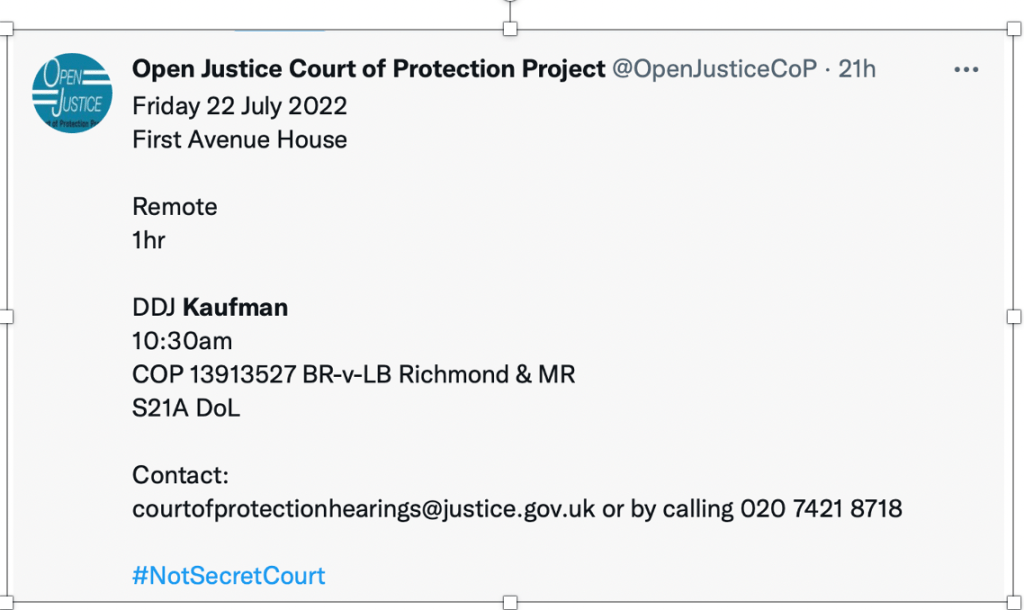
The hearing I was finally able to observe (COP 13913527 BR-v-LB Richmond & MR) on 22nd July 2022 was before DDJ Kaufman at First Avenue House and was listed as concerned with s.21A and Deprivation of Liberty.  I located it from the Open Justice Court of Protection twitter feed.

I received the MS Teams link 40 minutes before the listed hearing time, and a copy of the Remote Hearing Order was attached to email.  I was not sent a Transparency Order but the judge made it very clear to me (and the parties) that it was important to keep the identity of P (the protected party at the centre of this case) and his family confidential.  The judge also asked all parties individually if there were any objections to an observer being present and then approved my presence as an observer. 

At the beginning of the hearing the judge asked counsel for P (via his litigation friend the Official Solicitor) for a summary for my benefit as an observer – and for everyone’s benefit.   Counsel only stated the current position and nothing about the history of the case. The judge picked up on that and confirmed this was a challenge under s.21A of the Mental Capacity Act [MCA] 2005. At this stage I was unaware of the nature of P’s impairment (more on this later) or what his objections were to the Deprivation of Liberty Order or with the current Care home.  

Later I was able to work out that P was unhappy with where he lived and was challenging the DOL Standard Authorisation. He sought either an alternative home or care in the community with a bit more freedom. The local authority and current care home were respondents. 

P’s daughter had previously stated that she didn’t want to be litigation friend (this had been established at an earlier hearing). However, she was on the video call. It  was challenging for her as she had her 2-year-old daughter on her lap. The judge was very particular to ensure that she was included in the discussions and carefully tried to understand her views and thoughts. She was asked if she had visited the current care home or any of the alternatives. P’s daughter said she just wanted her dad to be happy.

P was also present on the call. His current care home had facilitated a room for him to participate (not on screen though). The judge specifically addressed P whilst acknowledging that P may be able to hear but not respond.

The Judge offered P a face-to-face meeting with the judge appointed to decide the case at either at the care home, the court’s offices or at the offices of counsel for the Official Solicitor. Alternatively, she offered him the opportunity to have a discussion on the telephone, whatever works best.   

P did not speak to the court.  I also don’t know how much of the hearing P understood or knew what was going on.

Counsel for the local authority was adamant that their position was unlikely to change, irrespective of any further care home assessments. In their view, the current care home is in P’s ’s best interests as P needs 24-hour care. 

The judge summarised the order she was going to make, and the next steps, to P’s daughter to ensure she understood it and was happy with it.  The judge ordered:

  • An assessment of the possible alternative care home in question.
  • Final witness statements from all parties.
  • Extension of the current Standard Authorisation to expire at midnight on the day of the final hearing.
  • A final attended hearing in mid-August with a time estimate of one hour and hearing to be on a submission basis.  

I was pleased that the judge made a great effort to involve P and his daughter in the hearing.  I hope this is followed through at the final hearing where it appears that the options are limited for P’s care.  

In terms of transparency and open justice, my sense was that the court clerk, the judge and the office were very accommodating – the judge especially so in making sure all parties were aware of the observer and the legal responsibilities that attach.  

There are some unanswered questions. What are P’s objections to the current care home or the DOL? To what extent will P be able communicate his concerns during his face-to-face meeting with the judge who will make the final decision?  What are the LA’s reasons why 24-hour care cannot be provided in the community for P?  I am sure all of these questions are answered in the ‘bundle’ of paperwork before the judge, but as an observer I was left in the dark.

The courts are complex and can be daunting.  My previous dealings with the COP gave me an advantage,  however I was still apprehensive.  I didn’t want to attract attention to myself.  I didn’t expect to be addressed directly by the judge at the beginning of the hearing.  (She asked me to confirm that I understood and agreed to keep P’s identity confidential. In addition, I had to confirm there was no one with me on the call: she explained that these would be a contempt of court risk.)

Overall, my impression of this hearing was very positive, and I am encouraged by the emphasis placed on P and his family. Watching this hearing was really helpful for me as someone who may be involved in a Court of Protection hearing in future.

Jamal L. Din is a volunteer supporting people and charities, offering support and campaigning for the rights of people, a voice for people who cannot be heard. He is also a court-appointed Deputy.

Determining capacity for sex with her abuser

By Celia Kitzinger, 25th July 2022

UPDATE: We’re sad to learn (from Mr Justice Poole on Thursday 27th October 2022) that the woman at the centre of this case (KF) has recently died.

This is a desperately sad story about a woman (KF) who is pleading to have intimate unsupervised contact with her abuser before she dies[1].  

She’s been diagnosed with triple negative breast cancer which has spread to her bones, liver and lungs.  Her life-expectancy is somewhere between a matter of months and (at the very most) two years.

Her abuser ( W ) has entered a guilty plea and is due to be sentenced on 29th July 2022. He’s likely to be facing a custodial sentence, and there’s a realistic chance that by the time he’s released from prison, she’ll have died from her cancer. In light of these facts, she’s “expressed a very strong wish to have unsupervised overnight contact with him” before 29th July 2022.

The sexual assault W committed against KF was very serious.  Joseph O’Brien described it as “horrific”.  It resulted in serious internal damage requiring hospital admission, surgery and a blood transfusion.  More broadly, W is said to have been violent and abusive towards KF and to have engaged in “coercive control”. There’s also a history of concern about his financial abuse of her.

Initially KF requested contact with W at the flat where she and W lived – and from which she was removed by court order on 23rd February 2022.  She’s willing, alternatively, to have that contact at a hotel.

Since she was removed from their flat, contact between the two “has taken place sporadically”  There was mention of “concern about things said during telephone and video contact”. 

According to Joseph O’Brien QC (acting for KF via her litigation friend), “it is a fact in this case that it may well be that that contact will be intimate and could lead to sexual activity between her and WBoth KF and W are adamant that they would object to very close supervision of that contact.  And so, in the light of [KF’s] expressed wish, this application was made on 8th July for the court to determine whether it’s in KF’s best interests to have unsupported unsupervised contact with W in the knowledge that could lead to sexual intimacy between them”. 

The case was heard before Mr Justice Poole on Wednesday 13th July 2022.  He was sitting in Teesside at the time, and brought the case with him – meaning that it was not (as would be usual for cases heard before Tier 3 judges) listed in the Royal Courts of Justice cause list[1]. I almost missed the opportunity to observe it as a result. It was listed for a 30 minute hearing, but actually lasted for around an hour and a quarter.

Capacity issues

KF is 34 and has a moderate learning disability (diagnosed in the 1990s).  She has been assessed by an experienced independent expert (Dr Laurence Mynors-Wallis) as lacking capacity to conduct proceedings, as well as to make decisions about where she lives, the care she receives, her contact with others, and her property and affairs. She does however have capacity to engage in sexual relations, on the basis of the test applied by the independent expert following the Supreme Court decision in Re JB.

According to Joseph O’Brien QC, “The case of JB in the Supreme Court was a bit of a watershed in terms of how we approached capacity to engage in sexual relations.  We’d regarded it as a decision-specific and act-specific test, but certainly not as a person-specific test.  There had been a chipping away over the years at the actual test.  So, pregnancy would not be relevant information if you had two 85-year-olds, and where certain relationships were monogamous the court was unwilling to say that the protected party needed to understand information on sexually transmissible disease,s when it was clear there was no risk of sex with other partners.”

Joseph O’Brien QC referred to §§72-74 of the judgment in Re JB to make the point that the court had recognised “that person-specific characteristics of a sexual partner could be relevant, and the court is not prepared to lay down when or how, because each case is truly fact-sensitive.

In this case, said Joseph O’Brien QC, the local authority has a significant concern that if W has sexual contact with KF, “there is a real risk that W may inflict physical harm on KF”.  

Joseph O’Brien QC pointed out that the independent expert who’d assessed KF as having capacity to engage in sex also said that “KF is not able to weigh up the reasonably foreseeable risks if she has contact with [W]”.  He suggested that must surely mean that in fact she lacks capacity to engage in sex, since that must be relevant information for the decision that needs to be made. 

O’Brien:  That must raise the real likelihood, bearing in mind the factual scenario, that this is relevant information for capacity to consent to sex.  As I say in my Position Statement, it’s difficult to see, in the facts of this case, how this could not be relevant information.

Judge: In terms of contact, at the moment the court’s position is not only a declaration that she lacks capacity concerning contact with others, but also that it’s not in her best interests to have contact with W save in a public place and supervised.  That being the position, isn’t that the end of the matter, if the court considers that best interests decision remains applicable? 

O’Brien: It would, My Lord, except that she has capacity to consent to sexual relations.  She wishes to exercise that capacitous right. The circumstances she faces are such that she’s saying that this may be her last chance to have intimate contact with W.  The local authority has not ruled that out, but is anxious as to whether that can be achieved without serious risk.

Judge:  There are no conditions on W’s bail?  I find that slightly surprising, that there are no restrictions on his contact with KF.

O’Brien:  Nothing like that appears on W’s bail.  So, the court’s available options are not restricted by the jurisdiction of the Crown Court.  The decision has to be taken by this court.

It was agreed that the independent expert should be asked to reconsider the question of KF’s capacity to engage in sex, given the specific facts of this case.  “If he changes his view that KF has capacity to enter into sexual relations, then in those circumstances the court is in a very different position from if she has capacity.  If she lacks capacity, there can be no intimate relations” (said Simon Batt, the solicitor for the local authority, Hull County Council).

The judge remarked that “KF is not able to weigh up the reasonably foreseeable consequences of contact with W, so it might be difficult to see how that could be different if the contact was sexual.

Without pre-judging what [the expert] will say,” said Simon Batt, “the writing may be on the wall, if I may put it that way”.

Advance plans

Given that time is tight (due to the sentencing and likely custodial sentence on 29th July 2022), contingency plans were put in place, in the event that the expert assessment continues to find that K has capacity for sexual relations.  

Discussions have already taken place about booking a hotel for KF and W “without prejudice to any decision, just so we’re not stymied, and we’ve had discussions about what the hotel needs to be told”.

The solicitor for the local authority (Simon Batt) said they would be content, given the circumstances, to fund the cost of a hotel room for the carers, and the cost of the carers themselves: “we’d require the carers to be awake throughout the night in case their assistance is required”. 

There was a question about whether W should be a party to this case.  I think it was agreed that he would be notified of the application and invited to join as a party.

The judge also made clear his willingness to speak with KF prior to the hearing.  “It’s very clear she wishes to discuss matters directly with you, and to ensure that her views and her reasoning behind those views are clear to the court,” said Simon Batt

The decision before the court

Joseph O’Brien summed up the dilemma before the court:

Many people would ask objectively why would anyone allow a woman in the circumstances of this case to have contact with the man who has inflicted this harm on her, four days before he’s sentenced for inflicting that harm.  There’s no doubt the risk is real.  But My Lord, you are dealing with someone facing the end of her life, and she is very clear about what she wants.”  (Joseph O’Brien)

The next hearing is listed for 10.30am on Tuesday 26th July 2022 before Mr Justice Poole in the Royal Courts of Justice, via MS Teams.  It will be heard in open court. The judgment has since been published: Hull City Council v KF [2022] EWCOP 33 (28 July 2022).

Celia Kitzinger is co-director (with Gill Loomes-Quinn) of the Open Justice Court of Protection Project. She tweets @kitzingercelia


[1] This was a “hidden” hearing, inaccessible to most members of the public who might have wished to observe it.  It was not in the Court of Protection list on CourtServe, nor did it appear in the Royal Courts of Justice Daily Cause list where hearings before Tier 3 judges usually appear. I found it because I was trawling through the court lists for the County Courts, knowing that important hearings are sometimes incorrectly listed there. And I found this (see photo) under the heading, “Teesside (Middlesbrough) Daily Cause”.   Nowhere does it say it’s a Court of Protection hearing.  I only recognised it as such because of the case number: I know that eight-digit numbers with no letters are characteristic of Court of Protection case numbers.  It was also impossible to read what time the hearing was listed for: the cut-off left hand margin is as it appeared on CourtServe (not my error).  I’m grateful to the staff at the Newcastle hub who spent time sorting this out so that I was able to observe the hearing, but this really shouldn’t be happening – and these hidden hearings happen repeatedly. Between a quarter and a half of all COP hearings each day do not appear in the COP list but are ‘hidden’ in the County Court lists instead. Note also that I have also not received Position Statements from the parties so have had to rely in this blog post solely on what I heard in court. Quotations are as accurate as I could make them, based on contemporaneous touch-typed notes, but they are unlikely to be entirely accurate.

From CourtServe, under the County Court list for Teesside (Middlesbrough) County Court

Serious Medical Treatment and Restraint: A young woman with HIV

By Daniel Clark, 25th July 2022

This case (COP 139622855) was heard before Mrs Justice Artbuthnot as an “Urgent” application at 10:30am, on Tuesday 19th July.

I asked for the link to observe the hearing late on Monday night, and received the link at 8am Tuesday morning. This was a refreshing change to having to send repeated requests, and allowed me to ensure I had everything I needed prior to the hearing. 

I requested a copy of the Transparency Order, which I did not receive (though Celia Kitzinger, who observed the first half hour of this hearing, did receive it). The key restrictions in the Transparency Order were explained verbally at the start of the hearing. Unfortunately, despite requesting them, I also did not receive Position Statements from either parties. This is unfortunate as it would have allowed me to better understand P, and the decisions to be made.

I chose to observe this case at random as (characteristically of hearings listed in the Royal Courts of Justice) there was no information available as to what matter was before the Court. This is a great shame as I believe more people may have requested to observe the hearing if its content matter (in this case, serious medical treatment) was made known. To observe a Court of Protection hearing can be educational, and it would improve the transparency of the Court if there was a more concerted effort to ensure that information about the issues before the court was available in advance on the daily cause list.

This hearing was particularly technical at times, and concerned multiple medical conditions and treatments. I am grateful to Conrad Hallin, of Serjeants’ Inn Chambers (Counsel for the applicant NHS Trust) for acknowledging the presence of observers, and for providing a detailed background of the case. I have tried my best to make the medical information as clear and concise as possible, and have chosen to focus here on two particular issues that stood out for me in observing this hearing: the extent to which P was (or wasn’t) involved in the hearing; and the question of restraint.

It is worth noting that P’s family (her aunt and brother) were not present but that they have expressed support for the proposed treatment plan at a previous best interests meeting. 

Background to the case

At the centre of this case is a 17-year-old woman (P), born overseas, who is living with HIV. It is believed she acquired HIV vertically at birth, and her mother died when she was young. P has been raised by her grandmother in this country, and in recent years it appears that she has been looking after her grandmother, who is now elderly with health issues of her own.

P requires consistent and regular antiretrovirals to keep HIV “at bay” but “consistent compliance hasn’t happened in the community and in recent times P has suffered a deterioration of her condition[1]”. 

In May, P was admitted to hospital, complaining of headaches, vomiting, and a general feeling of being unwell. It transpired that “she has been inconsistent with her antiretrovirals” since last year, and possibly stopped them altogether in January. Whilst in hospital, she was diagnosed with Progressive Multifocal Leuko-encephalopathy (PML), which is a neurological condition in which a virus targets the cells that make myelin. It has affected P’s brain, causing cognitive difficulties and particularly damaging her short-term memory. Her capacity to consent to treatment has been assessed on a number of occasions in hospital and each time she’s been found to lack capacity due to impairment in her cognitive functioning.

The treatment for PML is sustained re-introduction of antiretrovirals. However, a possible complication of this is Immune Reconstitution Inflammatory Syndrome (IRIS). This occurs when a person’s immune system begins to recover from immunosuppression but responds to a previous infection in an aggressive way. Paradoxically, this makes the infection worse. It is feared, as a result of a deterioration in P’s condition, that she now has IRIS. This needs to be confirmed via MRI, so that steroid treatment can begin. Without treatment, the condition “could be damaging her brain further”. However, although P has previously agreed to the idea of an MRI in principle, clinicians have tried unsuccessfully a number of times and found that P is “incapable of seeing it through”. This is because “she doesn’t tolerate at all well any injections or cannulation”, which is needed for the MRI contrast. Without treatment P’s prognosis is poor, and she may only live for another year. 

The applicant Trust has brought proceedings for orders to allow the MRI scan to be undertaken under a general anaesthetic – with physical restraint and sedation if necessary to provide the anaesthesia safely. 

It took a while for the point of contention between the applicant Trust and the Official Solicitor (represented by Parishil Patel of 39 Essex Chambers) to become clear. 

Both parties agreed that P lacks the capacity to make the decisions before the Court. Both parties agreed that it was in P’s best interests to be administered general anaesthetic for the purposes of having an MRI scan. During this period, a PICC line would be inserted so that some medication could be administered to her, and bloods could be taken. Both parties also agreed that it was in P’s best interests to have a PEG inserted, so that she can receive some nutrition and her HIV medication (which cannot be administered via a PICC line). The point of contention was the timing of the procedures. 

The MRI and insertion of the PICC line could happen as soon as Friday, when a specialist clinic is held. A clinician who can insert the PEG, however, is not available until next week. The position of the Official Solicitor is that it is least restrictive, and “less risky”, for all of this to happen ‘in one go’; that is, be administered general anaesthetic once, and all three treatments be given. The applicant Trust argues that diagnosis and treatment of IRIS is urgent, and the MRI cannot wait until next week.

The involvement of P

P was present on camera at the start of the hearing – a young, slender woman, in a hospital bed propped up against the pillows, and at one point snacking on something (dried fruit and nuts?) from a tub. She was being supported by a member of her healthcare team, who was holding her hand. 

Parishil Patel referred to her presence (“P is with us”) at the beginning of the hearing.. However, it didn’t seem to me that P’s participation in the hearing was managed at all well.

It transpired that the consultant was to give her evidence in the same room as P, who had just listened to Conrad Hallin providing an opening summary of the case.

Arbuthnot J observed that P seemed to be becoming distressed.

Consultant: She’s a little bit bewildered by the conversation that seems to be about her but isn’t really including her.

Judge: I don’t want to exclude her but if she’s going to be harmed by it [hearing the evidence], would it be better to proceed without her?

Consultant: Her main question is ‘what do you want from me’, and if she was able to respond to that it would be helpful.

Parishil Patel intervened to say that P had expressed a wish to attend the hearing and to speak to the judge in court: “maybe she can do that and then we can carry on without her”.

Judge: We’re all talking about you and what treatment you should have. What treatment would you want?

P: Nothing at all

The judge then asked P if she would like the consultant and laptop to move to another room, to which the answer was yes.

This brief exchange struck me as quite surprising. It had already been established that P is living with a significant cognitive impairment which affects her memory. I feel it would have been beneficial for the judge, or the consultant, to reiterate (for P’s benefit), what was happening, and what sort of decisions were going to be made. She then may have had something to offer. 

Furthermore, Arbuthnot J said that the hearing may return to P’s bedside if there’s anything she wanted to know from her but this never happened. As a result of these two decisions, P’s opinion was never really heard. 

In fact, P’s voice didn’t really shine through in this hearing at all.

It was reiterated on multiple occasions that P has a history of not taking her antiretrovirals, and (according to her consultant) will “delay and procrastinate” taking them whilst in hospital. It was not discussed in the hearing why P has been so resistant to taking her medication, which is all the more surprising given that one of the purposes of inserting a PEG was so that she could be given her antiretrovirals consistently. The Mental Capacity Act (2005) stipulates that those making a best interests decision should consider “the person’s past and present wishes and feelings” (s.4(6)). It struck me as rather odd, therefore, that time was not given to P’s long history of aversion to medication.

Although it was not raised orally in the hearing, Celia Kitzinger notes that the Official Solicitor’s Position Statement (which I don’t have) records that P has had the treatment explained to her on a number of occasions and is unable to recall the conversation when asked about it shortly afterwards, and is “unable to articulate what cause[s] her alarm or upset about the treatment”. She has also “consistently expressed the view that she does not wish to die”. 

After the consultant left P’s bedside and had moved to another room, she was affirmed as a witness, and questioned by both counsel.

Restraint

During Conrad Hallin’’s questioning of P’s consultant, it became clear that nobody knew whether P’s antiretrovirals were working because they have been unable to take bloods. The importance of this became clear during examination by Parishil Patel. 

In sum, it is important for blood tests to be carried out to see whether P’s CD4 count is rising. If it is, her antiretrovirals are working, and would therefore indicate that it is IRIS that has caused her cognitive deterioration. If they have not, it would indicate that her deterioration is a result of the progression of PML. 

If the medical team had this information, they could start steroid treatment for IRIS and delay the MRI until it was possible to insert a PEG on the same day. As they do not, and because P is continually declining, the consultant believes it is extremely important to go ahead with the MRI on Friday rather than delaying it so that it can be done at the same time as the PEG insertion. To begin steroid treatment without some confirmation could, the consultant explained, “precipitate psychosis”, which would make the eventual MRI very confusing to interpret.  

Parishil Patel then made a suggestion that I found quite disturbing. After clarifying that P may not accept an oral sedative ahead of her MRI, and therefore require an intramuscular injection for which she would have to be restrained, he explained that his job is to “see the least restrictive path”. Therefore, he suggested, would it be the “least restrictive option” if P was physically restrained for the purposes of blood taking, and then the MRI and PEG insertion can all happen on the same day. The consultant’s response was quick: “It doesn’t appeal to me because it would be traumatising for her and the staff”. There is an increased risk of needle stick injury, and could involve half-an-hour of physical restraint. She concluded that “having been in a similar situation before, I don’t relish it”. I absolutely understand why she took this position. 

Unfortunately, during the course of my work in health and social care, I have physically restrained people. I say unfortunately because physical restraint is far from pleasant. It’s physically and emotionally demanding, and consists of at least two people forcing somebody to do something that they do not wish to do (because they are a danger to themselves or others). During restraint, I’ve been kicked; I’ve been spat at; I’ve been seriously verbally abused (the most disturbing of which occurred when I was called a paedophile, which was followed by a long description of the abuse of children). The people I have restrained have been extremely angry but, at times, have cried. A lot of the restraint I have been involved with has been for the purposes of supporting somebody with their personal care following incontinence, and this has been re-traumatising for people who have experienced sexual abuse. As a trainer on a recent course put it, a room where restraint takes place ‘is a room full of trauma’. 

One type of restraint I’ve never been involved with has been restraint for the purposes of blood taking. This is because it’s relatively rare. It can be dangerous for all parties, and is usually reserved for when there is a desperate need to take somebody’s blood. In this case, no such desperate need was evident. With the insertion of the PICC line, under the same round of general anaesthetic as when the MRI takes place, nursing staff will be able to take blood with ease, and assess the efficacy of P’s antiretrovirals. I imagine the Position Statement might have shed more light on how and why the OS came to suggest this. Unfortunately, as I did not receive the position statement, I can only write about what happened in the hearing.

In this case, restraint may be necessary to give P a sedative through the intramuscular route, if she does not accept one orally (or, it is not effective). However, this restraint would take “a matter of seconds”, and would be much less traumatic. To put P through a traumatic (and potentially prolonged) restraint, when it could be wholly avoided, would not be the least restrictive option at all. If anything, it was the most restrictive option put on the table. I’m relieved that P’s consultant was so firmly against it but also shocked that it was proposed as a viable option – especially when you consider that, if P’s CD4 count is high enough, she would still potentially have had to be restrained again for the administration of sedation. In my view, one possible restraint is better than one definite restraint and one possible restraint. 

Some cause for hope

Towards the end of giving evidence, P’s consultant informed the Court that “she [P] may have capacity for neuro-regeneration” following treatment and (possibly) neurological rehabilitation. This was a glimmer of hope in an otherwise sad story, and was well received.

During final submissions, Conrad Hallin asserted that the Trust’s “submission remains as was” and Parishil Patel said “the evidence is clear all three treatments are necessary and in her best interests”. Therefore, as it is not practically possible for all three treatments to occur at the same time, “we can agree that these orders should be made”

Arbuthnot J was in agreement, and made clear that the Order should “cater for” the possibility of P regaining capacity (which included instructions on accommodating a further capacity assessment as and when it seems to be appropriate). It was also clear that, should an appropriate clinician become available on the day of the MRI, the Order did not stand in the way of the PEG being inserted on the same day. 

The possibility of P regaining capacity is a very real one, and I sincerely hope that P goes on to live a fulfilling life.

Daniel Clark works for the NHS as a healthcare assistant. He is also deputy director of Backbench: an unaffiliated, open platform, blog that publishes a range of articles about current affairs. In October, he will start a PhD in the Department of Politics and International Relations at Sheffield University on the changing meaning of old age. He has written and contributed to previous blogs for the Open Justice Court of Protection website including: “Challenging behaviours? The importance of language” and “The politics of the pandemic in the Court of Protection” He tweets@DanielClark132.


[1] We are not allowed to audio-record hearings.  All quotations from the hearing are taken from contemporaneous notes and are as accurate as I can make them but are unlikely to be entirely verbatim.

An “unacceptable” care placement – and why public observers help to hold the state to account

By Jordan Briggs, 22nd July 2022

This hearing, listed before His Honour Judge Berkley at Manchester County Court (via MS Teams) on Wednesday 20th July 2022, concerned a woman in her early twenties with complex emotional needs (‘P’) who had absconded from her placement on 18th March 2022. 

There’s a previous blog post on the Open Justice Court of Protection Project site about two of the earlier hearings in this case (COP 138365220) under the title “Absconded”.

She had moved to the current placement in February 2022 from prison. 

It’s a specialist placement with restrictive care conditions (e.g. accompaniment by two staff members at all times and use of a security vehicle for transport).

P was still missing and nobody knew where she was at the last hearing on 24th March 2022.

At that hearing, Ben McCormack (acting for P via her litigation friend the Official Solicitor) made three key points:

  1. The court, other parties and probation service need a proper explanation of what has happened since P ran away.
  2. The local authority needs to think about and explain what will happen when P is brought back unwillingly into the restrictive special placement. 
  3. The case should come back for an urgent hearing, preferably with P attending. 

We’re told there were subsequently three hearings in this case (on 1 April, 14 April and then 27 May 2022), ie between the hearing on 24 March and the one on 18 July which I observed. They were all in court in Manchester rather than online, and I’m not aware that any member of the public observed them. So I don’t know what active case management had been done during that period – only what was revealed in the hearing I observed.

The Local Authority was represented on this occasion by Adam Fullwood.

Although nobody said expressly that P had returned to her placement (and she didn’t attend this hearing), updates on her progress therein implied that she has. 

My blog post deals first with issues concerned with open justice and accessing this hearing, and then with its substantive content. 

Accessing the hearing

Accessing this hearing was hard. I initially emailed Manchester County Court for the link, first at 10.16am and again at 12.21pm. I didn’t receive a reply to either email. 

I then telephoned Manchester County Court, first at 2.23pm. I was told that I would be emailed the link at 2.45pm. That didn’t happen. I called again at 2.53pm. I was told that HHJ Berkley was still hearing the case before this one, meaning this one would be delayed. I was assured that the link would be emailed to be in due course.

I received the link at 3.04pm. It said “the ink will be available for advocates discussions” [sic] and “His Honour will join the link at the allotted time”, which was (now) at 3.45pm. I clicked the link. Microsoft Teams displayed a message saying “When the meeting starts, we’ll let people know you’re waiting”. I presumed that the meeting had started, but that the advocates were discussing the case privately, which the public would not be allowed to observe even during in-person hearings. So, I waited.

Nothing changed at 3.45pm, save for a car outside the library in which I was seated beginning to very loudly play Thin Lizzy’s “The Boys Are Back In Town”. The irony was not lost on me: on my screen precisely nobody – boys or otherwise – had returned to public view.

At 3.51pm, Microsoft Teams asked for permission to use my microphone. I granted it, yet still nothing changed. At 4.05pm, the hearing began. 

Beginning the hearing

At the beginning of the hearing, only HHJ Berkley and Adam Fullwood had their cameras switched on. HHJ Berkley apologised for the delay, but hoped that that “some progress could be made moving forward”. HHJ Berkley specifically welcomed observers to the hearing, but reminded us that transparency and confidentiality orders prevent us from revealing the case’s sensitive details (although I’ve not been sent the Transparency Order). 

The judge asked whether advocates had been discussing the case whilst he was delayed. Adam Fullwood nodded. The judge accordingly invited Adam Fullwood to “assist… with whether they’ve been productive and where the parties stand at the beginning of the hearing”.

Adam Fullwood: Counsel for the Local Authority

Adam Fullwood obliged by saying that the directions he would invite the court to make were “almost all agreed” between the Official Solicitor and the Local Authority, who had discussed them while waiting for the hearing to start. 

The directions fell into two categories, namely that the court should: (i) authorise a continuation of P’s current arrangements, which amount to a deprivation of liberty, and (ii) have another hearing in about 4 weeks’ time.

Adam Fullwood did not, at this stage, provide an opening summary of the facts of the case, despite  Mr Justice Hayden in March 2020 stressing that it is “helpful, for a variety of reasons”, for advocates to do so. The facts were eventually summarised, but halfway through the hearing by Ben McCormack. The absence of an opening summary did not inhibit my understanding, because I had read previous blogs from the Open Justice Court of Protection Project, and I’d familiarised myself with the case before joining the hearing. But, without that assistance, the absence of an opening summary would have prevented me from understanding the hearing’s facts and history. 

Rather, after outlining the two categories of directions, Adam Fullwood expanded on them by listing seven issues that were agreed between the Official Solicitor and Local Authority. 

Issue 1: Capacity

Adam Fullwood said that he had received a report from ‘Dr Todd’. Adam Fullwood did not explain what that report contained, but Ben McCormack later mentioned that Dr. Todd was a clinical psychologist. 

Adam Fullwood said it was agreed that Dr Todd needed to be asked two further questions. These concerned clarification of: (i) what is causing P to lack capacity and; (ii) what “model” of care Dr Todd considers is in P’s best interests.   

Expanding the need for a different care “model”, Adam Fullwood said that P’s existing care placement was “fraught”. Eighteen staff members, Adam Fullwood said, have now refused to work with P on account of her behaviour. Accordingly, while previously only restraint-trained staff would supervise P, the care placement is now using staff without formal restraint training albeit with instructions to nevertheless restrain if necessary. 

In light of this, Adam Fullwood reminded the judge that the Local Authority “has always accepted and continues to accept that the [current] placement itself is unacceptable”, thereby underlining the aptness of its revision.

Issue 2: Alternative placement options

Adam Fullwood said that the Official Solicitor has been provided with “limited evidence” about the parameters of a search for alternative placement, but wished for richer evidence – showing precisely what had been looked for, and why no search had yet succeeded. This point was taken no further. 

Issue 3: Drug misuse 

Adam Fullwood said there was a “dramatic conflict of evidence” about whether P was currently misusing drugs. P’s care staff say there’s no evidence that P is misusing drugs. Yet P says that she is. Adam Fullwood suggested that the matter be kept under review. Ben McCormack would shortly return to the issue, as detailed below.

Issue 4: Smartphone

Adam Fullwood said that P had recently purchased a smartphone, and had said that she uses it to contact her “sugar daddy”. There was, he continued, no evidence that she had met this man in person.

Here, my internet momentarily failed. I regained access to the hearing within twenty seconds. I heard Adam Fullwood saying that he was not applying today to restrict P’s smartphone use, but that he may do so in future if that becomes appropriate. 

Issue 5: Community access and transport

Adam Fullwood relayed that, in the words of P’s social worker, P has “caused chaos” travelling into – and when in – the community. Adam Fullwood explained that, although secure vehicles have been commissioned specifically to transport P, their drivers are refusing to drive her because P threatens to cause them to crash during the journey. Once in the community, Adam Fullwood explained, P has participated in “street homeless and/or begging activities” 

In light of this, Adam Fullwood invited the judge to direct that placement staff may adopt a “consequential approach” with P. That envisages P’s community access continuing, albeit under the proviso that if P misbehaves, the following day’s access would be cancelled. I think I saw the judge nod, ever so slightly. 

Issue 6: “Restrictions”

This issue was difficult to follow. Adam Fullwood directed the judge to page 271-2 of “the bundle”. “The bundle” is legal shorthand for a package of documents given to the judge by a lawyer. It usually contains relevant evidence and documents expressing the lawyer’s submissions about how the case should be decided. (There’s a previous blog post explaining what ‘the bundle’ is” (”Bundles and bundles of Documents”) 

The public rarely has access to these bundles. Accordingly, when advocates invite judges to read parts of the bundle without explaining in open court what those parts contain, it is impossible for the public to know what the judge is reading (unless they read it aloud).

I understood, from what passed between Adam Fullwood and the judge, that P’s care team would not allow her to use public transport to access the community. Accordingly, until P’s drivers resumed transporting her, she presently had no practical access to the community. However, once P’s drivers resume transport, I understood the plan to be that P travels with them and under two staff members’ supervision.

Issue 7: Property and affairs deputyship

A ‘deputy’ is someone appointed by the Court of Protection to make decisions on behalf of somebody who lacks capacity to make those decisions for themselves. There are two types of deputy: (i) a ‘property and financial affairs’ deputy, who can make financial decisions like paying bills or organising a pension, and (ii) a ‘personal welfare deputy’, who can make decisions about medical treatment or care. [For more information about deputies, see: https://www.gov.uk/become-deputy)

Adam Fullwood reported that the Local Authority had applied to become P’s financial and affairs deputy, so as to make financial decisions on P’s behalf, but that they had not yet been approved to so act. Adam Fullwood said that “there’s a delay of up to six-months when we send [the application] to London” before applications are answered. 

Accordingly, Adam Fullwood invited the judge to approve the Local Authority’s deputyship application. The Court of Protection is empowered to approve these applications by virtue of ss 16(1)(b) and 16(2)(b) of the Mental Capacity Act 2005 (which say that “if a person (“P”) lacks capacity in relation to a matter or matters concerning… P’s property and affairs…The court may… appoint a person (“a deputy”) to make decisions on P’s behalf in relation to the matter or matters). Again, I think I saw the judge nod. 

Adam Fullwood concluded by asking that the court reconvene on the 18th or 19th of August 2022. He conceded that “whilst arrangements are clearly suboptimal, we invite, at least in the interim, for the court to authorise this deprivation of liberty”

Adam Fullwood also said that, rather soon, it may become necessary to hold a full hearing conclusively addressing whether P has capacity. Saying “the longer someone is deprived of liberty, the greater the need to consider grappling [with] and determining capacity becomes”, Adam Fullwood invited a capacity hearing sometime after the above mid-August hearing. By that time, he hoped, Dr. Todd should have answered to the additional questions that the Official Solicitor and Local Authority would shortly put to him.  

HHJ Berkley thanked Adam Fullwood, then asked Ben McCormack whether he had anything to add. Ben McCormack turned his camera on and began speaking. 

Ben McCormack: Counsel for P (via the Official Solicitor)

Ben McCormack began by repeating the facts of the case, and saying that the “nub of the problem” was finding suitable arrangements for P. There was “no doubt that [care staff] are doing the best that they can”, he said, “but the bottom line is that they’re just not equipped” to deal with P. 

Ben McCormack accepted that the existing arrangements are the “best option for [P]”, given that the alternative was life “effectively on the streets or close to that”, which brings a “far greater risk of harm”. Yet Ben McCormack underlined the inappropriateness of a care plan which envisages restraint, but knowingly allocates staff who have no training in it.

Ben McCormack suggested that P was exhibited disruptive behaviour because she was “just bored” in her current arrangements, leading her to do things which “she probably shouldn’t”. Connectedly, Ben McCormack said P is “lonely, meaning when people reach out to her on the internet, she says yes”. 

Against this background, Ben McCormack revisited five of the seven issues which were agreed between the Local Authority and Official Solicitor. 

Issue 1: Smartphone

Ben McCormack said that P’s smartphone use had generated some discussion amongst her multidisciplinary team. All in that meeting knew that she is now contacting a “sugar daddy”. Ben McCormack related that, according to one social worker, “someone had been paying [P] for ‘certain services’”, but Ben McCormack had “no idea” whether that was true.  What was clear, Ben McCormack said, was that P was no longer seeing the “boyfriend” who had been mentioned in previous hearings.

Yet, Ben McCormack re-stressed that P was simply “bored out of her skull” in her current arrangements. “Taking her phone off her”, he said, “would be quite a step in that situation”.

Ultimately, Ben McCormack said that the court needed “better and clearer evidence about the edges of [P’s] life that need intervention”. That is, whilst in future the “dial [c]ould tip towards problems” which clearly necessitated intervention, Ben McCormack said that the facts were presently too unclear to justify restricting P’s smartphone use.

Issue 2: Drug Misuse

Ben McCormack said that his instructing solicitor had recently visited P three times. On the first and second occasions, the instructing solicitor had smelled cannabis in her residence. On the third, P told the instructing solicitor that she was smoking cannabis “every day”. Ben McCormack said “it seems odd that she’d lie about that”.

HHJ Beckley interjected, adding “especially [so] given her history”. The judge suggested that perhaps “the monitoring of that issue hasn’t been as good as it ought to have been”, and said he had “no doubt that [P] will continue to misuse cannabis”

Ben McCormack suggested that social workers’ and P’s evidence are not mutually exclusive: P could have been smoking cannabis, perhaps late at night, with staff simply not noticing it. The judge did not reply.  

Issue 3: Alternative placement options

Ben McCormack accepted that Dr Todd could be asked his opinion on the “model” of care that might suit P. Realistically, Ben McCormack doubted that Dr Todd could recommend specific locations to house P, as Dr Todd was not based locally, but had “no problem with him being asked”.  

As regards the search for alternative placements, Ben McCormack said that it would be useful if lawyers were given the minutes of P’s multidisciplinary team meetings. At present, Ben McCormack said, he was only being updated about complaints towards the end of P’s caring periods. Reading minutes throughout the period, and not merely at their end, would allow him to “spot in advance [any] issues that are properly the business of this court”. Later the judge asked Adam Fullwood whether he disagreed with his suggestion: he did not.

Issue 4: Capacity

Concluding his remarks, Ben McCormack related that, according to Dr. Todd, “emotional dysregulation” and,“probably”, a “learning disability” together rendered P incapacitous, with the former being the more significant. Against that background, Ben McCormack aligned with Adam Fullwood by saying that at some point “reasonably soon”, the Court of Protection would have to deal with P’s capacity head-on.

Ben McCormack said there was “no doubt that [P] can’t make decisions – the question is why”. He was “not absolutely sure that ‘emotional distress’ is a sufficiently good explanation of ‘impairment in the functioning of mind or brain’”, as must be the case if a person is deemed to lack capacity under s.2(1) Mental Capacity Act 2005. 

Ben McCormack assured the judge that the court could proceed on an interim basis because there is “reason to believe that P lacks capacity”. He  was referring to s.48 of the Mental Capacity Act 2005, which says “[t]he court may, pending the [final] determination of an application… make an [interim] order or give directions if […] there is  reason to believe that P lacks capacity… [and] it is in P’s best interests to make the order, or give the directions, without delay”). However, Ben McCormack said that there was a “lot riding on the capacity issue”, and so agreed that a full capacity hearing may well be necessary. 

HHJ Berkley

The judge began his concluding remarks by saying that, in his “instinctive view”, a full capacity determination would be necessary after the next directions hearing. He suggested that next directions could fall on 18thAugust 2022, but was concerned that Dr Todd might not supply “full and proper replies” to his new questions by that date. 

Ben McCormack assured the judge that the 18th August date was workable in two ways. First, Ben McCormack said that Dr Todd’s provision or non-provision of answers doesn’t affect the court’s continuing jurisdiction to hear the case. Rather, “if [the court] has it [i.e. jurisdiction] today, nothing will have changed by the 18th of August”, so the court needn’t worry. Second, Ben McCormack said Dr Todd is not a “necessary ingredient” in the search for P’s alternative placement. That search would fall to the Local Authority in any event. Indeed, Ben McCormack said, given “all the indications of a place[ment] that isn’t working”, the search “has to start right away”, with or without Dr Todd’s help.

Satisfied, HHJ Berkley proceeded to authorise all the directions above. Namely, he had “no difficulties with the proposed way forward about capacity or best interests”, and accepted that smartphone use and community access would be kept under review. He said there was “no alternative” to authorising the continuation of P’s deprivation of liberty, adding that it was “absolutely necessary given the risk that she currently faces”. He also approved Adam Fullwood’s “consequential approach” (i.e. community access is revoked if P exhibited disruptive behaviour) as “necessary and proportionate at this point in time”.

HHJ Berkley also accepted control of the property and affairs deputyship issue, saying that he had issued a similar direction in another recent hearing. 

And he approved P’s multidisciplinary team meetings being shared with lawyers, adding that it would “no doubt help the Official Solicitor’s understanding between hearings”.

Finally, the judge fixed the return date for 2pm on 18th of August 2022, “on an attended basis” (i.e. in person). The judge gave no reason for moving the hearing offline. 

Adam Fullwood indicated that he would draft the directions order, and that if any application to restrict smartphone use became necessary, he would draft it as soon as possible. 

Reflections

I think there were three barriers to open justice in this hearing.

The first barrier was the onerousness of obtaining the Microsoft Teams link. Two emails and two telephone calls were required to discover whether I could observe. I don’t criticise the court staff for that: courts are busy places, and I think it’s unreasonable to expect administrative staff to email and mediate between lawyers, judges, Ps and other implicated parties, all at the same time, and over numerous hearings happening all at once. 

Yet, it would have been helpful to receive a brief reply to my 10.16am email, saying that I would receive the link 15 minutes before the hearing, whether that be at 2.45pm as planned, or later if there were delays. Ultimately, I persevered with accessing this hearing because I had successfully accessed hearings before, and because I was supported by the Open Justice Court of Protection Project. Had I been a curious first-time observer, however, I probably would have given up. It’s not optimal, in my view: open justice shouldn’t require such determination and stamina from would-be observers.  

The second barrier to open justice was the public’s exclusion from advocates’ discussions. Effectively, in this hearing advocates agreed all matters off-camera, then had them ‘rubber stamped’ by the judge in open court. 

However, again, this barrier is not necessarily objectionable. I have undergone work experience as a barrister and so have observed advocates’ discussions myself. I therefore know that advocates’ discussions involve openly exchanging relevant but sensitive details about P (and connected persons).

So, whilst open justice favours transparency, individual privacy points the other way. In my view, it’s right that advocates’ discussions aren’t indiscriminately broadcast to the public,  especially where P is highly vulnerable. Yet, I remain somewhat uneasy that in hearings like today’s, all open justice exposes is a hearing’s scripted and closing act.  

The third, and least forgivable barrier, was the absence of an opening summary. The judge effectively reminded advocates that observers were attending when he welcomed observers at the outset. Especially after such a reminder, there was no good reason why an opening summary did not follow. 

To my mind, opening summaries transform observers from mere spectators into helpful scrutinisers. Without a basic understanding of the facts and issues in the hearing, observers cannot tell whether important issues are given due weight, or whether the court is exercising its power appropriately. With a basic understanding, however, observers are empowered to hold the court and its actors to account. 

Accordingly, while the absence of an opening summary did not inhibit me today because I could read online blogs on the case, its omission in other cases risks undermining the comprehension and utility of public observers.

The facts of this case justify my protracted focus on open justice. P is a young lady who, without having had her lack of capacity firmly established, is being subjected to highly restrictive conditions that are agitating her and resulting in harm to persons around her. Effectively, the state is expending its scarce resources to coercively restrict the autonomy of somebody whose decisions, while perhaps reckless, cannot yet be attributed to a mental disorder. 

The idea that the state could privately so restrict is frightening. Accordingly, cases like these are precisely those in which open justice becomes a functionally important principle, as a means of holding courts to account for their treatment of vulnerable persons. That is why the three barriers to open justice in this case merited such close, balanced reflection.  

Jordan Briggs works as a Paralegal and is a trained, unregistered Barrister. His previous blogs on legal matters include a brief history of legal aid and a 3-part series on the government’s response to Covid-19 and the rule of law. Jordan has previously published blog posts for the Open Justice Court of Protection Project including “Advocacy in the William Verden hearing” and “Covid vaccination and a Christmas visit”.  He tweets @JordanBr1995

Family members as parties to proceedings: Pros and cons

By Astral Heaven, 21st July 2022

I am a Local Authority Approved Mental Health Professional (AMHP) and Deprivation of Liberty Safeguards (DoLS) Lead and a practising Best Interests Assessor (BIA). 

Part of my role as BIA when I’m undertaking DoLS assessments is to talk with the person I am assessing, and with their family and friends, about their right to challenge through the Court of Protection, my assessment that they lack capacity to make a decision about whether or not they should be accommodated in the hospital or care home for the purpose of being given care and/or treatment and/or my decision that it is in their best interests for them to be deprived of their liberty

As part of this discussion, I need to explain about the Relevant Person’s Representative (RPR) role. This is the person the Council as ‘Supervisory Body’ must appoint when a Standard Authorisation under DoLS is granted, to maintain regular contact and to represent and support the person in all matters related to the authorisation. This includes requesting a review of the DoLS, requesting an Independent Mental Capacity Advocate, or challenging the DoLS authorisation in the Court of Protection if the person wishes or would wish to do so. The RPR can also bring an appeal if they believe it would be in the best interests of the person subject to DoLS to do so. 

If the person being assessed has mental capacity to choose an RPR and they have a friend or family member aged over 18, willing to act and eligible for the rolethey select the person to act as RPR. If the BIA assesses that the person lacks the mental capacity to select their RPR then any attorney or deputy with personal welfare authority can select one for them (including selecting themselves). If the person themselves or their deputy cannot select anyone, then the selection is made by the BIA – and if they too are unable to make a selection because there is no one who can meet the requirements of the role, then the council will appoint a professional independent paid RPR. 

When we have discussions with the person and their friends and family about the RPR role, very often we will be asked questions about the court process if an appeal is brought and how much they can be involved in this. In cases where a family member may wish to be appointed as RPR but the BIA assesses they do not meet the requirements for the role or there is a potential conflict of interest and a Paid Representative is appointed rather than a family member, the friend or family member might feel upset that a challenge is being made or concerned they will not be included within the process. Therefore, being able to provide them with information about how the court process works, and reassurance that they can be fully involved, is very important when we are having these discussions. 

As BIAs, our involvement in the DoLS process ends at the point we submit our report, and it’s been scrutinised and a Standard Authorisation has been granted. We rarely then get the opportunity to follow what happens next when the person wishes to challenge the authorisation.  It is therefore really valuable learning to have the opportunity to observe hearings to see what happens once a s21A challenge reaches Court. Personally for me, it significantly increases my understanding of the process and means I am then able more clearly and confidently to explain the process to others, including families.

I have previously observed around 15 Court of Protection hearings and I’ve written or contributed to blogs to the Open Justice Court of Protection Project before (e.g. “Why covid vaccination is NOT in this care home resident’s best interestsIs it lawful for C’s carers to support him in accessing a sex worker?)

Having a little space in my diary one Friday recently (8th July 2022), I applied to observe 2 directions hearings I found from the list published by the Open Justice Court of Protection (OJCOP) Project, and – as it turned out – both raised issues relating to the question of what was entailed for family members who wanted to be involved in proceedings, and whether they should participate as “parties” or not. One of the hearings had been brought as a challenge to a DoLS authorisation.

I’ll start by writing about my experience of gaining access to the hearings and issues relating to Open Justice and then I’ll turn to the questions that watching these hearings raised for me.   

Open justice matters – and why I didn’t send my CV to the court

The first hearing I observed was before Her Honour Judge Bloom (COP 13953155 Re DM) at Luton Justice Centre & Bedfordshire County Court for 1 hour starting at 10am on 8th July 2022.  It was listed as an interim and directions hearing concerning residence and care and deprivation of liberty.  

The second was before Her Honour Judge Smith (COP 13953702) at Newcastle County Court at 12pm, again for one hour on 8th July 2022: it was listed as concerned with where P should live, healthcare, and appointment of deputy for personal welfare. 

Both requests to observe were responded to very quickly and I was sent the Transparency Orders for both. Having now observed so many remote hearings over the past couple of years, I would say it’s been fairly rare to have been sent the Transparency Order without requesting it, so I noticed a very clear improvement in this respect. 

One concerning issue is that for the second hearing, I was initially advised that the Judge required a copy of my CV to be sent to her. This was a surprise – and it is only due to the  confidence I have from regularly reading the OJCOP blogs and from observing previous hearings, that I felt able to reply to the court, saying that I should not need to send a copy of my CV as I was applying to observe the hearing as a member of the public, in line with the Court of Protection’s transparency project. This project arose from a pilot in 2006 which has since been adopted into court practice and enables professionals working with the Mental Capacity Act 2005 and other members of the public to gain really helpful insights into the work of the COP and see first-hand how such important and often life or death decisions are made (without reference to our CVs).

Had I not held the level of certainty I did, that sending my CV was NOT a requirement of being allowed to observe a hearing, I know I would probably not have questioned this and it would have put me off observing – both that hearing and probably future hearings too, largely (for me) because my CV would have needed some updating, which I simply would not have had time to do. 

I am quite certain that a request for a CV would put others off from observing hearings too. Many people would not question the request: after all you would not normally query a request from a court. For example, when I told my husband that I had challenged this request, his mouth dropped open and he replied ‘only you could do that!’ So, this type of request could be detrimental to open justice. In addition, although I am a professional requesting the link to observe hearings, this opportunity is not just open to professionals, but to any member of the public – not all of whom would have a CV to send.

Despite this shaky start, however, I feel HHJ Smith actually went out of her way to accommodate my request to observe this hearing. I was a little late logging on and court staff both emailed and then called me to make sure I was able to log on. The judge spent some time in making sure everyone had read and fully understood the Transparency Order and time was given to ensure this was done. 

Unfortunately, there was no summary of the case in either hearing and with each being a directions hearing only lasting less than an hour, I was limited in my understanding of the cases. 

Family members as parties

The interesting shared element of my experience of watching these two short hearings on the same day was the issue of whether or not family members should be joined as a ‘party to proceedings’ – and for the first hearing a large part of the hearing was dedicated to discussing this. 

In the first hearing (before HHJ Bloom), there were 2 sons, seemingly in dispute as to the best interests of their mother (P). She had been living with Son A, but Son B had made allegations (these were not discussed), which appear to have led to her moving to a care home. There was a Standard Authorisation under DoLS in place and an appeal had been brought by her RPR (who was also attending as litigation friend). The first half of the hearing comprised a discussion about whether or not each of the sons wanted to be a ‘party to proceedings’ in their own right or not. Son B, who had made the allegations about his brother, said he wished to be made a full party.  Son A, with whom P had been living with, said he did not. 

Son A was advised that if not made a party to proceedings he could still submit evidence, ‘but not as a party’, and would still be provided with copies of the orders, served with statements obtained, and would be able to attend all hearings. 

It was explained to son B, that if made a full party there can be cost consequences, because if expert reports are required, he would, as a party, be responsible for part of the cost of any assessments. The judge said it was unlikely in this case that an expert report would be needed as there was no query about capacity and the court was looking at best interests and whether P could go home with a care package or whether that would be untenable. 

Son B, who wished to be made a party, said he would not have any money to contribute toward reports –  so it was suggested he could be made a party, but could then step out from being a party if an expert report was needed, in order to avoid him being impacted financially. 

Son A, although not being made a party, was advised he would get invited to round table meetings, receive copies of the orders and attend hearings, so would still be able to participate fully. 

In the second hearing before HHJ Smith, which appeared to be about an order to remove P from her property to a care home, it was stated (during the discussion as to whether family were to be made party to proceedings, that if they were parties, this would mean they were ‘formally and actively involved in proceedings and can present arguments to the court rather than being an observer’. There was no mention of this involving any possible costs. 

Listening to these two approaches led me to want to understand more about what being a party to proceedings means and whether or not (and under what circumstances) this would be the better option for family members.  If in fact this risks incurring costs, and families can still be fully involved in proceedings without being a party, then what would actually be the benefit? Also, what information is provided to families to enable them to make this decision?

In my view it would be really useful to have a guide for families – maybe in a Q&A format. “What is a party to a case?” “Why have I been asked to be a party?” “Why haven’t I been asked to be a party” “How do I participate in a case if I’m not a party?” “Can the judge make someone a party if they don’t want to be?” “Can I change my mind about being a party and join/drop out later?” “Will there be financial implications of being a party?”. 

Closing remarks

I was very pleased to have watched these two hearings as they forced me to think about what information I should be providing to families about s.21A appeals. 

I am currently in the process of updating our RPR pack for families so it would be really helpful to have a guide for families about the s21A appeals process and information on what it means to be a party to proceedings.  

So this is a call to lawyers in the Court of Protection: please can someone write a guide for families informing them about the pros and cons of being formally a party to proceedings – something that I and others can then include in our packs. 

Astral Heaven is a qualified social worker and AMHP and has been practising as a BIA since 2009. She is currently AMHP and DoLS Lead for a Local Authority in the West Midlands. She tweets as @AstiHeaven

After more than 4 months in hospital (for “assessment”), there’s a new placement and a transition plan for Mr M

By Celia Kitzinger, 19th July 2022

This was a short hearing in a long-running case – and if things go according to plan, it will have been the final hearing.

There were two hearings in February 2022, the second of which approved Mr M’s transfer to hospital for what was projected to be an overnight stay.  At the time of this hearing (6th July 2022), he was still there, more than four months later.

There have been three subsequent hearings (one in each of March, April and June 2022) followed by this hearing in July 2022 at which a discharge plan and a transition plan to a new placement were finally approved.  (See the Appendix for a list of previous blogs – with links – about this case.)

Background

This case (COP 13883671) first came before the Court of Protection on 8th February 2022 as an “Urgent” application from the local authority to convey Mr M (who has schizophrenia) into hospital against his wishes, so that the ulcers on his legs could be assessed.  

He didn’t want his legs to be assessed and had declined to go outpatient appointments.

The local authority  (represented by Ulele Burnham) was concerned that the ulcers were “suppurating”  and “malodorous”.  Mr M was allegedly injecting Class A street drugs into his wounds, and there was a risk of sepsis. Both the local authority and the NHS Trust, represented by Emma Galland, agreed there should be an order to convey him to hospital.

However, at the first February hearing the judge (Peel J) declined to authorise transfer to hospital because Mr M was not represented (i.e. did not have a barrister in court to address the judge about his best interests).

A next hearing was arranged in short order and took place on 14th February 2022 before Mrs Justice Theis (who has been the judge at all subsequent hearings). At the second February  hearing, a barrister, Katie Gollop was in court to represent Mr M (via his litigation friend, the Official Solicitor). She agreed that he should be transferred him to hospital (against his wishes) because this was in his best interests.

Mrs Justice Theis approved the order that Mr M should be taken to hospital (forcibly if necessary) for assessment of his leg ulcers.   

He was taken to hospital (apparently without the need for force) on 21st February 2022.

Although the assessment visit to hospital was predicted not to involve more than one overnight stay, Mr M was still in hospital 18 days later, at the next hearing on 11th March 2022. A consultant vascular surgeon had examined his legs and said that there was currently “no clinical urgency to treatment” but that the infection of his legs, if combined with “non- compliance” with treatment in the community, could lead to sepsis and death.  At that point Mr M was willingly taking antibiotics for his infection and that was “holding the ring”, and the infection had not moved into the bloodstream. During his time in hospital Mr M had been assessed by two consultant psychiatrists, both of whom agreed that he did not have  capacity to make decisions about his physical health and treatment options.  He had also been seen by the ‘drug abuse team’ and prescribed methadone, which he was taking. 

Everyone seemed to think it was clear that Mr M couldn’t go home to where he’d been living. The NHS Trust position statement said: “… it is noted and accepted that he will not be returning to his previous accommodation”. 

At the next hearing, on 8th April 2022 (by which time Mr M had been in hospital for 40 days),  the medical assessment and recommendations were now agreed: there is only one treatment option: regular and frequent (3 times a week) dressing changes to Mr M’s ulcerated legs.  Neither amputation nor debridement is required. It is likely that the ulcer will never heal and that Mr M will remain at risk of repeated infection and deterioration.  

The issue now was the parties involved in Mr M’s care working out a solution, either with, or for, Mr M about where he lives and how his needs can best be met. There was a suggestion that he might regain capacity to make decisions about his medical care and where he lives. 

The next hearing, due to be held on 20th May 2022, was vacated, but on 23rd June 2022 the case was back in court for another hearing before Theis J.  The question now was where he would be discharged to and the concern was that if he returns to his flat, he would fall back on his previous refusal to accept care for his ulcerated legs. After a “protracted search” for a placement, a nursing home had been identified where he can get wound care. All parties agreed that the placement looks appropriate and he could move on 7thJuly 2022.  

The issue now was whether a decision to move him to the placement could be made in his best interests, or whether he has mental capacity to decide for himself where he lives and receives care.  A mental capacity assessment was needed, and the judge was clear that she also wanted details about the ‘transition plan’ (i.e. how Mr M would be moved from the hospital to the new care home that has been identified for him).

Hearing on 6th July 2022

Counsel for the local authority (Ulele Burnham) gave a brief and very helpful opening summary.  

She reported that a capacity assessment had been done and “he lacks capacity in the relevant areas … ”.    

“All parties in the case agree that it’s in Mr M’s best interests to be moved to that placement.  So, what is before the court is in essence an agreed order seeking the court’s approval for the move, and for deprivation of his liberty until such time as the statutory declaration can be given. … A discharge placement has been identified and a transition plan created for his conveyance.”.  

The move to the new placement was now planned for 12th July 2022.

Mr M’s own views about the move were reported.  “His objections are not as strenuous as had been thought and the hope and expectation is that he will comply with the terms of the order”. 

The transition plan permits sedation (with oral diazepam) and “guidance and encouragement” from the police, “with physical restraint only so far as it amounts to guidance.  If more restraint is needed, it will be put before the court for further authorisation”.

There were also some issues about funding to be sorted out (I didn’t understand quite what those were) but the expectation is that Mr M will move to his new placement on the afternoon of 12th July 2022.

If for any reason the move doesn’t take place on 12th July 2022, there will need to be a further hearing, but the hope was that this wouldn’t be necessary.

Celia Kitzinger is co-director (with Gill Loomes-Quinn) of the Open Justice Court of Protection Project. She tweets @kitzingercelia

Appendix: Previous Blog Posts about this case (by Celia Kitzinger, Claire Martin and Diana Sant Angelo)

  1. No decision without representation 
  2. A man with a diagnosis of schizophrenia can be conveyed to hospital against his wishes for assessment of his ulcerated legs
  3. A long wait for medical recommendations – still in hospital after 18 days 
  4.  More on Mr M: Medical recommendations, still awaiting discharge and final hearing plans
  5. Mental capacity assessment and transition plan for a man with schizophrenia and ulcerated legs 

“Grave concerns”: Funding arrangements, capacity for sex, and a TZ-style care plan

By Celia Kitzinger, 13th July 2022

The protected party at the centre of this case (COP 13627568 before DJ Glassbrook sitting in Northampton on 8th July 2022[i]) was described as “ a 19-year-old lady with diagnoses including Mild Learning Disability. Mixed Disorders of Conduct and Emotion, and Reactive Attachment Disorder of childhood”.  

Introducing the hearing for the benefit of the observer, the judge said that there were two issues before the court today: the funding arrangements for the protected party’s (P’s) accommodation, and P’s capacity to engage in sexual relations.  

The latter issue was clearly something he was concerned about:

Some time ago, I believe at the beginning of the year, I made declarations about capacity.  Having reviewed that, I expressed reservations about the soundness of some of those declaration in April.  I expressed the same reservations in May.  There was to be a TZ-style care plan before the court today. It has not come into being. Those declarations will be reviewed today.”

There were two barristers in court. For the local authority, Catherine Rowlands of Cornerstone Barristers and  Benjamin Harrison (covering for Jake Rylatt) of Serjeants’ Inn Chambers for P, via her litigation friend, the Official Solicitor,

The Head of Operations of the Registered Provider of P’s placement was also in court because the judge had issued a witness summons. Also in connection with the placement, the local authority Revenues and Benefits Manager was present.

Funding arrangements for the placement

The parties had previously agreed in principle (at a hearing in December 2021) that it was in P’s best interests to move to a particular placement, but the funding arrangements have still not been resolved. 

This is despite the fact that P has already moved to the new placement because her previous placement experienced issues with the heating and water supply: it was necessary to turn off the heating and hot water completely and remove the kitchen sub-floor.  She simply couldn’t live there while that was going on.   

So, she’s living in the new placement with various concerns (from the judge) about the basis on which she occupies it, and about “due diligence” issues.  

The Head of Operations for the housing provider had been summoned (i.e. ordered) to appear in court – an unusual move for the Court of Protection.  The judge said:  “It’s is not something we do regularly, but if we don’t get to the bottom of funding arrangements it could all fall down”.  He explained to that it had proved impossible to get the necessary information any other way and this had “been going on for many months”.  The judge was concerned that P should not have to move again from a placement that “falls down” – “that’s why the sustainability of the package is so important”, and it had “proved necessary”, he said, to summons her as a witness to get the information needed.

I don’t know enough about housing law or funding arrangements for placements to understand the significance of the exchanges between the judge, counsel and the Head of Operations for the placement.  

A key problem seems to have been a delay in the provision of “statutory compliance certificates” (the judge confirmed that meant “fire safety, gas, electrical, that sort of thing?”) which had been awaited for many months. Once they’re received, they need to be reviewed by the Board and there may then need to be remedial work, so it sounded as though this could take many months more. 

But this year, not next?” asked the judge.  “Yes”, said the Head of Operations: “Any later would raise significant questions as to the ability of the freeholder to maintain a compliant asset”.

The property is one of 17 in a wider portfolio under consideration by this provider.  Counsel for P checked that it would be possible to pull out this particular property as soon as the statutory compliance certificates are in hand and take it to the Board separately and try to get it approved then, rather than present all 17 properties to the Board “en bloc”.  The Head of Operations confirmed that this was “very much an option we’d consider” and that under the circumstances it could be done between scheduled Board meetings, to minimise further delay.

A concern that the provider had received a regulatory notice was also discussed.

I’m not sure how (or whether) the evidence of the Head of Operations influenced the court’s decision-making.  

After the Head of Operations left the platform, the judge returned swiftly to the matter of P’s capacity to engage in sex, and the missing TZ-style care plan (and nobody returned to the housing issue at the end of the hearing).

Capacity to engage in sex

The judge then announced that he understood there had been “a delay with the TZ-style care plan” which “should be here by now” (as was accepted by counsel).

A “TZ-style care plan” is a reference to a case heard by Mr Justice Baker (A Local Authority v TZ (no. 2) [2014] EWHC 973 (COP).  In that case, Baker J, finding that TZ had capacity for sex but not for contact, said there needed to be a care plan that aimed “to identify the support to be provided to assist [TZ] in developing a sexual relationship without exposing him to a risk of harm” (§56(6)). The judge emphasised that  “[w]hen delivering a plan to address TZ’s lack of capacity to decide whether someone with whom he may wish to have sexual relations is safe, the principal focus should be on educating and empowering him to make these decisions. Any provisions in the plan directed at protecting him and restricting his contact should be seen as interim measures until the time when he acquires skills to make such decisions for himself”. The judge wanted to see, in practical terms, the support TZ would receive if he were to meet a potential sexual partner, and a plan that clarified circumstances under which care workers might intervene to protect TZ and how they would do this. 

Returning to the current case, according to the local authority’s position statement:

“The Court has asked the applicant to prepare a “TZ-style plan”, in other words a care plan which makes provision for sexual relations in accordance with the guidance given in A Local Authority v TZ (No2) [2014] EWCOP 973). A TZ style care plan is in draft form, but is still awaiting comments from the care providers. The applicant seeks a short extension for it to be filed and served.”

The judge then expressed his “grave concerns”:

As things stand, there is a peculiar declaration that P does not have capacity for ordinary social contact, but does have capacity for sexual relations.  On reviewing that, I was unhappy with the situation, and said so in April and May.  I don’t see how it can be right that an individual lacks capacity to decide to sit down in a café and have a brew, but does have capacity to have sex.  It’s completely illogical.  I was persuaded in April not to upset those declarations, pending the document that should have been here today.  So certainly, I had anticipated that by the time we got here, I would have had the opportunity to review them.  I have grave concerns about the (he pauses and sighscommon-sense of the declarations that have been made, and consequently of the validity of them.”

Counsel for the local authority said “it may be of some comfort that you are not the first judge to express concerns about this issue”, which is “unusual but not unique”.  She outlined a version of how the care plan would potentially work – such that P’s contact with others (for which she lacks capacity) would be circumscribed to keep her safe, so that she would not be in a position to have sex with a dangerous stranger. The TZ-style care plan would, she said, “be with you for the 3rd August hearing.  We’d seen this hearing as focussing on finance and rent”.

But the declaration doesn’t set things out as you just have”, responded the judge.  “You could interpret the declaration that if there is somebody who is new to P, she does not have capacity to go and sit with him or her in a café and have a brew, but can decide that a one-night stand is on. […]. In April, the Order made it plain I was unhappy with the situation.  Back in May, the recordings are more extensive because I was again unhappy with the situation.  And of course, if this is a contested issue- and even if the parties agree, I don’t! – and if there’s a contest between the parties and what I have said, I have a strong suspicion that this will need reallocating – possibly the whole case, but certainly that discrete issue.  This issue may not be one for a Tier 1 judge.  Today’s Order should reflect this.” (Judge)

Some discussion of the need for reallocating the case to a higher tier judge followed – and also some discussion of the importance and relevance of a TZ-style care plan in a context in which “the Court of Protection can make best interests decisions for P about contact if she doesn’t have capacity, but it can’t make best interests decisions about engaging in sex once a person is found to lack capacity.  It’s over. You can’t do it.  So, the plan is a way of squaring the circle” (Benjamin Harrison, Counsel for P via the Official Solicitor)

The judge clearly remained troubled.

It’s important that we deal with this in August.  The standard wording on declarations (sighs) are possibly, or the ones used in this case (pause)…. It may be that it isn’t full enough. I can appreciate that there is an argument that if one has an existing contact, an existing safe contact, then there may be occasions when a protected party might have capacity for that social contact to become a sexual contact.  But the wording completely ignores the possibility of P happening upon a stranger that she finds attractive, and deciding that there will be sexual contact, even though she’s incapable of deciding to have a cup of tea with them.”

That”, said counsel for P, “is why the TZ-style care plan is so important”.

With that care plan, I hope Mr Rylatt may be able to persuade me there’s some sense in it”, said the judge.  “It is with some considerable disappointment that I note that we don’t have the care plan. But there we go. I’ve said my piece.”

There was a  brief discussion of a few other matters – a capacity assessment of P’s social media use, my request for the parties’ position statements (many thanks to both counsel for sending these over to me), and the judge’s request for the bundle to sent in a timely manner for the next hearing.   

On the basis of today’s hearing, I anticipate that the hearing on 3rd August will be of interest to those concerned with issues relating to capacity for sex and TZ-style care plans – especially in view of the decision in the JB case in the Supreme Court.  

Celia Kitzinger is co-director (with Gill Loomes-Quinn) of the Open Justice Court of Protection Project. She tweets @KitzingerCelia


[i] As is very common for remote hearings, the list said that this hearing was “Private”.  As is also very common for remote hearings heard “in private”, I was admitted without question.  I’m grateful to the court staff and to the judge for successfully admitting me to this hearing which I asked to observe only because it was listed to start at  9.30am (and in the absence of any information as to what the hearing would be about).  In my experience, despite everyone’s commitment to open justice, it often fails for hearings listed to start before 10am, because staff don’t have time to read their emails and get the request to the judge.  My request was sent at 18.20 the day before this hearing.  I re-sent it at 09.12 the morning of the hearing saying that I’d not had a response and the hearing was due to begin in just over 15 minutes.  I was told the hearing would start slightly late and received the link at 09.15, and which point I tried to join the platform. At 09.36, I emailed court staff again worrying that I was not in the hearing and was continuing to receive the message “When the meeting starts, we’ll let people know you’re waiting”.  At 10.42 I received a response explaining that the judge was running late and the hearing actually began a few minutes later.  (It turned out he’d needed more time to read the bundle).