This was an unusual hearing because of its focus on a treatment (clinically assisted nutrition) that doctors were not willing to offer.
By the day of the hearing, the person at the centre of this case (P) had not received nutrition for 10 days, ever since his nasogastric (NG) tube had been withdrawn following problems with NG feeding.
The doctors were clear that this was not now a treatment they were willing to offer – even on an interim basis, and even though there was a risk that P might die by the time of the next hearing.
Clinically assisted nutrition was not, in fact, a treatment about which the court was being asked to make a decision, but it loomed large in the course of the hearing.
Overwhelmingly, the treatments discussed when serious medical treatment cases come to court are treatments that Trusts are willing to offer, but the patient is refusing them. Or they are treatments that the Trust is willing to offer, but which either they or the family, do not consider to be in the patient’s best interests.
For example, in the recent case before the court concerning William Verden (“Best interests and kidney transplantation”), the Trust made clear its position that it did not consider a kidney transplant to be in William’s best interests, but that they would carry out the surgery and the post-transplantation treatment if the court decided that it was in William’s best interests (which it did).
By contrast, in the case discussed here, the Trust would not provide clinically assisted nutrition and was not giving the court the opportunity to make a best interests decision about it.
The case (COP 13892144) before Mr Justice Moor on 25th February 2022 concerned a man in his early 20s (P) who’d suffered a cardiac arrest about four months previously.
Following cardio-pulmonary resuscitation, it became evident that P had suffered a severe hypoxic brain injury. He also has irreversible lung damage, pre-dating his cardiac arrest, caused by untreated Type 1 diabetes.
He’s now in a prolonged disorder of consciousness “on the borderline of the vegetative state and the minimally conscious state” and doctors say that “there is no real prospect of recovering consciousness”.
There was no dispute that P lacks capacity to make his own decisions about medical treatments.
The Trust’s position
The Trust (represented by Jack Anderson) had made an application to withdraw clinically-assisted hydration and to provide palliative care in the form of intravenous (IV) administration of morphine and midazolam, to reduce symptoms of pain or distress.
The application before the court was limited to these three treatments only (withdrawing hydration; administering morphine and midazolam).
The treating doctors have already made clinical decisions not to provide other treatments they see as counter-indicated or futile. These include:
clinically assisted nutrition
cardio-pulmonary resuscitation (CPR) in the event of cardiac arrest
treatment escalation to the Intensive Care Unit, High Dependency Unit, or Medical Emergency Team
surgical interventions
antibiotics in the event of infection.
They have accessed second opinions supporting this course of action.
The doctors’ decisions not to provide these treatments are purely ‘clinical’ and do not involve consideration of P’s best interests.
The underlying principle is that the court must make a decision about which treatments are in P’s best interests by reference to the ‘available options’.
The doctors are willing to offer hydration (which they are currently providing, although they do not consider it to be in P’s best interests) and morphine and midazolam (which they are not currently providing, although they do consider it to be in P’s best interests). These treatments are ‘available options’.
The doctors are not willing to provide clinically assisted nutrition, CPR, treatment escalation, surgical intervention or antibiotics – so these treatments are not ‘available options’ before the court, and are therefore not a matter for best interests decision-making.
The family position
In their position statement, P’s parents (represented by Sophy Miles) oppose withdrawal of hydration and want an independent expert to advise on P’s condition and whether nutrition can be provided via Total Parenteral Nutrition (TPN). (P’s partner was also in court, and shared the parents position but was unrepresented.)
The parents don’t believe that their son is at the “lower end” of the spectrum of consciousness. They believe they have evidence from their own observations and videos they’ve recorded that P is responsive.
And although family members clearly don’t want their son/partner to suffer pain, they are concerned that the palliative care regime will hasten his death.
The parents also take the position that the Trust should have made an application to court much earlier – as soon as it became clear that there were fundamental disagreements between treating clinicians and the family about the way forward.
Those disagreements became obvious back in November 2021 when the first Do Not Attempt Cardiopulmonary Resuscitation (DNACPR) notice was signed and the parents registered their objection to this. They also registered an objection in early February 2022, when – shortly after P was moved to a rehabilitation unit – a second DNACPR notice was signed. (This is, however, a purely ‘clinical’ decision and I don’t really see how a court application could have been appropriate at this point.)
At a meeting between clinicians and family on 15th February 2022, the day feeding was stopped, the parents expressed their disagreement both about the withdrawing of nutrition (a clinical decision) and about the proposal for palliative care, which they believe will actively hasten P’s death. P’s mother said at that meeting: “Anyway, I don’t agree with the referral to palliative care and I want that to be recorded”.
The parents are concerned that a delay in making the application “has effectively pre-empted the decision of the court. P’s condition is now perilous given that he has not received nutrition since 15 February 2022”.
They asked for the hearing to be adjourned to enable appointment of an independent external expert chosen by the family to explore all of the treatment options, including other methods of providing P with nutrition (specifically Total Parenteral Nutrition (TPN))
The Official Solicitor’s position
The Official Solicitor (represented by Katie Gollop QC) supported the family’s view that the hearing should be adjourned to permit an independent expert appointed by the family to provide the court with a second opinion.
She also “grasped the nettle” – her phrase – and made an argument for the provision of nutrition to P until the second opinion was provided.
Why clinically assisted nutrition isn’t an ‘available option’: Medical and legal background
At the time of the hearing, P had been without nutrition for 10 days.
Doctors had withdrawn clinically assisted nutrition from P on the grounds that it is clinically inappropriate.
On 15th February 2022 (10 days before the hearing), nasogastric feed was observed coming out of P’s nose. The hospital say that “as a result of P’s brain damage, normal gut movement is disordered such that food may flow forwards or backwards, or remain in place, giving rise to risks of aspiration into the lungs, or food and air becoming trapped in the gut….. Significant quantities of small bowel contents continue to be aspirated from the stomach”. Feeding was stopped because of the risk of aspiration (although he continues to receive intravenous fluids).
An alternative method of providing nutrition is Total Parenteral Nutrition (TPN). The Trust says that this is “technically possible but in the context of catastrophic brain injury and chronic aspiration, would be clinically futile and may cause serious complications such as infection and thrombosis”. They are not willing to provide it.
The key principle here is that if a patient requests a medical treatment that doctors consider not clinically indicated, they are under no legal obligation to provide it – although they should seek a second opinion when there is any discord between their views and that of the patient.
It is well-established in law that patients cannot demand clinically inappropriate treatment, and that the court cannot demand what clinicians consider to be clinically inappropriate treatment on P’s behalf. There is no obligation to provide ‘futile’ treatment (Burke)
So far as the general position is concerned, we would endorse the following simple propositions advanced by the GMC:
i) The doctor, exercising his professional clinical judgment, decides what treatment options are clinically indicated (i.e. will provide overall clinical benefit) for his patient.
ii) He then offers those treatment options to the patient in the course of which he explains to him/her the risks, benefits, side effects, etc involved in each of the treatment options.
iii) The patient then decides whether he wishes to accept any of those treatment options and, if so, which one. In the vast majority of cases he will, of course, decide which treatment option he considers to be in his best interests and, in doing so, he will or may take into account other, non clinical, factors. However, he can, if he wishes, decide to accept (or refuse) the treatment option on the basis of reasons which are irrational or for no reasons at all.
iv) If he chooses one of the treatment options offered to him, the doctor will then proceed to provide it.
v) If, however, he refuses all of the treatment options offered to him and instead informs the doctor that he wants a form of treatment which the doctor has not offered him, the doctor will, no doubt, discuss that form of treatment with him (assuming that it is a form of treatment known to him) but if the doctor concludes that this treatment is not clinically indicated he is not required (i.e. he is under no legal obligation) to provide it to the patient although he should offer to arrange a second opinion.
In sum, “ a patient cannot demand that a doctor administer a treatment which the doctor considers is adverse to the patient’s clinical needs” (§55 Burke v General Medical Council [2005] EWCA Civ 1003, [2006] QB 273)
In respect of patients who lack capacity to make their own decisions about treatment, the principle laid out in Aintree v James [2013] UKSC 67 is that the Mental Capacity Act 2005 is concerned with enabling the court to do for the patient what he could do for himself if he had capacity to make the relevant decision, but it goes no further than that. This means that the judge in the Court of Protection has no greater powers than the patient would have if he were capacitous. Patients cannot demand that doctors administer treatment which the doctor considers is not appropriate – and nor can the judge.
In this case, doctors had determined that nutrition would not be appropriate and so the judge is not able to order that the patient should receive it.
What happened at the hearing?
The hearing lasted just under an hour.
Jack Anderson, counsel for the Trust provided a short summary of the case, outlining the treatments that are not on offer (including nutrition), and the treatments that are on offer.
Concerning the treatments on offer, he said:
“The Trust is prepared to offer, if the court were to decide it were in P’s best interests, continued hydration. But for the reasons in the Position Statement, it’s submitted that it’s not in his best interests, in a situation where he won’t regain consciousness, and has no opportunity to experience any positive quality of life but may be experiencing negative quality of life in the form of distress, pain and discomfort. It is also the Trust’s position that it would like to administer a continuous infusion of morphine and midazolam, carefully titrated. This would minimise pain, and not have any adverse effect on his life expectancy. The alternative is to administer pain relief on an ad hoc basis, but the disadvantage of that is that it won’t take effect until it’s been prepared, administered, and taken effect in the body – so P would experience distress at the onset of any episode. Also, that mechanism of delivery makes it more difficult to tailor the pain relief so that the minimum, and no more than the minimum, pain relief is administered at the time it is needed. The Trust has secured a second opinion [from a neurorehabilitation specialist] who is in broad agreement with our application.”[1]
He added that he understood why the family would like the opportunity to obtain their own evidence and the Trust was “not in principle opposed to allowing them time to do so, so long as that doesn’t impact on the clinical decision-making in the meantime, and providing also that IV administration of morphine and midazolam can be implemented so that any pain or discomfort is relieved”.
Katie Gollop, counsel for P via the Official Solicitor expressed her sympathy for the family “who must be in a traumatised condition”. She said: “The Official Solicitor is sensitive to the fact that they feel they would have liked to be having these conversations last week, rather than between a rock and a hard place now, in terms of the treatments said to be available against a clock that is allowing them rather less time than they might otherwise have”.
This references the family view that the Trust should have applied to the Court much sooner – at least at the point when the decision was made not to continue to provide clinically assisted nutrition (on 15th February 2022).
Katie Gollop also wanted to “grasp the nettle” (her words) of “the treatment that is and isn’t on offer”. She noted that “the hospital has said it will not provide nutrition” and that “the court cannot order the provision of treatment”. But went on to suggest the following”
Gollop: On the other hand, and in circumstances where arguably there has been some delay – since it was decided that P should be for palliative care only on 15th February – then in the case of a party who approaches the court for judicial determination (as opposed to not going to court), there is a question about how far that party would then go to enable the court process fairly to take place. Otherwise, the applicant can dictate, or steer, that which is open for judicial determination and that which is not.
Judge: My understanding was that to continue NG feeding is positively dangerous. Feed was coming out of his nose, he was aspirating, his stomach was distended, it was causing all sorts of difficulties.
Gollop: His stomach is not functioning. The only alternative to NG feeding is Total Parenteral Nutrition [TPN]. TPN is the only option available and that’s what the family would like some evidence about, to look at that issue, rather than feeding into the stomach. There is evidence in paragraph 9 of the Trust’s position statement that TPN may cause infection and thrombosis. But without food he has no chance. It’s not expected he’ll die imminently, but he’s obviously being weakened by days and weeks of no food. So, I would ask for there to be some consideration, on a purely interim basis – no more than 10 days – that the Trust might see its way to provide IV nutrition in circumstances where they have decided to make an application for a judicial determination.
Sophy Miles, representing the family, expressed gratitude for the submission from the Official Solicitor and said she “would invite Your Lordship to give consideration to the proposal for TPN”. The family had located both a gastrointestinal expert and a neurology expert who would be able to provide reports relatively quickly, if the judge were minded to order an adjournment.
The judge expressed concern about adjourning the hearing and delaying a decision on the grounds that P might be in pain and Sophy Miles reported that “having had the benefit of advice from a legal team, my clients do agree to pain relief being provided on the basis of the care plan, and on the understanding that it’s not going to hasten P’s death”.
The following exchange then took place between Jack Anderson (counsel for the Trust) and the Judge:
Anderson: On TPN – my instructions are clear. That isn’t treatment they’re willing to offer at the current time, even on an interim basis.
Judge: In my view, there’s a need to keep a level playing field while I collect all the information necessary to resolve this case.
Anderson: It’s not within the court’s jurisdiction to order clinicians to give a treatment.
Judge: I wasn’t considering making an order that they should do so. I can see why the NG feeding had to end – that was causing irreparable damage. But in terms of the TPN, the Trust is only raising the risks of thrombosis and infection. The parents would say those are risks that should be taken because they don’t want P to pass away before the court has made a decision.
There was then some discussion about how quickly the expert reports from the family’s gastroenterologist and neurologist could be supplied (“I don’t think it can wait for a month”, said the judge). The implication was (I think) that P might well have died by then.
Katie Gollop (for P via the Official Solicitor) then invited the judge to make a “declaration” that nutrition was in P’s best interests – rather than an “order” requiring clinicians to provide it. She drew a comparison with the Charlie Gard case in which the hospital was not prepared to provide experimental treatment (available abroad) and the domestic courts had ruled that ongoing treatment was not in the child’s best interests – but the hospital continued to provide it “so that the judicial process [the application to the European Court of Human Rights] could be properly completed”. The position was “somewhat fudged” (because the hospital concerned was willing to provide treatments contrary to the child’s best interests on an interim basis) but involved discussion of “the difference between a declaration and an order”. Drawing on that case, she said:
“We’d like to invite you to provide a judicial determination – and at the moment, the clinicians are taking the perspective: ‘we’ll be the arbiters of the dividing line between the clinical, over which you have no jurisdiction versus those treatments we say we are willing to provide if you consider it in P’s best interests’. We would like you to provide a declaration that nutrition is in P’s best interests – not an order.”
Jack Anderson (for the Trust) responded:
“The distinction between a ‘declaration’ and an ‘order’ seems artificial, if what is intended is that the court is applying a degree of pressure on clinicians to deliver treatment which clinicians don’t consider appropriate. There is nothing unsatisfactory that clinicians have identified that there are those treatments they are not willing to provide, and treatments where there’s a dispute – in that treatment is offered, but clinicians don’t consider them in P’s best interests.”
He added, in relation to the facts of the matter, that although the risks are different, the Trust’s view is that neither TPN nor NG feeding is in P’s best interests in any event.
“You don’t accept that it’s in his best interests to have IV fluids either,” said the judge, “but that is something you are willing to accept”.
“Each particular treatment falls on one side of the line or the other”, said Jack Anderson for the Trust. “There is nothing untoward about that. It’s important that we understand the desire of the family to obtain their own evidence, but fundamentally these proceedings are about the treatment of P, and clinicians have to make a decision about what treatments they can offer. It is not appropriate for the court to put pressure on the clinicians.”
Judgment
In a short ex tempore judgment, Mr Justice Moor first briefly outlined the facts of the case, and then made some decisions.
On withdrawal of IV fluids, he said: “it would be wrong for me to deal with that substantively today. The parents, who oppose the Trust’s application, have had no opportunity to put evidence to the court, and I’ve had no opportunity to see their case, or hear what their expert opinion might say. For there to be a fair trial under Article 6, they must have that opportunity. I am not going to determine those substantive matters today”.
On pain relief, he said: “I watched a short video of P in hospital. I am no doctor, but I was concerned he might be in pain and distress. This is also something the treating clinicians were concerned about, and [the Official Solicitor’s agent] who went to see him. …. We cannot have P in pain and distress. I am grateful to Ms Miles for indicating to me today that the parents do now accept morphine and diazepam[2].”
On TPN, he said: “This is a matter that has troubled me. I understand Mr Anderson’s position that I cannot require treating clinicians to offer a treatment that is against their belief about what is right for this patient. There have been some criticisms about the delay in bringing this case on, and I make no comment on that. But if it had come before the court two weeks ago, the issue would not be so stark as it is now. I need to adjourn this case to hear this case fairly. I would not want P to die of starvation between now and the case being heard. I understand there are downsides to TPN. But the infections and complications of TPN are not in the same league as the problems of NG feeding. I do see the force of what both Ms Gollop for the OS and Ms Miles for P’s parents say about effectively maintaining a level playing field until this case can be determined. I am not making an order. I am not even making a declaration. All I ask in this judgment is for the Trust to consider it again, on the basis that this court should have the ability to deal with this case at a final hearing – rather than the matter being taken out of the court’s hands by what the Trust itself accepts would be a very unpleasant death. I intend merely to ask the Trust to consider the matter again.”
This is as close as I have ever heard a judge come to putting pressure on clinicians to administer a “clinically inappropriate” treatment that is not on offer as an ‘available option’ before the court.
The case will be back in court on 14th March 2022. It’s listed to be heard at 10.30am before Mrs Justice Judd.
Celia Kitzinger is co-director (with Gillian Loomes-Quinn) of the Open Justice Court of Protection Project, and co-director (with Jenny Kitzinger) of the Coma and Disorders of Consciousness Research Centre. She has published widely on end-of-life decision-making for people in prolonged disorders of consciousness. She tweets @KitzingerCelia
[1] We are not allowed to audio/video record hearings, and so the quotations I have used from the hearing are as accurate as possible based on the notes I touch-typed during the hearing itself, but they are unlikely to be verbatim.
[2] This was an error – he meant midazolam and was corrected by Jack Anderson before the end of the hearing.
The woman at the centre of this case, AX, is in her late twenties. She’s 40 weeks pregnant and may go into labour at any time.
She had an emergency caesarean section with her first child, three years ago. That child now lives with AX’s mother (the child’s grandmother) under a Special Guardianship Order. The relationship between AX and her mother is strained as a result.
After her last experience of a caesarean, AX is adamant that she doesn’t want a caesarean section this time.
But today the court declared her to lack capacity to make her own decision about mode of birth (she has schizoaffective disorder) and approved an order declaring it lawful for the medical team to anaesthetise AX (including a general anaesthetic if necessary) and to deliver her baby by caesarean section.
Counsel for the Chelsea and Westminster Hospital NHS Foundation Trust was Parishil Patel QC. I’m grateful to him for sharing a case summary and draft order with me.
Counsel for AX was Katie Gollop QC, via the Official Solicitor. She’d been only very recently appointed to represent AX (“parachuted in” was how the judge put it), and she hadn’t had an opportunity to prepare a position statement.
The judge was the Honourable Mr Justice Francis.
Various medical staff had provided witness statements, including AX’s consultant obstetrician, consultant anaesthetist, consultant in liaison psychiatry, and consultant perinatal psychiatrist. Some of these witnesses were in court ready to give oral evidence, but counsel did not consider this necessary.
AX’s stepmother (who is also her chosen birth partner) was also in court, and addressed the judge, providing some background information as to her view of AX’s wishes, and why AX might hold the views she does.
I think the hearing had started before I joined at 4.15pm (10th March 2022), when the court reconvened following a break to allow Katie Gollop to catch up with the paperwork. I don’t know what happened before I joined, but I assume that counsel for the applicant Trust had set out the case for approving the draft order. The part of the hearing that I watched lasted for about 45 minutes (including the judgment).
An emergency?
As so often in these caesarean cases, I wasn’t sure why this came before the court as an emergency.
Her stepmother (and intended birth partner) said that AX had experienced mental health problems for at least 8 years. She is diagnosed with schizoaffective disorder. She’s had nine previous hospital admissions, and on this occasion she’s been in hospital since 24th February 2022 under s.2 of the Mental Health Act 1983 because of a deterioration in her mental health. That’s two weeks during which the hospital could surely have figured out that an application to the court would be necessary.
It also seems she’s been at least “sporadically compliant” (I’m quoting counsel for the Trust) with antenatal care during her pregnancy. So at various points during the past few months, professionals have met with her, and she has “allow[ed] foetal monitoring”. These interactions must surely also have offered the opportunity to plan ahead for the birth?
AX has “fixed beliefs” that “the health of the foetus is not compromised and that there are no risks in having a spontaneous vaginal delivery”. These “fixed beliefs” run counter to those of the medical staff treating her – and must have done so for some time before this application was made when she is in the last week of her pregnancy.
As with some of the end-of-life decisions that come before the Court of Protection, I am puzzled and dismayed that opportunities to plan ahead seem to have been missed.
Was it not possible to make an earlier application to the Court? It was surely forseeable that an application might be required.
“Urgent applications … must be limited to those rare and few cases where a genuine medical emergency has arisen and an immediate court order is necessary. I do not consider a failure to plan appropriately and/or a failure to identify a case where an application to the court may be required constitutes a genuine medical emergency.” (Keehan J in NHS Trust & Ors v FG [2014] EWCOP 30)
And if (as seems possible) there had been times during the past 40 weeks when AX had capacity to make her own decisions about mode of delivery and wished capacitously to refuse a caesarean under all or some conditions should she lack capacity to do so in future, she could have been advised to make a written statement (of the kind given legal weight in s.4(6)(a) of the Mental Capacity Act [MCA]) or even a legally valid Advance Decision to Refuse Treatment (ss. 24-26 MCA) so that her wishes could not be over-ridden.
Alternatively, might there have been a time during the past few months when she was well enough to recognise that, even though she didn’t want a caesarean, it would be better to have one rather than risk her baby’s life – and she could have given ‘advance consent to treatment’ she knew she might later refuse when she became ill. ‘Advance consent’ isn’t legally binding in the way that advance refusals are (for more information see: Psychiatric Survivors’ Views on Advance Consent and ‘Forced’ Treatment) but they are enormously important as written expressions of a person’s wishes, which must be considered when making best interests decisions about them.
Even without the capacity at any point during the last few months to make her own decisions about mode of delivery, it is likely that she could have contributed to a future best interests decision by documenting (with support from her psychiatric and obstetric teams) her wishes and feelings about caesarean vs vaginal birth. Did anyone discuss with her what was so upsetting or frightening about the previous caesarian, and how a future caesarean might be managed so as to make it less upsetting? Did anyone raise the possibility that she might formally appoint someone she trusts (maybe her stepmother) to make decisions for her if she could not (ss. 9-14 MCA).
Maybe there was some preparation and forward planning that I’m not aware of, but it certainly wasn’t evident from watching the hearing.
The medical need for a caesarean
I didn’t learn from the hearing, or from the documents I was sent, why a caesarean was considered medically necessary. I assume the details were laid out in the witness statement by the obstetrician.
Assertions were made in court that a vaginal delivery posed “risks to her and her foetus”, that there was a “high risk of still birth” and that if she were to go into labour spontaneously and attempt a vaginal delivery, there would be “a high likelihood of a caesarean being required to deliver the child safely”.
It’s likely that the previous caesarean is a factor in this, and – perhaps most saliently – the fact that she has developed gestational diabetes and “her compliance with medication to manage the risks from diabetes has been sporadic” (Trust).
According to the NHS website, “most women with gestational diabetes have otherwise normal pregnancies with healthy babies”, but the site also lays out a whole raft of possible problems:
“your baby growing larger than usual – this may lead to difficulties during the delivery and increases the likelihood of needing induced labour or a caesarean section
polyhydramnios – too much amniotic fluid (the fluid that surrounds the baby) in the womb, which can cause premature labour or problems at delivery
premature birth – giving birth before the 37th week of pregnancy
pre-eclampsia – a condition that causes high blood pressure during pregnancy and can lead to pregnancy complications if not treated
your baby developing low blood sugar or yellowing of the skin and eyes (jaundice) after he or she is born, which may require treatment in hospital
the loss of your baby (stillbirth) – though this is rare.”
“If you have gestational diabetes, it’s best to give birth before 41 weeks. Induction of labour or a caesarean section may be recommended if labour does not start naturally by this time. Earlier delivery may be recommended if there are concerns about your or your baby’s health or if your blood sugar levels have not been well controlled.”
AX’s stepmother said that when she’d spoken to AX the previous day, she’d said she was “controlling her diabetes herself with healthy eating” and she was “adamant there’s nothing wrong with her baby”.
According to the Trust, “she has fixed beliefs about her care and treatment, namely that the health of the foetus is not compromised, and that there are no risks in having a spontaneous vaginal delivery”.
Of course, a woman with mental capacity to make her own decision about mode of delivery could decide to refuse a caesarean (and opt for a vaginal delivery) whatever was said by obstetricians about the risks to herself and her foetus.
But AX has been deemed to lack the mental capacity to make that decision.
Capacity
The evidence on capacity came from two psychiatrists who had assessed AX as having schizoaffective disorder and being currently unwell. She can understand, retain and communicate information relevant to the decision about mode of birth, but she is (they say) unable to weigh it properly. She has “poor ability to evaluate the options”, “limited mental flexibility, foresight and judgment”.
The judge concluded that “I’m in no doubt that I can and must conclude that P lacks capacity. The jurisdiction of this court is therefore established”.
Best interests
There seemed to be no doubt in anyone’s minds but that a caesarean was in P’s best medical interests.
But what of her wishes and feelings (s.(6)(a) MCA)? What are the beliefs and values that would likely influence her decision if she had capacity (s.(6)(b) MCA)? What factors would she be likely to consider if she were able to do so (s.(6)(c) MCA)?
The court learnt a bit about P from her stepmother – although it was clear that the stepmother supported the application from the Trust to order a caesarean against AX’s stated wishes.
She said AX “feels she’s being controlled” by people who try to provide her with guidance. That might be true! A midwife had talked to her about caesarean the day before. Counsel for the Trust said that “the hospital thought that [the midwife] could improve her compliance and their meeting yesterday went well. But today she completely reverted back to refusing a caesarean, so the avenue that was to improve her compliance hasn’t worked”.
Her stepmother also said that AX’s “biggest fear” is that her baby “is going to end up in the care system – the longer she stays pregnant, the longer she has the baby. She’s asked me when she has it, is the system going to take the baby away? If we could give her an insight into what the plan is for after, maybe she’d willingly have the caesarean with some kind of hope that she may be able to keep her child.”
The judge pointed out that he knew nothing about the care proceedings, either for AX’s previous child or for this one, and that it would be wrong to offer “false hope”. I think it was stated that there is already a child protection plan in place for the unborn child.
Overall, I got very little sense of AX as a person. I don’t know why she wasn’t in court. Perhaps she’d been offered the opportunity and declined, as many Ps do. I don’t believe the judge had met her: he certainly didn’t mention having done so. I don’t think AX’s litigation friend had met her either, since she’d so recently been instructed.
The absence of AX’s ‘voice’ in the proceedings was one consequence of the lack of advance planning and the ‘emergency’ nature of the hearing.
Of course AX was, technically, represented by her litigation friend, Katie Gollop via the Official Solicitor. But Katie Gollop argued that a planned (“elective”) caesarean was in AX’s best interests.
So this was one of those cases where the lawyer representing P makes an argument that runs directly counter to P’s stated wishes.
This happens reasonably frequently because the Official Solicitor is charged with making submissions in P’s best interests – which is not always the same as what the person says they want (see Alex Ruck Keene’s blog post, “Litigation friend or foe”).
“It’s never comfortable to have to say that it’s in P’s best interests to have a serious surgical intervention against their wishes”, said Katie Gollop.
She did so because, she said, the obstetrician’s evidence in paragraphs 12 and 13 of her statement (to which I don’t have access) is that there is “a high likelihood that a caesarean section would be required in any event, even if she were to commence labour, and ‘have a go’ as it were. And in the next paragraph, about the anaesthetic risk – which is particularly high if you crash into an unplanned emergency caesarean section. I completely understand she’s had the experience of a caesarean section and didn’t like it and doesn’t want it again. But it’s important to her to have a healthy and live birth, and have an opportunity to be a mother to her child. So I would advocate for a precautionary approach – given the risk of ending up with a c-section anyway”.
The risk of an attempted vaginal delivery resulting in a dead baby was raised several times – and as Katie Gollop said, whether or not she actually has the opportunity to live with this child (depending on care proceedings), “a live birth will give AX options that don’t exist with a stillbirth, of which there is a high risk”.
Judgment
Having established to his satisfaction that AX lacks capacity to make her own decisions (and hence that the jurisdiction of the court is engaged), the judge was clear that the “risk of stillbirth” played an important part in his best interests decision-making.
For the judge, the risk is “if I do not intervene soon, it’s extremely likely that the foetus would be lost”. He considered the “prospect of a vaginal delivery going wrong, with AX refusing to accept a caesarian, leading to the sort of disaster identified by [the consultant obstetrician] in her report. I remind myself that I must apply the best interests test to AX and not to the foetus, but the consequences to AX of a chaotic birth, resulting in the loss of life to her baby, would be simply devastating. I know nothing about the care proceedings. I don’t know whether she’ll be able to provide a home for her baby. I make no comment on that. But I do consider the psychiatric and emotional consequences to any mother – any parent – even without AX’s psychiatric condition – in that situation.”
He approved the order the relevant part of which (in the draft form I was sent) reads as follows:
IT IS HEREBY DECLARED THAT:
1.AX lacks capacity:
a.to make decisions regarding her antenatal care and treatment and/or in connection with the management of her labour and birth, including whether to undergo a caesarian section;
b.to conduct these proceedings.
2.Having regard to the best interests of AX, it is lawful for the medical and nursing practitioners who have responsibility for her care and treatment to do the following in accordance with the Care Plan appended hereto:
a.To provide such care and treatment to AX, including nursing care, as may in their opinion be necessary and proportionate for the purposes of delivering safely her baby, including but not limited to:
i.monitoring AX’s condition;
ii.monitoring the condition of the foetus inside AX’s uterus;
iii.the insertion of needles for the purpose of intravenous infusions, sedation and/or anaesthesia;
iv.the administration of sedation, general anaesthesia or regional anaesthesia;
v.a caesarian section to deliver the baby;
vi.such peri-, post natal care and treatment as is required to ensure that AX suffers the least distress and harm and
which allows her baby to be delivered safely.
b.Administration of such medical treatment and nursing care as may be appropriate to ensure that AX suffers the least harm and distress and retains the greatest dignity.
Draft Order
The hearing ended with the judge thanking everyone – especially AX’s stepmother and the medical professionals – for attending the hearing at short notice. And he asked “from personal concern not professional duty” if someone would inform him of the outcome of the case.
Reflection
Court-authorised caesarean sections are a draconian use of judicial power to compel a woman to submit to surgery she doesn’t want. I find them disturbing to watch. I experience a visceral sense of outrage at the idea that anyone might subject me to medical treatment against my will.
As a feminist, my values are strongly: My body, My choice.
Judges are always meticulous in avoiding any suggestion that their decisions are influenced by a notion of “foetal rights” or that they are protecting the life of an unborn child against the unwise decisions of its mother. Instead, the birth of a live baby (as against the risk of stillbirth) is explicitly evaluated in terms of its likely effect on the woman, who is presumed or known to want a live baby.
And it can be quite frustrating to observe court hearings – especially ‘emergency’ ones like this – without enough of a background understanding of the case (there was no summary of the case in today’s hearing), and without sight of the witness statements or the expert evidence that the lawyers and judge are relying on.
I hope there was good evidence that a caesarean was medically required. I am acutely aware of other cases (e.g. Guys and St Thomas [2019] EWCOP 35) where doctors have made pessimistic assessments of women’s ability to safely deliver a child via vaginal birth, and judges have approved caesareans – but in the event women have given birth without the need for surgical interventions.
I hope there was good evidence that the psychological and emotional harm caused to AX by a planned caesarean against her wishes would be outweighed by the psychological harm caused by violation of her autonomy and bodily integrity.
I hope the court is not displaying a ‘protection imperative’ in making this decision about AX.
More than anything, I hope for better advance planning for pregnant women with mental health challenges in the future, so that they can exercise their right to bodily autonomy (even if that means making decisions that others see as unwise or morally repugnant) and can have their wishes and feelings fully acknowledged and respected in best interests decisions made about them.
Celia Kitzinger is co-director, with Gill Loomes-Quinn, of the Open Justice Court of Protection Project. She tweets @KitzingerCelia. She thanks PA journalist Brian Farmer for alerting her to this emergency hearing. There are media reports of the same hearing, e.g. ‘Pregnant mentally-ill woman can have C-section against her will, judge rules“.
I’ve been watching a four-day Court of Protection hearing about whether a kidney transplant is in the best interest of William Verden, a 17-year -old with a rare kidney condition and end-stage kidney failure. He is also autistic, and has a learning disability and ADHD.
I observed this hearing wearing two hats: as a legal academic and also as the parent of an autistic child.
As a parent, I found it difficult to listen to descriptions of how William’s needs had been managed. At various points, it was absolutely clear that had there been greater understanding of those needs, William would have been more able to cope with the many challenges his treatment presented.
I was struck, too, by the way the Trust framed his behavioural difficulties. Clearly, William’s behaviour was at times very challenging for those offering him care, but I found it disheartening to hear repeated descriptions of that behaviour as almost intolerably difficult. Ms Butler Cole QC, acting for William’s mother, Amy McLennan, raised a concern that there was a narrative building up amongst those who didn’t know him that he was terribly difficult, but that from those who had actually met William and worked with him, the picture was very different.
Ms Butler-Cole QC made the very important point, too, that the person who knows him best — his mother — had considered his behavioural challenges very carefully, and felt that his behaviour was much more able to be managed than was being suggested. She pointed out that Amy McLennan had explained that William could be helped to accept treatment – it just had be approached in the right way. I felt strongly for Miss McLennan at this point, because it was clear that she was in a position I recognised well from my own experience: that of not being listened to, despite being best-placed to know her child’s capacity. Of all the parties involved, she will have spent the most time with William, know best how to support him through years of experience, and her perspective on what was right for him, how he might be supported and what he could achieve if he were, deserved substantial weight.
Part of this narrative was the repeated suggestions that he might pull out his lines, but both Ms Butler-Cole and Ms Sutton through careful exploration of the evidence demonstrated that this had not been the case in the past. It seemed, however, that the Trust feared that regardless of this fact, he might be likely to pull them out in the future anyway. Again, this is a familiar scenario for the parent of an autistic child — the extrapolation that if they have exhibited one challenging behaviour, this is evidence that they will exhibit a different challenging behaviour in the future. But, as both counsel rightly pointed out, this is simply unconvincing. As Dr B explained, in such cases, past behaviour is the best predictor of future behaviour, and if he had no history of pulling out lines, then there was not a sufficient reason to predict he would do so in the future if the conditions remained similar.
At this point I shall begin to swap my hats over. Over the course of three days of evidence, it was made clear multiple times that a neurotypical child in William’s position would have unquestionably been offered the option of a transplant. Having listened as a parent, I found it hard not to think “is this discrimination?”. Or are they simply under-estimating him?
I do not take the view that his life was considered any less valuable, and there was certainly no suggestion of this on the part of the Trust. It was, I should be clear, very evident that the Trust wanted to do what was right, and were very concerned for William’s wellbeing. But a comment from his mother when she made a statement to the court brought my uneasiness into sharp focus. Ms Butler-Cole QC asked her what she thought about all the risks associated with the transplant, the long-term psychological consequences and so forth. She simply replied “the other option is death”.
How, then, on any analysis could it not be in his best interests to have the transplant?
Well, of course there are many cases in which life-sustaining treatment is not considered to be in the patient’s best interests. In the case of treatments that have no clinical benefit, or no chance of success – those that are futile – the question of patient best interests usually does not arise because these treatments are not ‘available options’ to be considered by the court. In some cases in which best interests need to be determined, it will be a matter for debate whether a treatment is futile, and so this will form part of the overall determination. For example, in the case of Charlie Gard, it was debated whether the treatment his parents wanted for Charlie would have any chance of success. It was held that the treatment was futile, and so it could not be in his best interests for it to be offered.
In this case, the proposed treatment was clearly not futile, and hence it was an available option. But the concern was that the sedation and ventilation needed maximise the likelihood of successful a successful transplant carries serious risks that raise the question of whether it is in William’s interests to receive it.
If William is able to tolerate not just the transplant but subsequent treatments, given the likely scenario of disease recurrence, then the chances of it extending his life are the same of those of any other child with the same condition (who, we know from the evidence, would have been offered the option of transplant). So this case is not at all like those where the Trust does not support the option of offering the treatment because it considers it to be futile.
Rather, this is a situation in which the Trust is concerned that the harms and benefits arevery finely balanced, and hence it looks to the court for direction on what is in William’s best interests.
To determine whether a treatment is in an incapacitated person’s best interests, the court performs a ‘balancing exercise’, examining factors for and against.
In favour, is the chance that it might prolong his life, that it is what he wants, that it accords with what his family want and that the risks it entails might be mitigated.
Against, are the limited chances of success, and that there are considerable risks associated with the treatment that might cause him harm.
This led to one of the key elements for discussion — whether he could tolerate the treatment and the post-operative care he would require.
It was never seriously suggested that he could not tolerate it at all, nor that the treatment simply could not be performed. Rather, it would be deeply challenging, and he might (the Trust believes) remove lines and thereby undermine the treatment’s potential efficacy.
Even if the transplant were to succeed, he might suffer life-long psychiatric injury as a consequence of the treatment. At the worst, the grafted kidney might be lost if William’s behaviour preventa the supportive care he would need post-operatively.
However, my position is that even if that were the case, it would still be in his best interests to receive a transplant, as it at least gives him a chance that it would succeed. To refuse it obviously means he would have no chance, and it is trite (but perhaps necessary) to point out that some chance is better than no chance.
It could only, then, be in William’s best interests not to receive the transplant if, on balance, he would be worse off after having it than he would if he remained on haemodialysis.
The evidence was that without the transplant he would have to have numerous sessions of haemodialysis each week and would die within around 12 months.
By contrast, the transplant has the potential to extend his life by between 7 and 20 years, depending on whether his disease recurred.
The Trust’s argument initially on why it felt the matter was ‘finely balanced’ was that the transplant would be burdensome, painful and was likely to leave him with a severe psychiatric injury for some years, and might be futile. This psychiatric injury would flow from the sedation and ventilation William would need, it was argued, to tolerate the post-operative lines and treatments.
But why, we should ask, was this even a question of best interests, because of course there are many situations in which children are sedated and ventilated to enable them to receive life-saving care? This happens regularly in paediatric intensive care units, and while some of those children suffer the same psychiatric injuries that William might experience, there is seemingly no question that the treatments are worth the risk, given that the alternative is death. Evidence was given that children are sedated for even the longest period that had been suggested for William at one point (6 weeks), and the outcomes and risks were well-known.
The answer from one of the Trust’s intensivists was that even with the harms it brings, sedation and ventilation in the intensive care context is a positive thing because it enables the child to survive a critical illness. An example might be a child with sepsis who must be sedated to enable life-saving treatment. The distinction, it was suggested, was that here it is an entirely elective intervention, and that seems to alter how we might think about risks. But this is a mistake. If William can only have the kidney successfully with sedation and ventilation, the cases are the same — both the critically ill child with sepsis and William alike will die without it.
It was agreed by all that it was not really an option to proceed without sedating him for at least seven days post-operatively, and so William’s case is effectively the same as that of the child with sepsis, so the only difference is the time available to think about the risks and benefits.
These critical case decisions are not in substance different, it is simply that the evaluation has already been pre-made — it is assumed that it is better to try to save the child’s life, even at the risk of later psychiatric injury. The question is not asked, not because there is no time, but because the reasoning for cases of this kind has already been undertaken. That William’s case allows some luxury of time to think about the calculus should not change that calculus, if both concern a child who will without receiving treatment, which includes sedation and ventilation. The calculus on the risks of sedation should be the same — that is it worth the risk if it prolongs his life.
This accords with the Mental Capacity Act 2005 Code of Practice (the Code), which directs that ‘all reasonable steps which are in a person’s best interests should be taken to prolong their life’.
The major concern raised repeatedly was the burden of the treatment on William in terms of the harm it might cause him — in terms of distress, and the risk of a psychiatric injury. So the question is whether the steps needed, in this case the sedation, would be reasonable. It is hard to see how they cannot be, given the sepsis example, and given that they are necessary to prolong his life.
But the Code does note that ‘there will be a limited number of cases where treatment is futile, overly burdensome to the patient or where there is no prospect of recovery’. This provision leaves room for a treatment that might be life-prolonging not to be regarded as in the person’s best interests if it considered too great a burden to place upon them. This was not the Trust’s argument in any explicit way, but the risks and burdens to William did appear to be the major concern that made the matter so ‘finely balanced’, rather than a clear decision in favour of offering the possibility of a transplant that could lengthen his life.
So, the fundamental question is whether a life that is longer, potentially marred by a psychiatric injury, is worse than a much shorter life, marred by regular haemodialysis and the distressing knowledge that the option William wanted was denied him.
To make such a decision on behalf of someone else is of course profoundly difficult, as we do not all take the same view of what makes a good life (or a good end to our lives). Rightly, section 4(6) Mental Capacity Act 2005 takes account of this in directing the court to consider, so far as is reasonably ascertainable, the person’s past and present feelings, and the beliefs and values that would be likely to influence his decision if he had capacity. Further, the Mental Capacity Act 2005 Code of Practice sets out, the person who lacks capacity should be at the centre of the decision to be made, but their wishes, feelings, beliefs and values ‘will not necessarily be the deciding factor in working out their best interests’.
The extent to which the court does so sufficiently in practice, however, is a matter of debate. In cases such as Wye Valley NHS Trust v B, the incapacitated person’s wishes were followed. In that case, it was considered that the treatment would not be in a patient’s best interests because Mr B was so firmly opposed to it, and the court respected his Mr B’s refusal.
The Supreme Court emphasised in Aintree v Jamesthe central importance of ascertaining and taking account of the person’s wishes.
In many others cases, however, decisions have been taken with which the incapacitated person strongly disagreed. For example, in Re E (Medical Treatment – Anorexia), E was found to lack capacity due to her anorexia and the court declared that ‘it was in her best interests to be fed against her wishes with all that this entails’.
In William’s case, his wishes are clear but the risks to him if he is sedated are very serious, hence the Trust’s perception of the matter as ‘finely balanced’.
In cases such as this, Baker J (as he then was), has rightly urged the court to allow incapacitous people to take acceptable risks to achieve some good, particularly their own happiness (B v D).
I would argue that in a case such as this, the court should be strongly influenced by Baker J’s view, in part because William has formed clear views about which course of action is more likely to bring him happiness. It is important that it is not assumed that William, by reason of his disability, is incapable of forming desires about how he wants to live. He can and he does, despite lacking full capacity to make his own decisions.
The evidence was that William very much wanted the transplant. Indeed, the impact on him of learning that he would not receive a transplant, if denied, was described as likely to be very harmful. Not only would he distressed and disheartened, but it was suggested that he might resist coming back to the hospital or receiving the haemodialysis needed to prolong his life. Ms Sutton (William’s litigation friend via the Official Solicitor) argued that: “it’s reasonable to assume that he would take on the risk of psychological harm, he would take on board the risk of psychiatric harm if it meant that he has a chance to life longer…”
Added to this is the evidence of the impact on William of denying him the treatment option he would wish to pursue. It became clear that he would find being told that there was no possibility of him being considered for an organ transplant very distressing, and that this might undermine his engagement with future care (such as ongoing haemodialysis and hospital visits). The burdens of treatment must be weighed against both the benefits, and the certainty that William’s life will be considerably shorter without the transplant, and those remaining months will be blighted by his distress at being denied the kidney he had been told might save his life.
For anyone this would be hard to process; for a child with autism spectrum condition, it would be even harder. Evidence was given that he would find it particularly difficult to accept that what he regarded as a promise had been broken, supposedly for his own good. Children with autism often struggle with black and white thinking, and have strong moral codes for understanding the world. When something such as a promise is broken, or a plan is not followed, they suffer particular distress. For a child like William, with the addition of learning disabilities and challenges in understanding abstract concepts, this distress would be even further compounded.
I would also argue that the court should resist the temptation to regard William’s life as so full of challenges, that he (unlike other children) should be denied a chance at a longer life because those challenges might be compounded by the distress of a psychiatric injury. We would not deny the septic child the chance to live, even if sedation would reduce her quality of life. Nor would we deny the neurotypical child a chance at life because the transplant might fail. So we should not deny William. The burdens on him if the treatment fails or results in injury will be very serious, but the evidence did not support a conclusion, in my view, that they would be too burdensome to outweigh the possibility that his life will be prolonged and its quality markedly improved.
Parents, in my experience, are the best judges, of what their children with disabilities can achieve. Our children are constantly under-estimated, set aside, and given insufficient care and support. William has, by any estimate, done an incredible job in tolerating the treatments to date. He has shown exceptional resilience and courage in the face of challenges any child would find difficult, let alone one with his particular disabilities. This should be recognised in determining whether the burdens are too great, as should his clearly asserted wishes.
Hopefully, the court will listen to William himself, and to the person who knows him best — his mother, Amy — who urged them just to give him a chance.
Imogen Goold is Professor of Medical Law at the University of Oxford. She tweets @ImogenGoold
I watched this hearing (COP 13866627) over Microsoft Teams between 28th February and 3rd March 2022. It concerned whether kidney transplant was in the best interests of a 17-year-old, William Verden (SV), with a rare kidney condition. Its facts are detailed here.
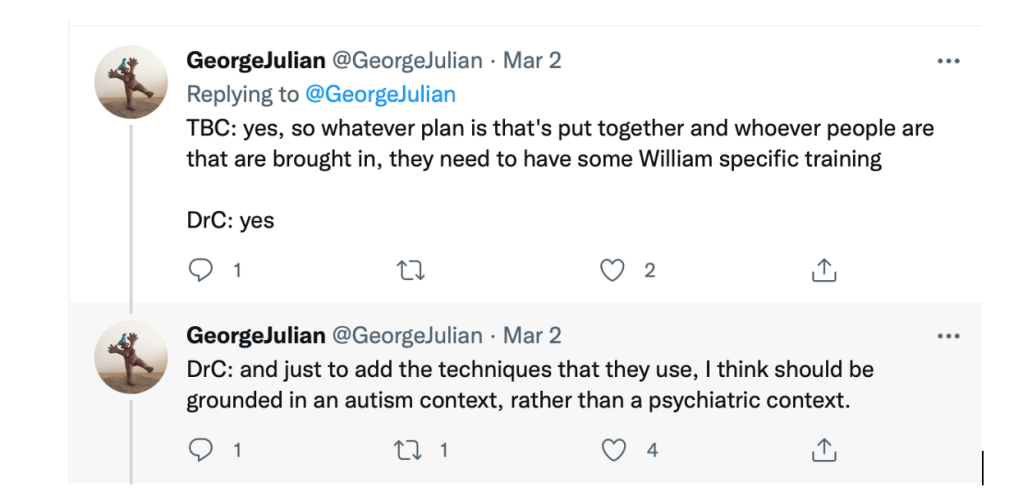
In what follows I draw on my own observations of the hearing and on George Julian’s helpful live-tweeting of the case as a public record to supplement my own notes. George Julian live-tweets Court of Protection and inquest proceedings to increase public awareness of disabled people’s personal and legal experiences. She provides an exceptional public service for which she has rightly been recognised by the BBC.I am indebted to her for what follows and hyperlink her tweets throughout.
I observed this hearing because I’m currently training to be a barrister, intending to practice in the Court of Protection, and wish to gain practical experience of matters therein. I observed in the company of fellow-observers (including a trainee psychologist, academic lawyers and a disability rights activist). These observers and myself gathered virtually in a private chat room, where we exchanged our views about the experience.[i]
By means of background, barrister training involves tuition in academic and practical skills. Academically, we learn the ethics of advocacy and the rules of procedure in criminal and civil courts. (‘Civil’ simply means ‘any legal matter that isn’t criminal’.) That includes how civil and criminal proceedings are instigated, what evidence can be admitted to courts and barristers’ ethical obligations to never mislead courts.
We principally learn those matters from large textbooks which state the courts’ procedural rules. The textbook setting out criminal procedural rules is called ‘Blackstone’s Criminal Practice’. The textbook setting out civil procedural rules is called ‘Civil Procedure’, but it is colloquially known as ‘The White Book’ because it is white in colour.
The practical skills we learn include how to hold conferences with clients, how to write legal opinions and skeleton arguments and how to handle witnesses in court (i.e. how to conduct cross-examination and examination-in-chief).
Given my training in such matters, in what follows I will compare what Bar training has instructed me to do in court against what I observed real barristers doing in WV’s hearing. I observed both convergence and divergence. My observations fall under three headings:
(1) Evidential complexity
(2) General witness-handling
(3) Cross-examination
1. Evidential complexity
I have two reflections on the evidential complexity in this hearing. They concern:
the technicality of the evidence
the value of visual aids.
(i) Technicality of evidence
This case involved what, in closing submissions, Helen Mulholland described as “very detailed and complex medical and other evidence” about nephrology and learning disabilities. By contrast, in Bar school, we learn advocacy in the context of simple factual scenarios (e.g., road traffic accidents or contractual disputes about home refurbishment). That is understandable: it allows us to focus on learning new skills without grappling also with complex facts. Nonetheless, this case was a potent reminder that legal practice can require literacy in challenging, technical science.
Unfortunately, and inevitably, there was a disjunct between barristers’ and witnesses’ medical literacy and some observers’ understandings. Some social media users (I will not hyperlink them in order to respect their privacy) argued that WV’s non-receipt of the transplant would amount to ‘eugenics’, grounded in ‘ignorance’ and ‘prejudice’ about ‘neurodivergence [and] disability’. That is a regrettable misrepresentation – or misunderstanding – of the Court of Protection’s best interests jurisdiction. Yet such commentary also raises a difficult question. If, in technical cases like WV’s, open justice is insufficient to secure public understanding, ought we do more to secure it? If we should, what might that involve?
One answer would be for the Court of Protection, in complex and/or high-profile cases like WV’s, to issue plain English factual and legal case summaries before or after the hearing. The United Kingdom Supreme Court so issued(here) in the recent case A Local Authority v JB [2021] UKSC 52 (as a downloadable pdf). Such a summary in WV’s case could have clearly stated the risks of kidney transplant so that the public could understand why it was not straightforwardly ordered. However, pragmatically it is difficult to imagine the Court of Protection writing (or commissioning) plain English summaries for the vast majority of its hearings because it is overworked and under-resourced. Therefore, for the time being, the question of whether and how public understanding should be secured in technical cases like this one remains open.
(ii) Value of visual aids
It has never been suggested to me in Bar school that barristers may create and submit visual aids to the court to aid their understanding of a case. Yet, in this hearing, Victoria Butler-Cole QC created and annexed to her Position Statement a helpful diagram setting out each of WV’s four different possible treatment pathways (see Appendix – with thanks to Victoria Butler-Cole QC for permission to reproduce it here).
That diagram helped everybody. All barristers referred to it at one point or another. One of the expert witnesses, Moin Saleem, was shown it too. When he was, I noticed the judge smile warmly. While Moin Saleem could not access the diagram during the hearing due to a failure of his electronic bundle, he confirmed that it was broadly correct. These observations have inclined me toward producing similar diagrams when appropriate in order to similarly assist the court.
(2) General witness handling
I have three general reflections on the witness handling in this hearing. They concern: (i) witness temperaments; (ii) the speed of witnesses’ evidence, and; (iii) a technique called ‘insulating the witness’.
(i) Witness temperaments
In Bar school, we are taught how to handle – and therefore perhaps impliedly, to expect – witnesses who are vulnerable or obstructive. That is understandable: it is better for students to anticipate challenging witnesses and encounter pleasant ones than the other way around. Yet, none of the witnesses in this hearing were problematic. On the contrary, all were intelligent and articulate. As Helen Mulholland observed in closing submissions, (even) the lay witnesses’ evidence – Drs X, Z and Y – gave “very detailed”evidence backed by a “great detail of expertise”.
Some temperamental differences naturally separated the witnesses. Moin Saleem spoke more softly than Dr X, whose evidence he followed. Dr Y spoke quieter still and, at the beginning of his evidence, was asked by the judge to speak more loudly. However, this hearing was a good reminder that contrary to Bar school instruction, witnesses can be pleasant, intelligent and helpful.
(ii) Speed of witnesses’ evidence
A recurrent problem in this hearing was that witnesses spoke too quickly for the judge to note down their evidence. On the first day, the judge twice had to ask witnesses to slow down. On the second day, the judge had to ask twice more. By the third day, the barristers had cottoned on.
Victoria Butler-Cole QC, for example, began her cross-examinations of witnesses giving evidence over the remote link by saying “If I look away from the [computer] screen that is because I’m trying to watch the judge to see if she’s getting it down”. Helen Mulholland, when conducting examination-in-chief of Dr. Y, was similarly attentive. She fixed her eyes on the judge and frequently raised her palm to Dr. Y, indicating that she should pause her evidence to enable the judge to note it all down.
It was useful to observe this. In Bar school, teachers do not always note witnesses’ evidence when we are practicing examination-in-chief or cross-examination. Teachers focus instead on whether our examination technique is too rapid or otherwise improper. This hearing was therefore a useful practical reminder to students like myself that good examination-in-chief or cross-examination involves controlling the pace of the witness to ensure that the judge can record their evidence.
(iii) ‘Insulating the witness’
Here is our first term of art. There will be only one more. ‘Insulating the witness’ occurs in examination-in-chief. It describes when a barrister, anticipating that the credibility of their witness might be attacked in cross-examination, asks special questions to the witness specifically in order to protected their credibility from being so undermined. (The functions of cross-examination are discussed in the section below this one.)
By means of example, imagine a criminal case involving the night-time burglary of a house. Mr. B is the alleged burglar. The elderly Mr. A says he saw Mr. B do it. Mr. A was thirty-feet away when so observing. The prosecuting barrister will call Mr. A as a witness, whose evidence will suggest to the court that Mr. B was indeed the burglar. However, Mr. A’s credibility is vulnerable to attack. Namely, the cross-examining defence barrister could argue that Mr. A’s identification is unreliable because of the long-distance nature of his observation, the cover of darkness and (proven or suggested) age-related macular degeneration. To ‘insulate’ Mr. A against such attack, the prosecuting barrister could ask “How can you be sure that you saw Mr. B?”. Mr. A may answer “I was wearing my glasses and Mr. B was illuminated by a porch light”. If he does, it is no longer open to the prosecuting barrister to suggest that Mr. A’s view was unsafe. Accordingly, through ‘insulating’ Mr. A, his credibility and persuasiveness have been safeguarded.
Moin Saleem was insulated in this manner when giving evidence about the risk of disease recurrence after transplant. With reference to his own clinical study, Moin Saleem said that the risks of recurrence for WV were not a reason to not authorise the transplant. However, the sample patients in Moin Saleem’s study included some with different forms of kidney disease to the kind WV has.
Emma Sutton must have anticipated that, in cross-examination, other barristers would seize upon that difference to suggest that Moin Saleem’s evidence should be given little weight because it was not based upon patients like WV. Accordingly, Emma Sutton ‘insulated’ Moin Saleem against such attack by asking whether the patient sample in his study “made his research any less valid”.
After this, it was no longer open to other barristers to suggest that the difference between WV and Moin Saleem’s patient sample undermined the transferability of Moin Saleem’s findings.
That was the first time I have seen a witness insulated in real-life. I found it satisfying and instructive as to how I will deploy the technique. I am glad to share in this blog the mechanics of precisely why Emma Sutton asked that question when she did.
(3) Cross-examination
I have three reflections on the cross-examination in this hearing. They concern:
framing of questions
‘boiling the frog’
paying attention to witnesses’ answers.
(i) Framing questions
By means of background, cross-examination has two core purposes. First, and most simply, barristers ‘put their [client’s] case’ to the witnesses who do not agree with it. Barristers must, in general, tell the court what their client says happened factually or ought to happen going forward. In cross-examination, that means confronting a witness who says ‘x’ with ‘well, my client says ‘y’’. That is an ordinary feature of legal advocacy. Nothing more need be said about it here.
The second, more relevant purpose is that, as explored in another blog post on cross-examination, cross-examination seeks to undermine the credibility of a witness. This is important because it can influence the outcome of a legal case.
Recall the elderly Mr. A above, who says that he saw Mr. B committing burglary. Imagine that Mr. A’s credibility is undermined so that nobody believes he clearly saw Mr. B. Without other evidence that Mr. B did the burglary, Mr. B must be acquitted. So, through undermining the credibility of a witness, a barrister seeks to obtain the legal outcome they want by persuading the court that their opponents’ arguments are too weak to be accepted.
Victoria Butler-Cole QC achieved this by persuasively framing her cross-examination questions. The genius in Victoria Butler-Cole QC’s cross-examination involved, in my view, co-opting the witness doctors’ clinical deference.
Doctors tend to tightly define their own areas of expertise and when matters fall outside those areas, they readily defer to others who do specialise in such matters. For example, Dr. Z, a consultant in paediatric intensive care, was reluctant to express any views on renal matters or “stray into renal expertise”.
Moin Saleem agreed to be guided by clinicians who knew WV personally because he did not.
ES: do you defer to Dr Z in terms of his history
MS: yes, happy to be guided by clinicians who've seen him
ES: in terms of your analysis of WV prognosis if HGD continue as only treatment plan… we heard from Dr X WV has two viable veins, and he said he'd be surprised if WV
Dr Y deferred to WV’s mother on the nature of WV’s ‘triggers’ because she had known WV for so long.
DrY: I'd defer to her, if she feels they upset him, yes. Ami knows William better than all of us, has brought him up all these years. These plans are collaborative in nature, she's very observant and good at communicating with us. Absolutely I'd agree with that
In my view Victoria Butler-Cole QC anticipated or detected this deferential tendency and cross-examined Dr X in a manner designed to benefit from it. (See tweet thread starting here).
VBC [Victoria Butler-Cole QC]: “Your analysis for best interests is based on opinion that, in order for WV to have plasma exchange, he’d need to be sedated and ventilated. But, if it turns out not everything has been tried for him to tolerate treatment, then you could be wrong about that, do you agree?”
Dr X: “Yes.”
VBC: “And if you were wrong about that, then your view on dialysis would change, right?”
Dr X: “Yes.”
VBC: “So we wait to hear from Dr Y and Dr Carnaby [the psychiatrists]: if they say reasonable chance [of WV tolerating dialysis] with [amply soothing] measures in place, would. You accept their advice on that?”
Dr X: “Yes.”
In her last question, Victoria Butler-Cole QC is triggering Dr X’s clinical intuition to defer to doctors with more specialised relevant experience than his own. Mr. X’s affirmative answer was, perhaps, unavoidable given clinicians’ deferential tendencies, but it acted to discredit Dr X’s present view that plasma exchange is not in WV’s best interests. Deliberate or not, that exchange is a masterclass in framing your questions to trigger witnesses’ known idiosyncrasies in order to elicit an answer which helps your case.
(ii) ‘Boiling the frog’
This is our second term of art. It describes a cross-examination tactic. If one were to ‘boil a frog’ in a pan of water over a hob, one would not toss the frog into water that was already frothing and searing. The frog would simply leap out. Your chance would be lost.
Similarly, in cross-examination, the advocate does not begin with the hardest, most consequential questions. The witness would simply answer nothing. Your chance would be lost.
Rather, when cross-examining you must slowly turn up the heat: beginning with gentle, inconsequential questions and only later reaching the hard, consequential ones. That is what it means to ‘boil the frog’ in cross-examination.
Victoria-Butler Cole QC demonstrated this technique with Dr Y. Her first question was “could you tell us how many times you’ve met [WV]?”. That is an easy question because it has a simple factual answer which ought not compromise Dr. Y or have any direct bearing on the central issue in the case (whether transplant was in WV’s best interests).
However, over time, the questions asked became increasingly relevant to that contested issue or otherwise impugned the conduct of WV’s attending staff (see the tweet thread from here onwards)
VBC: “Do you accept that nobody has ever seen [WV] pull out the [dialysis] line?”
BBC: “It was predictable, wasn’t it, that saying to WV that he can’t have the lunch we told him he’d have might cause him agitation and distress, particularly when he was already in pain and distress from dialysis?”
VBC: “WV said he didn’t want [a particular staff member] in the room… [and] didn’t want [the same] to connect him to a machine. 20 minutes later that staff member came back in the room, even though WV said he didn’t want her doing it. [Why?]”
VBC: “[In a particular day a number of things went wrong which] ultimately resulted in security guards physically restraining WV… that’s not right and shouldn’t happen, should it?”
By beginning with questions unconnected to the contested issue and neutral on persons’ conduct, then slowly introducing questions implicating one or both of those matters, Victoria Butler-Cole QC was ‘boiling the frog’.
The technique can be deployed far more antagonistically in courts which, unlike the Court of Protection, are adversarial. Indeed, throughout the hearing Victoria Butler-Cole QC exhibited a calm, clear and personable demeanour.
This was the first time I have observed ‘the frog boiled’ in real-life. I recommend such observation to other Bar students to optimise their own use of the technique.
Paying attention to witnesses’ answers
Some of my barrister-training colleagues think that, in cross-examination, you need not pay any attention to the witnesses’ answers. Their reasoning is that, if you frame your questions correctly, you can impliedly discreditthe witness irrespective their answers.
By means of example, return to Mr. A, Mr. B and the night-time burglary. The cross-examining barrister may ask Mr. A “it’s right, isn’t it, that you couldn’t see the burglar’s identity because it was dark?” or “your poor eyesight prevented you from seeing the burglar’s face, didn’t it?” Even if Mr. A protests his credibility, the questions sow doubt in the court’s mind that, in fact, Mr. A didn’t see Mr. B as clearly as he purports. My colleagues consider that implied doubt sufficient to undermine witnesses’ credibility.
This hearing demonstrated that my colleagues are not right. Victoria Butler-Cole QC was especially attentive and persuasive in relation to witnesses’ answers (irrespective of who was examining them at the time). For example, in his examination-in-chief by Emma Sutton, Moin Saleem disclosed information that revealed an inaccuracy in Victoria Butler-Cole QC’s diagram. Victoria Butler-Cole QC opened her cross-examination by immediately asking Moin Saleem whether her diagram ought to be amended and by proposing such an amendment. Moin Saleem answered affirmatively to the need for and substance of the amendment.
TBC: I ask questions on behalf of WV's mother; just a few questions. You said you'd seen chart I'd attempted to put together, I think at least one mistake on it having heard your evidence this morning, graft life expectancy is not 10-15yrs if been recurrence
This made Victoria Butler-Cole QC look persuasively medically literate.
The utility of listening during one’s cross-examination was evident when Victoria-Butler Cole QC cross-examined Dr Y. Dr Y said that security guards attending WV had an ‘information pack’ describing how to interact with him during dialysis. Dr Y said that, pursuant to that information pack, guards could sit outside WV’s room. Victoria Butler-Cole QC immediately identified that nowhere in the information pack was it specified that the guards should sit outside WV’s room. Dr Y conceded that, saying instead that in any event the guards had the option of sitting outside WV’s room.
Through that exchange, Victoria Butler-Cole QC optimised her undermining of Dr Y’s credibility. By engaging critically with witnesses’ answers to her questions, Victoria Butler-Cole QC’s cross-examination – and ultimately the presentation of her case – gained strength and authority.
Bar students would benefit from observing such examination to decide whether, to be most persuasive, one should respond to witnesses’ cross-examination answers or insist on a list of pre-planned questions in any event.
4. Conclusion
This was a profoundly useful hearing to observe as a Bar student. I believe that all trainee barristers should observe a Court of Protection hearing, especially while hearings remain ‘hybrid’ or fully ‘remote’ on video-platforms.
One reason to observe Court of Protection hearings is because by doing so one observes a range of advocacy styles. Often only two barristers appear in hearings (representing the prosecution/defence in crime, and the claimant/respondent in other civil cases). Yet in the Court of Protection, three (or more) barristers frequently appear because representation is required for P, the NHS Trust(s) and other interested parties like members of P’s family. Observing more barristers is helpful because it allows trainee barristers to make informed choices about the style they consider most effective and thereafter seek to emulate.
Additionally, ‘hybrid’ or ‘remote’ hearings allow trainee barristers to get closer to justice than they may ever get otherwise. Trainee barristers routinely undergo work experience schemes called ‘mini-pupillages’ where, on application to a set of chambers, the trainee is assigned one of chambers’ barristers to shadow over the course of a week. Unfortunately, trainee barristers may spend that week deposited at the back of a courtroom, straining to observe proceedings or doodling away in a notepad. Yet, in ‘hybrid’ or ‘remote’ hearings, trainee barristers see not lawyers’ backs but their faces. This provides a unique opportunity to observe the expressions of barristers and of the judge. Through such observations, trainee barristers can learn that real barristers are not stony-faced and solemn, and observe what sort of advocacy influences judges (recall that, as described above, the judge smiled at the mention of Victoria Butler-Cole QC’s helpful diagram). Again, such observations can only inform and strengthen trainee barristers’ choices of advocacy styles.
Accordingly, ‘hybrid’ or ‘remote’ Court of Protection hearings provide very valuable opportunities to observe the practice and effect of oral and written advocacy from skilled QCs and other barristers. Every trainee barrister would come away stronger after observing a Court of Protection hearing. It is a credit to the Open Justice Court of Protection Project that they facilitate access to this court.
This post is about the final day of the hearing concerning whether it is in William Verden’s best interests to have a kidney transplant. This day (Thursday, 3 March 2022) was devoted to closing submissions.
If you have been reading my previous blog posts on the case, you’ll know there was one that introduced the case (here), and another (here) covering Days 1-3 of the hearing.
Back at the beginning of the hearing, I compared the experience of observing in court to gazing through a kaleidoscope. I started off with a blurry image of what William’s case entailed – especially given conflicting facts presented by the media. The image has gradually become clearer as I’ve listened to the oral evidence and watched the brilliant examination by the legal counsel.
Today’s closing submissions brought me one step closer to finally seeing the full picture.
There’s one final turn of the kaleidoscope before the full image is revealed: that will come on Tuesday 8 March 2022 when Mrs Justice Arbuthnot hands down her judgment.
As a brief reminder, the person at the centre of the case is William Verden, a 17-year-old who has a rare kidney condition (steroid resistant nephrotic syndrome) which has led to end-stage-renal-failure. Without a kidney transplant, William will die within about a year or so.
William also has diagnoses of moderate to severe learning disabilities, autism, and ADHD with accompanying behavioural disturbances. All parties agree that William does not have the capacity to make his own decision about a kidney transplant. It’s also agreed that the combination of his rare kidney condition and his other diagnoses mean that adjustments would need to be made, if transplantation were to be successful. Some of these adjustments carry quite serious risks: for example, being sedated and ventilated for days or weeks (which is likely the only way he would be able to tolerate the treatment required for disease recurrence immediately post-operatively) is highly likely to cause psychological harm (including Post Intensive Care Syndrome), which could last for years. There’s also an estimated 50:50 chance of the kidney transplant failing.
In line with section 4 of the Mental Capacity Act, the Court of Protection has been asked to consider whether a kidney transplant is in William’s best interests.
Over the course of the previous 3 days, the parties have heard extensive evidence from a range of health professionals. On this last day, they presented their closing submissions – final speeches from each of the parties summarising their position after hearing the evidence.
I will detail the closing position taken by each party but in summary:
The applicant Trust claimed the same position as in the position statement they submitted to the court at the outset (i.e. it’s “finely balanced” and they can’t positively say that transplantation is in William’s best interests and are asking the court to decide).
The mother’s position remains unchanged (it’s in William’s best interests to have a transplant).
The litigation friend for William, the Official Solicitor (who reserved their decision at the beginning of the hearing) came down strongly after hearing the evidence in favour of transplantation.
The Trust’s position at the outset of the hearing was that the decision was ‘finely balanced’ such that “the Trust is not able to agree, on the basis of all the evidence, that renal transplant is in William’s best interests, given that he would be put through burdensome and painful treatment which could ultimately be futile, would be likely to cause him injury – physical and psychological – and which, it is submitted, could compromise any future treatment he might require.” The Trust therefore asked the Court to decide whether a kidney transplant is in William’s best interests.
In her closing submission, Ms Mullholland, on behalf of the Trust continued to refer to it as a “finely balanced” case, and took essentially the same position.
“The Trust as you know looked at transplant in great detail with its own nephrologists, intensivists and psychiatrist, took second and third opinions, and approached the hospital’s ethics committee. Those opinions were not in favour of transplant. But at the time of making the application to court. The trust acknowledges this is extremely finely balanced and there are compelling arguments both ways…Trust cannot agree to transplant and asks the court to make that decision on William’s behalf”
But, even under these circumstances the Trust acknowledged the gravity of their position: “It is a stark choice, it’s so balanced because even a successful outcome for William will have severe implications for him. He will have…a severe psychiatric injury for several years…The Trust has reservations, but it quite sees that the alternative is equally stark for William.”
Ms Mulholland expressed positive views about all of those involved in this case. Describing William’s mother, Amy McLennan as “the person who knows him better than anyone”, she said: “One cannot fail to be moved by her evidence…it was compelling evidence. On behalf of the Trust, I should like to pay credit to her for her care that she has given and continues to give to William”. She recognised the doctors who’d given evidence as “conscientious, compassionate doctors and they seek the right outcome for William”, and acknowledged the incredibly hard work from both the Trust and William’s family in trying to reach the right decision” but “William has perhaps worked the hardest of all”.
From a clinical perspective, one of the features that contributes to the complexity of William’s case is that his rare kidney condition might recur in his new kidney – the likelihood of this happening was described by Ms Mulholland as a 50/50 chance much like “the toss of a coin”. This success rate is based on the evidence that was presented by Prof Saleem on day 2 of the hearing (the Trust’s own estimation of the risk was higher (up to 100% in their position statement).
She also referred to the serious risk detailed in oral evidence that William would suffer psychiatric injury, including post-traumatic stress disorder for several years. She quoted an earlier expert who’d said other children have referred to intensive care treatment as “torture”.
Ms. Mulholland presented the Court with two possible outcomes for William. The first, is one of no diseases recurrence which was described as an outcome that “everyone would hope for”. The second would be disease recurrence. If this were to happen William would require treatment by means of plasma exchange and high doses of steroids.
Over the course of the last three days, it’s become clear that the provision of the plasma exchange is where the true complexity and difficulty of William’s case lies as it’s been largely agreed that sedation and ventilation will be needed to provide the treatment. This decision is largely based on the clinician’s standpoint that “… if transplant were to take place it should have the very best chance of success for William to do other than that would be to do him a disservice.”
It’s the effect of this required sedation and ventilation that concerns for the clinicians.
“The evidence has developed and crystallised during the course of this hearing. Prior to the hearing the intensivist at least on paper were not in favour of this course of action but they can see that this is a delicate balancing exercise. But that doesn’t eliminate the risks…not only is it clear now that there is likely to be significant psychiatric injury…Dr Carnaby went further than Dr Y and said it’s very likely… there is also the distinct possibility of post intensive care syndrome. The evidence of the intensivists is particular stark. It’s important when making this difficult assessment that we don’t shy away from that. Dr Z speaks of children that come round of such experience and queried why they happened and described them as torture”.
Ms Mulholland ended like this:
“It’s important in this assessment to bear in mind what success looks like and what failure looks like and this is not a binary assessment. There are many possible outcomes…makes this a very difficult assessment and that’s what leads to the position of the Trust being taken as it is. On the one hand, William could continue with his haemodialysis with his good quality of life but under those circumstances he would likely live for a year or two…difficult to predict. On the other hand, he can have a transplant with a 50% possibility of success and then not require further transplant for potential 15 years. During these years he will be without his dialysis but with an unknown and unquantifiable psychiatric injury.”
From the outset of the hearing, the position of William’s mother has been that a kidney transplant is in William’s best interests, and none of the evidence during the hearing changed that basic position.
Speaking on behalf of Amy, Ms Butler Cole QC started her closing statement / argument by thanking Arbuthnot, J for the time she’d taken to not only hear the evidence but also to meet with William.
Ms. Butler-Cole QC said that Amy had found the Trust’s position confusing.
“…At a point in the Autumn, it was suggested that mediation might be appropriate but that was rejected by the mediator because the views about transplantation were so polarised. It seems now we’re in slightly different territory”
That ‘different territory’ is one in which there’s nobody clearly stating that transplantation is not in William’s best interests. Either they say that it is, or “at its lowest if I may put it that way, was Dr X, who when asked, by me, “is it your view that it’s not in P’s best interests?” said, “we just want the court to decide”. This is, as Ms Butler-Cole QC said, “Mr Justice Hayden’s territory” in guidance issues in 2020 (Practice Direction 9E: Applications relating to medical treatment): you must always consider making an application to court if the decision is “finely balanced’, even if there is no disagreement about what is in P’s best interests.
“We are actually in that territory. There was no evidence from any of the witnesses that transplantation was not in William’s best interests.”
So, the burden is on the Court to make a decision that clearly involves serious risks.
“That is something that fortunately for doctors and the family members the court is familiar with. One can see from the cases including cases like Re D , where totally untested stem cell therapy was approved as being in someone’s best interests contrary to medical opinion, probably contrary to Bolam, precisely because the Court’s role in making a best interests decision is not necessarily to make the least risky decision or a not even a sensible decision, because the person’s wishes and feelings are so critical.”
She also referred to the case of Wye Valley NHS Trust v Bwhere the Court of Protection decided not to amputate Mr B’s leg even though that meant he would die, because of his strong wish not to undergo amputation.
And she quoted from a lecture given by Mr Justice Hedley (as he then was) in 2013 to the Mental Health Lawyers Association annual conference. Hedley J recognised that where risk and danger is involved – such as the risk of psychiatric illness from sedation and ventilation, and the negative consequences failed transplantation for William, which the Trust express such concern about:
“… it is readily understandable that the authorities themselves were not prepared to incur that risk. That is the proper function of the judge … I think we have to be sensitive to the pressures that operate on public bodies but at the same time be willing to assume responsibility for running risks where the general interests of the person concerned seem so to require. … The purpose of the jurisdiction is to enable those who lack capacity to enjoy life to the fullness that is potentially available to them. To live life to the full is always to incur risks. That seems to me a proper approach in regard to those who lack capacity even though it is the judge rather than the person who is incurring and authorising the risk. I do not think we should be afraid of this for in my view it accords with any sensible philosophy of providing for the welfare of those who, through no fault of their own, are restricted in their ability to control their lives.
Amy recognised and appreciated that the Court would be willing to make such a ‘risky decision’ on Williams’ behalf.
One of the changes resulting from the court hearing was that the evidence had changed – the Oral Evidence was not the same as the written evidence before the court.
For example
Dr X (The Treating Nephrologist)
Writing Evidence
Oral Evidence
“We find it very difficult to support the option of putting him forward for a renal transplant” (this evidence was based on the basis that William would require sedation and ventilation for 6 weeks)
“It is a difficult and finely balanced issue and we come to ask the court for their view on it. It would be straightforward for me to say from the point of view of the kidney that he should have plasma exchange and any other treatment but clearly we understand that a long period of sedation and ventilation is not ideal”
Dr Z (Consultant in Paediatric Intensive Care)
Writing Evidence
Oral Evidence
It would not be in William’s best interest to subject him to mechanical ventilation of 2-6 weeks
Ms Butler-Cole QC provided a helpful summary of the oral evidence: “He had sedated patients for 5-7 days. The risks were not so great that they shouldn’t be considered at all. The key concern was the possibility of psychiatric or psychological harm…He accepted that there were protective factors for William. William is not critically ill at the moment and most if not all children who are going into ICU are critically ill…That’s a protective factor for William because he will be going into ICU electively, not in a crisis situation with other risk factors that children would have experienced.”
Dr Y (Consultant Psychiatrist)
Writing Evidence
Oral Evidence
Did not express a view on the best-interests- determination.
Even with knowing the risks and potential harms Dr Y was of the opinion that the proposed treatment and elective period of sedation and ventilation was in William’s best interests.
Ms Butler-Cole QC also addressed the weight of the second opinions and documents received from the Ethics Committee. She started off by framing the context of the second opinion document: “…at the time one of the things the trust was considering was stopping haemodialysis and the first question that was posed was ‘is this vulnerable adolescent suitable to receive a kidney transplant in the meantime his only chance to survival is dialysis”. To this the opinion was that a transplant was William’s best option if ongoing active treatment was pursued.
An ethical concern was also raised by the Ethics Committee about “offering William a kidney rather than another candidate more likely to maintain transplant kidney function for a longer period.” But, during Dr X’s evidence it was made clear that this concern did not form part of the best-interest process – “this is not about whether someone else deserves a kidney more than William, it’s about whether this is the right course of treatment for William”.
Returning to the question of continuing dialysis, Ms Butler-Cole QC emphasised that at the time the second opinions were requested, the information provided stated that providing haemodialysis was extremely difficult.
“…security guards have to sit with him at all times…he can easily hurt himself or staff. Sessions have to be often prematurely stopped resulting in inadequate dialysis…”
This is not the position that William finds himself in at the moment.
Based on this information of the previous situation (before William received adequate support to assist him with his dialysis). The opinion stated:
“I can only envision William lurching from one crisis to another on dialysis. If it’s not line displacement, it may be fluid overload or line sepsis…or just being fed up to sit for another three hours week after week after week.”
Referring to it as a ‘pessimistic view’ Ms Butler-Cole QC reminds the Court that this view of what was going to happen did in fact not occur.
“William has got better and better at tolerating dialysis. There have been fewer and fewer problems and there haven’t been a series of major crises”
The second opinion concluded
“If William finds it impossibly miserable tolerating the transplant operation and rescue treatment, considering low chances of success embarking on listing for transplantation would be futile”
However, the Trust’s case is not that the treatment is futile.
It’s pointed out by Ms Butler-Cole QC that the analysis does not take into consideration the measures that has been proposed to help William tolerate the sedation and ventilation.
Ethics Committee Letter
A letter based on the views of various medical professionals was also presented to the Court which asked them to consider whether it was in William’s best interests to switch to best supportive care and palliation of symptoms. The Committee’s response was that it was a reasonable view to take and also referred to making an application to the Court of Protection if agreement could not be reached about best interests determination.
It’s disappointing and rather concerning to hear Ms Butler-Cole QC point out that this clinical ethics meeting and discussion took place without involving William’s mother. Reference is made to the case of Great Ormond Street Hospital v MX which stated: “…a lack of involvement by patients and their families is itself an issue of medical ethics and I’m most surprised there is not guidance in place to ensure their involvement and participation…while of course professionals may need to have discussions on their own to exchange frank and professionals views. It cannot be good practice for there to be no prior consultation or participation of the patient or the family”
Consequently, it was put forward that neither the second opinion or ethics committee letter assisted the Court.
The crux of William’s case
After discussing the second opinion and ethics committee letter, Ms Butler-Cole QC outlined the important aspects of William’s case.
The alternative if William is not offered a transplant
“The critical point here, this is treatment that would be offered to someone with William’s condition; if he doesn’t have it, we know what the outcome is – it will be death in a relative short period (likely to be 12 months not two or three years). We have the luxury of considering the risks and the benefits in fine detail but ultimately the balancing exercise is the same that doctors and parents have to make every day when admitting a critically ill child to ICU. It’s a bridge of treatment to help someone recover. It has negative side-effects, but one adopts it because the alternative is much worse.”
Organ Transplantation and the Mental Capacity Act
“It’s been interesting that none of the experts or professionals appear to have encountered a situation before where organ transplantation has been offered to someone without capacity to make decisions, who also potentially will display challenging behaviour. We don’t know if that is because people in William’s situation aren’t offered transplantation, or whether it’s just to do with the rarity of transplantation as a medical procedure”
Court authorisation for elective sedation and ventilation
The issue of elective sedation is not at all novel for the Court of Protection. It’s frequently authorised by the court. Ms Butler-Cole QC relied on cases where the Court has authorised sedation and ventilation to allow for procedures to be carried out when the patient doesn’t comply (e.g. court-authorised caesarean (e.g. C-section and general anaesthesia against her wishes? Capacity and best interests and cancer treatment to which a non-capacitous patient is resistant (she cited NHS Trust v K).
What has the evidence told the Court about the risks to William?
Prof Saleem’s evidence stated that the risk of recurrence in William’s case was 50% – Ms Butler-Cole QC asked the Court to proceed on the basis of this evidence as it represented the national basis. She also emphasised that the risk of recurrence did not mean that it was a 50% risk of failure and that the Court should bear in mind that there is the likelihood that the plasma exchange could allow for even the new kidney to function without disease.
William’s behaviour and the need for sedation and ventilation
It was put to the Court that William’s mother had reflected significantly on how William’s behaviour might necessitate the need for sedation and ventilation if a plasma exchange is required. Amy’s view is that “with the right support, William’s behaviour is much more manageable than the trust think…” Amy felt that it was a good sign that William had kept his central line in since September 2021 and that his behaviour had improved over the last few months when attending dialysis. The concern was raised that the narrative that was presented that William was a difficult patient to dialyse was based on the opinions of medical professionals who didn’t even meet William. Lastly, William’s mother also felt more hopeful since the indicated focused support team became more involved towards the end of December. Their involvement showed that with a William centred autism-friendly approach he could be assisted to comply with treatment.
One thing that Amy made clear though is that she did not want William to have a poor quality of life and she was not insisting on treatment at all costs.
The public appeal for a living kidney donor
William’s case first caught my attention when I saw the BBC article on the public appeal that had been launched to find William a living kidney donor. At the end of her submission, Ms.Butler-Cole QC returned to this point. She told the Court that William’s mother was ‘extremely moved and grateful’ for the donors who had come forward, but she was concerned about the fact that at least one donor was told that there was an upper age cut limit of 60. This advice does not seem to be in line with the information provided on the NHS Blood and Transplant website. Seeing that during my own empirical research I spoke to living kidney donors in their 70’s I also returned to the NHSBT leaflet on living donation and this clearly states: “There is no maximum age limit for donation. Donors are assessed on their own health and the suitability of the kidney for the intended recipient. In the UK there have been successful living kidney donations from people more than 80 years of age“.
This is also echoed by the British Transplantation Society’s Guidelines for Living Donor Kidney Transplantation. I guess it could be questioned whether an older donor might mean a lower success rate for William, but either way it’s important to have an answer on this matter. It would be unfortunate if members of the public above the age of 60 were led to believe that they could not act as living donors.
The critical part of this case though is to consider what William wants – what are his wishes and feeling. It’s become undoubtedly clear that he wants a transplant, and that this is a process he has been prepared for since July 2021. Ms Butler-Cole QC stated that it would be ‘cruel’ to now tell William that his transplant was not going ahead. She ended by stating ‘…the only reasonable conclusion the court could reach is that it is in his best interests that transplantation proceeds”.
Ms. Sutton presented her closing submission in three parts: 1) an overview of the position; 2) an analysis of how the Court should reach their decision by applying the evidence to the statutory framework; 3) the specific terms of the draft order the court will be invited to make.
An overview of the position
William’s mother’s confusion regarding the Trust’s position was immediately echoed by Ms. Sutton, when she outlined the evidence presented by Dr X and Dr Z. She referred the Court to the following:
“…Dr X’s written evidence where it said my staff and the team feel it’s in William’s best interests for haemodialysis to continue, the inevitable consequence of that is if dialysis is to continue, then transplant is not an option put forward by the professionals ”
“…Equally conclusions of Dr Z, he says ‘in my opinion it would not be in William’s best interests to subject him to a prolonged period of mechanical ventilation for two to six weeks to facilitate a renal transplant’.”
The Court was referred to the earlier judgement concerning the Reporting Restrictions Order where the position of the trust was that they objected to a transplant for William. Mrs Justice Arbuthnot interjected to express that the Trust’s position here was based on that William would need 4 – 6 weeks of sedation and ventilation and she described it as “a very different picture to what we have here today…”. Ms. Sutton explained “the reason I outline that is that the tenor of the evidence this week makes it easier for the decision to be made because you have no clear evidence pointing againstthe position that it is in William’s best interests to have the kidney transplant”.
The more difficult decision in the Official Solicitor’s opinion was rather the issue of elective sedation and ventilation – as explained by Ms. Sutton this was a measure that “would not have been provided, but for William’s difficulties”.
It was concerning (she said) that the key professionals who provided the oral evidence did not necessarily know William well.
“This is not an overt criticism at all of the Trust, but was clear from the oral evidence is that it’s quite unusual for the Trust to call witness who know William well. There was a tendency to paint William as a child who is difficult, and can’t be managed due to his learning disabilities, ASD and ADHD. Whereas the reality of the situation on the ground when you properly analyse the records is that staff have been able to manage him for a period of two years. That’s significant. If you look at the managing techniques – it was light touch: it was distraction techniques and it was handholding.”
Elective Ventilation and Sedation
On the question of elective sedation and ventilation to ensure the success of William’s transplant, Ms. Sutton started by saying that the Official Solicitor was nervous of accepting this course of treatment for William. She used the two scenarios of no disease recurrence and disease recurrence to outline why it might be necessary to sedate and ventilate William.
In the situation where there was no disease recurrence, the main concern based on Dr X’s evidence was that line joining William’s bladder and new kidney could be pulled out and even though the consequences of pulling out the line would not be fatal, it was still considered as a serious situation. But, even in this situation it was explained by Ms. Sutton that William would be “in a situation he’s never experienced before”.
The ’unknown’ territory might be more for William if disease recurrence did occur as he would require plasma exchange (10 sessions over 14 days for 2-3 hours) and for the first three days he would be treated with high steroid dosages which is likely to cause verbal and physical aggression (as noted by Prof Saleem).
Ms. Sutton summarised the situation as follows:
“We say tolerance of such an intensive post-operative plan for any young person would be a huge ask but for William having regard to the learning disability, ASD and ADHD this would be a significant uphill battle and reasonable adjustments need to be made for him”
Due to this, she stated: “it does lead to the consideration of the post-operative sedation and ventilation….I asked Dr X if it was possible to hold off sedation…his words were that would have ‘missed the boat’. So, that is absolutely out of the question.”
Based on the evidence, Ms Sutton put forward that the ‘appropriate’ threshold would be 14 days (with the bulk of the risk occurring in the first 48 hours) and allowing 3 to 4 days for disease recurrence. On this point, she also highlighted that the sedation and ventilation would give William the best chance of the transplant being a success and also that it would have no additional risk to the health of William’s kidney. The Official Solicitor felt that it would be in William’s best interests for the Court to authorise this treatment.
Appropriate Support
Stepping away from the matter of sedation and ventilation, if disease recurred William would need to be in hospital for approximately six weeks (it was mentioned that there might be room for movement between home and hospital). If this were to happen, Ms. Sutton said that: “William would require continuous care and support to ensure that he is able to tolerate the necessary treatment post-extubation. That may amount to a deprivation of liberty…” Here, the Official Solicitor supported the position that 1) if the hospital could not provide the necessary care it should be commissioned externally and 2) carers known to William should be properly utilised. It was also added that the Clinical Commissioning Group would fund the haemodialysis at home (subject to finding appropriate staff).
Another issue regarding appropriate staff was the issue of security guards. On this point, Ms. Sutton said, ‘it would be inappropriate for security guards to be part of the future plan unless they have further training and advice’.
William’s functioning age
It was also asked by Ms. Sutton that the reference to William’s functioning as a three-year-old (reproduced in one of the expert witness reports) should be discounted by the Court. “I don’t know where that came from and it’s just unacceptable…”
An analysis of how the Court should reach their decision by evidence to the statutory framework
In line with S 1(5) and S 4 of the Mental Capacity Act, Ms. Sutton put forward the four key factors that point in favour of William having a kidney transplant.
Factor
Supporting Evidence
The transplant would be prolong William’s life and improve his quality of life.
The evidence presented by Prof Saleem clearly indicated that if the transplant was successful William could live for a further 15-20 years. And even in the unfortunate event of disease recurrence William’s life expectancy could still be 7 – 10 years (this should be compared to estimated 12 months if William was only to continue dialysis)
It is William’s wish to have a kidney transplant
The Court heard from William and his mother that he is very focused on the operation and when it would happen. Ms. Sutton also stated: “…from his perspective, it’s reasonable to assume that he would take on the risk of psychological harm, he would take on board the risk of psychiatric harm if it meant that he has a chance to life longer…”
It was also the wishes of the family that William should have a kidney transplant
It was clear from William’s mother ‘s statement that her wishes was that William should receive the transplant. But Ms. Sutton also added: “…having heard from Ms McLennan in evidence, it’s very clear that she has been so respectful to professionals, she’s conducted herself exceptionally in what is in unimaginable position for any parent to be in. William is very lucky to have her as a main support in this case. Her views should be given significant weight…”
Mitigation of identified risks (duties of the Trust)
The Trust needs to provide patient-centred care and make reasonable adjustments. The Official Solicitor’s submitted: “…it’s apparent that a person-centred care for William would involve a period of sedation and ventilation for the minimum period and the continuous support post-extubation in accordance with his treatment plan.”
The 7-point plan that was discussed during Day 3 was also outlined by Ms. Sutton and put forward as being a part of the mitigating factors that would assist William and “goes in favour of balance towards a kidney transplant”.
The Negatives?
Yet, in a balancing exercise, one also has to consider the negatives. The negatives were outline by Ms. Sutton as follows.
Disease recurrence (as submitted by Ms Butler-Cole QC this should be seen as a 50% risk)
The risks associated with elective sedation and ventilation. A table was used to outline the risks by comparing the situation according to 7 days, 2 week and 6 weeks of ventilation. Here was a specific focus also on the risks of psychiatric injury as outline by Dr Y during day 3. This was summarised by Ms. Sutton: “…post 48 hours, it’s more likely than not that William will suffer psychiatric injury – it could be depression, anxiety, PTSD, delusional memories, and it’s likely to last more than a couple of years. Although, it is difficult to predict…it would lessen over time if treated with medication and therap. But significantly, she confirmed…this would be a risk worth taking if it gave William the opportunity to have a kidney transplant…”. Ms. Sutton made it clear that she was not minimising the issue but that it was an unknown.
The second opinion letters. Here Ms. Sutton echoed the submission of Ms Butler Cole: the second opinions should be considered but not given significant weight.
In concluding, Ms. Sutton clearly expressed “a kidney transplant is the first line of treatment for end stage renal disease. But for William’s behavioural issues, the Trust would agree it is in William’s best interests. Disease recurrence of itself is not a reason not to transplant…. Affording William the opportunity of a transplant, as other patient would who do not have disabilities, and which prolongs his life, is the key point in this case. There are very real risk associated with a course of action where there is a likelihood of harm to his mental health. If this sustains his life, it’s a risk worth taking. Affording William, the opportunity to have a kidney transplant is the least worse option if the alternative is premature death – particularly in circumstances where we know he has a full and joyful life.”
Ms. Sutton drew on existing case law to challenge the ‘protection imperative’ – as formulated by Mr Justice Baker in B and D: “People, including a Court or Judge of Court of Protection might be drawn to a course that is more protective of an adult…. all life involves risks…”. As Mr Justice Munby (as he was then) is so often quoted as saying (and is indeed quoted by Baker J in B and D: “what good is it making someone safer if it merely makes them miserable? As Ms Sutton put it: “What good is it making William safer if it does not allow him the full opportunity to live a prolonged life which he deserves to have?”.
According to Ms. Sutton there was one factor of ‘magnetic importance’ for the Court and that is the right to life protected by Article 2 of the Human Rights Act.
Finally, Ms. Sutton asked the Court, should the judgment be as she hoped, to urge the Trust “to remove red tape” and “that all that can possibly done for the transplant to become a reality for William to be done”.
The judgment is expected on Tuesday 8th March 2022.
Bonnie Venter is a PhD candidate and Research Associate at the Centre for Health, Law and Society situated within the University of Bristol Law School. Her PhD research is based on an empirically informed evaluation of the legal and regulatory framework guiding the living kidney donation pathway in the United Kingdom. She has blogged about other hearings for the Open Justice Court of Protection Project (e.g. Ethical complexity in a life-sustaining treatment case and Covid vaccination in the Court of Protection). Bonnie tweets @TheOrganOgress.
Acknowledgements: I am greatly indebted and would like to thank 1) Celia Kitzinger for her endless efforts and time in helping me prepare these blog posts – I could not have done this without her guidance 2) George Julian for her extremely comprehensive live tweets of the hearing and 3) the legal counsel for sharing their position statements with me.
I’m watching a four-day Court of Protection hearing centred around the legal question of whether a kidney transplant is in the best interest of William, a 17-year -old with a rare kidney condition. The hearing (Case No. 13866627) concerning started just after 14:00 on 28th February 2022.
To quickly get up to speed with the background of the case you can read my introductory post here. You can also have a look at the brilliant live update tweets from George Julian (@GeorgeJulian). Since writing my previous post, I’ve received copies of counsel’s position statements for this hearing (thank you to the lawyers involved!), so I now have much more detail than when I wrote my introductory post, and I’ve provided a new “Background summary of the case” below
Access to this hearing was a little stressful because the hearing hadn’t been listed on CourtServe so there was no publicly available information about which email to use to gain access or when the hearing would start (or even that it existed). With the support of Celia Kitzinger from the Open Justice Court of Protection Project, I was able to join the hearing from the start because she took the time out of her Sunday morning the day before to assist me in reaching out to counsel and the judge’s clerk – both of whom were incredibly helpful in enabling me to gain access. I was really impressed by the fact that I received a link to the case from Mrs Justice Arbuthnot’s clerk early this morning and was able to join the hearing from the start.
Whilst I sat observing the case from the comfort of my MS Teams screen, rain pouring down outside, I couldn’t help but think about how observing the hearing is similar to playing with a kaleidoscope as a child. At first when you look, the pattern seems blurry but as soon as you start to adjust your gaze and turn the cylinder, the image becomes clearer. Day 1 of William’s case was like that first moment you stare into the kaleidoscope and squint a bit to try to decipher the image…
I can’t help but to pause here for a moment to quickly add how inspiring it was to see a Court filled with an all-female legal team and a female judge! Especially in a field where – even as recent as my own undergraduate degree – females were advised to rather pick areas of law outside of the court where they’d be able to divide their time between work and care-giver duties.
William Verden is at the heart of this matter. As is to be expected at this stage of the hearing we know a great deal more about his clinical condition than who he is when he’s not being viewed as a ‘patient’. But the Official Solicitor did help us to form an image of this young man, when she spoke about his good quality of life outside of the hospital and some of his hobbies, which include golf, laser-tag and football.
Clinically, William has reached end-stage renal failure which has been caused by his rare kidney condition (steroid resistant nephrotic syndrome) – in other words, William’s kidneys cannot fulfil their function on their own and due to this he is undergoing dialysis treatment. Dialysis is unfortunately only a temporary solution in a situation like this and ultimately William requires a kidney transplant to survive. Without it he is unlikely to survive more than 2-3 years. William also has diagnoses of moderate to severe learning disabilities, autism and ADHA with accompanying behavioural disturbances. It is uncontroversial between the parties that William lacks capacity to make decisions about his treatment options.
The Court of Protection has been asked to decide whether a kidney transplant is in William’s best interests, applying s.4 Mental Capacity Act 2005, which requires the court to set aside any assumptions and consider all the relevant circumstances, including William’s own past and present wishes and feelings, his beliefs and values and any factors he would be likely to consider if he were able to do so. There is evidence that William understands the basics of the choice he faces (that a transplant gives him a chance of extended life without the need for continued haemodialysis, but that it may not work) and he’s been consistent in his wish to have a transplant.
A patient’s wishes are not, of course, determinative of his best interests and it became obvious that the question the court has been asked to decide is not an easy one to answer.
The Trust’s position: The challenges soon became clear in Ms Mulholland’s opening statement where she acknowledged the complexities of the case and stated that ‘the decision that is to be made by this court is an extremely finely balanced one and one which comes with significant risk to William either way.’ The crux of the problem is that William would need an extended period of elective ventilation and sedation to ensure compliance with post-operative care, as he will otherwise not be able to tolerate treatment and will pull out lines and catheters. There is also a high chance (between 50% and 100%) of disease recurrence in the transplanted kidney, and this would ordinarily lead to a need for an intensive treatment, “plasma exchange” which is delivered daily in sessions of 6-8 hours at a time (alongside haemodialysis). Two intensivists (one instructed by the Trust, the other by the Official Solicitor) agree that the impact of sedation and ventilation to enable post-operative care would be acutely distressing for William and that he’d experience “long term psychological injury that would decrease his quality of life”, including Post Intensive Care Syndrome. The two experts consulted were of the view that ventilation and sedation “would potentially allow his transplant to succeed but as at a very significant cost to his wider health, both physical and psychological”. In sum, the Trust view is that there is a low chance of successful transplantation outcome and that the ‘interplay between William’s physical and mental needs’ makes his case, and especially his treatment plan difficult, and unique to him. Due to this, the Trust is:
“not able to agree, on the basis of all the evidence, that renal transplant is in William’s best interests, given that he would be put through burdensome and painful treatment which could ultimately be futile, would be likely to cause him injury – physical and psychological – and which, it is submitted, could compromise any future treatment he might require”.
William’s mother, Amy does not agree with the Trust’s position and believes that kidney transplant (whether from a deceased or living donor) is in his best interests. She would like the issues about post-operative care to be looked at “with a creative approach and an open mind”, asking what can be done to maximise the chances of William being able to tolerate treatment, including support from trained staff, and having clear strategies and plans to respond if William becomes agitated. It became clear from exchanges in court that William’s mother recognises that kidney transplantation may not work: all she is asking is that it should be attempted, and that if the disease recurs in the hours or days after surgery that plasma exchange should be attempted for a short period and if that also fails, then. “with very heavy hearts” (Victoria Butler Cole’s phrase), it would need to be accepted that the attempt had been unsuccessful.
The Official Solicitor’s position (note it’s a preliminary position which may be amended after oral evidence has been heard) is that “the strong presumption that in favour of treatment that would or might prolong his life has not been rebutted – particularly where attempting the proposed treatment cannot be said to be futile or where there is no prospect of recovery.” A successful kidney transplant will prolong William’s life, it accords with his wishes and feelings (and those of his family), and the “valid” concerns about compliance with post-operative care should be addressed through person-centered care and reasonable adjustments to enable the delivery of that care. However, the Official Solicitor also recognises three key facovers which point against William having a kidney transplant: the limited chance of its success, the risks involved in sedating and ventilating William, and the professional opinion of William’s clinical team, and second opinion evidence from a consultant paediatric nephrologist and a consultant nephrologist, that a kidney transplant is not in William’s best interests. The decision is “finely balanced” and final submissions will be made at the conclusion of the oral evidence.
Day 1: The first witness: The treating nephrologist
Today’s hearing predominantly focused on the first witness for the Trust. The Court of Protection often relies on expert witnesses to help them to understand facts of the case that is beyond the expertise of the Court. Basically, in a case like this, they will help the court to grasp the intricacies of William’s condition, the complexities involved with transplanting an organ, and other factors relating to his healthcare. In this hearing, we’ve been told that we will hear oral evidence from six medical professionals with various backgrounds relating to William’s condition. More details will follow as the case continues.
A few minutes passed while we waited for Dr A, William’s Consultant Paediatric Nephrologist to be admitted to the virtual court room. As is standard practice when giving evidence in court he was first asked to provide a court affirmation and adopt his written statement.
What has Dr X helped us understand about the case?
William requires a kidney transplant to survive more than another 2-3 years.
Transplants are complicated operations and the main aim after the surgery is making sure that the new organ – in this case a kidney – stands the best chance of surviving and staying ‘healthy’. [Transplantable organs are a scarce resource and due to this it’s important to ensure even before the transplant that the surgery will be a success.]
When considering whether a transplant is in William’s best interests, we need to look at the care William will need to make sure that the transplant is successful. This point is where William’s case becomes tricky and due to this a lot of time was spent today exploring the various outcomes and what would be needed to ensure a successful transplant.
The main concern with William is that his rare condition might recur in his new kidney. Usually, if this occurs the doctors will administer a treatment called plasma exchange to try and save the kidney. Plasma exchange can be compared to dialysis – the patient is attached to a machine and their blood is filtered to remove the plasma component of their blood. Like dialysis, this procedure requires a patient to be attached to the machine for 6-8 hours a day – a situation that might be difficult for William to endure but not impossible.
After the surgery, William will require a number of ‘lines’ (a haemodialysis line, a catheter, and wound drains). These lines all have different functions, for instance Dr X explained that the catheter will be used to check the ‘communication’ between the ureter and the new kidney. Collectively, all these lines will be used to make sure that the new kidney is not put at risk.
Because it might be difficult for William to endure the treatments that could potentially be needed to make sure that his transplant is successful, the Trust is recommending that he should be sedated and ventilated after the transplant.
The period of sedation and ventilation is dependent on how William’s body reacts to the transplant and what treatment he requires. It’s estimated at anything from seven days to six weeks.
Throughout, Dr X stressed that William has a rare disease, this means that research is difficult to undertake and subsequently research data is limited. As Dr A put it: “Because it’s a rare disease, people can’t do large trials and the literature is hamstrung somewhat by the small number of cases”.
The treatment regime being proposed for William would be unlike anything the hospital had attempted previously, making it hard to predict its likely outcome.
Under cross-examination by Victoria Butler-Cole QC, some points that were addressed were:
1) whether William could receive post-transplant treatment from home (for example, the plasma exchange)
2) whether all measures were taken to support William in having a successful transplant (for example, providing a full-time carer in case William were to interfere with ‘the lines’.
3) whether a possible cause of one of William’s lines being displaced previously could have been due to an inappropriate restraint by hospital security guards in December 2021 (“quite a shocking incident”, according to Dr A)
The effect of this questioning by Victoria Butler Cole QC, was to raise doubts about the extent to which William would actually interfere with lines (because it seems that there is actually limited evidence that he has done so in the past) and whether the Trust’s best interest determination truly takes into account of all possible reasonable adjustments that could be used to help William tolerate the treatment and its aftermath.
Ms Sutton started her cross-examination by checking that what was before the court involved “very stark comparables”, in that “…If he (William) had a transplant without disease recurrence, he’d live into his 60s…the comparable that we’re looking at is living into his 60’s as opposed to being surprised if he lived for another three years…these are very stark comparables that we’re looking at in terms of the 17 year-old’s life expectancy…”.
Under cross-examination Dr A confirmed that “but for his mental health issues the Trust would agree that kidney transplant is in his best interests”. The Trust, said Dr A, has previous experience of kidney transplants for children with autism and ADHD, but William is “at the far end of the spectrum”. There were also discussions about whether William’s past reaction to treatment could be used an indicator for how he’d act in the future, and it was emphasised that since December 2021 there has been a significant improvement in the way he reacted to treatment. Dr A felt that this change was because William had become familiar with his treatment and routine. This same familiarity and routine could not necessarily be guaranteed when it came to the stage of offering William a transplant. It was highlighted that the use of living donor might leave more room for proper planning and getting William familiarised with his treatment
The hearing came to an end with a re-examination from Ms Mulholand. She asked Dr A a hypothetical question about how he would advise parents about the risks of a transplant if their child did not have William’s behavioural issues and had a disease recurrence under circumstances where plasma exchange could not be offered. Dr A replied that ‘treating anybody…without being able to offer plasma exchange would not be a sensible approach and would not be supported by our peers…it would not be a wise decision’ The re-examination also gave Dr X the opportunity to raise his concerns that William might be distressed by the situation he could find himself in after his transplant – he might wake up in a recovery room with alarms going off, surrounded by other children recovering and faced with staff he had never met before. This is a situation that would be difficult for anyone but even more so for William who according to Dr A could try to get rid of the lines – an act that would be detrimental for the success of his transplant.
After the re-examination, the hearing was adjourned to provide Mrs Justice Arbuthnot with an opportunity to meet William who (according to the Official Solicitor) “very much wants to meet her Ladyship”.
The hearing will resume on Tuesday, 1 March at 10:30.
Day 2: Oral evidence from a paediatric nephrologist and two intensivists
My start to the second day of William’s hearing was a bit rushed. I received an email from Celia Kitzinger (sent 10.13am) stating that she’d been informed by the judge’s clerk that the hearing would start 15 minutes earlier than listed – so the new start-time was 10:15am. I joined a few minutes late and must admit that I was a bit concerned about disturbing the legal proceedings. Luckily, my MS Teams screen soon changed from ‘waiting in the lobby’ to the virtual courtroom and I quickly realised that I hadn’t missed any of the substance of the hearing as the Court was in the process of affirming the first expert witness. (I wondered if I’d missed the judge’s summary of her meeting with William the evening before, but other observers who’d attended from 10.15am said that – unusually – no report had been given publicly to the court.)
Today’s hearing revolved around the oral evidence of three key professionals, Dr Saleem, Dr Z, and Dr Danbury. It was an intense day of observation, lasting close to five hours with a lot of discussion of William’s clinical condition and explanations of the treatment that William might require as part of his post-transplant care, and what adaptations could be made to those treatments to balance care of the kidney with holistic care for William and his psychological health, and what the cost of omitting or curtailing some treatments might be.
Nobody watching this hearing could doubt the intense scrutiny being given to how to act in William’s best interests, with a complex set of facts (some disputed) about a rare disease in relation to which there’s limited research evidence, and some possible treatment regimes that have never before been tried.
With kidney transplantation, doing the transplant itself is only one part of the treatment:
it’s also necessary to make sure that the kidney is taken care of afterwards. The witnesses are helping the Court to understand what would be necessary to ‘take care’ of William’s transplanted kidney, and whether or not, and how, standard transplantation treatment procedures could be adapted to help William tolerate what is, for anyone, an onerous procedure.
There were a lot of references to the “Gold Standard” treatments that the Trust wanted for William in order to ensure the best possible transplantation outcome. The ‘Gold Standard’ was contrasted with variations/adjustments/adaptations that might impair the likelihood of the kidney transplant being a success, but would effectively help get William through the experience.
Some of these adaptations were: sedating and ventilating William so that he’s ‘out of it’ for a period of time after surgery (when an onerous treatment called ‘plasma exchange’ is likely to be needed); providing intensive support from carers and family who can help him to cope; withdrawing steroids early (to avoid behavioural side effects) and using the TWIST protocol. Doctors were asked about the risks and benefits of each option. There was some difficulty in answering questions where certain options had simply never been tried before.
Because this is an extremely complex clinical case (a fact acknowledged so far by all witnesses) I will only be writing about the parts of the evidence that stood out for me. A more detailed live Twitter thread by George Julian can be read (starting with Day 2).
Day 2 of the Court of Protection Hearing where the court will determine whether it is in William Verden's best interests to have a kidney transplant.
Witness 2: Dr Moin Saleem (Professor of Paediatric Renal Medicine)
Dr Saleem, a Professor of Paediatric Renal Medicine) is the first expert witness (as opposed to treating clinician) that we’ve heard from in this hearing.
Within the first few minutes of his statement, we’re reminded of the unique nature of this case and why it has reached the Court of Protection.
Emma Sutton (counsel for William via his litigation friend the Official Solicitor) said:
“you say in your report that you’ve managed several patients on dialysis with difficult behavioural problems but not with the degree of severity of ADHD and the aggressive behaviour…is it fair to say that treatment planning for William is particularly complex because of the LD, ASD and ADHD”.
He said yes, he agrees with that.
“If he was a child who didn’t have these added complications, we’d, as a part of standard procedure, be working up to renal transplant” he said, There are always risks associated with transplantation but (without the LD, ASD and ADHD) Dr Saleem indicated that he’d expect “on balance, a good long term outcome”.
The overarching question in this case is whether that can be achieved for William.
Dr Saleem’s account of the value of the TWIST protocol (hopefully to increase the likelihood that William’s transplant would be successful) quickly lost me and I was relieved to realise that I was not the only one drowning in medical jargon when Ms Sutton reminded Dr Saleem (not for the first time!) to slow down a bit ‘please wait, I’m not able to get any of this down. It’s going realty quickly, and we’re not clinicians.’.
In yesterday’s hearing, it became clear that in William’s case we need to keep in mind that 1) his rare condition might recur in the new kidney (putting the safety of the kidney at risk) and 2) if this does happen the recommended treatment is plasma exchange (according to the Trust this will most likely need to be done by sedating and ventilating William).
Ms Victoria Butler Cole (counsel for William’mother) asked about the chance of the transplant being successful if William was not able to tolerate plasma exchange. The doctor said “it’s really hard to say because we’ve never tried it”. When asked to entertain the hypothetical possibility that “no way he’ll make the plasma exchange, but let’s do the transplant anyway and try other treatments” he said, “it wouldn’t be futile but I would be putting a finger in the air to give you a figure”.
Additionally, “if he needs haemodialysis post-operatively and he can’t tolerate it, it’s potentially a life-threatening situation. He would absolutely have to have a minimum level of haemodialysis to keep him alive”
Dr Saleem described the plasma exchange as a ‘gold standard treatment’ and also confirmed that ‘no responsible nephrologist would withhold plasma exchange’ . This ties into the Trust’s position that ‘the transplant should have the best possible chance of success.
“The Trust feels – or at least their nephrology department feel very strongly (and there may be a tension here between nephrology and the intensivist) – that… it would be wrong to deprive William of plasma exchange as the standard only proven treatment and in fact that would be treating him differently from his peers.”
One thing that really became clear during the re-examination by Ms Mulholland (counsel for the Trust) was that the Trust and the Official Solicitor, as well as his mother had put a huge amount of work into making sure that every possible treatment plan has been considered for William: ‘the Court looks at this matter as creatively as it possibly can to help William’.
Witness 3: Dr Z (Consultant in Paediatric Intensive Care)
Shortly before lunch, Dr Z a Consultant in Paediatric Intensive Care joined the court for his oral evidence. Most of his evidence was centred around giving the Court a better idea of what could be expected if William had to be sedated and ventilated after his transplant – in particular the risk of psychiatric harm to William.
I found it useful that Dr Z provided an explanation of the role of an intensivist in William’s case. He said that ‘as an intensivist our job is to facilitate the treatment recommended by the specialist teams. I’m reliant on the nephrology teams and their wider multidisciplinary team to predict and explain the level of intervention and the various lines and tubes that will be required to facilitate William’s treatment’.
The crux of his evidence was captured for me when Dr Z said:
“That’s a really key issue coming at this from the perspective of a critical care doctor…. Almost always the treatments that we provide are in an emergency situation and there is a clear risk / benefit outcome in favour of undergoing intensive care treatment. This is a completely different scenario where you are looking at a very unusual situation of someone being intubated and ventilated for a really prolonged period, much more than what would usually be encountered. The reason it is difficult is because we know that being ventilated in intensive care is dangerous and harmful. It’s looking at a balance of risk and benefit across the whole piece. Clearly a human can be ventilated almost indefinitely but you will cause considerably harm to them during that episode.”
During Ms Cole-Butler’s cross-examination she returned to the harm that William might be subjected to and stated ‘…because you’re helpfully setting out all the bad things that could happen, we come away with this view that intensive care is full of extremely risky awful things and we can lose perspective that, yes, it is intensive treatment and there are risks but often there are risks that are worth taking…”. She continued to outline the different scenarios would need to be considered, and stated that for William’s mother, even if the psychiatric harm did lead to a significant reduction in William’s quality of life, this reduced quality of life would be better than William dying.
Dr Z’s response to this was difficult to listen to and truly made me realise why it is so important for the court to fully understand the consequences of sedating and ventilating William. With a truly empathetic expression, he said: “I would not want to reduce the value of her [the mother’s] opinion at all, but we just come from a different standpoint where I have been faced with patients who have passed through intensive care who have described it as being like ‘torture’ and asking why we ever put them through it…and that is inevitably going to colour my opinion of the costs and the burden of intensive care leading into the future. It’s really hard to appreciate those if you haven’t been in the situation yourself.”
Witness 4: Dr Danbury (Consultant Intensive Care Physician)
The last witness we heard from for the day was Dr Danbury, a Consultant Intensive Care Physician. Right from the start it was clear that Dr Danbury also regarded William’s case as a complex one.
Ms Sutton referred to Dr Danbury’s expert report, saying “…you confirmed that you have never ventilated a patient on ICU electively for six weeks or you haven’t even heard of an adult receiving elective ventilation for two weeks”.
Dr Danbury confirmed that he would not recommend elective ventilation for six weeks but he had changed his view on whether two weeks of ventilation would be in William’s best interests after hearing the evidence by Dr Saleem and Dr Z: “if the Court decides that it is in William’s best interests to receive elective ventilation, I can see that a period for up two weeks…might be in his interests, but I struggle to go further than that and it would be very much a maximum.”
The much-discussed risk of psychiatric harm (as highlighted by Dr Z) was a risk that Dr Danbury did not underplay – especially if William is subjected to a long period of elective ventilation. He spoke about the factors (medication and previous history of renal replacement therapy) that added to William’s high risk of delirium as well as other psychological risk such as Post Traumatic Stress Disorder (or Post Intensive Care Syndrome).
From his statement it once again became clear how finely balanced William’s case is: ‘…from a strictly medical point of view I think it’s justifiable [the risks] but if you take things in a holistic perspective, it might not be. I’m glad that’s not my decision…’
At the end of this second day of the hearing, the court was told that on the following day William’s mother, Amy, would like to give a statement to the court. There will also be oral evidence from a consultant psychiatrist and consultant clinical psychologist.The hearing will resume on Wednesday, 2 March at 10:30am (unless otherwise notified: it might be wise to be ready to join from 10.00am just in case of an early start).
Day 3: Evidence from treating psychiatrist and expert psychologist – and a statement from William’s mother
This morning, I joined the MS Teams virtual court room to observe the third day of William’s hearing. There were no hiccups and the hearing started promptly at 10:30am.
Today the court heard more oral evidence and after hearing evidence from so many health care professionals over last two days, I feel I have a much better understanding of the clinical side of William’s case.
Terms like ‘disease recurrence’, ‘elective ventilation’ and ‘plasma exchange’ are no longer words from another language that leave me puzzled. This is largely due to not only the clear way in which the key professionals have provided their evidence, but also because of the legal counsels’ comprehensive questioning to ensure that the Court is provided with a holistic view of William’s condition and possible future treatment.
This third day of the hearing focused on the oral evidence of Dr Y (William’s treating psychiatrist) and Dr Carnaby, a psychologist appointed by the court with expertise in learning disabilities and autism. Together they helped the Court to understand more about the psychological and psychiatric aspects of William’s situation.
Their evidence was followed by a statement from William’s mother, Amy who once again reminded us that at the heart of this matter is William: she described him as ‘very active, loves golf, any activity he can do really, any job – if anybody has any jobs, he’ll do it. He just loves being busy. He’s just full of life. He’s full of energy. He’s such a beautiful boy – beautiful inside and out’. As yesterday, my post is by no means a full reflection of everything that happened in court today. I’ve rather chosen to focus on the parts of the evidence that stood out for me. There a brilliant, detailed comprehensive Twitter thread by George Julian here:
Day 3 of the Court of Protection Hearing will start shortly, where the court will determine whether it is in William Verden's best interests to have a kidney transplant.
Mrs Justice Arbuthnot is sitting in Liverpool, in a hybrid hearing.
Witness 5: Dr Y – Treating Consultant Psychiatrist
Dr Y, a Consultant Psychiatrist who works in the child and adolescent mental health services was the first witness to join the court today to give oral evidence.
The evidence from Dr Y revolved around the following aspects of William’s treatment plan (not in this order).
1) whether it was in William’s best interests to receive a transplant.
2) the likelihood of William developing a psychiatric injury if he is sedated and ventilated post-transplant.
3) Whether William had been offered enough support from the Trust to comply with his treatment.
4) The mental impact on William if a) he received a transplant, but the treatment was unsuccessful or b) he did not receive a transplant because it was decided that it was not in his best interests.
5) Factors that counted in William’s favour to receive a transplant.
Whether it’s in William’s best interests to receive a kidney transplant?
Writing this now, after the hearing I can only say that it was a bit of a “oh wow” moment when Ms. Butler-Cole QC asked Dr Y at the end of her cross-examination whether a renal transplant was in William’s best interests and Dr Y responded simply with: “Yes, I think it’s probably is in his best interests”.
In re-examination, Ms Mulholland asked Dr Y whether she based her opinion that a transplant was in William’s best interests on a psychiatric perspective or on nephrological aspects. Dr Y responded: “It factors in the nephrological component…in my view it would be in William’s best interests to have a transplant and were he to have one it would be in his best interests for him to have optimal treatment to ensure that that transplant was successful – because that will not only be a better outcome for his physical health, but also, as you asked me previously, there would not be the impact of having not only having gone through a transplant but it not being successful, which would have a significant detrimental effect”. It was also confirmed that in reaching her assessment, Dr Y did include the 50/50 chance of disease recurrence in the new kidney.
2. Psychiatric Injury
When asked by Ms. Mulholland what the likelihood was that William would incur psychiatric injury if he were sedated and ventilated after the transplant surgery, Dr Y responded:
“I think it’s more likely than not. The risks of, for example, developing PTSD post-treatment on PICU is anywhere between 35%-80%. That risk is increased in children who have neurodevelopmental difficulties…so the risks are likely to be on the higher side for William”,
Dr Y also explained why there is a higher incidence in children and young people with neurodevelopmental difficulties.
“…Reason for that is thought to be, for example in ASD the sensory overload in that environment where children have sensory processing difficulties…it’s also about the intrinsic ability to process and understand events and memories post-PICU. You can see how the two interplay. The way in which people recover from psychological trauma is to understand and process experience and memories. That requires a degree of flexible thinking and abstract thinking. You can understand that is difficult for someone who has ASD…”
Apart from PTSD, Dr Y also told the Court that William could also potentially suffer from a range of other psychiatric injuries: depression, anxiety, delusional memories, nightmares, panic attacks, flashbacks, low mood, lack of motivation, sleeping problems and general lack of enjoyment. Although it was difficult to predict precisely how these conditions would affect William, and their longevity, Dr Y’s evidence can be summarised as follows:
PTSD and other psychological injuries could resolve or get better in the first couple of years.
Psychotropic medications could be used to assist William in his recovery. But she emphasised that William is ‘particularly sensitive’ to these medications and does not always have a typical response.
Based on the evidence presented by Dr Y, Ms. Sutton asked during cross-examination: “is that a risk worth taking if it provides him the opportunity of having the renal transplant”. Dr Y replied with a single “yes”.
3.Has William been offered enough support?
At the start of her cross-examination, Ms. Butler-Cole QC (representing William’s mother) stated that Dr Y was the first witness the Court had heard from who’d actually met William. Dr Y described herself as not being a ‘regular face’ and said that she only met William on a few occasions – during capacity assessments and when there were difficulties on the ward etc.
Ms. Butler-Cole QC returned to Dr Y’s earlier statement where she explicitly stated that it was a ‘team effort’ to care for William, and that team included William and his family. Ms. Butler Cole QC questioned whether his mother had been invited by Dr Y or the ‘team’ to draw up plans for how William should be treated in hospital.
To this, Dr Y responded: “My understanding is that Amy [William’s mother] has spoken to and sees the focused-support team. We’ve commissioned a team specifically to meet the needs of young people on the ward. They are based around the corner from the dialysis unit and have daily interactions with William and the staff supporting him”.
Referring back to the records, Ms Butler-Cole QC said it seemed as if the team had only been involved since December 2021.
“Uhm…they have been involved prior to that, but you are probably correct, it’s probably more so since then…but they have been involved prior to that to help us draw up the psycho-education and information packs for William, for example when doing the capacity assessments”.
Familiar carers who know William are a crucial part of ensuring that William gets the best possible care, tailored according to his needs. For instance, we heard from Ms. Butler-Cole QC of words that were triggers for William: calling him ‘Will’, rather than ‘William’, and referring to ‘dialysis’, rather than ‘therapy’. The level of support he receives is also key to William shows a tendency to ‘pull out’ or ‘fiddle’ with his lines and whether this past behaviour should be seen as indicative of how William would act if he received a transplant (with the necessary and adequate support).
This also raises the issue of whether staff involved with William’s care are adequately trained. Ms.Butler-Cole QC questioned the witness about a few examples which seemed to indicate a problem. I will not go into detail, but check out the live tweets by George Julian.
Then there was the incident with the security guards in December 2021. “The previous Friday, one of the security guards told William to ask for him because they have a good relationship. That Monday when they arrived, that security guard wasn’t on shift which disappointed William and he became very unsettled.” Ms.Butler-Cole QC pointed out that this was a departure from the PBS (Positive Behaviour Support) plan: William shouldn’t be told something will happen and then it doesn’t.
The next deviation from the plan was that one of the nursing staff told William that dialysis would take five hours rather than four hours.
His mother’s account of the incident (as reported by Ms Butler Cole QC) continued, “William then hit out at a carer and a member of nursing staff, so three security guards attended the ward, and he was then taken off the machine. Security suggested that he restarted and then have a long walk after that”.
William agreed to this and was told that it would take five minutes to be reconnected to the dialysis machine, but this then took 45 minutes. As pointed out by Ms Butler-Cole QC – this was another obvious trigger for William.
What followed is captured by George Julian (TBC is Ms Butler Cole QC: WV is William Verden):
Ms Butler-Cole QC concluded, ‘We can see with the benefit of hindsight all the things that went wrong that day and ultimately it culminated in a security guard physically restraining William and that’s not right and shouldn’t happen should it.” . It was confirmed by Dr Y that this behaviour would only be justified if there is an ‘immediate risk’ and that the correct approach would rather be “to follow William at a distance to ensure his safety and allow him to calm down”.
When this incident was later brought up during Ms Sutton’s cross-examination of Dr Y, I was relieved to hear that the Trust had already taken steps to involve the security personnel in training to be better equipped to deal with William.
4. Pathways and mental impact on William
Two different scenarios were addressed and their impact on William’s mental health considered: first that a decision is made that a kidney transplant is not in William’s best interests; second that it’s decided it is in his best interests to have a transplant, but it turns out to be unsuccessful.
A decision not to attempt a transplant would be ‘tricky’. Social stories based on a kidney transplant have been used with William since July 2021 and William has developed an understanding of what a transplant would mean for him. Dr Y summarised it as “He knows having a transplant means no more dialysis and he wouldn’t have to come to hospital all time”. Ms. Butler-Cole QC asked Dr Y during cross-examination what the impact would be on William if he was told that he would in fact not receive a transplant. Dr Y explained that it would ‘undoubtedly be very upsetting for him’ and that it might have an impact on his compliance with dialysis treatment.
In her re-examination, Ms Mulholland raised the question of how William would respond if he had the transplant, but it was unsuccessful. Dr Y replied: “That would have a huge impact on William. He does not have an understanding of that concept. He understands that a transplant would mean no more dialysis, no more line but… if the transplant does not work and dialysis continues it will be a huge loss for him…especially having gone through a traumatic process…”.
5. Factors in favour of a transplant
During the cross examination, Dr Y confirmed that William understood that he would die if he did not comply with his dialysis treatment. Ms. Butler-Cole QC asked: “it’s more than parroting back, he is understanding from his behaviour and he is putting two to two together, isn’t he?”
To answer this, Dr Y spoke about William’s understanding of death.: “When you have in-depth discussion with William…his understanding of time is quite impaired…so his concept of death is that it’s not a good thing. But his concept of death wouldn’t be what your concept, or my concept of death would be…He understands it’s not a good thing and not something that he wants because he wants to carry on doing the things that he likes to do…”
Ms. Sutton cross-examined Dr Y about the work that would be needed to prepare William for a transplant. This involved (said Dr Y):
Part 1: Social stories to help William understand his treatment plan. These stories will focus on haemodialysis at home, the transplant, and treatment for disease recurrence.
Part 2: William will meet the clinical team and support staff.
Part 3: Mock lines will be placed to ensure that William knows what to expect post-transplant.
Part 4: Using a 3D model to help William understand the transplant process.
Part 5: A pre-packed hospital bag (Dr Y described it as an ‘anchor’ to take away some element of surprise)
Part 6: Update the PBS plan to take into account likely post-operative risks
Witness 6: Dr Steve Carnaby (Consultant Clinical Psychologist)
Dr Steve Carnaby, a Consultant Psychologist, was the last witness called to provide evidence. I’ve grown oddly accustomed to seeing witnesses join remotely so it took me a moment to get used to seeing a witness in the court building.
Ms. Sutton opened the questioning, which briefly covered capacity before focusing on best interests.
Dr Carnaby confirmed that in his view, both in his written report and now having listened to the updated evidence and heard from Dr Y this morning, William lacks capacity to make his own decision about whether or not to have a kidney transplant.
On best interests, Ms Sutton focused on the written evidence submitted by Dr Carnaby that, with reasonable adjustments (including the social story, mock lines, PICS visit etc previously outlined by Dr Y), William could be supported to get through the experience of transplantation and its aftermath with minimal need for sedation and ventilation (and the risks associated with that).
Summarising Dr Carnaby’s position, Ms Sutton said:
“From a behavioural perspective it is your opinion that if it were possible to reduce post-surgery sedation to the absolute minimum so as to reduce the risk and impact… a transplant for William could be considered on the back of a highly intensive experimental simulation training programme developed for him…”
Dr Carnaby’s position – on the basis of having observed William while he was receiving dialysis, as well as meeting him in person, and discussing his situation with his family and treating professionals – remained that, with the right kind of preparatory work, post-surgery sedation could be reduced to a minimum.
Counsel for William’s mother said that “clearly the purpose of this hearing isn’t to cast aspersions, but Mrs McLennan’s case is there are a number of things that weren’t done which could make things better for William”.
Given the Trust’s position is that post-surgery sedation and ventilation will be essential, it’s not surprising that Ms Butler Cole QC, picked up this matter in her cross-examination. With support to “make things better for William”, could sedation and ventilation be minimised? Dr Carnaby thought it could and accepted that it would be important to have William’s regular carers with him in hospital, “people he feels safe with, who he trusts, who understand him and have a good understanding of autism”.
In particular, Dr Carnaby focused on the need for autism-sensitive and “William-specific” training for anyone brought in to care for William:
Counsel for the Trust challenged the idea that William might not require post-operative sedation and ventilation.
Ms. Mulholland said: “The position of all the team, apart from you, is that post-operative sedation and ventilation is essential to keeping William safe, keeping his graft safe… In light of all of that do you maintain your view that post-operative sedation and ventilation is not necessary?” Dr Carnaby replied: “I think my comment was, I defer to the experts”.
Even when questioned about William’s ability to deal with an unexpected situation such as deceased donor donation, when William might be called into hospital in the middle of the night, with all the stress that would occasion, Dr Carnaby emphasised (while deferring to experts) the value of supportive interventions that could help William: “A social story could make it something to look forward to, something exciting. So, yes, it might happen quickly, but it may be another area of life where surprises can be built in. It’s not on the timetable but it’s a good surprise.”
Dr Carnaby repeatedly emphasised that William’s clinical and support team would play an important role in the success of his treatment. For example, “what’s been said about risk of trauma, PTSD in particular, I think that risk can to an extent be mitigated by thinking carefully about who is supporting him at the time. Everything is based upon ensuring that the core team that is trained and consistent are able to give him what he needs…”. The risk of William pulling at his lines could be mitigated (he said) if a team of carers could be provided to look after William around the clock.
When asked about the mental health consequences for William of not being offered a transplant, he said:
“William has a very black and white way of seeing things. Meeting him, my sense was he believes that he has a transplant or he will die. I think he will struggle with another way with no clear outcome…In terms of impact on his mental health, the risk is that he’ll no longer want to comply with treatment, I think there would need to be a complete revisiting with him about sessions and end goal. He needs things to be concrete.My concern for him is that he’ll give up. He won’t see the point of complying (with the dialysis regime)…”
And if the transplant was unsuccessful?
“I think disappointment obviously, sadness and loss… I think it will rest on how it’s framed to him…how the outcome is explained to him. There’s something around everyone trying to give him the best chance. My view would be he could move more towards accepting something that’s gone wrong, when something’s been tried as opposed to being stopped from doing something…”
William’s mother, Amy McLennan’s, Statement
The day ended with William’s mother, Amy, addressing the Court. For a moment, the Court was able to view William through her eyes – a young person who is ‘open to life and everything it has to offer’and ‘deserves a chance’.
The evidence presented over the last three days leaves no doubt that Amy is a dedicated mother, who is and will continue to be fully involved in William’s care. But, it’s towards the end of her statement that it becomes clear just how well Amy grasps William’s future prospects “I understand everybody’s risk, but I think William’s voice needs to be heard… and he, I think deserves a transplant… I’m not under any illusion that it might not work but he just deserves a chance”.
At the end of day three, I found myself feeling a bit disappointed.
I am by no means a medical expert but I was hoping that the evidence would address what life with a transplant would be like for William. The evidence focused predominantly on preparing William for the transplant procedure and making sure that post-transplant care (in hospital) is adequate and possible, but did not really address what his life would be like afterwards, if it’s successful.
Throughout the hearing, evidence was provided that William finds disruptions to his routine “very anxiety-provoking” (Dr. Y) – but life (as far as I understand) with transplant involves a great deal of change and potential disruption to routine. It’s filled with uncertainty that is often beyond the organ recipient’s control and often involves hospital admissions for treatment due to the transplant (for instance when infections occur). Obviously, this is not a reason to decide that a transplant is not in William’s best interests, but as part of making this best interests decision, it is important to understand what life would be like for William after a successful transplant once he left hospital. The only consideration of this was in relation to PTSD and other psychiatric trauma caused by ICU, and his expected lifespan. But, given the focus on adequate support for William’s in-hospital treatment, it would be my hope that consideration would also be given to similar support once he is discharged.
My next blog will be about the closing submissions in this case on Thursday, 3 March 2020.
Bonnie Venter is a PhD candidate and Research Associate at the Centre for Health, Law and Society situated within the University of Bristol Law School. Her PhD research is based on an empirically informed evaluation of the legal and regulatory framework guiding the living kidney donation pathway in the United Kingdom. She tweets @TheOrganOgress.
Acknowledgements: I am greatly indebted and would like to thank 1) Celia Kitzinger for her endless efforts and time in helping me prepare these blog posts – I could not have done this without her guidance 2) George Julian for her extremely comprehensive live tweets of the hearing and 3) the legal counsel for sharing their position statements with me.
Ms C says she hates where she lives – in a residential care home (I’ll call it“Beech House”). She has said so “loudly”.
She expressed her “strongly held feelings” directly to the judge when he met with her on 25th January 2022. Throughout that meeting she maintained, in strong terms, that she does not wish to remain at Beech House and that she wants to move to a home of her own in the countryside.
The court has just decided, at a hearing I observed on 3rd February 2022 (COP 1002630T, before HHJ Farquhar at Brighton County Court) that she’ll be staying at Beech House for the foreseeable future.
It’s not that unusual for the court to make decisions that run counter to the wishes and feelings of the person at the centre of the case. An oft-quoted judgment by Mr Justice Mumby (Re M: ITW v Z [2009] EWHC 2525 (Fam)) was cited in this case in relation to the decision:
“… in considering the weight and importance to be attached to P’s wishes and feelings the court must, of course… have regard to all the relevant circumstances… [including] […]
(d) the extent to which P’s wishes and feelings are, or are not, rational, sensible, responsible and pragmatically capable of sensible implementation in the particular circumstances; and
(e) crucially, the extent to which P’s wishes and feelings, if given effect to, can properly be accommodated within the court’s overall assessment of what is in her best interests”
It was submitted by the CCG (represented by Eliza Sharron, that Ms C’s wishes are “not capable of being given effect to, within the context of her best interests”.
Counsel for P (Oliver Woolley, instructed via her litigation friend the Official Solicitor) agreed – with the caveat that “the Official Solicitor is fully cognisant of the importance of [Ms C’s] ascertainable wishes and feelings and the conclusion reached by the Official Solicitor has as a result not been reached without a degree of hesitation”.
This is another clear example of the tension between P’s wishes and feelings and the position advocated on P’s behalf.
It is routine practice for the litigation friend in the Court of Protection not to represent P in any conventional legal sense but to instead identify and relay P’s wishes and feelings, investigate and assess the available options, and present what the litigation friend considers to be in P’s best interests.
“Ordinarily, a lawyer who submitted entirely the opposite of what she knew her client to wish would face, at best, professional sanctions, and at worst, a claim for negligence. In the Court of Protection, however, current practice would tend to suggest that there are circumstances where the lawyer must indeed argue against their client’s wishes. It is ironic and is (or should be) a cause for concern that they are doing so in relation to the most vulnerable of clients, and do so on the basis of instructions given by a person – a ‘litigation friend’ – contending that they are acting in the best interests of the individual concerned.” (Litigation friends or foes? Representation of P before the Court of Protection, by Alex Ruck Keene, Peter Bartlett and Neal Allen)
The practice of P’s litigation friend advancing something contrary to P’s wishes is unremarkable in the Court of Protection
What really stood out in this case was the approach taken communicating the decision to Ms C (who was not in court for the hearing).
The hearing
Ms C is in her 40s with cognitive impairment caused by an acquired brain injury in 1996. She also has a diagnosis of organic mood disorder and engages in “emotionally dysregulated behaviour”.
There’s agreement between the parties that she lacks capacity to make her own decisions about residence and care: this means that the ‘capacity’ qualifying requirement for the s.21A standard authorisation for deprivation of liberty is met.
The parties also agree that the ‘best interests’ qualifying requirement is met. Their view is that, given the options available to her (basically there aren’t any alternative placements on offer that will meet her needs), it’s in her best interests – despite her wishes and feelings – to stay where she is.
Ms C has been in Beech House since February 2020, following the breakdown of a whole series of previous residential and community-based placements.
When she was living in a supported living bungalow with 2:1 support, she made threats to staff and threats of self-harm. These incidents led to her being admitted to hospital and the provider served notice.
She was then admitted to Beech House on an emergency basis, on what was supposed to be an interim placement while somewhere more suitable was identified – and she’s been there ever since.
The problem is that, after a long search (proceedings have been ongoing for almost 3 years), no alternative viable options are available that will meet Ms C’s needs.
Although a number of different types of placement have been explored, the independent social worker, Mark Caulfield, who acted as the court-instructed joint expert, came to the conclusion that it was in Ms C’s best interests to remain at Beech House.
In part, this is because the level of care she’d need in a supported living or community-based placement would in fact be more restrictive than at Beech House. She currently has 1:1 care and carers are (as counsel for Ms C put it) “able to step back when not needed”. It seems agreed that she’d need 2:1 care if she were to live in the community, and she’s previously described that level of care as feeling “like a prison”.
She also seems to have “settled to a degree” in her current home. She’s expressed “shifting” views about it, and is “happy with some elements of the care environment, whilst expressing frustration with others”. The expert considered it likely that Ms C would “express some level of unhappiness about any package of care and support that would meet her level of need”.
He recommended that she should remain at Beech House but that steps should be taken to support her with more activities, including art sessions, physiotherapy, and a gardening group starting up in the late Spring (all of which the CCG has agreed to fund).
When she moved into Beech House, she brought very few of her own possessions with her (it was supposed to be an interim arrangement) and most of her things are in storage. She’s now being helped to access the storage facilities and sort out what she wants to keep.
The parties agree with the expert that “it is currently in Ms C’s best interests to remain living at [Beech House], given the failure of the community-based models that have been attempted previously”. They think she might make progress and potentially move to independent living in the future, but that will take sustained professional input over some years – of the type available to her at Beech House.
The Official Solicitor endorsed the view of one of the CCG witnesses:
“Having tried a range of community-based models for [Ms C] in the recent past without success, it is the CCG’s view that the best chance of [Ms C] making meaningful progress over the long term, with a view to attaining some of those goals, including potentially moving to independent living, is at [Beech House] where she has access to a range of outside professional input that will be available to her there in a stable environment.”
In the end, he said, there are no other options available, and Beech House is appropriately meeting Ms C’s needs. Ending these long-running proceedings is also in her best interests (he said), as “although it is not the decision that [Ms C] would have wished for, it will at least provide certainty as to her arrangements moving forward”.
All this seems to have been agreed between the CCG and the Official Solicitor back in December 2021, at what was anticipated to be a final hearing.
But before a final decision was made by the court, the parties agreed that consideration would need to be given about how best to inform Ms C of the outcome. The Official Solicitor also requested that Ms C be given the opportunity of meeting with the judge, so that she could express her wishes and feelings directly to him.
At the hearing I watched on 3rd February 2022, the CCG invited the court “to determine these long running proceedings, based on the fact that the qualifying requirements are met”. It was, said Eliza Sharron, “effectively an agreed order that could be dealt with on the papers, but seeing that it’s clearly against the wishes of Ms C, it was important that the issues should be set out in a hearing in a public setting. It doesn’t need to look rubber-stamped.”
The judge approved the order, acknowledging that: “everyone knows that this decision is not what she wanted; she’s made that very clear to everyone who wanted to hear it and lots of people who probably didn’t want to hear it.” He was, he said:
“… satisfied the criteria are met in terms of capacity and best interests and so I’m left with the position – and I’m not going to say ‘unfortunate’ position, because I am satisfied this is in her best interests, and so although I know it’s not what she wants, that’s only one factor I have to take into account. I approve the order in full. I hope things go well.”
Communicating the decision to Ms C
So, having had a bit more than month to consider how best to communicate to Ms C the unwelcome news that she would be remaining in Beech House, here’s what the team came up with (having consulted widely with those caring for her). This approach is formally documented in a lengthy recital to the order made by the judge.
Representatives of the CCG will inform Ms C of the outcome after the court has made a final determination by meeting Ms C in person in the conference room at Beech House
They’ll commission additional support for Ms C in the event that the court decision triggers distress and very challenging behaviour
The CCG will provide an easy read document to Ms C during the meeting (covering the points set out in a document annexed to the final order) – but will mainly discuss the outcome with her 1:1 and answer any questions she may have.
It was not proposed that a social story be developed, because it was believed that this could cause further distress and confusion to Ms C.
Once Ms C has been informed of the decision by the CCG, her solicitor will make contact to consider the appropriate timeframe for a final visit to speak with Ms C (to try to ensure that she’s not too distressed at the time of that visit)
The same information (from the easy-read document) will be used by all professionals when informing Ms C of the decision.
The “essential contents of easy-read document” attached to the order are:
That there was been a court case all about Ms C, and where she should live in the future
A Judge has been asked to decide where Ms C should live, because everyone thinks that she cannot make the decision for herself because of her brain injury
Ms C has solicitors [names redacted] who come to visit Ms C and meet with her on video to find out what Ms C wants.
The judge has met with Ms C and listened to what Ms C wants for her life. Ms C has been clear that she does not want to remain at [Beech House].
The judge has also listened to what her case manager [name redacted] and independent expert professionals think is best for her.
Ms C has been having some input into her mental health and is being seen by new professionals. Everyone is pleased at the progress Ms C is making.
The Judge thinks that Ms C is well cared for and is receiving the care she needs and thinks she should stay at [Beech House] for now.
Everyone hopes that Ms C will make enough progress to live more independently in the future.
The Judge has made a decision in Ms C’s best interests that Ms C should continue to live at [Beech House]
Everyone knows that this is not the one that Ms C wanted. It is okay to feel upset and angry about the decision. Ms C can ask questions about the decision. She can talk to staff about how the decision makes her feel.
Ms C’s court case will come to an end, but Ms C will continue to be seen by her case manager [name redacted], and her RPR [name redacted]. Although Ms C’s court case has come to an end, she may be able to make an application to court in the future if there is an actual alternative option for the Judge to consider. She should speak to her RPR about this in the first instance.
I haven’t seen the easy-read document itself, and I don’t know how well – or how badly – Ms C took the news, but I was impressed by the care taken over how to inform her.
UPDATE
Georgina Byrne, a solicitor at Macintosh Law, acted for P in this case. She says:
“A difficult decision for the judge, but ultimately the right one. It is always difficult to manage a P’s expectations throughout a case, and particularly so when it is unlikely that the court will be able to endorse their strong wishes. Careful and delicate consideration of how best to inform P of the outcome of their challenge is essential and it was certainly worth the extra time spent. P understandably didn’t take the news well, but we’ve tried to make sure that she has the support in place for her to try to process the decision“
Celia Kitzinger is co-director of the Open Justice Court of Protection Project. She tweets @KitzingerCelia
Over the next few days (from 28th February 2022), I’m going to be observing a Court of Protection hearing (remotely) in Liverpool, concerning whether or not a kidney transplant is in the best interests of a 17-year-old called William Verden.
The case is called Manchester University NHS Foundation Trust v William Verden and Amy McLennan[i]. The applicant Trust is providing medical treatment for William. Amy McLennan is William’s mother.
I’m going to be writing a blog at the end of each day of the hearing describing what happened and highlighting significant issues.
My research
My interest in this case stems from my passion and interest in organ donation and transplantation.
Donation and transplantation raise so many ethical questions. Who should be allowed to act as a living donor? Should we allow the use of animal organs as a substitute for human organs? Should we consider all citizens to be potential organ donors upon their death?
I’ve spent most of my academic career engaging with questions about how law and policy can play a part in addressing the ever-increasing gap between the supply and demand of organs.
My research started off somewhat optimistically exploring the suggestion that paying living kidney donors would be the perfect solution. But, after conducting more research, spending time in transplant clinics and observing a few transplants, I realised that I had to adjust my sights slightly and be more realistic about ways to improve the shortage.
Mostly, I learned that, as lawyers, we don’t always consider clinical practice when making policy recommendations and that this often leads to good laws on paper but these laws fall short when applied in a hospital.
This approach led me to pursue my PhD at the University of Bristol where my research looks at the relationship between the law, regulation, and living kidney donors. As part of my research, I’ve been fortunate enough to interview living kidney donors, health care professionals and policy makers to gain a better understanding of how they experience the law.
Living kidney donation is one of the main ways to overcome the organ shortage. Although, it was at first met with some resistance since a healthy person is ‘harmed’ (operated on) to improve the life of another, it has now become a common occurrence. The law in the UK (The Human Tissue Act and its accompanying Regulations) allows for both related and unrelated donations as well as donations from ‘strangers’ which are known as non-directed altruistic donations.
Media coverage
A few weeks ago, I was scrolling through Twitter – a hub of activity for the transplant community. With hashtags like #organdonation, living donors share their insights on the donation process, organ recipients often express their gratitude, and transplant professionals are quick to post and retweet new developments in organ transplantation.
It’s not often that the law becomes an active player in this field, but on the evening of 8th February 2022, tweets were being fired off about a ‘legal battle’ between a mother and the Manchester University NHS Foundation Trust after the trust decided to oppose a kidney transplant for her 17-year-old son. Naturally, I was immediately intrigued and decided to delve into it further.
Earliermedia coverage from 2021 seemed to have a different tone, the Mirror reported a boy begging ‘I don’t want to die’ after NHS doctors insisted on end-of-life care and the Daily Mail referred to possibility of a High Court challenge to save a boy from a ‘death sentence’ after a decision was made to withdraw life-saving dialysis. These headlines pointed to various legal questions: was this a best interest decision to withdraw dialysis or could it perhaps rather be a matter for judicial review because the transplant was related to a resource allocation decision due to the scarcity of donor organs (a situation that has sadly been exacerbated due to the ongoing COVID-19 pandemic).
Luckily a Twitter post by Victoria Butler-Cole QC (@TorButlerCole) who is acting for William’s mother, soon clarified the situation: the Court of Protection was being asked to make a best-interest decision regarding medical treatment options for the 17-year-old son. What is expected to be a four-day hearing is scheduled to start on Monday 28th February.
The young man at the centre of the case, William Verden (aged 17), is living with steroid resistant nephrotic syndrome. William also has diagnoses of moderate to severe learning disability, autism, and ADHD with accompanying behavioural disturbances.
William is in end stage renal failure which means that only two treatment options are available: (1) the dialysis that he is currently receiving, which is only a temporary solution or (2) a kidney transplant.
The applicant, Manchester University NHS Foundation Trust, approached the Court of Protection for declarations concerning William’s decision-making capacity and to make a best interests determination regarding his treatment options.
The Trust does not consider a transplant to be in William’s best interests. This decision is based on (1) the likelihood of the steroid resistant nephrotic syndrome recurring in a transplanted kidney, which will mean that William will require another transplant in the future; and (2) William will require sedation and ventilation for up to 6 weeks to ensure that he complies with post-transplant care.
William’s mother, Amy McLennan does not agree with the Trust’s decision and relies on other expert evidence which essentially states that a transplant is a ‘feasible option’ and that there is ‘reasonable potential for a good long-term outcome’.
All parties agree that, if he were to have a transplant, then a living kidney donor would be the best option for William, both clinically – because the waiting time would probably be shorter and William would be likely to have a better-matched kidney – and because a living donation can be planned beforehand which will allow William to be well-prepared for the transplant.
This last fact, regarding the preference for a living donor, is where the Reporting Restriction Order comes in. William’s mother made an application to vary the reporting restrictions to permit naming of her son. This was because she wanted to launch a public appeal for an altruistic living donor (a decision supported by William). The variation in the reporting order was made at a hearing on 8th February 2022 (which is why in writing this blog post and reporting on the case I can also – unusually for a Court of Protection hearing – not just report what happened, but also use the names of the key people at the heart of the case). Fortunately, the law does not prevent patients from seeking an altruistic donor via social media but this must be done with the help of NHS Blood and Transplant and the medical team treating the potential recipient. In William’s case a call for a potential living donor has already been launched and within a week media coverage reported that a number of potential living donors had already come forward and would be tested to determine whether they would be a suitable match for William.
Yet, not all aspects of the hearing have been as positive as the public appeal for a living donor. There’s been some concern that William is being discriminated against based on his autism diagnosis, and Mrs Justice Arbuthnot touched on this point in her judgment when she said that “there is a great deal of public interest in the way that people with autism are treated by the NHS”. Relating to the point of discrimination, is the matter of how the court will engage with the question of decision-making capacity and transplantation – especially since there is a growing interest in how to improve access to transplant for individuals who lack decision-making capacity but a rather limited legal and regulatory framework to guide these decisions.
This court case will have a life-changing impact on William and his family. The judge is tasked with making difficult decisions that will have a major impact on individuals’ lives.
Decisions about organ donation and transplantation are usually made by multi-disciplinary teams consisting of transplant co-ordinators, surgeons, nephrologists, and other health care professionals (depending on the trust) based on clinical guidelines provided by the British Transplantation Society and NHS Blood and Transplant. It’s rare for these decisions to be scrutinised by a Court.
I’m excited to have the opportunity to witness first-hand a hearing so close to my personal and academic interests. My daily blog posts for the Open Justice Court of Protection Project will share my observations about what happens in the hearing. I’m eager to see how it plays out in court and whether this hearing might lead to any legal developments in organ donation and transplantation.
Bonnie Venter is a PhD candidate and Research Associate at the Centre for Health, Law and Society situated within the University of Bristol Law School. Her PhD research is based on an empirically informed evaluation of the legal and regulatory framework guiding the living kidney donation pathway in the United Kingdom. She tweets @TheOrganOgress.
[i]The mother’s first name is spelt “Amy” in most of the media coverage and in some court documents I’ve seen, including the judgment of 8 February 2022, but “Ami” in other media reports and other court documents, including the transparency order. I understand she uses both spellings, and will use “Amy” (except where quoting) in my posts.
A man in his 40s, Mr M, has severely ulcerated legs and he is reported to be declining or avoiding medical assessment. He has a long-standing diagnosis of schizophrenia and depression and is said to be addicted to Class A drugs (heroin and/or crack cocaine). He lives in supported living accommodation.
This application is made by the local authority with responsibility for providing Mr M’s s.117 care and support package. His social worker made a statement in support of the application. The Official Solicitor commented that the social worker’s attempts “to protect Mr M’s health, and his sense of being powerless to do so, come across clearly. It seems that he feels driven to make this application, believing it to be the only way to avert amputation”.
We have blogged about other amputation cases here, here and here – and amputation is a potentially foreseeable outcome of the next hearing (depending on what the assessment of the legs reveals about treatment options).
This case (COP 13883671) was before Mrs Justice Theis at 2pm on Monday 14th February 2022. The Local Authority was represented by Ulele Burnham, who provided a helpful ‘thumbnail sketch’ (at the judge’s request) to the history of the case:
This is an application brought by Local Authority on 3rd February 2022 concerning an application to remove P and have him conveyed to hospital and detained there by force if necessary for assessment of his ulcerated legs. The Local Authority has been trying for some time to persuade P – he also has an arm amputated and is said to be an IV drug user – it has become more worrisome and he has been declining to have it examined by the district nurse. The reason for Local Authority concern is that those who visit say that the wound is becoming more malodorous and he has refused any offers to have it assessed. The Local Authority has sought to have contact with clinicians when he was taken for treatment for his leg in October 2021. The Social Worker was not provided with any significant guidance about what to do … and the Local Authority felt bound to place this matter before the court as they have very grave concerns about sepsis and the risk of amputation if not attended to[2].
At a previous hearing before Mr Justice Peel on the 8th February 2022 (blogged here) Mr M had been unrepresented and the case had been adjourned to secure representation for Mr M via the Official Solicitor (Katie Gollop) and for the NHS Trust to provide more information about his clinical situation (as far as it was possible to know). The applicant Local Authority was also directed to provide a skeleton transition plan, pending an order that Mr M could be taken to hospital for assessment.
Celia Kitzinger notes the following exchange in her blog about the first hearing for Mr M:
Mr Justice Peel:I understand you want to achieve an assessment as quickly as possible. For me to be satisfied with that, there has to be some opportunity for Mr M through the Official Solicitor, to make representation. I find it hard to see on the basis of what I’ve read that I could do otherwise. The Official Solicitor needs to be present for these sorts of discussions doesn’t she?
Burnham:My Lord, I would say not. She’ll be on notice for this application. It should be rare for this to happen, but it is the concern of the local authority that he should get to hospital quickly.[from No decision without representation, the previous blog about this case]
Today, Ulele Burnham referred to this first hearing as ‘slightly abortive’. The position of the Local Authority was that, on this occasion (at the last hearing), representation for Mr M was not necessary for an order to be made for medical assessment. The application was being made urgently, and of course there will be very urgent situations when action does need to happen, but this case did not appear to be of those:
Mr Justice Peel :That’s exactly the problem you are dealing with. You were right to bring this application, but you don’t have medical evidence, so you’re dealing with this slightly in a vacuum, and that makes it very difficult for you to put forward any cogent evidence that if he doesn’t have an assessment this afternoon it might have life-changing consequences. It’s the absence of up-to-date clinical evidence, combined with the absence of Mr M who isn’t here and isn’t represented, that prevent me from making the orders you are seeking today. I can’t see how I could be persuaded to go down that route. [from No decision without representation, the previous blog about this case]
What has been happening for Mr M?
The current situation for Mr M, in terms of accessing health care, is that he was last seen in hospital in October 2021 and has not been seen by district nurses since, as he tends to go out when they are due to see him. He is reported to have developed ‘circumferential’ leg ulcers around January 2020, which have now become infected. He prefers to dress them himself using pillowcases and rags. One leg is now said to be very swollen and he cannot get a shoe on it, and the ulcers are reported to smell badly. However, a vascular surgeon has advised that the smell does not necessarily indicate infection, and that fever is more of a risk indicator (for infection and urgency of treatment).
Mr M was diagnosed with schizophrenia in 2006 and has also had an arm amputation (reportedly due to ‘non-compliance with medical advice’). He does not have any family to support him and is not known to have friends either. He receives a lot of support from the workers in the supported living home where he lives on the first floor.
Katie Gollop, counsel for the Official Solicitor, described Mr M as a ‘sweet and charming gentleman’ who ‘goes out and begs and then he spends the money on heroin – and because he’s only got one arm, he can’t inject it into his arm so he injects into his legs. He injects into the open ulcers because he gets swifter access that way.’ This sounded excruciating to me and I could see that others in the hearing might have had a similar visceral response. When there have been attempts to speak to Mr M about his leg ulcers, he is reported to say that he thinks there is nothing wrong with his legs, which would explain why he declines to accept offers of district nurse and hospital appointments.
In October 2021 a rehabilitation psychiatrist assessed Mr M’s capacity to make decisions about the medical treatment of his leg ulcers and found him to lack capacity to make this decision – based on an inability to use and weigh relevant information. Following this, Mr M did go to hospital (in October 2021):
Judge:Am I right that previously, P had been compliant with a visit to hospital?
Burnham: Yes, the crucial circumstance was the police were in attendance and explained to him there was a record of his capacity and he was encouraged to get into the ambulance and he did so with some persuasion. It would probably have been difficult for him to physically resist but he didn’t appear to physically resist. He was guided to the ambulance without further incident.
There was an urgent Deprivation of Liberty authorisation, but Mr M left the hospital twice and apparently on 27th October 2021 the hospital discharged him ‘without prior warning to the applicant [Local Authority]’.
So, since that time it seems that there has been a lot of liaising between the Social Worker/care home and the hospital (including advice from a vascular surgeon and contact with the mental health team in the form of a further capacity assessment by an Occupational Therapist, in January 2022). It was unknown whether talk of an IMCA (Independent Mental Capacity Advocate) had been acted upon in November last year.
The assessment, we were told, would be ‘visual’. The reasons given by the NHS Trust for requiring assessment at hospital rather than at home were that Mr M tends to go out when professionals arrange to see him at home. Further, the lighting at home is not good enough for an adequate visual assessment of his legs and the environment is not sterile. The Official Solicitor was satisfied that the proposal to transport Mr M to hospital was proportionate.
It wasn’t clear to me how efforts had been made to discuss the leg ulcers with Mr M – although it was clear from the hearing that his Social Worker had made repeated efforts to do so.
Katie Gollop submitted that ‘having spoken to two members of staff who work at P’s accommodation [there is] sufficient evidential basis for an interim declaration that there is reason to believe that Mr M lacks litigation capacity’ and that ‘his thinking is driven not so much by schizophrenia but addiction to Class A drugs’. It did not seem, however, that a definitive assessment had been completed addressing litigation capacity and this was suggested to be necessary by counsel for the Official Solicitor.
Mr M’s voice and views were conspicuously absent in this hearing – other than a clarity that his actions suggest that he prefers to avoid medical assessment and intervention (and that this seems to be a longstanding attitude, given the information about his arm amputation ‘several years ago’). Katie Gollop clearly stated that, even with assessment of his leg ulcers and medical recommendations, it is far from straightforward to determine his best interests – Mr M uses a crutch to walk about, and the loss of a leg (if this were the medical recommendation) would make getting about extremely difficult for him. It might mean he had to leave his current home, and he might not adjust to prostheses (if these were possible).
What was the outcome of this hearing?
Mrs Justice Theis agreed the order that Mr M should be taken to hospital (forcibly if necessary) for assessment of his leg ulcers. She ordered that the case should come back to court on Friday 11th March 2022 for a further hearing to establish Mr M’s litigation capacity, and (if necessary) to determine his best interests in relation to treatment of his leg ulcers.
The judge was concerned to establish the details for the ‘conveyance’, Emma Galland (counsel for the hospital trust) set out the hospital’s proposals, which include arranging for the police to be present for the transfer to hospital:
Galland: [Mr Mwould be] conveyed to A&E, there would be a flag on his medical records, so that the consultant vascular surgeon would be aware and do the transfer from A&E to ward.
Judge:I want more detail as to the underlying practicalities. I suspect there is one realistic opportunity to do what this order hopes – assessment, advice and discussions, but busy professionals with changing rotas and times and things, and there needs to be a drilled down recital that sets out what’s going to happen. … The order needs to be redrafted to have more details in the recital. It needs some more thought. At the moment the order takes [Mr M] to hospital and then there’s an assessment and then a hearing fixed. All of that presumes there’s going to be cooperation but given the context of drug addiction I doubt it’s going to be that straight forward.
The hearing broke at around 2.30pm to enable counsel for the applicant to amend the draft order and what she called the ‘conveyance plan’, and reconvened at 3.23pm.
The revised order included the possibility of needing an anaesthetist at the ready ‘in case they need to sedate him to assess or treat him’. Katie Gollop asked that the words ‘will be given diazepam’ be changed to ‘may be given diazepam’.
There was discussion of providing the court order to the ambulance service and to the police, and the need to ‘tidy up’ how it was written, since, the judge said:
“If I was an ambulance driver and I was given this order as a framework to operate in, I wouldn’t be very sure about what I could and couldn’t do. It needs to be clear to each of the people who are going to have this order as to what they can and can’t do” (Theis, J)
It was established earlier that the use of the Mental Health Act was not relevant, since the proposal was for assessment and treatment of physical health (“the connection between his impairment and amputation is too remote for the Mental Health Act”, Emma Galland). The Deprivation of Liberty authorisation was therefore key in ensuring all professionals charged with caring for Mr M on the day he goes to hospital understood the scope and limits of their authority to act. I left the hearing feeling quite unclear about exactly how a paramedic or police officer, for example, would be allowed to restrain or sedate him, and anticipate that this level of detail would be in the final order sent to the judge for approval.
Final Thoughts
I felt quite sad at the end of this hearing. Mr M’s case had come to court ‘urgently’ the week before (though he has had leg ulcers since 2020), without him being represented.
Though he was represented at this hearing, no one had managed to engage Mr M in thinking about himself (he’d left the house shortly before the time when the agent for the Official Solicitor had gone there to meet him, by appointment). As a result, we had no idea what he thought about the prospect of being ‘conveyed’, potentially against his will, to hospital for assessment of his legs. Had Mr M been told that this hearing was happening? Might he feel frightened at this suggestion? If he knew that the assessment in hospital might be ordered anyway, might he have views on people from his home whom he would like to accompany him, to help him cope with it? Were any of Mr M’s care workers asked to give evidence? Was he offered the chance to meet with the judge?
It seemed likely that Mr M wouldn’t want to engage, but we didn’t hear about wider efforts to include him. This recent guidance from the Vice-president of the Court of Protection notes s.4(4) Mental Capacity Act 2005, that efforts to include Ps ‘must’ be made:
“A judge meeting with P can achieve a number of important objectives, including (where P lacks capacity) their participation in ‘best interests’ decision-making, as required by s.4(4) Mental Capacity Act 2005. Which provides:
(4) He must, so far as reasonably practicable, permit and encourage the person to participate, or to improve his ability to participate, as fully as possible in any act done for him and any decision affecting him.
It is important to emphasise the mandatory nature of this obligation”.
The Official Solicitor had instructed an agent to try again to make contact with Mr M prior to the hospital appointment, which I felt very pleased to hear.
I did wonder whether any other form of engagement with Mr M had been considered (apart from the vague mention of an IMCA). Mind and Rethink both offer advocacy services. These might have been tried of course, and not discussed in the hearing. Had Mr M been made clearly aware (over several occasions) of the potential consequences of treatment or no treatment? Again, he might have been and have been unable or unwilling to join in with this sort of conversation. It is important to note that, just because he has a diagnosis of schizophrenia does not mean he could not understand these issues. So, what is the reason for his proposed lack of capacity? The submission was his drug addiction.
Kate Gollop suggested that “his ability to use and weigh information about depriving him of his legs or healing his ulcers is affected by the fact that either would inhibit his drug-taking activity on which he’s clearly dependent on a daily basis.”
Was the medical situation so urgent that time cannot be given to working out whoelse might be best placed to help him understand the situation further? I kept thinking that he had managed to avoid seeing health professionals for so long (since October 2021) that he might have no idea what was in store for him, should he continue to give everyone the slip.
I have been thinking about Mr M’s life as a whole – is he the sort of person who just does not want to engage with the healthcare system? If he were deemed to have mental capacity to make health care decisions, he would be allowed to refuse any and all assessment and treatment.
From a medical perspective, it is clearly the best option to at least assess what is happening with Mr M’s legs and recommend (and, if necessary, offer) treatment. The consultant vascular surgeon has advised that general treatment options could include above the knee amputation, debridement or meticulous wound care. Whether Mr M himself – when capacitous – would agree to this is another matter, and at present we do not have much to go on in terms of his wishes and values.
Katie Gollop noted that, if amputation is recommended, clinically, as the most appropriate action, then consideration needs to be given to, and balanced against, making a best interests decision. The impact on Mr M’s mobility, access to the outside world, capability to adjust to the physical demands of an amputation, the psychological impact and how his drug addiction could be managed are all relevant factors in a best interests decision for him, should it be declared that he does lack capacity to make this decision for himself.
The case comes back to court on Friday 11th March 2022, and, in the judge’s words will last for a ‘day less an hour’. We are not sure if it will be remote, hybrid or in-person. Look out for the listed hearing on our Twitter account and on the home page of our website where we post “Featured Hearings”
Claire Martin is a Consultant Clinical Psychologist, Cumbria, Northumberland, Tyne and Wear NHS Foundation Trust, Older People’s Clinical Psychology Department, Gateshead. She is a member of the core group of the Open Justice Court of Protection Project and has published several blog posts for the Project about hearings she’s observed (e.g. here and here). She tweets @DocCMartin
[1]Thanks to Celia Kitzinger and Aura Mackintosh Bamber, with whom I (virtually) observed this hearing: reading our private messaging conversation has helped me to remember reflections as we went along. Thank you also to Katherine Newman-Taylor, Consultant Clinical Psychologist (Hon), Associate Professor, and Lead for PG Diploma in CBT (Severe Mental Health), University of Southamptonfor helpful discussion about capacity and people who experience psychosis.
[2]I would like to thank Celia Kitzinger for her detailed notes from the hearing, which enabled me to cross-check against my own notes for accuracy of quotes and information. Nevertheless, some quotes are likely to be paraphrased or with substitute words, as we are not allowed to record hearings and we rely on typing up our notes as quickly as we are able during the course of the hearing.
For any child’s family, a diagnosis of Prader-Willi Syndrome brings with it a number of responsibilities and worries that are involved in properly caring for and managing this complex disorder.
These worries are only exacerbated when a decision is made to deprive that child of their liberty in the name of them receiving, what should be, the appropriate care.
In the case in question (COP 13866679, heard before Theis J on Monday 14 February 2022, also blogged about previously here), the individual (P) had been deprived of his liberty via orders in the Family Division since September 2021 and had been placed in a care home more than 100 miles from his home since October 2021.
There have been problems at the care home which (it seems agreed) is not able to provide the appropriate specialist care for him – and I found it was rated “Overall, requires improvement” by the Care Quality Commission.
Having acknowledged that they are unable to keep him safe, P now faced potential eviction from his current placement.
Whilst the principal issue that brought the case to court was where the appropriate placement would now be, what was really in issue for the young man was whether he would finally be able to go somewhere that he felt comfortable: somewhere that he hoped would be close to his family in the London area, rather than isolated, miles away in the Midlands, and somewhere where he can get the help he needs.
What quickly became clear from his family’s testimonies in this hearing was that, in their eyes, where he had been sent had in no way been appropriate for responding to his disorder.
Prader-Willi Syndrome is a rare genetic condition. (More information is available from the Prader-Willi Syndrome Association.) It requires expert care in order to deal with its specific effects such as excessive appetite, low muscle tone and learning difficulties. As a result of the Care Home’s apparent lack of requisite expertise, proper diet management and encouragement to exercise, the young man had gained considerable weight and was as a result at a greater risk of developing diabetes.
After some discussion, and welcome contributions from both P and his family, the case was reconvened for consideration in 4 weeks time when up-to-date information could be compiled, including GP records, psychological analysis and behaviour support plans.
In the meantime, despite an offer from P’s aunt to have him back at home until a suitable placement can be found, the judge ordered that he would stay in the Care Home.
After giving a judgment if formal legal language, the judge explained to P’s aunt (who’d brought him up since he was 3 years old – at one point he called her “Mum” and she sometimes refers to him as her “son”) that the main outcome of this hearing was that she’d made an order “to require the local authority to set out its evidence in relation to various matters that you and others have raised about what the plans are for P to leave the current placement and what the options are – whether to come back to stay with you or what the other options are”.
This was clearly undesirable from his aunt’s perspective:
Aunt: So, do we have to wait for two weeks. So, P will still have to stay there?
Judge: Yes. The short answer is yes, because it’s important that everyone has the best information. The matter will come back for a hearing on 11th March. I know that seems like a long time for you, and for P, but it’s important that all of the relevant information is gathered.
Aunt: I am just thinking about P’s well-being – and I am truly worried about my son. He has had four months there and has suffered a lot. The way they treat him is different to what they say. I am worried about his mental and physical health.
Judge: P now has a very experienced team in place, and they will support him[1].
At this point P also intervened.
P: Is there no possible way we can sort out something else? I mean, I have been here for 3 or 4 months, and I don’t think I’ve benefitted. I don’t know what benefits I’ve had from staying here. Really truly it’s done nothing but give me distress.
Judge: P, I absolutely understand your frustration and wanting to move things on as fast as you can. But you’ve got people in place now, with your solicitor, your barrister, the Official Solicitor, assisting you, and if they think the matter should come back to court at a sooner time than I’ve set out, or circumstances change, they will talk to you about that. I understand how frustrating it is for you.
There was a representative from the Prader-Willi Syndrome Association [PWSA] in court. She’d been supporting the family – and she’d intervened earlier in the hearing to ask for the local authority to liaise with the PWSA “because I don’t think the condition has been fully understood”.
P’s aunt now asked for her to be allowed to address the court, saying that “we tried for weeks and weeks to communicate with the local authority and got no reply”.
The judge did not appear inclined to hear from the PWSA representative:
Judge: The order I’m making directs the local authority to liaise with the PWSA.
Aunt: Well, I hope they do. Because the previous judge did that, but the local authority didn’t bother to pick up the phone, or make emails back. I hope they do, because this is my son’s life.
I found the delay in finding a new placement for P to be quite troubling considering that P had repeatedly voiced his distress at being forced to stay in his current placement, and his unequivocal desire to leave.
Both family members also voiced their very genuine concern as to the impact on P’s mental and physical health being forced to stay at where he is. They also explained that many of his behavioural issues, such as absconding, were fuelled by his condition not being properly understood or managed there. Therefore, in their opinion, his placement there was putting him in very real danger.
However, despite both his family’s concern and P’s express wishes, the possibility of him returning to his aunt’s house in the interim period, before a new placement is found, was not discussed.
This was my first experience observing in the Court of Protection, and having had some reservations about how deeming a person to lack capacity to make decisions for themselves allows decisions to be made against a person’s wishes, I was glad to see P being given the opportunity to be so directly involved.
I was also touched by Mrs Justice Theis being sensitive to both P and the family’s perspectives, and giving positive feedback to P for his clear and coherent expression of his desires for the future. She engaged well with P throughout the hearing – at one point explaining to him how to raise and lower his electronic hand (“there’s a little face with a hand on it, so you just click on that. There you are! Well done!) and at another point explaining to P that there would be a short break in the hearing and it would resume at 1.50pm: “Cool!”said P. “Well, I’m glad it’s ‘cool’”, said the judge. “That’s a first for me”.
I don’t know the circumstances that led to P being taken from his family in the first place. Perhaps returning him home would make him unsafe. But, in the absence of knowing that, and despite the friendly engagement of the judge with P, it felt to me that neither P’s wish to return home, nor his family’s wishes, were accorded enough weight, especially in light of the harm caused to P’s mental and physical well-being while he remains in a care home that is clearly wholly unsuitable and cannot meet his needs.
I hope suitable specialist care options are on offer for P at the next hearing, on 11th March 2022, and that arrangements for his transfer will be made as soon as possible.
Aura Mackintosh Bamber is a trainee barrister and Inner Temple Scholar. She completed a Masters with a focus on Medical Law and Ethics in 2021 following on from her undergraduate degree in Law with French and French Law at the University of Nottingham. She tweets @AuraBamber
[1] Direct quotations from the hearing are as accurate as I could make them, given that we are not allowed to audio-record hearings. They are based on checking my own notes about what was said against the notes (kindly shared with me) made by Claire Martin and Celia Kitzinger, both very experienced observers who also observed this hearing. Our notes were fairly consistent (remarkably so in places) but with some minor differences which means that the extracts I quote are unlikely to be 100% verbatim.