“Does that mean I am off the hook?”: A successful s21a Deprivation of Liberty Challenge

By Claire Martin, 23rd June 2025

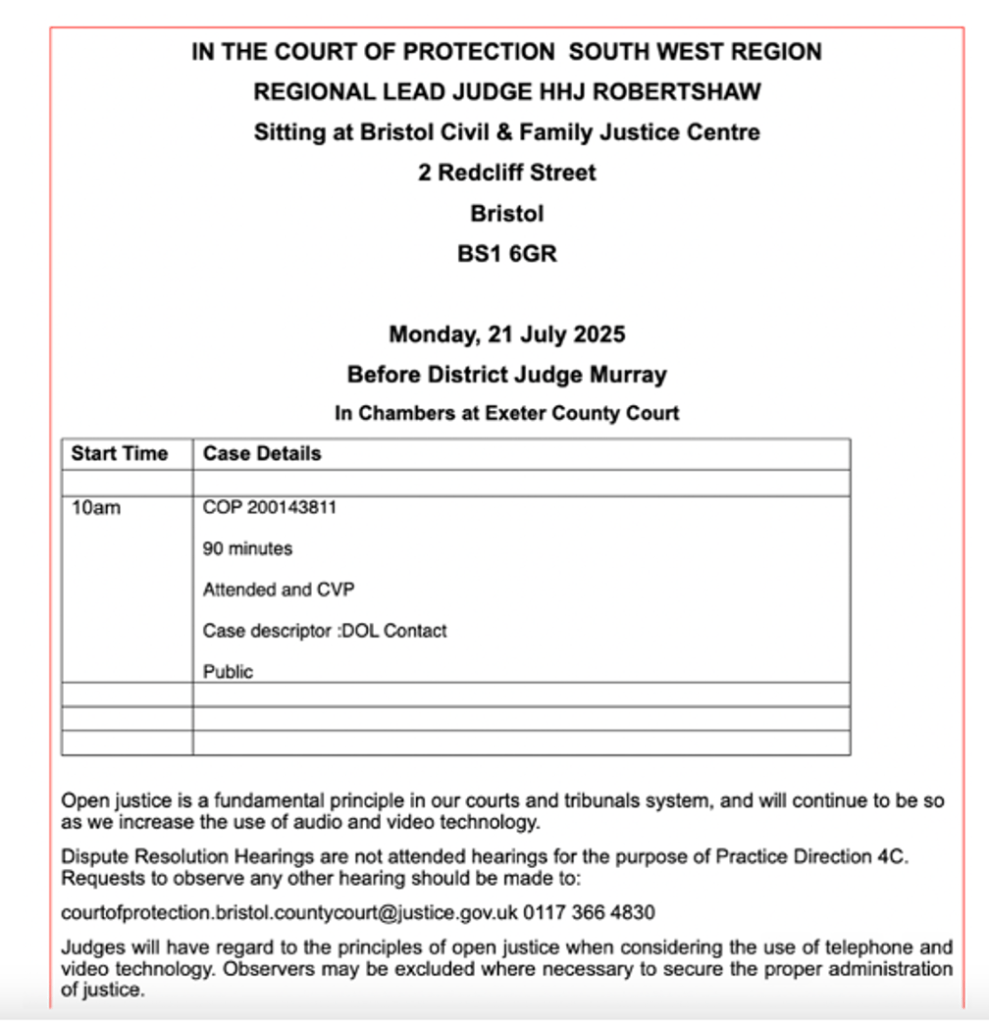
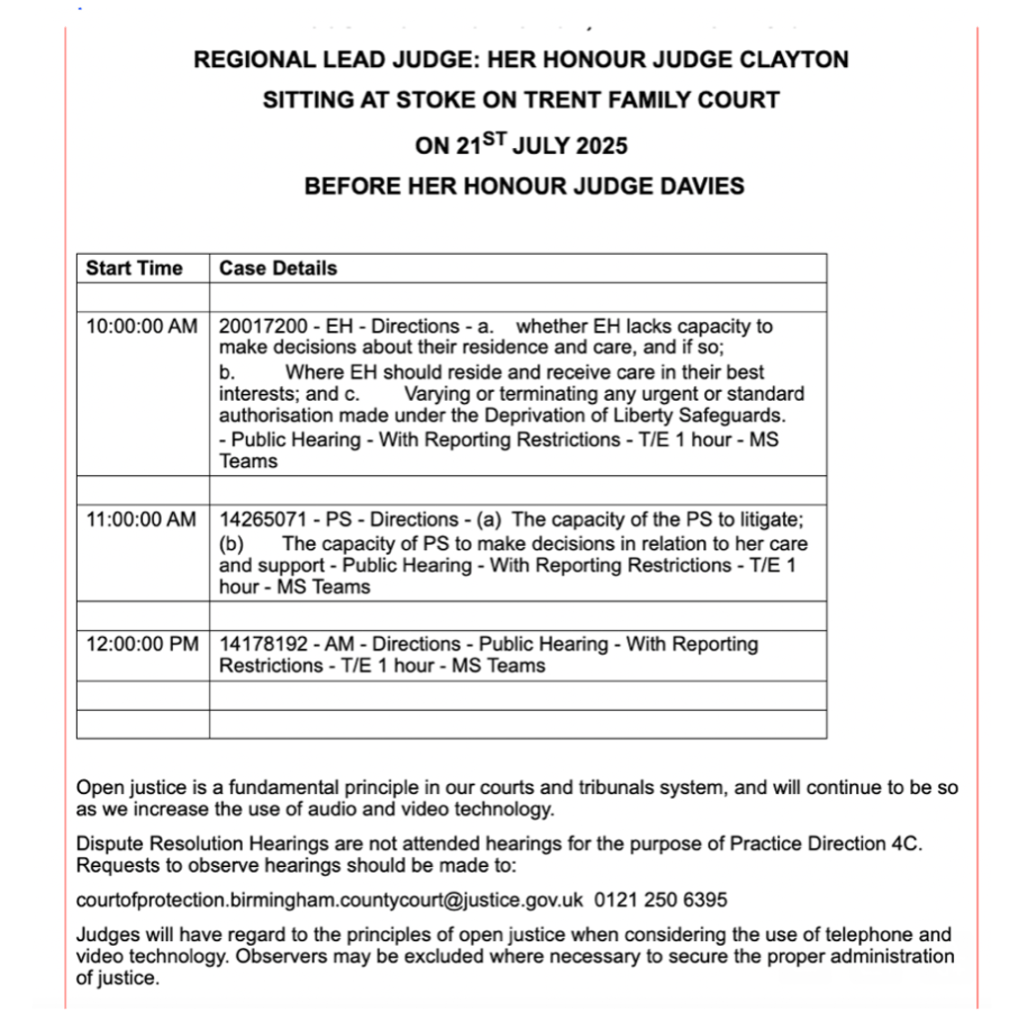
I had some unexpected time on Monday 16th June 2025, so I had a look at the listings the night before, and this one caught my eye because it said ‘FINAL HEARING’, so I knew that the judge’s determination on the matters listed (‘capacity and best interests’) was likely to be delivered.

I asked for link – there was nothing in this list entry (from Courtserve) to tell me whether it was remote, hybrid or attended, so I just assumed there would be one. In fact, had I looked at the page for First Avenue House in London (as I did later), I would have seen that it stated that the hearing was “attended” – which usually means (and did in this case mean) “in person”.

Had I looked at the First Avenue House listings first, I might have felt deterred, but we’ve had many experiences of the court staff, if at all possible, providing a remote link for us, even for in-person hearings. And so it was for this particular hearing: COP 99011621 before Tribunal Judge Reeder.

I received the link to observe at 9.40am on the day of the hearing, along with the Transparency Order, which I had requested. I had also sent a message to the judge, via the court staff, requesting that the parties be permitted to share their Position Statements, which are very helpful to us as public observers because, as well as outlining the parties’ positions for the hearing, they often provide historical context to the case. In hearings where an opening introduction is not provided (contrary to the guidance), Position Statements often mean the difference between understanding and not understanding the case, making open justice more actual reality than mere  aspiration.

The hearing start time came and went.  I was waiting in the MS Teams ‘lobby’ and, getting a little worried that my tech might be at fault, I emailed the court to check whether it was starting late. The member of staff replied very quickly confirming the late start (thank you!) and just before the start time (of 10.51), I received both Position Statements from counsel for the parties (as requested of them by the judge). I really appreciated this – and the process was so much more efficient than (as is often the case)  taking up time either during or after the hearing to address the request to share Position Statements.

Background to proceedings

The protected party (“AF” are the initials used for him in the listing) is a 78-year-old man currently living in a care home in London. He has lived there since November 2022. Up until that point he was living with his long-term partner who I will call X. In the hearing, she was described as his ‘common-law wife’. Prior to November 2022, AF assaulted X and was detained for four months under the Mental Health Act 1983. When he was discharged from hospital he went to live in the care home. He would prefer to be back living with X.

AF has several psychiatric diagnoses, for which he receives psychiatric medication including a depot injection of Haloperidol on a regular basis. There was some confusion in the hearing about whether AF is subject to a Community Treatment Order, and counsel for the Local Authority confirmed later that he is not.

In December 2023, a ‘standard authorisation’ was granted to deprive AF of his liberty in the care home. This included (I believe) not going out alone for his own safety. In May 2024, s21a proceedings were issued to challenge that. So, proceedings in this case have been live for just over a year. Subsequent authorisations for deprivation of AF’s liberty have been issued, pending the outcome of the case.

The remaining issues for the court to determine (as outlined in the LA’s Position Statement) are:

(a) Does AF lack capacity to make decisions about residence?

(b) Does AF lack capacity to make decisions about his care?

(c) Does AF lack capacity to make decisions about accessing the community?

(d) Does AF lack capacity to conduct these proceedings?

(e) Are the qualifying requirements for the standard authorisation met?

(f) What further best interests evidence is required, in the event the court concludes that AF

lacks capacity in the relevant domains?

Earlier in proceedings it had been determined that AF retains capacity to make decisions about sexual relations.

The Hearing

I found the hearing an instructive experience in how a judge works out, bit by bit, whether a protected party in the Court of Protection retains mental capacity for specific decisions, and how important that process can be.

This was a very routine s21a challenge for a P deprived of his liberty (in several ways, including where he lived, his freedom to go out alone and what care he received). There are very many such cases, most of which do not make it to the court. But what unfolded in the hearing made me think that everyone who is subject to a deprivation of their liberty needs a robust, independent eye (with authority to make change) on how those decisions are made in people’s ‘best interests’.

The protected party, AF, was at the hearing, represented by Kyle Squire (via his Accredited Legal Representative (ALR)). They were both sitting out of view on the remote link. I could see the judge, and Louise Thomson, who was representing the Local Authority (Royal Borough of Kensington & Chelsea).

When the hearing started, the judge spoke to me. I put on my camera and microphone. TJ Reeder confirmed with me that I had received and understood the Transparency Order. He also checked that I had received the Position Statements and reminded me that they are ‘unredacted’  (i.e. they hadn’t been anonymised) and that I should ensure that I look after them carefully (or words to that effect). I confirmed that I understood their confidential nature.

The judge then asked me if I was part of the Open Justice Court of Protection Project and when I said I was, he said ‘so you’ll be familiar with all of this’. At that, he asked me to turn off my camera and microphone.

Kyle Squire (KS), counsel for AF via his ALR, opened proceedings at the invitation of the judge:

KS: [I have the] observer in mind – shall I outline the issues?
Judge: Timewise – I am afraid we need to crack on. She has the Position Statements.

So, I had to quickly try to work out what was happening.   I had only received the PSs about 5 minutes prior to the start of the hearing, but they were short, so I was able to bring myself up to speed.

There had been a jointly appointed expert witness (a Professor Afghan – I’ve not been able to find a website to link to so as to identify him) whose evidence had been questioned at a previous hearing [I think in May 2025] and he had been tasked by the court to complete a further assessment addressing specific questions (more on this later). He had completed this subsequent assessment via a remote meeting with AF [on 2nd June 2025].

Counsel for AF submitted that “the ALR on behalf of AF does not accept the conclusions of Professor Afghan […] Whilst we are grateful the expert has met with AF,  it’s not a robust assessment. It does not meet with the statutory criteria”. Counsel went on to submit that Professor Afghan had not “set out what he relies on, it’s clear from the assessment narrative that the information considered is not the right information which was set out in the letter of instruction to him”.

So counsel for AF was clearly saying that the expert witness had not provided the ‘relevant information’ to AF on which to base his conclusions in the mental capacity assessment.

One example was the capacity assessment regarding residence decisions. Counsel for AF said that this had been done incorrectly. The expert (in his report) had said that AF had identified two options – to go back to live with X, or to stay where he is (or in the ‘general area’ in a care home). The expert is reported to go on in his report to “criticise AF for identifying [living with X] as an option. The point my instructing solicitor makes is that it’s not clear that AF knew that living with [X] was not an option”.

Counsel quoted from the expert’s report that AF demonstrated an ‘inconsistent expectation that he will be able to reside with [X]’, but that it was only on that day that it was known that X had informed parties that living back with her was not an option, and that it wasn’t clear whether the expert had shared that information with AF when he did the capacity assessment. Counsel submitted that the expert report did show that AF could understand, retain weigh and communicate the ‘relevant information’ provided by the LA about where he could live and what care he would need to receive, because he was able to say what ‘general area’ he would live in and talk about what care home would be able to provide the type of care he would need.

The judge said, “yes, he also consistently acknowledges that” [in relation to his care needs], going on to say that “it may be [Professor Afghan’s] conclusions are that he lacks capacity, but I need to see his workings out”.

I have heard judges say this before in relation to expert witness evidence, and Mr Justice Poole published guidance in a judgment in 2020, aimed at assisting experts to understand how best to assist the court when making and reporting capacity assessments. In this judgment Poole J states at §28:

‘”e. An expert report should not only state the expert’s opinions, but also explain the basis of each opinion. The court is unlikely to give weight to an opinion unless it knows on what evidence it was based, and what reasoning led to it being formed. 

f. If an expert changes their opinion on capacity following re-assessment or otherwise, they ought to provide a full explanation of why their conclusion has changed.’ (§28 [2020] EWCOP 58]

Counsel for AF continued that Professor Afghan had failed to set out how AF’s reported lack of capacity is as a result of his diagnoses or ‘impairment of the mind or brain’ (the ‘causative nexus’), that the expert (in his report) “simply states ‘I have provided my rationale’, but it doesn’t come close to displacing the presumption of capacity”.

After counsel for AF made further submissions about the limitations of the capacity assessment, the judge then said:

“How does … in the ALR’s view … what’s the position of squaring this report with the EARLIER report of 24th February. It is striking that they are entirely opposite?”

It transpired that Professor Afghan, in February 2025 had assessed AF as having capacity for all relevant decisions, and then assessing AF as lacking capacity for all relevant decisions, save for contact with others.  

The Position Statement for AF shows the stark change in the short space of time:

Capacity

6. The court now has two reports from Prof Afghan, the single joint expert psychiatrist in these proceedings. The court will be aware that in the first, dated 24 February 2025 the expert concluded that AF:

(a) Has capacity to make decisions about his residence;

(b) Has capacity to make decisions about his care;

(c) Has capacity to decide to have unescorted community access;

(d) Has capacity to made decisions about his contact with others, including [X];

(e) Has capacity to engage in sexual relations;

(f) Has capacity to conduct proceedings.

7. In his addendum report, dated 3 June 2025, the expert concluded that [AF]:

(a) Lacks capacity to make decisions about his residence;

(b) Lacks capacity to make decisions about his care;

(c) Lacks capacity to decide to have unescorted community access;

(d) Has capacity to made decisions about his contact with others, including [X];

(e) Capacity to engage in sexual relations was not reassessed;

(f) Lacks capacity to conduct proceedings.’

Counsel for AF said that the ALR regarded this as a “complete volte face […] without explaining why”.

Of course, under the MCA 2005, capacity is time and decision specific, so it could be the case that AF’s capacity had changed between those two time periods. However, counsel for AF strongly advanced the position that the expert’s evidence did not “soundly apply the statutory principles and tests, and [that] the conclusions are not robustly reasoned”.

I wondered what the Local Authority position was going to be in relation to the ‘volte face’ in the expert’s evidence.

The following exchange between TJ Reeder and counsel for the LA (LT) was interesting:

LT: As you have seen [the] Local Authority’s view is that AF lacks capacity to make the decisions and accepts there are some areas where he DOES have capacity, but in relation to these decisions, residence and care, our submission is that he lacks …

J: How do you square that [with the expert’s change of evidence]?  […] Professor Afghan has had two opportunities to report to court and one opportunity to explain and assist in relation to some misgivings about understanding his methodology in first report. […] So really what I could do with help on is how I square that Professor Afghan provides two reports in a short timetable and comes to different conclusions in relation to key matters (residence and care). In the first report … one of the things that was striking was that AF got full marks on the mini-ACE [a 30-point cognitive screening test that is a short form of the Addenbrooke’s Cognitive Examination, covering the domains if attention, memory, verbal fluency and clock drawing] and in the second [report, there was] no evidence that [he had deteriorated]. […] I need the workings, especially when he reaches entirely different conclusions. I am struggling, with your submissions as to why Professor Afghan’s second report is evidential … notwithstanding that he gives the opposite conclusions to his first report.

LT: He did the addendum [second report] AFTER hearing what was required of him.

J: Help me with residence and care. It is quite striking that we go from ‘has capacity’ to ‘lacks capacity’.

LT: Yes it is

J: I’d expect that to be explained, the change of opinion.

Counsel for the LA said that a second assessor, a (Social Worker) DoLS (Deprivation of Liberty Safeguard) assessor, also deemed AF to lack the capacity to decide on where he lives, at around the same time and that AF had given different responses in relation to returning home to live with X.

It was interesting to me observing the judge tease out the reasoning for submissions – to help him to weigh the evidence to make a decision. He was finding it hard to follow a logical path to a determination of incapacity for the decisions at hand. The judge said – multiple times – “I am struggling to understand”.

The judge decided to examine the DoLS form that counsel for the LA had just referenced:

J: Let’s look at the DOLs form, at the moment I am not impressed with Professor Afghan’s report and no one has yet been able to explain to me how one goes from capacity to no capacity in such a short space of time.

LT: It [the DoLS form] does state what the relevant information is […] and at the bottom of that box, when [he was] asked to ‘repeat to me what we have discussed’, he mentions when he can go out on his own, where he is living and not much else.

J: Yep, what significance is that?

LT: It’s expressing recall of the conversation they had had and information relevant to the decision.

J: [quoting from the DoLS form] ‘I asked him to repeat what we’d discussed ….. going out, where [he is] living, care…’  What else would they have discussed?

That’s [the judge is explaining that it is too high a bar to expect more recall]. I’m not sure, that’s how a functional thought process works, isn’t it? He’s repeated the headlines – has he missed any? He doesn’t appear to have done?

LT: No. He’s repeated the headlines and doesn’t appear to have missed any.I take your point.

J: So, his lack of capacity is [reported to be] based on being unable to understand the relevant information, and [being] unable to retain it. What’s he unable to understand?

LT: What he’s saying in the paragraph I just took you to, but you didn’t agree.

J: Which is what?

LT: I understand. I just refer to the information at the top, saying he’s not able to understand the relevant information.

J: It’s the workings. What IS IT he’s not understanding? I am struggling.

Counsel for the LA didn’t respond to that question.

J: Again, it’s wrapped up in these statements which could suggest a degree of insight. He’s asked if he can come and go: he says ‘Yes, but traffic is an issue’. Again, context is important, [he’s showing] awareness. […] There are two occasions where he wants to prove himself but acknowledges it’s busy and that he needs help. The retention point is just due to limited cognitive ability. Where can I find the workings for that?  […] Look somebody needs to help me. You say that this is evidence that AF lacks capacity for residence and care. Can you help me with the workings?

LT: I can’t.

So, the Local Authority’s position was that the court should accept the expert witness’s evidence that AF lacked capacity for the decisions in question. And the judge could not discern the evidence to back up this position.

The judge asked counsel for AF the ALR view about the DoLS form:

KS: I would simply say that the reasoning is simply not sufficient to conclude that the  presumption is rebutted. The rationale is not there. Some of the points […] don’t make sense. It’s surprising the assessor is able to conclude that AF is unable to retain ‘due to limited intellectual ability’ … AF is not someone who lacks intellectual ability in my submission.

Whether or not AF ‘lacks intellectual ability’, Section 2 (3) of the Mental Capacity Act 2005 makes clear that:  

‘A lack of capacity cannot be established merely by reference to—

  1. (a)  a person’s age or appearance, or
  2. (b)  a condition of his, or an aspect of his behaviour, which might lead others to make unjustified assumptions about his capacity.’

At the start of the hearing counsel for AF had suggested instructing a further expert. The judge later returned to this proposal:

J: Does the ALR have any [further] submissions on that?

KS: Erm …. Yes it’s difficult

J: What do you say I should determine or direct today?

KS: First of all, I’d invite you determine that the evidence of Professor Afghan is not sufficient to displace the presumption of capacity, for all the reasons we have discussed.

J: So why should I pause for further evidence? Isn’t your submission that we should discharge the authorisation?

KS: Yes erm…

J: Doesn’t it follow?

KS: Yes it does, yes I think that has to be right. The opportunities have been given to [Professor Afghan]. In my submission then, the qualifying requirement isn’t met and the opportunity to terminate should be given.

J: I need to be clear that this is the ALR’s position. If you need to make a phone call then do.

KS: Yes I think I need to.

The position of the ALR was not clear and counsel needed a break to take instruction. And the position of the LA was:

LT: If you are of the view that you not able to determine he lacks capacity TODAY,
we would say we need further evidence [from a new expert witness].  

At this point Professor Afghan joined the link. The judge informed him that the court was having a short break and to return in ten minutes. When the court reconvened, the judge checked with both counsel and agreed that the expert’s attendance was not required.

The position of the ALR was now clear: “The ALR says that the standard authorisation should be discharged today. There has been ample opportunity for the LA to discharge that burden [of proof to displace the presumption of capacity] and they have not done so at this point, and they are unlikely to do so speedily”.

And the position of the LA, also shifting from the start when it said to accept the expert’s evidence, was that the LA’s view now was that  “Professor Afghan’s assessment and the DoLS assessment […]  that there’s no workings out. We would seek further assessment. We wouldn’t seek discharge”.

The judge made a swift ex tempore judgment:

Am going to make a short judgment which I will speak. […]. The gist of this is that my determination [is that] there is insufficient evidential […] [a] compelling body of evidence to discharge the statutory presumption [of capacity]… that means I am not satisfied that you lack capacity.

At this point I heard AF say, “Does that mean I am off the hook?”

The judge said he would explain in more detail:

Between February and June 2025, [dates of] those two reports, nobody has suggested that there has been a material change in AF’s presentation [or] his functional abilities.

One therefore looks quite carefully for the reasoning for the reversal of an expert’s opinion from capacity to lack of capacity. What is apparent between the exchanges between counsel is that it is impossible to find adequate reasoning for the change in opinion.”

“I am asked to consider by the LA the parties putting their heads together to find yet another expert to assess AF. It seems to me [that would be] inappropriate case management and an interference with AF’s rights.”

“It seems to me the only proper course of action available is to exercise the power under s21a. The court orders – directs – the supervisory body [the LA] to terminate the standard authorisation in force”

 At the very end of the hearing P spoke again:

J: That’s my decision. [AF] I wish you well

P: [What’s the] long and short?

J: My decision is that there is not enough evidence for me to say the court makes decisions for you. You can make decisions yourself. Please work with people at the [care home] and your social work team.

P: I can go out on my own?

J: The court’s not making any restrictions on that. Be sensible about it. You’ve not been out on your own for a long time .. yeah… ‘getting back on your feet’ as you called it. As I said, you have the benefit of a skilled social work team and the people at the [care home] struck me as lovely. You don’t have to listen to me any more!

Reflections

AF was quiet throughout this hearing. He made a few interjections, but I was struck by how much he didn’t intervene, given what transpired in the proceedings. I felt quite astounded on his behalf that there seemed to be no reasoning provided by the expert for the stark change in the assessment of AF’s capacity to make these important decisions in his life. How could this happen?

Then I thought: what if AF does in fact lack the capacity to make these decisions for himself and his best interests have not been served? The court seems to have been badly served in this case. Reflecting on some of the hearings I have observed over the past five years in the Court of Protection, and the detail and care with which capacity assessments are often conducted, I know that robust judicial determinations can be made, based on good evidence. All decisions in the Court of Protection – I think – are difficult. All judgments involve people (the assessors, health professionals, judges)  – who do not know, or know well, the person at the centre of the case – making important recommendations and decisions about their life.

This case concerned me because, despite the capacity assessments not providing adequate rationale for the conclusions (of lack of capacity in many areas), the Local Authority’s submissions were to accept those assessments as adequate evidence. I found myself wondering how they had reached the conclusion themselves to make those submissions, given that the judge clearly ‘struggled’ throughout the hearing to make logical sense of the two assessments. How often are capacity assessment reports accepted without question, when people’s lives do not come to court? I was relieved to observe the judge scrutinise the capacity assessment process to the degree that he did, but alarmed that the expert report was so poor.

For now, AF is ‘off the hook’ – but possibly at risk if in fact a better report, properly conducted, would have established that he does in fact lack the requisite decision-making capacity.

Claire Martin is a Consultant Clinical Psychologist, Cumbria, Northumberland, Tyne and Wear NHS Foundation Trust, Older People’s Clinical Psychology Department, Gateshead. She is a member of the core team of the Open Justice Court of Protection Project and has published dozens of blog posts for the Project about hearings she’s observed (e.g. here and here). She is on X as @DocCMartin, on LinkedIn and on BlueSky as @doccmartin.bsky.social


Open Justice Court of Protection Project is five years old today

By the Core Team of the Open Justice COP Project (Celia Kitzinger, Gill Loomes-Quinn, Daniel Clark, Amanda Hill and Claire Martin), 15th June 2025

It was launched – with no funding and no clear plan about what we were going to do beyond observing a few hearings and writing some blog posts – on 15th June 2020, by Celia Kitzinger (retired academic psychologist) and Gill Loomes-Quinn (disability scholar-activist).

It was the beginning of the pandemic.  Court of Protection hearings had almost all moved from physical courtrooms where – at least in theory – the public could observe them, to  ‘remote’ hearings via telephone and video-platforms, where they’d become pretty much inaccessible and were mostly marked “PRIVATE” in the lists.  

By chance, Celia had been involved in the first all-remote hearing of the pandemic: a contested hearing about life-support treatment.  She was supporting the patient’s daughter through what turned out to be a terrible experience in the new virtual court, as Celia describes here: Two years on: A postscript to remote justice.  That’s what initially spurred us to create the Open Justice COP Project to monitor what was happening in these new “remote” hearings. 

We had no idea, back then, just how difficult this would turn out to be, or how enthusiastically others would join us, or how big and influential this Project would become, or that five years later the eminent barrister Alex Ruck Keene KC (Hon) would describe it as “an amazing achievement – one of the few silver linings of the pandemic”.

Who we are and what we do

Born of our passionate belief that “publicity is the very soul of justice” and our strong desire to support the judicial aspiration for transparency, the Project has developed as a core team of five volunteers who do the day-to-day management of the Project and make its practice and policy decisions: Celia Kitzinger, Gill Loomes-Quinn, Daniel Clark, Amanda Hill, and Claire Martin.

Anyone who’s been watching closely will have realised that a core team member called “Anna” disappeared from the group (with no fond farewells) earlier this year, and was replaced with Amanda Hill.  They are one and the same: “Anna” was a pseudonym.  After a great deal of hard work, and many delays, Amanda finally succeeded in March 2025 – with the pro bono help of a legal team from Irwin Mitchell (thank you!) – in getting the Transparency Order for her Mum’s case varied, so that she can identify herself as the daughter of a protected party in the Court of Protection.  Last time we published a photo of the core team, we had to obscure Amanda’s face so that she couldn’t be publicly identified.  We’re thrilled that Amanda can now reveal herself and we can say “Welcome Amanda” (two years later).  (You can read more about Amanda’s experience as a litigant in person in the Court of Protection here: “Our ordinary story ….and how it became an unbelievable family experience of the Court of Protection“.)

We’ve also supported other family members (sometimes with pro bono legal help) to seek discharge or variation of the Transparency Orders affecting them so that they too can publish information about court proceedings in their own names (e.g. see “A mother now free to tell her Court of Protection story” and  “Bureaucracy blots out the sun”: Telling Ella Lung’s story”). 

We’re grateful to Tor Butler Cole KC for her help in particular in the protracted struggle to discharge the Transparency Order preventing Jill Stansfield, daughter of the protected party in the first-ever all-remote Court of Protection hearing of the pandemic, from speaking out in her own name.   Then pseudonymised as “Sarah”, it was her story, and the brutal nature of her COP hearing, that motivated Celia and Gill to launch the Project back in 2020.  Today, Jill Stansfield draws on her experience to promote Advance Decisions to Refuse Treatment: following her father’s sudden collapse, he was given medical treatment (for years) that she is sure he would have refused if he could (“Why is it important to start advance care planning conversations early and before crisis”). 

It is striking to us how people seek to use the distressing and sometimes unfair experiences they’ve suffered in health and social care (and/or in the justice system) to try to make the world a better place by sharing information with others and offering support. Discharging or varying reporting restrictions so that people can speak out about their experience is often essential for that to be effective. We’d like to be able to help more families who want to speak publicly about their Court of Protection experience in their own names, and we’ve developed some expertise in challenging Transparency Orders over the years. Please get in touch with us if you’d like support with this. 

 “OJCOP have been amazing to me personally. As a parent and  ‘litigant in person’, they have helped me to get my Transparency Order varied so I can speak about my experience of going through the court, and most importantly be able to share the experience with other bewildered parents with disabled children who are going through the same often overwhelming process. Happy birthday OJCOP! May you have many more birthdays and continue helping others like me to understand the mysteries of the Court of Protection!”  (Heather Walton, parent and litigant in person in the Court of Protection)

In addition to the core group of five, there’s a shifting group of around 100 people in a WhatsApp Observers’ Group. We are in contact most days, exchanging information about hearings we’re hoping to observe, and the challenges we’re confronting. 

We also have an Advisory group of three lawyers (see “Meet the Team”) and we’re enormously grateful to them for the work they do – often at short notice – to provide us with information and support especially in relation to getting the law right when  writing and editing blog posts.

We run “webinars” (hosted by Claire and Amanda) to offer support on how to observe hearings, and we offer to “buddy up” with people who would like someone to attend their first hearings with them (usually virtually).  Thousands of  people – health and social care professionals, disabled people and their families, and those with experience of the Court of Protection as protected parties, litigants in person and expert witnesses – have developed the confidence from our website and/or our webinars to watch Court hearings.

Although we still have no regular funding, we were lucky enough in the last year to receive money from two different university sources (the White Rose University Consortium and Cardiff University) to support PhD students Daniel Clark and Amanda Hill (separately) to carry out paid research on transparency issues in the COP. As a result, we now have a health and safety policy and employees’ insurance – even though we don’t employ anyone! If you’re interested in doing something similar on placement with us, do get in touch![1] 

Blogging about hearings remains a key part of what we do to publicise the work of the Court of Protection.  We’ve published 580 blog posts over the last five years (91 in the last year), including (on request, for a judicial training event)  “Fifteen Top Transparency Tips for Judges”.  We’ve seen some indications that our “tips” have been effective in changing judicial behaviour, which is encouraging.

With the appointment of Nicklin J as Chair of the Ministry of Justice’s new Transparency and Open Justice Board, it may be that the landscape for court observers is changing.  We have contributed to the Board’s consultation exercise with “stakeholders” (Response to the Transparency and Open Justice Board proposed “key objectives”) and we know that the Board is aware of the problems we frequently face: unhelpful court lists (though they have significantly improved lately); difficulties with access (no response to emails; links that don’t work); and problems with hearing and seeing the court (both in person and remotely).  Perhaps the Board’s proposed new “Open Justice Champions” within HMCTS will come up with solutions?  We’ll report back on that next year.  

We know that there are ongoing challenges – possibly specific to us in the Court of Protection – as regards both committal hearings for contempt of court (Contempt of court proceedings: Are they transparent?) and with the listing and holding of closed hearings (those from which a judge directs that one party and their legal representatives should be excluded).  We expect to work on these issues over the coming year.

Open justice can sometimes feel like an uphill struggle – not (by and large) because anyone is actively opposed to it, but because the overriding objective of the court is to do justice – and letting us see it being done sometimes falls by the wayside. The judges’ lists are full, the lawyers are busy with last minute conferences with their clients and navigating unwieldy bundles, HMCTS is understaffed and under-resourced.  Even if everyone felt as strongly as we do about transparency, it would still be hard to accomplish given the constraints on the ground.  So we have tried – and we think on the whole HMCTS staff, the lawyers and the judiciary have tried – to treat open justice as a collaborative endeavour: we are all pulling together in the same direction, and sometimes we fail nonetheless. Figuring out where things are going wrong and how best to put them right is more productive than blame and suspicion.

So a big thank you to all the ushers, clerks, office staff and administrators in HMCTS who have dealt with our recurrent complaints about listings and access over the last year;  to the solicitors and barristers who’ve negotiated our requests for position statements and opening summaries;  and to the judges who’ve engaged with the needs of observers in court, including (importantly) not just handing down orders about reporting restrictions but making time for us to make oral applications to vary them there and then thereby averting lengthy COP 9 applications and the need for further hearings before open justice can be accomplished.  We increasingly realise from talking with court observers in other jurisdictions (as members of the Courts and Tribunals Observers’ Network) that the Court of Protection may well be more committed to transparency and open justice than other courts.

Feedback

Finally, we’re delighted with the positive feedback we’ve received about the Project, from judges and lawyers, from health and social care professionals and from members of the public. Of course, we do also value critical feedback, corrections to our blog posts and challenges to our approach – and we do receive those frequently – but just for one day, on our birthday, we’d like to focus on praise and congratulations for what we’ve achieved.

The Project featured in a previous High Court judgment  by Mr Justice Poole as “an important project that makes a significant contribution to transparency and public understanding of the workings of the Court of Protection” (§68 Re A (Covert medication; closed proceedings) [2022] EWCOP 44. This year, a judgment by Mrs Justice Arbuthnot (involving an application by Celia to vary a Transparency Order) referred to the Project as having “an important role in supporting public understanding of the Court of Protection which was, and arguably still is, a little-known court” (§17, Norfolk County Council v CA & Ors [2025] EWCOP 16 (T3).

Solicitor Heledd Wynn values the Project for the way it helps her  “to understand the things that we as lawyers take for granted as we are trained to do so – language, protocol, procedures”, thereby alerting her to the need to “translate” for non-lawyers. 

Law students tell us that it’s shown them that  “the publishing of judgments is not sufficient for  open justice. The opportunity to observe hearings has provided greater insight into the COP than I could ever have achieved through reading books and judgments” (Rebecca Pritchard, final year LLB law student, University of South Wales). “The OJCOP has enabled me to engage with an area of law that was previously unfamiliar to me- an area I had only seen listed among the services offered by barristers’ chambers, without fully understanding what it involved”, says Brittany Murphy, LLM student at Cardiff University, adding: “Were it not for the project, I would not have known how to observe Court of Protection (COP) cases, nor felt empowered to do so. Thanks to the guidance it provides, I have not only been able to observe such cases but have also developed a strong academic interest in the field, and will be writing my LLM dissertation on COP proceedings”.

Another law student, Sarah Shee, says the Project has taught her “so much about the workings of the court and its functions and the different organisations and people represented.”

“It’s shown me how relevant statute and case law work when applied to practice in different situations: e g capacity for sexual relationships, moving placement and housing, advance directives, whether or not to feed an unconscious anorexic patient, whether to put a long-term ventilated patient with irreversible brain damage on a palliative pathway, parental contact with P…. All so varied and interesting.  The judgments really show the analytical way in which law is used and synthesised to make a decision. I’ve been impressed by how empathic a lot of the judges are and how they can understand and analyse complicated medical issues despite having had no medical training. It just brings law alive and also gets you really thinking about ethical issues. As a student of mental health law, it has been a brilliant insight into the COP and the sort of cases they have. It’s brought my academic studies alive seeing the different cases and judgements. I have honestly learnt so much. It’s like doing a module in COP (but without exams/essays thankfully) I can’t wait to have time to get more involved.” (Sarah Shee, studying for LLM in Mental Health Law)

The Project is also valued by health and social care professionals:

The OJCOP Project has deepened my understanding of the legal issues surrounding CoP proceedings, the ethical complexities they present, and the raw human emotion often absent in published judgments. I have also had the privilege of connecting with inspiring colleagues and mentors who have influenced my progression as an Expert Witness in the CoP and my journey into socio-legal research. (Eleanor Tallon, Independent Social Worker)

 “I feel incredibly grateful… I’ve grown, learned, and been inspired by the passion and knowledge shared by everyone. It’s a privilege to be part of something so meaningful, and I’m excited for all that lies ahead.” (Laura Natale, social worker)

As a psychiatrist with a special interest in complex anorexia, the OJCOP Project is a rare gem.  Hearings have deepened my understanding of the workings of the CoP and significantly improved my practice – especially through observing cross-questioning of clinical teams and independent experts.  Observing hearings in the Court of Protection is a must for every medic working with anyone who lacks (or may lack) capacity. The Project is a fantastic support and resource. (Adaeze Bradshaw, Consultant Psychiatrist)

The Open Justice Court of Protection Project provides valuable insight into these proceedings. As a Mental Capacity Act Lead in the NHS I find reading about the experiences of those with an interest in the person’s welfare, and others with a link to ‘P’, particularly insightful and valuable food for thought in my day to day practice. (Edd Bartlett, Mental Capacity Lead Professional, Berkshire Healthcare NHS Foundation Trust)

In case management I think what you’re doing is making the COP processes much more accessible and providing learning opportunities to those in the field. In particular I think it helps those on the ground working with challenging aspects of capacity and best interest decision-making to understand what needs to go to court, whilst also being more confident about what does not, how to make good decisions and how important their documentation is around all of these aspects. It is something I’d encourage all those in complex case management to follow and to get involved in. (Vicki Gilman, Executive Director at Social Return Case Management Ltd and past chair of BABICM)

There’s no substitute for watching the decision-making process of the judges and the care and attention they take to get the judgment right for the person at the very heart of the hearing…. The OJCOP team provide their expertise to navigate you through the practicalities of attending the hearings and how to maintain safe behaviour (accidentally being in contempt of court was one of my worries!). (Emma Heron, Lead NHS Research Nurse)

It’s not just professionals of course.  There are members of the public who observe hearings and read our blogs because they hold Lasting Powers of Attorney, court appointed Deputyships, or act as Relevant Person’s Representative – or simply because someone they care for (or they themselves) may lack – capacity in some domains and/or because they’ve become caught up in COP proceedings already. Unpaid carer, Maggie Bruce-Konuah, has described how “observing COP hearings has brought the MCA to life for me — seeing the principles enacted in real time has been truly eye-opening and I’m grateful to all who’ve made this access possible”.  All of us, MCA professionals as much as the rest of us, could potentially be involved in Court of Protection proceedings and that’s an important reason why transparency really matters in this of all jurisdictions.  Former litigant in person, Kim Dodd, makes this point powerfully in her appreciation of the Project’s role

“I’m in awe of the OJCOP Project team’s energy, approachability, knowledge and dedication, and am grateful for the hours you’ve sacrificed, individually and collectively, over the last five years to help the judiciary and legal professionals creep steadily towards their stated aspirations of open justice. The concept of open justice in the CoP is especially critical because as citizens (unlike with the criminal and civil courts) we cannot conduct our lives in a way which puts us out of the court’s reach by not committing criminal or tortious acts. Becoming a P, or a family member of a P is something that can happen to anyone.  Happy Birthday OJCOP! Amazing individuals. Amazing progress. Thank you.” (Kim Dodd – member of the public and previous Litigant in Person in CoP proceedings)

Finally, a special thank you to everyone who’s blogged for the Project over the course of the last 12 months (in alphabetical order): Georgina Baidoun, Daniel Clark, Kim Dodd, Laura Eccleston, Ty Glover, Keir Harding, Amanda Hill, Ruth Hughes KC, Hita Jadeja, Celia Kitzinger, Jenny Kitzinger, Gill Loomes-Quinn, Richard Lung,  Claire Martin, Ruth Meyer, Sophie Monaghan, Elissa Novak, Rebecca Pritchard, Lucy Series, Tim Sugden, Eleanor Tallon, Heather Walton, Sydney White, Meg Niven Withers, Jess Wright

We’d also like to thank each other for being such a great team!  Happy Birthday to us!


[1] Blog posts reporting on Daniel’s research: “A review of transparency and open justice in the Court of Protection”; “Access to the Court of Protection in London: Do court buildings support transparency and open justice?”.

Preparing for possible future lack of capacity: My advance decision to refuse treatment and the case before Poole J

By Claire Martin, 13th June 2025

Le soleil ni la mort ne se peuvent regarder en face.

You cannot stare straight into the face of the sun, or death.

François de La Rochefoucauld, Maxim 26

Over the course of the last year or so, I’ve been thinking about what provisions I want to put in place in the event that I might lack capacity to make my own decisions about my health and social care in future. I’ve watched so many hearings concerning people who haven’t considered, in advance, at a time when they did have capacity to make those decisions, what they would want in the future – and that’s caused untold heartbreak for their families, and challenges for the court, in trying to establish what their former wishes would have been, and how to make a best interests decision that properly takes into account those former wishes, feelings, values and beliefs[1].

And so, I’m trying to make an Advance Decision to Refuse Treatment [ADRT]  (currently in draft form) and I have also drafted an Advance Statement. I already have in place Lasting Powers of Attorney (both for Health & Welfare and for Property & Finance). In this blog post I  reflect specifically on my concerns about my ADRT in the context of a case before Mr Justice Poole (COP 20006397). I observed a two-day in-person hearing (remotely) all day on 22nd May and part of the day on 23rd of May 2025.  I have not observed previous hearings in the case, but have read blog posts about them which provided essential background [2].

The first judgment in this case has now been published (AB (ADRT: Validity and Applicability), Re [2025] EWCOP 20 (T3) (10 June 2025) and it addresses the validity and applicability of the ADRT for the man, AB, at the centre of the case.

The story is terribly sad. AB is a 43-year-old man who is being given medical treatment to keep him alive in a minimally conscious state.  There’s a document that AB made not long before his brain injury, that he called a “Living Will”  (not a legal term, but one which is commonly used), which includes refusals of life-sustaining treatments, including clinically assisted nutrition and hydration (i.e. the feeding tube, which is the main treatment currently keeping him alive).  There’s been a dispute about whether these treatment refusals constitute a legally binding valid and applicable Advance Decision to Refuse Treatment (ss. 24-26 MCA 2005): that’s been resolved: the court has now ruled that they do.  But the family also says that the document is fraudulent (that it’s not his signature on it) or if it is his signature, then it was made under duress or undue influence.  Meanwhile, the Trust continues to give him medical treatment which is quite possibly contrary to his legally binding instructions, and may also be contrary to his best interests – although these seem not  to have been properly addressed.  There is a bitter dispute between AB’s birth family and fiancée that is likely to be aired in court at the next hearing on 30th June-3rd July 2025.

For me, this case is of great interest because it involves determination of the legal status of an Advance Decision to Refuse Treatment (ADRT) so I clearly have a personal stake in the outcome of this case.

My Advance Decision to refuse treatment

I am completing my ADRT with the very clear and helpful ‘Living Will’ service on the Compassion in Dying website. I have procrastinated and prevaricated, not because I don’t want to complete it, but because I want to ensure that I have properly considered what treatments I am refusing, under what circumstances, and that whatever I sign is valid, and will apply when I want it to.

At the same time, I have noticed that I have found it a harder document to complete than I anticipated. I muse on the potential reasons for this later (see “Reflections” at the end of this blog), but on a practical level I have needed to think in a lot of detail about which specific treatments I would wish to refuse under which specific circumstances. And from a current position (for me) of not knowing what those circumstances would be, because I do not have a life-limiting or chronic condition that has a predictable trajectory with putative treatments that I can consider in advance,  with foresight, and decide whether or not I would wish to consent to them.

However, ADRTs aren’t set in stone, they can (and should) be revisited and revised (if appropriate) regularly, at least yearly. That’s the advice I have heard many times, given the nature of the document and the nervousness that they can engender in health settings.  So, I am now thinking that it is enough to know the broad canvas of what treatments I would and wouldn’t want if, at some future time, I wasn’t able to make a capacitous decision myself (e.g. life-sustaining treatments in a long-term coma are definitely on my “refusal” list), and I can add nuance and detail in years to come.

Furthermore, what I do know about myself and what matters to me, tells me that I should complete an ADRT now, because I know for certain that I would not want to endure some ‘benefits’ of modern medicine, simply to keep my body alive in specific circumstances, like those for AB, the man at the centre of this case. His ADRT, which has now found to be valid and applicable (though his family is asserting it is a forgery or made under coercion), stipulated the kinds of things that I too would want to refuse for myself.

My interest in this hearing and its outcome is therefore heavily influenced by the direct impact it will have on how I make plans for my own future, in the form of my ADRT and Advance Statement.

Mr Justice Poole is an excellent judge in my opinion. I have observed him to be pragmatic, clear and humane in many other hearings. The fact that he is the judge for this case made me eager to observe and understand the issues before the court and how they are resolved. How could AB’s ADRT have reached such a point of dispute, and (for him) after such a long time following his initial brain injury? How would the court navigate the questions of validity and applicability for an ADRT? What does this mean for those of us who want to write our own ADRTs and have them respected in future?

Sadly, though, this hearing made me less, not more, confident that my ADRT will be respected in a future scenario when I cannot decide contemporaneously for myself. This is not due to the way Mr Justice Poole conducted the hearing for the case that I observed, but due to the way in which the NHS Trust has handled AB’s ADRT from the get-go, necessitating the court process, leading to protracted litigation, and revealing disturbing issues in how AB’s care was managed.

In the May 5th 2025 blog, Celia Kitzinger noted: “The capacitous person’s right to refuse medical treatment was recently reinforced by Mr Justice Hayden who said: “It is important to emphasise … that there is no obligation on a patient, who has decision-making capacity, to accept life-saving treatment. Doctors are not obliged to provide treatment and, perhaps more importantly, are not entitled to do so, in the face of a patient’s resistance.  This reflects a mature understanding of the importance of individual autonomy and respect for human dignity” (§9 NHS Heartlands ICB v JH [2023] EWCOP 3)”

I understand that the circumstances under which  AB’s living will came to light are in dispute, and that is the reason his purported ADRT is in doubt. That will not be the case for me – I intend to speak to my GP about my ADRT, and ask her to put it on my medical file.  At a time when I am not worried about my health, I will share it with my family and close friends, so that they know what medical treatment I want to refuse in future and under what circumstances. As noted in the earlier blog post: “a valid and applicable Advance Decision to Refuse Treatment stands apart from best interests decision-making: it represents the person’s own decisions and its treatment refusals must be complied with, whether or not others consider them to be in the person’s best interests“.

This point of law is emphasised by Mr Justice Poole in the judgment for this case:

A signed, written ADRT that is valid and applicable to the clinical situation is legally binding on clinicians. There is no need for a best interests discussion because the patient has made their decision and it is to be treated as if it is their decision at the time when a question of treatment arises. The wishes of the family cannot override a valid and applicable ADRT nor can clinicians’ views of the wisdom of the ADRT. (§53.3 (AB (ADRT: Validity and Applicability), Re [2025] EWCOP 20 (T3) (10 June 2025)

So, I am at pains to ensure it will be my decision – and that my family will not be under any pressure to contribute to decisions about me in future. I know what that might feel like and I do not want them to be faced with such a scenario. Some years ago, my mum had an emergency with her appendix. Two options were available: either she could have surgery to remove the appendix or alternatively the doctors offered to treat her with antibiotics (called non-operative management of appendicitis). She was at extremely high risk of death with the surgery (because of her other health conditions). She was at extremely high risk of death without the surgery. It was her decision. When the doctors came to discuss the decision with her and me, I remember panicking inside: ‘What if I say that I think she should have one option and she dies, or has brain damage from no oxygen if they operate?’ I looked at her in distress and said ‘I don’t know what to say’. My mum, bravely and to look after me, said ‘I have to make this decision’. She had the surgery and survived it. She was able to make that capacitous decision though. Had she not been, then I (as her Health & Welfare attorney, and given that the doctors were saying the decision was hers because both options were available) would have had to make the decision for her.

Although this scenario is not the same at all as AB’s, it illustrates why I want to make an ADRT: not only to prevent me enduring a life I would not want to endure, but also to look after my family.

Although I have a Lasting Power of Attorney in place for health and welfare,  I want to ensure that the burden of any decisions made on my behalf by my attorneys is not more distressing than it needs to be for them. How can I confidently protect my attorneys and ensure that – at least for some life-and-death decisions – it is I, ultimately, via my ADRT,  who remains the decision maker?

An alarming case in court

What I observed in this hearing alarmed me, particularly in relation to questions of whether AB’s ADRT was ‘applicable’ in the circumstances he was in: there was a startling lack of clarity – after more than a year in hospital – about whether or not he had ‘emerged’ from a prolonged disorder of consciousness, and how his current diagnosis and prognosis related to his statements in his ADRT. It made me think that – unless I can absolutely and clearly define what I mean, for example, by ‘quality of life’, ‘recovery’, ‘functioning’ – potentially gossamer-thin differences and distinctions could be used to argue to continue ongoing treatments that I have refused, in order not to ‘give up’ on me.

In this case,  AB’s meaning of the word ‘quality’ was questioned by the treating NHS Trust. AB wrote in his ADRT: “I would choose to not have any lifesaving treatment if I were to have a bad brain injury that caused life changing permanent disabilities and not  [sic] quality of life.”The blog post reporting on the  March 26th 2025 hearing (which I didn’t watch) reports the the NHS Trust’s position on the applicability of the ADRT at that time: “ ….. was that the ‘Living Will’ says that P “wants no life-sustaining treatment if he was to have no quality of life – rather than no life whatsoever. The degree of recovery that can be achieved cannot be determined at the point of brain injury – it takes a year, potentially three years, and some quality of life is very possible. Whether or not he will have quality of life is yet to be seen”.”

By the time of the hearing on 22nd-23rd May 2025, the Trust’s position had changed, as Mr Justice Poole records in his judgment:

§25 The Trust’s position has changed significantly during the course of these proceedings. Whilst it initially contended that the ADRT within the Living Will was not valid, at the pre-hearing review on 12 May 2025, by which stage Mr Harrison had been instructed as Counsel for the Trust, it informed the Court that it accepted the prima facie validity of the document. When AB was in the care of the Trust it believed that he had a realistic chance of progressing towards a quality of life that it believed he would find (or would have found) acceptable. At the date of the pre-hearing review on 12 May 2025 the Trust believed that the prognosis remained unclear. Following receipt of the up to date records from placement J and Professor Wade’s report, the Trust informed the Court that it did not challenge Professor Wade’s conclusions on the issue of AB’s current prognosis and did not challenge the applicability of the ADRT.

§26 The Trust has accepted that it, rather than CD [AB’s fiancée] ought to have made an application to the Court of Protection when the existence of the Living Will had been made known and a serious issue had arisen as to its validity and applicability. It further accepts that it ought to have done more to alert McFarlane P to the fact that it was treating AB contrary to the terms of the ADRT having determined that it was either invalid or inapplicable. The Trust has apologised to the Court for these errors and has informed the Court of a change in its internal protocol.

AB (ADRT: Validity and Applicability), Re [2025] EWCOP 20 (T3) (10 June 2025)

I fear that my family might be put in a position of thinking that any scintilla of doubt (about what I meant by ‘quality of life’, ‘recovery’ or ‘functioning’) would mean that my prior refusal of treatments X, Y or Z should not apply.

For example, this excerpt from my values statement that accompanies my draft ADRT says: “I love sharing time together, playing games, chatting, eating and enjoying each other’s company. If I were unable to do this in a meaningful way with the people I love, I would consider my quality of life not worth living“.

Would my word ‘meaningful’ be queried by clinicians in the same way ‘quality’ was queried for AB? How can I be clear so that people know what I intend when I use specific words? I understand that health professionals want and need to be certain of their own legal footing when making life and death decisions. I would certainly want to be. How this Trust acted in relation to AB, however, makes me think that their approach was not driven by a desire to make sure that they knew what AB himself would have wanted, but by something else.  Perhaps the uncertainty (and expense?) of the legal process? Or a paternalistic imperative to keep someone alive at all costs (despite their apparent – potentially legally binding – wishes)? Or were they simply distracted by the arguments about contact between AB and his family (which are part of the ‘living will’ but not part of the ADRT)?

Celia Kitzinger argues passionately that citizen-led (as opposed to clinician-led) advance care planning is deeply anomalous in the NHS context, and leads to lack of respect for ADRTs people draw up outside of the NHS forms and procedures, like AB’s, and like Celia’s own.  She reports her own experience of this: “One senior intensivist at a professional seminar on ADRTs announced that if I were to collapse in front of him during the course of the seminar, he would not hesitate to resuscitate me in my best interests, even knowing my decision to refuse resuscitation“.

I think she may well be right. I recently spoke in an NHS context about fluctuating mental capacity and presented some legal cases and judgments. I was dismayed to hear some (very experienced) clinicians say that they would ‘over-ride’ someone’s previously expressed wishes about treatment, in order to keep them alive. Their view was essentially: how can the person know in advance what they will and won’t accept as an adequate quality of life, until they are faced with the situation? And because they think someone cannot know in advance, they believe they should act in accordance with their own values in this respect.

There’s a valid point here:  how does any of us know, exactly, how we would feel about and respond to being in a severely brain-damaged (or any other incapacitous) state? We don’t.

But for me, that’s not the point. This line of reasoning risks prioritising clinicians’ values and feelings over those of the patient, and is a dangerous, and controlling, path to follow. The law is that, for those of us who feel sufficiently moved to think ahead and want to try to exert some control over what is done or (more accurately) not done to us medically when we lose the capacity to consent to or decline treatment, we can legitimately record those instructions in a legally binding way that treating teams must follow. Surely this protects the medical teams as well?

The Position Statement from the Official Solicitor (OS) at the 22nd May 2025 hearing I observed states the following:

What this case does underline is how important it is for a Trust to properly ventilate these matters before the court. The history of this case is not acceptable.

On the last occasion, the Trust accepted that it ought to have:

(a) made an application to the court, in respect of the ADRT, as soon as they considered there was an issue as to validity / applicability;

(b) alerted the President of the Family Division (when the matter came before him in respect of the contact application) that they were treating P contrary to the ADRT, having determined it was in some way either: (i) invalid or (ii) inapplicable;

(c) made contemporaneous records of their decision making in respect of the validity or applicability of the ADRT.

The fact that safeguarding professionals both at the Trust (and outside of it [3]) did not identify the issue with the ongoing treatment against the background of the living will is remarkable. The Official Solicitor cannot say any more than that in these proceedings.”

Trusts should also have an eye to their own finances in such cases. In relation to costs the OS Position Statement also says: “The Official Solicitor’s position as to costs remains reserved, especially in respect of the instruction of Professor Wade. Many of the costs could have been avoided if the Trust had correctly proceeded with bringing this matter to court earlier”. The Trust in this case did not seek an expert opinion with respect to prognosis, nor did they seek legal clarification of the ADRT – that was, shockingly, initiated by AB’s fiancée. It is clear in Poole J’s judgment that, where there is disagreement of the kind that occurred here, the case should have been referred to the court. It was the Trust’s responsibility to make the application:  

Unless the ADRT is clear, questions as to its applicability under MCA 2005 ss25(3) and (4) and, if the treatment under consideration is life sustaining treatment, s25(5), require careful consideration and may require legal advice to be sought, as the RCP PDOC Guidelines 2020 recommend. […] The Trust had the resources and experience to make a prompt application for a determination of the validity and applicability of the ADRT and it should have done so. The need to make a prompt application when the validity, admissibility or authenticity of an ADRT are in doubt or dispute is clear: administering a treatment to a person who has refused it through an authentic, valid and applicable ADRT is as unlawful as is providing treatment to a person with capacity who refuses consent to it. MCA 2005 s26(5) allows treatment to be given “while a decision as respects of any relevant issue [relating to an apparent advance decision] is sought from the court” but that is not a reason to delay seeking a decision from the court. §53.7 AB (ADRT: Validity and Applicability), Re [2025] EWCOP 20 (T3) (10 June 2025)

The Royal College of Physicians Prolonged Disorders of Consciousness (RCP PDOC) Guidelines can be found here.

Alex Ruck Keene KC, summarises these issues in his blog about this judgment: “Even advance decisions that clearly exist (i.e. where there is no doubt that the person had the relevant decision-making capacity, and was not under coercion) pose ethical dilemmas […] However, even more problematic is the situation where those involved do not know what questions to ask, or actions to take, in the face of knowledge of a potential ADRT being in play.  Poole J’s guidance is therefore particularly useful for setting out so clearly what needs to happen“.

My fears are about those involved in my future care not knowing ‘what questions to ask, or actions to take’ despite knowing about and being in possession of my – legally binding – ADRT.

Reflections on mortality and planning for the future: Staring into the sun

Existential psychotherapist Irving Yalom quotes the maxim from La Rochefoucault with which I opened this blog post, likening facing one’s mortality to ‘staring at the sun’. That’s also the title of his book (downloadable here). He says:

“It’s not easy to live every moment wholly aware of death. It’s like trying to stare the sun in the face: you can stand only so much of it. Because we cannot live frozen in fear, we generate methods to soften death’s terror. We project ourselves into the future through our children; we grow rich, famous, ever larger; we develop compulsive protective rituals; or we embrace an impregnable belief in an ultimate rescuer.

Some people—supremely confident in their immunity—live heroically, often without regard for others or for their own safety. Still others attempt to transcend the painful separateness of death by way of merger—with a loved one, a cause, a community, a Divine Being. Death anxiety is the mother of all religions, which, in one way or another, attempt to temper the anguish of our finitude. God, as formulated transculturally, not only softens the pain of mortality through some vision of everlasting life but also palliates fearful isolation by offering an eternal presence and provides a clear blueprint for living a meaningful life.

But despite the staunchest, most venerable defenses, we can never completely subdue death anxiety: it is always there, lurking in some hidden ravine of the mind. Perhaps, as Plato says, we cannot lie to the deepest part of ourselves.”

Yalom, Irvin D. 2008. Staring at the Sun: Overcoming the terror of death. San-Franscisco: Jossey-Bass.

Perhaps our wish to make future plans via ‘Living Wills’ is about us not lying ‘to the deepest part of ourselves’.

In relation to wills (i.e. last wills and testaments), the National Wills Report in 2024 reported that “over half of people have written a will in the UK, including 57% of men and 50% of women. That means that (on average) between 40-50% of people do not have a will. The stats below show the breakdown by different groups:

I fall into the groups ‘living with a partner’ and ‘with children’ and I have had a will (and LPA) for a long time.

Why haven’t I finalised my ADRT? I have been thinking about it for several years. I have been drafting it online for at least the past year or so. Maybe a part of me agrees with the caution: how do I know what I would want in future situations of which I currently have no personal experience? Maybe part of me has a fantasy, suggested by Yalom above, that there will be an ‘ultimate rescuer’ and that I might be making premature decisions that would mean I die when in fact I could have lived in a way that was acceptable to me. Maybe I just can’t face ‘the anguish of [my] finitude’.

All of that might be true. A version of a head versus heart dilemma. I know (in my head) that the reality, like for AB, is that being alive following severe brain damage is not a life I would want to live, or to put my family and friends through with me.

Also, my line of work is with older people, many of whom have dementia or other neurological conditions. So, although those experiences are not my own personally, I have witnessed life for people with such conditions, their families and friends, and I know my own views on what I would and would not want in those circumstances. I have worked with many inspiring people who have faced their own ‘finitude’ and have been able to guide others around them, both professionals and those close to them, to respect their wishes.

Yet maybe, in my heart (which possibly reflects why so few of us engage with advance care planning in the form of wills, ADRTs, LPAs), it’s hard to imagine that this sort of scenario will happen to me, and even if it did, it’s too upsetting to contemplate.

For me though, the grit in the oyster is that I know, if I make myself think about it and stare at the sun, what I would find intolerable (if I had conscious awareness). I also know that, if I did not have conscious awareness, and was not going to regain that awareness to a point where I could advocate for myself, I would not want to be kept alive.

I am wondering whether my procrastination is a slow but sure process akin to the complex ‘on the balance of probabilities’ approach that I have often seen in the Court of Protection at its best. I will never know for certain  (how could I, and how could anything like this ever be certain?) but it is on balance my considered wishes and feelings for my future self who has lost the ability to tell people at the time. I know myself better than any professional would, who is meeting me for the first time, and I definitely don’t want ‘best interests’ decisions being made for me by others who have never known me, if I can help it.

For me, this is taking time. For others it might be much more straightforward. For others still, an ADRT might not be something they wish to make at all, and they would rather doctors make those decisions for them. All of these positions are within our gift to adopt.

But many people do not know about the existence in law of ADRTs  – including those working in health and social care settings. If we don’t know about the possibility of making our wishes and feelings known, how can we make an informed decision about our futures? And how can we help those we work with to decide whether they would like to make these provisions for themselves?

Without this sort of planning ahead for when we lose capacity to make decisions for ourselves – which, let’s face it, is very likely to happen to very many (probably the majority) of us  – then others will have to make those decisions for us.

And there will be loads and loads of decisions. Some relating to refusal of medical treatment (so ADRTs) and others not.  What will I wear? What will I eat (I am vegetarian and have never eaten a steak and never want to!)? Where will I live (I am not keen at all on communal living and quite like being on my own)? There are small daily decisions as well as important, ‘macro’ decisions like those covered in ADRTs about refusing medical treatments. Our wishes and feelings about what we would want daily life to be like can be covered by an Advance Statement (which is also part of the ‘Living Will’ service with Compassion in Dying) to accompany an ADRT. Advance Statements, though not legally binding, do have legal standing and provide some guidance and protection for us in our future care when other people are making best interests decisions for us.

Mr Justice Poole reproduces some of AB’s ADRT in his judgment. At present AB’s family is alleging that the ADRT is fraudulent or coerced. The judicial finding on that allegation is to be determined at the end of this month (June 2025). I quote some of AB’s ADRT here (from the judgment), because I really like the way it is written in ordinary layperson’s terms. I think it conveys a sense of how one might ‘stare into the sun’ and reach an on-balance view, and I find it as sobering as I do inspiring in its straightforwardness[4]:

“§28 The relevant parts of the document which ostensibly amount to an ADRT are as follows (without corrections but with anonymisation and a redaction to protect the identity of a relative who took their own life):

‘Reasons

3.1 I’m making this living will because: I do not want my life artificially prolonged. I want to stay in control of my life. I want to make my own decisions. I have witnessed loved ones having a bad death. I’m getting older I want to be prepared. I think I might have throat cancer. I want to make choices while I have capacity. I want to make things easier for [CD]

4. Statement of Circumstances

4.1 have witnessed firsthand the impact on those living with dementia and the impact on family. My Nana had dementia before she died, but she died before her death it was just her body surviving. She was a shell of the person she once was, if I ever diagnosed with dementia I would not want any lifesaving intervention such as lifesaving surgeries, lifesaving antibiotics CPR or other lifesaving protocols during any time that I have dementia.

4.2 … if I ever have …  sepsis I would want lifesaving treatment. I would not want loss of multiple limbs if this is what was needed due to the sepsis to survive, I would not mind loss of one limb but not multiple limbs, if I needed multiple amputation I would choose to refuse lifesaving and life sustaining treatment.

4.3  […] I would choose to not have any lifesaving treatment if I were to have a bad brain injury that caused life changing permanent disabilities and no quality of life. I would choose to refuse any life sustaining treatment, I do not want to prolong my life and do not wish for my life to be sustained by medical life sustaining treatment. It is of my personal opinion that it is no life for a dog to live on life sustaining treatment, I wouldn’t put my dog through that, I certainly do not want that for myself.

4.4 I have personally witnessed the devastating effect of dementia, brain damage and life changing disabilities. In a professional capacity I have trained people who have brain damage on different levels and disabilities on different levels, I have nothing against people with dementia, limb loss, brain damage or disabilities, I treat everyone the same with respect but it is not a life I choose for myself, I’m an active person who likes to be in control of my life and I do not want to live with dementia, limb loss, serious brain damage where it causing me to live with permanent life changing disabilities or life altering disabilities.

5. Life sustaining or lifesaving treatment I refuse

5.1 I refuse any medical treatment, including anything intended to prolong or sustain my life in the event that I have dementia, multiple amputation from sepsis or a bad brain injury causing life-long life changing disabilities. The treatment I refuse includes:

• cardiopulmonary resuscitation (CPR)

• mechanical ventilation, both invasive and non-invasive

• clinically assisted nutrition and hydration

• antibiotics for life-threatening infections and serious infections

5.2 I’m a very active person and have always been an active person, I would not choose to have tubes or machines keeping me alive, I strictly would not choose to have my life prolonged with dementia, limb loss or bad brain damage causing permanent disabilities. This would not be life to be it would be suffering, I want a dignified death.

6. Quality of life definition

6.1 The impact of health on my ability to live a fulfilling life. Physical, psychological with social functioning and well-being.

6.2 If I were to get dementia, multiple limb loss or a bad serious brain injury I do not want to live in a care home, nursing home and do not want to live a life with 24 hour care where I cannot do basic living for myself example going to the toilet, having a shower, cleaning myself, getting dressed. I want to have the dignity in death that I have in my life, all my life.

6.3 I do not want to live a life on artificial food, hydration or on medication to keep me alive for the rest of my life.”

8. My Decisions

8.1 I confirm that I refuse medical treatment to prolong my life by keep me alive by artificial means in the event of:

a. I’m medically diagnosed with and suffering from Dementia or Alzheimer’s I do not want to live with this

b. I suffer from severe permanent disability mentally or physically which I’m unlikely to recover to have a quality of life without full time care

c. I suffer from bad brain damage which I’m unlikely to recover to have a quality of life without full time care

d. I have multiple limb amputations which I’m unlikely to recover to have a quality of life without full time care

e. I am unlikely to regain the ability to make these decisions for myself

I have told people my wishes above which they will attest to, if I need to refuse medical intervention, I would only want medical treatment to free me from pain. I wish to be given pain relief to alleviate pain and distress aimed at ensuring my comfort. I’m not an organ donor and do not wish to be. I want a dignified death, my grandad was a strong, dignified man who had a dignified death. I want a dignified death, I want to protect my wishes.’”

I am finding this case disturbing, vicariously – for AB, his fiancée and family – and also personally. Given what’s happened with AB, I feel all at sea about whether there’s any point in making a ‘Living Will’ (i.e. an ADRT and a carefully articulated advance statement about my wishes and values). I now have very little confidence that clinical teams will follow the law when it comes to my ADRT. It could be that most of the time ADRTs are followed without difficulty and when they are, of course, this doesn’t end up in court. I don’t know. I await the final outcome of the case with great interest.

Claire Martin is a Consultant Clinical Psychologist, Cumbria, Northumberland, Tyne and Wear NHS Foundation Trust, Older People’s Clinical Psychology Department, Gateshead. She is a member of the core team of the Open Justice Court of Protection Project and has published dozens of blog posts for the Project about hearings she’s observed (e.g. here and here). She is on X as @DocCMartin, on LinkedIn and on BlueSky as @doccmartin.bsky.social


Footnotes

[1] See for example: Treatment withdrawal in the ICU when clinicians and family disagree; A best interest decision about life-sustaining treatment for a person with profound neurological injury following COVID-19 infection; Application to appeal against judgment authorising withdrawal of life-sustaining treatment: Re XY; Best interests in a contested end-of-life case: Cambridge University Hospitals NHS Foundation Trust v AH & Ors [2021] EWCOP 51.)

[2] For more information about what has been happening in this case so far, see: Determining the legal status of a ‘Living Will’: Personal reflections on a case before Poole J and Validity and applicability of an Advance Decision to Refuse Treatment: A pre-trial review .

[3] The local authority was conducting safeguarding enquiries while P was an inpatient at the Trust and were aware of the living will document.

[4] Please don’t use this ADRT as a model for your own. The charity, Compassion in Dying, can help you think through what you want and produce an ADRT specific to you, which (we hope!) will be recognised as valid and applicable by NHS services and won’t end up being disputed in court. They offer downloadable forms and also a nurse-run helpline (tel: 0800 999 2434) 11am-2pm Monday to Thursday.

A judge without a bundle adjourns the case

By Daniel Clark, 11th June 2025

A bundle is a collection of documents that are relevant to the decision that the court is being asked to make. As Kyle Squire, then a barrister at 5 Pump Court Chambers put it in a blog for the Open Justice Court of Protection Project, “‘Bundle’ may be a foreign term and may seem daunting at first but it means nothing more than paperwork: something we are all familiar with and work with in our day to day lives”.  Bundles can be digital (usually pdf) or paper.

Practice Direction 13B  states that the applicant must prepare the bundle but “[w]here the first named respondent is P [the protected party], and he or she is represented by the Official Solicitor, the responsibility for preparing the bundle will fall to the next named respondent who is represented” (§3.2). In turn, that bundle “must be lodged with the court not less than 3 working days before the hearing, or at such other time as may be specified by the judge” (§6.3).

Not complying with this Practice Direction has consequences: “Failure to comply with any part of this practice direction may result in the judge removing the case from the list or putting the case further back in the list and may also result in a “wasted costs” order in accordance with CPR Part 46.8 or some other adverse costs order” (§12).

I’ve often heard judges complain about the bundle, not only because it’s arrived late but also because the pagination of a paper bundle doesn’t align with the digital version, or it’s become too large and unwieldly with extraneous material.

The hearing I tried to observe on Monday 2nd June 2025 was unique to me in that it’s the first time I’ve seen a judge placed in a position where she’s needed to complain about a bundle being filed just 14 minutes before a listed hearing.

This case (COP 12999111) was before Her Honour Judge Williscroft (incorrectly titled as His Honour in the online list) who was sitting remotely (via MS Teams, not Cloud Video Platform as the online list said) at Chesterfield Civil Justice Centre.

I’d had some problems getting the link – none of my emails were acknowledged and, in a classic case of sod’s law, my phone had decided it must be updated immediately before the listed time of the hearing. This therefore meant I had no way of calling the court.

I was just about to give up and get on with my day when I received an email, at 10:09, with the link and the message “please join now”.

When I joined the link, the only people present were the court clerk, Rory O’Ryan, a barrister, and Poonam Dadhania, a paralegal. Unfortunately, I don’t know who they acted for because nobody said. I expected to find out when I was sent the position statements but, at the time of writing, I’ve not received them.

Rory O’Ryan asked me to confirm I’d received the Transparency Order – I had and was reading it as he asked. I also took the opportunity to say I’d requested the judge’s permission for position statements to be shared, and I saw him take a note of that.

The court clerk said she’d let the judge know we were ready. So far, so ordinary, except there were so few people on the call. The Transparency Order listed four parties; the applicant, NF (the protected party), and three respondents – Leicestershire City Council, NHS Leicester, Leicestershire and Rutland Integrated Care Board, and LF.

I knew there simply weren’t enough people on the call for that number of parties but the person I assumed to be the court clerk had already confirmed everybody was present. 

As I was becoming increasingly confused, and wondering whether I’d been sent the wrong Transparency Order, HHJ Williscroft joined the link at around 10:14.

This is what happened, reproduced from my contemporaneous notes. They may not be completely accurate (we can’t record hearings) and, where I’m not sure what was said, I’ve either said so,  or used an ellipsis (…) to indicate that.   

Judge (J): This case is listed before me for an hour but I got the bundle at 9:45am. As a result, I am not proceeding. It is unrealistic and unfair to expect me to read a bundle in 14 minutes. So, I’m adjourning the case to another hearing. I understand Mr Clark would like to observe and have some information. I have no difficulty with that … What is the explanation for not providing a bundle?

Rory O’Ryan (RoR): Your Honour this is a situation where matters have been developing. For Your Honour’s benefit and the benefit of the observer, these proceedings relate to Mr [NF] who is in residential care. The residential care provider wishes for him to move on to another placement. It may be that your honour is not aware – there is a further notice…

J: How would I be aware since I haven’t had a bundle?

RoR: I acknowledged within my submission the court may not be aware. It is in the position statement of the local authority and ICB.  

J: I haven’t seen the local authority’s position statement.  

RoR: The local authority has been attempting to obtain a new placement for Mr [F] to go to –

J: – So that’s your explanation?

[at this point both the judge and Rory O’Ryan were trying to talk at the same time].

RoR: I do not wish to speak over Your Hhonour. Can I just finish the point?

J: Do.


RoR: Confirmation [of funding] from the two public bodies was only received on Thursday and Friday last week. So, the Official Solicitor and ourselves were not in a position to know what order to submit to the court…I accept that an earlier version of the bundle might have been put forward but that wouldn’t have contained the intention to confirm the funding…Perhaps it was an error of judgement on the part of my instructing solicitor and myself, insofar as I was involved. Your Honour, the court has mentioned the lack of the bundle as the primary difficulty. In what I’ve said just now, I’ve also set out the difficulty we and the Official Solicitor were having in terms of identifying what our own position would be. I wasn’t aware the current proposed placement was on the table. I hope that assists in explaining the position.

J: So, will you be in a position to have things organised by 3pm on 12th June? I assume you would want to move him quickly.

RoR: Your honour…the placement is…

J: We’re having a hearing now. I told you we’re not having a hearing. My suggestion to you is 3pm at 12th June.

RoR: I expect the parties will be ready to attend on that occasion. I can’t speak to the availability of the particular advocates as to their personal availability and [I think this is what he said -] to the extent that the court wishes to check our availability –

J: I don’t. That’s the date I’ve got on offer for you, my diary is chock-a-block.

RoR: Can you repeat [the date]?

J: 12th June at 3pm

RoR: I anticipate the other parties will be in a position…. There is a care plan which was updated as recently as 28th May which the applicant and ICB are in agreement with. There needs to further work as to conveyance, and the issues of transition and conveyance are connected to one another. Quite a detailed conveyance plan was created for another transition…  The ICB are leading on the issue of conveyance.

J: So those matters could be resolved…ready for 12th June. Mr Clark can you attend on the 12th June?

[I confirmed I could]

J: And you’d like the position statements. Is there any difficulty with that from the applicant?

RoR: No Your Honour [I think RoR corrected the judge here by saying he didn’t represent the applicant. I assume from what he was saying that he represents the local authority] … If I can confirm, should we send these to Mr Clark directly?

J: Well I imagine you won’t have his email address but you can get it from my clerk, and that can be included in the order.

RoR: Is that for all of the parties?

J: Yes. Is there anything further?

RoR: The standard authorisation expires 7 days from now. I assume the court will be satisfied with me including in the order that it will be extended by a further 7 days?

J: Yes do that. Is there anything further?

RoR: No, Your Honour.

J: Then I will see you all at 3pm on 12th June. Good bye.

The judge and Rory O’Ryan seemed to leave the link at the same time, at just past 10:20am.

Reflections

After reflecting on this hearing, I felt a great deal of sympathy for Rory O’Ryan. He was, so to speak, up against it: the only barrister and therefore the only person in the judge’s (very hot) firing line. To say I didn’t envy him would be an understatement.

I don’t know where the other parties were – nobody acknowledged their absence so I assume everybody but this party had been excused from attendance. I had the distinct impression that the judge had only appeared on the link so she could give somebody a telling off, and I couldn’t help but wonder whether the reason was because I’d asked to observe. Perhaps if I’d not, this matter would have been dealt with in writing. After all, removing the case from the list is a potential consequence of not complying with the directions of the Practice Direction I referenced at the start of this blog but a reprimand is not.

That being said, the failure to file the bundle with the court, meaning that the judge could not be properly prepared, resulted in an hour of the court’s valuable time being wasted.

I do understand the reasoning given for not filing the bundle at the end of the previous week. However, that strikes me as a decision that’s so obviously wrong that I wonder why it was the course of action chosen. (Maybe late filing of bundles is much more common a problem than is apparent to observers. Maybe many judges have just become resigned to it and we are not exposed to their concerns.)

I always tell my undergraduate students that it’s better to come to a seminar having done half the reading than not to come at all. Watching this hearing, I couldn’t help but think that this was a bit like somebody not having done the reading, not attending the seminar, and hoping to still do well in the exam.

 Would it not have been better to file an incomplete bundle and then update the court with developments at the start of the hearing? I’ve seen plenty of barristers say something like, “document X isn’t in the bundle in front of you because it was filed late”. Why couldn’t that have happened here?

Although I have yet to receive them, I’m grateful to the judge for ordering that I should be provided with the position statements. Hopefully that will make it much easier to follow the hearing when this case returns to court at 3pm on Thursday 12th June

Daniel Clark is a member of the core team of the Open Justice Court of Protection Project. He is a PhD student in the Department of Politics & International Relations at the University of Sheffield. His research considers Iris Marion Young’s claim that older people are an oppressed social group. It is funded by WRoCAH. He is on LinkedIn, X @DanielClark132  and Bluesky @clarkdaniel.bsky.social.

Risk aversion and delay: Losing sight of best interests?

By Rebecca Pritchard, 2nd June 2025

I have observed a number of Court of Protection hearings but have never blogged one before. I chose to blog about this case (COP 14265088 heard by Lieven J on 6th May 2025 in the Royal Courts of Justice, observed via MS Teams), because firstly, it struck me as the most ‘P’-centric case I have observed, and secondly, it was discussed whether a decision over an important point of law (whether P had capacity over where they lived) was needed in this case.

A brief overview of the case

The case involved an eighteen-year-old female who had been living in supported living for over a year. Prior to this placement, there had been difficult times whereby P had been in hospital under the Mental Health Act. P has a love for art and the hope is for restrictions to reduce, to enable her to attend college independently, and gain greater autonomy and independence generally. Reductions had already commenced, for example one staff member was now accompanying P in the community, reduced from two. There is disagreement between parties regarding P’s capacity to decide where she lives and how the expert report is to be interpreted.

The hearing

Everyone agreed that restrictions should be reduced and eventually removed, due to the widely acknowledged progress that P had made. It became clear, however that a road map for reductions was not going to be available by the end of the hearing because a restriction-reduction meeting was scheduled for the 13th of May (a week later). Mrs Justice Lieven made it clear that a plan was required with dates, so that there was a clear path to follow and for P to know the trajectory and the requirements for each step. Lieven J stated that the focus must remain on P and that the care plan should no longer be such as to constitute a deprivation of liberty by the autumn – and this should be reflected in a final order. A holiday abroad and attendance in the community alone, including college, is the plan for end of summer/beginning of autumn. The social worker said this was “not unrealistic” and would find out information regarding colleges nearby. Counsel representing P (Francesca Gardner instructed by the OS) also highlighted the importance of college and independent time.

Lieven J continued to emphasise the need for momentum moving forward and ensuring that reducing restrictions occurred between hearings, highlighting that risk aversion could delay progress without a judicial nudge, detrimentally impacting P. Counsel for P was told to apply to the court for a hearing if there was a lack of progress so that a hearing could be listed swiftly to prevent delay. The issue of delays or inaction between hearings appears to be an issue not isolated to this case, it has been present in many other cases I have observed and read about.

Counsel for the Local Authority (Ben McCormack) raised the issue of P’s capacity and how the expert report should be interpreted. It was unclear to me why there was disagreement between parties, I do not have the report, and it was not discussed in detail but appears to state that when P is going through a difficult time, she may lose capacity to decide where to live, but when stable and well she does have capacity. The disagreement appeared to concern whether a clear decision needed to be made regarding capacity, should a residency issue arise in the future. It was highlighted by counsel representing P that she was happy at the present placement with no desire to move elsewhere.

Lieven J raised concerns regarding a hearing to decide capacity, namely that it would cause delay, as it could not be heard until October, which would affect the whole trajectory of the case (as discussed previously, it is hoped that the care plan will be the least restrictive possible by the autumn). Lieven J decided that in this case a hearing to decide on capacity was unnecessary; the plan was to move forward to removal of restrictions, and a change in accommodation was theoretical and therefore, determination of capacity was considered not only detrimental to P but a waste of public funds. Lieven J suggested that there could be a vague declaration within a final order to come back to court should the theoretical issue over residency become reality. This appeared to be well received by counsel for the local authority.

The parties were invited to draft a final order with that in mind.  If, however,  no agreed decision could be reached, then an October hearing would need to be listed. I have requested the order and was informed that it had not been finalised but would be forwarded to me in due course. I have not received it to date (30th May) so I’m unsure if a decision has been reached or whether a hearing will be listed for October. Lieven J emphasised how this would not be in P’s best interests describing it as a “holding pen”. The purpose of the Court of Protection is to act in the best interests of the protected party, and it raises the question on whether risk aversion is leading to delays counter to P’s best interests.

Reflections

This was the first hearing I have observed before Lieven J and I was struck by her holistic, personable approach; her management of the case appeared to be very much in P’s best interest. It was discussed that she had visited P and viewed her art, describing P as very talented. I understand that with delays and time pressures that judges cannot visit the protected party in every case but after observing the hearing I was left thinking about how important this may be. The protected party after all is a person, who has likes, dislikes, talents and personality that may not be fully conveyed through written documentation. It also highlights the importance of ensuring that P’s wishes and feelings are heard, so that P can be heard as part of the decision-making process.

Rebecca Pritchard is a final year law student at University of South Wales, interested in the treatment of vulnerable people and their families in the justice system.  

Unsuccessful Application for Permission to Appeal

By Claire Martin, 19th May 2025

In May 2024, a year ago, Amanda Hill blogged about this case: “The protected party in this case (“L”) is a man in his twenties with “significant learning disability”, autism and complex physical disabilities. He had been living at home with a care package in place until July 2021, when his care package broke down and he was moved to a new placement after an application by Swansea Bay University Health Board to the Court of Protection. This was supposed to be a temporary emergency placement, but L is still there nearly three years later because, over the years, suitable alternative arrangements have not been found.”

His Honour Judge Porter-Bryant has been the presiding judge for this case (COP 13290314) for the four years it has been in court. There are two published judgments:  Swansea Bay University Health Board v P & Ors [2023] EWCOP 67 (and we blogged about that hearing:  ‘Can a judge discharge a deputy without determination of wrongdoing: statutory interpretation in action’); and an appeal upholding the judgment CL v Swansea Bay University Health Board & Ors[2024] EWCOP 22.

L is now living in a second care home (H), since his place at the first care home also broke down (May 2024). It is now almost four years since the start of the proceedings and the search for a more appropriate place for L to live is ongoing.

The current care home is some one and a half hours’ drive from L’s home town, family and friends. In a hearing on April 19th 2024, the judge said “Community is of magnetic importance to L, he is a (home town) boy.”

Yet, according to the Health Board responsible for commissioning his care, it seems there is no suitable current alternative place for him to live that is nearer to his family and friends in the town where he grew up and is part of the community. L’s mother and father disagree and have clearly expressed their dissatisfaction with the efforts that the Health Board says they have made to find somewhere else. They assert there are alternatives nearby.

The case has been marked by conflict between the Health Board and L’s family, in particular his mother (called C in the published judgments, the initial I will use for her in this blog), who has been very unhappy with the Health Board’s discharge of their duties. There have been counter-allegations from the Health Board and care agencies, about C. Findings of fact have not been made and allegations have not been proved. The 2024 appeal judgment states (at §14) “In the Health Board’s position statement for that hearing [May 2023] they questioned whether a fact finding hearing would be necessary”, and at §16 (ii) “On that basis, it was not necessary to engage in a five-day fact-finding hearing”. The original judge acknowledged (in the 2023 judgment ) “I have never lost sight of her [L’s mother’s] love or strength of feeling and determination to do all that she can to secure what she feels is the best outcome for P.”

C, and L’s father, V, assert that the place where L lives now, that has been deemed suitable (at least in the interim) is, in fact, ‘dangerous’ and that they have needed to raise safeguarding alerts.

There has been a subsequent hearing this year, on the 31st March 2025, at which HHJ Porter-Bryant made a further 12-month residence order for L to stay at this same care home. C has now sought permission to appeal that court order.

The hearing I observed (on the 12th May 2025, remotely at the Royal Courts of Justice before Mrs Justice Morgan) was to determine whether C would be granted permission to appeal that most recent judgment.

How to appeal a decision

Information on the government website about applying for a one-off decision from the Court of Protection states:

“Appeal a decision

You must ask for permission to appeal if there was a hearing. Download and fill in the appellants’ notice (COP35).”

C completed and submitted the appellants’ notice (also called ‘notice of appeal’) and will have paid the £230 to do so.

The Appellants’ Notice has guidance at the end which says:

“Permission to appeal will be granted only where:
• the court considers that the appeal would have a real prospect of success; or
• there is some other compelling reason why the appeal should be heard.”

It also notes:

What are you asking the appeal judge to do?
You need to explain in section 4.3 what order you are asking the court to make.
Please be specific about what you are asking the appeal judge to do. The appeal judge has the power to:
• affirm, set aside or vary any order made by the first instance judge;
• refer any claim or issue to that judge for determination;
• order a new hearing; or
• make a costs order.

Grounds for appeal and arguments in support
An appeal must be based on relevant grounds (i.e. reasons for appealing).

An appeal judge will only allow an appeal against a decision that is either wrong or unjust because of a serious procedural or other irregularity in the proceedings before the first instance judge.

Please set out briefly why you are appealing the judge’s decision. Remember that you must not include any grounds for appeal that rely on new evidence (that is evidence that has become available since the order was made). You may not produce new evidence in your appeal unless the court allows you to do so.

The court will tell you if permission is granted, refused or if a date has been fixed for a hearing of the application for permission.”

Mrs Justice Morgan said that a decision had been made to hold a hearing (rather than deciding the permission to appeal ‘on the papers’)  because “in this particular circumstance, I and the vice-president [of the Court of Protection, Theis J] decided that the matter should be heard by way of an oral hearing. It came to me because I am the presiding judge for the part of the country …. I decided [it should] to come to me orally not on the papers, partly because the proposed appellant, C’s, papers are not straightforward to follow. And there is a hearing listed on 20th May which would be in jeopardy [if the permission to appeal was successful].”

C was therefore the appellant in this hearing, representing herself. The first respondent was Swansea University Health Board, represented by Emma Sutton. The second respondent was L, represented by Nia Gowman via his Litigation Friend (who I think is someone from Mental Health Matters). L’s father (V) is also a party and was present at the hearing, and I think is represented, though the judge noted that his representative was not present.

The hearing

The judge explained the five grounds on which permission to appeal was sought:

Ground 1:  L was placed at the relevant care home without relevant assessments being  completed to reside there in the longer term.

Ground 2: A closer location in a placement nearer to the family home is just a few moments from home and had not been considered. Other viable options were also contended.

Ground 3: The Health Board committed perjury, making unfounded allegations against the appellant and detracted from L being cared for at home without regard to his Article 8 rights to respect for private and family life and home.

Ground 4: The recommendations of the Independent Social Worker were not taken into account sufficiently or at all.

Ground 5: L constantly asks to return home to live with his mother and this was given insufficient weight or dismissed out of hand.

Morgan J took time at the start to deal with the administration of the hearing. I thought she made respectful efforts to ensure that C, as a litigant in person, understood the process that the judge was proposing, allowing her to contribute her thoughts about those proposals [my notes are typed contemporaneously as we are not allowed to record the hearing, so they are as accurate as possible, given that I do not touch type] :

Judge: We have until 1 o’clock – [this is] your appeal. I have read the documents from the Health Board and the second respondent and your documents and I had a message from you on Friday to say that you will find it helpful if you could have a break in the middle of your submissions. Because we have limited time available, and I have seen what is said by other parties, I propose that you have the bulk of the time before 1 o’clock to say whatever it is you want to say about permission to appeal.

It’s now 11.45. If I work on the basis that you should have until half past twelve to make your arguments and that Ms Sutton and Ms Gowman should share the remaining time from 12.30 and you may have 5 mins or so at the end to respond to what they say. Then I will come back at  2pm with my decision. [C] does that work for you?

C: Yes and I don’t mean to appear rude but I will be looking at my notes

Judge: That’s perfectly understandable – would it be best to schedule in a break or would you like to say when?

C: Thank you – I will just say and I hope I won’t need a break.

The Equal Treatment Bench Book (2024) outlines the underlying principle of ‘fair treatment’ in court:

Fair treatment is a fundamental principle embedded in the judicial oath and is, therefore, a vital judicial responsibility. For many judges this will be how they will approach much of the guidance provided in this Bench Book. For most, the principles of fair treatment and equality will be inherent in everything they do as judges, and they will understand these concepts very well. The Bench Book seeks to support and build on that understanding. It is not intended to be prescriptive, but simply to inform, assist and guide.

It includes guidance for judges to assist litigants in person with understanding the court process and how to make reasonable adjustments and its foreword explains its purpose:

The Equal Treatment Bench Book (ETBB) is a key work of reference. It is used daily by the judiciary of England and Wales. It is referred to in their training courses and commended by the appellate courts. It is admired and envied by judiciaries across the globe. Since 2018 it has been published online and, whilst its focus is primarily aimed at all judicial office holders and is written by judges for judges, it has also come to be regarded as an invaluable resource for litigants in person and to many other people connected directly or indirectly with issues relating to equal treatment.

I thought Morgan J was fair to C in this appeal hearing. I can’t speak to how she has been communicated with by the other parties prior to this hearing, or previously across the very lengthy proceedings, but at this hearing I observed I thought the judge showed respect and concern for C as a litigant in person, and helped her to understand both the process and the content of the hearing.

C’s submissions as a litigant in person

C presented her case eloquently and with clear concern for the wellbeing of her son. She maintains that there was inadequate assessment of his needs, and that the current care home he is living in is dangerous and isolating for him. She argued that other, closer, places are available, having contacted them herself. She argued that L’s Article 8 human rights to a family life are being breached and that his own wishes and feelings are not given sufficient weight. She summed up her position:

I do feel that myself and L’s father are very frustrated that the Health Board is very complacent in what they do. They say things will be done, yet nothing is being done. Whether it’s concerns about the placement or looking [for alternative places]. They will leave L continued in isolation and depressed. His quality of life is not being met where he is. I would like to add that I felt, as well, that after giving the evidence in my statement this was the only way [to make an appeal]. As his mum, I could never give up. L should be back home in [home town]. The judge said ‘No that’s it  – I am not going to look’. So, for myself, this is where I feel that unless the judge does keep watching, L will end up continuing in that place.

The judge checked that V (L’s father) was in support of C’s position, and he confirmed that he was, adding, in relation to where L lives now:

“… the rooms are small, there is no toilet or wet room [of his own]. He can have toilet issues, there’s no dining room, there’s no interaction with other residents, peers, [ … ] he has to wait for someone to come out of the toilet. […]  He eats his food in his bedroom because there’s no dining room. It’s inadequate. One more thing … the car park where L’s van is positioned is reversed out into the main road. It is dangerous, there’s a lack of staff and a fire hazard, no access for L to get out of the front door.”

Both counsel (for Swansea University Health Board and L’s Litigation Friend) submitted that permission to appeal on the five grounds should not be granted.

Submissions from the Health Board

Counsel for the Health Board gave very short shrift to C’s suggestion that they had not made efforts to find an appropriate place for L to live, stating: “… a residential decision was made by the court [on 31 March 2025] for a 12-month period. Under the Mental Capacity Act, this calls for sensible decision making. It’s not a pursuit of perfection. It was accepted by all parties that the ideal solution is that he would live closer to his parents. It had been in front of the judge for four years. No other placement is realistically possible to meet L’s complex needs.”

Submissions for L (via his litigation friend)

Counsel for L’s Litigation Friend said: “The Litigation Friend’s position is that court should refuse permission to appeal. Firstly, on the basis that it has not been demonstrated by C that the decision was in any way wrong on any of the grounds. Neither is there a compelling reason to give permission to appeal.”

And: “I echo Ms Sutton regarding the extensive efforts by the Health Board looking for other options.”

C’s response

 The judge gave C an opportunity to respond:

“[C] in the last eight minutes before I retire to consider what I have heard, is there anything you want to say that arises from what you have heard.” [Judge’s emphasis]

C reiterated her view that there was inadequate assessment of L’s needs, that ‘parent-carer blame’ was at play (and cited the work of Professor Luke Clements from Leeds University), summarised her view of the nature of the inadequate search efforts by the Health Board, and (contrary to counsel for L’s assertions) that L does not express anything positive about being at the current home.

Judgment

After retiring for lunch and to consider the submissions, the judge resumed  the hearing at 2pm.

Morgan J ensured that she could be heard (the hearing had been plagued by poor sound quality from the Royal Courts of Justice) and assured parties that “In time this will be subject to a transcript, a written version will be sent out.” Indeed, just five minutes into her judgment the sound completely cut out and there was a fourteen-minute hiatus before the judge explained “Sorry about that – there was a complete power cut in court.”.

Morgan J foregrounded her judgment with the following regarding C: Although she has represented herself and plainly found matters emotionally difficult, she has acquitted herself well and made clear what it is she wishes me to have in mind.

This felt important: C is a litigant in person, up against very experienced and formidable barristers with the benefit of legal training and years of advocacy. C is the mother of a young man whose care she is extremely concerned about, and in which she has an emotional investment. The parties are clearly not on a level playing field.

The judge outlined the process of her deliberations: considering the ‘relevant and applicable law’, that she is only entitled to “interfere with a decision if I am satisfied it was wrong” (judge’s emphasis) and she also addressed the second reason that appeals can be granted (that it will have a ‘real prospect of success’).

Morgan J then took each the five grounds for appeal in turn and addressed the merits of each of them, summing up as follows:

“In the application for permission to appeal which I should grant, I have been driven to the following conclusion. Relevant matters [were] all considered by this judge. He had been the allocated judge for some very significant time; he had the evidence before him to carry out a best interests decision for a 12-month period. It can be reviewed if an alternative place becomes available.

He plainly had in mind the overriding objective – he has made a best interests analysis decision for the next 12-month period.

It is plain from the note that he was thorough in analysing the issue on the evidence before him – there is nothing to suggest he was wrong in his application of the law. Again, C has fairly conceded in her most recent statement that she does not take issue with his application of the law. All arguments made by the applicant were made with sincerity and real concern for the welfare of her son. I regret to say they do not come anywhere near to me saying the judge was wrong,

I have to refuse permission to appeal.”

Reflections

A co-observer of the hearing, Kim Dodd, reflected that it had ‘felt like David and Goliath’ and I agree.

The judge, throughout the hearing and when giving her judgment, appeared to feel for C. She seemed regretful that she had to dismiss the application – but legally I think she did.

That does not mean, however, that L is in a place that meets his needs, that he is happy (or even settled) there, that he has any regular connection with his home town and the things he likes to do there, or that he sees his family anywhere near as much as he (and they) would like.

I don’t know what efforts the Health Board has made to find a better, closer place for L to live. Maybe they have done everything possible, maybe they haven’t. It’s not an area that I know a lot about but a brief search on the internet about availability of adequate supported living for young adults with learning disabilities in England and Wales suggests that there are just not enough places offering adequate quality support (this from 2018, this from 2019 and this in 2023).

A hearing like this is upsetting to observe, and (despite C presenting her case clearly) is often distressing for the litigant in person. Although the judge showed compassion for C, I thought that this was not mirrored in the style of presentation from either counsel. Understandably, they advocated for their clients’ positions (that everything is being done and that they have taken time to understand L’s wishes and feelings). It was the harsh tone from counsel and short shrift they gave to C’s position that left me feeling uncomfortable and wondering whether that was a necessary feature of their submissions. I know that’s what a court of law can be like, and especially between counsel. C is not a lawyer though.

One issue of interest that I know very little about cropped up: why C did not go for Judicial Review (instead of an application to appeal). C suggested she was given no help (earlier in proceedings) to understand the system and what the options were. C expressed a view that I have heard from family members many times in court (whether Litigants in Person or not) – that their options and the legal process is not made clear to them by lawyers:

Judge: Can I be sure … when you were talking about if you’d known more about the legal processes …. [there has been] no Judicial Review of the decision making?

C: Yes we weren’t told there could be a Judicial Review of the decision making, no one told me. We weren’t given information about time limits about appeals. This whole system for parents like myself is a new world. It is complicated to understand. Now the decision has been made, I would have gone to judicial review.

This was later summarily dismissed by Emma Sutton saying C had been represented back when the case first to court. Being represented doesn’t necessarily mean, of course, that C would have been told about the option of Judicial Review.

I have learned this about Judicial Review:

Judicial review is a type of court proceeding in which a judge reviews the lawfulness of a decision or action made by a public body. In other words, judicial reviews are a challenge to the way in which a decision has been made, rather than the rights and wrongs of the conclusion reached. It is not really concerned with the conclusions of that process and whether those were ‘right’, as long as the right procedures have been followed. The court will not substitute what it thinks is the ‘correct’ decision.
This may mean that the public body will be able to make the same decision again, so long as it does so in a lawful way.

So, for C, perhaps a Judicial Review might have been more appropriate, had she known about its purpose: to review the decision-making processes of the public body rather than the decision-making processes of the judge. Indeed, Morgan J said, in her summing up:

“The issue that developed is in relation to a decision taken by a public body, but not subject to Judicial Review. […] Listening to the applicant say that she must do everything she could, there is some sense of regret that at an earlier stage a Judicial Review has not been taken. It informs me as to the way in which the decision [was taken] to pursue the appeal route, and leave no route exhausted, is one which has assumed a great prominence in those who care for LL.

[…]

Importantly, [what has been] difficult to focus attention on in this short hearing, is to review the hearing below and NOT to rehear it.”

It must be extremely hard, as a litigant in person without legal knowledge and training, to present in court submissions about what a judge has got wrong in law. We have seen many appeals from families where they tend towards arguing the same case before a different judge, in the hope that that judge will make a different decision. As Morgan J was at pains to ensure C understood in this hearing, this was not, and could not be, the purpose of an application to appeal a judicial decision.

An explainer blog for the Open Justice Court of Protection Project about Judicial Review, the relative merits of taking this approach instead of appealing a judicial decision, and how families and litigants in person can navigate the waters of these tricky decisions, would be very welcome. Would anyone with expertise in this area be willing to write one for us?

Although Swansea University Health Board and L’s Litigation Friend are advocating for the proceedings to come to an end, I have a sinking feeling, as C submitted, that “unless the judge does keep watching, L will end up continuing in that place”.

The next hearing for this case, before HHJ Porter-Bryant, is scheduled for Tuesday 20th May 2025. I think it will be about contact arrangements between C and L.

Claire Martin is a Consultant Clinical Psychologist, Cumbria, Northumberland, Tyne and Wear NHS Foundation Trust, Older People’s Clinical Psychology Department, Gateshead. She is a member of the core team of the Open Justice Court of Protection Project and has published dozens of blog posts for the Project about hearings she’s observed (e.g. here and here). She is on X as @DocCMartin, on LinkedIn and on BlueSky as @doccmartin.bsky.social

Note: Judges must give permission for parties to share their Position Statements and we routinely ask the court associates (when we email requesting the link to observe a hearing) to pass a message to judges asking them to give permission to parties to share Position Statements. I did so for this hearing. Reading Position Statements assists enormously with understanding the law and the submissions, and with improving accuracy in our blogs. Judges often address the request during the hearing, but Morgan J did not do this on this occasion. I don’t know whether she received my request. I have since requested the Position Statements directly from counsel for the public body and for the litigation friend and informed them that I requested permission from the judge, but to date I have not received a reply. Given that the next hearing for this case is very soon, we have chosen to publish the blog without the benefit of reading these Position Statements. Observers will be asking for the Position Statements for the next hearing and hope the judge and counsel will respond.

DJ Clarke calls time on public body delay: Internet restrictions, consultation with deputies, and a rejection of judicial “micromanaging”

By Daniel Clark, 16th May 2025

This case concerns XY: an autistic man in his twenties who lived an active and sociable life until a decline in his mental health.

As described in an earlier blog post, he’s been failed by NHS South West London ICB and the London Borough of Wandsworth.

The issue before the court is whether the deprivation of liberty arising from his care and support arrangements is proportionate and in his best interests. With the exception of one element of this deprivation of liberty (up to 2:1 supervision), the judge has so far declined to authorise these arrangements.

I have observed four hearings in this case (COP 13261362): in October 2024 (“the October hearing”), December 2024 (“the December hearing), February 2025 (“the February hearing”), and one on Monday 31st March 2025 (“the March hearing”).

It is the March hearing that this blog concerns. As with the other hearings, it was before District Judge Clarke, who was sitting in person at First Avenue House.

The public bodies involved in this case are: the NHS South West London Integrated Care Board (represented by Ulele Burnham), the London Borough of Wandsworth (represented on this occasion by Peggy Etiebet), and the South West London and St George’s NHS Trust (represented on this occasion by Jake Thorold).

Eleanor Leydon represents XY via his litigation friend, the Official Solicitor. XY’s mum, dad, and two siblings are his court appointed deputies for health and welfare. XY’s mum is also a party to proceedings. She was unable to secure representation for this hearing, and therefore represented herself as a litigant in person. She was supported by a McKenzie friend.

Rather than set out the background of this case, which I have done elsewhere, I am going to make reference to my previous blog throughout this blog. That’s because there has been very little meaningful development. This blog is structured as follows:

 (1) Issues about transparency: in particular, difficulties in identifying which barristers represented the parties in this hearing.

(2) Judicial directions in relation to placing restrictions on XY’s internet use

(3) Judicial concern about the exclusion of XY’s family (especially insofar as they are also his deputies)

 4) Blood tests, and a reduction from 2:1 supervision – two other issues already repeatedly raised in this case

1. Transparency Matters: Secret barristers?

A few hours before the hearing in March, the Open Justice Court of Protection Project received an email from a lawyer representing the ICB asking us to correct “significant errors in the reporting of the case” in our reporting thus far (in this blog post). 

There were two concerns raised. First was an erroneous attribution of the words “I can see the court’s concern” to Counsel for the ICB (it was actually said by Counsel for the local authority). Second was a potential for misunderstanding in a way that I’d presented some dialogue. The ICB was concerned that I might be read as implying  that a social worker was employed by them when the social worker is in fact employed by the local authority. I was disappointed that I’d inadvertently made these mistakes, but I was glad to be able to correct them speedily.

For the March hearing, as I always do but with an eye on the fact that they are the best guarantee of fully understanding a party’s position, I asked (via email) if the judge could give permission for position statements to be shared. As with previous hearings, she did so but the choice of whether they are shared remains with the parties.

This hearing was in person, and the court had been able to establish a video link for remote observers (which is a positive for transparency). Less positively, however, the camera was fixed firmly on the judge (which couldn’t be corrected, despite the judge’s best efforts), and the sound from microphones in front of counsel was – at the beginning – weak.

This meant that none of us on the link could properly hear the introductions. We could hear enough to distinguish different voices but couldn’t be sure we had heard the right surname. As is usual in court proceedings, counsel was introduced as “Mr/Ms X” (i.e. surname and no first name) making it even harder to be able to identify exactly who was representing the parties. Since we could neither see the barristers, nor hear them clearly, we didn’t know who they were – except that I thought I recognised the voice of one of them (counsel for the ICB), who had acted at other hearings I’d observed. I sent her an email. I asked both for her position statement and to confirm the name of counsel for the local authority (I thought I knew counsel for the Trust but turned out to be mistaken).

She told me that she needed to take instructions about whether I could have the position statement (I never received it so I assume the answer was “no”) but did not acknowledge my question about other counsel. A follow-up email, in which I asked who represented the local authority and Trust, also went unanswered.

A paralegal sent me the position statement filed on behalf of the Official Solicitor, and I asked if he could confirm the names of other counsel. He was happy to do so – but only after he had confirmed that they were happy for this information to be shared. Of course, they did give that permission but it took until nearly the end of April before I received the names of both barristers.

I don’t want to be critical of the paralegal for taking this approach – he was more than happy to help – but I do wonder whether it was strictly necessary. This case was heard in open court, and it naturally follows that the names of counsel can therefore also be lawfully placed in the public domain. 

I think I wouldn’t have had this problem if I’d asked the court. According to HMCTS guidance[i], “in line with Part 5 of the Civil Procedures Rules (CPR) […] journalists […] should be given factual information about cases such as […] the names of parties, the judges, barristers, solicitors’ full names”. Furthermore, “staff should treat the public the same as the press and give out details about cases as set out above”.

The Court of Protection can apply the Civil Procedure Rules where a situation is ‘not expressly provided for’ in the Court of Protection rules. (Rule 2.5). I see no reason why this particular rule would not carry across into the Court of Protection, notwithstanding the fact that there doesn’t appear to be a specific rule about this issue.

All of this could have been avoided if each of the parties’ representatives had introduced themselves (clearly and loudly) with their first and last name. As the Open Justice Court of Protection Project suggests in its transparency tips for judges, asking counsel to be introduced by their first and last name may not be court etiquette but it does ensure both accurate reporting and a guarantee that we will be able to find the right person online (so we can ask for position statements).

As it happens, knowing the name of counsel didn’t help me to get a copy of the public body’s position statements. In the end, I only ever received the position statement of XY’s mum and the Official Solicitor. As a result, I know neither the full position of the public bodies nor whether what was discussed in court was foreshadowed in their position statements.

2. Restrictions on internet use

In my previous blog, I explained that the parties agree both that XY lacks capacity to access the internet and that it is not in his best interests to have unrestricted and unmoderated access to the internet. At the December hearing, XY’s mum (represented by Oliver Lewis) wanted Cyber Spider to be commissioned in order to provide a report on possible interventions to restrict XY’s internet use in a “specific and autism informed way”.

The position of the local authority was that it had made a public law decision to not commission Cyber Spider, and therefore the Court of Protection had no jurisdiction to direct its commissioning. The judge agreed.

By the time of the February hearing, a best interests decision had been reached that XY’s internet access would be supervised but there was no clear plan for who was responsible for the implementation of that decision.

It was depressing, but also unsurprising, that there were further submissions around internet use in the March hearing. In order to respect XY’s privacy, and out of respect for the request from XY’s mum (made in open court) that certain information is not reported, I will not detail the specific risks that arise from XY’s internet usage. It suffices to say that, given the nature of these risks, I find it extremely worrying that appropriate restrictions are still not in place.

The Official Solicitor’s position statement sets out the restrictions as: XY agreeing to hand in his phone at 10pm, XY being encouraged to use his phone in communal areas, XY being provided with an education package, and support staff having access to free online resources.

A statement from the local authority, filed at the end of February 2025, notes this plan needs review due to issues in implementation. At a Round Table Meeting on 10th March 2025, it became clear that XY’s care co-ordinator and Care Provider had written to the local authority to set out that they think XY remains at risk because the interventions were not working.

The other parties requested that the plan was reviewed within 7-10 days but the Official Solicitor’s position statement goes on to note that, “It is disappointing that the review of this plan has not been completed in good time before the instant hearing [the March hearing], or the draft plan circulated to XY’s legal representatives (the Local Authority have not filed a version of the latest plan, although a version is appended to [XY’s mum’s] position statement).”

In many ways that updated version is a more rigorous version of the above. Now, support staff should: suggest alternative activities, remind XY to take a break from his phone after one hour, regularly discuss what XY is accessing on the internet, and ask XY how he feels about his internet use. 

XY’s care provider had provided some evidence to suggest that XY would hand in his phone at 10pm. However, as the judge put it, “it clearly isn’t [happening] when he’s texting [family] at 4am…It seems to me that what you have in place at the moment isn’t being implemented.” Indeed, XY’s mum told the court that “he’s never handing in his phone – he hasn’t done that since May [2024] when the Trust removed restrictions”.

In the last blog, I wrote about the February hearing: “the judge’s patience in waiting for a decision had run short. It is quite unusual to observe a judge who appears angry but, on this issue, she clearly was.” If the judge’s patience had run short in February, it had all but expired by the March hearing.

The judge asked Counsel for the local authority what is being done to prevent him accessing certain material. Counsel told the court that, from looking at the Official Solicitor attendance notes, “[XY] is quite honest in relation to internet use” (which the updated plan is clearly contingent upon).

Judge: Well, how do you know that? How does the Official Solicitor know?

Counsel for local authority: [Care provider] provided that information.

Judge: But [Care Provider] told you he’s handing his phone in.

Counsel for the Official Solicitor: In respect of how [Care Provider] know, they watch…The Official Solicitor and [XY’s mum] share concerns about what websites are being accessed…That’s why the draft order provides for specific consideration of monitoring measures….

Judge: Forgive my naivety, but I find it incredible that, having assessed his capacity and found he can’t use the internet safely, and making a best interests decision there should be some restrictions, there seems to be nothing effective happening, and he continues to have unfettered access to the internet that is barely monitored.

A little later, the judge reiterated the point: “It’s all taking too long. It’s just taking too long. He’s still got unfettered access to the internet…with limited evidence to suggest that is not the case.

It’s worth pointing out that, in the position statement that XY’s mum filed, she notes in relation to handing in his phone: “[XY] has, and continues to refuse to do this. Anyone who knows [XY] knows this.”

During the March hearing, XY’s mum once again raised the possibility of Cyber Spider being commissioned and after, a long pause, the judge said, “I can’t require them [the local authority] to get Cyber Spider to get involved as a service that they commission. But does anybody want to address me on whether I have the power to have Cyber Spider report to the court?”

This course of action was supported by both XY’s mum and Counsel for the Official Solicitor.

As has repeatedly been stated in previous hearings, and during this one, decisions about internet restrictions are within the purview of the local authority. Nevertheless, it was Counsel for the ICB that the judge turned to first.

Counsel for the ICB submitted that, while she understood the concerns of XY’s mum, she did not think it was necessary to instruct an expert. Rather, the court should direct the local authority to revise its best interests decision on the basis that it is inadequate. Counsel also submitted that she did not think it was appropriate for the ICB to fund a joint report on an issue that was not part of the ICB’s responsibilities.

The judge was not satisfied with this proposed approach. She pointed out that neither she, nor any of the parties, could properly explain what possible restrictions are available. It therefore seemed logical to direct “a section 49 report from a cyber expert – not necessarily Cyber Spider – so I can have the details in front of me”.

Counsel for the ICB resisted this approach, thinking this could be dealt with between the parties. In the words of the judge: “I think I understand your position quite clearly; you think there is a cheaper way and you shouldn’t pay for it. Unless there’s something I’ve got wrong in that summary, I’ll turn to the other two parties”. That summary was not corrected (at least not in a way that was audible to those of us on the remote link).

Counsel for the local authority put forth a similar position. She submitted that, “the local authority considers it would not be proportionate to instruct an expert”, that it could give consideration to further monitoring, and that commissioning a specialist “is outside the jurisdiction of the Court of Protection” due to the previous public law decision.

On behalf of the Trust, Counsel submitted simply that their position is similar to that of the ICB: internet use is not an issue that the Trust has been asked to give evidence on.

What followed was a complex discussion, that I struggled to follow, about Court of Protection rules. Rule15(12), it was submitted on behalf of the ICB and local authority, meant that only the instructing party should have to pay. The judge said that this was “not helpful” because the rule related to the instruction of a joint expert. Having researched the relevant rule for this blog, it’s quite clear that’s exactly what it was intended for. Here’s what it says:

The judge did not have in mind an expert instructed under this rule. 

The court has taken a cautious approach…and resisted, previously, attempts to obtain outside assistance. What is utterly clear is that those steps are not working and we are now months and months down the line. This vulnerable person lacks capacity to access the internet use but is effectively left to do so…The local authority have made best interests decisions about what they think is necessary but at no point is it clear to the court that I have been provided information with the range of options open to me to keep him safe….[and] how to restrict his internet access in the least restrictive way… I am content that we have reached the stage that some expert evidence outside of the parties should do so….The parties have had ample opportunity to do so and not done so in an adequate way… It is for me to identify what evidence may be required in order to resolve the issues in the proceedings, and the biggest issue I see is of the least restrictive way to access the internet to ensure XY’s safety. I can order a s49 report and it seems to me that may be the way to deal with it. Cyber Spider has been identified as a possible source but that isn’t the only possible source”.

With that the judge had clearly made her decision. An expert – perhaps Cyber Spider but perhaps somebody else – must provide a report on what restrictions are available. It falls on the local authority to make the necessary arrangements.

I’m glad that the court has now taken more assertive action in establishing how XY’s internet usage could be monitored and restricted. I’m just not sure why this required an assertive approach.

3. The continuing exclusion of XY’s family

XY’s mum, as well as his dad and two siblings, are his court appointed deputies for health and welfare. Despite this, and as I explained in my previous blogs, they’d repeatedly been left out of the loop, and have not always been involved in the making of best interests decision making.

At the February hearing, the judge said: “there appears to be a disconnect between various people taking decisions and the level of involvement of the deputies…so I will include a recital reminding the parties you [XY’s mum] are an unrepresented party [who is also a deputy] and they must comply with their obligations to consult on best interests decisions under s4 of the Mental Capacity Act, and they should do so with a sufficient time to consider and respond to anything before the deadline of any filing that they have to do”.

I hoped – apparently naively – that this would have sharpened the mind of the public bodies, and encouraged them to properly involve XY’s family. At the March hearing, it became clear that this was not the case.

During a discussion of appropriate restrictions on internet usage, XY’s mum pointed out that some of the proposals would not work: “[XY] does not spend time downstairs on his phone. He has a duvet over his head. He deletes his history…Like everything else, there is no collaboration with family”.

The judge was concerned to hear this, asking: “Why are the family and in particular people who hold deputyship not being asked, and who would be best in the sum of knowledge, not being engaged?”

No clear answer was forthcoming (perhaps somebody answered out of range of a microphone but the judge didn’t respond to it if they did).

This issue was revisited toward the end of the hearing. XY’s mum had said something that I didn’t quite catch but it was met with the judge saying, “Why is that? Is there a reason they’re [family] being excluded?”

Counsel for the Trust told the court that there was not and, once again, the judge had to remind them of their duties: “You have an obligation to consult them, and to do so in a meaningful way unless there is a reason why it’s not practicable. I’m not seeing any evidence that it isn’t practicable unless an urgent decision has to be reached. So is there any reason why you shouldn’t include her in all of these meetings?”

Counsel for the Trust pointed out that it would be disproportionate for XY’s mum to be invited to every meeting (such a Multi-Disciplinary Meetings where plans are formulated) but the judge was alive to the issue. She said she would include a recital in her order that XY’s deputies must be consulted every time a best interests decision is taken.

I found this really quite remarkable. As I said in my last blog, “The very fact that this recital had to be included demonstrates that the public bodies have utterly failed in their duties.”

It seems that little has changed.

4. Blood tests and transition plans

There were two other issues that the court had to deal with; issues that, it seems, really should have been resolved before.

One of these issues was the question of blood tests. Due to his restricted food intake (the position statement of XY’s mum explains that he is prescribed high protein supplements), he may need blood tests. However, there had been no assessment of XY’s capacity to consent to, or to refuse, blood tests and there was no apparent plan to conduct any such assessment. As the judge put it, “that’s an ongoing problem”.

The Official Solicitor’s position statement reveals a disturbing lack of action in this regard. It states that XY’s care-coordinator had said in December 2024 that he may accept blood tests with the right type of social story but (according to the Official Solicitor) “it is not clear whether this was ever progressed”.

In the early part of 2025, a dietician reportedly told the care provider’s staff that “XY’s weight was within an acceptable range” but there was no written evidence. Finally, 11 days before the March hearing, the Trust met with XY’s GP, and the public bodies had a meeting the day after. In the stark language of the Official Solicitor’s position statement: “no other progress has been made in respect of blood tests beyond a plan to review and assess the urgency of blood tests, and an agreement to agree a plan for arranging blood tests”.

This was another area in which the judge gave detailed directions for the filing of further evidence. She directed the following to be filed with the court: “a narrative on the work done in relation to blood tests”, including how urgent they are, as well as a capacity assessment (I think to be completed by XY’s GP).

At the February hearing, the judge had authorised the deprivation of XY’s liberty that arises from close supervision (either 2:1 or 1:1). XY’s mum told the court in March that it “would make a difference” for this level of supervision to be reduced and had sent the parties a proposal for its reduction.

While neither the ICB nor the Trust were able to take instructions on this specific point, Counsel for the ICB did flag that XY’s mum had raised concerns about the transition. The judge declined to get into this further, instead making it clear that she has authorised “up to 2:1 for the time being…and require everybody to put together a plan that doesn’t have to wait until the next hearing to be implemented if everybody is in agreement I am not going to go into the ins and outs of the transition plan, that is micromanaging too far at this stage”.

This case will return to court at 11am on Monday 14th July 2025. I hope, by that time, the judge’s firm handling of this case has resulted in positive results for XY.

Daniel Clark is a member of the core team of the Open Justice Court of Protection Project. He is a PhD student in the Department of Politics & International Relations at the University of Sheffield. His research considers Iris Marion Young’s claim that older people are an oppressed social group. It is funded by WRoCAH. He is on LinkedIn, X @DanielClark132  and Bluesky @clarkdaniel.bsky.social.


[i] I’m grateful to the Mouse in The Court for alerting me to this guidance.

Validity and applicability of an Advance Decision to Refuse Treatment: A pre-trial review

By Celia Kitzinger, 14th May 2025

The man at the centre of this case (COP 20006397, before Poole J) is in his 40s.  On 5th May 2024, he suffered a cardiac arrest resulting in a severe hypoxic brain injury. He was for many months – and may still be – in a prolonged disorder of consciousness.

The key issue before the court is whether or not the “Living Will” provided to Trust doctors around three months after P’s collapse constitutes a legally valid Advance Decision to Refuse Treatment (ADRT) in the terms set out by the Mental Capacity Act 2005 (ss 24-26) –  and if so, whether its treatment refusals apply to P’s current situation.  Validity and applicability will be the main issues at the next hearing, which is listed for two days  (22nd and 23rd May 2025).  The family also make allegations that the living will is fraudulent (e.g. that the signature may be forged) and that it may have been written under coercion or undue influence.  If necessary, there will be another hearing after the 22nd and 23rd May to consider those issues.  

I’ve watched one previous hearing in this case (there have been two – I think – that I’ve not watched) and I blogged about it here: “Determining the legal status of a living will”. At that last hearing, the Trust informed the court that P had “emerged” from his prolonged disorder of consciousness.  At this hearing, on 12th May 2025, that statement was put in doubt. It was reported that records from the specialist brain rehabilitation centre to which P was moved on 2nd April 2025, a week after the last hearing, state that P remains in a prolonged disorder of consciousness (a “minimally conscious state”) and that a doctor there says there is no evidence of his having “emerged”. It turns out, belatedly, that there has been no assessment of P by an appropriately qualified medical expert.

There’s also some new evidence that’s been filed since the last hearing: statements from the two people who witnessed P’s signature on his ‘living will’[i]. They report that P’s partner was not present at the time the document was signed, that as far as they knew she wasn’t aware of its existence, and that they didn’t bring it to her attention until they learned about the severity of P’s brain injury some months after his cardiac arrest. They also report that they discussed its contents with P at the time, in one case, comparing personal experiences of relatives with severe brain injury. One witness wrote of P, “he said he would not want to survive in that situation”; the other wrote, “the situation he is in now is like his own nightmare”.

The hearing I’m reporting on in this blog post was a “pre-trial hearing”, i.e. it was an opportunity for all the parties to make representations to the judge about what remained to be done (and by what dates) before the hearing on 22nd and 23rd May, to make sure everything is in place and runs smoothly.    The hearing lasted just a little over one hour and addressed two key issues:

  • Appointment of an appropriately qualified independent medical expert to report on Ps current condition and prognosis. Nobody opposed this and the judge considered it ‘necessary’ (although there were some issues with funding[ii]).  Professor Derick Wade, a consultant in neurological rehabilitation, will assess P,  provide a report and give oral evidence at the next hearing.
  • Scope of the hearing on 22nd and 23rd May. The scope of the hearing for 22nd and 23rd May was contentious with the ICB, the OS, and P’s partner wanting to include oral evidence and cross-examination from the two people who witnessed P’s living will, and the mother strongly opposing that, since there is further evidence she wishes to gather relevant to their cross-examination which will not be available by that date. (I’m not sure what that evidence is.) The judge had previously decided that the only two issues to be addressed at that hearing would be (1) validity, i.e. does the document comply with the requirements of the Mental Capacity Act 2005; and (2) applicability, i.e. are the treatments being provided treatments P has refused under his current circumstances.  The allegations from P’s mother (supported by the wider family) that the ADRT is fraudulent (e.g. the signature is forged) or created through undue influence (and presumably that the two witnesses were part of that conspiracy) were to be decided at a subsequent hearing, if necessary. After hearing from all parties, the judge restated his original decision to consider only validity and applicability at the late May hearing, adding that “if the court were to find the living will either invalid or inapplicable, then there would be no requirement for that further hearing.  It may be that if the court were to find that the living will is valid and applicable that the family may take a view on the evidence available as to whether or not it is worth pursuing the issue of authenticity”. 

The hearing

The Trust had left it to P’s partner as a litigant in person to bring these proceedings to court and she was initially the applicant. The applicant now (I think at the judge’s suggestion) is the ICB who manage P’s funding at the specialist rehabilitation placement (NHS Staffordshire and Stoke-on-Trent Integrated Care Board).  Counsel representing the parties are as follows:

  • P’s partner now has pro-bono representation (i.e. for free) via the charity Advocate, from Victoria Butler-Cole KC and Catherine Dobson.
  • for the ICB, Nicola Kohn;
  • for P (by his litigation friend, the Official Solicitor), Ian Brownhill;
  • for the Trust:  Benjamin Harrison (at the last hearing it was solicitor Natasha Sond who represented the Trust);
  • and for P’s mother Parishil Patel KC along with Eliza Sharron (Ms Sharron was previously counsel for the mother, had authored the mother’s position statement[iii], and was present in court at this hearing but did not address the judge.) The mother is formally the represented party, but her views are shared by those of other family members, including three of P’s sisters and a brother.

It’s striking that six of the seven barristers (Benjamin Harrison at Serjeants’ Inn being the exception) are at 39 Essex Chambers. All seven are highly respected barristers with excellent advocacy skills, which means that the important issues raised by this case should now be addressed with the appropriate level of expertise.

Counsel for the applicant ICB provided a helpful and detailed introduction to the case at the beginning of the hearing[iv], following which each party made updating submissions.

The ICB: NHS Staffordshire and Stoke-on-Trent Integrated Care Board

Counsel for the ICB (Nicola Kohn) reported that “the parties have got together and recognised that regrettably P’s recovery is less than thought, and he may not have emerged from a PDoC [Prolonged Disorder of Consciousness]”.  She suggested that this less positive diagnosis may mean that “issues between the parties have narrowed” (i.e. that there are fewer specific points of dispute between them). This (she said) might make possible “a more truncated manner of managing the case” because “if it turns out that Professor Wade says the prognosis is very poor, and if [the witnesses to the living will] say ‘well, these are the circumstances he anticipated’, then the issue of authenticity may fall away […] The hope is that it might be that, having got to the end of the two days, the parties may be in a position to agree a final outcome in P’s best interests, albeit that the Official Solicitor may wish to determine the validity of the living will”. 

This strikes me as a pragmatic position to adopt, and one I’ve seen before in disputes (out of court) about the validity and applicability of purported ADRTs.  People with intractable disagreements about whether or not a document refusing treatment is legally binding, are sometimes able nonetheless to agree that treatment is not in the patient’s best interests. This may seem an attractive (if possibly optimistic) solution, but in my view, it could lead to the right decision for the wrong reason. In this case, a ‘best interests’ decision to discontinue treatment would worry me, because it has the potential to undermine the statutory provision for ADRTs. It would be open to the interpretation that the criteria for valid and applicable ADRTs are so stringent (and the potential for accusations of fraud and undue influence so potent) that few such documents can sustain legal challenge, and are best treated instead as expressions of ‘wishes and feelings’ (s. 4(6)(a) MCA 2005).  This would subvert the statutory provisions of ss. 24- 26 of the Act, and it would leave very vulnerable those of us whose advance decisions to refuse treatment are not viewed by clinicians or the court as being in our own best interests (see my earlier blog post “Determining the legal status of a living will: Personal reflections on a case before Poole J”).

The Trust: Midlands Partnership University NHS Foundation Trust

Counsel for the Trust (Benjamin Harrison) expressed the view that “it’s difficult to separate out allegations of bad faith and fraud, and the court took the decision to consider validity and applicability first, without issues of fraud, which might be the safer course” (so supporting the judge’s initial decision for hearing the case in two stages).

To my surprise, counsel then announced that “the Trust position is that the living will is prima facie valid, and that’s a change in our position”. It certainly was!  At the previous hearing, the legal representative for the Trust (Natalie Sond) had said that the written treatment refusals were not valid because P had done things “clearly inconsistent with the advance decision remaining his fixed decision” (s.25(2)(c) MCA 2005). She didn’t say what those things were (I speculated about this in my previous blog post), but based on what I learnt from this hearing, it seems the Trust at that point took the same position said to have been adopted by P’s mother, namely that, by occasionally responding to a therapist, P is indicating that he wishes to engage in treatment, and that this amounts to an act by P which is “inconsistent with the advance decision remaining his fixed decision”.

Their position now has changed, in part as a result of further legal advice: “the Trust is now cognisant of Poole J’s decision in Re PW [Re PW (Jehovah’s Witness: Validity of Advance Decision) [2021] EWCOP 52] that (1) it should not strain to find something done which is inconsistent with the advance decision remaining the individual’s fixed decision and (2) arguable inconsistency, or something which might be inconsistent, does not reach the threshold in section 25(2)(c) MCA 2005”.  So, there is no longer any argument from the Trust that the ADRT lacks validity.  And the Trust has never alleged coercion or fraud. 

One of the treatments specifically refused in the ADRT is clinically assisted nutrition and hydration and P is currently receiving this via a PEG tube.  However, the Trust maintains that this treatment refusal is not applicable[v] to P’s current situation (and also that it wasn’t applicable when P was in the care of the Trust). This is on the grounds that “the circumstances specified in the Advance Decision are not currently present”, because “at the one-year point post his hypoxic brain injury, [P’s] prognosis remains unclear”.  This is an odd statement given P’s current presentation and the length of time since his hypoxic brain injury. It seems almost indisputable (certainly to anyone familiar with PDOC) that P will remain profoundly disabled and require support with all activities of daily living – precisely the issues that P had specified in the ADRT as causing him to want to refuse treatment due to an unacceptable quality of life.

The ADRT refuses life-sustaining treatment following brain injury in the event that it “caused life changing permanent disabilities and no quality of life”, but according to the Trust, it is not yet clear that P won’t have “quality of life” which, for him, includes: “not living in a care home; not living in a nursing home; not receiving 24-hour care where he cannot meet his own basic needs by going to the toilet, showering, cleaning himself, and getting dressed” (from §42, Trust position statement).  The Trust position is that “the question as to whether the circumstances described in [P’s] Advance Decision apply in this case resolves itself into an assessment of [P’s] prognosis, i.e. whether or not the treatment proposed will actually give [P] a realistic prospect of living a life of an acceptable ‘quality’”.  Well, yes, and that’s why a proper medical diagnosis and prognosis is needed.  According to the Trust,  P’s “rehabilitative potential and prognosis” are still unclear, and so the ADRT is not (or not yet) applicable, yet they are “neutral” on the matter of appointing a medical expert.

The reason why P’s “rehabilitative potential and prognosis” are still unclear (and hence, according to the Trust) the ADRT is not applicable, is because the Trust believes (possibly wrongly) that P has emerged from a prolonged disorder of consciousness and because the Trust has not taken any steps to appoint a properly qualified expert to assess P’s diagnosis and prognosis.  In other words, in my opinion,  it is the Trust’s own negligent inaction, that has – in their analysis – rendered the ADRT “inapplicable”.  I find this shocking.  It’s also terrifying for those of us with ADRTs that a Trust would decide to simply wait “for two or three years” to see what level of recovery the patient achieves.  By that time, of course, treatment refusals may no longer be relevant – as in my sister Polly’s case (see: “Doctors wouldn’t let my sister die”).

The Trust now wishes to apologise for their mismanagement of this case.  Counsel for the Trust said “the Trust apologises through me, and you’ll have seen lessons learnt and we accept that that an application should have been made once issues arose as to the validity and applicability of the Advance Decision. The points in Ian Brownhill’s position statement on behalf of the Official Solicitor are fairly made”. I’m not sure to whom this apology was directed. I think it was made to the judge. I hope P’s partner and family also receive a full and frank (written) apology – as my family did (eventually) from the Health Board who administered life-sustaining treatments to my sister Polly without proper reference to the Mental Capacity Act 2005.

It appears (from the section called “Lessons learned” in the Trust’s position statement) that the Trust’s relevant internal policy is “based in large part” on the Mental Capacity Code of Practice 2007.  It’s widely accepted by legal professionals that this is out of date and does not reflect developments in law or medicine.  It is not, and has never been, “the law”.   But I too, interceding on behalf of other families caught up in disputes with Trusts, have been referred (sometimes by Trust lawyers) to passages in the Code of Practice which misrepresent the statute, or interpret it in ways that are not congruent with recent case law.  The behaviour of this Trust is sadly not unusual.  The Code of Practice urgently needs updating – and until it is, no professional body should rely on it as the basis for their internal policy.  The Midlands Partnership University NHS Foundation Trust says its policy and procedures will now be revised and “further training” implemented.  It’s most certainly needed. 

The Official Solicitor (for P)

Counsel instructed by the Official Solicitor to act for P submitted – clearly and succinctly and with reference to each of the relevant sections of the MCA 2005 –  that the ADRT is valid, but that the court is “unlikely to be able to come to a finalised decision as to applicability without medical opinion as to the prospect of neurorehabilitation”. On applicability, the OS position seems to be the same as the Trust’s, i.e. (as the Trust now says) “the applicability of the Advance Decision depends on further and better evidence to establish [P’s] prognosis and rehabilitative potential, with a comparison as to how that fits with [P’s] definition of ‘quality of life’”. The OS says there is no evidence that the ADRT is a forgery but does not currently take any position as to whether P was subject to undue influence  – and these matters will in any case not be addressed in the next hearing.

The criticisms of the Trust raised by the Official Solicitor and accepted as “fairly made” by the Trust are as follows:

  • The Midlands NHS Partnership Foundation Trust ought to have made an application to the court, in respect of the ADRT, as soon as they became aware of it[vi];
  • The Midlands NHS Partnership Foundation Trust should have alerted the President of the Family Division[vii] that they were treating [P] contrary to the ADRT, having determined it was in some way either: (i) invalid or (ii) inapplicable
  • The Midlands NHS Partnership Foundation Trust should have made contemporaneous records of their decision making in respect of the validity or applicability of the ADRT.” (More on this below.)

The OS adds that “any dispute between the Midlands NHS Partnership Foundation Trust and the NHS Staffordshire and Stoke-on-Trent Integrated Care Board as to who knew what and when is very unlikely to require resolution within these proceedings”.

Counsel said that it was a “core concern” of the Official Solicitor that there might yet be another hearing (to determine fraud and undue influence) after the 22nd and 23rd May  hearing devoted to validity and applicability. The OS position was that it would be “helpful” for the two witnesses to the ADRT to be cross-examined at the next hearing to see if this might further narrow the issues, thereby obviating the need to protract this case further beyond the end of May.  (The judge – as I’ve already said – decided against this course of action and stuck to his original decision.)

P’s partner

Acting as counsel for P’s partner, Victoria Butler-Cole KC pointed out that the only party still raising a challenge on the issue of validity was P’s mother, whose position seems to be that P is acting inconsistently with the ADRT remaining his fixed decision by occasionally responding to a therapist. She raised the question (to be addressed in some form by the court-appointed expert): “could someone in a PDOC sensibly be said to be doing something contrary to his ADRT?

On applicability, “we need to know what the likely outcome is, whether he is in a minimally conscious state or has emerged from a prolonged disorder of consciousness. One year later it’s likely he will be hugely disabled and unable to do things he could do earlier. The question of whether that’s covered by the ADRT is not a legal issue – it’s a medical one, it’s prognosis.  The sad reality, looking at the PDOC Guidelines, is they flag up various factors – hypoxic brain injury, more than four weeks in a PDOC, more than a year later hasn’t emerged from MCS [Minimally Conscious State]. All those factors rather strongly suggest that Professor Wade is going to come back with a rather grim prognosis. It’s unfortunate we don’t already have the expert report.

Commenting on “the immense delay that’s already taken place”, counsel for P’s partner said that many people might not want to receive life-sustaining treatment in this situation. She urged the judge to allow the two people who witnessed the ADRT to give evidence at the next hearing, not least because it might help in establishing P’s views (and hence his best interests) irrespective of issues of the document’s validity and applicability: “At the moment best interests decisions are being put on one side, but two individuals say ‘we met up with him, we spoke with him’:  why not hear from them?”.  The problem with this, said the judge, is that the family’s position, in what the judge called “I hope not facetiously” their “full blooded case”, is that the living will is a fraudulent document and that “these witnesses must be part of the conspiracy if you like – and I don’t mean that in a derogatory way […] the full-blooded case would be undermining their honesty”. Calling them as witnesses without the family having yet had the time to gather the evidence they want in order to fully scrutinise or challenge them in cross examination (effectively to prove that the witnesses are telling lies) is not fair on the family, said the judge; nor is it fair on the witnesses to be cross-examined “without the case against them, including their possible involvement in a fraud, having been set out and them being given notice of that before they are cross-examined”. I could see his point.

P’s mother (and wider birth family)

Counsel for P’s mother (Parishil Patel) said he did “not accept on behalf of my clients that we can move straight from validity and applicability to authenticity” at the next hearing.  He referred to the family’s position statement (which they’ve refused me permission to read) and said there are “a number of pieces of evidence we won’t have by the May hearing” which would make it “unfair” for the two witnesses of the living will to be cross-examined in court at that hearing.  He mentioned one such piece of evidence – “potential forensic linguistics experts, based on the family’s concern that the way the document is worded is not something created by their brother, son, whatever”. I gather there are issues relating not only to the living will, but also to P’s last will and testament, and to a “letter to the presiding judge”.  Counsel said: “if we’re going to say these documents are not authentic, we’d seek to understand the full context before cross-examining those witnesses”.

Counsel then turned to the issue of validity and applicability and suggested that they “may fall away in any event, or even if they don’t, a consensus may be arrived at, given the likely very bleak prognosis”.

Reflections

I am frankly appalled by the way the Trust has handled this case.  The Trust failings as raised by the Official Solicitor (and apologised for by the Trust) have had devastating consequences for P, for P’s partner and for P’s birth family. 

For many months, P has continued to receive invasive medical treatment which (if the ADRT is held to be valid and applicable) he will have lawfully refused.  His partner, birth family and friends have been left in limbo, with no clear structure or pathway in place for decision-making about P, exacerbating what I understand were existing tensions between P’s partner and his birth family. The mismanagement of this case has caused incalculable harm to people who must have been shocked and distressed by P’s sudden catastrophic brain injury and subsequent prolonged disorder of consciousness. They needed accurate information and support.

As soon as the living will was before them, the Trust should have considered whether or not the purported ADRT it contains was valid within the meaning of s. 25 of the MCA 2005 and applicable to P’s current situation – and if not why not. Documents disclosed by the Trust do not contain any contemporaneous record of their decision that it was not valid and applicable. 

A statement written many months later for the court by someone who seems to be the Trust’s Mental Capacity and Liberty Protection Safeguard Lead is a curious jumble of non-sequiturs that fails completely to explain in any coherent way the basis for the Trust’s view that the ADRT is not valid and “does not impact these proceedings”(!). This failure properly to document decision-making is fairly typical in my experience of supporting families in relation to end-of-life decision making.  Even when we can get written reasons for Trust decisions, those decisions can be impossible to challenge (except by getting the case to court) because they are based on very poor knowledge of the law, inadequate evidence, and illogical arguments (as in the text of the statement I’ve seen in this case). In court this makes them easy to challenge, of course – but the delay, financial cost, anxiety, and fear of exposure of taking a Trust or Health Board to court makes this a daunting prospect for many people.  The hope is that simply explaining that they’ve got it wrong, and here’s what they need to do to put it right, will fix matters.  Sometimes it does – but often not. 

In my experience, the Mental Capacity Act 2005 is, in practice, whatever distorted version of it medical practitioners, Trust administrators (and even Trust lawyers) believe it to be.  That’s the version of the MCA incorporated into internal policies, guidance, memos and forms (like the version of the MCA from the Code of Practice relied on for internal policy by this Trust).  I’ve lost count of the number of template forms I’ve seen put out by Trusts which misrepresent the MCA, e.g. by requiring a diagnosis before a functional test is done for capacity assessments, or by stating categorically that an ADRT will be used in best interests decision-making.

For anyone like me with experience of Court of Protection hearings concerning life-sustaining treatment and knowledge of the Royal College of Physicians’ National Clinical Guidelines on Prolonged Disorders of Consciousness following Sudden Onset Brain Injury, it is utterly bizarre to learn that, in arriving at a view about the (in)applicability of P’s ADRT, the Trust did not obtain appropriate medical evidence concerning his diagnosis and prognosis. 

As recently as last month (April 2025) shortly before this hearing, the Trust’s solicitor, Natasha Sond, went so far as to query the relevance of diagnosis and prognosis and resisted disclosure of medical records. She explained that “the Trust’s view is that [P] has emerged from PDOC and that although the Trust’s statement is not provided by a clinician, the clinical assessment is “well noted within the Trust records”  and in any event not the issue before the court” (quoted from the position statement for P’s partner). It should go without saying that the fact that something is in Trust records doesn’t make it true – especially when it is a diagnosis provided by a person (or MDT) not qualified to make that diagnosis.

But again, I’ve seen failure to get a properly qualified clinician to assess PDoC patients many times before (both in relation to ADRTs and in relation to best interests decision making) – partly I think because there is limited knowledge about the need for a PDoC-qualified expert or how to locate and fund one.  But without expert assessment from a qualified clinician how could anyone claim to know whether or not there was a realistic possibility of a patient recovering to a “quality of life” that they would consider acceptable?

I’ve also encountered situations where clinicians and others have taken it upon themselves to argue that the patient’s version of “quality of life” (either as defined in an ADRT or Advance Statement, or as reported by family and friends) is the “wrong” definition (even “unethical”) because it isn’t their definition. And of course, it’s common for people who raise the possibility of withdrawing or withholding life-sustaining treatment to be viewed with suspicion (as was my family when we asked for my sister Polly’s treatment to be stopped).  

Those of us involved in the Coma and Disorders of Consciousness Research Centre at Cardiff University have published analyses of some of these cases (the ones that made it to court) and pointed out years ago that “repeated calls for lessons to be learned […] seem to have produced only very slow change[viii].

Postscript (16th May 2025)

On receipt of the approved Order from Mr Justice Poole dated 14th May 2025, I have gained some clarity about what the parties agree about and how the case is likely to play out at the next hearing.

The parties agree that:

  • there is no basis to dispute that P had capacity, within the meaning of MCA 2005, to make the ADRT on 3rd April 2024
  • if P were to continue to require 24-hour care and were unlikely to regain the ability to make decisions for himself, this is a scenario that would be covered by the ADRT
  • they will review their positions on the applicability of the ADRT upon receipt of the expert report of Professor Wade and will set out any points relating to its interpretation in their skeleton arguments in light of Professor Wade’s opinion concerning (1) the likely outcome for P and (2) the ‘best case scenario’ for P.

P’s mother reserves her position on whether or not she will seek to cross examine the treating clinician (I think this is who the person named in the order is?) following review of the MDT minutes and the report of Professor Wade.

Celia Kitzinger is co-director of the Open Justice Court of Protection Project. She has observed more than 600 hearings since May 2020 and written more than 100 blog posts. She is on LinkedIn (here), and also on X (@KitzingerCelia) and Bluesky @kitzingercelia.bsky.social)  Full disclosure in relation to ‘conflict of interests’: In addition to having family experience with a sister in a prolonged disorder or consciousness (and her own ADRT, as discussed in the previous blog post about this case), she was a member of the core editorial group that wrote the Royal College of Physicians’ Guidance on Prolonged Disorders of Consciousness after Sudden Brain Injury and a member of the British Medical Association working party that produced the guidance on clinically assisted nutrition and hydration for adults who lack capacity. She has also (with her colleague and sister Professor Jenny Kitzinger) produced an online “healthtalk’ resource for families and training resources for healthcare professionals working with people in vegetative and minimally conscious states.

Notes

[i] Only one witness signature is required by law (s. 25(6) MCA 2005) and there is no requirement that the witness read or discuss its contents.

[ii] According to the Official Solicitor: “The regrettable procedural history of this case means that it is not a serious medical treatment case whereby the Official Solicitor is able to offer to meet the fees of an expert from her budget. The security for her costs comes from [P’s] legal aid certificate.  Realistically, it would seem unlikely that an expert in neurorehabilitation will accept instruction on legal aid rates. The process of security the authority of the legal aid agency is likely to prolong matters and there is every risk that the court will have to revisit the President’s recent decision in Re K and Re S (Legal Aid: Experts’ Fees) [2025] EWFC100 and apply it to the Court of Protection”.    I don’t know enough to make sense of this, but include it as a footnote for those who do, and might find this of interest.

[iii] I am grateful to parties who shared their position statements with me – they are invaluable in supporting my understanding of the case and maximising accuracy of reporting.  I requested but was refused access to the position statement prepared by Eliza Sharron on behalf of the mother (and P’s birth family more broadly). I’m told that the birth family find the presence of observers and the publicity associated with this case distressing and I have taken this into account in my blog posts.

[iv] Material purporting to be directly quoted from what was said in court is based on my contemporaneous (touch-typed) notes and is as accurate as I can make it, but unlikely to be 100% verbatim.

[v] In my previous blog post I wrote: “I noticed that none of the parties (nor the judge) mentioned whether or not the document complies with s.25(5)(a) of the Act (“An advance decision is not applicable to life-sustaining treatment unless […] the decision is verified by a statement by P to the effect that it is to apply to that treatment even if life is at risk”). The Trust says in its position statement for this hearing that it does.

[vi] Given the circumstances of this case, that’s correct in my view.  But cases involving ADRTs should not automatically require a court hearing where there is no controversy or uncertainty about the validity or applicability of treatment refusals. I certainly hope to avoid a court hearing about my own.

[vii] The President of the Family Division also hears Court of Protection cases and this case came before him on 20th November 2024 (see my earlier blog post for more information about what happened: “Determining the legal status of a living will: Personal reflections on a case before Poole J”)

[viii] Kitzinger, J and Kitzinger C. 2017. “Why futile and unwanted life-prolonging treatment continues for some patients in permanent vegetative states (and what to do about it): Case study, context and policy recommendations International Journal of Mental Health and Capacity Law.  See also Kitzinger, J & Kitzinger, C (2016) Causes and Consequences of Delays in Treatment-Withdrawal from PVS Patients: A Case Study of Cumbria NHS Clinical Commissioning Group v Miss S and Ors [2016] EWCOP 32Journal of Medical Ethics, 43:459-468. Kitzinger, J 2021. “Burdensome and futile” treatment and dignity compromised: Poor practice at a leading UK hospital.

Determining the legal status of a ‘Living Will’: Personal reflections on a case before Poole J

By Celia Kitzinger, 5th May 2025

Editorial note: There is a now published judgment, following the later hearing of 22nd and 23rd May) (which will be blogged separately). Click on the link in the name of the case: Re AB (ADRT: Validity and Applicability) [2025] EWCOP 20 (T3)

This case (COP 20006397), heard by Mr Justice Poole sitting at the Royal Courts of Justice, centres around the authenticity, validity and applicability of a so-called ‘Living Will’ – specifically, those parts of it that appear to constitute a potential Advance Decision to Refuse Medical Treatment (ADRT).

The hearing I observed on 26th March 2025 was a short directions hearing. The case is back before the court on 12th May 2025 for a pre-trial hearing. It’s listed to be heard in full on 22nd and 23rd May 2025, in person, at the Royal Courts of Justice.

In this blog post I give a short account of what, in law, constitutes a valid ‘Advance Decision to Refuse Treatment’ (ADRT) then sketch out the background to the case so that others can follow subsequent hearings and blogs about them. Throughout, and especially in the last section, I reflect on this case from my own perspective, based on my personal and family experience, my volunteer work for the charity Advance Decisions Assistance[1], and my academic and policy-related research[2].

What is an advance decision to refuse treatment (and why do I have one)?

The right to refuse medical treatments, including life-sustaining treatments, is long-established for people with the capacity to make a contemporaneous decision (e.g. Re T (Adult: Refusal of Treatment) [1993] Fam 95; Ms B v An NHS Hospital Trust [2002] EWHC 429 (Fam); Re C  [2015] EWCOP 80).

The capacitous person’s right to refuse medical treatment was recently reinforced by Mr Justice Hayden who said: “It is important to emphasise … that there is no obligation on a patient, who has decision-making capacity, to accept life-saving treatment. Doctors are not obliged to provide treatment and, perhaps more importantly, are not entitled to do so, in the face of a patient’s resistance.  This reflects a mature understanding of the importance of individual autonomy and respect for human dignity” (§9 NHS Heartlands ICB v JH [2023] EWCOP 3)

An Advance Decision extends the right to refuse life-saving (and other) treatments into the future when a situation could arise where capacity to do so has been lost (e.g. due to brain injury or dementia). A very basic Advance Decision might state, for example, “I refuse a feeding tube and all other life-prolonging treatments if I am diagnosed by two appropriately qualified doctors as being in a prolonged disorder of consciousness”. This would be a valid and legally binding Advance Decision in England and Wales if it had been made by someone with the requisite capacity at the time they made it, and if it was signed, witnessed and included a statement to the effect that ‘this decision is to apply even if my life is shortened as a result’. The statutory requirements for an Advance Decision are set out in ss. 24-26 of the Mental Capacity Act 2005.

I first made my own Advance Decision to refuse life-sustaining medical treatment in 2009, and I’ve had one ever since, though I regularly update and revise it in a – possibly doomed – attempt to protect my rights. 

I made an ADRT because of what doctors did to my sister, Polly Kitzinger, who sustained devastating brain injuries in a car crash, resulting initially in a prolonged disorder of consciousness (see: “Doctors wouldn’t let my sister die”). Doctors said early on that it was highly unlikely that Polly would ever leave 24/7 care or be able to make significant choices about her own life ever again. Her family was unanimous that Polly, who we’d known for almost half a century, wouldn’t want life-sustaining treatment given that prognosis.  Respecting her wishes in the days and weeks after the car crash would have meant things like no CPR, no ventilation, no tracheostomy (or subsequently deflating it and discontinuing suctioning apart from comfort care) – all accompanied by no antibiotics for life-threatening infections, of which she was at very high risk during these early months. Later, once she was breathing on her own, clearing her own secretions and mostly free of severe chest infections, it would have meant withdrawing the feeding tube, or not replacing it when it became dislodged. But Polly had not made an Advance Decision to refuse treatment, and doctors believed that continuing treatment was in her ‘best interests’.  We disagreed, but treatment continued.  By two years after the car crash, Polly no longer needed the feeding tube: she  was able to swallow pureed food spooned into her mouth, which is ‘basic care’ not ‘medical treatment’ and cannot lawfully be withdrawn.  Although ceilings of treatment were eventually put in place in her best interests (a ‘do not attempt resuscitation’ notice, and no screening or treatment for life-threatening infections or illnesses), she is no longer receiving any ongoing life-sustaining treatment that could be withdrawn, and she’s robust enough to survive illnesses without antibiotics (and COVID-19 without vaccination).  Sixteen years later, Polly is still alive, now fully conscious but still profoundly brain injured, in 24/7 care, with a quality of life we are all certain she would have refused in advance if she’d been able. She missed the ‘window of opportunity’ for death after severe brain injury[3].

My ADRT is an attempt to ensure that nothing like that happens to me.  It states – starkly – that I refuse all life-sustaining medical interventions under all circumstances if I am not able to consent to them.  I acknowledge, of course, that’s a very draconian Advance Decision and not one that most people would want for themselves. My greatest fear, though, is not that I will die prematurely as a result, but that my ADRT will not be honoured and that I will be forced to undergo treatments I don’t want and that my life will be extended by medical interventions against my will.  What I’ve heard of this case so far has absolutely reinforced that fear, and (as I often do after observing end-of-life cases in the Court of Protection) I’ve already reread my own ADRT with a view to revising it (again) so as to protect myself as far as possible against some of the challenges I’ve heard raised in this case.

So, that’s the very personal perspective from which this blog post is written.

For me as someone who has made my own Advance Decision to Refuse Treatment, supported many other people to make ADRTs (via a charity) and carried out academic and policy-related research in this area, there are some deeply alarming aspects to this case.  They include:

  • A document appearing, on the face of it, to contain some form of Advance Decision to Refuse Treatment did not make its way to doctors treating the patient for more than three months after he suffered a life-changing hypoxic brain injury[4]. By that time of course P had already been provided with a great many life-sustaining interventions which he may have lawfully refused.
  • On receipt of the ‘Living Will’, the Trust seems swiftly to have reached a decision that its treatment refusals were not legally binding. It did so without seeking direction from the court – despite the fact that the court has now listed a two-day hearing to make a determination as to whether these treatment refusals are or are not legally binding, which strongly suggests that there is an arguable case that they are legally binding.
  • In the face of dispute with P’s partner concerning validity of the ADRT, the Trust left it to P’s partner as a litigant in person to make the application to the court for a judge to determine the issue.
  • A final decision about the status of P’s treatment refusals will not be made – at the earliest – until towards the end of May 2025, and maybe much later than that if the family pursues their claim that the document is fraudulent or the result of undue influence.  The earliest possible date, in May 2025, is more than a year after P sustained his brain injury, and nearly 9 months after the Trust first became aware of the ‘Living Will’. During that time, he’s received multiple invasive and ongoing medical treatments which it is possible that he will be found to have lawfully refused.

The truly awful thing about this story, as I understand it so far, it that it doesn’t surprise me in the least. Regardless of whether or not the judge finds this ‘Living Will’ to include an authentic, valid, and applicable ADRT, the way the Trust (in particular) has dealt with this document gives me a horrible sense of déjà vu. It reflects and reinforces my own experience, and that of many others who seek  to exercise their right to refuse life-sustaining medical treatments.

Background to the case

The person at the centre of this case (“P”), a man in his forties, suffered a severe hypoxic brain injury on 5th May 2024.  For some months after his injury, he was in a prolonged disorder of consciousness. He’s now ‘emerged’, with life-changing brain damage.  (CORRECTION 12 May 2025: This was what the court was told at the hearing on 26th March 2025 and so I reported it as fact. It now transpires from today’s hearing (12 May 2025) that the Trust did not have any medical evidence from a suitably qualified clinician as to P’s diagnosis and prognosis. The placement to which P has been moved state that P say that they have seen no evidence of P having emerged from a prolonged disorder of consciousness and he’s recorded there as being in a “minimally conscious state”. The court has now appointed an independent expert to assess P and prove an opinion on diagnosis and prognosis). His physical condition has stabilised: it was said that the only life-sustaining treatment he currently receives is clinically assisted nutrition and hydration (CANH) via a PEG tube[5]. At the time of the hearing, he was about to be discharged to a placement where he would receive intensive rehabilitation, so there is a possibility of some further ‘improvement’ in his mental condition (although it is also reported that he has become more ‘agitated’ with increasing awareness).  Currently, he has  “fluctuating levels of awareness”. He cannot consistently communicate a ‘yes/no’ response.  He’s dependent on carers for movement, continence care, and nutrition. Nobody disputes that he lacks capacity to make his own decisions about residence, care, contact with others, and medical treatment.

Usually, in this situation, all relevant decisions would be made in P’s best interests.  As P has not appointed anyone with Lasting Power of Attorney[6] to make ‘best interests’ decisions for him, it is the professionals working for the Trust (and now the ICB) who have primary responsibility for ensuring that all decisions made are in his best interests. 

A valid and applicable Advance Decision to Refuse Treatment stands apart from best interests decision-making: it represents the person’s own decisions and its treatment refusals must be complied with, whether or not others consider them to be in the person’s best interests. If the ‘Living Will’ made known to the Trust in August 2024, three months or so after P’s brain injury, does incorporate a valid and applicable ADRT, those decisions made by P in advance of losing capacity are lawfully binding.

I haven’t seen the “Living Will”, but snippets were read out in court and paraphrased or quoted in the parties’ position statements.  Those parts relevant to treatment refusal include:

  • 5.1 I refuse any medical treatment in the event I have, for example, dementia or a bad brain injury causing life-long, life-changing disabilities” (section of the ‘Living Will’ read out by the judge)
  • The “general thrust” is that “P would not wish to receive certain life-sustaining treatments in circumstances where he was incapacitated and disabled” (Official Solicitor)
  • The Living Will appears to suggest [P] would not wish hislife [to be] artificially prolonged’” (ICB)
  • The main treatment contrary to the ‘Living Will’ is clinically assisted nutrition and hydration via the PEG feed (Trust).

It’s clear from the various position statements I’ve received from the parties that the “Living Will” has been the subject of a great deal of legal discussion and debate since the Trust learned of its existence in August 2024, but this seems to have focussed on contact arrangements and information-sharing with P’s family – which is part of the “Living Will” as a whole, but not part of the purported ADRT incorporated within it.

The ‘Living Will’ states that P would not wish to have contact with certain members of his birth family and that he doesn’t want information about him to be passed on to them.  There is a suggestion (challenged by the birth family) that P was estranged from them.  The judge mentioned a best interests meeting on 18th September 2024 attended by family members (including a sister and both parents) as well as P’s partner and nursing staff, at which there were “extensive and substantial disputes” about P’s wishes. 

At what I think was the first attended hearing, on 20th November 2024, the judge who heard the case (the President of the Court of Protection, Sir Andrew McFarlane), dealt with the issues concerning the family[7], and with the application for deputyship from P’s partner. But the judge was NOT asked to make any determination about the (purported) refusal of life-sustaining treatment, and I understand that the existence of the ‘Living Will’ was not brought to his attention.  I find this extraordinary, and I think the Official Solicitor does too:

The Official Solicitor repeats her submission that the Trust ought to have alerted the President to the presence of the ‘living will’ and the fact it contained what, appears on the face of it, to be some form of advance decision. The Trust did not do so. […] [T]he Official Solicitor does not seek any declaration as to the conduct of the Trust. Whilst the Trust’s approach is concerning in light of section 26(5) MCA 2005, there is no value in this forum reviewing their approach, save to indicate in any judgment that this type of approach ought not to be repeated in future cases. The Official Solicitor is clear, at the very least, the Trust should have told the President when this matter was before him.” (See footnote added 6th May and revised 10th May 2025)

At the beginning of this hearing, counsel on behalf of P via the Official Solicitor (Ian Brownhill) summarised the current position like this:  “The legal status of the Advance Decision contained within the ‘Living Will’ is the most pressing matter that needs to be grappled with.  Does it meet the formalities required, and is it applicable to the treatment he’s receiving now?

The position of the parties

P’s partner  

The application to court was made by P’s partner as a litigant in person. Her position is that the ‘Living Will’ incorporates a valid and applicable Advance Decision to Refuse Treatment under ss. 24-26 of the Mental Capacity Act 2005.  She is concerned that the Trust (and now the ICB?) is not complying with what she considers to be a binding document – at least as far as treatment refusal is concerned. She says that P’s ADRT has been “disregarded . .. with treatment continuing in a manner contrary to his clearly expressed wishes”.  She says that continuing life-sustaining treatment is contrary to P’s lawfully-made decision. The feeding tube should be withdrawn to ensure that P’s “rights, wishes, and autonomy are respected”. 

The Trust: Midlands NHS Partnership Foundation Trust

The Trust is the second respondent, represented by Natasha Sond. I am not wholly clear about the basis on which the Trust takes the position it does, or what evidence they have to support their position, and I did not receive a position statement from them, which would have helped my understanding.

From what Ms Sond said in court, their position seems to be that the decisions to refuse treatment are neither valid nor applicable to P’s current situation. 

On validity, she said that the decisions were not valid because P had done things “clearly inconsistent with the advance decision remaining his fixed decision” (s.25(2)(c) MCA 2005). She didn’t say what those things were, or cite any case law in her oral submission.

There are two judgments in other cases relating to the sorts of things that a person might do that would invalidate their own advance decision – short of explicitly withdrawing it when they still have capacity [s.25(2)(a) MCA 2025] or subsequently conferring authority on an attorney to give or refuse consent to the treatment to which the advance decision relates [s.25(2)(b) MCA 2005).  Both judgments relate to urgent hearings about blood transfusions. 

  • In HE v A Hospitals NHS Trust [2003] 2 FLR 408 (heard by Munby J), a young woman was at death’s door and needed a blood transfusion, but she had signed a properly made advance decision (in accordance with case law prior to the implementation of the Mental Capacity Act 2005) refusing blood products. She had used a pre-printed forms provided by the Church of which she was then a member, stating “being one of Jehovah’s Witnesses with firm religious convictions [I] have resolutely decided to obey the Bible command “Keep abstaining … from blood” (Acts 15: 28, 29)”.  She was unconscious and so unable to make any wishes or feelings known at the time of the court hearing, and obviously lacked capacity to make her own decision. In court, her father gave evidence of her recent rejection of her former faith: she was engaged to be married to a Muslim man, had confirmed that she would follow his faith, and had not attended the Witnesses’ meetings or services for several months. The judge decided Since it is quite clear that the Advance Directive was founded entirely on AE’s faith as a Jehovah’s Witness – that is made clear beyond argument by the very terms of the Advance Directive itself – it seems to me that it cannot have survived her deliberate, implemented, decision to abandon that faith and to revert to being a Muslim”. The judge found that “there is simply no clear and convincing proof that the Advance Directive is still valid and applicable. The father’s evidence having raised doubts – real doubts, not fanciful doubts or mere speculations – those doubts must be resolved in favour of the preservation of life”.  He ordered that “she must have the blood transfusions which, but for the Advance Directive, her doctors would already have given her”.
  • In a case heard by Poole J (Re PW (Jehovah’s Witness: Validity of Advance Decision) [2021] EWCOP 52) an 80-year old Jehovah’s Witness with dementia was discovered to have made an ADRT twenty years earlier, refusing blood or blood products, even if her life were in danger. It was properly made, compliant with – albeit pre-dating – the MCA 2005, and clearly applicable to her current circumstances: she had severe anaemia following internal bleeding due to an ulcerated gastric tumour and was at risk of death. If the ADRT was valid, then it was a binding decision. It was noted that in late 2020, she had made a health and welfare power of attorney in favour of her four children, without including any preferences or instructions to the attorneys, and without telling them that she had made an advance decision. Two of her daughters gave evidence in court that their mother had been pressurised into making her advance decision because their mother simply went along with what their (now deceased) father, a committed Jehovah’s Witness, wanted: “she is a “person who likes to please” and she wanted to be a “good wife”. They were convinced that their mother wanted to stay alive, and would choose to have a blood transfusion if she were able to give a considered and clear view.  And indeed a few days before the hearing, the patient had in fact expressed the (albeit incapacitous) wish to have a blood transfusion if she would die without it (although she was inconsistent on this matter and had also expressed the contrary view). In that case, the judge decided that “if she had capacity, she would not now adhere, at least not with commitment and consistency, to the tenets of Jehovah’s Witnesses regarding blood, as she appears to have done two decades ago when she made her advance decision. Her wish to live is stronger than any residual beliefs that she should not receive blood or blood products.” He found it in her best interests to have a blood transfusion.  

On applicability, the Trust position was that the ‘Living Will’ says that P “wants no life-sustaining treatment if he was to have no quality of life – rather than no life whatsoever. The degree of recovery that can be achieved cannot be determined at the point of brain injury – it takes a year, potentially three years, and some quality of life is very possible. Whether or not he will have quality of life is yet to be seen”.

P’s mother

The patient’s mother is the fourth respondent, represented by Eliza Sharron (and I believe that other family members are seeking permission to join as parties, all with the same position as P’s mother).  Their position is that the ‘Living Will’ is either fraudulent (a forgery) or the result of undue influence from P’s partner.  Counsel also referred to evidence that “P was suffering from anxiety and mental health issues at the time these instruments were purportedly executed”: I think this was raised as indicating the possibility that P may have lacked capacity to make the decisions about life-sustaining treatment at the time.  There was some discussion about a handwriting expert to determine whether in fact it was P who had signed the ‘Living Will’.  The two witnesses to P’s signature are to be contacted by the Official Solicitor.

Pressed by the judge to identify issues of validity “leaving aside undue influence and whether that’s his signature”, counsel for P’s mother said there were concerns about “whether the terminology is sufficiently tight to be enforceable”, and gave an example: “He mentioned he would not want to have CANH for the rest of his life […] but it may not be the case that he needs it for the rest of his life – just for a period of time as part of his rehabilitation”.

The ICB: NHS Staffordshire and Stoke-on-Trent Integrated Care Board

The ICB (represented by Nicola Kohn) “recognizes that the status and effect of the Living Will requires clarification as soon as possible” and seems not to take any particular position on the matter of whether or not the treatment refusals are legally binding.

Official Solicitor

Ian Brownhill is instructed by P’s litigation friend, the Official Solicitor, whose views on the Trust’s failure to inform the judge about the ‘Living Will’ at previous hearings are quoted above.  The OS’s position now is that “the status of the ‘living will’ needs to be definitively determined’ so that all parties, and future treating Trusts, and the ICB, have clarity as to whether it contains a valid advance decision or not.  The OS recommends a ‘staged’ approach. First the court should deal with the authenticity of the ‘Living Will’, gathering evidence as to the context in which it was made, and then determining what effect it should have moving forward.  If it’s valid, the OS is “unlikely to advance a position that contradicts that document unless [P’s] condition substantially improves and his ascertainable wishes and feelings have changed”.

What next?

In terms of the timing of the next hearing, the parties seemed to take a rather relaxed approach.  Only P’s partner asked for a hearing “at the earliest possible opportunity, to ensure that [P’s] lawful decisions and personal dignity are upheld without further delay”.  This was clearly also the judge’s view and he arranged for the case to return “as soon as it can be heard by the court”.

The ICB initially suggested October 2025 to “give [P] an opportunity to develop any rehabilitation potential he may have and the parties an opportunity to take stock of their respective positions”. That would mean another 6 or 7 months during which P would continue to receive medical treatment he has quite possibly lawfully refused, and during which, indeed, he might cease to ‘need’ CANH and thus miss the window of opportunity to avoid having to go on living with “a bad brain injury causing life-long, life-changing disabilities” – something he seemed to reject in his ‘Living Will’. 

Counsel for P’s mother suggested first a hearing for the judge to decide whether the advance decision is compliant with the legal formalities required by ss. 25 and 26 of the Mental Capacity Act 2005, and then if (and only if) it is so compliant, a second ‘fact-finding’ hearing to determine whether the document had been created as a result of undue influence or fraud. The judge saw the “logic” of that, “but the difficulty is that he suffered his brain injury in May last year, the Living Will has been known about since August last year, and there is ongoing treatment that on the face of it will be covered by the Living Will.  There’s some urgency to it.”  In response to the suggestion that the ‘fact finding’ hearing would need to be scheduled over several days, the judge said, “I can see this taking 5 days potentially, but without tight control by the court that means it would probably be September or October before it was resolved. But how can that be appropriate to the case?”

I think the judge eventually decided on a hearing to determine the validity and applicability of the advance decision “on the assumption that it’s an authentic document”, acknowledging that “it’s regrettable that if I find it is [valid and applicable], there may remain issues as to whether the signature is fraudulent or there has been undue influence”.  It’s “regrettable” because it means further delay.

I also noted that the judge enquired, on three separate occasions in this short hearing, as to whether there was “any prospect that [P] might regain capacity” to make his own medical decisions, especially as he is about to move to a rehabilitation placement.  The responses on all three occasions were equivocal, but I got the impression that nobody thought this was a strong possibility.

Reflections

I know very little about the person at the centre of this case, or why he (apparently) made a ‘Living Will’ just one month before his brain injury.  I know nothing about his relationship with his partner or with his birth family, and very little about his current medical condition. I can’t discount the possibility that the ‘Living Will’ is a forgery or the outcome of coercive control or undue influence from his partner, or that it simply doesn’t apply to the situation P is now in.  Perhaps, like many of the purported advance decisions I’ve seen, it’s poorly drafted and doesn’t meet the requirements of the Mental Capacity Act 2005.  For example, I noticed that none of the parties (nor the judge) mentioned whether or not the document complies with s.25(5)(a) of the Act (“An advance decision is not applicable to life-sustaining treatment unless […] the decision is verified by a statement by P to the effect that it is to apply to that treatment even if life is at risk”).  Perhaps the document isn’t authentic or valid or applicable. Perhaps, even if it is, the delay in implementing it will mean that he’ll recover sufficiently to enjoy whatever ‘quality of life’ he can experience post-brain-injury (with challenging implications for an otherwise valid and applicable ADRT).  Perhaps he’ll even regain capacity and be able to make his own medical decisions in future.  Maybe everything will turn out for the best in the end.

But listening to this hearing, my overall impression of what is going on leaves me with a terrible sense of déjà vu. It reflects my experience with ADRTs over the years – with my own ADRT, and in relation to those of others, both in my family and people I’ve supported via the charity.  In my view, the fundamental problem lies in the fact that citizen-led (as opposed to clinician-led) advance care planning is deeply anomalous in the NHS context.

Clinician-led advance care planning is the norm. The policies and practices of treatment limitation originate from, and are organised in relation to, a perspective of benevolent medical paternalism whereby a clinician (or clinical team) makes an informed expert decision that initiating or continuing some treatments (e.g. CPR, CANH) is medically futile, or that their harms outweigh the benefits. In theory, these decisions depend on “difficult conversations” about the sick or dying patient’s best interests, with the patient and/or their family members – often in the face of what doctors assume will be their desperate insistence that the doctor should “do everything” possible to sustain life[8].  The research literature is awash with evidence that these conversations often do not go well – the “taboo” on talk about death and dying, and “poor communication skills” from practitioners are often held responsible. Training is routinely advised: how to ask open-ended question, display empathy, provide reflective feedback, and manage patient/family distress and ‘magical thinking’. There are numerous “guidelines”, and sample “scripts” to help practitioners with “communication techniques”: “Have you talked about the kinds of treatments you would want if you suddenly became very ill?” or ““I need your help to make sure that we give you treatments you would want to receive. Some patients would want treatment continued or started. Others would not. Do you know what you would like to do?[9] The intended outcome of these “difficult conversations” is to improve patient care and manage risks of medical culpability: this is typically accomplished via completion of an NHS form (e.g. DNACPR, Treatment Escalation Plans, ReSPECT) which is then placed on the patient’s records as evidence that that the conversation has been had, patient “wishes” and “preferences” have been recorded, and the patient has been informed of treatment-limitation recommendations in accordance with legal requirements.

Citizen-led advance care planning sits very uncomfortably within this framework.  My Advance Decision to Refuse Treatment is an exercise of my legal right to autonomy over my own body – and it feels like bucking the system.  Health care professionals are taken aback and seem very ill-prepared when it’s me, not them, who initiates “the difficult conversation”, and me, not them, who decides on treatment limitation. Perhaps it’s because the “communication skills” packages they’ve been exposed to don’t cover that eventuality. Perhaps it’s because they perceive me as  the ‘wrong’ kind of patient for these conversations – I don’t have a life-limiting illness or any chronic condition particularly likely to result in a sudden life-threatening episode. I repeatedly feel that I’m experienced as a difficult patient’,making intractable demands on a busy NHS service that is ill-equipped to record my decisions (especially DNACPR) in any way likely, in practice, to influence my treatment in a medical emergency.  The professionals I’ve spoken to in my role as a service-user seem to be well outside their comfort zone. It takes considerable emotional labour on my part to avoid alienating or upsetting them, and to get them on board with a collaborative rather than confrontational approach to my treatment choices. I routinely find myself needing to mollify and reassure, finding ways of cajoling them into respecting my legal rights, while simultaneously trying to correct their confidently-asserted misrepresentations of the legal framework. I resent the need to negotiate these professional sensitivities in circumstances where I’m ill or anxious about upcoming surgery. I recently had a meniscus repair under general anaesthesia and found health care professionals evasive and uncomfortable with discussing my refusal of cardio-pulmonary resuscitation (“oh it won’t come to that!”) and baffled by the role of my wife not as ‘next of kin’ but rather as my attorney for health and welfare. My ADRT does not ‘fit’ with any NHS proforma. My carefully-crafted ADRT was ignored on hospital admission in favour of the DNACPR form completed by my GP (which simply says that I’m not for CPR because I have an ADRT refusing it!) – because that’s the form they’re used to, the one they understand, the one with the red border.  Clinicians have even told me (wrongly, of course) that my ADRT is not legally binding because it’s not on the “proper” NHS form, because it’s not ‘signed off’ by a doctor, because my treatment refusal is too broad, or because the decisions I’ve made are not in my own best interests. One senior intensivist at a professional seminar on ADRTs announced that if I were to collapse in front of him during the course of the seminar, he would not hesitate to resuscitate me in my best interests, even knowing my decision to refuse resuscitation. (This led to a lively discussion about how other participants – some of them lawyers and ethicists – might respond to his efforts.)  Professionals who should know better have equated my ADRT (especially as it includes refusal of a feeding tube) with ‘euthanasia’ or ‘assisted dying’.  Some have doubted its legality and questioned its moral status.

I’m in the privileged position of having been able to share my ADRT with some very senior lawyers in the Court of Protection.  It’s legally as watertight as I can make it.  But having the law on my side is not enough – especially as medical professionals either don’t understand the law, or seem prepared to disregard it.  For one thing, I don’t want to have to wait (like the P in this case before Poole J) for months or years after losing capacity, stuck in a hospital or care home, for a court to make a decision about whether my ADRT is legally binding. 

The concerns raised about the ADRT in this case are very familiar to me.  For example:

  • Many ADRTs are unavailable to treating clinicians. It’s not clear why treating clinicians in this case didn’t have access to the patient’s ADRT for the first three months.  But it’s not unusual – in part because there is no central repository (as there is for LPAs) from which clinicians can retrieve them, but also because family and friends may not know about them, or because hospitals lose them. Eighty-one-year-old Brenda Grant was PEG-fed for 22 months after a devastating stroke contrary to her advance decision to refuse treatment because the hospital misplaced her ADRT: she was subsequently awarded an out-of-court payout of £45,000). Eighty-five year old former nurse,  Jillian Rushton, was also PEG-fed contrary to her advance decision for 3 years in a prolonged disorder of consciousness because the hospital did not request the ADRT from her GP, but relied on a summary of its contents conveyed over the phone –  which turned out to be incorrect, NHS Cumbria CCG v Rushton [2018] EWCOP 41).  Neither of these patients had informed their adult children about the existence of their ADRTs: that’s not uncommon in my experience – people can’t face “upsetting” family members by talking about their own death, especially when they suspect there may be family opposition to their plans.  All my family is of course fully aware of my ADRT and its contents and my wife and sister  – who are also my LPAs – are under instruction to get it to clinicians immediately, and then to the Court of Protection in the event that my decisions are not implemented right away.
  • Many ADRTs are poorly drafted. I haven’t seen the purported ADRT in this case, but I know from looking at others that many do not comply with the legal requirements in the Mental Capacity Act 2005 for a valid ADRT refusing life-sustaining treatment. I’ve seen some where signatures are not witnessed (they are witnessed in this case) and several that omit the ‘magic sentence’ to the effect that the person’s treatment refusals are to apply to that treatment even if life is at risk (s. 25(5)(a) MCA 2025) (I don’t know whether or not that’s present in this case). Documents are often internally contradictory, and muddle together legally-binding treatment-refusal decisions with other decisions (e.g. about place of care, or who should visit) as seems to have been done in this case. ADRTs are likely to be more readily recognised as legally binding when they are stand-alone documents, concisely expressed, separated from ‘wishes and feelings’.  It helps to title them  “Advance Decision” (the statutory term) and to explicitly reference the Mental Capacity Act 2005.  Advance Statements (which are not legally binding but which have legal standing (s.4(6)(a) MCA 2005)) can be in a separate document for use alongside ADRTs, addressing wishes and preferences more broadly (rather than binding decisions about treatment refusals). Amongst other things, my Advance Statement (attached to my ADRT) explains why I have made an ADRT.  Here’s an extract.
  • Capacity to make an ADRT. Counsel for P’s mother said that P was suffering from anxiety and mental health issues at the time the document was made.  I was, too, when I made my own first ADRT in the aftermath of Polly’s forced treatment: I was off work for six months diagnosed with clinical depression.  Diagnosis with a mental disorder or impairment does not automatically mean that someone lacks capacity to make an ADRT, and there is an argument to be made that the statutory ‘presumption of capacity’ should apply.  But rather than risk my ADRT being later dismissed by clinicians, or by the court, on the grounds that I lacked capacity to make it at the time, I sought out a capacity assessment and attached it, along with my Advance Statement, to my ADRT.  This course of action was confirmed as appropriate in a subsequent court judgment, which stated that where there are reasons to consider that the person may lack capacity to make the advance decision, a “full, reasoned and contemporaneous assessment to make such a momentous decision” should be undertaken and recorded so as to eliminate the possibility of later doubt (Jackson, J §65 A Local Authority v E [2012] EWHC 1639 (COP)). I have since recommended that course of action to many others (most often to people with dementia diagnoses).
  • Dealing with legal ‘safeguards’. Listening to this hearing raised several ‘red flags’ for me in terms of my own treatment refusals.  I heard the judge ask, three times, whether P might regain capacity to make his own medical decisions.  Not only does that seem unlikely in this case, but it’s also something I don’t want considered in my own case.  My ADRT already states that “I do not wish anyone to administer life-sustaining treatments… in the hope that I might subsequently regain sufficient capacity to make a decision for myself”.  This is because continuing treatment in the hope that I might regain capacity would require me to go through the painful and possibly protracted process of recovery and rehabilitation – quite possibly without regaining the requisite capacity in the end.  And it could then turn out that (as happened to my sister Polly), the medico-legal ‘window of opportunity’ for death had closed, and I’d be trapped with a quality of life I would not have wanted.  I also note that counsel for the Official Solicitor says that if P’s ADRT is found to be valid, then “the Official Solicitor is unlikely to advance a position that contradicts that document unless [P’s] condition substantially improves and his ascertainable wishes and feelings have changed” (my emphasis).  I know people have different perspectives on this matter – and it’s common for people to tell me that they don’t want to make an ADRT, because they don’t know how they would feel as the incapacitous person they might become, or what they might want in that situation. Obviously, I also don’t know how I’d feel with dementia or brain damage that caused me to be unable to make my own medical decisions: I know some people are content or even happy to be alive in that situation, and I can’t rule out the possibility that I’d be one of them.  But it remains my hope that my ADRT will prevent me from ever being in this situation.  It had not initially occurred to me that the effect of s. 25(2) MCA 2005, which provides that the ADRT will not be valid if the maker has done anything clearly inconsistent with its remaining her fixed decision, includes actions done AFTER losing capacity. I want my capacitous decisions to override my non-capacitous wishes and feelings. Unfortunately for me, the law seems not to be on my side about this.  I am in the process of drafting my ‘wishes and feelings’ in relation to both of these points (treating me in the hope I regain capacity; allowing my non-capacitous wishes to invalidate my ADRT) for inclusion in my Advance Statement’ in the hope that – even though they cannot bind the court – they will be used in any ‘best interests’ decision-making about me. I’m also trying to forestall any possible argument that my ADRT was written under coercion or undue influence (though it’s been pointed out that my strongest safeguard in that respect is my public profile as someone who advocates for ADRTs and publicises my own advance decisions and the reasons for them)..
  • Delay and the ‘window of opportunity’ for death. This case has been characterised by delay.  Delay in producing the ADRT. Delay in asking the court to rule on its authenticity, validity and applicability.  And now inevitable delay (despite the judicial sense of urgency) caused by the need to gather evidence and prepare for a next hearing.  Delay has even been lauded as offering P the opportunity to “develop any rehabilitation potential he may have” (ICB).  Waiting to see how much someone will recover after severe sudden-onset brain injury, hoping that they might regain what they could experience as ‘quality of life’, and even that they might become able to make medical decisions for themselves, can all sound fine in theory.  In practice, it can mean a person enduring the pain and suffering of intensive care and rehabilitation for an uncertain outcome – something they might not choose to do.  For myself, in my late sixties, there are diminishing returns: I’m ready to cut my losses and choose to forgo the opportunity of longer life, especially one without capacity and without an exit route. My sister Polly’s additional 16 years of life (so far) is certainly not what I want for myself.  That is why I have simply refused all life-sustaining medical treatment if I cannot consent to it, in the hope that my life will be shortened as a result.

This case has already raised disturbing issues about how ‘Living Wills’ are handled by clinicians and Trusts. As it goes through court, it  will raise important issues about the authenticity, validity and applicability of Advance Decisions to Refuse Treatment. All of us who care about making our own decisions at the end of life will benefit from understanding what the judge decides and why.

Celia Kitzinger is co-director of the Open Justice Court of Protection Project. She has observed more than 600 hearings since May 2020 and written more than 100 blog posts. She is on LinkedIn (here), and also on X (@KitzingerCelia) and Bluesky @kitzingercelia.bsky.social)

[1] This charity no longer exists, but I strongly recommend Compassion in Dying for anyone wanting to find out more about end-of-life decision making, and especially how make a valid ADRT.

[2] For example: Kitzinger J and Kitzinger C. Increasing understanding and uptake of Advance Decisions to Refuse Treatment in Wales (2016); Kitzinger, Celia. 2014. Advance decisions: Do they work in practice? Elder Law Journal 4(2): 198-204.

[3] Kitzinger J and Kitzinger C. 2012. The ‘window of opportunity’ for death after severe brain injury, Sociology of Health and Illness https://doi.org/10.1111/1467-9566.12020

[4] At this point there is, said the judge, an “absence of evidence to explain the failure to produce it [i.e. the ‘Living Will’] for three months

[5] I suspect from what I know about the treatment provided to patients during and after emergence from PDOC that in fact other treatments are being provided that could be considered ‘life-sustaining’ treatments (e.g. physiotherapy and suctioning to prevent chest infections, various medications). I understood from what was said in the hearing that there are no treatment limitations in place with regard to either cardio-pulmonary resuscitation or antibiotics (in the event that either might be medically indicated), so these life-saving interventions might yet be provided at any time.

[6] There is an application for deputyship pending from P’s partner, which the court cannot determine before having evidence as to P’s capacity to execute a Lasting Power of Attorney (LPA).  Although, “put frankly, there appears little prospect of [P] having the capacity to do so at this time” (OS), the court ordered back in January 2025 that a Special Visitor should assess his capacity – but this has not yet happened. Note that a court-appointed deputy (unlike an LPA) cannot make decisions about life-sustaining treatment.

[7] The parties agreed that the wishes expressed in the “Living Will’ about matters such as contact with family members, restriction of  information about P to some family members, and a preference not to move to certain types of care setting are relevant to ‘best interests’ decision making  under s.4 of the Mental Capacity Act 2005,  but do not (cannot, by law) represent P’s binding decisions.

[8] Talking About Dying: How to Begin Honest Conversations About What Lies Ahead, Royal College of Physicians https://www.rcp.ac.uk/improving-care/resources/talking-about-dying-2021-how-to-begin-honest-conversations-about-what-lies-ahead/

[9] Lakhani, M & Workman Talking about death and dying: Five core scripts for doctors, Leicester, Leicestershire and Rutland health and social care

‘Sentencing’ for Contempt of Court: HHJ Hilder decides on no penalty

By Claire Martin, 28th April 2025

The Courts and Tribunals Judiciary defines contempt of court like this:  

I have recently discovered, at a different hearing for contempt, that the criminal standard of proof (of beyond reasonable doubt) is required for both criminal and civil contempt.  That is different to the usual standard of proof in the Court of Protection, which is the civil standard of proof: on the balance of probabilities (whether something is more likely than not), sometimes called the ‘51% test’.

The person committing the contempt is referred to as the ‘contemnor’ (or the ‘defendant’ in relation to their role in proceedings as a person against whom an application is made).  The terms  ‘committal hearing’  and ‘contempt hearing’  seem to be used interchangeably in the literature. I have used ‘committal hearing’ and ‘contempt proceedings’ in this blog.

The Open Justice Court of Protection (OJCOP) Project has blogged about several hearings involving contempt of court, here, here, here and here. Cases mostly involve family members or friends of P who are alleged to have breached the orders of the court. They might have contacted (or behaved in other ways towards) P contrary to court orders or revealed to others aspects of the Court of Protection case that they weren’t meant to, such as P’s name. They might have broken an ‘undertaking’ (a promise) that they made to the court.

It’s important for anyone caught up in Court of Protection proceedings to understand what can happen if they breach court orders or undertakings – and why what can happen ranges all the way from no penalty at all as in this case (and also in Esper) to immediate prison sentences of some months (potentially up to two years).

The case of Melvin Wright

On 3rd February 2025, Melvin Wright was found, by HHJ Hilder, to have been in contempt of court.

Sentencing was adjourned until 22nd April 2025. This was how the listing appeared on the First Avenue House website:

I blogged about the committal hearing here: “A named defendant awaits sentencing for contempt of court“. At that hearing, represented by Ben Harrison, Mr Wright admitted to four breaches of court orders:  

  • Allowing P into his flat (including overnight) in December 2024, unsupervised. He did not inform the Local Authority that she was there and the police located her.
  • Replying to messages from P during the prohibited timeframe (which at the time was 6pm – 9am)
  • Communicating with P about the Court of Protection proceedings
  • Making reference to P’s sexual activities in response to messages that she herself sent Mr Wright about her sexual activities.

All of these acts are contrary to a court order served on Mr Wright in 2024.

In this blog I will report on what happened at the sentencing hearing. It’s important to say that I have not observed any of the welfare hearings in this case (which are about contact between P and Mr Wright, and about residence for P). So, I don’t know the context regarding restrictions on Mr Wright’s contact with P, why he is said to pose a risk of harm to her, or anything of the history of their relationship.

I didn’t really know what to expect of this hearing. I have observed one previous sentencing hearing, which was in person and I had been following the full case so knew a lot about the circumstances. This was different, and my involvement as an observer had started with the 3rd February 2025 hearing when (supported by the OCJOP Project), I submitted an application to ‘vary’ (change) the Transparency Order to permit the naming of the defendant. The previous blog details that process and why being able to publish the names of  defendants in committal cases is an important part of open justice.

Before the sentencing

I was joined by three other observers (two remote and one who was at the hearing in person). The hearing started at 2.06pm and HHJ Hilder explained that P herself had no representation, her counsel having requested and been excused from the hearing by the judge. A legal official was instead present on behalf of P’s representatives, ‘on a noting brief’ said the judge.

Mr Wright was joined to the link from his home, and he was supported by a legal professional who was sitting beside him. He confirmed that he could hear the judge and he appeared calm and collected to an outside eye. Of course, he might well have been feeling extremely nervous, given that this was a hearing to sentence him for breaching court orders – which can be a sentence of imprisonment.

HHJ Hilder then noted the presence of observers, asking us all, one by one, to turn on our camera and confirm that we had received and understood the court order concerning “anonymisation of  defendant” dated 3rd February 2025. Then she said: “To all observers, thank you for taking the time to observe today”. She also asked Ben Harrison  (again representing Mr Wright) to send all observers a copy of his Position Statement for the hearing, to assist our understanding of proceedings. This was very welcome.

Ben Harrison drew the attention of HHJ Hilder to  the legal framework for considering what sentence to impose, and also to case law in support of his submissions regarding mitigating factors for his client. I found the explanation of how a breach of court order might be assessed, and a sentence decided, very interesting (and was later supported in my understanding by the Position Statement which was helpfully emailed to me by the court clerk straight after the hearing). I know nothing about how these decisions are made and was wondering about the purpose of a committal and sentencing in a case such as this.  Helpfully, Ben Harrison emphasised that “in civil contempt cases the focus is on ensuring future compliance”. So, the purpose of bringing such cases to court, making findings of contempt and sentencing the contemnor, is to try to make sure the person obeys the court orders in future.

What can the court do in relation to sentencing in the Court of Protection?

The relevant Act is the Anti-Social Behaviour, Crime and Policing Act 2014. There is Home Office ‘Statutory Guidance for Frontline Professionals’ (revised March 2023) in relation to the Act. However, Ben Harrison went on to describe a framework in the Civil Justice Council’s guidance document, entitled Anti-social behaviour and the civil court, dated July 2022. The first step is to establish the levels of culpability and harm:

On behalf of Mr Wright, Ben Harrison submitted that his client’s breaches fell into the following sections: Level C for culpability – ‘low culpability, minor breach/es’ and Category 2 for harm – ‘cases falling between categories 1 and 3’

Mr Harrison explained the position:

Mr Wright is 89 years of age, and he wishes me to emphasise that he loves P dearly. He had no intention to cause her harm or distress. That example is a Category 2 case: no intention to cause harm or distress. Addressing culpability in more detail and his witness statement from the last hearing – he takes 18 tablets including Tramodol, he can be more sleepy and forgetful, it makes it more difficult to comply with the court’s orders. He asks the court to take this in mind when considering culpability.

There are no supervision contact arrangements between Mr Wright and P at the moment: that’s been unsuccessful. When Your Honour handed down her judgment last year, the court had in mind that there would be some sort of supervision contact arrangements in place. Mr Wright has been willing to comply … without straying into other matters … I am not sure WHY these arrangements have been unsuccessful.

I believe he said to you he 110% supports the Local Authority package of care for P. His aim is to ensure P is kept safe. It is fair to say he is very much on a journey as to how he is to interact with P in order to help her. [….] Contact is to be restricted […] this is in tension with his concerns […] – if he turns her away he thinks she will believe he has abandoned her at this later stage in his life.”

Step two, explained Ben Harrison, is the ‘starting point and range of sentence’. The sentencing framework from the same document is replicated below. The ‘starting point’ suggested by counsel for Mr Wright was 2C: ‘adjourned consideration’ (which he acknowledged is what HHJ Hilder had already done at the previous hearing on 3rd February 2025).

According to the Civil Justice Council’s guidance document, there are five options open to a judge ‘when faced with a breach of an order under the 2014 Act’. These are:

  • An immediate custodial penalty
  • A custodial penalty which is suspended
  • Adjourning punishment
  • An unlimited fine
  • No order

Ben Harrison explained to the court that, if Mr Wright’s breaches are deemed to sit in Category 2C (above) the options for the court ‘range up to one month imprisonment’, and that the court is ‘is entitled to take into account mitigation’.

In mitigation, it was submitted that Mr Wright is seriously unwell and under the care of a palliative care team. He regrets and repeats his apology to the court for the breaches; he has attended the committal hearings including when he was unrepresented; the Local Authority has not filed any evidence of further contempt since the committal hearing on 3rd February 2025. Mr Wright was said to have ‘abided by the court’s injunctions and proved himself capable of doing so in future’ – which is the purpose of contempt proceedings in the Court of Protection.

Ben Harrison emphasised that any sentence should be ‘just and proportionate’ and aligned with the guidelines. He had ‘impressed upon Mr Wright’ the need to comply with court injunctions and interestingly, suggested that ‘the process itself has secured […] his compliance and achieved the purpose of proceedings’.

I thought that Mr Wright’s counsel did a very impressive job, not only of summarising the legal framework and case law for the court, but of drawing together all strands of the committal part of the case, humanising the situation for the court on behalf of his client, and drawing attention to the messiness of contact arrangements that seem to have gone wrong through no fault of Mr Wright’s. At the time of the hearing, he was not in supervised contact with P, and there had been several aborted attempts.

HHJ Hilder asked about Mr Wright’s financial situation, which was not clear, but definitely not one of surplus income.

The ‘Sentencing’

HHJ Hilder was very stern and emphatic delivering the sentence. Perhaps that’s how all judges are when they are sentencing someone. It was clear she wanted Mr Wright to understand the seriousness of his breaches of court injunctions.

The judge has published her judgment here: Committal for contempt of court: London Borough of Camden v Melvin Wright & Ors  [2025] EWCOP 14 (T2), and I also have my own contemporaneous notes on what she said in court, which forms the basis of the published judgment. This offers me the opportunity to check one against the other.

Comparing my notes against the published judgment, I’m pleased to see how accurate they are – albeit with bits missing because I couldn’t keep up with the speed of her delivery.  I also have some observations that are not in the published judgment.  For example –

Judge: Mr Wright – I am speaking to you directly as far as I can. Can you hear me?

Mr Wright: Yes I can, Judge.

That little piece of human interaction, which shows that the judge wanted to ensure that what she said was heard by the person it most concerned, is missing from the published judgment.

I also picked up features of the judge’s speech that don’t come across in the published judgment – particularly the stress she placed on particular words, as here:

Judge: Today I am concerned with the very serious matter of ensuring that court orders are obeyed. YOU have admitted breaching a court order, so I am considering what penalty should be imposed. Your barrister has very helpfully set out a summary of the legal framework that applies to the legal position [….] I adopt that framework and in particular Lovett against Wigan Borough, paragraph 33 of the judgment. I am reminded that the emphasis today is on the importance of ensuring that there is compliance in the FUTURE with court orders.

The judge then ran through the orders made on 21st October 2024 that Mr Wright had admitted breaching (in the published judgment those are §3 (the orders) and §4 (the admissions of breach), before summarising them preparatory to considering the penalty.

In the published judgment at §5 the judge says “[t]here are four heads of admission”, which sounds very legalistic. In the spoken judgment, my notes record her as saying: “So, four admissions have been made” – which both indicates (via “so”) that she’s summarising what has gone before, and is closer to ordinary conversational spoken English (though still in the passive tense, where “so, you’ve made four admissions…” would have been used to convey that she was (as she said earlier) addressing Mr Wright directly. Also, both in the written  judgment and in the oral judgment in court, the judge described these admissions as “very serious”, but in my notes I have capitalised and bolded those words to mark emphatic delivery (“They include VERY SERIOUS admissions that you allowed P to stay at your flat).

I was pleased to note that I’d captured the two references to case law in §4.7 of the published judgment (Dahlia Griffith and Poole J in Macpherson).  This was possible for me because I already knew of both cases and I’d watched the committal hearing before Poole J concerning Luba Macpherson and blogged about it here.  For many court observers, the names of cases whizz by in an undifferentiated blur – as they did for me in the early days.  But understanding the case law that judges rely on is very important for observers – and it’s another reason why we need to be supplied with Position Statements.

My version of what was said at the end of the judgment is virtually identical to the published version (§16 and §17), save for the fact that I noted the emphasis that HHJ Hilder put on the words ‘No Penalty’:

Judge: Finally, I bear in mind that it is proportionate and just that the sentencing for your breaches recognises the court’s preference to allow you an opportunity to end your life respectfully and for [P] to see that opportunity to be given.

In conclusion, regarding the finding of breaches made on the 3rd of February, today I formally impose NO PENALTY for those breaches. The injunctions stand. This court expects you to conduct yourself now in such a way that no further committal proceedings will be required.

The judge checked with counsel for Mr Wright whether there was ‘anything arising from that?’.  And Tony Harrop-Griffiths (representing the Local Authority, the London Borough of Camden) confirmed that ‘in general terms’ the Local Authority did not disagree with the sentencing.

Ben Harrison had asked the court to consider a couple of other issues – which I won’t report on here – and indeed the judge (whilst agreeing to briefly address them) said that ‘generally speaking we try to keep committals separate’.

And with that, HHJ Hilder said ‘Mr Wright, thank you and good afternoon’.

Mr Wright looked quite surprised at the sudden departure and said ‘You have gone!’.

The hearing lasted 49 minutes.

Reflections

As I said at the start of the blog, I haven’t observed any of the welfare hearings in relation to this case. So, I don’t know what are said to be the risks of harm to P from Mr Wright. I don’t think I am in a position to comment on the fact of contempt allegations being brought against him, or the committal and sentencing of this man.

It has become clear to me, from the two hearings in the committal element of the case, that P’s situation is complex and Mr Wright sometimes finds himself in situations with P that are not of his making. This mitigating factor, along with others such as Mr Wright’s admission to the breaches, the current and ongoing obeying of court orders and his health status, were taken into consideration in the judge’s sentencing.

The guidance from the Civil Justice Council referenced earlier, discusses the Working Party’s findings into the consistency of penalties for anti-social behaviour in the civil courts (the word ‘sentencing’, I now realise from this helpful document, is applicable only to criminal courts, and the word ‘penalty’ should be used for civil contempt):

It is of legitimate public interest  to know about penalties imposed for contempt of court in the Court of Protection, including the range of penalties imposed, whether they are consistent across cases (although, as the guidance makes clear, each case has to be weighed on its own facts) and how many contempt of court cases (with and without penalties) are decided in the Court of Protection. As we said in our submission to the Ministry of Justice Law Commission Consultation on contempt of court, the lack of systematic data collection about contempt proceedings and the failure to publish Transparency Data in relation to contempt of court is “clearly a problem for a court with aspirations to transparency and should be remedied immediately” (“Contempt of court proceedings: Are they transparent?”, section 2)

Claire Martin is a Consultant Clinical Psychologist, Cumbria, Northumberland, Tyne and Wear NHS Foundation Trust, Older People’s Clinical Psychology Department, Gateshead. She is a member of the core team of the Open Justice Court of Protection Project and has published dozens of blog posts for the Project about hearings she’s observed (e.g. here and here). She is on X as @DocCMartin, on LinkedIn and on BlueSky as @doccmartin.bsky.social