Reflections on the Supreme Court’s judgment in Abbasi on the duration of reporting restrictions

by Daniel Clark, 25th April 2025

On Wednesday 16th April 2025, the UK Supreme Court handed down judgment in two cases. One of them, For Women Scotland Ltd v The Scottish Ministers, has received a huge amount of attention in the press and in social media. The other has not.

It is nevertheless a very important judgment that considers when and how freedom of expression can justifiably be limited. Two cases were joined for this appeal – and there was only one issue before the Supreme Court: was it right for injunctions that prohibited the identification of medical staff to be extended indefinitely?

The first case concerned Zainab Abbasi, who was born in 2013 “with a rare and profoundly disabling neurodegenerative disease, to which was added lung damage as the result of her contracting swine flu in 2016”(§9)[1]. She was placed on a palliative care pathway, and her parents disagreed, considering that active treatment was more appropriate. She died on 16th September 2019, before a full hearing. The High Court injunction (“the Abbasi injunction”) prohibited publication of the names of four clinicians (all consultants) (§21-25).

The second case concerned Isaiah Haastrup, who was born in February 2017.  “[D]ue to clinical negligence he suffered oxygen deprivation during birth which led to grave damage to his central nervous system” (§14). He was dependent on a ventilator, and his parents opposed withdrawal of the ventilator. In the High Court, Mr Justice MacDonald found that it was in the child’s best interests for that treatment to be discontinued, and he died on 7th March 2018.

This High Court injunction (“the Haastrup injunction”) was far more wide-reaching than the Abbasi injunction. It restricted publication of the names and/or personal details of clinical staff involved in ante-natal care and labour; clinical and nursing staff and non-clinical staff  who cared for Isaiah; any second opinion clinician; and any clinical staff that were consulted or received communication about a possible transfer (§26).

In 2020, the two families applied to discharge these injunctions, and Mr Justice Cobb ordered that the applications be heard together. The respective Trusts cross-applied for the injunctions to remain.  In the High Court in June 2021, Sir Andrew McFarlane, the President of the Family Division of the High Court, dismissed the applications of the families, allowed the applications of the respective Trusts, and extended the injunctions indefinitely.

He found that the article 8 rights (to a private and family life) of the treating clinicians took priority over the article 10 rights (to freedom of expression) of the parents. This was particularly because of the risk of abuse and harassment of those clinicians. You can read that judgment here: [2021] EWHC 1699 (Fam).

The parents appealed to the Court of Appeal and, at the end of March 2023, that court allowed the appeal and discharged the injunctions. You can read that judgment here: [2023] EWCA Civ 331

The treating NHS Trusts then appealed that decision to the Supreme Court and the Court of Appeal “stayed” (i.e. suspended implementation of) its order pending the outcome of the appeal. This was because if the families had gone ahead with publicly naming the relevant clinicians and nursing staff involved in their children’s care there would not have been much practical point in the Supreme Court making a decision about whether or not the Court of Appeal was right to discharge the injunctions. By then it would have been too late to continue the protection of those people’s identities – the cat would have been out of the bag.  It is usual practice, when at appeal is anticipated, to require the parties to ‘maintain the status quo’ while waiting for the judgment of the higher court (see, for example, the stay granted by the Court of Appeal in the Andy Casey case, which I wrote about here: “Application to appeal the finding that Andy Casey is dead “)

The case was then heard by the Supreme Court over two days in April 2024. You can watch the recording of those hearings on the Supreme Court’s website.

In its judgment, handed down more than a year later in April 2025, the Supreme Court dismissed the appeal.  They found that the Court of Appeal were correct to note “the high value attached to freedom of expression both under the common law and under article 10 of the Convention: a value which, as the Court of Appeal observed, is reflected in the use of adjectives such as “convincing” and “compelling” by both the European court and domestic courts to describe the nature of the considerations required to justify restrictions” (§168).

The stay on the order made by the Court of Appeal was therefore lifted. In other words, there is now no prohibition on the identification of clinicians.

In this blog, I will first consider the concerns raised by some doctors – particularly the Intensive Care Society – about the effect of this judgment. I have some sympathy but think that the Supreme Court ultimately provides important safeguards.

I will then explain why I welcome the judgment. Indefinite injunctions are a significant infringement of the rights of family members to talk openly about their experience of healthcare systems. It is only right that any interference in the exercise of that right is for the shortest time possible.

Finally, I will consider what the implications are for the Court of Protection.

A consideration of risks to clinicians

Some doctors have expressed serious concerns about the implications of this judgment. For example, the Intensive Care Society describes it as setting “a worrying precedent”. They say:

“As we believe that decisions reaching the courts for scrutiny are never made by a single individual, we are concerned that it is unreasonable — and potentially harmful — to single out and name one person as the ‘face’ of a collective decision.”

This concern is a fair one. Decision-making is a complex process that rarely, if ever, is the sole responsibility of one person. Indeed, if one person was identified as the prime mover in any one decision, the risk of abuse or harassment to that person could be huge.

Clinicians are already making very difficult decisions in cases such as these: the risk of harassment could have a chilling impact both on their ability to undertake their work as well as on their personal wellbeing.

I nevertheless don’t think that the Intensive Care Society gives the Supreme Court enough credit.

To begin with, its judgment does not prohibit the use of the reporting restrictions for the duration of court proceedings. In fact, the justification for the restrictions at this stage do not need to be contextual; that is to say, the application for them does not need to be based on a specific risk.

The court acknowledges that it would be perfectly reasonable, at this stage, for restrictions to be justified on the basis of evidence concerning the risks of abuse and harassment from earlier cases (see the comments on “generic evidence” at §155).The primary focus will need to be on collating evidence about “the determination of the life or death question which the proceedings have been issued to have speedily resolved” (see §42).

In other words, the proper focus of the clinicians is the welfare of the child they are caring for. This is a point that is emphasised by Lord Sales in his concurring judgment (see §183-203). It’s not altogether clear why Lord Sales felt compelled to offer a concurring judgment, particularly given that he emphasises what the majority judgment says rather than posing a major difference in reasoning. Whatever the reason, my suspicion is that this may explain the length of time (a year) between hearing and publication of the judgment (which Joshua Rozenberg also suggests).

I was also particularly struck by this passage from the judgment: “[t]he fact that the internet is awash with harassment and vilification is no reason why anyone should be expected to put up with it, if it reaches a level which constitutes an interference with their legal rights” (§157).

It seems surely right to me that the very fact of abuse does not mean that somebody has to put up with it. Where there is a real risk of that abuse, it also seems right that the court should be able to protect individuals from experiencing it.

The British Medical Association, which acted as intervenor (i.e. not a party but nevertheless with permission to address the court) in the Court of Appeal and Supreme Court, has expressed its own concerns. Similar in substance to that of the Intensive Care Society, their press release also notes that:

“The public attention and response to these cases does not simply disappear once proceedings have ended in court and doctors who are simply doing their job in the best interests of their patients should not live in fear for their privacy or their safety.”

The Supreme Court was alive to this issue, and it does not hold that these injunctions should simply fall away at the end of proceedings: “A reasonable duration would be until the end of the proceedings and, in the event that they terminate with the child’s death or the grant of the declaration sought, for a subsequent cooling-off period” (§182(10), see also §66).

However, any extension beyond a cooling-off period must be carefully justified. This is because, with the passage of time, the risk of abuse and harassment will most likely reduce. While not minimising the grief that the parents will feel, the court (I think accurately) notes that, “the emotional reaction of the general public is unlikely to be as strong, especially if publicity was restricted while the child was being treated […] By contrast, the effect of the restraint upon the parents’ freedom of expression is likely to be much more enduring in its consequences. The sense of injustice engendered by being prohibited from speaking freely about the loss of their child may well be lifelong in its effect” (§46, my emphasis).

The court also doesn’t completely rule out the possibility of indefinite injunctions. However, the court found that, if injunctions are being sought at the end of proceedings and the cooling-off period, the Trusts would have no legal basis for applying for these injunctions. Instead, a new injunction would need to be made, an application for which must be brought by the individual clinicians (or representatives of said individuals) concerned (see §181).

If new injunctions are being applied for, there is a need for “specific evidence” (§182(13)) about the risk posed to clinicians if their identities became known. The court notes that, “it appears to us that it would be difficult to justify the continuation of the injunctions in the absence of evidence demonstrating a real and continuing threat of a serious nature” (§181). This is in contrast to the injunctions made at the start of active proceedings, which can rely on speculation of the risk of harassment and abuse based on previous cases.

The relevant court then needs to engage in a balancing exercise, which the Supreme Court provides a mini checklist for:

  1. Is there an interference with a relevant right, namely article 8 or article 10?
  2. Does the interference with that right pursue “a legitimate aim”; legitimate referring to whether it can be justified in accordance with the law?
  3. Is that interference “necessary in a democratic society”? §182(15)

This analysis seems to me to be in line with the liberal philosopher’s J.S. Mill’s Harm Principle: that speech should only be curtailed in the event that it may cause significant harm.

Mill provides the example of somebody expressing a view that corn-dealers are starving the poor. This opinion might be wholly without merit but Mill does not think the right to express it should be curtailed. That changes, however, if the same opinion is repeated to a baying mob who have assembled outside a corn-dealer’s home. In that event, the risk of harm is so great that the speech can reasonably and morally be curtailed. In other words, curtailing that speech in that context is “necessary in a democratic society”.

Why I support the Supreme Court’s decision

The Supreme Court expands further on point C), above. They say that, “the need for any restriction of freedom of expression must be established convincingly. It must be justified by a pressing social need, and must be proportionate to the legitimate aim pursued” (§182(16)).

I think this is an important clarification on the limits of interference in freedom of expression. In my view, the rights of families to freely discuss their experiences is of great social importance. Taking into account the injunctions on speech during proceedings, and then for a cooling-off period, the need for indefinite restrictions on speech will only exist in limited circumstances. I do not think that there will never be a situation that demands this; instead, I imagine it will be very rare indeed.

As the Supreme Court notes, medical clinicians are “public servants acting in an official capacity” and that “the requirements of protecting them [from criticism] have to be weighed against the interests of freedom of the press or of open discussion of matters of public concern” (§176).

Furthermore, “the treatment of patients in public hospitals is a matter of legitimate public interest, and that the medical and other staff of public hospitals are public figures for the purposes of the [European] Convention [on Human Rights], with the consequence that the limits of acceptable criticism are wider than in the case of private individuals” (§179).

The Intensive Care Society has said, “It is disappointing that clinicians working for the NHS rather than in a private capacity now seem to have to meet a higher threshold to prove their own rights outweigh those of the public interest, simply because they work for the NHS”.

I do agree that it seems odd for a specific place of employment to mean that somebody needs to meet a higher justification for protection. However, as Alex Ruck-Keene KC (Hon) points out, “even if the limits of acceptable criticism may be wider than in the case of private individuals, that does not give carte blanche to those who wish to criticise clinicians and other hospital staff who may – in many cases – not be in a position to be able to respond”.

That being said, the NHS is a public institution that is funded by taxpayers. Much like civil servants, those who work for it do need to be able to justify why the public cannot know who they are. In fact, the Supreme Court points out that a member of the public with a functioning knowledge of the internet would be able to find out the names of individual clinicians anyway, and perhaps even deduce who is involved in certain cases, once they know the name of the hospital (§170).

I also think it’s important to point out that the absence of a prohibition on publicly naming an individual does not necessarily mean that journalists or members of the public will name them. I haven’t seen any reporting of the names of the clinicians. Nor has Lucy Reed, writing for the Transparency Project.  This may be because it’s in the pipeline; it may be because the clinicians have sought injunctions as the Supreme Court says should happen; it may be because they’re not going to be publicly named.

What is at stake is the principle of transparency, and the freedom of family members – those most closely affected by decisions taken by clinicians and the court – to talk freely about their experience if they want to. It should not require a costly and lengthy court application to be able to do that.

What does this mean for the Court of Protection?

We need to be cautious about reading too far into this because the court was concerned with injunctive orders made in the context of cases concerning the withdrawal of life-sustaining treatment from children. However, the judges do acknowledge some of the issues are raised in cases concerning adults. For example, at §172, the court notes that, “the moral and ethical questions surrounding the treatment of children and adults in positions analogous to Zainab and Isaiah generate intense public debate. Naming the clinicians involved is relevant to that debate” (my emphasis).

It seems to me, and Alex Ruck-Keene KC (Hon) notes the same, that this will have implications for life-sustaining treatment cases in the Court of Protection. Indefinite injunctions in those cases will need to be based on cogent evidence rather than a default imposition.  

I am not actually sure that indefinite injunctions are the default position in life-sustaining treatments heard before the Court of Protection. In a blog about a case concerning an application to withdraw life-sustaining treatment, Celia Kitzinger notes that the Transparency Order prohibited, “the identity of the treating clinicians, which is less usual and which – when this restriction is applied – is often lifted at or shortly after the end of a hearing, or after the protected party has died” (my emphasis).

The standard Transparency Order, which acts as the default template, makes provision for the prohibition on the publication of names, and other identifying information, of P and their family members. It also makes provision for the non-identification of “ANONYMISED PERSON WHOSE IDENTITY SHOULD NOT BE PUBLISHED (who the court has so identified to the parties in private”. This can include those providing care for P, including clinicians.

It is helpful to have confirmation from the Supreme Court that, as Celia Kitzinger noted, these restrictions should indeed be lifted.

I think that this judgment has implications beyond life-sustaining treatment cases (and beyond cases involving medical treatment and clinicians). The professionals in most Court of Protection cases are social workers, best interests assessors, professional deputies, NHS psychiatrists, psychologists, nurses, etc. It seems to me that the Supreme Court’s judgment may also be applicable to those professionals.

The judgment may also have some impact on the duration of Transparency Orders. 

The standard, default, Transparency Order template offers three possible options for the durations of the order. It says:

Duration of the Injunction

(8) This Injunction shall have effect [ until further order of the Court ] [ the death of THE INITIALS CHOSEN TO IDENTIFY P ] [ X weeks / months after the death of THE INITIALS CHOSEN TO IDENTIFY P ].

The second and third options, that the injunction shall have effect until after the death of P, or X weeks/months after P’s death, align with the Supreme Court’s decision regarding a cooling-off period. However, in my experience it’s much more common to see Transparency Orders that have duration “until further order of the Court”.

This means that family members of protected parties in the Court of Protection have to apply to the court for a discharge of that Order so that they can speak freely[2].  This process is time-consuming (because the court doesn’t tend to treat the applications with any sense of urgency) and stressful. If a person doesn’t know how to make that application (which is via the filing of a COP 9), they may also need to hire a lawyer for advice.  This can incur additional financial costs that may well be unsustainable, making freedom of expression contingent upon personal finances.

When the duration of an order is “until further order of the court”, an application to vary or discharge it still needs to be made even after the death of the protected party if the family want the freedom to speak about all aspects of that person’s life, including their role as a “P” in the Court of Protection (see Bureaucracy blots out the sun”: Telling Ella Lung’s story).

A main force of the standard Transparency Order is to prevent family members from revealing that a person is or was a P in the Court of Protection. This differs from what the Supreme Court judgment concerns, which is specifically about the naming of medical professionals. In fact, by the time High Court was considering these injunctions (in 2021), the families could publicly use the names of the child at the centre of each case: Zainab Abbasi and Isaiah Haastrup.

That being said, in my view this judgment from the Supreme Court makes the default position of Transparency Orders being made “until further order of the court” entirely untenable. A Transparency Order of this duration is one that indefinitely inhibits the free expression of those involved in Court of Protection cases.

It is not clear at all whether or on what basis that is “necessary in a democratic society”. In my view, it is not.

Daniel Clark is a member of the core team of the Open Justice Court of Protection Project. He is a PhD student in the Department of Politics & International Relations at the University of Sheffield. His research considers Iris Marion Young’s claim that older people are an oppressed social group. It is funded by WRoCAH. He is on LinkedIn, X @DanielClark132  and Bluesky @clarkdaniel.bsky.social.

[1] Note: Unless otherwise stated, all quoted material and references with only paragraph numbers (marked by “§”) are to the published Supreme Court judgment. You can read it here: Abbasi and another v Newcastle upon Tyne Hospitals NHS Foundation Trust [2025] UKSC 15.


[2] See, for example:

A SEND advocate observes a hearing in the Court of Protection: Learning about the Official Solicitor – and a penal notice against an expert witness

By Michelle Hughes (with postscript by Celia Kitzinger), 23rd April 2025

Update 23rd September 2025: A judgment has been published for this case, Darlington Borough Council v AW & Ors [2025] EWCOP 33 (T3)

Henke J found that P does have capacity.

Para 60 reads: “I have written this judgment to enable AW to have a brief record of court proceedings which were before the court for a year. During that time AW was deprived of her liberty first under the Inherent Jurisdiction relating to children (s.100 Children Act 1989) and later in the Court of Protection wherein it was declared in the interim that she lacked capacity in the relevant domains. However, once the expert evidence had been finalised and tested before the court, it became apparent that in her case the evidence did not support the presumption of capacity being displaced. AW is an adult now with capacity, able to make good and bad choices about her own future. I wished her well on 22 May 2025 and I do so again as I end this judgment.”

An observer at the final hearing, who had been following the case closely, noticed that P and her parents were all shedding tears of joy at the conclusion. As Ms Justice Henke dismissed the proceedings, she told P “It’s been lovely to see you but I hope I never see you again” and wished her all the best for the future.

Original Blog:

I am an independent SEND advocate supporting families with issues related to Special Educational Needs and Disabilities across education, social care, and health sectors.

My journey began when my youngest child was identified as having SEND at the age of 2 (now 21). Since 2012, I have worked in a voluntary capacity supporting parents and serving as an active steering group member of my local parent carer forum. I have contributed to several service improvement projects, notably the redesign of the autism pathway into a neurodevelopmental pathway, which inspired me to pursue an MA in Autism Studies.

Prior to attending Court of Protection (CoP) hearings, my only court experience was at the First-tier Tribunal (Special Educational Needs and Disability). My first hearing was in 2015, where I attended as a parental supporter for a case involving a refusal to assess. The COVID pandemic transformed these proceedings, with hearings shifting online, enabling me to support parents throughout England rather than only those within geographical proximity. Since then, I have supported families at countless tribunal hearings.

Why I’m Interested in the Court of Protection

My interest in the Court of Protection (CoP) stems directly from my SEND advocacy work. As I observe CoP cases, I’m interested in whether the autistic adults in these proceedings have experienced the same early support barriers I currently witness in my advocacy work.

Many families I work with face repeated rejections from Child and Adolescent Mental Health Services (CAMHS) due to diagnostic overshadowing, where professionals dismiss concerns with “it’s just part of being autistic”. Similarly, families often struggle to secure appropriate support from local authorities and the education system.

This system operates largely reactively—children and young people typically need to fail first, face exclusions, or experience significant crises before adequate support is provided. My current understanding of systemic support gaps leads me to question whether these same barriers affected individuals now subject to Court of Protection proceedings.

My thinking on this is also informed by following George Julian and her work documenting the deaths of autistic people and people with learning disabilities, many of whom would have been subject to the Court of Protection proceedings through Deprivation of Liberty Safeguards (DoLS). The Learning from Lives and Deaths Review (LeDeR) programme reviews the deaths of people with learning disabilities and autistic people in England to improve health and social care services.

My research for MA Autism, titled “Parental advocacy as a ‘dangerous game’: An exploration of mother blame through subject access requests; accounts of advocacy from the mothers of autistic children” further informs my perspective on this issue.

In my experience supporting families, I’ve consistently observed that it is much harder to address issues once they’ve developed than to provide appropriate support from the beginning. Delaying intervention merely transfers responsibility and financial burden to another department or agency.

The CoP hearing I watched

The hearing (COP 14276063)was listed for 16th April 2025 at 10.30am, before Ms Justice Henke, and I asked to observe via Microsoft Teams. I submitted my observation request at 9:57 and received the link at 10:19. I never received the Transparency Order – but Celia Kitzinger (who also observed the hearing) did – and she said I was copied in, but when I checked, my email address had been wrongly typed, which is why I didn’t get it.  Celia passed it on to me in the course of writing this blog post.

There was no previous published judgment, or blog post, to help me to understand in advance what this hearing was about. There wasn’t an opening summary, which also made it hard to follow, and the hearing itself only lasted for about 30minutes.  So I gained the experience of logging in and watching lawyers and the judge in court – but not really any sense of what the hearing was about, except that the judge seemed very cross with someone for not producing a report on time.  I liked this judge and her manner – I thought she was committed to getting things back on track for the young woman at the centre of the case (P).

The most important thing I got out of observing this hearing was a better understanding of the role of the Official Solicitor as litigation friend. 

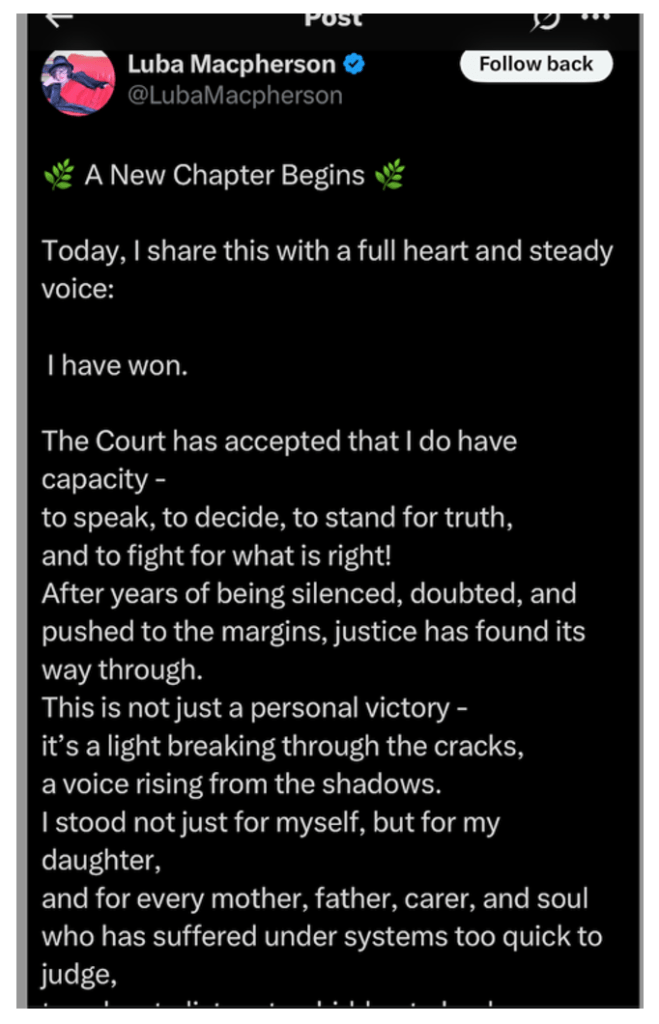
This was the fourth Court of Protection hearing I’ve observed.  There’s a WhatsApp support group for observers and I’ve raised numerous questions (perhaps too many—apologies!) in the WhatsApp Group about things I’ve experienced so far.  One such query was (reflecting on Luba MacPherson’s anger at being represented by the Official Solicitor),  “I was wondering why having an official solicitor was bad compared to having the capacity to appoint someone?“.  This led to a discussion on the WhatsApp Group about how if you instruct your own solicitor, then they argue for the position you want them to take in court, but if it’s decided that you lack capacity to instruct your lawyers, then you are usually represented by the Official Solicitor, who doesn’t necessarily argue the position that you want but takes a position that she thinks is in your “best interests”. This means that she can actually argue the opposite of what you want  (e.g. for a feeding tube when you don’t want a feeding tube).

The critical distinction became clear: When appointing your own solicitor, you must be able to read, understand, and process legal information in order to provide proper instructions. In contrast, the Official Solicitor (who is appointed when you can’t do those things) acts according to what they determine to be in your best interests, rather than following your direct instructions.

This left me thinking that the Official Solicitor would not be on P’s side, so I was confused when I heard the barrister for P, Eleanor Keehan, who seemed very caring and focused on P.  I thought she must be P’s own lawyer, and it wasn’t until after the hearing that it was explained to me that actually she was acting for P through the Official Solicitor. 

The barrister acting for P on instruction from the Official Solicitor did not say very much in court, but what she did say was based on P’s best interests and took into account P’s wishes and feelings.  Her two main points were:

  • She wanted practical supports to help P understand the proceedings, and a Communication Passport (which she said had not been updated since Children’s Services).  The judge strongly supported this and asked for a summary of P’s communication needs to be in the notes on the end of her bed: “It doesn’t have to be War and Peace. It can be simple bullet points to make sure everyone communicates with P in a style she can understand”.
  • The Official Solicitor expressed concern about a medical treatment (a naso-gastric feeding tube) that might be given to P “in the face of P’s objections and without application to this court”.  The judge said there would be a recital (a note) on the face of the order about the need to bring the case to court if treatment were being considered that P didn’t want to have.

So, I saw the Official Solicitor support P’s communication and P’s choices.

There was discussion in court about P’s physical health conditions.  She was in hospital and (as the judge said) “clearly unwell”, and this was preventing  her from being able to read and process the necessary legal documents.  That’s why she was deemed to lack litigation capacity.

A difficulty in the hearing was that an independent psychiatric expert, Dr Christopher Ince, had written a report saying that P does have capacity to conduct legal proceedings. This contradicts what the lawyer for P (on behalf of her litigation friend the Official Solicitor), Eleanor Keehan, was saying –  that P would “struggle” to read the reports and instruct her directly.   This seems to have arisen because Dr Ince has not provided an updated report since P has been in hospital.  It seems that usually P would have capacity to instruct a lawyer, but because of her current health situation she doesn’t at the moment.  Her mother was in court and said: “All I can think about is P’s physical health… She doesn’t have capacity to understand and retain as she normally would – she can’t concentrate, she can barely string a sentence together”.  The judge, who seemed to know P quite well, said “she’s deteriorated, that’s obvious”.  But without  an updated report from the expert witness, it’s awkward for the judge to make a declaration that P lacks capacity to litigate.

The key message of this blog is simple. Don’t let knowledge gaps deter you from observing CoP hearings. Attending real proceedings brings theory to life and makes complex concepts clearer through practical context. The insights you’ll gain from direct observation are invaluable, even if you’re unfamiliar with the proceedings at first. After all, open justice should promote observation from all walks of life and not be dependent on specific background knowledge.  My message to everyone is: Just do it!

Postscript from Celia Kitzinger: A penal notice against Dr Ince

We’re happy to provide support for people who are unsure or anxious about attending proceedings – just get in touch.  As Michelle says, watching a court hearing can be confusing at first, and there’s likely to be a lot you don’t understand.  But everyone has to start somewhere, and it’s a real learning opportunity! 

I watched this hearing alongside Michelle: we were in WhatsApp contact throughout and had a video-call discussion about it afterwards. I’ve watched more than 600 hearings and I still almost always learn something new at a hearing.  This is the first hearing I’ve watched where a judge has imposed a penal notice on an expert witness.   Dr Ince was asked to submit a report, asked for extra time and (I understand) submitted the report in advance of the hearing. He had also been asked to provide an addendum report. It’s several months overdue and the judge sounded concerned and frustrated about this.  “Dr Ince has been extraordinarily tardy in the provision of this report, missing numerous deadlines”, she said, “and so we’ve been playing catch-up”.  The judge set a new deadline for Dr Ince’s addendum report and announced that her order to deliver it by that deadline “will be backed by a penal notice” (i.e. a note saying that that if it’s not delivered on time he can receive a prison sentence). 

There was also some discussion about the date of the next hearing and the need for Dr Ince to attend it.  Counsel confirmed that Dr Ince had already been asked about his availability and was able to attend on the date when the next hearing was to be scheduled. Nonetheless, the judge said that, if necessary, she would issue a “witness summons” (i.e. an order to attend which means Dr Ince could be arrested and taken by the police to court if he does not attend).  “I’m not joking”, said the judge. “What has happened with Dr Ince in this case is truly unconscionable.  The idea that I am going to set the timeline of this case by reference to Dr Ince’s availability is to fail to understand the gravity of the situation he is in.  He will be directed to attend, and that too will be backed by a penal notice”. 

The next hearing is listed for 22nd and 23rd May 2025.

Michelle Hughes is an independent SEND Advocate interested in the link between access to services and outcomes.

Celia Kitzinger is co-director of the Open Justice Court of Protection Project. She has observed more than 600 hearings since May 2020 and written more than 100 blog posts. She is on LinkedIn (here), and also on X (@KitzingerCelia) and Bluesky @kitzingercelia.bsky.social)

Statutory Wills: A barrister explains

By Ruth Hughes KC, 22nd April 2025

Editorial note: We commissioned this blog post due to the interest in statutory wills generated by the case of W v P [2025] EWCOP 11(T3) which was heard in private. The blog author acted for the P in that case, instructed by the Official Solicitor.  We have also subsequently published a blog post about a public hearing relating to a statutory will (“Judge approves statutory will in contested hearing”). This post by Ruth Hughes KC sets out the legal framework for statutory wills.

  1. Where an adult P lacks mental capacity to make a will the Court has jurisdiction to authorise the execution of a will on P’s behalf: see section 18(1)(i) of the Mental Capacity Act 2005 (“MCA”).  The Court will authorise a will if to do so would be in P’s best interests in accordance with section 4 MCA. 
  2. Best interests in the context of testamentary and lifetime giving were discussed in three important cases following the coming into force of the MCA: (i) Re P [2010] Ch 33 [2009] EWHC 163 (Ch), a decision of Lewison J (as he then was) concerning the using of a will to change the terms of a pre-existing trust; (ii) Re M [2011] 1 WLR 344 [2009] EWHC 2525 (Fam) – a case where P had been the subject of undue influence by a bad Samaritan neighbour, a decision of Munby J; and (iii) Re G(TJ) [2010] COPLR Con Vol 403 [2010] EWHC 3005, a decision of Morgan J. The latter case in fact actually concerned the authorisation of gifts to be made by P rather than a statutory will.   

3. From these three early cases the following principles are established:

  1. P’s best interests extend to after his death: Re P at [44];
  2. P has an interest in being remembered for having “done the right thing” by his will: see Re P at [44].  However, circumstances of dispute among those close to P can make this concept tricky to apply: see Re G(TJ) [53].  Nevertheless, it can be more helpful when there is unity in the family.
  3. It can be in P’s best interests to act altruistically: see Re G(TJ) [56];
  4. The weight to be given to the factors relevant to each person’s best interests is case-specific.  There is no hierarchy of factors, although P’s wishes and feelings will always be significant and a factor to which the Court will pay close regard: see Re M [32] and [35]. 
  5. In some cases, there will be a factor of “magnetic importance”: see Re M [32].
  6. Although best interests is not a test of substituted judgement, (i.e. what P would have done if he or she had a lucid interval of capacity, which had been the test for a statutory will before the MCA: see Re D(J) [1982] 2 All ER 37), substituted judgement remains an element of the test: see Re G(TJ) [55]. 

4. As is plain from Morgan J’s judgment in Re G(TJ) the concept of doing the right thing can sometimes be tricky for the Court:

  1. In Re Meek [2014] EWCOP 1 (a case in which the author acted for P, via her litigation friend the Official Solicitor) HHJ Hodge suggested with reference to the decision of Baroness Hale in Aintree University Hospitals NHS Foundation Trust v James [2013] UKSC 67 that “the right thing” was to be judged by reference to the standards of P herself. 
  2. In Re J(C) [2012] WTLR 121; [2012] MHLO 35 Senior Judge Lush had difficulty with the concept of being remembered with affection or doing the right thing in that particular case.  He said at [54]

“JC has an appalling track record.  He has spent his entire lifetime doing precisely “the wrong thing” in his relationship with others, and his malevolence is such that he would probably relish the prospect of thwarting his children’s designs on his estate and would rejoice in being remembered by them with disaffection.  In any event, it would be unrealistic to expect him to undergo some sort of Damascus Road experience simply because he lacks capacity.”   

5. A helpful summary of the case law can be found in District Judge Eldergill’s decision in Re Jones [2016] WTLR 661 [2014] EWCOP 59 from [59].  This case concerned a P who was intestate and had a history of extreme tax avoidance.  He had an estate of nearly £2.5m (in 2014).  P had a wife (of 40 years’ standing) and a child from a previous relationship. The daughter was adult and suffered from drug problems and was not financially secure.  The task of the Court was to decide whether to make a will in P’s best interests (or whether to leave the intestacy in place) and, if so, what form the statutory will should take.  The author represented P by his litigation friend the Official Solicitor, who almost invariably acts as litigation friend in statutory will cases. 

  1. The Court did take into account that both the wife and P’s daughter would have standing to bring a claim after P’s death against his estate under the Inheritance (Provision for Family and Dependants) Act 1975 if reasonable financial provision had not been made for them on P’s death.  NB it can be in P’s best interests to avoid post-death litigation: see Re D [2010] EWHC 2159 (Ch). 
  2. As for doing the right thing, this was an appropriate criterion for “most but not all people”: see [61]. 
  3. “The onset of mental incapacity is not an opportunity for moral correction.”: see [67]. 
  4. Nevertheless that still left room for the court to authorise a “[67] statutory will which makes good the omissions of P but does not seek to correct their considered acts and decisions.  For various reasons all of us never quite get round to doing many of the things we know we ought to do.  Making a will may be one of them.  Most people would wish to make a Will if they knew both that they were going to be incapacitated by a stroke tomorrow and the consequences of dying intestate or leaving a defective Will.  They would seek to avoid the sometimes arbitrary nature of intestacy, the consequences of dying intestate on those dear to them, the resulting inconvenience and worry for their family, the possibility of family discord and avoidable litigation arising from a failure to make clear their intentions.  [68] Thus, in the absence of clear evidence to the contrary, one is entitled to assume that had P given proper thought to their pending incapacity and intestacy he or she would have wanted to put their house in order and make a Will.  They would want to do the right thing and not to leave family members with such unintended consequences and problems.” 

6. Ultimately, District Judge Eldergill held that it was in P’s best interests for £625,000 of provision to be made for the daughter in the form of a lifetime gift (which was settled on trust to protect the daughter) and a legacy with the rest going to P’s wife.

7. In my experience statutory will proceedings are brought in order to:

  1. deal with an intestacy which is not in P’s best interests;
  2. deal with a substantial change of circumstances since P made a will;
  3. prevent litigation after P’s death, particularly claims under the Inheritance (Provision for Family and Dependants) Act 1975 or that P’s will is invalid or defective in some way. 

8. It is rare for there to be a dispute as to the law to be applied in relation to a final statutory will application. 

9. Statutory wills can become urgent if P is dying and it is possible to obtain an interim statutory will (often called a holding will) under section 48 MCA.  Such a will is final if P dies with it in place.  The order authorising execution of a will is not sufficient: a will must actually be executed by the person authorised on P’s behalf prior to P’s death.  The form of execution is prescribed.  The Court will then seal the will.  Sealing can happen after death but must occur before an application for a grant of probate is made. 

10. The Court will make a will only for Ps who are habitually resident in England and Wales or have property here (in relation to that property only).  It will not make a will in respect of immoveable property outside England and Wales: see para 4(4)(a)(i) of Sch 2 to MCA.   

11. The Court has been willing to authorise settlements (i.e. trusts) of property for children under section 18(1)(h) MCA which have essentially testamentary effect to avoid an undesirable intestacy which is not in P’s best interests: see for example Re CJF [2019] COPLR 262 [2019] EWCOP 1 in which provision was made for effectively a foster family who had shown extraordinary kindness to P.  The author acted for P (via his litigation friend the Official Solicitor) in that case also.

12. As with all property and affairs cases, the usual rule on costs is that P bears the (assessed) costs of an application.

Ruth Hughes KC is a barrister at 5 Stone Buildings.  She has in-depth experience in all matters concerning property and affairs in the Court of Protection, including foreign issues and is also comfortable advising in relation to associated welfare issues.  She is frequently instructed by the Official Solicitor. 

If this had been my first court observation, it would have been my last!

By Clare Fuller, 17th April 2025

In the following blog,  I’m going to combine two experiences of the same event written contemporaneously and originally as separate pieces. The event is a hearing in the Court of Protection and both experiences are mine.

In Part 1 I describe abortive attempts to obtain a hearing link.

In Part 2, I focus on a public rebuke from the judge and the impact this had on me.

As in all events, there are multiple lenses these experiences can be viewed through and unseen reasons behind actions. I have no doubt there were human factors at play in both scenarios.

Neither experience supported transparency or open justice in the Court of Protection.

Part 1 Open Justice Denied: A Frustrating Attempt to Attend the Court of Protection

This morning, I had what I can only describe as a non-experience with the Court of Protection. It was to have been my eighth opportunity[i] to observe a hearing through the Open Justice Court of Protection Project — a valuable part of my professional development as a Lasting Power of Attorney (LPA) consultant and Advance Care Planning Educator. But despite my best efforts, I never made it into the virtual courtroom.

Observing Court of Protection hearings helps me to understand where Lasting Power of Attorney arrangements can go wrong, where they are challenged, and how I can best advise my clients to avoid distressing disputes later on.

Each hearing I’ve attended has offered rich learning: insight into legal reasoning, the lived experience of ‘P’ (the person at the centre of the case), and the ways families and professionals can work either in harmony—or, sadly, in conflict. Which is why today was so disappointing.

I was alerted by a direct message that there was to be a hearing  involving an application to revoke Lasting Powers of Attorney. This felt pertinent to my roleand I was keen to learn more. I rearranged my diary commitments and plans, freeing the potential three hours to be present, and requested the hearing link.

This is the email I sent at 09.07am that morning.

I also started work to blog about the hearing using the Open Justice Court of Protection Project Hearing Feedback template. From previous experience, I know how valuable it is to join a hearing up and ready to go.

In the lead-up to the hearing, I also joined the WhatsApp group for observers. WhatsApp Group support is an initiative that I have not accessed the previous times I attended a hearing and I found it tremendously valuable. I understand the concept of using WhatsApp groups developed recently as a way of providing support for the people observing Court of Protection hearings. Reading the WhatsApp messages made me aware that one observer had been sent the link but two others hadn’t.

As the listed start-time of 10.30am approached, time I became worried that I still did not have a link. I checked in with the WhatsApp group to make sure I had sent my request to the correct email (I had) and I  re sent my request.

I sent a further request, this time marked as urgent.

Timeline of a morning that went nowhere

TimeComment
08:33I received an X direct message alerting me to a hearing. I replied immediately to confirm I was available.
09:07I sent my official request to observe the hearing via email, using the Open Justice Court of Protection template.
09:53I sent a second request via email, this time also asking for A Transparency  order.
10:15Still no email link. I waited, hopeful.
10:24I re-sent my observation request.
10:37I marked a third request as urgent.
MeanwhileWithin the WhatsApp group, it became clear that only one of the four of us had successfully received a link.
10:46No link received. I gave up hope of attending the hearing.

I had been actively trying to observe this hearing for over 90 minutes. I didn’t want to log in late, potentially disrupt the process, or feel like an intruder. But I was deeply disappointed. I’d set aside time, prepared myself mentally and professionally, and was eager to witness justice in action.

Instead, I was left in limbo.

The whole aim of the Open Justice Court of Protection Project is to make the court’s vital work visible; to shed light on the complex, sensitive decisions being made about some of the most vulnerable members of our society.

But openness isn’t just about permissions—it’s about access.

Today, I was willing, prepared, and enthusiastic—but still not admitted. It doesn’t feel like open justice when observers are left behind because of administrative delays or communication breakdowns.

I understand the complexities. I appreciate the pressures. But I hope the system can be improved, because attending hearings really does help professionals like me to support families better, to understand the law more deeply, and to advocate more effectively for those whose voices are often least heard.

This morning, justice was happening somewhere—I just wasn’t allowed to see it.

I thought my story and blog would end here.  But there is a sequel.

Part 2 A Troubling Experience with the Court of Protection

I originally wrote the piece that now forms Part 1 of this blog when I believed I had lost the opportunity to attend a hearing. You’ll see from the timeline of emails that I first requested access approximately two hours before the hearing was due to start—a detail that’s important in understanding what followed.

What happened next was not just frustrating—it was uncomfortable and unsettling, and left me with a poor impression of the Court of Protection. Here’s what happened, and how it made me feel.

At 11:03, I was informed by the WhatsApp Observer support that the court clerk was aware of my request and that a link would be sent. Although I knew proceedings had already started, I felt it would be discourteous not to join after time had been spent arranging the link. Other observers from the Open Justice Court of Protection Project had already been admitted by this time. I don’t know what time they made their requests, but it would be interesting to reflect on what difference, if any, that may have made.

This is the email I received at 11:06:

When the email arrived, I read the attached Transparency Order immediately, so I could confirm I had done so if asked. I joined the hearing at 11:07, with my camera off and sound muted, as I knew was appropriate. I was prepared to confirm that I had read the order.

What I was not prepared for was what happened next.

The hearing began as expected, with Judge Hilder asking me to switch on my camera and microphone. I complied, confirming I was alone and had read the Transparency Order.

Then, things shifted quickly. Within moments, Judge Hilder addressed me sharply, describing late access requests as disruptive and advising me to “consider that, in the future.” This was done in front of all present in the court. I was stunned, embarrassed, and humiliated. It felt like I was being publicly told off for something outside of my control.

I had requested to join at 09:07, more than 90 minutes before the hearing began. Yet I didn’t say this. I didn’t explain that previous hearings had started late, which had shaped my expectations. I can’t even remember whether I said sorry—I simply acquiesced.

In the space where I had planned to take notes on the hearing, I instead wrote: “I feel discombobulated, anxious and humiliated. Joining late also means I have missed the introduction and any summary – I feel on the back foot, anxious and without full understanding through no fault of my own.”

Reflections

I am grateful that I have had six positive experiences as an observer in the Court of Protection and acknowledge that if this had been my first experience it may well have been my last.

I still don’t understand:

  • Why I wasn’t sent a link in a timely manner
  • Why, once I did join, I was made to feel so unwelcome and uncomfortable

The impact on me was deeply unpleasant. I had to accept a public rebuke for something I felt was not my fault. Even more concerning, I missed crucial early parts of the hearing and struggled to focus due to the emotional impact of the experience. My fight-or-flight response kicked in, crowding out the calm, attentive state needed for observation and reflection.

I want to be clear: this is not the norm in my experience of the Court of Protection. I share this not to put others off from attending, but in the hope that it might help prevent a similar situation in the future.

Conclusion: Key Learning Points

  • Timely access is critical: Requests to observe hearings should be acknowledged and acted upon promptly to ensure meaningful participation.
  • Respectful communication matters: Public rebukes, especially for issues beyond an observer’s control, can have lasting emotional impact and undermine trust in the process.
  • First impressions are powerful: For those new to observing, an unwelcoming experience could discourage future engagement with the justice system.
  • Transparency requires support: Open justice must be paired with effective administrative processes and respect to be truly effective.

Clare Fuller RGN MSc is a Registered Nurse with 30 years’ experience in End-of-Life Care (EoLC). She has worked in hospices, the community, and acute sectors as a Clinical Nurse Specialist, and at a national level as a Consultant Nurse for the Gold Standards Framework. Clare is a CQC Specialist Advisor for EoLC and a Lasting Power of Attorney Consultant. Clare is also currently advising as a Commissioner for the Parliamentary Commission on Palliative and End of Life Care.  Clare is the owner and director of  Speak for Me which helps organisations to improve EoLC and provides professional and public education about Palliative and End of Life Care and Advance Care Planning. Clare campaigns for proactive Advance Care Planning and hosts the podcast Conversations about Advance Care Planning

Footnote – previous hearings I’ve blogged about


[i] Bearing Witness: Anorexia Nervosa and NG Feeding;

Lasting Power of Attorney: Across Borders

Capacity to make a Lasting Power of Attorney

Reflecting on Re MW and Advance Planning: Legal frameworks and why they matter 

What happens when Lasting Power of Attorney goes wrong?

Decision-making with clarity and compassion: Validity of LPAs and appointment of Deputy

The logic, law and language of Lasting Power of Attorney: A case before Hayden J

.

A named defendant awaits sentencing for contempt of court

By Claire Martin, 16th April 2025

Following an adjourned committal hearing back in December 2024, we were concerned that the defendant (referred to only by his initials, “MW”), who is facing a prison sentence for contempt of court, had been anonymised in the public court lists – and the observer considered it likely that there would be a prohibition (for reasons she didn’t know) on publishing his name.

Although the names of people facing contempt of court hearings can lawfully be kept out of the public domain, this should be a very rare and exceptional occurrence (see the Practice Direction on Committal for Contempt of Court in Open Court and the guidance in the key case law, Esper v NHS ICB (Appeal: Anonymity in Committal Proceedings) [2023] EWCOP 29). As stated in the earlier blog post, though, “in my experience, despite the Practice Direction and the Court of Protection Rules, as well as Poole J’s guidance in Esper that defendants in committal hearings should normally be named, in practice they are normally not named.  The court is repeatedly finding reasons why they should not be. I find this concerning” (“Another committal hearing, another anonymised defendant”).

As it turned out, the December hearing was adjourned because MW didn’t have legal representation.  The next hearing was arranged for a couple of months later, and I was able to observe.  This is an update on what’s happened since.  The good news is that transparency has prevailed and we can name him as Melvin Wright.

In this blog I will address:

  1. Open justice in a committal hearing – how the judge managed the transparency issues prior to the hearing with forethought and how she managed the hearing itself
  2. What happened at the hearing. Part 1: Our application to vary the Transparency Order and to allow the naming of the defendant and Part 2: the committal hearing – the substance of the hearing
  3. Reflections

Open Justice in a Committal Hearing

The Practice Direction Committal for Contempt of Court – Open Court says that open justice is “a fundamental principle” and that “the general rule is that hearings are carried out in, and judgments and orders are made in, public” (§3). The alleged contemnor should normally be named and committal applications listed as specified in §5(2):

FOR HEARING IN OPEN COURT

Application by [full names of applicant]

for the committal to prison of

[full names of the person alleged to be in contempt]

Any derogations from the principle of open justice “can only be justified in exceptional circumstances, when they are strictly necessary as measures to secure the proper administration of justice…” (§4).

On 29th January 2025 we (in the OJCOP project) were alerted, by a Court of Protection administrative officer, to a court order for the committal hearing on 3rd February 2025. This was the email:

HHJ Hilder had issued a court order stating:

This meant that we knew in advance of HHJ Hilder’s decision not to publish the defendant’s name in the court listing (i.e. prior to the hearing) and we were able to decide whether to request to make representations regarding this departure from the usual practice of naming contemnors in court listings.  

The order said:

Rule 21.8(5) says:  “The court must order that the identity of any party or witness shall not be disclosed if, and only if, it considers non-disclosure necessary to secure the proper administration of justice and in order to protect the interests of that party or witness.”

Hooray! We could give some forethought, as HHJ Hilder had done, to whether we wished to apply to name the defendant in this case, as court rules and Esper stipulate is the default position in committal hearings.  

It didn’t leave much time (we received the court order on the Wednesday and the committal hearing was the following Monday). Celia Kitzinger had observed the previous hearing but was away on holiday. The rest of us in the Project liaised and produced a Position Statement to apply for permission to identify the defendant. I was available to attend and so the application was in my name, supported by the Open Justice Court of Protection Project.

We public observers rarely see any journalists in the Court of Protection and when they have attended, they have typically not addressed the court. On this occasion a Press Association journalist did attend (in person) and it was reassuring to be able to contact him privately and garner his support for the Position Statement we submitted. I am very grateful for that. As it turned out, the Press Association has decided (so far) not to report on this case.

I have not written a Position Statement before. It was quite a nerve-wracking process. We (in the OJCOP project) have all applied to ‘vary’ (change) Transparency Orders before, for example when a public body is included in the reporting restrictions. There are very rarely times when publishing the name of a public body acting as applicant or respondant in legal proceedings should be banned, and we have almost always been successful in overturning the restriction. Preparing a Position Statement such as this was a different matter and required some knowledge of the law regarding disclosure of people’s names in the context of committal proceedings.

We also noticed, though, that the current Transparency Order for this case did also prevent naming of the public bodies, including banning publication of the names of the Local Authority, ICB, and NHS Trust. So we also included in our Position Statement an application to vary that restriction, to enable the naming of public bodies involved in the case.

HHJ Hilder had helpfully pointed to the relevant case law (the Esper judgment) in her court order. I had also, coincidentally, observed in person a committal hearing at the Royal Courts of Justice the week before, which had been an open justice disaster – see “Draconian reporting restrictions in a contempt of court case”).  So I knew about the Esper judgment and that I would need to read it with a ‘fine toothcomb’ (HHJ Hilder’s words in the previous hearing for this case).

Here’s the substance of our Position Statement below:

  1. This is an application to vary the Court Order for the second committal application (“the Order”) [in this case] made by Her Honour Judge Hilder, at First Avenue House, 42-49 High Holborn, London WC1V 6NP, on 29th January 2025, issued on 29th January 2025, in order to permit identification of the defendant ‘MW’, or otherwise for the court to give a reasoned explanation for non-disclosure of the contemnor’s identity.
  2. The Order sets out at §11: “Reconsideration. 11. This order was made without a hearing. Any person affected by it may apply to the Court, by filing a COP9 application within 21 days of the order being served, for its reconsideration pursuant to Rule 13.4 of the Court of Protection Rules 2017.” Mr [S – court administration staff] emailed Celia Kitzinger with the Order and redirected it to the OJCOP project on 29th January 2025. We have only just had time to prepare this statement and respectfully request that the court considers the application.
  3. On 29th January 2025 HHJ Hilder ordered the following at §4: “Reporting restrictions: Pursuant to Rule 21.8(5) the names of the Defendant (MW), the First Respondent (initials removed) and the Second Respondent (initials removed) shall not appear in the public listing of the hearing, and the involvement of any of them in committal proceedings shall not be published by any other means. The Court will consider at the hearing whether this prohibition should be continued or terminated, and will hear submissions on that issue from the parties and/or media organisations.”
  4. The Practice Direction Committal for Contempt of Court – Open Court[1] says that open justice is “a fundamental principle” and that “the general rule is that hearings are carried out in, and judgments and orders are made in, public” (§3). The alleged contemnor should normally be named and committal applications listed….”
  5. The Esper Judgment[2] at §54 (i) states: “Open justice is a fundamental principle and the general rule is that hearings should be carried out and judgments and orders made in public. Derogations from the general principle can only be justified in exceptional circumstances when strictly necessary as measures to secure the proper administration of justice.” And at §36: “It is expected that these conditions will both be met rarely for a defendant and extremely rarely for a defendant found to have committed contempt.” [my emphases]
  6. Court of Protection Rules: According to Esper §15, Rule 21.8(5) of the Court of Protection Rules (COPR) prevails over any practice directions where they are “incompatible”. Rule 21.8(5) requires non-disclosure of a defendant in a committal hearing when two conditions are met (and both must be met): (i) To protect the interests of the party or witness (i.e. the defendant); (ii) to ensure the proper administration of justice.
  7. Taking Point b (above) first: “To ensure the proper administration of justice”. This is covered by §37 and §39 in Esper. A number of circumstances are set out in §39 when this condition would be met. Point §39 (v) states that one would be when: “In some other way the proper administration of justice would be undermined”. This criterion at §39(v) is exceptionally vague (‘some other way’) and difficult to pre-empt when challenging reporting restrictions. We are not in possession of all of the facts about this case and are therefore not aware of reasons that would weigh the balance (of disclosure vs non-disclosure) in favour of non-disclosure. We appreciate that the reasons might be magnetic. We would submit that, should the decision for non-disclosure stand, in order to prevent the undermining of the ‘proper administration of justice’, as a minimum, the judge should record in the written public judgment (which we understand is required for all committal hearing judgments) her reasons for ordering the non-disclosure of a contemnor’s name.
  8. Focusing on Point a (above): To protect the interests of the party or witness (i.e. the defendant), Esper states:

9. It is difficult to make an argument for disclosure of a contemnor’s name without knowledge of why the contemnor (MW in this case) is said to meet criteria for non-disclosure. As far as we are aware, there is no public order or judgment explaining the reasoning for ordering non-disclosure. In Esper §54 (ix): regarding not naming the defendant in order to protect P: “COPR r21.8(5) is not triggered to prevent the disclosure of the identity of the defendant if the sole purpose is to protect the interests of P. It must be the interests of the defendant that need protecting.” [my emphasis]. We submit that, given that the Esper judgment stresses that this should occur only ‘extremely rarely’, and particularly if the defendant is found to have committed contempt, HHJ Hilder should justify with her reasons why the defendant’s identity should not be disclosed in order to ‘protect the interests of the party or witness’.

10. Why might identifying MW be risky? In the Open Justice Court of Protection blog[3] dated 3rd January 2025, Celia Kitzinger wrote: The only other reason I can guess at as to why it would be “necessary to secure the proper administration of justice and in order to protect the interests of that party…”that MW’s identity should be protected (and presumably [the second respondent’s]  too) is that publication of their identities risks public identification of the protected party, via jigsaw identification (that would be the “proper administration of justice” bit) and (it’s “and” not “or”) MW’s own ill-health, which is referred to in the order (“The Court is mindful that MW has health limitations”).  And: “… in relation to the risk of identification of P, most of the defendants in contempt of court cases in the Court of Protection are family members or close friends of the protected party, which means it can always be argued that knowing who they are might risk the public becoming aware of P’s identity.  In practice,  both in the Court of Protection (e.g. Re Dahlia Griffith [2020] EWCOP 46) and in the Family Courts (e.g. Manchester City Council v Maryan Yuse, Farad Abdi & the children [2023] EWHC 1248 (Fam)) family members have been named in judgments and there is no evidence at all that members of the public (or journalists) have subsequently tracked down the protected parties or children concerned or harmed them in any way.” 

11. The Open Justice Court of Protection blog dated 3rd January 2025 does not report any details of the nature of the family relationships, in order to minimise the likelihood of jigsaw identification in future, if disclosure of the identification of the contemnor is considered by the judge in future.

12. We have heard the argument from counsel (at another hearing) that disclosure of the contemnor’s name, even in the unlikely event that it led to jigsaw identification of P, was not likely to cause any ‘harm’, and that the balance is always in favour of open justice and continuity of judicial reporting (via judgments) to enable public scrutiny and accurate recording of judicial process. We do not know, in this particular case, whether ‘harm’ is likely to be caused to P or to the defendant, and would not wish that to happen, were this the case.

13. Our submission is that jigsaw identification is unlikely and might be mitigated by changing the initials of P in a judgment or preventing specific details of the case being reported, and unless there are very real risks of harm to [the young woman at the centre of the case], MW and [second respondent], should the defendant’s name be disclosed, the balance is in favour of Art 10 rights and disclosure of the defendant’s name. The OJCOP project might still decide, should disclosure be permitted, NOT to publish the name of the defendant, but the right to do so should be preserved.

14. Finally, it is not standard practice to anonymise public bodies in Transparency Orders.  The court recognises that local authorities are public bodies, funded by taxpayers, and therefore accountable to members of the public. A local authority/ICB/NHS Trust/other public body cannot be accountable if it acts in secret. The only (rare) circumstance under which the identification of public bodies is banned is when knowing the name of the public body is likely to lead to identification of the protected party.

15. In the event of concern that jigsaw identification is a real risk in this case and non-disclosure of the defendant’s name stands, the project will consider applying to the court to vary the Transparency Order and consider ways of protecting P’s identity other than the current draconian prohibition on naming the public bodies involved (i.e. prohibiting the publication of other potential pieces of the ‘jigsaw’ e.g. the initials used, or precise age).

Claire Martin, Open Justice Court of Protection Project

I sent our Position Statement to the court the night before the hearing, on 2nd February 2025.

What happened at the hearing: Part I – the application to vary the court order preventing naming of the defendant

I was observing remotely. I made sure that I logged on in plenty of time for the 11.30am start. The court associate was very helpful and communicative, joining me in good time on the link, checking that I could hear and advising me that he would turn on the court cameras when the hearing started. This sort of competent administration is exceptionally helpful for public observers – and I imagine for anyone remotely attending a court hearing who isn’t part of the inner world of legal procedures, including, in particular, family members. It communicates that the court is expecting and welcoming us to the hearing, and that we are considered a part of justice. I labour this point a little because not all hearings are the same.

All three counsel were in attendance at court. Another person was at the front of the court, alongside the barristers. I think this is the other family member who is a party to proceedings. She spoke only once in the hearing. The defendant was on remote link with a person who was supporting him (who I think was a legal representative).

I really wasn’t sure what to expect regarding the order of proceedings, in terms of hearing the allegations, findings, sentencing (if allegations were proved) and the issues regarding transparency and reporting restrictions.

I needn’t have worried. HHJ Hilder was exemplary regarding both providing an opening summary of the case and the transparency of the proceedings:

Housekeeping matters – I will give a succinct explanation for the benefit of observers why we are here. Then I will address the TO issues.

Explanation to observers – these are substantive proceedings in the matter of a 25 year-old woman in respect of whom declarations were made by DJ Mullins on 15th January 2024. She lacks capacity to conduct proceedings, [decide on her] care, contact, use of internet and social media, manage her property and affairs including entering into a tenancy. […] Orders were made by DJ Mullins restricting contact [with the defendant] on 25th October last year. [I] discharged [these] earlier injunctions and reframed them in an order material to today’s hearing. It is alleged by the Local Authority [my link cut out for a short moment at this point but the point must have been made that the LA have alleged breach of the injunctions] …. the earlier hearing was adjourned  [that would be the hearing reported in our previous blog post, which was adjourned to enable the defendant to get legal representation]. The Local Authority filed a second application in respect of further alleged breaches and today’s hearing was listed to consider both committal applications. Right – the first of the Transparency Order issues – I would like to address, I hope it’s not contentious. Ms Martin has set out a Position Statement requesting the TO regarding substantive proceedings – so that the public bodies’ names can be made public. That DJ Mullins’ paragraph 6 of the order doesn’t apply – doesn’t apply to today. Anybody object? Para 6 of that order includes within the bodies/persons anonymised the LA, ICB/NHS Trust/LD service – Ms Martin.”

I spoke at the invitation of the judge at this point, confirming that we were applying for permission for the public bodies to be named.

Counsel for P (Victoria Butler-Cole) explained the background to why it had been requested that the public bodies should not be named, but she said she did not have instructions yet. The judge asked me if I objected to Counsel for P getting instructions in time for the next hearing, so that she could make submissions then, at which point the judge would decide whether or not to vary the TO and allow the public bodies’ names to be reported. I said that I didn’t object.

HHJ Hilder then turned her attention to the other part of our application: to vary the court order allowing identification of the defendant: “I need to deal now with applying to this hearing […] on 6 Dec […] the order which I made was that names of P, [the second respondent], and MW would not be made public in the listing of this hearing, or elsewhere, but that I would hear submissions at today’s hearing whether they should be disclosed. The first question to consider is: does anybody object [to waiting] until I have decided the substantive matter?

The judge asked me directly if I agreed with her approach to dealing with the substantive matter (the allegations) first.  I said that it seemed a very sensible approach. I will report the allegations and committal aspects of the hearing in the next section.

At the end of the committal proceedings HHJ Hilder returned to our application. She asked me if I wished to add anything to our written application, and I said that I did not.The judge then asked counsel for P and for the defendant for their submissions:

Counsel for P: There is a slightly higher risk [of jigsaw identification, if MW is named) just because it is another piece of the jigsaw. We anticipate she [P] will want what [the defendant] wants.

Counsel for the defendant: MW is concerned about his name being made public – but I have a duty to the court not to make inarguable submissions. In light of the judgment in Esper, admissions have been made, I find it difficult to put forward what MW wants me to.

Judge: That is helpful

So, counsel for the defendant was saying that, even though the defendant did not want to be named, he (counsel) could not make that submission because it is ‘inarguable’. This will be because of the very clear judicial rules and case law on the naming of defendants in committal hearings, except in very rare circumstances, which clearly counsel for the defendant did not think were met in this case.

HHJ Hilder then made her ruling in respect of our application (which I reproduce in full – based on my contemporaneous typing of notes, which I attempt to make as accurate as possible (bearing in mind that we cannot record proceedings): “I am going to determine now the application made by Claire Martin of OJCOP in a written Position Statement dated 2nd February 2025, to vary the order which restricts identification of the defendant or alternatively her application was for the court to give a reasoned explanation of non-disclosure [of his name]. The application as it stands now, extends only as far as the defendant. I start by reminding myself of the order which is the substance of this application. Para 4 of the order, made on 6th December [2024]. I provided […] that MW’s name should not appear in the public listings, or other means. I went on to say that the court would consider at this hearing whether that prohibition should continue or be terminated. I included the Open Justice Court of Protection Project – an equivalent provision was made in the order of 29th January [2025], the second committal application. For the avoidance of doubt, the purpose of those provisions was so that I can ensure that court can be clear regarding the nature of proceedings, and on the other hand to preserve the opportunity for hearing any argument as to the naming of the individuals involved. Paragraphs 1-53 in the Esper judgment – in reality it would not be possible to have a sensible argument on identification of …. if names had already been put in the public domain. I reiterate, the reason for the provisions was to preserve the opportunity for argument – in my judgment [that is] the proper administration of justice in communicating the proceedings. At the point of both orders, the defendant had not admitted or been found to have been in breach. This hearing is in public. ANY member of the public could have observed. What is not public is the names of these three people. I acknowledge that the naming of a defendant is an important aspect of telling the story of proceedings. I am fully aware of the discussions of the Rules Committee, regarding changing the rules. At the moment, it is the current rules which apply. 21.85 specifically: the court MUST order the identification. The identity shall NOT be disclosed if and only if it considers non-disclosure necessary to secure the proper administration of justice AND protect the party or witness. It is very complicated. Both must be met. It is the interests of the person whose identity is under consideration. I have given MW’s counsel [permission] to argue the point. I am grateful to Mr Harrison for pointing out to me that the defendant has concerns:  to be absolutely clear that in telling me that, he has done his duty to his client. I am also grateful to Mr Harrison for acknowledging that he cannot make improper submissions. He has not asked me to restrict publishing of the defendant’s name any further. ….[missed]  None of the other parties has raised any objection to naming the defendant. He has now admitted breaches of the court order; that’s a serious matter which he has put HIMSELF in the position of being in. To that extent, looking at his interests … court has limited [options]…. In short that I am not satisfied that either of the thresholds in 21.8(5) are met and therefore I MUST lift the prohibition on naming the defendant – Mr Wright.  [judge’s emphases]

Another public observer, Kim Dodd, raised her ‘virtual’ hand and asked about naming of the Local Authority, to which the judge replied: For this committal hearing – there is no restriction on the naming of the London Borough of Camden in respect of today’s hearing.

What happened at the hearing: Part II – the committal hearing

There are injunctions (with a penal notice attached) against MW, forbidding him from: 

  • having face-to-face contact with P, except as organised and supervised by the local authority;
  • sending her any communication between 6pm and 9am;
  • sending her any communication that refers to sexual activities, her health, members of her family, these proceedings, her work or study, or that threaten violence against her;
  • complaining about P to the police.

Tony Harrop-Griffiths was representing the applicant Local Authority (the London Borough of Camden). He explained the current situation regarding allegations and admissions from the defendant (I couldn’t see him on screen unlike the two other counsel, and the sound from his microphone was poor, so it was harder to catch all of what he said, and my notes have some gaps):

A number of admissions are made; some don’t go to the allegations… are there sufficient admissions to the allegations… for it to not need to proceed? [… ] remaining allegations: the most egregious is the one at the end, on 18th December, when P was found in his flat, shortly before midnight by two police officers. The seriousness of that is that there had been a hearing on 17th December and MW had attended unrepresented at the time. He suggested that he understood the nature [of the restrictions] and yet he appears that evening … [to have] kept her there for two nights without contacting anybody. The Local Authority is not minded to proceed to prove the other allegations. ….My instructions … as far as the Local Authority is concerned … are to adjourn the hearing for 6 months, in the hope that MW will be able to stick to the terms of the injunction. But it’s important, in P’s best interests, that he does that. It would serve as a reminder if he needed, to not do what he has been doing, which is not in her best interests. The Local Authority must take into account his age and frailty. That’s where we stand generally.”

Counsel for the Local Authority then submitted two changes to the injunction, which were seemingly designed to enable slightly more, and a more realistic approach to, contact between P and MW:

  • Preventing MW sending text messages to P between 9pm- 9am (currently the injunction is 6pm-9am)

In response to the query ‘Well what happens if P turns up on his doorstep, who is he to contact?’ it was proposed that this did not to be included in an injunction (which is what NOT to do), but that an arrangement should be agreed which is that MW should contact Social Services straight away (on a daytime or out-of-hours number). Apparently, it is quite common for P to turn up unannounced at MW’s flat. It was acknowledged that Social Service was very unlikely to respond ‘immediately’ (especially out-of-hours), and that MW should be allowed to let P into his flat until they arrived.

The judge turned to MW’s counsel and asked what breaches the defendant admitted. MW was represented this time, by Ben Harrison, who explained that MW admitted some breaches, but could not recall exact dates. He admitted:

  • Allowing P into his flat on ‘various dates’ in December 2024.
  • Paying for P  to stay in a hotel for two nights, and on his floor on a mattress for 2 nights, and not calling Social Services as he had agreed to do (and subsequently she was found there by police officers).

Ben Harrison said ‘they are the extent of the admissions’. The judge asked how MW accounted for the other allegations:

Counsel for MW: The allegations … that he messaged in breach – he’s unable to recall the dates but he admits he has responded to P’s messages. He says, for context, that P herself continues to contact him and he responds to her messages. In respect of the allegation that he corresponds with P about these proceedings … he admits that he DID ask P to tell the truth about her communication with him, that he communicates with her about these proceedings, insofar he asked her to tell truth.[…] . He denies accusing P of being in a sexual relationship but admits … responding to information P gives to him about sexual relationships.

The judge clarified the allegation numbers that were admitted and said that she would ‘turn my mind to whether court needs to proceed in respect of further allegations now admissions have been made‘.

I could see that that judge was trying carefully to manage the committal hearing alongside the ongoing, and what seemed quite precarious (for the teams caring for P) welfare issues. MW’s admissions, the judge said, ‘suggests some positive gain with the opportunity that he now understands the situation.’ Victoria Butler-Cole (for P) pointed out that there had been further breaches but that, now, the ‘one thing that is different is that Mr W has legal advice’.

Cases like this rarely seem straightforward to me – yet the allegations have to be set out as clear, standalone events, decontextualised almost. I thought that HHJ Hilder made a very sensitive decision, that took account of P’s and MW’s situations in the round. She said: have considered carefully the full range of the allegations made in both applications. I take note of fact that Ms Butler-Cole has informed the court that there have been further breaches, but I have set those aside in the context of the current hearing. Looking at the admissions he has today made, I am satisfied that there is some … injunctive orders to be achieved on the basis of those admissions alone. Given that there is that potential, I am satisfied both that it is reasonable, fair and proportionate for the defendant, and in the best interests of the subject of these proceedings, that that potential should be given an opportunity. If it transpires that the potential does not bear fruit, there is always of course the prospect of further application. I am sure Mr Harrison will explain [to Mr W]. To be clear, I accept the admissions that have been made, I do not require evidence in respect of the other allegations, and they may be recorded as withdrawn. Now I think the next step is what the court wants to do in response.”

Counsel for MW advocated for adjournment of sentencing and suggested this was not opposed by the Local Authority. HHJ Hilder then, very helpfully, summarised the proposals: I am conscious of observers … I want to make sure they follow. Having made admissions, on his behalf, Ben Harrison says the court should not proceed to sentence today, but should adjourn sentencing, on the basis that the purpose of proceedings is the substantive proceedings, and to protect [those]. And the purpose of adjourning is to see how things go in the next however long, rather than make a decision today. The Local Authority supports that and Ms Butler-Cole does not oppose it. It seems to me that there is again some potential in that … I am content to take that approach. I will explain to him now.

After some refinements to be made to the injunctive order (the details of exactly how MW can tell P he is unable to respond by text during certain hours, when exactly he must call Social Services) the judge explained her decision to MW: Right MW I am going to address you directly. Can you hear me? [nodded] I would direct you to stand but in view of your medical condition it’s not necessary. What I say is significant and you should listen carefully. Today you have admitted breaching an order of the court. That is a serious matter, for which court has the powers to sentence you to prison for up to two years, seize your assets, or fine you. I am going to adjourn sentencing. The reason I am doing that is because I bear in mind that you have now constructively engaged with the court and legal representatives and have taken steps of acknowledging breaching the order. I take account of the fact you have apologised and accept that apology. I bear in mind your own difficulties in respect of your health and the practical complications that lie at the heart of proceedings. I acknowledge the need for proper arrangements between yourself and P. They are not easy to achieve. Efforts have been and will continue to be made – there is further provision to come back to court if they are not up and running. It is very important that I take you at your word when you say you want to support the Local Authority with care for P. The purpose of the adjournment is to demonstrate to me that you support that care, and by [complying] with orders that the court has made to support that care. You do not know all of the circumstances; you are required to abide by my orders to support P’s care provision. If you do that between now and sentencing, then there is every likelihood that no penalty will be imposed. If you do not, then the possibility of penalties still exist. I hope you bear that in mind.

MW: Thank you

Discussions followed about the precarious nature of P’s care and living arrangements, that she was no longer living in the local area (meaning it’s harder to arrange supervised contact) and that her only real contact is with MW. Victoria Butler-Cole (for P) said: “Welfare proceedings are at a very delicate stage … it is critical she needs to engage with the Social Worker and find a place to live.”

The judge empathised with the potential concern for MW in not responding to P, saying that she had ‘some sympathy with Mr W’s concern for her to not feel abandoned. It is mitigated by the fact that she now has professional carers with her to make sure she doesn’t feel abandoned.’

The court order stipulated that, if P contacted MW during prohibited hours of contact, he may reply once with a message saying, ‘I am not allowed to communicate with you until 9am tomorrow morning’.

HHJ Hilder received submissions regarding how to manage the next welfare hearing and the adjourned sentencing. She decided to hold the next hearing on the 29th April 2025 at 2pm, and for the welfare part of the hearing to precede the sentencing hearing. This will mean that, as long as MW has abided by the court’s injunctions, the ordering of the parts of the hearing will ‘give the possibility of concluding at that time’. The judge’s earlier remarks suggest that – as long as MW does comply – then she is unlikely to impose any sanction on him for breach of the court orders. So, the court needs to know, first, what has been happening since this hearing, in order that, second, an informed sentencing decision can then be made.

This seemed like a very neat way of knitting together the welfare best interests aspect of the case and the contempt proceedings, whilst delivering a compassionate court order that recognised the complexities of the situation, both for P and for MW.

Reflections

I was very pleased to have been able to make the case for transparency in this hearing and HHJ Hilder took what I thought was an extremely clear, systematic and transparent approach to this committal case.

She had ordered that the defendant’s name was not to be published in the public listing for the hearing (contrary to the Practice Direction Committal for Contempt of Court – Open Court); however, she planned this, so that (in her words) “the court would consider at this hearing whether that prohibition should continue or be terminated. …  For the avoidance of doubt, the purpose of those provisions was so that I can ensure that court can be clear regarding the nature of proceedings, and on the other hand to preserve the opportunity for hearing any argument as to the naming of the individuals involved”.

Whilst this represented a departure from the court rules, HHJ Hilder, I thought, applied forethought and consideration of the competing aspects of this case – the primary aim of protecting P and acting in her best interests, whilst also taking the principle of transparency very seriously and coming up with a workable solution. There was a careful balancing – in open court – of Article 8 rights to privacy with Article 10 rights to freedom of expression.

Having written the Position Statement (with the support and feedback of the OJCOP Project team), despite feeling nervous (and a bit of an imposter!), my experience of the court process was that it was handled in an exemplary fashion by this judge. I would do it again, as long as I was aware of the relevant legislation and case law.

HHJ Hilder also, in my view, ensured that the court process was understood by observers. This does not always happen. I was not the only observer and – as the Court of Protection sits (generally) in open court – this surely should be a default, to build public understanding of how our laws are applied and to instil our trust in those who deliver justice. HHJ Hilder’s explanations did not take up a lot of court time, and she flagged what she was saying for observers, so we knew to pay particular attention: “I will give a succinct explanation for the benefit of observers why we are here” and “I am conscious of observers … I want to make sure they follow”.  Acknowledging the relevance of public observers – and, implicitly, our role in supporting the judicial aspiration of transparency – was very welcome at this hearing.

Finally, in relation to the substance of the hearing itself – and very conscious that I know little about the welfare aspects of this case, including the reasons why MW is subject to contact restrictions with P – I thought that HHJ Hilder took an ‘in the round’ approach.

She seemed to understand the imperfections, tangles and pulls of people’s (messy) relationships – that the young woman at the centre of this case will seek out contact with MW even though he is said (in ways I don’t know) to have harmed her and to be a risk now to her.  Despite this hearing being a committal hearing for breaches of court injunctions, I observed the judge show understanding for the unpredictable position that MW might find himself in (“Well what happens if P turns up on his doorstep, who is he to contact?”) and, again, find a workable solution. I have observed other cases where defendants are said to pose a risk of harm to P, and have been subject (in my view) to unrealistic and unworkable orders (such as ‘not to upset’ them, for example). HHJ Hilder’s approach was firmly rooted in what was going to be achievable in the real world outside of the courtroom.

The next hearing in this case (for sentencing) is on 22nd April 2025 at 2pm.

Claire Martin is a Consultant Clinical Psychologist, Cumbria, Northumberland, Tyne and Wear NHS Foundation Trust, Older People’s Clinical Psychology Department, Gateshead. She is a member of the core team of the Open Justice Court of Protection Project and has published dozens of blog posts for the Project about hearings she’s observed (e.g. here and here). She is on X as @DocCMartin, on LinkedIn and on BlueSky as @doccmartin.bsky.social


[1] https://www.judiciary.uk/wp-content/uploads/2015/03/practice-direction-committals-for-contempt.pdf

[2] https://www.bailii.org/ew/cases/EWCOP/2023/29.pdf

[3] https://openjusticecourtofprotection.org/2025/01/03/another-committal-hearing-another-anonymised-defendant/

Transparency in twenty days at Cardiff Court of Protection

By Kim Dodd, 15th April 2025

I was a Litigant in Person in my dad’s Court of Protection case from February 2024 until his death in August 2024.  He died in the care home it was deemed to be in his best interests to be forcibly removed to, from his own home – despite his wishes and feelings to the contrary. In those five months, Dad had contact with his family only to the extent allowed by what we considered an unnecessary, disproportionate and draconian contact plan. Our experience of the Court of Protection (CoP) proceedings and the gagging effect of the Transparency Order (TO)  – for Dad, and me and my sister as respondents – piqued my interest in the court and the Mental Capacity Act 2005.  During the last fourteen months I have observed CoP hearings regularly.

On Monday 17th March 2025, I started a 20 day ‘study’ of CoP hearings at the Cardiff Civil and Family Justice Centre. I felt much more confident than when I’d nervously observed my first few CoP hearings (which I blogged – under the pseudonym “Jean Louise” –  about  A newly addicted observer’s reflections.)

I realise that despite how much I have learned, through the approximately sixty hearings I have observed, I still feel a sense of trepidation when preparing to observe, and observing, a hearing. I set out equipped with enthusiasm, preparedness (including, like a kid on the first day of term, new pens and notepad). I even made a spreadsheet.

I do find that observing hearings can be quite a dizzying affair: there are so many courts to choose from when scanning listings the evening before, and often several choices on the ‘menu’ of each. Then there’s all the hearings that get vacated on the day, or those that you don’t get to observe despite your timely request, which means you end up selecting a different hearing from your ‘back up’ list and joining a hearing you know absolutely nothing about.

My decision to focus on a single court for twenty days helped me feel more grounded, able to concentrate on the rhythm and flow of the court. Here is a factual summary of what I observed during the four weeks, and some reflections.

Health warning: unless you’re interested in the details of how transparency does and doesn’t work, this isn’t a particularly interesting blog. Teaser: it gets a bit more interesting at the end, with my account of the final, 12-minute-long hearing I observed.

Week 1

Monday 17th March 2025

Three hearings were listed. I emailed the Cardiff address provided on the listings, requesting to observe one or more of them (two were listed for the same time), and pointing out that the listing didn’t name the public bodies represented in the hearings. On the matter of public bodies in the listing I was told that the matter is: ‘with our development team, and we are awaiting their directions’. In response to my observer request I was told: ‘The 3 hearings that were listed today have now been vacated’. I asked whether, and if so when, the hearings were re-listed, and whether it would be possible for them to share information about the public bodies involved, and if possible let me have the Transparency Orders. They didn’t reply.

Tuesday 18th March 2025

Again, three hearings were listed, albeit with two of them starting at the same time before the same judge (who was ‘sitting in retirement’). None of them gave the name of the public bodies involved in the hearings. I asked Cardiff staff who the applicant/respondent public bodies were, and which of the three I would be able to observe. I was sent a link and Transparency Order (which included P’s double-barreled surname in the file name) for the 11am hearing and was informed that one of the other two hearings had been vacated, and the other was ‘in person’.  The TO used the initials “JJW” for the applicant protected party (confirming for me that it was indeed his name that had been used in the file name) and named the respondent as Swindon CC.  At 10.13am I received notification from Cardiff that, ‘Judge has vacated the above matter from his list this morning’. So, two days into my study and still no observable hearing – but some concerns about transparency.  First that P’s Article 8 privacy rights had been breached by including his name (entirely unnecessarily) in the file name of the Transparency Order, and second that, although the judge had not prohibited naming the public body, the name of the public body had not been included in the public listing.

Wednesday 19th March 2025

Only one hearing was listed; COP 12641952-09 at 10.30am before HHJ Edwards. I received the link and TO (again with P’s surname in the file name) at 7.48am. I noted again, that as with the hearing described the previous day, there was no prohibition in the TO on naming the applicant public body (Ceredigion County Council) but it had not in fact been named in the list.

I joined the link and was looking forward to the opportunity to observe the hearing.  But then, before the judge joined, I was grilled about why I was observing by a fairly assertive woman, who said, ‘these are supposed to be closed hearings. This has been an issue before’. I introduced myself, briefly explaining why I was there (I had a right to be at a hearing listed as “public”), and asked whether she was objecting to my presence in her role as a legal representative or as a family member of P. She said she was P’s mum.

Had she been a legal representative, I would undoubtedly have stood firm and argued my position before the judge (the right to stay and observe, unless they really were ‘closed proceedings’ in the legal sense, rather than layperson’s sense, as I suspect P’s mum may have used the term), but I had a moral dilemma in the moment. I said I would remove myself from the hearing to avoid the judge’s investment of hearing time on the matter which perhaps may come at the expense of more important issues for P and his mum. I reiterated that I was leaving out of respect for the requested privacy of P and his family, not because I saw any further reason for me not to observe. I suggested it would be very helpful if in future hearings they could clarify the issue of whether or not the hearings were actually ‘closed’ – or at least “private” – as P’s mum contended.

I was torn in the moment about what to do, and I know some people would have stayed in the hearing unless or until they were asked to leave by the judge (quite rightly in my opinion, as the concept of open justice demands it), but my compassion for P’s family led me to make what I felt was the right choice. As with all of the moral dilemmas I’ve encountered in my life, I’ve later wondered how much more interesting, and fun, life may have been had I made a different choice. I know from my own experience as a Litigant in Person in Dad’s CoP proceedings that the Article 8 (right to privacy) v Article 10 (right to freedom of expression) dilemma exists not just for the court to grapple with, but often for the family members who become involved in what are usually unwelcome and extremely emotional proceedings. As I left the hearing before the judge arrived, this doesn’t count as an observation on my spreadsheet.

Thursday 20th March 2025

There were no listings for Cardiff. I had the day off.

Friday 21st March 2025

Again, no listings for Cardiff. A week into the study and I still hadn’t observed a hearing. I did some gardening and went to the pub, suspecting this ‘job’ was going to be much easier than I’d assumed.

Week 2

Monday 24th March 2025

Only one hearing was listed (COP 20007012), at 3pm before DJ Bayouni. It concerned authorizing a DoLS in relation to care and residence. I received the link and Transparency Order, which again anonymised P with initials on the face of the TO and prohibited identification of P in the body of the Order, but included P’s surname in the file name. Unusually, the public bodies were anonymised on the face of the TO too. The hearing, which I’m not going to detail here, concerned an 80-year-old P who wants to go home but her son & granddaughter live there. There was also a discussion on the need for a deputy to be appointed. I emailed the court after the short hearing: ‘I notice the two public bodies were anonymised in the listing and in the header of the transparency order, but that there is no prohibition on naming them in the body of the order (in para 6). Please could you let me know which Health Board and Local Authority are the respondents in this case.’ I didn’t receive a reply. Another hearing has been scheduled for 22nd May 2025 which I hope I’ll be able to observe and at that hearing I will expect to be able to report back on the case, including the names of the public bodies. On the bright side, a week into my Cardiff study and I had finally observed a hearing!

Tuesday 25th March 2025

Again, only one hearing was listed: COP 12446297. I requested a link the evening before, but received an email at 8.13am on the morning, ‘HHJ Muzaffer has approved an order this morning that vacates today’s hearing, so it will not be going ahead’.  

Wednesday 26th March 2025

There were no listings for Cardiff. I had the day off.

Thursday 27th March 2025

There were no listings for Cardiff. I had another day off.

Friday 28th March 2025

There were no listings for Cardiff. I had yet another day off.

Week 3

Over the weekend my attention had been alerted, by the Open Justice Court of Protection Project, to the fact that there is sometimes a mistake in sending listings to Courtel/Courtserve, so that CoP hearings appear in the Daily Cause List (DCL) of a court, and not in the CoP list.  It turned out this had happened with three cases listed for Monday 31st March 2025 at Cardiff. (For the remaining two weeks of my study I checked the DCL as well as the CoP list, and this didn’t happen again.)

Monday 31st March 2025

The three listings on the DCL list, all before HHJ Porter-Bryant at 10am, 2pm and 3pm were shown as ‘restricted’.  They gave no information about the parties involved in the hearing – so no information about the applicant/respondent public bodies – and no information about the issues before the court. I had plans for the afternoon, so I was only able to request a link to the first one: COP 13290314. I received the TO and found that, yet again, there was no prohibition on naming the public body (Swansea Bay University Health Board) – but it hadn’t been named in the lists.

This was an interesting case concerning a young person, which I observed along with a member of the Open Justice Court of Protection Project.  I won’t describe the hearing here, partly because it may well be the subject of a future blog.

Tuesday 1st April 2025

There were no listings for Cardiff (either on CoP list or DCL). I had the day off.

Wednesday 2nd April 2025

There were no listings for Cardiff (either on CoP list or DCL). I had another day off.

Thursday 3rd April 2025

There were no listings for Cardiff (either on CoP list or DCL).  I had yet another day off.

Friday 4th April 2025

Finally, after three days with nothing, a listing! Just one, for an 11am hearing before His Honour Porter-Bryant: COP 20012119. As usual, the list didn’t name the applicant/respondent public body. I received the link along with TO (which anonymised P with initials on the face of it and in the file name – progress! – though there was no judge’s name on the order). The TO showed the applicant as JD (by his proposed Litigation Friend) and the respondent as Neath Port Talbot County Borough Council and there was no prohibition on naming the public body, which again causes me to wonder why the name of the public body hadn’t been published in the list.

Then, at 11am I received an email: ‘Please be advised that the below hearing has now been VACATED’. Another one bites the dust.

Week 4

The final week of the study!  With still with only two observations under my belt, I hoped for a busy week.

Monday 7th April 2025

There were no listings for Cardiff (either on CoP list or DCL). I had the day off.

Tuesday 8th April 2025

There were no listings for Cardiff (either on CoP list or DCL). I had another day off.

Wednesday 9th April 2025

There were no listings for Cardiff (either on CoP list or DCL). I had yet another day off.

Thursday 10th April 2025

Finally, another hearing, again the day’s only hearing, at 3pm before District Judge Bayoumi. COP 1214515t[1].

I received the TO, again with P’s surname used in the file name. Again I noted that the TO does not prohibit naming the public body, but the public body is not named in the list.

The was the shortest, rarest and potentially most interesting hearing I’ve observed. I have no idea who the LA in this case was – the TO only showed the initials of the applicant party, and it may not even have been a LA, though I assumed it was because it was about contact. Below is a close summary of the exchange (not to be taken as verbatim). It started at 3.04pm.

Judge: Good afternoon Miss Minton and Miss Newport. I have read the 61-page hearing bundle and your Position Statements. Is my understanding correct that all parties agree with the conclusions drawn by Miss Lock, that (P) has the capacity to decide to see Mr D, his father?

Counsel for the LA (hard to hear, it seemed partly due to court acoustics, and partly due to her muffled, almost sheepish replies): ….he’s a vulnerable young man

Judge: If he has capacity, I have no jurisdiction. I’m satisfied reading the reports of Miss Lock that it’s abundantly clear (P) has capacity to make these decisions. Therefore, your application is simply dismissed.

Counsel for the LA (inaudible):…..home….

Judge:  These are not Children Act proceedings. We’re nowhere near that territory.

Counsel for the LA: No Maam.

Judge:  As difficult as it may be for you to accept Miss Minton. Miss Newport?

Counsel for P (again hard to hear, due to court acoustics rather than any sense of sheepishness): .. The application should be dismissed…. we are nowhere near SA (probably a reference to In the Matter of SA [2005] EWHC 2942 (Fam))…. There’s no suggestion of influence…. what’s been achieved… it should be dismissed.…(P) has capacity… he has autonomy.

Judge:  Did the applicant see the previous assessment?

Counsel for the LA: No

P’s Dad: I want to see him. It’s been prevented by (P’s ?) mother.

Judge:  There’s no evidence. Even if ED (P’s father or mother?) influenced P, unless the threshold is met for a Section 9 judge that’s the end of the matter. P has capacity to decide on contact with his father. The court is satisfied it has no jurisdiction. The application is dismissed. (To Counsel for P) You’re not seeking an order for costs?

Counsel for P: No, but it would be a shot across the bow if they came back again with another application. A recital should be added to the order about P having autonomy and clear wishes and feelings which are to be respected.

Counsel for the LA: …. just who he spends time with….

Judge (to Counsel for the LA): Do you object to the inclusion of such a recital?

Counsel for the LA: There’s no need to include it.

Judge:  It may provide (P and his father) some reassurance. Why shouldn’t it be included?

Counsel for the LA: The content is implied from the previous recital and doesn’t need it.

Judge:  It’s a neutral position. It will be reflected in a recital. Please file a new order with me by the weekend. Good afternoon.

It was 3.16pm, the hearing had lasted only 12 minutes but had been eye-opening. I began to wonder how many such evidently problematic applications are generated in the context of ongoing Court of Protection proceedings.

Friday 11th April 2025

The last day of the study. Again, only one hearing was listed, yet again with public body / bodies not in the listing: COP 14234112 at 10am before DJ Morgan. I didn’t receive a TO but received an email at 8.56am to say that the hearing had been vacated. I subsequently requested the TO, but didn’t receive a reply. This ended the four-week study on a bit of a damp-squib, as it had started.

Reflections: The challenges of transparency

There were 15 hearings listed for Cardiff over the course of these 20 days. Of these, 8 were vacated (I have no way of knowing whether the one in person on Day 2, or the two hearings on the afternoon of Day 11, were vacated or not). The vacation rate is therefore a figure between 53% and 73%. There is an excellent blog (here) which explores the various reasons for hearings being vacated (and of course no one would want to add the cost of an unnecessary hearing), but the high percentage of on-the-day vacations in this study did surprise and concern me.

Despite my best efforts, I only managed to observe 3 hearings, and I received 6 Transparency Orders.

Not one of the 15 hearings listed for Cardiff over these 20 days gave the names of the applicant/respondent public bodies, yet not one of the Transparency Orders I received prohibited publication of the name of a public body. It has been difficult or impossible to get information about the names of the public bodies involved – staff haven’t replied to my emails requesting this information. (Also one of the 6 TOs does not give the name of the judge who made it!)

While protecting the names of public bodies (and a judge) from public scrutiny, the privacy of the protected party was jeopardized repeatedly. All six of the Transparency Orders I was sent prohibited publication of P’s name, but four of the six used P’s surname as part of the file name for the Order itself (including one that P’s mother claimed – probably wrongly – was a “closed” hearing!).  

I had hoped that after four weeks of cajoling, I would be able to report that ‘Cardiff is now routinely including the names of the public bodies on their listings’, but sadly, despite my request to several members of staff during these four weeks, Cardiff are still not including the public bodies in the listing.  

As the general public, and as taxpayers who are funding much of the Court of Protection’s costs, we have a legitimate expectation that these public bodies (who, unlike P, should be open to the scrutiny of the public) should be named in all but the most exceptional of cases.

Kim Dodd has previously blogged for the Open Justice Court of Protection Project (“A newly addicted observer’s reflections“) under the pseudonym of “Jean Louise” as she was at the time a respondent in her dad’s CoP proceedings and subject to a Transparency Order preventing her from identifying herself as a family member of a protected party. That TO  has only recently been discharged as a result of her dad’s death (the order had effect “until further order of the court OR the death of P“).  Having retired early from her own corporate career and studied for a Master’s of Law, Kim has developed her interest in law generally and particularly in the area of the law on coercive control. She is on LinkedIn (here).


[1] On a sidenote, I have long been intrigued by the ‘t’ that (sometimes, though not often) replaces the 8th digit in CoP case reference numbers. I observed a few hearings to try and work it out (which it transpired I couldn’t – though I was able to eliminate some of my theories, such that it may indicate a ‘translator’ was required). I asked the court after this hearing and was told the following: ‘The case numbers with a t were generated by our old case numbering system. As far as we know there is no significance to this change and they were just generated at random.’. If anyone can confirm or deny this account it would be much appreciated.

Our ordinary story ….and how it became an unbelievable family experience of the Court of Protection

By Amanda Hill, 9 April 2025

(Amanda previously wrote a blog about her experience in March 2023. She had to write that under a pseudonym, Anna. This is what she wrote at the time: https://openjusticecourtofprotection.org/2023/03/17/deprived-of-her-liberty-my-experience-of-the-court-procedure-for-my-mum/)

Last weekend I read through the 300-page court bundle of documents associated with my mum’s Court of Protection (COP) case for the very first time in its entirety.

At the hearing in June 2022, I’d been a Litigant in Person (meaning I represented myself and didn’t have a lawyer) – but at that point I’d only read the principal documents such as witness statements and position statements. And after the hearing I just wanted to forget about it. In any case, I don’t think I would have understood a lot of it then. Nearly three years on, I have learned so much more, although recent events have led me to realise that there is still so much more to learn.

Reading the full bundle has helped me to piece together more about why we became involved in a COP case, which I have never fully understood. Why us? But the jigsaw is coming together. And I was shocked and upset by what I discovered. Reading the bundle brought all the emotions back, not least reading Mum’s words and realising the impact of her dementia, then and now.

I could write pages but I will pare it down to the minimum for now. Because I am still subject to some reporting restrictions (and my three siblings are still subject to all the standard reporting restrictions), I will use random initials and no identifying information.

I’m sharing this not to blame anyone but to hope that there is learning from it, and to give a voice to other families who can’t speak out about their experiences of similar situations. And of course anybody, at any time, could become a family member of a protected party (‘P’) in a Court of Protection case.

Here’s the story:

  1. In 2013 Mum shows the first signs of forgetfulness. Me and my siblings (I have two sisters and a brother) all agree that Mum should appoint us with Lasting Powers of Attorney (for Finance and Property and for Health and Welfare) so that we could make decisions for her if, in the future, she’s not able to make her own decisions. For practical reasons, we all agree that my sister MC and her husband HC will do it. They are both qualified accountants (as am I, the replacement LPA). Mum willingly agreed to it, once I had explained to her about it. It was done after a visit to a solicitor, attended by me and Mum.
  2. In 2016 Mum is formally diagnosed with dementia.
  3. For many years, MC devotes a significant portion of her life to caring for both Mum and Dad, at the same time as having her own school age children and working. A typical ‘sandwich” carer. This includes sorting out a care package of four visits a day for Dad (after he suffered a stroke) at the home he and Mum share.
  4. Dad dies in 2019. The family agree that Mum needs her own care package and MC sorts all this out. Mum has three and eventually four visits a day from carers. During the covid pandemic lockdowns, MC organises everything for Mum, including all her shopping. She takes over Mum’s finances in order to pay the bills as Mum can no longer manage. She always keeps the rest of us informed about everything.
  5. MC spends more and more time caring for Mum, on top of the care visits by professionals. It’s difficult, as Mum doesn’t think she needs any care and doesn’t accept she has dementia. She resents MC and the professionals interfering with her life. She says she can look after herself. She says she just wants to be left alone.
  6. Over time, all four of her children become increasingly concerned about her wellbeing, both mental and physical, especially the risk of her setting fire to the house because of her smoking habits. MC and I contact social services for additional support as we are so worried. There are a couple of visits, but they say that they can’t do anything more.
  7. In 2021 the problems escalate and a new social worker gets involved and responds to our plea for support. Crisis point is reached and we all agree, us four children and the social worker, that the point had finally been reached that Mum should move to a care home providing specialist dementia care. It is July 2021.
  8. As MC and her husband hold LPAs for Health and Welfare, we assume that they can make that decision. After all, we thought that was the point of having one in place:

‘A health and welfare LPA gives your attorney the power to make decisions about your daily routine (washing, dressing, eating), medical care, moving into a care home and life-sustaining medical treatment. It can only be used if you’re unable to make your own decisions.’

(From the NHS UK website: https://www.nhs.uk/conditions/social-care-and-support-guide/making-decisions-for-someone-else/giving-someone-power-of-attorney/)

9. The family decide that my brother would take Mum to the care home as we know my Mum will blame MC. She blames her for everything, in spite of all that MC does for her.  Mum settles in pretty well. She is vocal about not wanting to be there, though, when anybody asks.

10. We think Mum will be there for good, as we can’t see any way that she’d be able to leave to live independently again. We agree to sell the family home, to pay for the care home fees and to pay off the equity release debt, which we understand has to be paid back when a person moves into full time care. So mum is a self-funder.

11. Although the social worker explains that it would have to be initially respite care, we assume it will be a formality to transfer that to permanent care. We have never heard of Deprivation of Liberty. We start hearing inklings, although nobody ever really explains it to us. ‘Court’ is mentioned. We don’t know what court. We try and find out more from friends who might know.  They say ‘Oh, it won’t get that far’. Including a friend of mine who is a GP.

12. Nobody tells any of us, including MC, that a paid Relevant Person’s Representative (RPR) is appointed to represent Mum. This is because we all agreed that Mum should move into the care home and we are therefore deemed not to be able to represent her,  since Mum’s expressed wish is to leave the care home. (I only learned this very recently).

13. The RPR never speaks to MC, HC, or us three other children.

14. Mum continues to say, when asked, that she doesn’t want to be there. But she doesn’t display any behaviour of trying to leave. And when I take her out into the community, she willingly returns to the care home.

15. Reading through the court documents, Mum says a lot of things when speaking to professionals. Included among the things mum is reported as saying are:

  1. I am 200 years old
  2. The Queen visited my mother
  3. The decorator in the home is from my home town
  4. My daughter has put me in a home because she is after the money from my house.
  5. I led hundreds of children over the mountains to save them from the Japanese (in the second world war).

I read about these in the court bundle. But they don’t surprise me as Mum still frequently says them, plus a lot more. None of them are true.

16. The RPR decides that, based on speaking to Mum, Mum is happy for a judge to decide where she should live. She first contacts a solicitor in November 2021, after meeting Mum remotely (because of Covid restrictions). Family are not consulted at all. Mum tells other people, including the social worker, that she doesn’t want to go to court.

17. Mum tells me and MC to watch out as “they” are out to get us.

18. The Official Solicitor is appointed and the court application is prepared and sent in. Reading the bundle this weekend, I have confirmation of what I had always suspected. It is clear from the documentation that somebody, somewhere, believed that Mum was speaking the truth when she said that MC was after the money from her house. The Statement of Facts, a document sent in with the court application, only mentions MC. None of us other siblings are mentioned in that document. The implication is that MC is an only child. I’m not sure who prepared the Statement of Facts. Paragraph 5 of that document is damning. It focuses on the sale of the house. In my opinion, anyone reading that paragraph will believe that the house sale is suspicious. The two A4 pages of Statement of Facts is compiled from pages and pages of documentation that many people would read and come to a different conclusion.

19. MC receives a letter in April 2022 saying ‘Ms X’ (Mum, who has always been ‘Mrs’) has applied to the COP, and with some forms for MC to fill in ‘only if you wish to participate in proceedings’.

20. On receiving the letter, MC phones the solicitor to ask if she can send the form to her sister (me). The solicitor she speaks to replies ‘But you’re an only child’. MC replies ‘No, I have a sister in France’. The solicitor replies ‘No, you’re an only child’. MC says ‘No, I have three siblings”. At which point the solicitor says she will call MC back. MC then receives a call from a more senior solicitor.  The senior solicitor says that only MC is named on the DoLS form(s?), and that is why the rest of the family were not contacted as interested people. This is repeated in the court documents in the bundle.  On reading the reams of pages used to prepare the Statement of Facts, it is clear that Mum has four children. Even the RPR refers in the documentation to Mum’s children. The other person holding LPA for Mum, my sister’s husband, HC, is never mentioned by name in the documentation, only briefly as MC’s husband.

21. I send an email myself to the solicitors to try to find out more.  But MC is told that as her siblings are not included in the application to the CoP, they cannot speak or communicate with anyone except through MC.

22. I want to learn more about the COP and search on the internet to find out more. I come across the Open Justice Court of Protection Project by chance. I start observing COP cases and with the support of Celia Kitzinger I ask to become a Litigant in Person (a party), so that the family can have a voice in the hearing. And so that we (as people who have known her all our lives) can try to make sure that Mum’s voice is heard.

23. MC and I attend the remote hearing held in June 2022. During the hearing, I am joined as a party by the judge, as requested. This means I receive all paperwork including the bundle. We ask the court’s permission to talk to our siblings about the hearing, which is given.

24. There are two subsequent round table meetings (lawyers, MC and me, Social Worker, care home staff) and everyone agrees that it’s in Mum’s best interests to remain living where she is. The court order includes certain things to reduce the restrictions on Mum, such as ensuring access to the community by going to the hairdresser. The hairdresser is a longstanding friend to Mum, and like another daughter to her. It was the one place she regularly went to, up until the very end of her life at home – taken by MC once a week on a Friday.

25. The final hearing in December 2022 is vacated (it doesn’t go ahead) because there is an agreed order. We are very happy with the outcome and it is all resolved amicably.

26. Life goes on. Family take Mum to the hairdresser as regularly as possible. MC continues to do most of the liaising with the care home, carries on paying the bills, buying clothes for Mum, and taking any phone calls from professionals. Etc Etc. All of us visit Mum regularly. My other sister visits often, and takes Mum’s greatgrandchildren when she goes, and they take Mum out. My brother also goes to visit regularly. We all are in agreement about everything to do with Mum’s care and where she lives. We are all very happy with the care home and how Mum is being looked after.

27. Mum has made friends. There is continuity of staff, who know her very well, and can cope with the ups and downs of her behaviour caused by the dementia. She says one of the carers in particular is like a son. I have the utmost admiration for them. Caring for people with dementia is so difficult on the whole, although I’m sure it has its rewards too. The care home activities team are wonderful.

28. Mum is now 91 and very frail. She has severe dementia but thankfully still recognises us. And depending on her mood, she still blames MC for where she is. But not the rest of us children. She at other times says how much she loves MC and how she has been badly treated. It depends on her mood. She remembers nothing about the court case and didn’t understand it at the time either.

29. Mum still gets distressed by people asking her official questions, as was the case at the time of the COP proceedings She still just wants to be left alone. As the court documents state she said, and as we know from knowing her all our lives, the most important things to her are her family and her faith.

30. MC receives a phone call annually about the DoLS assessment. It is a different person every year. In 2023, the Best Interests Assessor asked her if she knew Mum had been involved in a court case. Last week the new Independent BIA said that Mum was in a good mood. She also mentioned that “K” continued to visit Mum once a month.

31. This comes as a shock. We have no idea somebody is visiting Mum once a month. Nobody has ever told us.

32. When I contact the care home, they say they assumed we knew as it was ‘something to do with the court case’.

33. I want to find out who ‘K’ is and why she is visiting. And why nobody has spoken to the family about her. And why she has never spoken to MC. There is no information on the annual DoLS form and nothing in the court order about continuing visits from anybody. Nobody is named as RPR on the form.

34. I ask myself: Is this usual? Is this what should happen? And where does the official function of an LPA fit in? Has anyone recently determined that this visit by a stranger once a month is in Mum’s best interests? Especially as we know, and the court documents show, that Mum gets distressed when asked questions by officials.

35. I email the DoLS team. The Independent Best Interests Assessor comes back to me very quickly, thankfully. It seems that ‘K’ is a paid RPR.  She doesn’t visit Mum monthly, but “regularly”. She says that family can take on this role. I enquire more and the DoLS team say it doesn’t cost Mum or the family anything as the Local Authority pay for it. They suggest that MC takes on the role but I want to do it. MC has dealt with so much and I know more about the role.

36. The Independent BIA confirms that I can take on this role and the paid RPR won’t be needed any more. I am delighted by this and am grateful to the DoLS team, and Independent Best Interests Assessor, for their reactivity. But disappointed that maybe I could have been doing this ever since the court case.

37. The original RPR is no longer involved. I don’t know when she stopped being involved.

And that is, currently, the end of the story.

Professionals come and go but, for the vast majority of the time, family are constant. The vast majority of families want to do the best for their loved ones and spend many hours caring for them. In my opinion, safeguarding training creates an overly suspicious attitude towards families. And once a label or suspicion is attached, it’s hard to shake off.

There have been many positive consequences for me. It has brought us as a family closer together. I have found new purpose in life. I am passionate about open justice. I also want to shine a light on what going through COP proceedings can be like for families. That’s why I’m doing a PhD which focusses on this. I hope by shining a light, it will help families, many of whom are prevented from speaking out themselves by ongoing reporting restrictions.

I hope the professionals will understand more about what it is like for families. In an ideal world we all need to work together collaboratively for the best interests of ‘P’.

There have been such negative consequences – emotionally, reputationally (especially for my sister MC), medically (the young social worker who supported us ended up going on long-term sick leave, and I’m convinced this was at least a partial consequence of our case, as it was the first time she had been involved in COP proceedings).  And financially. What a huge cost to the taxpayer. Could there not be a way of avoiding going to court in this sort of situation? And the ongoing role of paid RPRs seems to be little understood.

Finally, I am writing this blog especially for my sister MC. So that all that she has done for Mum is publicised. So that she can be seen for the generous, kind and caring person she is, rather than as a suspect family member. She can’t speak about it so I want to. I hope one day soon she can.

Amanda Hill is a PhD student at the School of Journalism, Media and Culture at Cardiff University. Her research focuses on the Court of Protection, exploring family experiences, media representations and social media activism. She is a core team member of OJCOP. She is also a daughter of a P in a Court of Protection case and has been a Litigant in Person. She is on LinkedIn (here), and also on X as (@AmandaAPHill) and on Bluesky (@AmandaAPHill.bsky.social).

Draconian reporting restrictions (now lifted) in a contempt of court case: Severing continuity between judgments

By Amanda Hill and Claire Martin (with acknowledgment of significant input and support from Celia Kitzinger)

A few months ago, we observed a committal hearing at the Royal Courts of Justice at which someone was found to be in contempt of court for having breached undertakings and injunctions and given a (non-custodial) sentence.

We believe that the way these proceedings were managed does not meet the judicial aspiration for transparency in the following key ways:

  1. The public don’t know that the committal hearing even took place, because it wasn’t listed correctly as a committal: there was no public information in advance of the hearing about which public body made the committal application, and no record of the name of the person who faced being sent to prison, or fined, or having her assets seized[1].
  2. The judgment – which does name the local authority and the defendant – has not been published. This means there is no public record of what undertakings and injunctions the defendant was found to have breached, or what sentence was handed down.  There is also no public record of the applicant’s and defendant’s names: we’ve been unable to find the defendant’s name on the judicial website.
  3. We are banned from reporting on the substantive content of the committal proceedings including, in particular, reporting on the proceedings in any way that connects the committal with the previously published fact-finding judgment in the same case, and with our blog posts and other published legal commentary about the case.

Here’s what happened in relation to each of these concerns in turn. We’ll chart the problems here and then turn, in the second part of the blog post, to what actually happened in the hearing we attended[2].

1. The hearing wasn’t listed as a committal hearing

The hearing was listed incorrectly – as is often the case (see: Contempt of court proceedings: Are they transparent?).  The Practice Direction: Committal for contempt of court – open court sets out the standard format that should normally be used.

This was not complied with.  Neither the name of the applicant nor the name of the defendant were provided in the public listing on the Royal Courts of Justice public website, and nor were the words “committal to prison” used.[3]  This was apparently a mistake and not as a consequence of judicial direction: “With regard to the incorrect listing of the committal (which is also acknowledged in the judgment itself), this was due to an administrative error in the listings office. The court apologises for this”[4].

We knew it was a committal hearing because people involved with the Open Justice Court of Protection Project have been following this case for a while, and we knew that a committal hearing had been planned for this case on that date with this judge and we had arranged, in advance, to attend in person.  We also advertised the fact of the upcoming committal hearing on our WhatsApp group for people interested in observing hearings, and we’d supplied links to the previous blog posts and judgment: one other observer attended remotely as a result.  We do not know whether the judge had alerted the Press Association to this hearing – as also required by the Practice Direction – but in any event no journalists were in court.

2. There is no published judgment

A judgment was handed down which finds the defendant in contempt of court on five grounds and imposes a (non-custodial) sentence upon her.

We have been sent a document with 50 numbered paragraphs setting out the background to the case, the grounds on which the applicant local authority claims that the defendant is in contempt of court, the judge’s views on the evidence, and her decision and sentencing.  The document resembles a published judgment in its format and layout, save that it specifies on its face that the judgment is “ex tempore”, and the space where the “Neutral Citation Number” should go has been left blank. A recital at the beginning of the judgment says that it is ”PURSUANT TO the guidance in Esper v NHS NW London ICB (Appeal: Anonymity in Committal Proceedings) [2023] EWCOP 29)” – which is the leading case law on the matter.

There is no legal requirement on the judge to publish the judgment because, although the defendant was found to be in contempt of court, she was not sentenced to prison.  According to Poole J in Esper:

“If the court finds the defendant in contempt of court but does not make a committal order, then a reasoned judgment must be given in public and the defendant must be named in court and their name published on the judiciary website, but there is no requirement for a transcript of the judgment to be published on the judiciary website, although the court may choose to do so.” (§54(x)(b) in Esper v NHS NW London ICB (Appeal: Anonymity in Committal Proceedings) [2023] EWCOP 29)

We’ve been told that the judge “does not intend to publish her committal judgment” (email from judge’s clerk), so it will not appear on any of the usual sites (BAILLI, The National Archives, or the judicial website) where members of the public can access it.

We note that – contrary to the guidance in Esper (§54(x)(b))quoted above– there does not seem to have been any publication of the defendant’s name on the judiciary website (at least not where we’ve been able to locate it). 

So, for now, only the people directly involved in the case and those of us associated with the Open Justice Court of Protection Project, are aware that a named individual has been found in contempt of court for breaching specific undertakings and injunctions, and she has been sentenced for those breaches, and what the sentence is.

3.  A new reporting restriction effectively bans us from reporting the substantive content of the committal proceedings

During 2024, observers watched hearings in this case and blogged about them in compliance with the reporting restrictions imposed by the court, which were in all relevant respects those set out in the “standard” Transparency Order.

In 2025, the judge made a new Transparency Order (TO) specifically for the committal hearing.  This is common practice because the “standard” Transparency Order states that the injunction “does not apply to a public hearing of, or to the listing for hearing of, any application for committal” (§9(iii) in the template, though its paragraph number may be different in any actual TO).  The “standard” TO doesn’t apply to committal hearings because they are a different kind of proceeding, with rules all of their own[5]

In committal hearings, the name of the person facing a prison sentence should usually be published – even if publication of their name had previously been prohibited because they are a family member of the protected party.

Here’s the salient part of the 2025 TO.

Like the 2024 TO, the new TO in this case prohibits publication of the name of the person who is the subject of the Court of Protection proceedings and anything that is “likely” to identify her, or where she lives, or the name of her carers.  But it does not specifically prohibit us from naming the family member who is the defendant in this committal hearing.  The defendant’s name appears on the face of the unpublished judgment – as does the name of the applicant local authority – as well as, several times, in the body of the judgment itself.

The problem we face in writing about the case is not that we cannot name the defendant – we can! – but that the new TO (unlike the previous one) prohibits publication of information “that identifies or is likely to identify the specific relationship” between [the protected party] and the defendantand this information is already in the public domain.

The “specific relationship” (i.e. the nature of the family connection between P and the defendant, e.g. aunt/niece; grandmother/granddaughter) is revealed in the publicly-available fact-finding judgment in this case, published in 2024 a few months before the committal hearing took place. In the opening paragraphs of that judgment, the judge says of the person who is now the defendant that she “is P’s [X]” – where X names the “specific relationship” between them – and in the course of that judgment, there are more than 100 references to this “specific relationship[6]. 

Of course, at the point that judgment was published, the family member referred to in the fact-finding hearing was not yet a “defendant” in a committal hearing – but the judge helpfully says, in her 2024 judgment that there will be a committal hearing concerning this family member[7], and she names the date.  So, anyone reading the 2024 fact-finding judgment –available on public websites – has unfettered access to information about the “specific relationship” between the defendant-to-be and the protected party. 

We have experimented with google searches and with the search facilities in BAILLI and the National Archives to ascertain what information is “likely” (the word used in the TO) to lead people to uncover the “specific relationship” between the defendant and the protected party, as referenced repeatedly in the published judgment. Obviously, this includes any explicit link to the previous judgment (we would normally consider it good practice to provide the judgment name and an electronic link).  Since (it turns out) this judge is not a prolific publisher of judgments, information “likely” to lead people to her previous judgment in this case, also includes: the judge’s name, the date of the hearing, names of counsel, and distinctive facts about the undertakings and injunctions breached by the defendant (also covered in the ‘fact finding’ judgment).[8]

The Open Justice Court of Protection Project also published blog posts over the course of 2024 making explicit the “specific relationship” between these family members – as have other legal commentators.  At the time these blog posts (and legal commentaries) were published, this was not prohibited by any court orders – and it is well established that reporting restrictions cannot be imposed retrospectively (Roberts J, §109 in Re BU [2021] EWCOP 54).  We would normally provide links to previous blog posts (and perhaps to legal commentaries) as part of our effort to present a case ‘in the round’.  We cannot do that now without breaching the 2025 TO.

What all of this means is that we can’t report on the committal hearing in any way that relates it either to the public judgment that the (same) judge has already published about this case, or to our previous blog posts or to others’ legal commentary about the case.  To do so makes it “likely” that readers would be able “to identify the specific relationship between [the protected party] and the defendant” (TO, (4)(iii)).

In effect, the reporting restrictions in the 2025 TO sever the link between the committal hearing and everything that has happened in this case previously – as reported in the judgment, blogs and legal commentary from 2024[9].

This is a very serious interference with the public’s Article 10 rights to freedom of information.  Thousands of people have read our previously published blog posts about this case.  There is a legitimate public interest in learning what happens when family members are found to have breached undertakings and/or injunctions in the Court of Protection.  The effect of the injunction against us is that people can read about the events leading up to the committal hearing (in our blogs, in the legal commentary and in the 2024 judgment that announces the forthcoming committal proceedings) – but the trail stops there, with no public report of the committal itself.

We have submitted a formal application for variation of the Transparency Order to remove §4(3) (i.e. the prohibition on naming the “specific relationship” between the defendant and the protected party).

Why and how did the judge make the 2025 Transparency Order?

We attended this full-day committal hearing in person at the Royal Courts of Justice in London. 

The hearing began without us having had sight of a Transparency Order.  We’d asked counsel for the TO (and for the Position Statements) immediately before the hearing started, but it seemed there wasn’t one – not even in draft form for the judge to approve.

Consequently, the question of reporting restrictions was the first issue for the court to address.

Because –  as a consequence of the “administrative error in the listings office” – the defendant’s name had not yet been made public via the committal listing as it should have been, this raised the possibility of a Transparency Order banning publication of her name altogether.  The parties took different positions on this point.

Counsel for the Local Authority opened the proceedings by citing Esper and saying that the default position in committal proceedings is that the name of the defendant should be published.  The court should also consider whether additional reporting restrictions were needed in view of the possibility of ‘jigsaw identification’ of the protected party once the defendant’s name was in the public domain, but “the predicament that [P] faces is already well-known to those who know her … and this is not a case where she would be placed at risk, for example from vigilante groups if the defendant’s name is published…. So the defendant’s name should be permitted to be published and the TO should be amended to permit that”. 

Counsel for the Defendant submitted that the judge did have the power to make an order to prohibit reporting of the defendant’s name, and that she should do so because “the reporting of [defendant’s] name is almost bound to lead to [P’s] name being revealed” because of the specific family relationship between them. 

Counsel for P (via the Official Solicitor) had not yet received instructions but took the interim position that the new Transparency Order should continue the protection afforded by the previous Order to the identities of P and her carers, and that “the only issue is whether [the defendant’s] name should be permitted to be reported”.  He accepted that there is a risk of P being publicly identified as a result of identification of the defendant, who is a member of her family.  The judge asked whether there was a way to prevent reporting of the specific relationship between the defendant and the protected party, and counsel said yes, “that happened in Esper – the defendant was identified only as a ‘relative’, so that may be an avenue”. 

The judge decided to “see where we get to by the end of the day” before making a decision about the reporting restrictions – not least, since there would be different requirements concerning publication of a judgment depending on whether or not she handed down a custodial sentence (which would require a published judgment).  She reflected out loud however that “I wouldn’t want [the defendant] to be identified as P’s [specific kinship relation]… ‘Relative’ is a better approach”. 

Counsel for the Local Authority pointed out, in response, that “the only thing is, if there is a published judgment from today, is it going to have the case number on it?  That is a difficulty because the case number is linked to the previous hearings and will identify [the defendant] as the [specific kinship relation] of the protected party…. It would be obvious that [the defendant] is the [specific kin]”. 

The judge accepted this, remarking “the cat would be out of the bag”. Pending determination of the reporting restrictions, she ruled that we could not report at all during the hearing – including a reporting restriction on the discussion about the reporting restrictions.

The parties then focussed on the matter of the committal, of which we can provide only a minimalist account.  Essentially:

  • The defendant admitted breaches to undertakings she’d made regarding contact with the protected party – including having unsupervised contact and behaving towards P in ways that caused P to become upset and distressed. But she did not accept that she was in breach of the two terms of an injunction (the details of which we can’t give).
  • In relation to breach of the injunction (not admitted), a carer was sworn in to give evidence and be cross-examined about an “incident” she witnessed at which the defendant allegedly raised matters known to be upsetting to the protected party. 
  • The defendant exercised her right to silence and did not give oral evidence (which is apparently a choice from which – it was determined – the judge can draw adverse inferences). 
  • Counsel for the Local Authority argued that the evidence of the witness met the criminal standard of proof for a breach; the defendant’s counsel argued that it did not; and on behalf of P, the Official Solicitor took a neutral stance.
  • The judge found the defendant to have disobeyed the law and to be in contempt of court on all the grounds raised (bar one that was withdrawn by the Local Authority), including breach of the injunction.
  • The parties made submissions about the appropriate punishment – nobody argued for a custodial sentence: the breaches were said not to meet the requisite threshold (the Local Authority), not to be in P’s best interests (the Official Solicitor) and not to be merited given the “loving” relationship between the defendant and P, and the defendant’s commitment to P’s best interests as she sees them, at a time of some personal difficulties for the defendant. The judge imposed a penalty short of a custodial sentence. There was no application for costs.

The court then returned to the matter of reporting restrictions. The focus was firmly on the matter of whether or not the defendant should be named.

Counsel for the LA:  Talking about whether a defendant’s name should or should not appear in the court list, it [i.e. Esper, specifically, “Conclusions on PD 2015 and COPR r21.8(5) §54 III”)] says the defendant should be named, that anonymisation is derogation of open justice.

Judge:  I assume [the defendant’s] name was listed in the court list?

Counsel for the LA: No.  ((Judge shakes head)).  Mr Justice Poole noted in that case [i.e. Esper) that it was not the first time it (i.e. failure to name the defendant in court lists) had happened.  So, your order was not followed.  I don’t know if there’s anything you can do behind the scenes in future to prevent that happening.  [The defendant’s] name should have been made public prior to today’s hearing.  ((He then took the judge through the relevant law and guidance, concluding that the defendant should be named in the judgment.)) We can’t say [the defendant’s] name should not be published in order to protect [P’s] identity. There’s always a risk of jigsaw identification. You’ve already anonymised the initials in the previous judgment. This is not a case where harm would come to [P] if her name was inadvertently found out, even though there would be prohibition – our understanding is that the wider family and those caring for [P] are aware of the dynamic in the family and aware of the COP proceedings  […]. The interests of open justice should prevail.  There is public interest in learning the identity of people who are subject to committal proceedings. In this case, this is not a high-profile case with a lot of media attention. If people do find out, they are prevented from publishing the name of [P] in any event…. Your judgment from [2024] did say that there would be contempt proceedings in the New Year…. We say there is public interest in knowing what’s happened in that application.

Counsel for the defendant returned to the problem that, in their view, identification of the defendant would “inevitably” lead to public identification of P.  He suggested that “it may be that taking different initials is the approach the court takes” (i.e. using different initials for the parties in the contempt proceedings from those used in the fact-finding proceedings) in order to avoid “the two judgments [being] linked”. He said: “My instructions are to raise concerns about P being identified, and to ask the court to give consideration to ways those risks can be minimised. Of course, the obvious way is for [the defendant] not to be named at all, but the court needs to consider open justice….  I suppose my closing submission is this: if the court considers that naming [the defendant] has the inevitable impact of identifying [the protected party] as P within the Court of Protection proceedings, then if there’s no way of ameliorating that risk, we would be concerned about that course of action, from the perspective of wishing to protect P’s identity”.

Counsel for P (via the Official Solicitor) expressed concern about naming the defendant in a context where the committal proceedings had been brought for the protection of P, and naming the defendant risks undermining the protection (of her privacy) that has been put in place for the welfare and fact-finding proceedings.  He hoped that there might be “a sensible and appropriate way to name [the defendant] without risking jigsaw identification of P”.

We were asked for our views as public observers at this point[10] and took the general position that it was important for open justice to be able to name the defendant. We were not asked to consider, and did not think to address, the question of whether the defendant’s “specific relationship” with the  protected party should be concealed – and, in retrospect, that was a mistake.  If the judge had raised this as a possible outcome, we would have explained that not only had the previous judgment made this relationship explicit, but also that the Open Justice Court of Protection Project blog posts had too. But we are not lawyers and not accustomed to being asked to make submissions in court, and were doing so ‘on the hoof’, without having had an opportunity to prepare.  On previous occasions when we’ve made submissions in court, we’ve had the TO in front on us and have been able to point to particular wording as problematic – but there didn’t seem to be any concrete proposals (other than a total ban on naming the defendant) before the court. We had simply not appreciated at the time that naming the defendant but obfuscating her relationship with the protected party was a likely  outcome.  Our focus was instead on ensuring, as far as possible, that publishing the name of the defendant would not be prohibited.

Counsel for the Local Authority repeated again words to the effect  that the principle of open justice weighs heavily here, despite a risk of jigsaw identification, and that it’s “important that there is continuity between the judgments”so that the case can be understood in the round.

The judge concluded by saying that she would not give a ruling on the transparency issues that evening and that the existing Transparency Order would remain in effect until she had made a decision about whether or not the name of the defendant could be published.  She indicated that her decision would be communicated within five days or so.

In fact, the new TO was not issued until three weeks after the hearing – and we received it only after Amanda wrote to the judge enquiring about it. 

We were shocked when we read the new TO – immediately realising that it severs the link between the 2024 fact-finding judgment and the 2025 committal judgment.  The prohibition relating to the “specific relationship” between defendant and protected party (combined with the changed initials for the parties) ensures that nobody except the observers and those involved in the case can know that the two judgments refer to the same case.  This is not open justice.

There may be circumstances under which it is necessary and proportionate to sever the continuity of two judgments in a case and to block transparent reporting. But we have not heard any arguments in this case to indicate that P’s Article 8 privacy rights (or her right to protection from harm) would be so desperately imperilled by reporting the “specific relationship” between her and her family member as to justify this draconian restriction on the public’s Article 10 right to freedom of information.  

We will report back on the application to vary the 2025 Transparency Order in due course.

Amanda Hill is a PhD student at the School of Journalism, Media and Culture at Cardiff University. Her research focuses on the Court of Protection, exploring family experiences, media representations and social media activism. She is also a daughter of a P in a Court of Protection case and has been a Litigant in Person. She is on LinkedIn (here), and also on X as (@AmandaAPHill) and on Bluesky (@AmandaAPHill.bsky.social)

Claire Martin is a Consultant Clinical Psychologist, Cumbria, Northumberland, Tyne and Wear NHS Foundation Trust, Older People’s Clinical Psychology Department, Gateshead. She is a member of the core team of the Open Justice Court of Protection Project and has published dozens of blog posts for the Project about hearings she’s observed (e.g. here and here). She is on X as @DocCMartin and on BlueSky as @doccmartin.bsky.social


[1] For convenience, we refer to the defendant, the protected party and the judge using feminine pronouns (she/her etc) and to all the barristers in court (representing the applicant LA, P via the Official Solicitor and the defendant) using masculine pronouns (he/his etc).  Readers should not, however, draw any inferences as to the sex or gender identity of these persons.

[2] The two observers who wrote this blog post were Amanda and Claire. Celia Kitzinger was out of the country and without internet access at the time of this hearing, but as co-director of the Open Justice Court of Protection Project became involved on her return in trying to untangle the complex transparency issues involved in this case. She also took responsibility for submitting the COP 9 application to vary the 2025 Transparency Order. Thank you also to Daniel Clark for exhaustive experiments with different search terms in different search engines to determine how “likely” it was that naming the judge or giving the date of the committal hearing (for example) would lead to information about the “specific relationship” between the defendant and the protected party.

[3] In the unpublished judgment from this committal hearing, the judge says: “it was unfortunate that the court list did not show the defendant’s name but identified her by initials” (§15). This is incorrect: the initials that were published were not the initials of the defendant, but the initials of the protected party. The judge does not comment on the fact that the word “committal” was not used in the listing or on the failure to publish the name of the applicant public body in the list.

[4] Extract from an email sent by the judge’s clerk.  (We’ve avoided giving the date and other details since to do so would increase the likelihood of readers becoming able to source information prohibited by the 2025 Transparency Order in this case.)

[5] See the Lord Chief Justice’s  Practice Direction on committal for contempt of court and (especially) Esper v NHS NW London ICB [2023] EWCOP 29, in which Poole J offers a thorough review of the rules around contempt and transparency –  including the interplay of different regulations. 

[6] In the 2024 judgment, the defendant is referred to more than 30 times by reference to her “specific relationship” with P (e.g. “niece”) and the protected party is referred to more than 70 times by reference to her “specific relationship” with the defendant (e.g. “aunt”) – although, for the avoidance of doubt, we point out that this is illustrative only and that the reader should not draw from this example any inference as to the actual relationship of defendant and P.  Our point is simply that the published judgment repeatedly invokes the “specific relationship” between the defendant and P in sentences such as: “She told her aunt…”….“She accepted that her aunt….”  and “There was concern that her niece….”… “Her niece was observed by the social worker to….”). 

[7] The judge said, in the course of the committal proceedings, that she “rather regrets” having included reference to the upcoming committal hearing in the fact-finding judgment.

[8] It would be possible to argue, in our defence, that, although naming the judge (for example) would make it easy in principle for people to identify the previous judgment in this case, and hence to identify the “specific relationship” between defendant and protected party, would anyone really bother?  It would take less than 5 minutes to anyone familiar with the relevant legal archives, but the reality is (it could be argued) that very few readers of our blog posts will be sufficiently motivated to discover the “specific relationship” between the defendant and the protected party that they would enter the judge’s name into a National Archives search and open all her 2024 judgments to detect the one adumbrating an upcoming committal.  People have other, more pressing, demands on their time!  We don’t advance this argument for the following reasons: (1) it is a matter of principle that we should be able to link to published judgments, and this principle should not be predicated on an assumption that it’s unlikely that members of the public will click on these links; (2) in fact, in the last 12 months there have been more than 1,800 clicks on links from our blog posts to BAILLI, the National Archives, and the judicial website where judgments are published, so clearly some readers are accessing judgments from our blogs; (3) the 2025 Transparency Order is an injunction against us with a penal notice, and we don’t want to risk committal  for contempt of court on the basis of an untested argument about how “likely” is it (or isn’t) that linking to a judgment will mean people (a) click on it, (b) read it, and (c) discover the “specific relationship” between the defendant and the protected party.

[9] The 2025 TO also refers to the protected party (and another family member) with different initials from the initials deployed in the 2024 judgment (which already represented a different set of initials from those used in listings for earlier hearings in the same case).  This third set of initials makes it less likely that anyone casually stumbling over the fact-finding judgment will recognize it as relating to the committal judgment (which is public albeit not published) simply on the basis of the initials on the face of the judgment.  The decision to create a third set of initials for the parties must be part of a deliberate strategy by the court to sever the connection between the committal and the previously published judgment. (The judge’s stated “regret” at having announced the upcoming committal hearing in her 2024 published judgment supports that interpretation.)

[10] Perhaps our position in the physical courtroom, sitting front and centre on the press bench focused attention on us.  We’d asked to sit there in order to be able to hear better (and there weren’t any journalists in court competing for those seats). At one point earlier in the hearing, counsel for the Local Authority had looked over at us and said “The observers in court are responsible legal bloggers and part of the Open Justice Court of Protection Project and they won’t make it easier to identify (P)”.  Another observer was watching the hearing via the video-platform, but was not asked for her views about the Transparency Order.  It may also be relevant to point out that we’re not technically  “legal bloggers”, as that term is used in the Family Court Transparency Pilot (Family Practice Rule  27.11).  In the Family Court, “legal bloggers”  is defined with reference to  ‘duly authorised’ lawyers (see: Legal Blogging and the Open Reporting Provisions).  We blog about legal matters and hearings we have observed but we aren’t lawyers. (The judge also refers to us as ‘legal bloggers’ in §15 of her unpublished 2025 committal judgment.) Finally, the 2025 Transparency Order  has an opening recital “UPON hearing from…” which lists counsel for the applicant, counsel for the defendant and counsel for the first respondent, but (curiously) not us, despite the fact that the judge asked for our views and we provided them in court.


District Judge Weir thanks a Sheffield City Council social worker for her “enthusiasm and passion”

By Daniel Clark, 4th April 2025

The person at the centre of this case, who I’ll refer to as J, is a man in his 30s with a diagnosis of schizoaffective disorder. On several occasions he has been detained in hospital pursuant to the Mental Health Act 1983, and he now resides in what sounded like a supported living type accommodation.

His counsel, Sophie Allan of King’s Chambers, explained in a very detailed opening summary that, his “presentation is quite complex but, in short, he does object to the circumstances of his residence, care, and support which constitutes a deprivation of liberty”. These proceedings (COP 20006720) are a challenge to that deprivation of liberty: “he wishes to reside more independently in the community”.

I observed this case on Thursday 3rd April 2025. It was heard before District Judge Weir who was sitting remotely (via Cloud Video Platform) at Sheffield Combined Court Centre. She stated at the start of the hearing that she was “content” for me to observe the hearing and, I hasten to add, that word was spoken warmly.

The judge also said that she was happy in principle for me to have position statements. I say “in principle” because there weren’t actually any position statements filed for this hearing. I was nevertheless grateful for her saying this. The judge could have ignored my request for them but acknowledging that I could have had them if there were any contributed to a welcoming atmosphere. In lieu of the position statements, she asked J’s counsel to give a more detailed than usual opening summary. 

The respondent local authority, Sheffield City Council, was represented by Claire Farrell (unfortunately I’m not sure of her firm). The position of the local authority was that J should remain where he is for now while acknowledging that, with a combination of closer work with him and a change of medication, this position was open to change.

Counsel for the local authority didn’t actually have to say very much because J’s social worker, who was also on the link, made multiple contributions throughout the hearing. As the title of this blog states, the judge thanked her for her “enthusiasm and passion”.

In this short blog, that’s what I want to focus on. To my mind, this was very great praise indeed, and I think it deserves to be publicly known. The Transparency Order[i] prohibits me from identifying “care staff” and, while I don’t think that technically includes his social worker, there is a possibility it could. Even aside from this ambiguity, I have chosen not to identify this social worker because she may not want her name and place of work to be publicly available. Instead, I’ll refer to her as SW, which should be read as representing the words “Social Worker”, and which bears no resemblance to her actual initials.

The first time that SW spoke was during a discussion of how much debt (owed, I think, to the Department for Work and Pensions) J was currently paying off. Counsel for J wasn’t sure of the exact amount and, while she was looking for it, SW offered “an update on the financial situation”. I have to admit that I felt myself take a sharp intake of breath when this was offered. The last time I saw a social worker contribute to discussions unprompted was before District Judge Clarke, who sits at First Avenue House. On that occasion, it didn’t go well, and you can read about it here: A young man failed by NHS South West London ICB and the London Borough of Wandsworth

In the case that this blog concerns, SW was clearly knowledgeable – and was able to convey information that the court was happy to receive. She told the court that she had requested somebody, I think Citizens Advice Bureau, to have a close look at the amount of debt repayments being made because, “I think there’s something wrong”. Her passion was quite clear, and I got the strong impression that she had a wide knowledge of the benefits system.

SW also told the court that, “we want [J] to cook with staff…he really struggles to formally engage in any type of activity but he wants to cook”. It turned out that this had been on the judge’s mind, too.

The court heard that J has a good relationship with a support worker, with whom he enjoys cooking. He doesn’t like to use the ingredients provided by the place he lives, and shops for them himself. Ultimately, SW felt that more cooking would create a space to enable him to develop further skills for independent living. As she put it: “if [J] wants to do it, fantastic, let’s make it happen”.

The judge was very keen for this to happen, too. While J does not currently have a deputy for property and affairs (that issue will be before the court at the next hearing), the judge directed that he should be given £20 every fortnight in order to purchase ingredients for cooking. However, “if it goes well on a fortnightly basis [it’s possible J may stop wanting to cook], I’d like to see if it can happen more frequently”.

A little later in the hearing, the judge noted that J would like his own bathroom, which he currently does not have. SW told the court that, while she doesn’t know if there are any rooms with ensuite facilities, “I can check it out”. She then spoke about an element of J’s behaviour that she described as a way of “managing his mental health”, and which may complicate the search for another room. Not deterred, however, SW told the court she will talk to the placement about whether they have any suitable rooms “or if they have a room where [ensuite facilities] could be facilitated”.

The Open Justice Court of Protection Project has published multiple blogs about hearings in which the person at the centre of the case becomes lost amidst a sea of rules, procedures, and legal argument[ii]. It was therefore refreshing to see SW remain laser-focussed on J, using her wide-ranging knowledge, as well as some creative thinking, to identify how best to support him. It’s worth stressing that the judge also never lost sight of J.

Finally, as the discussion turned to timetabling another hearing, counsel for the local authority pointed out that SW is part-retired and is now only working a few days a week. In fact, the day of this hearing (a Thursday) was one of her non-working days, and she had given up some of that day off in order to attend court. Counsel was requesting that any future hearings are on a date where SW will be working. As the judge put it in response, this was, “another mark to your [SW’s] commitment”, and her clerk found a date and time (Monday 9th June at 11am) when SW would be working.

As the hearing came to a close, the thought at the forefront of my mind was that, in the event I need a social worker fighting my corner, I want it to be somebody like SW.

Daniel Clark is a member of the core team of the Open Justice Court of Protection Project. He is a PhD student in the Department of Politics & International Relations at the University of Sheffield. His research considers Iris Marion Young’s claim that older people are an oppressed social group. It is funded by WRoCAH. He is on LinkedIn, X @DanielClark132   and Bluesky @clarkdaniel.bsky.social.


[i] A Transparency Order will usually have effect ‘until further order’ or it will have effect ‘until the death of P’. It is not very common at all to see a Transparency Order that combines them both, as this one does. I think this approach to drafting Transparency Orders ought to be commended because it protects the privacy of J and his family while not creating open-ended, and difficult to challenge, reporting restrictions.

[ii] Most recently here: Public bodies argue about funding – Poole J feels like “a referee or go-between” by Amanda Hill, with contribution from Tim Sugden

Judge approves statutory will in contested hearing

By Celia Kitzinger, 27th March 2025

This is one of the most clear-cut cases I’ve seen. You have provided support, community and love to somebody in the times they really needed it. I want to acknowledge, on behalf of this court, the job you have done and continue to do”. That’s what the judge said to Mrs G and her husband after approving a statutory will leaving them several tens of thousands of pounds.  It was a lovely hearing to watch, because that seemed very much to be true!

Many people don’t know that it’s possible to apply to the Court of Protection (under s.18(1)(i) of the Mental Capacity Act 2005) for a will to be made on someone else’s behalf, once they’ve lost the mental capacity to do this for themselves.  These are called “statutory wills”.

The court can authorise the making of a new will in someone’s best interests where that person (“P”) is still alive and has not made a will at all; or when they have made a purported will but it doesn’t meet the legal requirements for a valid will; or – as in the case I observed – where they’ve previously made a valid will but circumstances have changed significantly since they did so, and there is evidence that they would have wanted to change their will if they still had testamentary capacity.

In the hearing I watched (COP 14055281 before Tribunal Judge Reeder sitting at First Avenue House on 18thMarch 2025), the judge made a final determination about a statutory will for a 97-year-old woman (“P”) who has advanced dementia and is now quite frail – and may even be “end of life”.  She was represented, via the Official Solicitor by  Thomas Entwistle of 5 Stone Buildings.

Mrs G, who brought the application, is the sister of P’s late partner (represented by Antonida Kocharova of 3PB Barristers).   She was not a beneficiary at all in P’s existing will.  It had been made many years ago (I think I heard “in the 1980s”) and it seems P had not even known Mrs G, and certainly hadn’t anticipated the important role she would play in her life, at the time that will was made.  

I don’t have as much detail as I would like – and am not fully confident of the facts – because the judge has so far declined to give the parties permission to release their Position Statements to me. He has also not yet released the approved order (to which I’m entitled under Civil Procedure Rule 5.9[1]).  The judge tells me he intends to consider the matter on 1st April 2025 and I will update this blog post after that – if I gain access to the documents. My account of the facts is as accurate as I can make it under the circumstances.

My understanding is that Mrs G had originally made an application to the court asking for a declaration that it was in P’s best interests for her (Mrs G) to receive a life-time gift from P of £100,000. The rationale behind the gift was because (it seemed common ground among the represented parties) there had been a “mistake” in P’s partner’s will and “his intentions were frustrated”.   He had intended his sister to have a legacy of  £100,000 on his death – but he had failed to sever the joint tenancy on the family home he co-owned with P, which consequently passed to P by survivorship, leaving barely anything in his estate.  It’s very likely that he discussed this legacy with P (they had mirror wills) and that she was in agreement with this legacy for Mrs G.  

The application for a life-time gift to Mrs G was opposed by P’s daughter and P’s daughter’s husband on the grounds that P needed the money to pay for accommodation and care. Mrs G then applied instead to be a beneficiary of P’s will.  This was also opposed by P’s daughter and P’s daughter’s husband on the grounds that there is “no evidence that P wished Mrs G or her husband to benefit from her estate”.

So, the matter had now moved to a contested hearing. 

Unfortunately, the two unrepresented parties – P’s daughter and P’s daughter’s husband – had not joined the hearing (conducted over MS Teams).  Nor had they filed reasons for their objections to the proposal agreed by the Official Solicitor and Mrs G about how to move forward – despite a direction so to do by a deadline of around a month earlier.  The judge went to some trouble to establish that P’s daughter and the daughter’s husband had been made aware of today’s hearing before deciding that there was some urgency to the application due to P’s frailty.  The cost of further protracting the case, and the delay and cost of another hearing, also played a part in his decision to go ahead with the hearing in the absence of these two parties.  The case, he said, needed to be resolved “expeditiously” and “in a way that saves expense” (especially given that some of that expense is borne by P herself).

According to the excellent Dictionary of the Court of Protection[2], there is, in these cases, an overriding objective to resolve the matter as quickly as possible and with minimum expense to P, and the court expects the parties to adopt a co-operative approach to resolve issues.  In practice, most statutory wills are agreed between the parties without the involvement of the court.

There had been an attempt to reach an agreement out of court.  The Official Solicitor and Mrs G had decided that it would be fair (and pragmatically likely to reach agreement with the daughter) if the will were to say that Mrs G should get 35% of whatever remained in P’s estate when she died, and her daughter should get 65%.  The funds were said to be “depleting quite quickly” with care costs and this would amount to “significantly less than £100,000” going to Mrs G. The daughter and her husband had not agreed, and had failed to comply with a court order setting out the reasons for their disagreement.

Counsel for Mrs G set out the reasons why the court should make the statutory will in the terms proposed: P’s former partner had intended to make provision for Mrs G; Mrs G and her husband are the only people who regularly visit P; and although P is not able to understand the issues and lacks capacity to make a will now, she would want – or would have wanted – to be seen to be doing the right thing by them.  

The judge accepted the evidence that Mrs and Mr G had provided “comfort and assistance, community and family” to P since her husband’s death: “outside of those who are paid to care for her – which is not intended to be pejorative, they do a marvellous job! – the Gs have been there for her, and the common thread is their commitment to P – and to P’s husband when he was alive.  It is entirely compelling that [P’s husband] during his life, and P now, would want to ensure provision for them”.

On screen I could see Mr and Mrs G looking overwhelmed with relief and quite emotional at this recognition of their role in P’s life.  Both were wiping away tears and smiling.

The will was approved (with the 35%/65% split as proposed) and the judge turned to costs – imposing an adverse costs order against P’s daughter and her husband on the grounds they had not taken “a constructive approach”, had adopted a “a capricious position”,  and that there had been “a conspicuous lack of helpful engagement” from them. Costs will be taken from P’s estate in the first instance with recovery of those costs from the daughter’s portion of the estate when P dies, so that Mrs G is not financially disadvantaged.

Celia Kitzinger is co-director of the Open Justice Court of Protection Project. She has observed more than 600 hearings since May 2020 and written more than 100 blog posts. She is on LinkedIn (here), and also on X (@KitzingerCelia) and Bluesky @kitzingercelia.bsky.social)


[1] “Supply of documents to a non-party from court records. 5.9.—(1) Subject to rules 5.12 and 4.3(2), a person who is not a party to proceedings may inspect or obtain from the court records a copy of any judgment or order given or made in public.” (Civil Procedure Rule) 

[2] Dictionary of the Court of Protection by HHJ Carolyn Hilder and others, 2025 edition, Class Legal