Two years on, P is still missing: Judge refuses application to conclude proceedings, holds proceedings partly in private, and issues injunction with penal notice against mother

By Amanda Hill, with contribution from Tim Sugden and Celia Kitzinger, 26th March 2025

The protected party in this case, “P”, is a woman in her early twenties, with diagnoses of autism, ADHD, behavioural difficulties and limited communication skills. 

Her mother took her to Jamaica in February 2023 “seemingly to evade the involvement of social care professionals”, according to the Official Solicitor, representing P, as reported in an earlier blog about this case  (Removing P to another country to evade the orders of the Court). I shall call P ‘Miranda’, the same as that blog.

Over two years later, in March 2025, Miranda is still missing. 

There have been attempts to locate her, including via the involvement of the British High Commission in Kingston, the Foreign & Commonwealth Office, UK Border Force, the UK Police and British Airways. Nobody admits to knowing where she is – except for two family members, both believed to be with her:  her mother, also a party to this case, and one of Miranda’s sisters. (Another of Miranda’s sisters remains in the UK.) Her father says that he has had no contact with his wife or with Miranda and the sister who is with her since the summer of 2023, and he does not know where they are. Emails bounce back and texts are unanswered. 

Now the Local Authority, Essex County Council, has applied to conclude proceedings because, they argue “continuing proceedings would be futile and a disproportionate use of public funds”. The police would be notified if Miranda and her mother returned to the UK, because Essex Police are treating Miranda as a missing person. 

In November 2024, there was a meeting between the Local Authority and Miranda’s legal representatives, and subsequent agreement to conclude proceedings. An application was made to the court dated 20th February 2025[1].  Counsel for the Local Authority also stated in his opening summary that P’s father supported the conclusion of proceedings.

A draft order was sent in the expectation that the decision would be made “on the papers” i.e. without a hearing. But this was refused by the court and a hearing in this case (COP 14027239) was listed for one hour at 10.30am on 19 March 2025, before Mr Justice McKendrick, sitting at the Royal Courts of Justice. 

Two of us observed the hearing in the morning (myself and Tim Sugden) but the morning hearing was adjourned after an hour or so, until 3pm in the afternoon, and I wasn’t then available to observe it.  Tim Sugden was able to do so and emailed a Hearing Feedback Form to the Open Justice Court of Protection Project which I’ve used, with his permission, to report on what happened in the afternoon.[2]. After the hearing, Celia Kitzinger requested and obtained the approved order (to which we’re entitled under Civil Procedure Rule 5.9 (“Supply of documents to a non-party from court records”, which reads: 5.9.—(1) Subject to rules 5.12 and 4.3(2), a person who is not a party to proceedings may inspect or obtain from the court records a copy of any judgment or order given or made in public.

The morning: Injunctions, penalties for contempt of court and next steps

In this remote hearing, conducted by MS Teams, the Local Authority was represented by Jim Hirschmann, Miranda’s father by Rose Harvey-Sullivan and Miranda by Keri Taylor (via the Official Solicitor). The father also attended the hearing and was on camera but he did not speak. The mother was not in court and the judge asked if she was aware of proceedings: that’s when it became obvious that nobody knew where she was or how to contact her. 

The main deliberations of the morning were whether the judge would grant the application to conclude proceedings. It was clear to me from early on that he would not. Counsel for the LA made submissions in favour of concluding proceedings. During the submissions, the judge asked, to my mind, a key question: “Is it the LA’s position that it is in Miranda’s best interests to remain in Jamaica?” to which the LA replied that it was not,  In the LA’s view, it is in Miranda’s best interests to return to the UK, to have a capacity assessment and for the public bodies to gather information to enable them to fill in gaps in the evidence. The judge then asked, “So, it is the LA position that Miranda should return?” – to which the answer was “yes”. 

Counsel for Miranda’s father then submitted that he didn’t know where his wife and daughters were and he was unable to contact them. The judge asked counsel “what does he think Miranda’s best interests are?” to which the reply was that “he thinks that her mum will look after her…..he doesn’t agree with going against the court but he believes that Miranda is safe and cared for by her mum.” 

In response to this, the judge stated that someone (meaning, the mother) has decided that Miranda should have no contact with her father and “this causes me concern”. Counsel for the father replied that it was “unusual” and the judge retorted “that’s an understatement”. 

The judge wanted more information about emails and text messages that Miranda’s father had sent to his wife. This is when I started to get the impression that the judge thought the father knew more than he was letting on about where Miranda was. He asked for information about the house the father was living in and the split of ownership with his wife. The reason for these questions became apparent later on. 

Counsel for Miranda via the OS submitted that the OS was in an “invidious position”. She had been appointed as Miranda’s Litigation Friend in December 2022 but had never been able to meet her. She referred to “closed material”[3] relating to Miranda’s return but “that horse has bolted”. It seems that documents had been served but the father’s counsel had been alerted despite the intention to exclude him from knowing about this. The OS was “neutral” as to whether the case should be concluded, but mainly because she couldn’t advance a positive case. 

Counsel for the Official Solicitor did suggest further enquiries that could be made, including whether P had in fact returned to the UK unbeknown to the authorities. These included seeking information about whether Miranda’s mother was claiming benefits in the UK, whether she had a bank account, whether Miranda was registered with a GP, and whether estate agents had been contacted about the sale of the house Miranda’s father was living in (which he co-owned with his wife). The position statement also suggested that Miranda’s father could be directed to “file further evidence” about what he knows about their whereabouts. 

The judge then set out his decision. He stated that he had only received the bundle of 700 pages at 7.30am that morning and a one-hour hearing was not enough to go through all the evidence. He raised potential safeguarding issues. Back in 2022, Miranda was found to have bruises on her body and as she is non-verbal she could not explain how she had come to have them. The judge described the family as “not co-operative” and her mother had taken her to Jamaica before an assessment as to her capacity to make decisions could be carried out. 

Mr Justice McKendrick continued by saying that Miranda was a British citizen and “remains extremely vulnerable”.  He was satisfied that the court retained jurisdiction. He found it “curious” that Miranda’s own Litigation Friend “does not know where she is or what steps have been taken to locate her”. He said: “I have little information regarding the up-to-date circumstances of Miranda”, including access to health care and medication and where she is living. He found that it was “inconsistent” with Miranda’s best interests to conclude the hearing today. 

He directed that Miranda’s father must file a “very detailed” witness statement about the removal in January 2023 of Miranda from the court’s jurisdiction and what has happened since. He ordered that the witness statement must include a chronology of contact with Miranda’s mother, including emails and texts sent. He directed Essex County Council to make urgent further enquiries to try to locate Miranda. He would not close the proceedings when there were “clear avenues to pursue”. 

Contempt of Court 

Another judge at a previous hearing in this case on 15th September 2023, Mr Justice Williams, had issued an order saying that Miranda’s mother must return Miranda to the family home. He attached a penal notice meaning that if Miranda’s mother disobeys, and is found as a result to be in contempt of court, she could be imprisoned, fined, or have her assets seized.

One issue for the judge at this hearing was to establish what has happened in relation to this (and other) orders already issued in the case so far. He wants to try to establish if Miranda’s mother has been served with the order of Mr Justice Williams – and if so, and if she is in contempt of court, one possible penalty is a sequestration order against the 50% share of the property that she co-owns with Miranda’s father (the house he’s currently living in, worth several hundred thousand pounds). If the mother is found to be in contempt of court, she could lose her share of the property she owns. He stated that it is open to the court not only to send her to prison, but also that her assets could be sequestered. He said he was “not making a threat” but it was his “obligation” to point out the possible consequences of non-compliance with court orders.[4]

 The judge’s view was that if Miranda’s mother was aware of the court proceedings, she should also be made aware that there were “repercussions” of not complying with judicial orders emanating from them. He was not going to say there would necessarily be an order for her to return Miranda to the UK, but the court wants to know where Miranda is and how she is living. 

Next steps 

The judge listed an in-person hearing at 12pm, Friday 28th March. He stated that Miranda’s father “must” attend in person as the judge may need to hear evidence from him. He asked Miranda’s father to take steps to contact Miranda’s mother because “I want [Miranda’s mother] to know that the OS must have communication with Miranda”. He wants all the parties to take steps to locate her. 

The afternoon: Important transparency issues

After just about an hour, Mr Justice McKendrick adjourned the hearing until 3pm so that a draft order could be drawn up. Tim Sugden reported back on what happened when the hearing reconvened: 

“When [the hearing] resumed, counsel for the applicant ran through the draft order that had been drawn up in the break, and the judge added / rephrased some sections in terms of what he expects the parties to do / write before then. That includes full details of whether (and if so, exactly how) the previous Return Orders were served on P’s mother; and the views of all parties as to whether (1) a further Return Order should be issued; (2) whether P’s mother is in contempt; and (3) whether the court has “continuing jurisdiction” in the matter, i.e. has P, by virtue of presumably residing in Jamaica for two years, become “habitually resident” there? 

Then OS counsel requested that the hearing become a private one from which observers would be excluded, to discuss a particularly sensitive matter that “lay outside the terms of the TO” and which the other counsel were all aware of. The judge asked for submissions on this request – but I’m afraid I was a bit flummoxed at this sudden turn of events and didn’t know quite what to say in response, and so he went ahead and asked me (the only observer still standing by that stage, as it were) to leave, which I did. I was told that if the ‘public’ hearing resumed after the ‘private’ bit, the court staff would let me know so I could rejoin, so I hung around for a while … but heard nothing further after a half-hour or so, so disconnected and went off to do other things!”

I really don’t understand what happened here. In my opinion, if the Transparency Order was not drafted in a way to protect Miranda’s privacy, due to these “sensitive issues”, then it should have been changed. Neither Tim nor I were issued with a TO before the hearing started. 

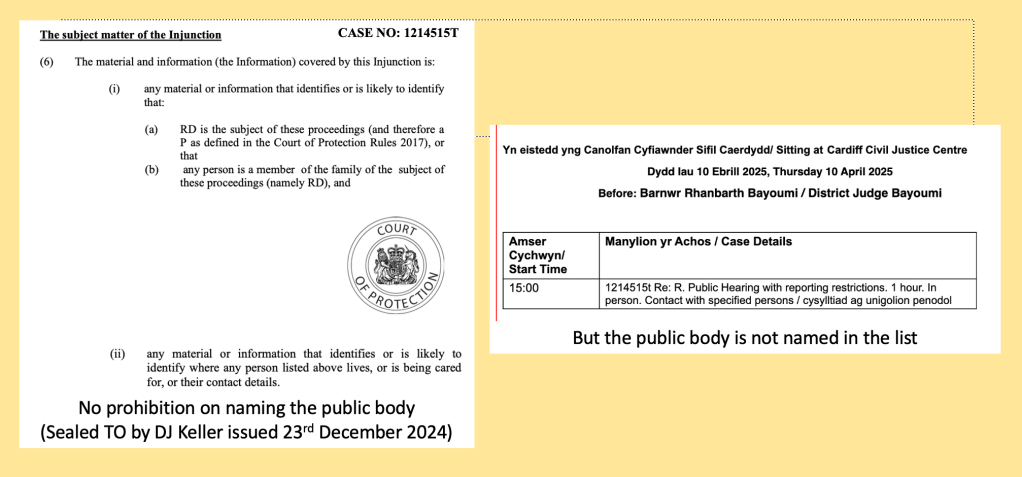
When the hearing started, there seemed to be some confusion about whether there even was a TO. But one was then located in the court “bundle” and emailed to both of us during the hearing. It was the sealed TO made by HHJ Hodges sitting in Chelmsford Justice Centre on 11th January 2023, and it’s in the standard form.   The “Information” we are prohibited from reporting is set out in §6:

Tim and I are both experienced observers. We know that we could be found in contempt of court if we report matters which we are forbidden to do by the TO and we both have experience of the court going out of its way to permit us to observe hearings about sensitive matters by drawing up careful reporting restrictions to protect Miranda’s privacy and any risks of harm.[5]

In my opinion, if there are sensitive matters which should not be reported, then they should be considered in advance and the TO changed accordingly. It should not automatically mean a hearing is made private. That is not open justice. Also, Tim, like me, is not a lawyer. We are just ordinary members of the public. It is very hard for us to make “submissions”. I think this should be recognised by the court. I now know that I should be prepared more for this, for example to ask that public bodies be allowed to be named. But like Tim, I would have been “flummoxed” if I had been there too. 

I don’t know whether the hearing on 28th March 2025 will be in public or not – or whether a video link for observers will be available if it is heard in public. I hope so, as I would like to observe to see what happens and be able to report on it.

Mr Justice McKendrick was clearly frustrated that more had not been done since 2023 to locate Miranda. I wonder if things will change before the next hearing. 

The approved Order by Celia Kitzinger

The approved order (dated 19th March 2025) says that the mother “must attend the next hearing at 12pm on 28th March 2025” before McKendrick J (either remotely or in person) and that if she doesn’t, she may be held in contempt of court and may be imprisoned, fined, or have her assets seized.

The father, must also attend the next hearing, in person, and must serve in advance a signed witness statement providing a clear chronology of his contact with his wife – including texts, WhatsApp messages, social media, emails, written correspondence, and phone calls, and any contact details he has used, and details of any means he believes the other parties could use to contact her. He must also provide information about the ownership of the property he jointly owns with his wife (and the equity in it) and his belief as to where his daughter is currently living.

Essex County Council must also serve a witness statement setting out its belief as to where P is living, why it is in her best interests to return to the UK, and the steps it has taken to ensure that the mother has received (in such a form as to “effect service” upon her) the previous injunctive orders, the order concerning today’s hearing and the approved order resulting from it. The parties are also asked to agree a note in respect of the law relating to (i) the legal test for withdrawal of proceedings and (ii) the Court of Protection’s jurisdiction when there has been a wrongful removal of P from the jurisdiction.

The order does not record that part of today’s hearing was held in private and that a public observer had been excluded by the court. A note on the face of the order simply records “THESE PROCEEDINGS ARE IN PUBLIC BUT SUBJECT TO A TRANSPARENCY ORDER…” (capitals in original) and one of the recitals records that the parties had been given “… permission to share their position statements with observers who attended this public hearing”. This implies the whole hearing was public – but according to Tim Sugden it wasn’t. This does not seem accurate, and I’ve asked for information to whether or not there is a separate order relating to the private part of the hearing. There is no indication in the order that the next hearing will be other than public in its entirety.

Amanda Hill is a PhD student at the School of Journalism, Media and Culture at Cardiff University. Her research focuses on the Court of Protection, exploring family experiences, media representations and social media activism. She is also a daughter of a P in a Court of Protection case and has been a Litigant in Person. She is on LinkedIn (here), and also on X as (@AmandaAPHill) and on Bluesky (@AmandaAPHill.bsky.social)

Tim Sugden retired in 2022, after a career in children’s services, to devote his time to providing accommodation and support to refugees from Ukraine.

Celia Kitzinger is co-director of the Open Justice Court of Protection Project. She has observed more than 600 hearings since May 2020 and written more than 100 blog posts. She is on LinkedIn (here), and also on X (@KitzingerCelia) and Bluesky @kitzingercelia.bsky.social)

This blog was edited on 31st March 2025 to correctly state that the meeting in November 2024 was between the LA and P’s representatives. It was further edited on 24th July 2025 to comply with (retrospectively) with a transparency order varying the initials to be used in reference to P and her parents.


Footnotes

[1] This information is taken from the Local Authority’s position statement. I asked the judge to grant permission to counsel to share their position statements with me, which he did after the hearing, and all three counsel shared them with me. I am grateful to both the judge and counsel for responding positively and quickly to my  request.

[2] We encourage other observers, especially those who don’t want to write blogs, to complete these Hearing Observation questions too – they are massively helpful to us, as this blog post demonstrates. You can find the form on our “Observer Resources page.

[3] “Closed material” means material which is put before the judge but (unusually) one of the parties is deliberately (by judge’s orders) excluded from access to it. This is lawful, under certain circumstances, and there is guidance as to how this should be done here: https://www.judiciary.uk/guidance-and-resources/guidance-for-the-court-of-protection-closed-hearings-and-closed-material/#:~:text=%E2%80%9CClosed%20material%E2%80%9D%20is%20material%20which,of%20a%20without%20notice%20application.

[4] We have blogged about many different contempt of court hearings, including: “A committal hearing to send P’s mother to prison”; “Committal hearing struck out and dismissed for procedural defects”.  It’s relatively rare for financial penalties to be imposed on people found to be in contempt of court: a recent example is the unpublished judgment in Norfolk County Council v Caroline Grady [2025] in which Arbuthnot J imposed a fine. We hope to be able to blog about this shortly.

[5] For example, I am bound by a very detailed TO forbidding the reporting of certain information about the protected party in another hearing I observed, (The patient with no friends or family: A challenge for best interests assessment) and Tim observed and participated in a hearing wholly devoted to working out reporting restrictions such as to permit public observation or and reporting on a case before HHJ Hilder, which also involves a committal hearing (ongoing – blog to follow). 

“I’m making these orders not for my own amusement, but for P”: Judge admonishes professionals over “disappointing” failures

By Gill Loomes-Quinn, 25th March 2025

I first came across this case on 9th October 2024 when I was looking for a hearing to observe. As frequently happens in the Court of Protection, the first one I found had been vacated (meaning it was no longer going to take place), so I’d requested a link for a second, and when this was also vacated, I started to feel the familiar tug between the desire to make use of the afternoon I had set aside to observe a hearing and the recognition that I was likely to be adding to the workloads of already overstretched court staff with repeated emails requesting links. I would quite possibly have given up, had not a particularly helpful court clerk in the Judicial Support and Listings Team at First Avenue House let me know that there was another that would be going ahead. That turned out to be COP 14155095 HMB – and this blog post covers two hearings: one on 9th October 2024 and another on 4thFebruary 2025.

First Hearing: 9th October 2024

I received later that day a link to the hearing and a copy of the relevant Transparency Order and was able to sign in and be admitted to the virtual waiting room shortly before 2pm when the hearing was due to begin. Counsel for the Official Solicitor representing the ‘protected party’ (referred to for the purposes of this case as ‘HMB’) –  Scott Storey – and  the barrister representing the Local Authority (the London Borough of Bromley)  – Kristina Hopper – were also in the waiting room, along with HMB’s mum and social worker.

            The hearing began with the judge (District Judge Batten) entering the courtroom at 2:11pm. She began by noting the presence of three observers – two online and one in the courtroom – and asking if there were any questions concerning the Transparency Order to which the proceedings were subject (there were none). She then asked Counsel for the Applicant (Scott Storey) to provide a brief summary of the background of the case so far.

            I learned from this that HMB is a woman in her early thirties living in the South-East of England. She has a diagnosis of learning disability and is said to be probably autistic. She also has diagnoses of “possible psychotic disorder” and anxiety disorder (i.e. agoraphobia/panic attacks) [1]. When she becomes anxious, she is said to “display some challenging behaviours”. HMB communicates verbally and “is able to make her views, wishes, and aspirations known with staff on simple matters” – e.g., choosing what to eat or wear and letting staff know if she is feeling unwell, although she is said to require “support with all her daily living activities”.

            The case before the court is an objection by representatives of HMB to a Standard Authorisation under the Deprivation of Liberty Safeguards (DoLS) – commonly known as a ‘s.21a challenge as it is brought under s.21a of the MCA 2005. This seems to be the culmination of a series of breakdowns in care and accommodation, which have involved HMB being moved repeatedly in a period of only a few years following a 5-month hospital stay that itself resulted from a “nervous breakdown” following a change in accommodation in late 2022. The ‘placement’[2] to which she was discharged from hospital in March 2023 broke down after only a few days as several incidents led to the home manager noting that HMB was at this time “a high risk to herself, other service users, staff, and members of the community”. A month’s notice was served in April 2023, but in what may have been a foreshadowing of challenges to come, the deadline for HMB to move out was extended by a further month “for an alternative placement to be sourced”. She then moved to her current home in July 2023. 

            The case is concerned with two tasks, specifically: (1) to identify appropriate accommodation and care package for HMB, and (2) relatedly – to ensure access to appropriate “care and therapeutic support” so she “doesn’t suffer” (as the judge phrased it) in her mental health and quality of life, while (1) is ongoing. The court heard evidence of ‘suffering’ in a “rough” attendance note following a visit to HMB on 3rd October 2024 by the solicitor representing her (Claire Langford). The note described HMB’s “presentation” during the visit as “not ideal” and indicated that “limited discussion” had taken place. During this discussion, HMB indicated that she is unhappy and bored, and that she wants to move – information that was received gratefully by the judge who affirmed the importance of hearing HMB’s views, “however rough” the form might be.

            Progress in identifying alternative provision for HMB has been far from ideal. Investigations prior to the hearing on 9th October 2024 had included a report by an independent social worker suggesting options of residential or supported living services, or an individual flat with a package of bespoke care. A key priority was identified as being geographical location so that HMB could be near her mum. However, when the judge came to enquire as to what progress had been made in locating an appropriate housing and care, she was demonstrably less than pleased – pointing out that the case is now one year on from initial application and asking, “Why does it take so long?”. She made an Order that before the next hearing, the Director of Adult Social Care should file a witness statement outlining what care and home have been identified; and if this has not been achieved, explaining why not.  

            Reasons were given for these delays, which seemed to fall into two categories: 1) Counsel for the Local Authority pointed to a lack of appropriate results from the “extensive placement searches” carried out by the Local Authority placement team – who were “on it”, but unfortunately “not much has returned”; and 2) Arising from probative questioning by the judge, a lack of clarity among the parties about what sort of placement or location is in HMB’s best interests. 

            The judge also heard from HMB’s mum, who pointed to the impact on her daughter of the current situation. She said that she sees the judge “making things happen” (via directions) but that HMB “is the one missing out”. Her daughter used to want to go out of her home but now finds it too overwhelming and “overthinks”. HMB’s mum explained that her daughter “needs people to keep trying” when she refuses to leave the home due to anxiety, rather than simply giving up after the first failed attempt.

Second Hearing: 4th February 2025

At the second hearing, there was new counsel for each party: HMB was represented by Stephen Williams (via the Official Solicitor), with Nikita Pierpoint appearing for the ICB (which had been joined as a party following the previous hearing). I was unsure about representation for the Local Authority as Zoren Nettey (an in-house solicitor) was present via remote link, but I couldn’t identify any barrister acting for the Local Authority, and the judge and Nettey interacted at various points during the hearing. 

            There is still no ‘placement’ identified for HMB, and her mum reports concerns about further impact of the delay and inappropriate home and support on her mental health and levels of anxiety. Williams was able to provide an “update of sorts” – as apparently HMB’s mum has been in contact with a potential new placement, which she has visited. The manager is “on Annual Leave until next week” but then an assessment can begin as to HMB’s suitability for the place.

            The judge was very critical of various failures to comply with Orders made at the previous hearing. It transpired that the Director of Adult Social Care had failed to provide a witness statement in compliance with the Order made on 9th October. In response to an attempt to account for this by Nettey, she responded, “That the Director of Adult Social Care is new in-post is not my concern” and “I’m making these Orders not for my own amusement but for P” – adding that any further such Orders “may have a penal notice attached”. And in response to the failure (again) of parties to hold a Round Table Meeting prior to the hearing, she exclaimed, “I’m completely at a loss to understand why a group of professional people can’t agree a date for a [meeting]”. 

            The ICB was also a focus of the court’s displeasure. They had been joined as a party at the previous hearing though it was clear they were dissatisfied with this and had initially asked to be discharged, with their Counsel subsequently indicating that they were “led by [other] professionals” and viewed the Local Authority as the “lead authority”. The judge admonished them, saying she expected them to be playing a “key role” rather than a “remote – ‘I’ll send you a list’ – role”. She ordered them to attend the next hearing in person.

            In conclusion, an Order was made retaining the ICB as a party (with the caveat that after the next hearing they were not required to attend if there was nothing specific for them to do). The 12 months of the DoLS Standard Authorisation was confirmed as still having time to run. The court wants to see improvement in record keeping regarding HMB’s daily care and activities and the manager is to liaise with the social worker to ensure this. The inadequate explanation for lack of input by the Director of Adult Social Care was noted, with the judge emphasising that hearing from them was “urgent”. A detailed witness statement was ordered to be filed by 28th February, with HMB’s mum being permitted to file a statement in response by 7th March if she wishes. The judge also hoped that HMB’s solicitor could visit her and file a note by 7th March as HMB’s views are “crucial at this point”. A Round Table Meeting must take place during the week commencing 14th March with a date to be agreed immediately after this hearing, and “the court will not be impressed if you fail”. A further hearing will take place as soon as possible after 24th March 2025 with the court clerk notifying the parties of the date. This will be a hybrid hearing with all parties except HMB’s mum being required to attend court in-person.

Reflection

As with any member of the public who observes COP proceedings, I bring to my understanding and interpretation of any hearing relevant aspects of my own experience and identity – notably as a disabled activist with complex health needs who receives social care. In this case, the seemingly glacial slow speed of progress in identifying appropriate accommodation and care for HMB – and the related apparent lack of such resources seemed to mirror my own experiences of delayed assessments followed by lack of available services to meet assessed needs. Similarly, I have experienced the collapse of care packages as providers “couldn’t meet my needs” causing me to empathise with the reported circumstances preceding HMB’s admission to hospital. It can feel as though a care package is both the elusive pot of gold at the end of the rainbow and a house of cards just waiting to fall down at the slightest breath of wind. 

What else stood out to me was how a significant part of each hearing was taken up with the judge asking probing questions to establish what each party believed was being worked towards for HMB – often revealing misunderstandings or lack of certainty among the parties and their legal representatives. It seemed as though what was going on between hearings was a game of ‘Telephone’ in which objectives became distorted over time and when passed between parties and colleagues. And the failure of “professional people” to organise a pre-hearing Round Table Meeting that so exasperated District Judge Batten seems to have exacerbated further the need to use court time for this case management function. 

As someone who must also rely on such “professional people”, it was difficult to watch this play out in court.  Those of us for whom health and social care services mediate access to the fundamental safety, dignity, and quality of life that many people take for granted need those professionals to work and communicate effectively, because there is so much resting on it for us. Such professionals have accepted a role in which they take on the responsibility that comes with the trust we place in them. We have no choice but to place our faith in others to facilitate fundamental aspects of our personal and social wellbeing – and that is hard enough – but to see the efforts of those individuals and organisations in whom we must place our faith falling short with such alarming regularity can be galling.
While I noted several aspects of ‘overlap’ or resonance between my own and HMB’s circumstances, observing these two hearings also prompted me to reflect on a key difference between her situation and mine – i.e., the involvement of the Court of Protection. The COP is constituted through the MCA 2005 as the arbiter of disputes regarding mental capacity and best interests, but what I saw in these two hearings led me to consider further facets of the court’s role in terms of case management and ‘advocacy’. 

There were several examples across the two hearings of the court managing the ‘case’ – which importantly means not only the legal case before the court, but the health and social care circumstances out of which this legal case has developed. The use of Court Orders to compel a Director of Adult Social Care to account for a lack of progress via a witness statement (from which the title of this post is taken) was particularly powerful given the threat of a penal notice attached to future Orders in the event of (further) non-compliance. This, of course, highlights a key aspect of what makes the COP’s involvement unique – it comes with the power to hold those who fail to do what it has ordered them to do (by the deadline it has set) in Contempt of Court. I have had (and continue to face) many situations in which those involved in my care have attempted to compel “professional people” and public bodies to do what they should be doing to secure my care package but have failed to deliver. But no one advocating for me in this way has ever had the authority to promise a penal notice in the event of future non-compliance. This seems to be a distinction that differentiates health and social care cases that become ‘welfare cases’ before the COP from those that don’t.
This, in turn, points to another feature of the court’s function that I observed in these hearings: i.e., how it goes about advocating for P’s ‘best interests’ alongside determining what these should be. As well as emphasising the importance of hearing P’s views (via her solicitor’s attendance notes), the judge was repeatedly explicit about her concerns for HMB’s “quality of life” and access to therapeutic input while the search for appropriate accommodation and care is ongoing. As I’ve indicated, the judge also expressed surprise, frustration, and exasperation throughout at the lack of progress and failure of “professional people” to comply with Court Orders and to make progress in identifying appropriate accommodation and care for HMB. It may be said that no amount of angry discourse directed at public bodies during COP proceedings is of itself going to make a material difference to P’s circumstances – in HMB’s case, she still lacks the accommodation and care deemed to be in her best interests. But as I observed these hearings, I reflected on the times when I have been let down by health or social care professionals who have failed to do what they promised. In my experience of such situations, it isn’t only the material circumstances that have a deleterious impact on one’s wellbeing – it is the feelings of powerlessness, invisibility, and ‘voicelessness’ that come with such circumstances. Although the COP may not be able to compel a public body to provide facilities or services to meet the needs of a disabled person (see further: the Supreme Court case of N v ACCG & Ors [2017] UKSC 22), I observed the judge’s surprise and exasperation at the lack of progress in HMB’s case as performing a function of delegitimising and ‘calling out’ the situation. When one finds oneself repeatedly let down by those on whom one is forced to rely, it can begin to feel as though this is all one is entitled to expect – as though such experiences are to be deemed socially acceptable. While discussing my experiences with others leads me to suspect that the majority of society is simply unaware of how health and social care bureaucracy works (or doesn’t work), it can feel as though in failing to exhibit surprise or disapproval at failures of care, society legitimises the situation. Hearing such disapproval from someone exercising the authority of the court (in open court) felt like a powerful counter to such tacit social legitimisation that I wish more of society could (or would) hear. 

Observing these two hearings caused me to feel empathy and deep anger that HMB is being failed by the bodies (and ultimately the State) in whom she, and those who care about her, should be able to place their trust. But I also had cause to reflect on the ‘advocacy’ potential to be found in the role of the COP in ‘welfare cases’ – and how this potential might be  harnessed further in the pursuit of social justice for disabled people. Of course, I think the fact that this role is exercised in public is fundamental to its impact, and the first step is for more disabled people, and our allies and advocates, to observe COP hearings – to bear witness when the court exercises such ‘advocacy’ and to seize its momentum for social change.

Gill Loomes-Quinn is co-director (with Celia Kitzinger) of the Open Justice Court of Protection Project. She can be found on Twitter and Bluesky @GillLoomesQuinn and on LinkedIn here.


[1] In drafting this post, I have drawn on position statements in addition to my own notes from the two hearings I have observed in this case. Given the general prohibition of recording of court proceedings, any quotes included from my observations are as accurate as possible but should not be assumed to be verbatim. 

[2] I noted that the term ‘placement’ was used throughout both of the hearings I observed in this case (and in the relevant position statements) to denote accommodation either assigned to or sought for HMB. I know that of course the use of such vocabulary is ubiquitous in professional discourses concerning disabled people – particularly those with learning disabilities. And some may seek to justify its use (as opposed to more ‘everyday’ terms – e.g., “home”) to indicate the ‘specialist’ nature of such accommodation. However, this brought to mind for me the ‘othering’ that is central to how disabled people and our life experiences are typically portrayed in and perceived by wider society. I had cause to wonder if/how reference to the search for a “home” for HMB (with the attendant connotations of privacy, safety, security, comfort, and family – as well as familiarity for professionals themselves), rather than a “placement” (with implications of non-domestic clinical sterility, and almost certainly distinct from the domestic arrangements of the legal, health, and social care professionals involved) may have made a difference to the case, or professional attitudes to it –  both inside and outside of the courtroom. For some more examples of the harmful language used by professionals in relation to the lives of disabled people, check out this short video by Rightful Lives.

Feeling foolish and frustrated: How I failed to observe an RCJ hearing due to an uncorrected listing error

By Amanda Hill, 23rd March 2025

I was excited to be travelling to London to observe an in-person hearing at the Royal Courts of Justice (RCJ) as part of my research with Cardiff University.  

This would be my third time observing in person at the RCJ and I was beginning to feel as though I knew what I was doing and how things worked. The evening before, when the listings were published, I’d identified an 11.30am hearing (COP 14070782 on 8 October 2024) before Mr Justice MacDonald in Court 39, which I knew was in the Queen’s Building, the newer construction behind the Gothic splendour of the old building that always appears in photographs of the RCJ. 

I arrived in good time at 9.50am. It was just as well, because I ended up queueing behind a school party going through security just ahead of me. The security staff didn’t seem as ‘fierce’ as they had done the day before when I was there, and were waving people through saying “Morning” and “Have a good day” as they checked them in. 

I double-checked the Daily Cause List printed out and pinned up in the glass cabinets in the middle of the impressive Grand Hall. I could see that the listing for the hearing I wanted to observe was still the same – it was in fact the printed internet page from the evening before, timed at 19.01:

I approached the enquiries desk and said that I wanted to observe the hearing in Court 39. Straight away, the member of staff helpfully gave me the map to show me where the courtroom was. There was no suggestion that it would be in private or that it wouldn’t be happening as listed. 

After a leisurely coffee in the on-site café, taking in my surroundings, I walked over to the Queen’s Building.

At around 11am, there were a few people around. I looked at the Daily Cause List in front of the court room door to triple-check the hearing was going ahead in that room, but the only list on display was for hearings before Mr Justice Poole from the week before. 

The lights were on in Court 39 and I could see somebody tapping away on a computer in front of the judge’s bench, so I assumed that that was the judge’s clerk.  I could also see one man in a consultation room next to Court 39, with the door open. My plan was to wait and see what happened around 11.30 (when the hearing was due to start), and follow other people into the courtroom when people started to move in. There also were a couple of people just in front of the court room who I assumed were waiting for the same hearing that I wanted to observe – but they left shortly afterwards so obviously not – and as time went on there  were fewer people in the lobby area in front of the court rooms.  

I sat and waited.

When 11.30 came and went I assumed that the previous hearing before the same judge was running late.  The list told me that there was a 10.30 “urgent” hearing (not a Court of Protection one) by MS teams.  It’s not unusual for hearings to run over their allotted hour and for subsequent hearings to begin late, so I just kept an eye on what was going on inside the court room. There were no signs of an in-person hearing going ahead.

At 11.38 I checked the listing using my phone to see if the listing had changed but it hadn’t.  The 11.30am hearing was still there and it still said it would be heard in open court in Court 39.

Nobody went into courtroom 39 and nobody came out of the courtroom to say what was happening with the hearing. 

At 11.43 I saw the judge in there, along with the staff member. The judge  was sitting at the bench looking at his computer.  

By 11.46 the judge had gone ,but the staff member was still at her computer. I felt  very uncertain as to what I should do. I kept looking through the glass panel window on the door. Should I go in and ask what the situation was? But I was worried that the urgent hearing from 10.30am (a private family one) might still be going on, and that the staff member would be involved with that. 

At 11.50 the judge sat back down at the bench but again did not stay long. 

At 12pm I decided to email the RCJ staff to tell them I was waiting to observe the Court of Protection hearing in person and asking what the situation was: 

By 12.10 there was still no news or signs of movement. Nobody was around apart from the people in the consultation room nearby behind the (now) closed door. I was feeling very frustrated and a bit stupid. I wondered again whether I should go into the courtroom and ask the staff member at the desk what was happening. I knew the hearing was not likely to continue past 1pm (when the court usually breaks for lunch) and time was ticking on. 

By 12.19 I hadn’t had a reply to my email, so I rang the RCJ number published on the Open Justice Court of Protection “Featured Hearings” page.  The phone was answered quite quickly and I spoke to a staff member and gave her the hearing details. She checked and said ‘they should be in court’. I told her that I was sitting in front of the court room and that I couldn’t see anyone in the court apart from a member of staff sitting at her computer. She put me on hold for a few minutes and then she came back, apologizing for keeping me waiting. She said that she had contacted the court associate who had told her that the hearing had been held remotely by MS Teams that morning. I’d spent 7 minutes on the call: 

So, I had missed the hearing

Having gone specifically to London to watch COP hearings, spending the whole morning at the RCJ and having sat outside the court room for an hour, I couldn’t believe it that this had happened.  I felt so foolish: it was such a waste of my time and a missed opportunity for open justice.   

At 12.30 I left the building without having watched a hearing, feeling very dispirited about the whole experience. 

What could have been done to support transparency?

As co-director of the Open Justice Court of Protection Project, Celia Kitzinger wrote to the court afterwards to find out what had gone wrong and received the following reply: 

Note: I did not (as the email says) “attend the public counter” about my concern – I’d phoned; and I think on the account given, a hearing did take place briefly to approve the agreed order (agreed orders are often approved “on the papers” and the hearing is vacated but that doesn’t seem to have been the case here).  But these are issues in passing, and not the key point.

A number of things could have been done in this situation.

  • The online listing could have been corrected promptly, but only if someone – the judge or judge’s clerk – had checked the list, seen it was wrong, and  told the listing team that it was wrong and asked them to correct it.
  • The paper daily cause list outside the courtroom could have been updated. By coincidence, I had booked a tour of the RCJ that same afternoon and the guide said that the printed paper notices (at least outside other courtrooms) were frequently annotated in pen so that the public were kept up-to-date. This would have required the court staff to look at the list and realise that it was wrong – which they would have known, obviously, since they were managing a remote hearing and the list said it was an in-person hearing – so court staff were in a position to do this.
  • A member of staff could have checked the corridor outside the court to see if anyone was waiting to observe as a consequence of the case having been wrongly listed and invited me into the courtroom, notwithstanding the fact that it was now a remote hearing (and a very brief one). This is what happened in another case we’ve blogged about: a hearing was changed from being in-person to remote and an observer who had travelled to observe the hearing in person was invited into the courtroom to observe the judge conducting the remote hearing (see Observing a remote hearing in court with the judge).  In that case, it seems that the hearing had also been wrongly listed as “public” when in fact it had been intended to hear it in private. Displaying a firm commitment to transparency, the judge  (HHJ Hilder) said: “Since Professor Kitzinger has taken the trouble to come to court, I made a Transparency Order and we are sitting in public” – and, “just to clarify,” she added (addressing the observer) “you would have been welcome to attend if it had been a private hearing”. 

Transparency is in peril when it’s made so challenging for would-be observers to access court hearings.  If errors and  last-minute changes are inevitable (and perhaps some are), then at least steps should be taken to facilitate observers, either by provision of remote links to in-person hearings, or by admitting observers to otherwise empty courtrooms where judges are conducting remote hearings.

The judiciary, lawyers and HMCTS staff need to work together to avoid errors and to improve procedures to ensure that we’re not excluded and left feeling so dispirited and disempowered about open justice.

What was the hearing about?

The point of my going along to the Royal Courts of Justice that day was to observe justice being done, in person, and report back to the public on what I saw. I can’t report on the process, but I do know a bit about what happened because I asked the judge for the approved order from the hearing and eventually (two months later) received it.  This means I can provide an update on what’s been happening in this case.

Another observer (Celia Kitzinger[1]) had watched – but not blogged about –  a remote hearing in this same case back on 10th July 2023, also in the Royal Courts of Justice, but before a different judge (Mr Dias KC).  

At that point (July 2023), the protected person, LO  – described as “a 17-year-old with significant impairments” – needed psychological support but there were difficulties in obtaining this and the parents’ lawyer (Ben McCormack) sounded very frustrated:  “Why are we sitting here time and time again to ask for directions: the psychologist left employment and it’s taken us six months to find another psychologist and get the authorities to agree to pay for one!”.  He said – rehearsing a familiar refrain in the Court of Protection – “this litigation is characterised by agreement, but also by delay”. 

The parents were also trying to get the authorities to plan ahead for when LO turned 18 in the course of the coming year, at which point he would transfer to adult services.  Would LO qualify for Continuing Health Care? Where would LO live?

Counsel for LO’s parents said: “The agreement is that LO will live at [X Placement] in [City] and it’s likely everyone agrees he should live there after he turns 18 – but it is absolutely mission-critical that [X Placement] starts that intensive hefty process to become registered with CQC”.

So, what’s happened with the “mission-critical” CQC registration?  

The approved order from the hearing I failed to observe (so three months later) says that LO’s support provider “remains unregistered with OFSTED” and that LO’s placement has “informed [the local authority]  that they will not be pursuing CQC registration” and it “is therefore also unregistered with the CQC”.  The landlord has also served notice.  The public bodies[2] were looking for a new place for LO to live long-term.[3]  This situation has serious implications for LO (and his family) and is a legitimate matter of public interest.  This is exactly the kind of thing we need to be reporting from the Court of Protection.

At the hearing, the judge authorised the continuing deprivation of LO’s liberty as being in his best interests, reallocated the matter to another judge (Mr Justice Poole), and ordered the local authority to come up with a list of options for – and best interests analysis of – different care providers and placements, plus if relevant a transition plan and a care and support plan.  There were also other issues relating to internet use and contact, plus the local authority was required to address “whether, and to what extent, external support may be required from a behavioural specialist and/or psychologist”.  

The matter was listed to come back to court on the first available date after 16th December 2024 before Mr Justice Poole.  

The next time we spotted it in the listings was 12th February 2025, so that probably was the first available date.  It appeared as “in Court as in Chambers” which is a fancy legal way of saying “in private”.  

We were puzzled about why this hearing had been listed as private, given that both the hearing Celia had attended remotely, and the one I’d tried to attend in person, had been listed as “public”.  When we asked about this, we were simply told this hearing had been “vacated” (i.e. it wasn’t happening), so we are none the wiser about whether (and if so why) the case is now being heard in private.  It might be another mistake – or it might not.

We also don’t know why the hearing listed for February 2025 didn’t take place.  It might be because everything has been done in accordance with the judge’s directions and LO is settled in his new home with the support of a psychologist, and all of the parties have agreed that a hearing isn’t needed.  Or it might be because the case isn’t ready to be heard again – because (for example) the local authority hasn’t yet assembled a list of options for places where LO could live, or has not worked out agreement to funding them, in which case there would be no options for the judge to consider and make decisions about in LO’s best interests.  We just don’t know.  We’ll be keeping an eye out for this case coming back to court in the future.

This blog illustrates the difficulty of tracking hearings of cases we’re interested in across the months and years that they’re before the court and, in particular, the challenges we face when hearings are wrongly listed as “in person” and no steps are taken to correct this.

Transparency requires the judiciary, lawyers, and court staff to be alert to the possibility of would-be observers at their hearings and proactively to facilitate our attendance.

Amanda Hill is a PhD student at the School of Journalism, Media and Culture at Cardiff University. Her research focuses on the Court of Protection, exploring family experiences, media representations and social media activism. She’s a family member of a protected party in a Court of Protection case and acted as a Litigant in Person. Amanda is on LinkedIn (here), and also on X as (@AmandaAPHill) and on Bluesky (@AmandaAPHill.bsky.social)


[1] Thank you to Celia Kitzinger who wrote the paragraphs about what happened in the July 2024 hearing and to Daniel Clark who raised concerns about the “private” listing of this case in February this year.

[2] Celia Kitzinger has no record of having received a Transparency Order for the hearing she observed on 10th July 2023 (despite emails asking for one).  I was sent the approved order – which includes lots of names of both public bodies and individuals involved in this case – but no Transparency Order. So this blog post has been written without any injunction concerning reporting restrictions having been served on us at any point.  In accordance with the standard restrictions imposed by these Orders, we have not published P’s name, the name of his family members, anyone’s contact details, or anything likely to identify any of these people or where they live.  We have also – to be on the safe side – chosen not to name the applicant local authority or the respondent integrated care board – those these should be (and normally are) in the public domain.  We have asked for a Transparency Order and will amend this blog post as necessary if or when we receive it. 

[3] The blog post cited earlier (Observing a remote hearing in court with the judge) is also about lack of progress in finding an adult placement for a young person transitioning to adult care and – coincidently – raises remarkably similar concerns.

Correcting judicial mistakes: HHJ Robertshaw’s transparency order

By Celia Kitzinger, 16th March 2025

Everybody makes mistakes sometimes. Even judges.

Some mistakes can be inconsequential: a typo, a bit of grammar that doesn’t make sense, paragraphs wrongly numbered. I’m not complaining about mistakes like that, what someone on X described (in response to my complaints) as “dotting the ‘i’s and crossing the ‘t’s”. Obviously it would be better if judges did pay attention to details like this – and goodness knows they are often enough described as “pedantic” and obsessed with precision of language – but I have better things to do with my time than correct these sorts of errors.

The mistakes that really matter include, for example, breaching the privacy rights of the person at the centre of the case. Or mistakenly banning observers from naming public bodies, paid for with our taxes and accountable to the public. Or not making it clear who is being referred to when injunctions say we can (or cannot) name someone under certain circumstances (it does needs to be clear which person exactly!).

Transparency orders are injunctions from the court that come with penal notices. It says on the face of the order that if we disobey them, we may be found guilty of contempt of court, and then sent to prison, or fined, or have our assets seized. That means I want to be very sure I understand what it is that the court is telling me I must not do. You’d think the court would want to be sure too – and that they’d make these orders as clear as possible. But in practice, they’re written in complex legal language that make them difficult for most ordinary members of the public to understand. Worse still, they’re often riddled with errors – as we’ve documented many times before.

For example, some orders say we can’t name public bodies – and in our experience that’s a mistake about 90% of the time. But there’s that other 10% or so when the judge has decided that there are good reasons for a public body not to be named (e.g. to protect P’s privacy) – so even if it is a mistake (and we know it probably is) -if it’s in a court Order, then we can’t just go ahead and name the public body and then say if the court objects: “oh I assumed it was a mistake in the order, as it usually is”.  The consequences (both for us and for the person at the centre of the case) are too serious if we get it wrong.  If the order says we can’t name a public body, then we can’t name the public body: our Project won’t publish a blog post that names the public body if the Transparency Order forbids it – however unlikely it is that the judge actually intended to stop us from doing so (see: What to do if the Transparency Order prevents you from naming a public body).

So, we’re constantly emailing court staff asking them please to check with the judge whether that’s a mistake, and please could the judge correct that mistake if it’s wrong. Sometimes corrections are done quickly – especially if the judge is able to deal with it right away, orally, in the course of a hearing – but even then it can take an hour or so of our time to write a formal letter explaining the mistake and citing the relevant law. Sometimes it can take weeks or months to get obvious mistakes corrected – especially if we’re required to fill in a formal application form (a so-called COP 9) and then, sometimes, go to court ourselves to defend our position. I describe one case where it took four months here: Prohibition on identifying Public Guardian is “mistake not conspiracy”, says Judge

It’s got to the stage now where I dread opening the electronic documents labelled as transparency orders that pop into my inbox when I ask to observe a hearing. Will there be mistakes? How much of my time (and the court’s time) will it take to correct them? And why, oh why, can’t judges get it right first time (as some, eventually, do, see: “Getting it right first time around”: How members of the public contribute to the judicial “learning experience” about transparency orders).

Five mistakes in one transparency order: COP 14225316 (HHJ Robertshaw) – and listing errors for good measure

This blog illustrates the problem with transparency orders by showing five mistakes in one of them. This transparency order was made by HHJ Robertshaw sitting at Bristol Civil and Family court on 18th March 2024. Her order was kept on file and used for subsequent hearings in the same case. The hearing I attended was nearly a year later, before a different judge, District Judge Mark Tait, sitting in the County and Family Court at Gloucester and Cheltenham on 28th February 2025. That’s the first time I saw this transparency order – sent in response to my request to observe the hearing – though I’m pretty sure there must have been several other hearings in the same case, with the same transparency order in the bundle each time, and nobody noticing the mistakes.

In fact, the mistakes with this case began before I even received the transparency order. Here’s how it was listed in Courtel/CourtServe, which is the only way members of the public normally learn about cases.

Obvious errors here: the word “restricted” shouldn’t be used for Court of Protection hearings (I think it’s intended to refer to the fact that there is a transparency order, which is what it should actually say). There’s no information as to what the case is about (there’s a drop-down list of menu options (e.g.”deprivation of liberty”, “section 21A”, “capacity for internet use” etc) that hasn’t been deployed; and it doesn’t say that it’s public. There’s also no case name. The case name that should, I learnt later, have appeared in the listing was: “Gloucester County Council v TD“.

And then I was sent the transparency order (it had been “approved” by the judge, and “sealed” by the court) – and my heart sank. I got out a red pen and started correcting it.

Mistake Number 1

Look at the face of the order: I’ve photographed it below. The applicant is listed as “GCC” (which I quickly figured out must be Gloucester County Council, since the case was being heard in Gloucester – but this should have been properly spelled out on the face of the order). The respondent is the protected party at the centre of the case – by his accredited legal representative (ALR as they are routinely referred to in COP jargon, all explained here: “Accredited legal representatives in the Court of Protection“). Contrary to all the guidance, his full name is displayed on the face of the order. Instead the court should have assigned initials – and in fact, it had: in this case, I later learnt, the initials chosen were TD. (Obviously I’ve concealed his name in the image below).

Mistake Number 2

The name of the protected party also appeared (twice) in the body of the order itself. That shouldn’t have happened. The assigned initials should have been used instead.

Mistake Number 3

Then there’s a paragraph where some initials are used – but they aren’t the initials the court has assigned to the protected party in this case (TD) but someone else’s initials (“CB”) – and CB is described as “the subject of these proceedings” – which they clearly are NOT. Was someone perhaps using a previous template and forgot to delete the last person’s initials?

Mistake Number 4

Having put the protected party’s name on the face of the transparency order, and referred to him (twice) by his name in the body of the order – and failed adequately to protect him since 6(a) above protects someone called “CB” instead – the order finally does belatedly provide P with some possible protection by preventing us from publishing anything that identifies or is likely to identify “anyone who is a party to these proceedings” (though we’ve been told in 6(i)(a) this is “CB” not “TD”).

Unfortunately, the formulation in 6(i)(c) can be read as covering all parties, including the public body – which isn’t named on the injunction but is referred to by its initials on the face of the order as GCC. So, another order apparently banning us from naming a public body. (Oh, and the words “or that” at the end of (6)(i)(c) make no sense – I suspect because there are missing initials for another person which should have been at the beginning of (d).)

Mistake number 5

Then there’s an order that information can be released “for the purposes of caring for […..]” 9(i)(e) – and who is that? No initials fill the blank. I presume that is where TD’s initials should have gone.

Correcting the mistakes

Once I’d looked through the transparency order and marked up the mistakes in red ink, I wrote a careful, detailed respectful email to the judge who was hearing the case (who wasn’t the judge who’d made this transparency order) asking him please to correct the errors. I sent this to the court staff, by replying to the email address from which I’d received the transparency order. It took me about an hour to make sure I’d spotted all the mistakes and write the email explaining to the judge what they were and why they needed correcting.

The formal process for making changes to a transparency order involves filling in a form (with all sorts of information extraneous to requirements for this purpose) and then sending it to the court, waiting for it to be “issued”, and then for a judge to look at it and make a decision about where the matter should go from there. It can take months! I said in the email that I hoped to circumvent this process: “I know I can make a formal COP 9 application to vary the TO, but I wonder if it might be more efficient (and less costly of court time) if I simply note the following points, which I would be grateful if you could raise with the judge before the 2pm hearing“. And then I listed the corrections required.

It was frustrating to get a response from the court staff saying: “Thank you for your email. I understand that you are trying to save some time by not submitting a COP9 application however an application needs to be filed for a Judge to review and/or amend the transparency order“. I know that’s not true in practice. Judges have often reviewed and/or amended transparency orders without my filing a formal COP 9 application – on the basis of either an email, or my oral submissions in court. In an email forwarding this response to senior HMCTS staff I commented: “this is nuts!” (for which intemperate language I subsequently apologised). I was surprised that senior staff too confirmed that “The process to amend the transparency order provided for by the Judge is as mentioned to file a COP9, the Judge will need to consider the points formally and any amendments required, and therefore a COP9 should be submitted, this is the process as set out within the Courts procedures.”

By now it was 12.14 and the hearing was at 2pm, and my hope that the judge would deal with it swiftly at the beginning of the hearing was fading fast. I spent the next 45 minutes cutting and pasting my email onto a COP 9 form, wrestling the form into submission (it didn’t want to take as many characters per text box as I’d written) and filling in extraneous information required. It did not feel like a productive use of my time to do this, nor did I think it a good use of the court staff’s time to have to process a formal application this way.

Depressed by the COP 9 response, and envisioning this as another episode that was going to drag on for months, I asked three other members of the public to request the link and come along to the hearing to see how it was dealt with. It was fairly shocking to me that after I’d already informed the court about the problems with the transparency order (especially the risks posed by circulating a document with TD’s full name on it), all three of the additional observers were sent the transparency order, uncorrected.

A happy ending?

I received a response to my original email (not to the COP 9 form submission) saying the judge could see no difficulty with my requests for variations to the transparency order.  Then right at the beginning of the hearing, after everyone had been introduced, DJ Tait said “The transparency order was made by HHJ Robertshaw and issued on 2nd April 2024. I’m grateful to Professor Kitzinger, who raised issues with the order, and I’m minded to adopt every recommendation that she makes. It’s important to get it right.” Then he went through the order, instructing counsel to make all the changes I’d pointed to, saying again that he was “grateful”.  So, that was good.

But it had taken hours of my time – and involved other observers and court staff, and also occupied about five minutes of court time during the hearing, plus the time the lawyers would now have to spend correcting the mistakes on the order. And, several weeks later, I’ve not received the corrected version of the order. It would all be so much better if they could get it right first time around.

There’s another cost too. It turned out that TD is a young man who’s in an unregulated placement which isn’t suitable for him. The local authority has located an alternative placement, but is unable to identify a registered manager to manage the placement. They’d offered the job to one person, but then had to withdraw the offer after that person tried to change the conditions of employment. TD’s mother was in court and quite distressed by what was going on. She said it was “overwhelming“. She felt “frustrated, disappointed – all this is taking so long. I feel quite emotional“. She wasn’t blaming anyone and nobody seemed to think it was anyone’s fault, and everyone seemed to be working very hard to try to solve the problem of TD’s placement. But it was obviously an upsetting time for TD and his mother. It’s unfortunate that the judge’s attention was diverted, at the beginning of the hearing, onto the transparency order instead of being able to address, right away, the substantive business of the case. It was also unfortunate that nobody had prepared TD’s mother for the possibility of observers in court. I don’t know if she minded us being there (one observer thought she did; I thought her focus was on her son and we were no more than a peripheral irritation) – but I wish the corrections hadn’t been necessary.

Here’s what two of the other observers said:

My overall impression is one of sorrow for ordinary people involved and how little they will probably be aware of the impact of these types of errors. Clearly privacy was important to Mum, upset that no notice was given about observers being present – and she kept her camera off the whole time. The system needs appropriate controls and accountability when errors keep being repeated. In my opinion, it’s sloppy, harmful and unneccesary. Goodness knows there are enough well-remunerated people in these processes who should be preventing this occurring.” (Angela Killeavy, public observer)

From my experience, I suspect they involve cutting and pasting of previous Transparency Orders and they often seem to be an afterthought, a supplementary part of the process of preparing for a hearing. I just don’t think that those involved in drafting them have any idea of their impact” (Amanda Hill, public observer)

I know that, in the real world, it’s not judges who literally compose these transparency orders. Someone else (paralegals, or solicitors?) tries to paste the relevant information into a template and puts it before the judge. But judges are approving them (surely, sometimes, without reading them?!) and off they go to be sealed by the court. In my view, the buck stops with the judge. It’s their order.

Everyone makes mistakes – even judges! But it takes all of about 3 minutes to spot mistakes in transparency orders (if only someone would check them before sending them out to observers) – and it’s surely not that hard to get them right in the first place? And when observers do spot mistakes and proffer corrections, we really appreciate the swift and courteous response of judges like DJ Tait.

Celia Kitzinger is co-director of the Open Justice Court of Protection Project. She has observed more than 600 hearings since May 2020 and written more than 100 blog posts. She is on LinkedIn (here), and also on X (@KitzingerCelia) and Bluesky @kitzingercelia.bsky.social)

Contempt of court proceedings: Are they transparent?

By Celia Kitzinger, 9th March 2025

This is an expanded and updated version of part of the submission I made on behalf of the Open Justice Court of Protection Project to the Ministry of Justice Law Commission Consultation on contempt of court. I plan to publish the other parts of my submission in a separate blog post. The consultation closed on 29 November 2024 (although a supplementary consultation not germane to the matters raised in this submission is currently ongoing).  There is more information about the Ministry of Justice  consultation (click here), and their consultation paper can be downloaded here: Ministry of Justice Contempt of Court Consultation Paper.

The proposals put forward in the Ministry of Justice Contempt of Court Consultation Paper involve four broad lines of reform, the second of which is described as “a move towards transparency and accountability”.  In my view, the suggestions on this front do not go nearly far enough and do not address the practical barriers to transparency and accountability as they (repeatedly) manifest in the Court of Protection.

In my response to this aspect of the Consultation Paper, I draw on the experience of the Open Justice Court of Protection Project to document the extent to which the court – in practice –  fails to ensure that contempt of court proceedings are transparent. In practice, the conduct of these proceedings often fails to comply either with the (updated) Lord Chief Justice’s  Practice Direction on committal for contempt of court or with recent guidance in case law, notably the guidance in Esper v NHS NW London ICB [2023] EWCOP 29, in which Poole J offers a thorough review of the rules around contempt and transparency –  including the interplay of different regulations. In addition, I suggest the rules and guidance need developing to further support transparency, in ways that go beyond the proposals in the Consultation Paper.

This blog post has five sections:

(1) Non-publication of contempt of court judgments

(2) Lack of comprehensive data about contempt proceedings

(3) Recurrent listing failures 

(4) Access difficulties for members of the public both in obtaining remote links and in locating courtrooms in physical buildings where contempt of court hearings are taking place in person 

(5) Derogations from transparency to protect P’s identity without appropriately or transparently balancing Article 8 with Article 10.

It seems unlikely that these problems are unique to the Court of Protection: they certainly extend to the Family Court as well. In the text box below, the (then) Press Association journalist Brian Farmer sets out his experience of seven contempt of court hearings over a seven-week period at the end of 2022 and beginning of 2023 in the Court of Protection and in the Family Court. 

As I’ll document below, there’s been repeated failure to apply the proper procedures in relation to contempt hearings throughout the time that I’ve been intensively observing Court of Protection hearings (so, since early 2020), and this has persisted over the course of 2024 and into 2025 despite the Esper judgment and the various summaries of its recommendations (e.g. the useful summary in the Court of Protection Handbook, by Alex Ruck Keene KC, albeit written in in language most likely to be best appreciated by legal professionals, here). My experience is that, no, with some notable exceptions, contempt of court proceedings in the Court of Protection rarely meet even the minimum qualifications for ‘transparency’.

1. Non-publication of judgments

Judgments from contempt hearings in the Court of Protection are very commonly not published at all  – or not published in a timely fashion or not published anywhere I find it possible to locate them.  In my view, judgments should all be published – and published swiftly – on The National Archives and BAILLI (and not solely on the judiciary.uk website where they are difficult to find and seem not to be permanent). 

In one case, a  custodial sentence of 168 days was handed down on 9 December 2024 (I watched the hearing) but no judgment was published – that I could find – until early March, by which time the contemnor had served five weeks of her prison sentence (ICB v Sophia Hindley [2024] EWCOP 79 (T2)). The judge had alerted me to the likelihood of delay due to challenges with transcribing services over the Christmas period, but I was personally sent transcripts of the judgments many weeks before publication. There are other cases (described below) – at least one of which I am fairly confident concerns a custodial sentence – which have still not been published months or years after judgment was handed down.

My understanding is that judges in the Court of Protection don’t have to publish judgments in contempt proceedings unless they make an order to send someone to prison.  That’s what it says in Practice Direction 21A: Contempt of Court which specifies that the relevant rule on publication of judgments “does not require the court to publish a transcript of every judgment, but only in a case where the court makes an order for committal“.

The Consultation Paper proposes that publication should be required in all cases resulting in custodial sentences – whether immediate or suspended.  This seems already to be a requirement in the Court of Protection and is self-evidently an important part of transparency in the court. People should not be sentenced to prison without a published record of the reasons. 

In my view, the requirement to publish judgments should extend to cover those judgments that do not lead to custodial sentences as well as those that do, not least since custodial sentences are likely to become less common if the Ministry of Justice proposals for alternative sanctions (as described in the Consultation Paper) are implemented.  Moreover, it is the threat of a custodial sentence (whether or not one is actually imposed) that does a lot of the ‘heavy lifting’ in these cases. People should not face the risk of being sentenced to prison without a published record of the reasons – whatever the eventual sanction imposed, and even (as in Esper) in the absence of any sanctions.

I suggest that publication of judgments (or orders/declarations – whatever marks the outcome or ‘final decision’ in relation to a case) should be required in relation to all committal hearings – including those where a defendant is not found to have breached court orders, those where a non-custodial penalty (or no penalty at all) is applied, and those that are abandoned. Contempt of court hearings represent a very small proportion of Court of Protection hearings (lawyers keep telling me they are “rare”), so this should not be an onerous requirement.

Contempt of court is a matter of legitimate public interest and these hearings are hugely important for public understanding of the authority of the court and what happens when we disobey its orders. The public should not have to rely solely on the reports of journalists and members of the public for their understanding of these matters. Both public reporting and public understanding would be greatly improved by the provision of authoritative published judgments or formal records of judicial decisions. Lawyers would find judgments useful too. Given the level of confusion and misunderstanding that currently prevails among legal professionals (including some judges), publication of all judgments and ‘final decisions’ in committal cases would also help to safeguard and enhance the administration of justice.

Here are two examples of committal cases I’ve observed for which there’s no published judgment – and no legal requirement to publish one. In both cases I believe publication is in the public interest, and would support understanding of contempt of court procedures for the public and for legal professionals alike.

Norfolk County Council v Caroline Grady (unpublished) is the only case I’m aware of from the Court of Protection where a penalty was imposed in the form of a fine rather than a custodial sentence. Since it’s not published (though I have read the unpublished judgment), the reasons for imposing a fine for contempt of court are not publicly available. The unpublished judgment refers to two arguments that are often raised in committal hearings and which represented the local authority’s position in this case: that the breaches did not meet the custody thresholds and that it would be contrary to the protected party’s best interests for her relative to be imprisoned. The mitigating factors referred to by the judge in deciding against a custodial sentence include the defendant’s admission of contempt on four of the six grounds and an apology for that behaviour.  Publication of the full judgment in this case would provide a helpful public record of judicial reasoning in relation to non-custodial penalties for contempt. 

Barnsley Metropolitan Borough Council v DB (unpublished) is a hearing that collapsed due to procedural defects that were spelled out in the judge’s decision to “strike out and dismiss” the application to bring contempt of court proceedings against DB. I don’t have a formal record of this decision from the court and have relied on my contemporaneous touch-typed notes from the hearing to capture the judge’s decision. (There’s more information in my blog post about the case here:  Committal hearing: Struck out and dismissed for procedural defects). This is what the judge said:

“Firstly, Rule 21.8(5) states that the defendant’s name will appear on the court list unless the court makes a rule that their name should not appear.  I have for the first time this morning had the opportunity to read Esper (Esper v NHS NW London ICB (Appeal : Anonymity in Committal Proceedings)[2023] EWCOP 29).  The defendant has never been informed of his right to have rule 21.8(5) considered, or to make any representations about that.  It may be that if an application were made, there would be no merit to it, but I have not considered the merits of it.  The procedural irregularity is that he’s not had that opportunity.

Secondly, the form that purports to be the application for the committal is wrong.  The local authority has not lodged a COP 9.  They have borrowed a form, M600 from another jurisdiction. It is the wrong form.

Thirdly, this court directed the defendant should be personally served with a notice of contempt by 19 January 2023, setting out the evidence relied on by the local authority, with a separate list of allegations numbered and identified separately to make it clear what it was being said he’d done, and when, and why it breached the order.  This was not done by 19th January, and no application to extend the time was ever made.  It was filed and served on Tuesday this week, less than 24 hours ago.  The notice of contempt filed on Tuesday has information presented in a manner which I consider to be confusing, using an “and/or” format which is insufficient to enable someone to identify which order they breached and when.

Finally DB has not participated in the proceedings but at no point has there been any consideration of a summons.

I have considered all of those defects and have had regard to Rule 20 of the Court of Protection Rules on appeals which states “The appeal judge shall allow an appeal where the decision of the first instance judge was […] unjust, because of a serious procedural or other irregularity in the proceedings before the first instance judge” (§20.14(3)(b)).  I am satisfied there are procedural irregularities and any decision I may made is likely to be successful on appeal, so I am going to strike out and dismiss this application for its procedural defects.  I am aware I can waive defects if I am satisfied this would cause no injustice, but I am not so satisfied.  I therefore dismiss the application that is before me today. 

I do not criticise parties for those defects in a context where there is, in my view, a need – an urgent need – for committal templates in the Court of Protection.  Without them, the parties and the court are challenged by everyone’s best endeavour to comply with the rules.  Clear templates are need to assist everyone.

Barnsley Metropolitan Borough Council v DB (unpublished) Note: This is not an official court transcript

It might have been useful to the Ministry of Justice consultation exercise on contempt of court if this decision had been published other than in my blog post. The judge raises important points – and in my experience procedural defects are very common in committal hearings (though often waived by judges).  Procedural deficits might be averted if more lawyers were aware of the proper procedures.

Publication of judgments should be timely if they are to make an effective contribution to transparency. Here are two examples where they were not (in addition to the concern raised earlier). I’ve referenced these two cases with the judges’ names and case numbers because both were wrongly listed (as described in section 3 below) and did not include the names of applicants and defendants (though I have since been provided with some of this information).

  • HHJ Searle (Exeter) COP 12991351 This case concerns a contemnor who – the court tells me – can be named as “Tia Bench” and it seems there is an intention to publish a judgment. I was told by HMCTS staff: “the name of the person with the committal hearing 12991351 is Tia Bench and Her Honour Judge Searle’s judgment for the Committal hearing of 28 June 2023 will be published in accordance with the rules”.  That was 19 months ago. I’ve received no replies to my multiple requests in late July and August 2023, or to my renewed enquiries in early 2025 (copied to senior HMCTS staff) in anticipation of writing this report. I’ve not been sent the judgment and I’ve been unable to locate a published version on any of the usual websites. I don’t know what orders Tia Bench is alleged to have breached, or why, or what penalties were imposed, or whether she’s purged her contempt, or appealed, or even whether she is serving a prison sentence. (See the update on this case in the Postscript, added 10th March 2025)
  • DJ Taylor (Truro) COP 14097158 I asked for a link to observe this hearing which was listed as committal hearing, in public, for 25 October 2024.  I was told it had been vacated. I raised a concern with the listing (it was not compliant with the Practice Direction) and asked for the names of applicant and defendant: I was told Cornwall County Council v. David Orange.  I then asked for the judgment and was told it “will be transcribed” and “published through the appropriate channels”.  Having subsequently chased this, I received a response on 28 February 2025 (so four months later) to the effect that the transcript has not yet been received, but that it would be sent on to me when it arrived with HMCTS.  Concerned that Mr Orange may have been given a prison sentence that  members of the public don’t yet know anything about – so effectively jailed in secret – I replied asking to know whether a finding of contempt was made and if so what the penalty was. So far, no reply.

I suspect that the delay in publishing judgments in these two cases is due to administrative issues and general muddle and confusion: “cock-up, not conspiracy” as I am regularly told. It may also have been caused by uncertainty and anxiety about the legal requirements, e.g. whether a member of the public must (or alternatively may) be given the information and on what basis – especially if the outcome for either Tia Bench or David Orange was something other than a prison sentence (I’ve not been told one way or the other). I recognise that efforts to achieve transparency via publication of judgments add to the burden of just trying to keep the justice system functioning in the context of chronic under-resourcing. Nonetheless, whatever the reasons, the judgments have not been published, and I don’t know anything substantive about these two contempt of court cases – resulting in a derogation from transparency, a principle to which (as I’m also regularly told) the judiciary aspire.

One further example of failure to publish judgments in a timely fashion relates to appeals. It is an extraordinary disheartening experience to attend appeal hearings as a public observer, only to be told that the “public” judgment being appealed is not yet published and not yet approved by the judge and so cannot yet be released to observers: this has happened to me several times both in the High Court and in the Court of Appeal (and I’ve seen judges in the Court of Appeal raise their own concerns about how close to the time of the hearing they sometimes receive transcript of judgments). Obviously, if a judgment is being appealed in open court, the public should have timely access to that judgment so that we can properly understand the basis of the appeal and the arguments being made for and against it.

Judgments reporting on ‘final decisions’ (including but not limited to custodial sentences) should in my view be published as rapidly as possible. I would also like to see publication of more of the judgments made over the months or years preceding those final decisions. I am not sure what position the judiciary take on the publication of judgments that form part of what are often very extended committal proceedings during which there are (more often than not) many separate hearings, and separate judgments made – all of which could properly be understood as part of the committal process. These include decisions like: fact-finding about breaches; findings relating to contempt; decisions about penalties; judgments relating to subsequent breaches and activation of suspended sentences; decisions relating to applications to adjourn committal hearings or to appeal findings or decisions; appeal hearings and applications to purge contempt. Publication of a single judgment on its own can give a partial or even misleading impression of the trajectory and outcome of the case. I’m particularly concerned that – in two separate cases I’m aware of – published judgments report information that was dismissed or criticised as unreliable by the judges in their own oral judgments at subsequent hearings – judgments that the judges concerned have declined to publish.

One exemplary instance of publication of judgments as a case unfolds is the case of James Grundy, heard by DJ Davies (sitting in Derby).  There are now several published judgments for this case, covering James Grundy’s sentencing (a suspended 28-day prison sentence) on 22 August 2023; then the raising of questions as to Mr Grundy’s capacity in relation to the injunctive order and/or in relation to conducting the proceedings, and then the eventual finding of capacity and on 29 January 2025 he was sentenced to 28 days in prison (Derbyshire County Council v Grundy [2025] EWCOP 1 (T1; Derbyshire County Council v James Grundy).  Given this judge’s excellent track record on transparency, I would expect any appeal to the sentencing decision or application to purge to be properly transparent in terms of listing and publication as well. This series of hearings, and the judgments emerging from them,  is one of the few examples of (largely) properly transparent practice in relation to contempt of court hearings. It’s been lauded by legal professionals as “a landmark case in Court of Protection enforcement, setting a rare precedent for committal to prison in contempt cases” (see: “Capacity, Contempt, and Custody: What Lawyers Need to Know from DCC v Grundy”).  In fact, it’s far from “rare” that the Court of Protection commits someone to prison (its apparent “rarity” is a notion fostered by non-publication of judgments) but what establishes it as a “rare precedent” (from a District Judge!) is the fact that the judgments are published and the reasoning relating to committal made public.  Clearly, legal professionals – as well as member of the public – value this transparency. Other (more senior) judges have a lot to learn from DJ Davies. We need more judgments like these.

2. Lack of comprehensive data

There is no systematic data collection about contempt of court proceedings, and no “Transparency Data”[1] is published in relation to contempt of court in any part of the court system.  The Ministry of Justice Contempt of Court Consultation paper (July 2024) reports starkly that “no data is published in relation to contempt” (§7.182).  

So, nobody – not the Ministry of Justice, not HMCTS, not the judiciary, not members of the public –  has any idea how many people have been subject to contempt proceedings in the Court of Protection in any given year, what their alleged offences were, what the outcome was, or even whether or not they received custodial sentences[2].  This is clearly a problem for a court with aspirations to transparency and should be remedied immediately. 

3. Recurrent listing errors

Contempt of court proceedings are not ‘transparent’ if members of the public do not know that they are taking place.

It is our routine experience that daily court listings are neither comprehensive nor reliable. It is common to find Court of Protection listings missing essential information and/or hidden away in the wrong section of Courtel/Courtserve, apparently as a result of “innocent human error” (“Court of Protection listing mishap leaves observers in the dark”). I regularly stumble over hearings that do not appear in the listings at all: when I’m alerted to an upcoming hearing by a party involved in a case, there’s only a 50:50 chance that I’ll be able to locate it in public court lists, and I’ve attended at least a dozen hearings that have never been publicly listed. So have other public observers – as described in this report about a Family Court committal hearing that seems never to have appeared in any public list: “East London Family Court holds ‘secret’ public hearing”.

When committal hearings are listed, they rarely comply with the relevant Practice Direction, which requires (except in exceptional circumstances justifying derogation from the general rule of open justice) the following format:

It is in fact RARE to find Court of Protection committal hearings listed in this format.  Here is a sample of listings which illustrate how very far normal practice departs from the Practice Direction (see Figures A – H and the explanatory text for each). 

  • Figure A shows a listing at Coventry Family Court from which it is impossible to know that it is a hearing concerning contempt of court and the possible committal of an alleged contemnor to prison.  It doesn’t use any of the required wording: it doesn’t say it’s a committal hearing and doesn’t name either an applicant or an alleged contemnor. I only discovered that’s what it was when I got the link to observe.  
  • Figure B is composed of two listings for hearings before the same judge in the same case, three months apart. It’s impossible on the basis of the way they’ve been listed – which bears no resemblance at all to the format mandated in the Practice Direction – to recognise that they are dealing with contempt of court.  I attended the first of these two hearings (B(i)) remotely. having been alerted to its existence by another member of the public. On being sent unpublished judgments from earlier in the case, I discovered that there had been several earlier committal hearings as well: presumably they, too, had been wrongly listed, so I’d not aware of them and had been unable to observe them, as I would have wished.  The hearing in B(i) turned out in fact to be a sentencing hearing at which the judge handed down an immediate custodial sentence of 168 days to one Sophia Hindley, on the application of NHS Humber and North Yorkshire ICB. In written correspondence,  I expressed my concern about the way the hearing had been listed. Nonetheless, the next hearing in the case was also incorrectly listed  – as a s.21A hearing and not as a committal (see Figure B(ii)).  Again, I wouldn’t have known it was a contempt of court hearing had I not been so informed by a member of the public. So, even after drawing  a judge’s attention to mistakes in listings – and even with a judge clearly disposed to be supportive of transparency in other ways – those mistakes can persist.
  • Figure C is  yet another listing for an ‘invisible’ committal hearing, this time before a Tier 3 judge, Poole J, sitting in Newcastle County Court.  Again, it is not identified as a committal hearing at all in this list: I only knew that’s what it was because the alleged contemnor (who was subsequently handed a custodial sentence) had told me about it. I understand that the judge had ordered non-disclosure of the defendant’s name. I do not know whether he also ordered that it should not be listed as a “committal” hearings and that the local authority should not be named.
  • Figure D shows a committal hearing incorrectly listed by the Royal Courts of Justice. There is no indication at all in Figure D that this is a committal hearing. As in the listings displayed in Figures A to C, the word “committal” is not used and nor are the applicant and defendant named. 
  • Figure E below shows two committal hearings listed at Exeter County Court.  These two listings improve on those in Figures A-D because they do at least contain the words “Committal Hearing”.  However, the hearing before HHJ Searle appeared twice in the listings – in identical form except that the start time was listed as 12.00 in one version and 1.30 in the other (the version displayed below) with no indication of which was correct.  Neither of the two versions of HHJ Searle’s case, nor the one before DJ Ireland, provides the name of the applicant or the name of the person alleged to be in contempt. In response to my enquiry about the hearing before DJ Ireland, I was given contradictory information including a one-sentence email to the effect that it was not in fact a committal hearing but a hearing about “capacity” – despite what it says on the listing: I have tried to follow this up with no success. In response to my enquiries about the hearing before HHJ Searle, I was provided on request with the name of the alleged contemnor – which indicates to me that it should in fact have been published on the public listings since it seems there was no judicial order to the contrary.  I also received information that the case before HHJ Searle had been correctly listed in accordance with the Practice Direction on the paper version of the list in Exeter County Court. 
  • Figure F shows listings for committal hearings before DJ Taylor in Truro and HHJ Marson in Sheffield. I believe the hearing before DJ Taylor is wrongly listed because it does not name the applicant or the defendant – and I subsequently requested and was told the name of both, leading me to deduce that the judge had not made any exceptional arrangements for applicant or defendant to be anonymised in the listing and that both names should have been on the public listing. As far as I can tell, though, HHJ Marson’s hearing is correctly listed because she had made an order that the defendant’s name should not be listed. I do not know whether she so informed the Press Association about this (as required by the Practice Direction) in advance of the hearing.
  • Figure G shows an almost correctly listed hearing before DJ Davies in Derby. But even with a judge whose commitment to transparency is exemplary and extended to permitting me to observe the in-person attended hearing via video-link, there were problems relating to transparency. At the beginning of the hearing, the judge expressed concerns about the way the listing had appeared on the door of the courtroom (not in accordance with the Practice Direction apparently, although I didn’t see it since I was watching the hearing remotely) and also pointed out that the non-disclosure order had not been served on the Press Association as per the Practice Direction.  So, even when judges are fully aware of what the procedure should be, things don’t always go according to plan (see: Committal and sentencing with a possibly incapacitous contemnor). My red sticker in the image below obscures the initials of the protected person which should not have appeared on this listing: she was not a party to the committal application and is referred to as “P” in the published judgments. There is generally no need to use P’s initials in listing a contempt hearing – and it may be inadvisable to do so in terms of protecting their Article 8 privacy rights. The case number provides all that is needed in terms of connecting the committal with proceedings up to that point.

These listing errors are clearly consequential for open justice.  They mean we don’t know that committal hearings are taking place, and we don’t know the names of the applicant public bodies or the defendants.  Furthermore, the fact that this information is not – as it should be – in the public domain via the lists, has consequences for what happens in hearings because listing errors are often seized upon by parties to advance arguments for suppressing the information that should have been in the listings, wasting a good deal of court time in the process with arguments and counter-arguments that would have been redundant if the proper procedure had been followed such that this information was already in the public domain.  

Finally, listing errors for committal hearings also sometimes constitute – in and of themselves – breaches of P’s privacy rights.  I’ve seen many times the use of P’s initials (sometimes their real initials) in public lists for committal hearings.  One family member said in court she and P were “mortified” by this. Another family member (Luba Macpherson) is – justifiably – angry that her daughter’s initials were used in both in the Court of Appeal list and in subsequent High Court lists in place of the correct naming of the case (i.e. her own name and that of the public body). The red sticker conceals the erroneously printed initials in Figure H below. The defendant has said publicly on social media, that errors like this reek of “hypocrisy” since the courts themselves have risked public identification of her daughter – the very offence for which she has been given a prison sentence.  

It’s ironic, in view of the efforts the court undertakes via Transparency Orders to prevent publication of P’s identity by P’s family and by the public, that it should so often publish information prohibited by its own orders: we’ve seen P’s full name on public lists dozens of times, and on a couple of occasions, the names of the care home where they are resident.  (We can’t show these, obviously, but we’ve sent some of them, with expressions of concern, to HMCTS staff, and previously published our concern here: A review of transparency and open justice in the Court of Protection ) It’s ironic that P’s name sometimes appears (wrongly) on listings and defendants’ names are (wrongly) omitted; and that P’s initials are used on committal listings where the defendant’s name (and that of the applicant) should be used instead. The work needed on listings clearly goes beyond simply the need to ensure that committal hearings are correctly listed – but what I’ve illustrated in this section is that the lists for committal hearings, in particular, can be very spectacularly wrong.

4. Access difficulties for members of the public both in obtaining remote links and in locating courtrooms in physical buildings where contempt of court hearings are taking place in person

Members of the public regularly experience difficulties in gaining access to Court of Protection hearings: like listing errors, this is not a problem specific to contempt of court hearings. We’ve raised concerns about access issues more broadly in our response to the Transparency and Open Justice Board consultation exercise on key objectives (also published as a blog post here) and we regularly blog about the challenges of trying to get access to observe hearings. These generic access problems impact equally on access to committal hearings.

In brief, public cause lists are published late in the afternoon the day before a hearing, leaving little time for staff to arrange remote access the following day, and making it hard to us to make travel plans to attend in person.  I have missed the opportunity to observe some committal hearings because I discovered that they were happening too late to travel to the court; other observers have missed hearings because they were listed as “remote” but were actually held in person, or vice versa.

It can take persistence to gain admission to remote hearings because there are delays in sending the link. In relation to the committal hearing listed in Figure A (above) for a 10am hearing (which at the time I was not even aware was a committal hearing!), I asked for the link the previous evening (19.22 on 4 December 2024), resent the request at 09.19am the following morning, and finally received the link at 10.30am for the 10.00 am hearing, which of course had already started.  I gather it started around 15 minutes before I joined. So, a significant proportion of this “public” committal hearing was actually held in private.

Lists in physical court buildings are frequently missing or wrong and staff are sometimes not able to direct us to the right courtrooms.   Sometimes, there is no notice on the outside of the courtroom communicating the correct information (in fact, sometimes a notice on the courtroom door even says that proceedings are “private”).  

I observed the whole of one in-person committal  hearing in Newcastle before Poole J (Figure C above) with some difficulty.  There was no public list displayed in Newcastle court showing the committal hearing I’d come to observe, and staff were unable to tell us which courtroom it was in (see: A committal hearing to send P’s mother to prison – and the challenges of an in-person hearing).  A journalist  seeking to attend another hearing in  this same case  “… was told by a security guard at the Newcastle Civil and Family Courts Centre that the hearing was a family court matter, was in private, and that he had no right to attend a private family court hearing” (see: “Committal hearings and open justice in the Court of Protection”.   

Another member of the public asked for the link to observe a committal hearing before Mr Justice Hayden that was publicly listed as “remote”. On asking for the link, he was told that in fact the court would be sitting in person at 2pm that day, and so he made his way to the Royal Courts of Justice, where the printed list on display still showed a ‘remote’ hearing, which initially stymied the attempts of staff to assist with finding the right courtroom. Eventually – after multiple phone calls and two protracted conversations with staff at different “enquiry desks” – he discovered which courtroom the judge was sitting in, only to find a notice on the courtroom door reading “NO ENTRY TO THE PUBLIC SAVE FOR ACCREDITED PRESS/MEDIA REPRESENTATIVES” Daniel Cloake is an unusually persistent observer – many others would have given up long before this. He eventually gained entry to this “public” hearing by attracting the attention of the judge’s clerk through the window in the courtroom door, but only eight minutes before the hearing finished. (‘No Entry’ – A committal hearing at the RCJ).  

These access difficulties show the real world consequences of listing errors. They effectively prevent members of the public from attending hearings in open court – obviously not limited to, but most certainly including, hearings for contempt of court.

5. Derogations from transparency to protect P’s identity without appropriately or transparently balancing Article 8 with Article 10

According to Nicklin J, Chair of the judiciary’s new Transparency and Open Justice Board, it is a “fundamental component” of open justice that there should be “open reporting“ and “ … that any restrictions imposed by the court preventing (or postponing) reports of proceedings (including anonymity orders) must (1) have a statutory basis … ; and (2) fulfil a legitimate aim, be necessary, proportionate, and convincingly established by clear and cogent evidence”. (Nicklin, J, Newcastle-upon-Tyne Law Society Annual Lecture 2024, 9th May 2024, Newcastle Law School) 

In my experience, the reporting restrictions relating to contempt of court hearings are often not (or not transparently) “necessary, proportionate, and convincingly established by clear and cogent evidence”.  

Some contempt hearings in the Court of Protection are listed as private – sometimes, it seems, incorrectly due to listing error (a problem in itself) – but others by order of the court because (I was told on one occasion) the judge had decided that this was the best way of protecting P’s identity.  

Parties sometimes arrive in the courtroom apparently assuming that the ‘standard’ Transparency Order for Court of Protection hearings that has covered the case up to that point remains in place – and that’s the one I’ve often been sent in advance of the contempt hearing. But the standard order includes the statement that it “does not apply to a public hearing of, or to the listing for hearing of, any application for committal” (9(3)). When I’ve pointed this out, it feels like a last-minute scramble by lawyers unprepared for this eventuality to draft an appropriate order.

The previous order – the one that “does not apply” to the committal application now about to be heard –  almost invariably protects P’s identity and that of their family members.  It is almost always one of those family members who is now before the court accused of contempt.  Lawyers and the judiciary display a protective impulse and are attracted to the idea of a new order which duplicates or extends the existing one – including the prohibition on naming not just P, but also the family member now risking a prison sentence, the defendant.  This is not, according to Poole J’s judgment in Esper the correct way to go. The Court of Protection Handbook summarises the situation as follows:

COPR r21.8(5) is not triggered to prevent the disclosure of the identity of the defendant if the sole purpose is to protect the interests of P. It must be the interests of the defendant that need protecting. In the event of a committal order it will be exceptionally rare for the court to find that the r 21.8(5) conditions are met in respect of the defendant. In the event of a finding of no contempt of court, it will be relatively more likely that the court will find that the r 21.8(5) conditions are met in respect of the defendant, but it will still be an exception for the identity of a defendant to committal proceedings not to be disclosed.

Despite this clear guidance, I have listened many times to counsel advancing the argument that publishing the name of the defendant is not in the best interests of P because it risks P becoming publicly identified. Sometimes this argument is advanced as part of a case for prohibiting publication of the name of the defendant. Alternatively, it’s sometimes advanced to point to the increased risk to P created by publicly naming the defendant, and as an invitation to the court to consider what further protection might be needed via enhanced restrictions in the Transparency Order to prevent jigsaw identification.

Protecting P’s right to privacy, and protecting P from harm that might result from public identification, are legitimate aims that have been long been widely accepted as justifications for derogations from open justice in the Court of Protection.  That’s why (except in exceptional circumstances) we are routinely prohibited from publishing the names of P and their family members, or their contact details, or anything “likely” to enable them to be publicly identified.

I have never seen an application to name P (during their lifetime) in committal proceedings. I have never made such an application myself and cannot imagine the circumstances under which I would wish to do so.  

In the context of committal hearings, in which the contemnor (often P’s family member) is named (which post-Esper seems to be more common), there needs to be a realistic assessment of the risks of this for P.  The key issue is not whether naming the defendant increases the theoretical possibility of someone being able to identify P (whose name they are in any case prevented by the Transparency Order from publishing) but whether, in reality, this is “likely”, whether it might cause harm, and what additional safeguards involving derogations from transparency are “necessary, proportionate and convincingly established by clear and cogent evidence“. Essentially, the judge is back in what should be familiar territory (from drafting the previous Transparency Order): she is carrying out an Article 8/Article 10 balancing exercise – but with different law and facts to consider in the new context of committal proceedings and in relation to what is already (or should be, or will be) in the public domain, including, now, the defendant’s name.

Former PA journalist Brian Farmer addresses some pertinent issues relating to the Article 8/Article 10 balance in a letter he wrote to Poole J in response to the judge’s decision, at an early stage in the committal hearing, to withhold the name of the defendant from the public court lists. Brian Farmer and I made an application for the defendant (subsequently identified as Lioubov [Luba] Macpherson) to be publicly identified, along with the applicant (Sunderland City Council). (We did not apply to publish the name of the protected party, her daughter.). Post-Esper I think it’s increasingly clear that naming the defendant is no longer viewed as discretionary (as Poole J saw it then) but must comply with strict tests of necessity – but Brian Farmer’s points about the real world implications of naming a defendant family member and the likelihood of P being publicly identified (or harmed) as a consequence are of continuing relevance.

Extracts from letter from Brian Farmer (then Press Association journalist), to Mr Justice Poole

We would say people have a fundamental right to know the names of members of the public who are facing jail sentences, and the names of people or bodies “prosecuting” them – and that right should prevail here.

I’d also urge you to step into the real world and consider how much harm P is really likely to suffer if her mother is named.

The vast majority of people won’t read your published judgment, they’ll find out about the case through the media. In reality, how many passengers on the Seaburn omnibus are going to read a report in the Sunderland Echo then try to piece together an information jigsaw? Dr Kitzinger and I might have the inclination and ability to track down your earlier anonymised judgment on BAILLI, but will the average person really even try? Will they really start searching for the mother’s Facebook and Twitter accounts? Why would they? People have a lot on their minds at the moment. They’re struggling to heat their homes, struggling to pay food bills, war is raging, Prince Harry is on the front pages, Sunderland look like they’re going to miss out on promotion. In reality, this case isn’t big news and I suspect the vast majority will glance at any report, think how sad life is and how lucky they are, then turn to the back page to check the league table. 

Likewise, how many people are really keeping track of what the mother is putting into the public domain?  She’s not the BBC, she’s not Prince Harry. This case hasn’t been the focus of enormous media attention.

[…]

 My proposal [to name the defendant] will obviously create a risk of jigsaw identification; however, I think you can take steps to greatly limit that risk.

Someone always knows the identity of the child, or P. Social workers know, court ushers know, friends of families know, neighbours know. Any report will identify the child, or P, to someone. We’d argue that the test must be “will the passenger on the omnibus, the average person, identify the child, or P?” The test should not be “will anyone identify the child, or P.” If the test is “will anyone identify…?” then the media can never report any family case, or Court of Protection case, because someone will always be able to work it out.

[…]

I suspect that, in reality, only the people who know the family will know the identity of the P, and they must already know.  I also suspect that, in reality, relatives, friends, neighbours etc will already know what has happened in this case – and will probably learn of the outcome regardless of whether or not there are media reports. 

[…]

I think in any weighing of the Article 8 rights of P, and P’s mother, against the Article 10 rights of the media and the public, the balance here falls on the 10 side. Naming the applicant and respondent would create a limited risk to P: not naming would effectively be secret justice.

(Originally published hereCommittal hearings and open justice in the Court of Protection

So, Brian Farmer’s argument is that not naming the applicant and defendant in committal proceedings  is “effectively secret justice” and that naming them creates only “a limited risk to P”, such that the Article 8/Article 10 balance comes down on the side of publication.  In this case, Mr Justice Poole agreed. Brian Farmer also makes the important point that identification of P is actually rather unlikely to result from naming a defendant in committal proceedings, because that’s not how it works in “the real world”.

I am struck that in Luba Macpherson’s case there’s been no indication either that P has been publicly identified (other than, obviously, by Luba Macpherson herself); or that P has been harmed as a consequence of publication of the name of their mother. (I’m also not aware of publication of P’s identity or harm to P arising out of identification of a contemnor in any other Court of Protection case.)

Each case has a distinctive set of facts relevant to assessing the likely risks to P: for example whether P and the defendant have the same last name, whether they live together, whether there is already media publicity about the case, the use of social media by P and their family members, and what information has been published in previous judgments in the same case. There can be “clear and cogent evidence” of risks to P and these risks may be based on facts not known to observers, who have always a necessarily partial understanding of a case. Equally, the “solutions” proposed to deal with those risks – the enhanced protections provided by new reporting restrictions – may impose impossible burdens on transparency in ways the court does not appreciate since it is bloggers and journalists (and not judges) who have the hands-on experience of publishing information about court hearings.

Given increasing acceptance in the wake of Esper that publicly naming an alleged contemnor is likely to be an inescapable consequence of launching contempt hearings, judges seem now to be less likely to entertain arguments about prohibiting public identification of the defendant, and more likely to be concerned with approaches designed to manage what they see as the resulting risks to the person at the centre of the case. Attempts to identify and manage the risks of jigsaw identification needs to be approached very carefully in these cases, considering the realistic (not merely hypothetic) risks to P, and with a view to necessity and proportionality in creating further reporting restrictions, and their practical ‘real world’ consequences.

We are alarmed by one particular strategy – a strategy we’d characterise as an attempt to sever committal proceedings from previously published judgments (and blog posts) about the same case.  We’ve been sent one unpublished contempt judgment which does name the defendant (albeit with no benefit to transparency since we’ve been informed that there is no intention to publish the judgment), along with a draconian new Transparency Order. The new Transparency Order bans publication of the “specific relationship” between P and the contemnor – information already published both in a previous judgment, and in Open Justice Court of Protection Project blog posts which are compliant with the Transparency Order in force up until the date on which the contempt hearing took place. In court, the judge made clear that she was concerned to manage a perceived risk of jigsaw identification if the contempt judgment were to be connected with her own previous judgment in the case.  This means, inter alia, that we cannot publish the case number, or the name of the judge or the date of the contempt hearing – all of which are (very) “likely” (in the words of the Transparency Order) to lead readers to the earlier judgment which includes the newly-prohibited information.  This is effectively secret justice.  We are in the course of making an application for this Transparency Order to be varied and will blog about this separately.

Conclusion

The pilot transparency project in the Court of Protection – which, at least in theory, threw open the courtroom doors to the public and journalists –  was launched in 2016.  It followed a Daily Mail campaign against committal hearings allegedly held in secret, starting with Wanda Maddocks “the first person known to be imprisoned by the Court of Protection” who was sentenced to five months in prison.  The Mail reports that Wanda Maddocks “was initially not allowed to be named after the hearing and was identified only by her initials WM” (a reporting restriction the Mail says was lifted only when P died) “[a]nd the court’s ruling containing details of her sentence was not published”.  I checked this out, and there’s a published judgment dated 31 August 2012, which states that the order for committal was made on 10 July (I assume of the same year) (§14 Stoke City Council v Maddocks & Ors [2012] EWCOP B31 (31 August 2012)), so publication of the judgment seems to have been delayed by about two months from the date of sentencing: it’s a short and sketchy judgment, but it does include the length of the sentence.

There have been many really positive changes in the direction of transparency and open justice in the Court of Protection over the course of the last decade.  But the evidence I’ve reported here suggests that many committal hearings are still held effectively in secret – if not by design, because they are not listed correctly so we don’t know they’re happening, or because there is no practical means for us to gain access. If we can’t get to hearings and their judgments aren’t published, then even if there’s no court-ordered reporting restriction, the names of the people who received prison sentences, or risked doing so whatever the eventual outcome, are effectively secret. Few people are motivated, as I have been, to pursue the courts to name people (like Tia Bench and David Orange) whose hearings we haven’t been able to attend – and still, despite all my enquiries, I have no idea what either of these defendants was alleged to have done, which orders they disobeyed, whether or not they were found guilty, and what penalties were imposed. And now, post-Esper, the “price” of transparency (in the sense of an increased likelihood that defendants’ names will be published) seems to be that we find ourselves up against draconian reporting restrictions relating to material already in the public domain, severely limiting what we can publish about the case.

So, are contempt of court proceedings now transparent? I’d say, clearly not.

Is the Court of Protection still sending family members to prison in secret?  I don’t know for sure. But I suspect the answer is ‘yes’. 

Postscript: Good news on transparency (finally) Re: COP 12991351

On 10th March 2025, within 24 hours of publishing this blog post, I received an email from HMCTS responding to my enquiry about the committal judgment handed down in relation to the (incorrectly listed) contempt of court hearing before HHJ Searle. I’m told that a transcript had been requested but not received, and is now being progressed urgently. 

Ever since 28th June 2023 (the date the contempt hearing took place), I’ve been raising concerns about the listing of this case, asking about publication of the judgment, and checking BAILLI and The National Archives in hope of finding the judgment. The email trail includes earlier messages from:

  • HHJ Searle in person (noting my concerns, and saying she’ll respond in due course, 28 June 2023 – followed on 2 August 2023 by a message from the Bristol office telling me the contemnor’s name and instructing me not to contact the judge directly again); 
  • the clerk to the Vice President of the Court of Protection (“I have forwarded to Theis J to consider”, 29 June 2023)
  • HIVE –  an internal Court of Protection group set up during the Covid-19 lockdown to advise on policy matters (“I’ll see what I can find out. Please bear with me“, 11 July 2023) – with a senior HMCTS staff member copied into the email to whom I have been told to direct enquiries
  • Bristol HMCTS court staff (“Just to let you know we are awaiting the directions“, 25 August 2023).

Finally, on 26th February 2025, in the course of preparing this blog post, I emailed senior HMCTS staff saying that I’d sent a submission to the Ministry of Justice (which I was now reworking for a blog post), in which I referred to this missing judgment “as evidence of the (sadly, typical) lack of transparency associated with hearings for contempt of court in the Court of Protection”.  I wondered if they might be able to pursue what had happened,  The 10th March 2025 message saying that no transcript of the judgment had ever been received was the response.  

I am baffled and dismayed that neither the judge concerned, nor her “lead judge” (to whom she told me she would refer the matter), nor the Vice President of the Court of Protection, nor HMCTS staff, all of whom I had made aware of this missing committal judgment, were able or willing to pursue this matter until now. It reflects very badly on the Court of Protection’s approach to transparency that my enquiry about a judgment concerning a prison sentence for breaching court orders simply disappeared into a void, with each contact sending me a holding message and then not following up with any action.  It’s a devastating derogation from open justice and transparency.

I will blog about the judgment if or when I receive it, and post a link to that future blog post here.

Finally, sadly – but as you might perhaps expect –  my experience is shared by other court observers in other courts. Inspired by this blog post,  Daniel Cloake (aka Mouse in the Court) posted a blog the day after mine (see “A fight for a contempt of court judgment”).  He  describes how, when trying to track down a judgment from a contempt hearing in the High Court, he was variously told over a (mere!) six-week period in 2022 that (1) the judgment didn’t exist (30th May); (2) “there is no judgment as such on the file, although it looks like Judgment is in the form of an order” (1st June);  (3) that the interlocutor “didn’t really know as this is not something I normally deal with” (1st June); (4) that he’d have to pay for a transcript – likely several hundred pounds (6th July); before finally – (5)  “After speaking to the Judge’s then clerk, I have been able to obtain a transcript of Arnold J’s judgment” (6th July).  

The courts urgently need to consider how better to manage the publication of committal judgments. 

UPDATE

The judgment has finally been published: Torbay Council v Tia Bench & Anor [2023] EWCOP 75 (T2).

Tia Bench was given a suspended custodial sentence on 28th June 2023. The judgment publicly reporting this custodial sentence was published about 22 months after sentencing.

There’s a note at the beginning of the published judgment saying: “This judgment was handed down orally at the end of the Committal hearing. This judgment was handed down orally at the end of the Committal hearing. The approved order of 28 06 2023 directed a transcript and publication of this judgement. Publication until now has not taken place.” I can’t see any date on the judgment indicating what date it was published (i.e. when “now” was), but on 23rd June 2025 I received an email from a Court of Protection Operations Manager sending me the link to the judgment and telling me, in response to my latest email (dated 18th June 2024) chasing this judgment, that: “The judge was informed on 24.04.2025 that the judgment  “Torbay Council v Tia Bench & Anor”, reference TDR-2025-CRMS, has been published on Find Case Law“, so it sounds as though it was published by the end of April 2025. Nobody thought to inform me although I have been chasing this judgment for nearly two years.

The delay of 22 months in publishing a committal judgment is obviously unacceptable. It is all the more shocking because (as documented above) I was repeatedly asking judges and HMCTS staff for the judgment over that time span. My multiple requests were largely ignored I published my submission to the Ministry of Justice Law Commission Consultation on contempt of court, which referred to this case. It should not be necessary to involve the Ministry of Justice, or to publicly blog about the court’s failings, before a committal judgment is finally published.

Part of the delay in publication was also occasioned by a judicial decision (reported in an email with attached order on 3rd April 2025) to consult counsel (and me) about naming the contemnor, Tia Bench, in the published judgment. I had already publicly named her in this blog post and on social media posts, in accordance with the reporting restrictions in force at the time I did so. Since I was not provided with any information about Tia Bench, the actions she had committed that constituted contempt of court, or her sentence, I informed the judge that I was unable to see any reason why the usual rules (i.e. that a contemnor should be named) would apply. I also informed the judge that, in the event that any party made submissions that the contemnor should be anonymised in the published judgment, I wanted the opportunity to make an application for naming the contemnor. Despite subsequently asking (on 16 May 2025, 3rd June 2025 and 18th June 2025) whether whether further submissions were needed from me, and what decision the judge had made, I heard nothing more, until the email of 23rd June 2025 telling me that the judgment was now published. This lack of communication is also unhelpful for those of us seeking to support transparency in the court.

From reading the judgment, this sounds a very sad case – for the protected party, obviously, but also for Tia Bench. We have blogged recently about a couple of different cases of contempt of court where there have been concerns that the contemnor lacks capacity either to understand and comply with a court order, or to litigate the contempt proceedings. There is no suggestion of lack of capacity in this judgment, but it does record that: “Ms Bench has done her best to inform the court of her own vulnerability. The court has been told that she will do anything to avoid going into prison and having a sentence activated. The court understands that her own evidence is that she has a borderline personality disorder which has not helped her react appropriately to the injunction and to the suspended sentence“. (§16 Torbay Council v Tia Bench & Anor [2023] EWCOP 75 (T2)). Ms Bench – who was on benefits – asked to be fined rather than sent to prison (§10): she recognised that she should not have breached the injunctions (§10) and sought to reassure the court that she would not breach the injunctions (preventing her from spending time with the protected party) in future (§17). The court considered the possibility that these were “crocodile tears” and that she was merely “trying to convince the court of the fact that she will now turn over a new leaf” (§18), but the judge was willing to give her the benefit of the doubt. Instead of activating the suspended sentence of 14-days imprisonment (which must have been imposed in an earlier committal hearing of which I was previously unaware), the court re-sentenced her to a further 4 days, making a total of 21 days suspended for 12 months (§19). The judge warned: “I want Ms Bench to be absolutely clear that if she, in any way, associates with [the protected party] and continues to breach the injunction which will continue, that it is almost inevitable that she will now go to prison and the sentence will be activated. I am prepared to give her a second chance, but I want her to be absolutely clear that it is most unlikely that there will be a third chance”. (§20).

Those sentencing remarks, only recently published, were made on 28th June 2023. I wish I could be sure that any subsequent committal hearings concerning Tia Bench had been properly listed and any committal decisions published. Obviously, given the history of this case, I cannot be confident that this is so. I have now asked for confirmation that there have been no further committal hearings in this case since June 2023. (I received a same-day response to my enquiry on 24th June 2025: “There have been no further committal applications in this matter.”)

Celia Kitzinger is co-director of the Open Justice Court of Protection Project. She has observed more than 600 hearings since May 2020 and written more than 100 blog posts. She is on LinkedIn (here), and also on X (@KitzingerCelia) and Bluesky @kitzingercelia.bsky.social)


[1] According to the MOJ consultation paper: “Transparency data” is the term generally used to describe data that is published on the government websites pertaining to the work of different government departments. A wide range of information is published for the purposes of enhancing transparency, for example, prison population figures, spending for services for government departments, data about senior civil servants in the Cabinet Office, as well as more specific data such as outcomes of unduly lenient sentence referrals by the AG.’ (footnote 7, Chapter 7, p. 170).

[2] Ministry of Justice data on prison receptions records that over 100 people were imprisoned for contempt from 2020-2022 (quoted in footnote 3 on p. 1, Ministry of Justice Contempt of Court Consultation paper (July 2024). Based on my observations of custodial sentences handed down in the Court of Protection this is a surprisingly low number, even allowing for successful appeals – unless perhaps custodial sentences for contempt of court are disproportionally frequent in the Court of Protection compared with other courts.

Public bodies argue about funding – Poole J feels like “a referee or go-between” 

By Amanda Hill, with contribution from Tim Sugden, 5th March 2025

The protected person (“MH”) has been diagnosed with dementia and lives in a care home. This case (COP 14214860) began as a Section 21A appeal (a Deprivation of Liberty challenge) and was initially before a district judge before it turned into a case about serious medical treatment towards the end of 2024 and was (therefore) escalated to the High Court.

For more than ten years, MH has been receiving dialysis. He currently needs haemodialysis for four hours at a time, three times per week. However, he has, over the past few months, become increasingly agitated about his treatment and consequently (say carers providing the dialysis), there is a high risk of fatality. As Mr Justice Poole put it “bluntly”, if a person in an agitated state removes the needle, they could die in under two minutes. This led to the Trust suggesting that dialysis treatment might be stopped.  However, without it, the patient’s life expectancy would be very limited. According to Mr Justice Poole, dialysis is “life sustaining treatment” for MH. His young adult sons are opposing withdrawal of dialysis. 

An urgent application was made and Mrs Justice Theis heard the case on 13th January 2025 but it then passed to Mr Justice Poole on 14th January 2025 (this information comes from the Transparency Order dated 13th January 2025 that I received at the hearing I observed). The Transparency Order states that the issues before the court are: (a) MH’s capacity to make decisions about haemodialysis treatment;(b) MH’s best interests in relation to haemodialysis treatment and whether this should continue (my emphasis).

This blog reports on two hearings: one I observed in person (on 27th January 2025) and one observed remotely by Tim Sugden a month later (28th February 2025).  Tim emailed a Hearing Feedback Form to the Open Justice Court of Protection Project and this enabled me to follow up the case.*

What a difference a month had made. 

Back in January, the judge had “good news” for MH’s two sons, who were sitting in front of me in court. Things seemed to be looking up. But at the February hearing Tim observed, funding was the predominant issue.  I’ll outline first what happened in the January hearing I observed, and then quote from Tim’s feedback on the February hearing. 

The January hearing 

On 27th January2025, Sophia Roper was counsel for MH (via the Official Solicitor). I didn’t catch the name of Counsel for King’s College Hospital Trust, who was in the physical courtroom with me, nor that of counsel for the Local Authority, (London Borough of Lambeth), who was attending remotely.

Mr Justice Poole asked Sophia Roper to provide a summary for me as an observer, which was very helpful. I learnt that since the previous hearing, MH has had a trial of being supported to attend his dialysis sessions, including transportation from where he is living, and it has generally gone well. He is not as agitated, either during transportation or during treatment. Future sedation through covert medication was mentioned in court as a possibility, and the judge stressed that the court would have to specifically authorise that. There was general agreement that MH lacked capacity to make decisions about his medical care and that it was in his best interests to be transported to hospital to receive dialysis. 

Who pays? 

Supporting MH to receive treatment is labour intensive and there was a question about who was going to provide and pay for it in future. His sons have been involved but, as counsel for P pointed out, “His sons should be getting on with their education and their lives: supporting their father should not be onerous for them”.  One of them has to work to support his family. She also raised the issue of who was going to provide funding. The Trust’s position was that they did not have the resources to fund support. The Local Authority had agreed some funding but it was probably not sufficient. 

The judge asked for submissions from the NHS Trust, who said something that I found quite surprising. He said that he had only found out 30 minutes before the hearing that funding for support to receive treatment (from the LA) was limited to two weeks. The LA were being asked to fund one-to-one support, and the Trust hadn’t previously been aware that funding was limited. The Trust was also concerned that they would end up funding costs for the s.21A appeal, which they were not involved in. 

At this the judge stated: “I hope you don’t think I am being too harsh, but it was the Trust’s decision to stop dialysis, which made it a serious medical treatment application”. When that matter is resolved the case could be transferred back to a lower tier judge.  

At the end of the hearing, the judge made it clear that there were two possibilities in terms of proceedings: either “two parallel hearings” or “one matter relating to MH”. He said: “for avoidance of doubt my view is the latter; I don’t want to give a free pass for the costs to the Trust which are s.21A and not serious medical treatment but I am staying [the s.21A application]. For avoidance of doubt, all matters are before me”. 

Counsel for the Trust stated that work could continue on the s.21A appeal “as long as it is earmarked as that” to which the judge replied “someone, somewhere may have to work that out”. 

The two sons were in court listening and I wondered what they thought of what they were hearing. Towards the end of the hearing, the judge addressed them directly and explained in plain language what the hearing covered and what had been decided. It did make me wonder why that sort of language couldn’t have been used from the start to enable them to follow the hearing. But I know that’s not the way things are done. 

The judge asked if what he had explained was clear to them and if they had any questions. One of the sons asked a question about the dialysis. The judge said: “Dialysis will continue but it depends if your father refuses or if he becomes agitated, and that’s why the Trust stopped it before…..it will have to come back to court…..will need your continued support, and professional support. As you have heard, the funding for that has not been secured, but it is life-sustaining treatment. But the funding decision is not in my hands. Dialysis will continue, and thank you for your help.  One of you is next of kin, so if there are meetings, it is very important that one of you to go to those meetings”.

At the end of the hearing, the judge personally thanked “those who are acting pro bono and those who over the last 10 days have acted to move things on, including clinicians and family.”   

The February hearing

I am quoting from Tim’s feedback form, as I feel it gives a perfect flavour for what happened at this next hearing. The protected person was again represented by Sophia Roper. Tim states that he couldn’t hear the names of counsel and there was no introduction so he has guessed their names.  London Borough of Lambeth was represented by Ms Flanagan (?) and King’s College Hospital Trust by Ms Stanley (?), who were in court in person. The East London ICB was represented by Eliza Sharron by video link. One of the sons was in the courtroom and the other was (intermittently) on the link. 

After setting out a brief background, Tim outlined what happened during the hearing:

Final reflections

I found it depressing reading Tim’s feedback form. How sad for the sons to hear those funding arguments. I do wonder what can be done to make funding decisions easier. After all, it is all taxpayers’ money, only in different silos. Using court time to decide who pays for what doesn’t seem to be the best use of either time or money. And how are the protected person’s best interests served by that? 

I hope to observe the next hearing on 14th April 2025 and will report back on what happens next. 

Amanda Hill is a PhD student at the School of Journalism, Media and Culture at Cardiff University. Her research focuses on the Court of Protection, exploring family experiences, media representations and social media activism. She is on LinkedIn (here), and also on X as (@AmandaAPHill) and on Bluesky (@AmandaAPHill.bsky.social)

Tim Sugden retired in 2022, after a career in children’s services, to devote his time to providing accommodation and support to refugees from Ukraine.

* We encourage other observers, especially those who don’t want to write blogs, to complete these Hearing Observation questions too – they are massively helpful to us, as this blog post demonstrates. You can find the form on our “Observer Resources page.

Response to the Transparency and Open Justice Board proposed “key objectives”

By Celia Kitzinger, 3rd March 2025

The Transparency and Open Justice Board recently sought views on the Board’s proposed key objectives.

The Board was created in April 2024 by the Lady Chief Justice, who said that it would “…set objectives for all Courts and Tribunals, focussing on timely and effective access in terms of listing, documents and public hearings. It will engage with the public and interested parties to make sure that these objectives properly reflect what should be delivered by a modern justice system.”  Those objectives were published on 6th December 2024, with responses invited by 28th February 2025.  The Board says that the key objectives “… represent the high-level outcomes that, once finalised, will guide the Board’s work; help to identify areas where changes can and should be made; and, finally, will be used to measure the success of the Board’s work”.  (https://www.judiciary.uk/wp-content/uploads/2024/12/Transparency-and-Open-Justice-Board-Key-Objectives-Engagement-explanatory-notes-1.pdf)

The Board’s consultative “Key Objectives” document consists of three numbered  paragraphs (§[1] is confusingly divided into numbered sub-paragraphs) as follows, and reproduced here in its entirety: 

Transparency & Open Justice Board

Key Objectives: Proposals

1. The principles of transparency and open justice require the proceedings and decisions of Courts and Tribunals to be open and accessible to the public and the media. On a practical level this should include: 

(1) timely and effective access to information about cases that are pending before a Court or Tribunal including: 

(a)  identification of the principal subject matter of the case and, if available, the date of the next hearing; 

(b)  for each hearing that has been scheduled: 

  • the identity of the case (including the names of the parties); the Court or Tribunal before which the hearing is to take place; where the hearing is to take place;
    the date and time of the hearing; 
  • the general nature of the hearing, e.g. application, case management hearing, or trial; 
  • whether the hearing is to be held in public; and, when known, 
  • the name(s) of the judge(s)/magistrate(s)/tribunal member(s) hearing the case; and 

(c) details of any reporting restrictions that apply to a case and the terms of any restrictions; 

(2) timely and effective access to the core documents relating to the proceedings held by the Court or Tribunal, including: 

(a)  the document that identifies the principal subject matter of the case e.g. a Claim Form or Appeal Notice in a civil or tribunal case, or the Summons or Indictment in a criminal case; 

(b)  the evidence (including any expert and/or audio/visual evidence) that is, or has been, considered by the Court or Tribunal at a hearing in public; 

(c) any written submissions (including skeleton arguments) that are, or have been, considered by the Court or Tribunal at a hearing in public; and 

(d) any public judgments or Orders of the Court or Tribunal.

(3) effective access to hearings of Courts and Tribunals held in public, including: 

(a)  enabling members of the public and media representatives to attend the hearing in person (including maintaining designated spaces for media representatives) or remotely by video link where appropriate; 

(b)  permitting, where appropriate, broadcasting of the whole or part of the hearing; and 

(c)  enabling transcripts to be obtained of proceedings in public (subject to any applicable fees). 

2. Open justice is the default position but there are recognised limitations to the principle. Some of the limitations are imposed by statute or statutory rules, which are set by Parliament not the Judiciary; any changes are a matter for Parliament, not the Judiciary. Sometimes, a Court or Tribunal will only be able to do justice in a particular case by departing from the principle of open justice. Any such departure from open justice must be necessary, proportionate, and justified. 

3. In some areas, the ability of the Courts and Tribunals to deliver open justice is dependent upon the availability of resources and support from the Ministry of Justice and HMCTS. 

Our Response

Responses were requested via a Microsoft form with just four questions – and an undeclared maximum number of characters assigned to each response box so that my text was cut off mid-flow when I pasted it in and I had to edit it down (repeatedly) until the form accepted it. (Please, Mr Justice Nicklin, if you’re going to use this response format again, let us know how many characters we have for each response box so that we can draft our responses accordingly – not having this information wasted a lot of time!) I’ve reproduced my response here: the only ways in which what follows differs from the submitted document are that I’ve corrected three typos and added the footnotes.

Q1 Please state your name and address here

Celia Kitzinger, Open Justice Court of Protection Project (founded in June 2020 to support the judicial aspiration for transparency  openjustice@yahoo.com

Q2 Do you agree that these are the correct objectives? 

Insofar as they go, yes  – they’re pretty self-evident as articulations of open justice principles, and as such they already form the basis of a lot of campaigning for transparency – but see [3] below for additions. 

The proposal for moving forward with them is disappointing insofar as it asks only the Courts and Tribunals to “carry out an evaluation of the extent to which their current practice and procedure achieve the Key Objectives“.  Many open justice organisations are also equipped to carry out this evaluation – in fact many of us have done so (repeatedly over the years, in relation to different objectives) and have made proposals already as to how what you are now calling your “Key Objectives” could be realised.[1]  At the very least, Courts and Tribunals need to consult with court observers as to the extent to which their current practice and procedure achieve the “Key Objectives” and what changes could improve the situation. But I would hope that you would invite us to make independent submissions to the Board on the extent to which the Courts and Tribunals we seek to report on achieve the Key Objectives.  Otherwise you will have a wholly lopsided view of the extent to which the Key Objectives have been realised.

I also note that a common response over the years to our calls for open justice principles to be properly implemented has been that changes need time and sufficient resources.  I have been hearing that message for years in relation to listings of hearings (Courtel/Courtserve listings are dismally inadequate) and access to hearings (insufficient staffing levels, staff training needs). Is there any evidence that resourcing is going to change? If not, do you risk setting unachievable objectives?

3. Do you think there is something that has been missed from the objectives? If yes, what else do you think should be included?

Yes.  

1(1)(b) should include an indication of the modality of the hearing (e.g. remote, hybrid, in person – and whether a link is available for public observation of an in-person hearing). It should also include where possible a time estimate for the hearing so that observers can plan accordingly. (In fact the good news is that Courtel/CourtServe does generally include this information – although the High Court does not.[2])

1(1)(c) needs expanding to cover the procedure in place for challenging reporting restrictions rather than present them as a fait accompli; our Project plays an important role in seeking variations to the so-called “Transparency Order” in the Court of Protection – both in relation to protecting the vulnerable person’s Art 8 right to privacy, and in relation to advancing the public’s Art 10 rights to freedom of information. We find the reporting restrictions handed to us in advance of hearings are often (a) riddled with obvious errors; and (b) show no engagement (at all) with the requisite Art8/Art 10 balancing exercise.  We often assist with this, and the Court of Protection judges have become accustomed to our interventions – sometimes made orally in court, sometimes via email and sometimes via COP 9 formal applications.  

1(3)(a) needs to include reference to the Equality Act and the need to make reasonable adjustments for public observers with disabilities.  For example, we have tried to support a Deaf observer who has struggled because (as I understand it) there are problems with the Court’s new AV platform which – unlike MS Teams – does not have a facility for automatic transcription (which judges have previously given permission for her to use on Teams). We also have observers with impaired hearing who often struggle in physical courtrooms because they’re routinely made to sit at the back so can’t lip-read or because mike quality in hybrid hearings is often very poor. Signs in courtrooms are also difficult for visually impaired observers. Lifts are often broken causing problems for those with mobility issues.[3]

The words “timely and effective” – as used throughout your document – need careful operationalisation with an understanding of the different perspectives of (a) HMCTS staff (b) judges and (c) those of us seeking to observe hearings. It’s frustrating (for example) that judges complain that we have asked to observe hearings “too late”, when we send a request at 5pm the day before i.e. within an hour of the Courtel/CourtServe listings being published[4].

Finally, our assessment is that, despite the undoubted ongoing challenges, the Court of Protection has in fact made dramatic improvements in transparency since June 2020.  The key changes we would still like to see relate to:

        (a) naming of applicant/respondent public bodies in the public listings (First Avenue House does this reliably; the regional courts in the COP list on Courtel/CourtServe do not).  There is rarely any legitimate reason to withhold the names of public bodies from publication and it’s not clear to us why this practice in the COP has been allowed for so long. This fits in your Key Objective (1)(b), first bullet point

        (b) Listing of, access to, and reporting restrictions relating to committal hearings for contempt of court (we have made submissions to the MOJ on this). The PD states these should normally be held in public and the applicant and defendant names published in the cause lists. This often doesn’t happen and we believe that family members of protected parties can be subject to effectively “secret” hearings at which they risk prison sentences.

        (c) Listing of, access to, and reporting restrictions relating to “closed” hearings (i.e. hearings from which a judge has excluded a party and their legal representatives).  We have made submissions to the COP about this and the previous vice-president (Hayden J) wrote Guidance which seems to be more honoured in the breach than the observance.

4. Do you think there is something that has been included within the objectives that shouldn’t be? If yes, what? 

Yes.  I don’t see how [2] and [3] are “key objectives” – or indeed, objectives at all.  On a cynical reading, they sound more like reasons why the objectives listed in [1] can’t actually be met.

What next?

We await the next stage of the consultation exercise. We hope the Project will be consulted and properly involved in the proposed implementation and “evaluation” of the objectives. We will report back!

Celia Kitzinger is co-director of the Open Justice Court of Protection Project. She has observed more than 590 hearings since May 2020 and written more than 100 blog posts. She is on LinkedIn (here), and also on X (@KitzingerCelia) and Bluesky @kitzingercelia.bsky.social)

Footnotes

(all added for the purposes of this blog post)

[1]Evaluations published by the Open Justice Court of Protection project include: Anxious scrutiny or boilerplate? Evidence on Transparency Orders   “Private” Hearings: An Audit by Celia Kitzinger; A review of transparency and open justice in the Court of Protection by Daniel Clark. We have also, in response to a previous consultation exercise back in September 2023, created a set of 20 Key Performance Indicators (KPIs) for the Court of Protection to be used in assessing to what extent the court is delivering on open justice and transparency (see: Evidence for Ministry of Justice Consultation on “Open Justice: The way forward”. I think it’s fair to say there’s been little or no enthusiasm from HMCTS or the court for engaging collaboratively with us in relation to these KPIs.

[2] The High Court also never includes information what  “the principal subject matter”, which speaks to 1(1)(a) of the Board’s proposal. Curiously, this is so despite the fact that the Transparency Orders for cases heard in the High Court often include explicit orders from the judges as  to how the case should be listed – and this regularly includes listing what the Board refers to as ‘the principle subject matter” (i.e. the issues to be decided by the court).

[3] We are aware that these access problems also often affect the protected person and their family, and can also affect lawyers and judges with disabilities (see the Disabled Solicitors’ NetworkBringing Disability to the Bar.  The judiciary’s  Equal Treatment Bench Book does specify that considerations relating to disability access “…  apply to everybody who is participating in, or may attend at, a hearing. A physical impairment/disability can impact upon the parties, the representatives of the parties, witnesses, observers, members of the jury, tribunal lay members, clerks and ushers, amongst others. It is important that focus is not on the parties alone. Consideration of adjustment ought to take place where a physical disability impairs any potential participant’s engagement with the court/tribunal process” (my emphasis).  In practice, we’ve not seen much attention paid to disability access for observers.

[4] There are ongoing discrepancies between the way transparency matters are understood and approached by HMCTS staff, the judiciary, and members of the public.  We are trying to communicate across the divides and explore the different perspectives, e.g. via consultation with senior HMCTS staff, representation at COP User Group meetings and by publishing what we hope might be helpful guidance for judges (see  Fifteen Top Transparency Tips for Judges)

A young man failed by NHS South West London ICB and the London Borough of Wandsworth

By Daniel Clark with reflections from Sophie Monaghan and Claire Martin, 27th February 2025 

The protected party, XY, is an autistic man in his twenties who previously had an active and sociable life. Over the past few years, his mental health has deteriorated. This resulted (in 2023) in a traumatic detention under the Mental Health Act 1983. 

XY returned home in 2024, and these proceedings (COP 13261362) relate to an application by his deputies for health and welfare (his mother, father, and siblings), who ask the court to authorise the deprivation of his liberty that arises from his care in his own home. The judge has now reconstituted the case so that it is the public bodies, not XY’s family, who are the applicants. This means that the job of presenting the case is on them, and not lay parties. 

I (Daniel) have observed three cases in this hearing: one in person on 3rd October 2024 (“the October hearing”), one hybrid hearing which I observed remotely on 17th December 2024 (“the December hearing”), and one fully remote on 6th February 2025 (“the February hearing”). There were five observers in total at the February hearing, including Claire Martin, Sophie Monaghan, and me.  

All the hearings I observed were before District Judge Clarke, who sits at First Avenue House. As far as I can tell, she has had oversight of the case since the application was first made.  

The NHS South West London Integrated Care Board (“the ICB”) was represented by Ulele Burnham of Doughty Street Chambers. The London Borough of Wandsworth (“the LA”) was represented by Lindsay Johnson of Cornerstone Barristers. 

At the December hearing, the judge joined South West London & St George’s NHS Trust as a party to proceedings. At the February hearing, the Trust was represented by Eloise White-Thomson of Bevan Brittain LLP. 

XY has been represented by  Eleanor Leydon of 39 Essex Chambers, acting as his litigation friend via the Official Solicitor – though at the October hearing he was represented by somebody else whose name I didn’t catch. I observed that hearing in person and didn’t catch the barrister’s name because there was no opening summary, and no introductions. I will discuss the experience of what can only be described as “opaque justice” at an in-person hearing in a separate blog. 

XY’s mum, who is one of his deputies for health and welfare, is also a party to proceedings. While the other deputies are not parties, it has been clear that they all have the same position. XY’s mum was represented by Oliver Lewis, of Doughty Street Chambers, who has been acting pro-bono (that is, for free) and via direct access (that is, there are no solicitors that instruct him). At the hearing in December, he was joined by his pupil, Jordan Briggs

Unfortunately, Oliver Lewis was not available for the hearing in February nor will he be available for the next hearing listed for the afternoon of 31st March 2025. It also became clear at the February hearing that there was no other barrister in his chambers who could act at the end of March. This means that XY’s mum will be unrepresented and, while XY’s mum would rather have formal representation, the judge was not willing to change the date of this hearing. 

This blog is in 5 sections. First (1), I will give a brief background to the case, and an overview of the three hearings I’ve. observed. Then I will discuss three themes across these three hearings: (2) restrictions on internet use; (3) the exclusion of XY’s family, who are also his deputies for health and welfare, and, (4) non-compliance with court orders.

Finally (5) Claire will reflect on the way in which this case exemplifies how reasonable concerns about inadequate support are often delegitimised.

I am grateful that the judge gave permission for position statements filed in advance of the December and February hearing to be disclosed to me (I didn’t ask the judge’s permission for the October hearing). In granting this permission, she made it clear that it did not create an obligation for the parties to share their position statement. As such, only the local authority and XY’s mum have elected to do so.

I am also grateful that the judge made provision for the Order made after the December hearing to be shared with me, which meant that I could be confident that I had understood what decisions had been made. The judge also made provision for the Order that listed the February hearing to be shared with me. This meant that I knew that the case would be back in court, which I otherwise may have missed (and also meant I could alert other members of the public to the case).

A brief background

Following an incident in 2024, the details of which I do not know, XY was detained pursuant to the Mental Health Act 1983. This detention, in a hospital not in his local area, was a traumatic experience.

Following some months detained in hospital, XY was discharged to his own property with the support of carers at a ratio of 2:1. That is to say, two people are with him at all times. During this time, his physical and mental health continued to decline. His care is funded by a mixture of funds from the LA and the ICB.

As I understand it, it was XY’s family (who are also his health and welfare deputies) who applied to the Court of Protection. It sounds like they did this via the Re X procedure because his care arrangements amount to a deprivation of liberty, and require the authorisation of the court. It is usual for the local authority in which a person resides to make this type of application, and I do not know why they failed to do so here.

The October hearing was predominantly concerned with trying to find a way forward. The public bodies had not complied with the judge’s previous orders (though there was no explanation why they were not complied with, nor what the orders actually related to);. The judge was therefore not clear on what restrictions she was being asked to approve. Despite being invited to do so, the judge declined to authorise the deprivation of XY’s liberty arising from his care arrangements as being in his best interests. This was because she had not seen an up-to-date care plan that was agreed between the parties. She also remarked that she has “concerns about how litigation has been conducted”. 

At the October hearing, Counsel for the ICB said there was hope of transcending the “impasse or the difficulties that have bedevilled the two statutory bodies working together”. This is a common theme in this case. The local authority and ICB have had a fractured response to supporting XY, with both of them disagreeing about what exactly they are responsible for. 

The core of this disagreement seems to be with regards to who is responsible for providing what services given the fact that XY is funded under s117 of the Mental Health Act 1983. He is in receipt of this funding because he has been detained pursuant to section 3 of the Mental Health Act, and is therefore eligible for funded aftercare. Mind explain that it is the responsibility of the ICB and local authority to provide aftercare services, “Sometimes there are disputes between different integrated care boards, local health boards and local authorities about who has to provide or pay for your aftercare services”. 

This means that, while shocking, the delays in this case are symptomatic of a broader problem, and are not specific to this case. 

At the December hearing, it was clear that very little progress had been made. In the words of the judge: “yet again there is an inability to identify who should be responsible for what”. There was nevertheless some agreement between the ICB and local authority as to who would file what evidence. It was also agreed that they would work together on creating “an umbrella care plan”. 

However, a letter from XY’s GP had raised concerns about his deterioration. As the judge put it, “I am told he is spending 23 hours in bed to the extent his muscles are wasting. He’s spending most of that time [unclear]. It’s probably impacting on his mental health…This is not something I should be seeing – a pattern of deterioration, not improvementI am saying that there is enough to raise a suspicion that everything may not be alright. I am saying this matter should be an expeditious enquiry”. 

The judge set down a strict timetable for the filing of evidence, and listed a hearing before her at the end of March 2025. Oliver Lewis indicated that he was unavailable on this date but the judge told XY’s mum that, “I cannot fit this hearing at the convenience of your barrister. You are always welcome to attend unrepresented, and we will do our best to accommodate you”.

The timetable has already failed, necessitating an additional hearing, on 6th February 2025. I will say more about this in section (4).

Restrictions on internet use

There is no dispute between the parties that XY lacks the mental capacity to make decisions about his internet use. It is also agreed that it is not in his best interests to have unsupervised and/or unmoderated use of the internet. This is as a result of the risk that he experiences in internet use. These risks have been briefly discussed in open court but it was clear that the judge and XY’s mum were keen to avoid the details, so I have decided not to report on them here. 

At the October hearing, the judge expressed concern that XY had been assessed as lacking capacity for his internet usage “but there is no plan to address what may be unhealthy use of the internet” – that is to say, what best interests decision should be made with regards to his internet use. Counsel for the ICB submitted that, given XY’s care plan was going to be reviewed later that month, “it seems appropriate for the review of that care plan to conclude”. Nobody disagreed, and the judge approved that direction of travel. 

At the December hearing, submissions were made on behalf of XY’s mum that Cyber Spider ought to be commissioned. Cyber Spider’s website explains that it provides assessments and interventions with the aim of developing a personalised ‘cyber care plan’.

Counsel for XY’s mum told the court that, “their reports have been very useful in providing the parties and the court [in other cases] on how certain websites can be blocked before certain times. XY is very technologically capable and Cyber Spider have the expertise to put in place software that blocks his ability to…without the provider turning off the Wi-Fi. It has to be done in a XY specific and autism informed way. There has to be some nuance[i].

The position of the local authority was that they’d made a public law decision not to commission Cyber Spider and therefore the Court of Protection had no jurisdiction to order its commission. There is however a distinction between Cyber Spider being commissioned and Cyber Spider providing a report on the options. 

Nevertheless, the judge decided instead to, “direct [that] the local authority will set out a best interests analysis in relation to use of internet and social media, and whatever its public law decisions are. And I will indicate that should include information that they have considered any free resources on CyberSpider’s website (because I can’t see how you object to that [Counsel for LA]). If you’re not happy, you may make a COP9 application for a further specific direction on the expert”.

The issue of internet use was raised again at the February hearing. This time, however, the judge’s patience in waiting for a decision had run short. It is quite unusual to observe a judge who appears angry but, on this issue, she clearly was. For example, she intermittently raised her voice as she spoke, and described the glacial speed of progress as “not acceptable”. She also moved around in her chair a lot (whereas in the October hearing she was relatively still) which seemed to me to be a sign of irritation. 

Counsel for the local authority told the court that a best interests decision had been made that XY’s internet use would, at all times, be supervised. What XY ought not to do on the internet, or what care staff should do if he did do those things, was far from clear.

The judge wanted to know who was responsible for implementing those best interests decisions. I have decided to quote (from contemporaneous notes) what happened in that exchange because it gets to the heart of the way that public bodies have been badly failing XY. The words in capitals are the judge’s own emphasis.

Judge: I am asking about restrictions on internet use. Anyone? [silence] Nobody? Does that notdisclose a SERIOUS problem?

J: So how are we going to remedy that? Because it is no good, with a vulnerable individual, determining they lack capacity and should have supervision, and then not knowing who is responsible. WHO is responsible for implementing it? 

J: When did that start?

SW: It is part of his support plan.

J: That is not an answer. You took a best interests decision since last time. When did it start being implemented?

SW: I think it has been implemented …. [Support staff] have been doing it.

JSince when? The last hearing?

SW: Since the best interests decision was taken.

J: Who communicates that they [the care provider] have to start doing the supervision?

SW: I sent an email to [the care provider]. They agree they will implement.

J: Who follows up to make sure it’s happening?

SW:  I am supposed to. It was supposed to be part of the review. I’m supposed to follow that up. 

J: And when will that happen?

SW: I will send off a date maybe in the next week. Yeah, I will do that.

J: It seems to me that we are yet again in the situation that there is a lack of responsibility clearly being defined about who is responsible. It is NOT acceptable that a best interests decision has been made and there is no information as to how it is being implemented and followed up… I appreciate the efforts to tell me about that but this is crucial. This is a young lad who has been on the internet [detailed risks] when he has no capacity to do so. So it seems to me that there needs to be further evidence about who is taking responsibility, how it is working.

This was one of the most remarkable exchanges I have ever observed in court.  At the end of this exchange, in which the judge did intermittently raise her voice and placed stress on key words, the represented parties were silent. As Claire Martin discusses at the end of this blog, it was actually XY’s mother who broke the silence despite the fact that it was the public bodies who were being reprimanded.

In sum, the judge was angry, the representatives of the public bodies had no answers, and the social worker seemed to give solutions only when prompted.

The judge has stressed at all three hearings I have observed that her job is to establish whether the restrictions on XY’s liberty are proportionate and in his best interests. It is not the role of the court to interfere in the on-the-ground care management. 

And yet, as a result of what can only be described as incompetence on the part of the local authority, she is now having to micromanage care planning and care.[ii]

The exclusion of XY’s family

It had been the position of XY’s family that his internet use played a large part in his mental and physical deterioration. At the October hearing, this appeared to be dismissed by both the local authority and ICB. By the time of the February hearing, they were finally listening. 

However, XY’s family had been left out of the loop. XY’s mum told the court in February that, following the best interests decision about supervision of internet use, “we were given less than 24 hours to respond to the document [a care plan] from them”.

This is not the only issue on which the public bodies have ignored XY’s family, who are also his court-appointed deputies for health and welfare. Toward the end of 2024, the ICB made a decision to reduce the level of support that XY receives, from 2:1 to 1:1. This had been enacted toward the end of January 2025, and a few days later XY “ejected a support worker from his home”. 

This meant that the carer had to sit in their car, outside the property, while XY was alone and unsupervised inside the property. XY’s mum, representing herself during the February hearing, told the court that XY’s family had informed the public bodies that this reduction in support needed to be done at XY’s pace. 

In other words, this parlous situation could have been avoided if the public bodies had just listened to those who know XY best.

The judge was concerned by this development. She directed the ICB to have a meeting within 24 hours to discuss the appropriate level of support for XY. While she continued to decline to authorise a care plan as being in his best interests, she did authorise the deprivation of liberty that would arise from close supervision (either 1:1 or 2:1).

Frustratingly, this is not the only time that XY’s family have been excluded. In the February hearing, XY’s mum also told the court that, “we’re not consulted in [the drafting of] any of the care plans”. 

Counsel for the ICB responded that XY’s mum’s “anxiety was raised in that she was not in the email loop…that is an administrative error that arose in the context of the emails [about] these proceedings”.

What I found most startling about this was that I had been (accidentally) included in emails between the parties. If I had been copied into these emails, why wasn’t XY’s mum? How is it that a family member and party to proceedings can be excluded from email chains, but I – a public observer – am (erroneously)included? 

The judge noted that this is an unacceptable state of affairs. As she put it, “there appears to be a disconnect between various people taking decisions and the level of involvement of the deputies…so I will include a recital reminding the parties you [XY’s mum] are an unrepresented party [who is also a deputy] and they must comply with their obligations to consult on best interests decisions under s4 of the Mental Capacity Act, and they should do so with a sufficient time to consider and respond to anything before the deadline of any filing that they have to do”.

The very fact that this recital had to be included demonstrates that the public bodies have utterly failed in their duties. Sadly, it was not exactly new. At the October hearing, the judge directed that the Order contain a recital “encouraging all parties to work together”. 

Non-compliance with court orders

Non-compliance with court orders is another issue that has plagued the case. At the October hearing, the judge stated that “not all of those directions [made at a prior hearing] have been complied with”. She raised this again at the end of the hearing: “I am concerned that the directions made on the last occasion have not been fully complied with, and I continue to remain concerned”.

On Monday 3rd February 2025, the judge made an Order, without notice to the parties, that set down a hearing for that Thursday (6th February 2025).  This was because it had come to the court’s attention (via an email from XY’s mum) that the parties were not complying with the timetable for filing evidence she had set down at the December hearing. 

In her opening summary at the February hearing, the judge acknowledged that “this is not the first occasion on which the timetable has somewhat slipped and so I listed this hearing, and required attendance of the parties, in order to look at what directions might be needed to keep this matter on track”.


It was the universal position of the parties that there was (in the words of Counsel for the local authority) “no need to disturb the hearing date in March”.

XY’s mum, who was representing herself, told the court that, “I don’t have faith in anything being filed on time because we haven’t seen that yet”. 

Even when new directions were being made at this February hearing, the parties did not offer any indication as to how they would be followed. 

The judge authorised XY’s deprivation of liberty arising from 24 hours of supervision on a maximum of a 2:1 basis. This is the only deprivation she was willing to authorise. She also directed that the ICB and Trust have a meeting about these matters within 24 hours, and that she wanted to see minutes of the meeting and a witness statement: “Who is going to provide an update? [no response from any party] Deafening silence”. 

Once again, the judge had to expressly state that XY’s mum will also be provided with the update. The fact that the judge felt like she had to say that a party should receive communications demonstrates to me just how fractured and dysfunctional the relationship has become. 

The judge concluded the hearing with a word of warning to the public bodies. 

This matter has been going on a lengthy period of time, it is in nobody’s interests. Sometimes action needs to be taken urgently. It seems to me that this is one of those matters. If there are problems, I expect you to make an application to vary the dates…If there are further delays, I will consider whether to make a costs order, and that order today is simply postponing that consideration…I will CERTAINLY consider if there are any further defaults, unless there are good reasons and an application in advance to meet the date.”

While the threat of a costs order may hang heavy over the heads of the public bodies, it is surely the case that they should need no such threat. A very vulnerable adult is being sorely let down by the incompetence of public bodies. If the threat of a costs order is what it takes to make them actually do something – so be it. But it shouldn’t be this way. 

This case will return to court on the afternoon of Monday 31st March 2025. 

Reflection I by Sophie Monaghan (Consultant Clinical Psychologist)

I am struck by the frustration and desperation of  P’s mum for the continued deterioration of her son’s well being. That she, as an expert in her son, and with rights as his carer and Deputy for Health and Welfare, is needing to take things to the CoP to get it moving.

Despite all this she presented as calm, and indeed I was struck by her preparedness and ‘professionalism’ – far more than the huge number of other people in the call.

The paralysis of action/diffusion of responsibility was striking. When we understand how this level of risk and concern for a client would play out at the clinical level (with the case being heard at the CoP for goodness sakes!), I am staggered that the NHS Trust seemed so relaxed, ill-prepared and ‘off-the-ball’.

Where does it end for XY?

It feels the direction is so sad and it felt that XY was lost in all this.

Reflection II: How reasonable concerns are delegitimised 
by Claire Martin, Consultant Clinical Psychologist

I observed the February 6th 2025 hearing in this case, remotely, with four other public observers. There were a lot of people on the remote link, and there were several people in the courtroom, including the judge and two training judges, P’s mother, and other people whose identities I don’t know. 

I wrote down thirteen other people’s names on the remote link, who were connected with the case in some way. These people included all counsel for the hearing (for the ICB, the Local Authority, for P) a social worker and a doctor for the NHS Trust. I think there were solicitors on the link too. Given the number of people involved in this young man’s case, I was shocked at how poorly his care, their communication and the trajectory of the CoP proceedings were going. 

Daniel has described the judge’s exasperation at the slippage of court-ordered timescales and the fact that this hearing had been called by the judge to try to get things back on track. 

I will focus on some of the language used in the hearing and consider how XY’s mother is framed and positioned in the case. 

Daniel wrote this, above. It got me thinking:

Yes. How is it that a family member and party to the proceedings can be excluded from email chains? It is curious that it’s XY’s mother and not one of the legal professionals being excluded. XY’s mother is not only representing herself at this hearing (since her counsel was unable to represent her): she is also XY’s deputy for health and welfare and is one of the people in his life (I am guessing) most likely to know an awful lot about him – his preferences, likely responses to things such as care, actions and attitudes of others, the environment around him. She is very likely to be a resource to the care system and now, legal teams, involved in trying to work out how best to help XY. It doesn’t seem as if she’s being treated as a resource. 

The word ‘anxiety’ used in relation to XY’s mother is interesting to me. Did XY’s mother tell counsel for the ICB that she (a party in the case) was ‘anxious’ about being left out of emails for the hearing? I don’t think I would have felt ‘anxious’ about it – I think I would have felt angry and would have wondered whether this was deliberate, given the context that XY’s mother has also said that she is not consulted about drawing up his care plans. 

Positioning someone as ‘anxious’ casts them in a certain light – a bit fretful, nervous, worrisome. Working in the health service, I often hear families’ concerns or reasonable complaints framed as them being ‘anxious’ about their loved one’s care. I think it can be a manoeuvre to delegitimise their (often perfectly reasonable) concerns and belittle their status as a full participant. Conversely, I don’t hear the word ‘anxious’ being used about powerful professionals when they speak up or raise concerns. 

In her book ‘Complaint’, Sara Ahmed talks about ‘what we can learn about power from those who complain about abuses of power’. She says in the introduction:

Could it be that XY’s mother raising issues regarding her exclusion from her son’s care and court proceedings is seen as ‘just complaining’ and, therefore can be dismissed by imputations of ‘anxiety’ and (so common) explanations of ‘administrative error’? Certainly during the hearing, even though counsel for the ICB said she had apologised to XY’s mother, I did not hear anyone say that they would look into how on earth she wasexcluded from the emails, or not consulted about her son’s care plans.

Often the ‘complainer’, by complaining, becomes the problem – rather than what they are complaining about. If you’re ‘anxious’ about something – that’s ultimately a ‘you’ problem, isn’t it? 

As Daniel notes, it is quite remarkable that a judge finds it necessary to include a recital that parties must take note of s4 of the MCA 2005, with the judge saying to XY’s mother:

In this 2017 research paper, called “‘It’s sometimes hard to tell what patients are playing at’: How healthcare professionals make sense of why patients and families complain about care”, the researchers interviewed many health care professionals and concluded: 

We find that interviewees rationalised patients’ motives for complaining in ways that marginalised the content of their concerns. Complaints were most often discussed as coming from patients who were inexpert, distressed or advantage-seeking; accordingly, care professionals hearing their concerns about care positioned themselves as informed decision-makers, empathic listeners or service gate-keepers. […]  We note that it was rare for interviewees to describe complaints raised by patients as grounds for improving the quality of care. (Adams M, Maben J, Robert G. ‘It’s sometimes hard to tell what patients are playing at’: How healthcare professionals make sense of why patients and families complain about care. Health. 2018;22(6):603-623. doi:10.1177/1363459317724853) 

At the hearing, XY’s mother said the following: 

I’m very grateful for you picking this up and holding the hearing today – I don’t have a lot of faith of things being complied with – they have not done so far. We are not consulted about care plans, not listened to. He’s not eaten anything except two oranges since Tuesday …. [Missed] carer …. locked out of house, [carer] sitting in the car for day and night shifts. He continues to lose weight, you can barely pull his trackies up … Doctor’s report on independence – [but there’s] no access to crash pads. The care-coordinator [name] from [place] is helpful – but can he be part of proceedings? He has made recommendations to the care company which have not been heard. […]  [XY] is in crisis NOW. The internet – it’s not going to work, it’s not practical [the plan the LA has put in place]… it’s been 24 hours now without supervision. I don’t want to delay the hearing [at end of March]– nothing seems to get done without the hearings….]. [emphasis of XY’s mother]

It was upsetting to hear a mother who has clearly been trying her best to be helpful to services providing care to her son, to have been repeatedly shut out and not listened to. It is important to say that, throughout the hearing, XY’s mother was calm, measured and did not appear at all ‘anxious’ or emotional. Goodness knows how she managed that though. 

I found the last part of the exchange (which Daniel quotes above) between the judge and XY’s social worker, about responsibility for implementing the plan for internet use, exemplified what XY’s mother was expressing about his poor, disjointed, care: 

Judge: It seems to me that we are yet again in the situation that there is a lack of responsibility clearly being defined about who is responsible. It is NOT acceptable that a best interests decision has been made and there is no information as to how it is being implemented and followed up… I appreciate the efforts to tell me about that but this is crucial. This is a young lad who has been on the internet [detailed risks] when he has no capacity to do so. So it seems to me that there needs to be further evidence about who is taking responsibility, how it is working.

XY’s mother: I would say on the best interests decision, we were given less than 24 hours to respond to a document from them, we did it. We pointed out that all these interventions … would not work…. 

Sara Ahmed again: “To be heard as complaining is not to be heard”. 

It seemed to me that the judge was having to micromanage a very badly conceived and implemented best interests care plan for XY, given that his mother – and again, deputy for health and welfare and a party to proceedings – is not heard and included by services looing after her very vulnerable son. 

XY’s mother: Thank you and thank you for bringing this hearing today and getting things back on track.

I don’t think our courts should have to be performing this function, forcing health and social care bodies to carry out their basic functions and to cooperate with one another, and include (as they legally must) a person’s family in the discharge of their duties. 

Daniel Clark is a member of the core team of the Open Justice Court of Protection Project. He is a PhD student in the Department of Politics & International Relations at the University of Sheffield. His research considers Iris Marion Young’s claim that older people are an oppressed social group. It is funded by WRoCAH. He is on LinkedIn, X @DanielClark132   and Bluesky @clarkdaniel.bsky.social.

Claire Martin is a Consultant Clinical Psychologist, Cumbria, Northumberland, Tyne and Wear NHS Foundation Trust, Older People’s Clinical Psychology Department, Gateshead. She is a member of the core team of the Open Justice Court of Protection Project and has published dozens of blog posts for the Project about hearings she’s observed (e.g. here and here). She is on X as @DocCMartin and on BlueSky as @doccmartin.bsky.social


[i]Claire Martin has written about a previous case in which a judge considered restrictions on internet use in a way that did not lose sight of the protected party: ‘The point is this – she is scared and vulnerable’: Judge about Laura Wareham. See also: “For now, it’s a ‘no’”: Court considers access to Grand Theft Auto, by Gill Loomes-Quinn
[ii] Multiple blogs published by the Open Justice Court of Protection Project document a tendency for judges to be clear that it is not their job to micromanage care planning and delivery. For example:  How much court ‘oversight’ should there be in long-running COP cases? By Claire Martin; Tony Hickmott: Not the happy ending everyone had hoped for by Amanda Hill & Lucy Series; Tangled webs, ‘enmeshment’, and breakdown of trust: Re A: (Covert medication: Closed Proceedings) – an implementation hearing  By Claire Martin‘Micro-management’ or appropriate case management by the court for a ‘dangerous young man’? By Claire Martin

P has capacity to decide to leave hospital – but there’s nowhere for him to go: Untangling capacity, “being on a DOLS”, and the care plan

By Amanda Hill, 24th February 2025

P, the protected party in this case, is a young man in his twenties, with an acquired brain injury and a spinal injury that has caused paraplegia. He’s been in hospital since October 2024 but has been medically fit for discharge for some months.  There’s an earlier blog post here: Detention in hospital, capacity and treatment: Silent contributions from P in court which reports the judge saying that “P needs to leave the hospital as soon as possible.” 

But P was still in hospital three months later at the time of this hearing, COP 14244533 before HHJ Burrows in Manchester on 7th February 2025. 

I observed the hearing remotely, as did P, who was in a room at the hospital with another person, presumbly a member of his legal team. Everybody else was in the physical courtroom, including Ben McCormack (counsel for P via the Official Solicitor),  Aisling Campbell (counsel for NHS Lancashire and South Cumbria ICB) and Eliza Sharron (counsel for the Leeds Teaching Hospitals NHS Trust).  

At least, I think it was Aisling Campbell and Eliza Sharron. I found it hard to hear the introductions and there was no summary of the case (so it wasn’t best practice in accordance with guidance from the former Vice-President of the Court of Protection, Mr Justice Hayden). But as I had read Celia’s blog, I was familiar with the background. The Local Authority was not represented in court

As the judge stated during this hearing, P wants to leave hospital, the hospital want him to leave, and “people shouldn’t be in hospital if they don’t need to be”.  (I try to be as accurate as possible when reporting speech but it won’t be completely accurate since we are not allowed to audio-record hearings and I don’t touch type.) 

As at the previous hearing, no suitable accomodation was available .  What had changed since the previous hearing, when there was a question about whether P had capacity to make decisions about where he lived and received care, was that P is now presumed to have capacity to make the relevant decisions. The judge stated that the capacity assessor “is not able to say that the presumption of capacity is rebutted”. 

Much of the hearing therefore focussed on what would happen to P once he left hospital. The nub of the problem was that there was nowhere for P to go. There was concern about P’s welfare if he discharged himself with no accomodation in place. But, since he is now presumed to have capacity to make his own decisions, the court cannot stop him from discharging himself. The discussions that took place in the hearing shed light on the difficulties facing people like P, public bodies with statutory responsibilities, and the role of the Court of Protection. 

Remaining in hospital: P’s view of “Being on a DoLS” and the role of multiple agencies 

It was clear from what P’s counsel reported, and later what P himself said, that P was desperate to leave hospital. And the judge acknowledged that the situation had been going on for too long. At one point P’s counsel  stated that the hospital “don’t want him there and P doesn’t want to be there” and the judge stated “We have been saying that all along”. But there seemed to be some misconceptions about why P was still in hospital. At the start of the hearing, the judge said that P was concerned about the status of “being on a DoLS”. P’s view was repeated later in the hearing when counsel for P ( via the OS) stated that “the DoLS has been ( the legal authority) stopping him….looking for his own flat”. P thought that “being on a DoLS” was stopping him from finding rented accomodation. The judge asserted that P was not the only one who “has difficulty with that as a status”. He said that people think “the court has sentenced them to prison”. The judge stated clearly that it was a “misunderstanding” and that “being on a DoLS” is not a status. He reiterated that it is important for professionals to state that restrictions are due to the care plan and that P will need a care plan even if the court has no further involvement. 

He outlined two components of the court’s role: P’s capacity to make decisions and then his best interests and the subsequent care plan. The judge then stated baldly that “due to the chaos of interactions between various state agencies in this case, care has been given an ambiguous definition.” He continued by saying that P has been kept in hospital for “months on end” because it has been deemed to be in his best interests. Now he has been assessed as having capacity to make the relevant decisions for himself (except in relation to litigation), his best interests will still be there. The judge said “there are still good reasons for him to have a care plan but the court will not have power over them”. 

HHJ Burrows has come across this ‘misunderstanding’ before and in a judgment published in December 2024, [2024] EWCOP 76 (T2), he explains clearly (see §45 – §62)why being “ on a DoLS” is not a status. Quoting directly from that judgment: “The Court approves the restrictions, it does not create them.” (§62)

Free to leave hospital – but where will P go? 

This hearing took place at 12pm on a Friday. It seemed to be a fast moving situation, as the judge stated at the start of the hearing that things had been coming into him when he was in his room so he wanted Counsel to “bring him up to speed”. He asked where P would go if, “as is traditional on a Friday”, he were discharged from hospital at 4pm, or he discharged himself. Various options were raised during the hearing. Counsel for the ICB stated that P could remain in hospital while the ICB investigated a B&B option. Counsel for the Trust later also stated that a B&B could be found if P was presenting as homeless and having capacity. But, if the DoLS was lifted, there would be no legal basis to keep P restricted and he could discharge himself. If he was street homeless, maybe he could stay with friends and family and become a priority for emergency accomodation? The judge seemed to prefer the idea of P staying in hospital than “sofa-surfing”. Counsel for P (via the OS)stated that the local Council would have responsibility for finding P accomodation. They would want to know as much as possible about P to find suitable accomodation, given that P uses a wheelchair and has ongoing health needs, such as needing wounds treated. The judge wanted a concrete answer as to who would take responsibility for finding accomodation for P: “Who is going to tell them that he might be on the market this afternoon?”. Counsel for P (via the OS)  suggested that discussions would happen as soon as the hearing finished. 

P’s voice in court

I could see from the screen that P had been listening intently to these discussions about his future and his lawyer reported that P knew that he needed continuing treatment and he was also happy to have welfare checks. P’s preference was to have a fixed address. The judge was told that P would like to speak to him, if there was time. P briefly spoke, finishing his short address by saying  “I feel like I deserve a second chance….I just want my independence back, I feel I deserve it”. The judge replied that he had “good news” for P. 

The ongoing role of the court and P having to prove himself in the ‘real world’

During discussions at the start of the hearing, the judge said that he was “trying to get my head around the order you want me to make…..we have got to the point where enough is enough”. Normally, if the court is satisfied that P does have capacity to make decisions concerning where he lives and his care, the Court of Protection’s involvement ends. The judge spelled it out by saying “I am interested in his welfare but I have no interest as a judge in his welfare if I order now (that he does have capacity for everything except conducting litigation)…everything else becomes a matter for him”.

But there remained concern for P. The judge stated that when P is back in the real world, he is likely to come up with things that “may test that” (evidence to “rebut the assumption of capacity”).  Counsel for the ICB had already said that they were “very worried about P and that he will come to harm”. They went on to suggest that two weeks would “give P a chance to prove himself”. In his final statement to the court, the judge said that there was still uncertainty about how P would make decisions about his care and “uncertainty about his capacity in the real world.” (my emphasis). The implication was that if P didn’t prove himself capable of keeping himself safe, the Court would become involved again.  The judge concluded that, “unusually”, he would list another hearing for two weeks time. This was to avoid having to go through the process of making a new formal application to the court. The judge hoped, though, that there would be no need for the hearing. 

The situation now is that he can make decisions for himself , it is not for the court to tell him what to do, he has capacity (except for litigation). I hope he looks after himself as he is physically and mentally vulnerable and I hope he will look after himself in the community. It’s important he stays in hospital until he has somewhere to go but ….he can do what he likes from now on….I wish P the best of luck now that he is free to leave.”

And, after the judge thanked the capacity assessor for her work, the hearing ended and P was free to do what he liked. For the time being. 

Reflections 

This hearing highlights the difficult situation where there are concerns about a person’s vulnerability but where they are deemed to have capacity to make decisions for themselves. Keeping somebody in hospital because they have nowhere to live does not seem an acceptable solution. I ask myself what was gained for P in the gap between the hearing that Celia observed in October 2024 and this hearing in February 2025? P was free to leave hospital but still had nowhere to go, just like last October. And it seems as though he blames the Court of Protection for his prolonged stay in hospital, whereas the Court was actually authorising restrictions in his care plan. It seemed to me, from what the judge was saying, that mulitple public bodies being involved had not helped this situation. And the confusion around who had responsibility for doing what for P after the hearing didn’t seem clear. 

There are echoes in the issues arising in this hearing with another case that I have blogged about: A “Catch 22” situation for P or Hobson’s Choice?  Disagreement among professionals as to whether P has capacity and a finely balanced decision for the judge . P was being kept in hospital amid doubts about his capacity to make decisions for himself, and having nowhere to go. 

Alex Ruck-Keene wrote about this type of situation in relation to a different case [CT v London Borough of Lambeth & Anor [2025] EWCOP 6 (T3)] :“The flashpoint in this case was around discharge from hospital (in particular in a situation where one potential option had been discharge to be street homeless). Capacity in the context of homelessness is a notoriously difficult area, not least because it is so often loaded with assumptions about individuals, and also capacity being used as a gatekeeper by organisations with stretched resources.” (see Capacity, insight and professional cultures – an important new decision from the Court of Protection). He points readers to research that is being carried out on the subject of “assessment of the mental capacity of people who are experiencing multiple exclusion homelessness (MEH)”

I did also wonder about the need for P to prove himself once he left hospital. It felt a bit like the court was saying:  we know you are vulnerable and we are worried about what your decisions will be once you are no longer supervised. So if you step out of line, we will get involved again. Would the pressure of future court involvement once again weigh on P? I can understand why there is concern about P , but is it the role of the Court of Protection to act as a deterent to keep P on the straight and narrow, so to speak? 

I am also curious about why P was assessed as having capacity in all areas except capacity to conduct litigation. Having the position statements may have shed light on that. I sent a message to the judge after the hearing asking that he give permission for the parties to share their position statements with me,  as it is always helpful to read the different arguments being made. But so far I haven’t had a reply. And I must admit that I didn’t feel brave enough to ask the judge during proceedings. 

The term DoLS seems to be frequently misunderstood by professionals and this is then passed onto a protected party.  Is it easier for professionals to blame a judge for a situation that a P finds themselves in? Or is it that the professionals themselves don’t understand Deprivation of Liberty Safeguards? His Honour Judge Burrows has made it clear what he thinks about the term “Being on a DoLS”. 

I made a note in my diary to see if this case was listed again on 21st February. I looked, but I couldn’t find it. I hope this means that P has adapted well to being back in the real world. Like the judge, I wish him good luck. 

Amanda Hill is a PhD student at the School of Journalism, Media and Culture at Cardiff University. Her research focuses on the Court of Protection, exploring family experiences, media representations and social media activism. She is on LinkedIn (here), and also on X (@AmandaAPHill) and Bluesky (@AmandaAPHill.bsky.social)

Access to the Court of Protection in London: Do court buildings support transparency and open justice?

By Daniel Clark, 17th February 2025

Remote hearings, commenced during the COVID-19 lockdowns, have made it possible for more people to observe (and write about) cases in the Court of Protection. In fact, the majority of the blogs on the Open Justice Court of Protection Project website are written about remote hearings.

At the risk of stating the obvious, the Court of Protection does continue to sit in person. That is to say, all of the lawyers, the judge, and (sometimes) all the parties are in a physical courtroom. 

We have a fairly good idea of how easy (or otherwise) it is to observe a hearing remotely. Sometimes we have to chase the links by phone and email; sometimes we hear nothing back at all. Other times, we receive the link well ahead of time. 

What we don’t know so well is what access is like to the physical courtroom. Of course, we have plenty of blogs from in-person hearings[i], and these can give us a fairly good idea. These blogs often focus on the hearing itself, and detail issues like audibility and “private” signs on a court door. 

When I started a research project with the Open Justice Court of Protection Project, we thought it would be good to look at how accessible the court buildings are: that is, before a hearing has even started. 

This research project

The project (a Researcher Employability Project, or REP) is a requirement of my PhD funder, the White Rose College of the Arts and Humanities (WRoCAH). I had to undertake research with an external organisation, and I decided to make this offer to the Open Justice Court of Protection Project. 

The first part of this research was compiling all of the rules, practice directions, statute, and case law that explains how judges should make decisions about transparency and open justice. The results of that research are here: “A review of transparency and open justice in the Court of Protection“.

WRoCAH offer some funding for travel and accommodation, so I asked them for the funds to stay in London for a couple of days. London could be described as the “home” of the Court of Protection, where its most senior judges regularly hear cases.

WRoCAH approved my application and, at the start of October 2024 (2nd-4th October), I stayed in London in order to get an idea of what access was like at the Royal Courts of Justice and First Avenue House. In my experience, it is a much smoother process to get a link for a remote hearing at either one of these courts compared to some of the regional courts, and I was interested to see how the in-person experience compared.  

Of course, this is by no means a rigorous academic study. The only way to do that would be to visit each court that hears Court of Protection cases, assess access and transparency there, and then compare it to the experience of accessing a remote hearing. While WRoCAH have been extremely generous with the funding that they have provided for this project, I think it’s fair to say that this would be a step too far.

It’s also worth emphasising that this is a London-centric blog. It’s my hope in 2025 to visit some regional courts, and report back on how the experience compares.  

I will first (1) discuss my first impression of both courts, as well as the process of getting through security. Then I will compare the process of finding the courtroom at (2) First Avenue House and then (3) the Royal Courts of Justice. I’ll then (4) raise a concern about the small font size of the signs at both courts, and (5) consider issues for all-day hearings, like toilets and the options for lunch. I then (6) make some tentative recommendations based on my own experience before ending with (7) a brief overview of access, reasonable adjustments and the Equality Act.

1. Entering the court: Security and first impressions 

While in London, I decided to walk to both courts. It was a lovely, warm, October week, and my hotel wasn’t too far away. It is however possible to catch the tube: Chancery Lane is the closest to First Avenue House and Temple is closest to the Royal Courts of Justice. 

The Royal Courts of Justice is a large and imposing building. From the outside, it looks like it could be a church – a fairly beautiful church at that. I could admire its exterior as I walked down Bell Yard (adjacent to the court) and then on to the Strand (which is where you can find the main entrance). 

By contrast, my first impression of First Avenue House was that it looked like it could be a building that contains council offices. As I walked down Browlow Street (adjacent to the court) I didn’t know what I was looking at until I turned left into High Holborn. There I immediately spotted a sign above the entrance, that reads, “Central Family Court” and “Court of Protection”. 

There’s a small entranceway that contains a very large noticeboard. On the noticeboard is the daily cause list for each courtroom so you can check before entering the building that you’re in the right place and have got the right time

At the Royal Courts of Justice, the daily cause lists are affixed to a noticeboard inside the court. To check those, you need to go through the security process first. 

When the Open Justice Court of Protection Project tells you to expect airport-style security at a courtroom, you must believe it. You need to empty your pockets, place your belongings (including hats and coats) through a scanner, and then you walk through a scanner. You also need to be prepared for the fact that you might be further scanned by a wand-type metal detector. You will be asked to take a sip of any drink that you have with you.

My visit to First Avenue House was exemplary. There were lots of security staff but each one of them was polite, explaining what I needed to do and when. This would surely be reassuring to those who had no idea what they needed to, especially family members and friends experiencing high levels of stress. 

As it happened, it took me about two minutes to get through security – there was only person in front of me. I suspect that this was because I was attending just after lunch, and so there were fewer people entering the building.

When I attended the Royal Courts of Justice, I decided to use the main entrance (though there are other, more discrete, side entrances). I did this because that’s where most people would aim to enter from. 

I arrived at 9:05 to a short queue that was mainly comprised of people in suits – lawyers, I assumed. It took me 15 minutes to get through security and, to my surprise given the size of the building, there were fewer security guards here than at First Avenue House. 

They were however very friendly, and (when I explained I’d never been before) pointed me in the direction of the enquiry desk just past the security line.

2. Finding the courtroom: The experience at First Avenue House  

It was fairly easy to find the courtroom in First Avenue House because there are signs everywhere. There is also an enquiry desk almost as soon as you enter, staffed (when I visited at least) by two people.   

I knew from the signs that I needed to head to the fifth floor, which is where the Court of Protection sits. Once I arrived there (by lift, though there are stairs) I couldn’t see any signs telling me what to do next. 

It turned out that I needed to “present” myself to the Court of Protection enquiry desk, so that I could sign in and receive a copy of the Transparency Order for the case that I was planning to observe. I only discovered that I needed to do this because I was asking where the courtroom was. A simple sign (preferably in large print – I’ll discuss this later) would be helpful. 

However, of all the people I spoke to during my visit to London courts, the staff at the Court of Protection desk were the most friendly and helpful. They were as kind, patient, and courteous in person as they are in their email correspondence.

I had to sign an attendance sheet, which I understand is common practice at in-person hearings. The form directs you to sign your name and address but, when I asked, it turned out that I could provide my email address in lieu of my home address. This will be reassuring for many people who (for whatever reason) don’t feel comfortable providing their home address. I do however wonder whether the form should include a reference to this option. I was there to ask questions but somebody who is visiting the court for the first time, without any idea of what to expect, might write their address even if they don’t want to. 

I was also provided with a copy of the Transparency Order, and told that I could ask the court staff about it if I had any concerns or questions.

3. Finding the courtroom: The (less positive) experience at the Royal Courts of Justice

It’s perhaps more accurate to describe the Royal Courts of Justice as an estate. In fact, I think I was a little underprepared for just how big it is. 

Lots of walking doesn’t even begin to cover it, and the signs tend to intermittently appear and disappear.  There are also a lot of steps. I’d guess that you wouldn’t be walking for further than half a minute before you come across at least a small flight of stairs.

I was told by staff at the enquiry desk that the building is wheelchair accessible. The website advertising tours of the RCJ also states that, while noting that it’s “only just” accessible – though that’s partly because the tour goes ‘behind the scenes’ to places most court users would not normally need to access if they were simply attending for a court hearing.


I think the “only just” description is accurate. I saw one lift not working, and the website does state that sometimes the building becomes inaccessible due to technical issues. But this isn’t really good enough, is it? We can’t meaningfully speak of an open justice system that accepts, as a matter of course, that sometimes wheelchair users will not be able to access the building.

I decided to first head for Court 39, which is where Mr Justice Poole was sitting as a judge of the Court of Protection. I also recognised this courtroom from the lists, and therefore knew that other Court of Protection cases are heard in there. 

However, I struggled to make sense of the map and had asked at the enquiry desk where Court 39 is. They explained it’s in the Queen’s Building, and gave me pretty good directions. Neither the online list nor the printed lists include this extra information, so members of the public are left with a choice between deciphering a large map or asking for help at the desk – not great if you’re in a rush. 

Once I finally arrived at Court 39 (signs for which only start to appear as you get closer), I noted an immediate problem. The court entrance is located on a long corridor with multiple other courtrooms: this is also where Family Court cases are heard (almost always in private). Fixed to the wall next to each courtroom entrance was this message: “NO ENTRY TO THE PUBLIC SAVE FOR ACCREDITED PRESS/MEDIA REPRESENTATIVES”. 

I can well imagine that a member of the public could be put off from entering a courtroom with this sign next to the entrance, and court staff shouldn’t be surprised by this. It’s like me having a “NO POST” sign on my letterbox, and then being surprised when the Royal Mail doesn’t deliver to me. 

On the door of courtrooms where Family Court cases were being considered, there was an additional “In Private. No Admittance” sign. But a member of the public who doesn’t know whether they should be allowed in anyway won’t necessarily notice this (and certainly won’t know how to interpret this disparity). 

Luckily, there was a very friendly (and very busy) court usher who noticed me sitting at a table, and enquired who I was (she thought I might be a party who was late to a hearing). She confirmed that the cases were being heard in open court in Court 39, and that I was very welcome. 

Once I’d decided which hearing to observe, I waited for quite a while – a hearing beforehand ran over by quite a lot. However, I wasn’t asked to sign an attendance form, which I understood was common practice. I also wasn’t given a copy of the Transparency Order until, at the start of the hearing I’d chosen to observe, the judge instructed the parties to give it to me. I wrote about that case here: “Treatment for Anorexia Nervosa: A brief directions hearing (with a new postscript on transparency)“.

4. Text size of signs

There was a stark similarity between the Royal Courts of Justice and First Avenue House: the text on notices is not very big.

The court lists, pinned on the foyer wall and inside the court building, were in the same font size as when they are posted online to CourtServe or the Royal Courts of Justice Daily Cause List. That isn’t a problem online because you can make them bigger but, at the risk of stating the obvious, you can’t do that when looking at a piece of paper. 

In theory you could take a photo of the list, and enlarge it on your phone – but in practice you can’,t because (for reasons of security and privacy) it isn’t permitted to take photographs inside court buildings. 

You could also try to look at the list by searching for it on Google on your phone. That isn’t wholly practical because the reception in both courts is quite poor, and the instructions on how to join the HMCTS WiFi network aren’t near the daily cause lists. 

It isn’t just the daily cause lists that are in small print. In the waiting room at First Avenue House, I had to squint (admittedly I do use reading glasses) to read a sign that told me a water cooler was located on the sixth floor.

To its credit, First Avenue House does have multiple signs that all information could be asked for in an alternative format: for example, large print and braille. Perhaps ironically, this was not in a size of text that I would expect somebody who needs large print documents to be able to read. It goes without saying that it wasn’t in braille, either. 

This was a similar problem in the Royal Courts of Justice: all of the signs were in a small font and the daily cause lists in the entrance were tiny. A copy of the standard Transparency Order was on a noticeboard outside Court 39 (where Mr Justice Poole was sitting as a judge of the Court of Protection). There were no other Court of Protection cases before other judges that day so I do not know whether this is standard practice or done at the direction of Mr Justice Poole.I thought that this was a good idea, notwithstanding the fact that it wouldn’t apply in every case. However, once again, the text was in the same size as it would be in a digital copy. This is an unnecessary, and easily corrected, barrier to access for those with poor eyesight. 

5. What if I wanted to stay all day?

It’s not uncommon for a hearing to be listed for a full day (and even if not observing the same case all day, the public could observe multiple hearings in one day). I therefore wanted to check how practical that was.

One important element for this is the toilets. It would be difficult to stay without them. In both courts, these are easy to find (if you can read the signs) and there are plenty of them (though the toilets at the Royal Courts of Justice don’t quite match the grandeur of the rest of the building – they reminded me of railway station toilets, especially in the Queen’s Building). 

There were toilets in both courts that were clearly marked as “accessible” and also operational. Those (male) toilets not identified as “accessible” were still well lit with wide doorways. Of course, I can’t vouch for the female toilets!

First Avenue House doesn’t have a café (at least not one I could find). However, I found the security process to be quick, and I don’t think it would be an undue burden if members of the public left the courtroom in order to get some lunch.While this does come with the disclaimer of the fact that the restaurants and cafes nearby are a little expensive (this is central London after all), there is also a nearby Tesco and Sainsbury’s where somebody could buy a meal deal. Alternatively, of course, somebody could bring their own lunch. 

Just down the road is the Royal Courts of Justice, and (as detailed above) I found the security process to be a lot slower there – most probably because of the sheer volume of people going into the building. It therefore wouldn’t be ideal if somebody needed to “pop out” to get some lunch.  It does however have a café, and I spent some time there before the hearing I’d chosen to observe.

The coffee was fairly cheap. I paid £2.55 for a black coffee, which wasn’t the nicest I’ve ever had but that’s hardly a barrier to open justice! The pre-packaged sandwiches were a bit more expensive at about £3-4 though this isn’t too far from the cost of a meal deal.  I didn’t notice any halal or kosher choices but I did notice a vegan sandwich. That doesn’t mean halal or kosher choices aren’t available – regrettably I didn’t look in too much detail because, after quite a disappointing breakfast, lunch was far from my mind! Again, somebody would be able to bring their own lunch.

6. Some tentative recommendations

All in all, I enjoyed this visit to London. I’ve never been in a court before and, if I’m honest, I did enjoy my first experience of observing in-person hearings. There were some problems with audibility of the hearing itself at First Avenue House but I’m going to discuss that in another blog about the case itself (to be published in the next month or so).

I do think that there are some ways that the court buildings themselves could be made more accessible, both to those who need adjustments and members of the public more generally.

First, HMCTS need to consider how the Royal Courts of Justice can improve the physical accessibility of the court building. It really isn’t acceptable that a wheelchair user could arrive at court only to find that a lift has broken, and not be able to access it. I appreciate it’s an old building but does that really mean the technology can’t be updated?  Of course, this isn’t just a problem for HMCTS, and nor is it unique to the Royal Courts of Justice – the government needs to invest in our court buildings.

Second, staff at the Royal Courts of Justice need to review the “PRIVATE” signs that seem to be a permanent fixture outside some of the courtrooms. I expected them to be there, and knew what they said wasn’t accurate. Other members of the public, perhaps observing a court hearing for the first time, may not. 

Finally, both the Royal Courts of Justice and First Avenue House need to review the font size of their signs. It’s all well and good to have helpful messages about water coolers and where to ask for information in Braille but, if somebody can’t read it, that’s no help at all. 

7. Accessing court and reasonable adjustments

The Equality Act 2010 is a piece of UK wide legislation that provides legal protection from discrimination for people with protected characteristics. 

§4 of the Act identifies the following protected characteristics: age; disability; gender reassignment; marriage and civil partnership; pregnancy and maternity; race; religion or belief; sex; sexual orientation. Note that this list is in alphabetical order, and does not imply a ‘hierarchy’ of protected characteristics. 

§20 of the Act then imposes a duty to make reasonable adjustments to avoid a disadvantage that may arise from certain features of an environment. One example given is ‘a feature of an approach to, exit from or access to a building’ §20(10(b). In practice, this means that buildings with steps leading to its entrance ought to provide a ramp or lift so that wheelchair users and those of reduced mobility can access the building in question. 

For a more in-depth look at reasonable adjustments, I recommend reading this blog by Daniel Holt (whose website says that he is a barrister and Disability Activist): Reasonable Adjustments Explained

The Equal Treatment Bench Book guides judges in how they can make adjustments for those with disabilities in order to ensure that they can fully participate in the court process. For example, §177 gives examples of adjustments that had been made in criminal trials, such as, “requesting that all witnesses be asked “very simply phrased questions” and “to express their answers in short sentences”, to make it easier for a defendant (who had complex needs but no intermediary) to follow proceedings”. 

These reasonable adjustments should also be made to court buildings. By making court buildings accessible, they are become both welcoming to all people as well as further the judicial aspiration for open and equal access to justice. As Helen Richardson, a Policy and Research Officer at the Magistrates’ Association, put it: “without accessible court buildings, an inclusive court estate that guarantees equal access to justice for all cannot be achieved.”

The Royal Courts of Justice have acknowledged problems with making this a reality because its listed status means there are restrictions on adjustments that they can make. However, at the end of 2023, they relaunched their “Disability Contact Officer network”, which is a team that devotes time to supporting people with disabilities. They run workshops for their colleagues, and help them with using accessible language.


This court also aims to provide large print forms, ensuring that “hearing enhancement systems are available and making sure ramps and lifts are available”.  In my view, ensuring that lifts are available is a somewhat different goal to ensuring that lifts are functional

Accessible courts don’t just ensure that all members of the public are welcome to participate in, and observe, court hearings. They are also important for lawyers and the judiciary, who may also need reasonable adjustments to assist their participation.  

However, a 2023 report from the Magistrates’ Association describes the court estate as “insufficiently accessible”, which has an effect on the the recruitment of magistrates, as well as how frequently they can hear cases. 

Inaccessible courts are bad for the public, bad for lawyers, and bad for the judiciary.  

Daniel Clark is a member of the core team of the Open Justice Court of Protection Project. He is a PhD student in the Department of Politics & International Relations at the University of Sheffield. His research considers Iris Marion Young’s claim that older people are an oppressed social group. It is funded by WRoCAH. He is on LinkedIn, X @DanielClark132   and Bluesky @clarkdaniel.bsky.social.

Note: This blog reports on research conducted as part of a Researcher Employability Project (REP), which is funded by the White Rose College of the Arts & Humanities (WRoCAH). Notwithstanding this funding, which only Daniel is in receipt of, the Open Justice Court of Protection Project retains editorial control over this blog. Furthermore, the views expressed in this blog are those of Daniel, and not those of WRoCAH. Further information about the REP can be requested by sending an email to openjustice@yahoo.com


[i] For example: An in-person hearing on anorexia (Re CC): Observer’s rollercoaster and the role of “hope” by Sydney White; My first in-person observation at the Royal Courts of Justice by Amanda Hill; Exemplary open justice: An in-person hearing at Teesside Combined Court  by Claire Martin; Inaudible in-person proceedings: A practical barrier to transparency and open justice by Tim Sugden; A committal hearing to send P’s relative to prison – and the challenges of an in-person hearing by Claire Martin