Elucidating the meaning of deprivation of liberty orders: HHJ Burrows and local authority at cross-purposes on DOLS and care plans

By Celia Kitzinger, 10th October 2024

This is a follow-up report on the case already blogged earlier (by Hita Jadeja): COP 14216532 before HHJ Burrows sitting in Preston: A Puzzling Application, Breach of Court Orders and Draconian Restrictions.  The “puzzling application” in that hearing was the Local Authority’s application to withdraw from proceedings, since they no longer considered it necessary for the court to authorise a deprivation of liberty for the person at the centre of the case. Neither the Official Solicitor, nor the protected party’s parents (both of whom are also parties), agreed: parties other than the LA believe that the care plan (which meets the criteria for ‘deprivation of liberty’) should continue – for now – in a modified version of its current form, a modified version that would continue to meet the criteria for ‘deprivation of liberty’. I watched the subsequent hearing in this case, around a month later, on 9th October 2024. The interaction in court very much revolved around the meaning and impact of ‘deprivation of liberty’ orders and their intersection with care plans.

I’ve not tried to be comprehensive about what happened in this hearing because the judge has said he will shortly be publishing a judgment, and that his judgment will focus on the meaning of Deprivation of Liberty: “I think it’s necessary for me to make some comments about understanding of what this court does and what its orders mean and what they do not mean”.  In reporting on this hearing, I’ve concentrated on what I think it was about this case that led the judge to consider such a judgment “necessary” – in particular the to-and-fro interaction between the judge and counsel for the LA, and the apparent cross-purposes at which they found themselves. The judgment will be the single authoritative voice of the judge, in a considered written form. The value of a blog post like this (in my view) is in capturing the live interaction which sparked that judgment. I’ll link to the judgment when it’s published.

Summary of the hearing

Briefly, the protected party, “Emma” (not her real name), is a young woman with diagnoses of “Autistic Spectrum Disorder” and “Attention Deficit Hyperactivity Disorder” – and possibly “Emotionally Unstable Personality Disorder” too (this was disputed). She’s clearly very vulnerable with a history of self-harm and suicide attempts. She’s subject to a restrictive package of care at her current placement which amounts to a deprivation of liberty which is currently authorised by the court. 

At the last hearing, the local authority (Bury Metropolitan Borough Council) sought the court’s permission to withdraw their substantive application (to deprive Emma of her liberty) on the grounds that her social worker has conducted a capacity assessment and found that her mental health has improved significantly at her current placement, and she now has capacity to make her own decisions about where she lives.  She’s keen to leave her current placement (with locked doors and windows and no freedom to go out unescorted) and to go to a less restrictive placement. The judge found the evidence concerning Emma’s capacity to be insufficient and (after considering whether an expert should be appointed, but finding this would take too long), he directed a capacity report from Emma’s treating psychiatrist.  

At the hearing I watched on 9th October 2024, the treating psychiatrist’s report on Emma’s capacity was now before the court. It says (in essence) that Emma has capacity to conduct the proceedings, and to make decisions about her care, and contact with her family, but does not have capacity to make decisions about contact with others.  On that basis, the local authority sought (again) to withdraw its application so that Emma could move to a new placement which would allow her considerable freedom (including leaving the placement unescorted): two possibilities have been located but neither (said counsel) would accept Emma if she were “under a DOLS”.

The Official Solicitor (Emma’s litigation friend, Francesca Gardner) does not accept the adequacy of the report from the treating psychiatrist: the assessment doesn’t set out the information provided to Emma or what she said during the course of the assessment; it doesn’t address her capacity to make decisions about where she lives; it doesn’t address the extent to which her capacity fluctuates.  Furthermore, at a subsequent Round Table Meeting at which the report was discussed, the treating psychiatrist gave additional information not included in the LA’s submissions.  She considers Emma’s capacity to fluctuate and that there are times that she lacks it; and she doesn’t consider that Emma is ready to move on from her current placement – that would be “premature” and “jumping the gun”.[1]

As an “inquisitorial” rather than “adversarial” court, counsel in the Court of Protection seem often to be working in harmony, even across differences in perspective.  In this case, though, there was some obvious antagonism and the Official Solicitor made clear that she has “significant concerns as to the conduct of this local authority, and the impact that that conduct is having on the decisions that are being made for [Emma]”.  She at one point interrupted her own complaint that “the Local Authority has not informed OS or the court that [the treating psychiatrist] has significant concerns”, to comment sharply on the LA’s barrister’s facial expression (“My Learned Friend may pull faces, but I ask her to reflect”). The LA had also (oddly!) objected to the treating psychiatrist being asked to assess Emma’s capacity to conduct proceedings, saying that this task fell to Emma’s legal representatives (even making an application for this to be considered “urgently” by the court!).  This, said the Official Solicitor, was “misconceived, obstructive and unreasonable”: on the basis of what I’ve seen in other hearings (s.49 – and expert – instructions to assess capacity to conduct proceedings are absolutely routine), I have to agree. 

The Official Solicitor asked (again) for an independent expert to be instructed – and this time the judge approved the appointment of Independent Social Worker, Mental Capacity and Best Interests Assessor, Eleanor Tallon, to address the care plan and Emma’s capacity on all relevant matters.  (I noted that he also mentioned at some point that Emma is a vulnerable person entitled to rely on the inherent jurisdiction of the High Court even if she does have capacity for some decisions.)

What is a ‘deprivation of liberty’ order? Some cross-purpose interactions

A lot of the hearing was spent with the judge questioning Julie Waring, counsel for Bury Metropolitan Borough Council, about why the local authority was asking to withdraw their application to deprive Emma of her liberty.  There was a series of questions at which the judge and counsel seemed to be at cross-purposes – and it is these exchanges, I imagine, that will have motivated the judge to produce a written, public judgment. I reproduce them here as best I can, based on contemporaneous touch-typed notes, since we are not allowed to audio-record hearings: note that they are unlikely to be 100% accurate.

LA: The local authority is seeking permission to withdraw the application. That is opposed by Official Solicitor who has requested permission to submit a further assessment of Emma – with a report that would not be available until the beginning of December, so we’re looking at another 12 weeks. So Emma would be subject to restrictions and DOLS for a significant period of time.

Judge: In what way would Emma’s care plan be affected by the decision I make?

LA: If our application is not withdrawn, the care plan would remain in situ.

Judge: So what does DOLS add to or subtract from the care plan?

LA: The restrictions.

Judge: But aren’t they part of the care plan?

LA: They are. That’s why we’re seeking to withdraw.

Judge: I’m having a déjà vu experience. Didn’t we have the same conversation at the last hearing? Forget “DOLS “ (it’s an ugly acronym) and think about the care plan. Is Emma allowed to come and go as she wishes?

LA: No.

Judge: And is that because it’s assessed to be not in her best interests to come and go because she may be putting herself at risk? In other words, forgetting the DOLS aspect, is it the position of the LA that it’s in her best interests to be escorted, or supported, when she leaves the placement? 

LA: Yes, but the care plan has been prepared because she’s under a DOLS

Judge: But hang on, care planning should be the other way round. Forget the DOLS for a moment. Is it necessary for this very vulnerable young woman with a history of extreme dysregulation, is it necessary for her to be subject to restrictions preventing her from leaving or not?

LA: The LA adopt the position that it’s not necessary. She’s made significant progress at [Placement]. [Runs through history of dysregulation incidents to illustrate diminishing severity and frequency]  It’s the LA’s position that, having considered the report of [treating psychiatrist], it’s not necessary, because she no longer lacks capacity.

Judge: I’m trying to avoid capacity at the moment. What I’m looking at is the care plan. I appreciate a care plan may be predicated on the need to make decisions for a P who lacks capacity.  But the current restrictions are that medications are locked up, windows and doors are locked, and she’s not free to leave – those are the restrictions LA feels no longer necessary?

LA: Yes.

Judge: So, regardless of any order I make, if the LA thinks doors should be open and she should come and go as she pleases, is that what’s going to happen whatever I decide?

LA: In the event that you accede to the LA’s request to withdraw the DOLS application, yes.

Judge: I don’t like the acronym DOLS it trivialises something extremely important. The deprivation of liberty this court authorises is a permissive not mandatory order. It means the local authority is able to deprive Emma of her liberty if it is necessary and proportionate and in accordance with the care plan. If I grant a DOLS it does not require the LA or anybody else to deprive that person of their liberty. That is something that has to be decided by the MDTs responsible for the care plan – including those responsible for looking after Emma on the ground.

Later there was this exchange:

Judge: So, most of the time, when she isn’t triggered by anything like a difficult episode with a co-resident, not only is she not challenging or injurious to herself, but she is also able to have reasonably frank and insightful conversations into her own circumstances. But there are situation – reduced by being at [current Placement] – in which she can become dysregulated and pose risks to herself?

LA: They are very few incidents now.

Judge: That’s because the care plan’s working, isn’t it. The care plan that’s going to be changed.

LA:  And the therapy and the work Emma has invested in herself.

Judge: I can’t make a longitudinal declaration, but I could make an anticipatory declaration of lack of capacity authorising those looking after her to use proportionate means. You’re not inviting me to do that?

LA: The LA is not inviting you to do that because it would hold Emma back in her aspiration to move on [to new placement which is not able – it has said – to implement these restrictions].

Judge: I’m not interested in that, to be blunt with you.  I’m interested in keeping her safe. I’m simply saying that, when she needs to be, she can be deprived of her liberty. It’s not mandatory but permissive. Why can’t she be subject to court authorisation which says if she is in need of restraint (like being kept in a particular place for a particular time) that can happen.  You’re saying if I made that order, she can’t move on.

LA: Maybe we can make enquiries of [candidate new placements] and they may be willing to take her on that basis.

Judge: We don’t know, do we. Also, [her treating psychiatrist] thinks, notwithstanding everything else, that Emma does lack capacity to make decisions about other people. What’s going to happen about that?

LA: Other professionals will work with Emma on that.

Judge: What does that involve?

LA: Social skills training.

Judge: If she meets someone who is likely to cause her harm, they can stop her from having contact with that person?

LA: No.

Judge: Yes, they can.

LA: Only if it’s in the care plan.

Judge: Well, the restrictions follow the care plan.

The judge was clearly concerned about Emma’s own perception of being “on a DOLS”. He said she “needs to understand she’s being looked after by professionals who I’m quite sure want to see her flourish” and being “’on a DOLS” is not her being put in a small envelope and filed away until someone makes enough fuss that she’s got out and had a look at”.  

Judge:  My concern is that the court is stigmatising her in her own mind – as if by the court making a permissive order it’s somehow acting as a jailer in the prison cell she doesn’t want to be.

OS: That is a fundamental misunderstanding of the function of the court – as though while this order is in place Emma must be deprived of her liberty. That is wrong in law. It is surely not beyond the wit of those involved to deal with an Order permitting them to provide care at the times when she needs it and to adopt the least restrictive approach. It is that which the Official Solicitor asks the court to approve.

Judge: It goes further than that.  I’ve been told the identified placement won’t take her if she is quotes “on a DOLS”. Well do THEY understand what that means?

OS: I suspect not. There is a good deal of misunderstanding and miscommunication. If you were satisfied that Emma’s capacity fluctuates and that when she lost capacity she could receive appropriate care, that would simply be legal protection for the care provider. It would be to assist care providers. That seems to be totally misunderstood. The Official Solicitor’s concern has been – I can’t stress enough the concern about the LA’s understanding in these procedures. They repeatedly say Emma is “on a DOLS”. She’s not “on a DOLs”. If permission were given tomorrow for door code so she could leave the placement,  or a key to unlock the door, that doesn’t require amendment to the Order. The Order provides for it. And there’s been a background of disagreement and dissenting voices relating to Emma – we didn’t know [the treating psychiatrist’s] views until the Round Table Meeting, or her mother’s views until this hearing. The LA hasn’t-  It’s the LA’s role to put that information before the  Official Solicitor and before the court and it has not. We’re having to search for it. 

Judge: What order would you like me to make? What do I say about the restrictions on Emma. She’s under constant supervision and control and not free to leave: it meets the Cheshire West test.

OS: The OS position is that there are reasonable grounds to believe that Emma lacks capacity,  and the up-to-date view of [the treating psychiatrist] is that Emma’s capacity fluctuates. We invite you to continue the Deprivation of Liberty Order but to make recitals on the face of the Order that it’s permissive and not prescriptive. On the evidence of [treating psychiatrist] and Emma’s mother, you can’t remove the Order.  And we invite you to instruct the Independent Social Worker and to require substantive and detailed evidence from the LA including risk assessment and a care plan and evidence that necessary conversations have taken place concerning what “deprivation of liberty” means.

Judge: As far as the DOLS issue is concerned, this is not a problem of the creation of social workers. This is a problem of the creation of lawyers, who use the term in what I regard as a flippant manner. It is simply approval of a care plan which the court regards as in best interests of the person. If a care plan is put before me, the Order would be led by care plan not by my own wish to incarcerate an 18-year-old girl – a wish I emphasise that I do not have. It’s very important to get back to care planning .  The social worker is committed and has had conversations with Emma’s mother but what is lacking here is a proper legal hand on the tiller of this litigation This litigation is about care planning.

Judical decision

The judge authorised the current care plan and Emma’s deprivation of liberty (“because the care plan does amount to a deprivation of liberty”) and appointed the independent social worker to carry out an expert assessment.  Picking up on a point from Emma’s mother, he also queried the contact restrictions between Emma and her family members:  “Emma enjoys contact with her family and enjoys being out.  If there are to be restrictions – formal or informal – they have to be very properly risk assessed and explained. If there is over-restriction on contact, then should be returned to me with some urgency.  I was asked at the beginning of this hearing  to remove ALL restrictions and let Emma come and go as she pleases, with whomever she pleases, so I can’t see how restrictions on contact with members of her family can possibly be sustainable”. 

Celia Kitzinger is co-director of the Open Justice Court of Protection Project. She has observed more than 560 hearings since May 2020 and written more than 100 blog posts. She is on LinkedIn (here), and also on X (@KitzingerCelia) and Bluesky @kitzingercelia.bsky.social)


[1] Emma’s mother, also in court, expressed considerable anxiety about her daughter being in a residence with no restrictions at all: she’s “easily led”, “quite giddy”, “thinks in black and white”,  finds it “difficult to ask for help from people she doesn’t know” and there’s a risk of her daughter ending up “back at Square One”.  By contrast, the social worker in court expressed the view that Emma was happier, more confident and ready to move on.

A Puzzling Application, Breach of Court Orders and Draconian Restrictions

By Hita Jadeja, 9th October 2024

This case concerns a young lady (P) with diagnoses of ADHD and Autism Spectrum disorder and with a history of self-harm.  She is currently in a rehabilitation placement following treatment at a mental health hospital.  

HHJ Burrows heard the matter (COP 14216532) remotely via MS Team, on 9 September 2024 sitting as a nominated Court of Protection judge at the Sessions House, Preston.  I received both the video link and transparency order in good time.

Present on MS Teams were P’s social worker, a representative from an NHS Foundation Trust, two solicitors – P’s solicitor and her colleague, P, P’s parents and another public observer.  Barrister for the relevant Local Authority (LA) was Ms Julie Warring Oriel Chambers.  P’s counsel was Ms Francesca Gardner | 39 Essex Chambers.  (Instructed via her litigation friend the Official Solicitor) 

After the hearing I requested position statements from both barristers, I am grateful to Ms Warring for sending the LA’s position statement (PS).  

The Hearing

The judge interrupted the LA’s counsel right at the start of the hearing, as she mentioned a point raised during the pre-hearing discussions, saying that there were two observers present, it would helpful to provide a case summary.  I am grateful to HHJ Burrows as this allowed me to fully appreciate the hearing.

From the opening summary, I learnt that P had been detained by the police under s.136 of the Mental Health Act (MHA) following a suicide attempt in March 2023. She was then sectioned (detained) in a mental health hospital under s.2 MHA and remained there under section 3 for about a year until a suitable placement was secured.  At this point a DoLS application was made, the restrictions include: inability to leave the placement, locked doors and windows during dysregulated episodes, and having her medication locked in a cabinet. It also appeared that there were restrictions surrounding contact, although I didn’t learn about these until later in the proceedings. 

HHJ Burrows added that before the matter came to the CoP, the LA had made applications to the High Court under the inherent jurisdiction when P was a child.  He also said that the Official Solicitor (OS) has made an application for a costs order against the LA for filing documents outside ordered timescales.  I was interested to see how the CoP deals with non-compliance of court orders.  I have commercial litigation background, and in my field, this carries the risk of high-cost consequences and the court’s approach (depending on the why, seriousness and significance of the breach) is generally not lenient in granting relief from sanctions. 

The PS provided further background. P has been diagnosed with ADHD and ASC, emotionally unstable personality disorder and anxiety.  There is a long history of taking overdoses, cutting and several attempts at ligature strangulation.  The judge referred to previous applications made by the LA.  From the PS, I ascertained that the LA had made an application for an order under the Courts Inherent Jurisdiction s100 of the Children Act 1989 and a short interim DoLS order had been granted.   At the expiry of that order, it was acknowledged at the hearing, that as P was subject to an order pursuant to s3 MHA, the court did not have jurisdiction to make a DoLS order, and the LA sought permission to adjourn the application with liberty to restore (i.e to return it to court) should P regain capacity and a placement is secured, before turning eighteen.  

LA’s Application & Capacity Assessment

This is a summary of the concerns and questions raised by the judge in relation to the LA’s application to withdraw proceedings on the basis that P no longer needs to be deprived of her liberty.

The judge asked the LA’s counsel if it is their position that P can be cared for at a placement that does not require her to be under constant supervision and where she would be free to leave.  LA’s counsel stated, yes but at the current placement the restrictions will remain (locked doors and windows, medication locked in a cabinet and not free to leave) and her care plan is geared around having therapy and support staff.  

The judge replied: “But your case is that she does not require those restrictions. Then picture a situation where P says ‘I want to go out on my own’ – what happens then?”  If P’s care plan states that she is free to leave, then it sounds unlawful if it is not in her best interests to be deprived of her liberty.  

If the LA state that the DoLS is no longer required because she has capacity, “what I want to know, is if I acceded to your application and the case is dismissed, what happens to P?”

The answer to this was that P can remain in her current placement until she reaches twenty-five years of age, and if she wishes to remain there, she will have to sign an agreement consenting to the current restrictions.  The LA will continue to look for a less restrictive placement: two have been found, however they are out the area/town to where P’s family live. 

The judge asked, “If the DoLS is taken out, has the LA properly assessed that it is fine for her to leave the placement?” Counsel for LA answered in the affirmative.

HHJ Burrows said that the LA’s application to withdraw proceedings is based on a capacity assessment carried out by P’s social worker.  P has been assessed to have capacity with regards to her residence.  This implies that P understands her care needs because where she resides is intimately linked to the delivery of her care.  

This he said was confusing. P has had turbulent years with various mental health problems: she has emotionally unstable disorder, dysexecutive problems, fluctuating capacity and during periods of being unwell she poses a risk to herself.  Leaving the capacity issue to one side and looking at the care plan, if she insists on going out when she wants to, either alone or mixing with whoever she wants, would that not expose her to considerable risk?

Counsel for the LA explained that historically there was risk on a daily basis, requiring restraint and restrictions.  Since being at the placement P has made a lot of progress: the last incident of self-harm was in early August and P is now able to better regulate herself.  

The judge said that P resides in a placement that can support two people and can operate a care package that P needs, but I understood that the operating model of the placement is that P will be subject to the same restrictions in terms of not being able to leave the placement when she wants – as the other person can’t. The judge raised a concern about this.  “If you were locked in because the person you are living with needs to be locked in, would you want to live there?

LA’s counsel replied: “No. The LA are looking for an alternative placement“.  P has expressed that she wants to move to a place with less restrictions – more of a supported placement.  The LA are looking at placements where there is an open-door policy, where she can have guests over and have a package of care to support her needs.

The Judge then turned to P’s social worker and commented that the assessment does not consider P’s capacity in relation to care and treatment which is linked to her residence; or whether P understands her welfare needs, her mental health problems and whether she understands what it is to live in a supported placement.

He asked P’s social worker to explain what it means to remain at the placement with and without the DoLS.  The answer was, she is not free to leave: doors and windows are locked and restraint is used if required.  “What is the reason for P not being able to leave the placement at the moment?“. The social worker replied, “because of the court order”.

HHJ Burrows stated that the court is here to approve P’s care plan.  Her care plan comes first, how can her needs be met, then apply the DoLS.  The court has authorised the power to use DoLS but it has to be in her best interests.

The LA’s position essentially was that P has capacity regarding her residence and that she understands all the restrictions that come with the placement, including restricted contact with her family (mentioned in the section below).  The judge was not convinced that she understood all the restrictions that come with her placement and whether they are in her best interests.  He therefore ordered that a psychiatrist should be instructed to provide a capacity assessment and comment on all aspects – contact, residence, litigation, care and, that it may be prudent to instruct an expert.  P’s counsel agreed that all areas need to be assessed and that she did consider a section 49 report (obtaining an expert report of P’s capacity) but the timescales in which the OS wants the capacity evidence ruled it out.  The judge agreed, stating it currently takes between 8 -10 weeks.  It was agreed, for now, whilst not ideal, that P’s treating psychiatrist who is engaged with the placement can be instructed to carry out the assessment.

The judge mentioned that the OS has commented that there has been a lack of care planning. He said, this may be those rare cases where an independent social worker might have to be instructed.  The judge added, this was not a criticism of P’s social worker as he does not know, what advice or support she has been provided with.  LA’s counsel stated that they do not accept that there has been an absence of care planning and that the social worker sees P fortnightly.

The judge further commented that the LA’s capacity evidence is in a state of disarray, there is no evidence of P’s capacity around care and treatment and yet it is asserting capacity as the reason to withdraw proceedings.  He questioned the LA’s counsel: “if I accept your application, P will be given an agreement to sign to stay at the placement, which we know she does not like. What if P does not consent to it? What would you do?”

She replied, “it’s between a rock and a hard place”.  The LA have found two other placements with twenty-four-hour support where there are no restrictions but they are out of area.  HHJ Burrows said he does not know the details of those placements.

P’s Mother’s view and P’s wishes

P’s mother was concerned about P’s safety if all restrictions were removed and if she could do whatever she likes.  In her opinion, P has not gone through enough therapies to allow for that kind of freedom.  She also expressed that P is bored at the placement.  Her mother explained that at some previous point in time (when exactly was not clear) she could visit P nearly every day, however that has changed and is now limited to two days a week for two hours.  This only allows time to take P out for lunch and feed the ducks.  P would like to go shopping but there is not much in the area and due to the time constraints, she cannot take her out of the town or plan other activities.  Other family members are not allowed to take her out which they could previously.

P’s counsel informed the judge that P was present on the link with her solicitor but is uncomfortable to switch on the camera.  The Judge greeted her and informed her that he will speak to her after everyone has gone off the link. We heard a “hi” from P.

Given that P has capacity to make her own residence choices, it’s curious (said P’s counsel) that restrictions have increased – as mentioned by her mother and also, she is not able to see her aunty.  P wants the restrictions to be reduced and she wants more meaningful contact with her parents. She also wants to go to a music concert with her friends which is important to her – the LA should set out whether she can go alone or supervised, if not, then to provide written evidence to back up their position.

Towards the end of the hearing, P’s counsel informed the judge that he has explored all her concerns so she would like to leave the link when everyone else does.  HHJ Burrows remarked, “sounds like I am being brushed off”. “ In the nicest possible way”,  replied P’s counsel.

Conduct & breach of court orders

P’s counsel made it very clear that the LA’s approach was impossible to understand – ranging from their lack of engagement, to their non-compliance with court orders, and (now) pursuing an application to withdraw proceedings.  She asserted that there had been a lack of communication from the LA, e.g. delays were never raised in advance and every single direction within the court order had been breached, including delayed disclosure of documents such social care records that the OS had requested. She only found out about P’s capacity assessment four weeks after it was conducted.  She invited the judge to reject the LA’s submission that this was due to staffing issues and, that the social care records were in possession of the relevant NHS Foundation Trust and not the LA.  She said that their conduct has simply been deplorable which has directly impacted P as the case has not been able to move forward.  Therefore, a punitive sanction should be imposed.

From my notes I cannot tell whether the judge or P’s counsel made the following point: the LA’s conduct also puts P at risk – if she does not consent to signing the agreement, she can no longer remain at the placement, and this potentially leaves a vulnerable young lady with complex needs homeless.

The LA’s counsel apologised for the breaches, explaining that the solicitor dealing with the matter left, the social worker was on leave due to illness and it took some time before a locum solicitor was appointed.  Secondly, the LA was required to obtain a lot of information in a short period of time.  She put forward that the breaches were not wilful or due to misconduct so the sanction should not be punitive.

HHJ Burrows stated that when the directions were made two senior people from the LA were present, there was no disagreement about the timetable: in fact, it was applied generously.  There has been no application for relief from sanctions to extend the compliance time, nor has there been an application to vacate the hearing knowing that the OS is without the requested information.  If this was a civil case, you would simply have to pay costs.  The threshold is higher in the Court of Protection, but it may well have been crossed here.  

Judgment

The judge did not grant the LA’s application and said he would give a short judgment – almost bullet points.  

This is what he said. 

I am not being critical of the professionals involved in this case but there seems to be systemic problem at the LA in terms of retention and interface between the social service and the legal department.  This has led to the position of hosting an hour and forty minutes meeting on how to get evidence to support the draconian measure against P.

I am somewhat bemused at the application to withdraw proceedings.  P needs security, I have a suspicion in my mind that she might not have the capacity about her residence and care, and the contact restriction with her family has to be justified.

Stating that P can go back to the placement even if she has capacity, reeks of inadequate consideration of care planning. The OS is rightly angered, that had the documents requested been provided in time, the OS would have made proper decisions about proceedings, what steps are in P’s best interests, and a new capacity assessment could have been done in domains including care, capacity to litigate etc.  

P is better mentally and because of that a capacity assessment was done, which only considered capacity in the narrowest sense.  Nothing about her volatile mental health state has been considered by the social worker. 

How can the LA come to court and make an application to withdraw proceedings, the effect of which is P can do whatever she likes.  The alternative is to remain and sign an agreement and consent to the restrictions, that is unsatisfactory, and for the LA leaves open to a civil liability claim. 

Understanding P’s needs and care planning cannot be done without proper assessment.  This confront me with a problem: an inhouse treating psychiatrist is not independent, although it is a good start. P’s capacity for residence and care are intertwined, but we also need capacity assessments in relation to contact with her parents, friends and other family members including her capacity to use other forms of communication including social media. A short instruction letter to the treating psychiatrist seeking her views, will do – a paragraph on each domain above is sufficient.  

The LA and social worker need to consider proper care planning factoring the outcome of the capacity assessment.  Too much use of DoLS in a flippant way is serious, care planning comes first then DoLS.  At the next hearing, I will consider whether an independent social worker and section 49 report is required.”

The LA has been directed to have an outline of their updated care plan ready for the next hearing.  HHJ Burrows had also asked the LA to file written submissions by 4.30pm on 16 September 2024 so he can determine on the costs order that the OS is seeking and he will give his decision in writing.                                                       

A hearing has been fixed for an hour to be held remotely on 9 October 2024 at 10.00am.  Another hearing is also scheduled for the same time so there may be a delay depending on which party is ready first.  

Final Thoughts

The Court of Protection is said to be an inquisitorial court, and this was definitely a very judge-led hearing.  Shortages of suitable care placements is well known but in my view the LA’s application showed little consideration of P’s welfare and rights: as such it was reassuring to see the rigour with which HHJ Burrows tested the LA’s evidence and how their proposed plan would safeguard P’s interests.

Hita Jadeja is a solicitor with a background in commercial dispute resolution and inhouse advisory work who has an interest in health and social care law, Court of Protection work and mental health law.

Note: The judgment and quotations are based on my contemporaneous notes and not a verbatim account.

When parties don’t appear in court and judge goes ahead anyway: Appointing a professional deputy

By Georgina Baidoun, 4th October 2024

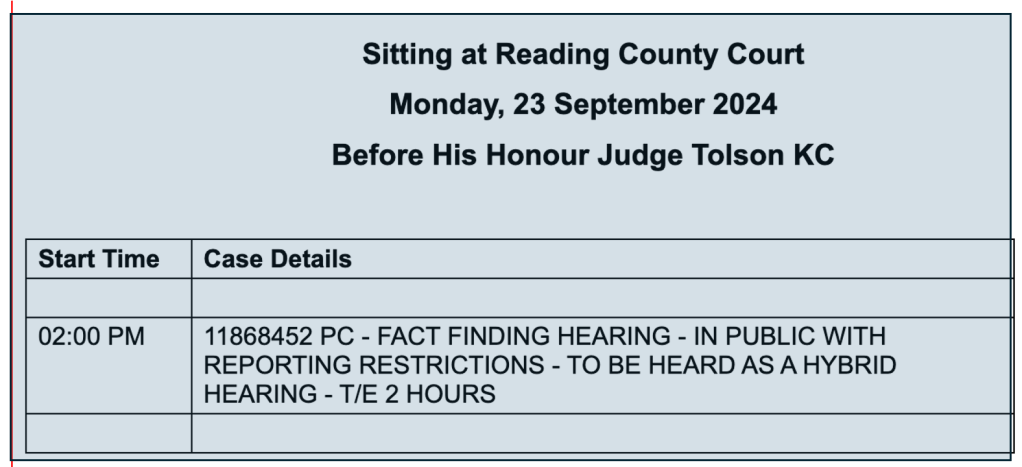
At 10.30am on 25 September 2024 I watched a hearing before DJ Ellington at First Avenue House, listed as below. 

Although listed as ‘in-person attended’, as with several other recent hearings, I had no difficulty in obtaining a link to observe remotely. It was a directions hearing concerning the appointment of a deputy for property and affairs and was timetabled to last all day. In fact, I watched only the morning session in which it appeared that there would be no need for further hearings. Certainly a decision was reached on the substantive matter although it might have been that the apportionment of costs remained an issue.

Appearing in the court were two representatives of the three parties concerned (not four as listed – see below). Mr Stewart-Wallace of Ten Old Square appeared for the applicant, EB, and another, whose name I did not properly hear but who could have been a Mr Machin, appeared for the two respondents, J-PE and MS.

I am afraid that I had the same hearing difficulties that I have experienced when observing previous attended hearings. Others say they have had similar difficulties (e.g.  The silent courtroom: A remote hearing without sound – and why transparency matters) and I have my own hearing problems. For this reason, I cannot pretend to give a blow-by-blow account of what was said or even be sure who the parties were. I think they were P’s sister and her two children. The listing shows a fourth party but on the Transparency Order ATR is P and EB is the applicant.

The issue before the court seemed relatively simple, although also rather unusual in my limited experience. There had previously been disagreement among the parties as to who should act as Court of Protection deputy for P’s property and financial affairs. As a result, an interim deputy had been appointed by the court and the application now was to make that appointment permanent. One of the parties, the original applicant for the deputyship, agreed with this but the other two were opposed. Their opposition was not to the principle of a professional deputy but to the particular appointment, and this was not because they had anything specifically against the proposed deputy but because they wanted more time to investigate her suitability. 

Application for an adjournment

The judge opened the hearing by noting that neither of the respondents was present, having requested that the hearing be adjourned. Their representative said that they were both abroad and, as it appeared later, had not requested a remote hearing until the day before. The applicant’s representative said he saw no reason for them to attend and, in fact, no reason for the hearing because there was no basis for opposing the deputyship appointment. The respondents’ position statement had only arrived the day before, however, and he had not had time to read it properly. 

I was surprised by how seriously the judge took the decision as to whether to adjourn the hearing. The respondents were, after all, represented in court by their barrister. She rehearsed in detail previous cases where hearings had gone ahead without one of the parties being present and, afterwards, I found these cases and extracted the parts to which she referred; they are included below.

The judge noted that the case had made no progress for a long time (the TO was dated March 2023) and the respondents had submitted no witness statements, but she also clearly felt she must consider seriously whether their presence was necessary for ‘a fair trial’. The applicant’s representative said he could not see what their presence would contribute. In any case, the use of the term ‘trial’ was itself questionable.

One of the respondents had submitted medical evidence to justify non-attendance and its status also became part of in-depth consideration (the case extracts below cover this issue too). There was a brief adjournment in which the respondents’ barrister attempted to get in touch with them to see if they could join remotely, even at this late stage. That attempt failed. 

When the hearing resumed, the applicant’s representative said that, during the adjournment, he had been able to read the respondents’ position statement properly for the first time. He reiterated that there was nothing at all in it that questioned the suitability of the deputy. The respondents had had quite enough time to instruct their representative. He also pointed out that the medical evidence, which referred to one respondent’s health issues and the stress that would be caused by the need to travel, was in another language with only an automated rather than certified translation.

The judge decided that the hearing should proceed. She reiterated the lack of progress to date, the interim deputy having been in post since July 2023. There had been several previous delays with at least one other hearing already having been adjourned. One respondent had provided medical evidence for non-attendance that she did not consider to be sufficient and the other had supplied no evidence.

The judge then referred to Section 1.1 of the Court of Protection Rules 2017 which says: “These Rules have the overriding objective of enabling the court to deal with a case justly and at proportionate cost, having regard to the principles contained in the Act.” It goes on to say:

(3) Dealing with a case justly and at proportionate cost includes, so far as is practicable—
(a) ensuring that it is dealt with expeditiously and fairly;
(b) ensuring that P’s interests and position are properly considered;
(c) dealing with the case in ways which are proportionate to the nature, importance and complexity of the issues;
(d) ensuring that the parties are on an equal footing;
(e) saving expense;
(f) allotting to it an appropriate share of the court’s resources, while taking account of the need to allot resources to other cases; 

Further delay would impact dealing with the case expeditiously, imposing a penalty on applicants in other cases. It would also be against P’s interests as her estate was ‘not huge nor complex’ and the costs of continuing action would be taken from her assets . 

The respondents’ position was that their concern about P’s finances had caused significant stress and that they had not been convinced by a statement given by the interim, and now proposed permanent, deputy which had been provided to the court previously. They continued to seek reassurance about her performance. However, the judge said that they had provided no evidence to support their concern. She accepted that their representative had not been instructed for this particular hearing but he had been acting for them for over a year. The stress of travel would not have prevented a remote hearing and no timescale had been given for when the respondent with the medical certificate would be fit again. She was therefore refusing to grant an adjournment.

Application for the appointment of a deputy

Returning to the decision about the deputy, the respondents’ representative said that they felt they were ‘still in the dark’ about P’s affairs and would be happier with more information, referring to ‘everything in paragraph 12’, presumably of their position statement. They were not suggesting that the deputy’s hands should be tied but they wanted to be sure P’s affairs had been fully investigated and to have more information about actions already carried out. The judge suggested that she could order the parties to notify the court of their requirements in these respects and that she could then order the deputy to make a report, including progress towards making a statutory will. She was, however, concerned about the costs, which would come from P’s assets.

The applicant’s representative expressed his concerns about this idea, referring to the poor relationships existing between the parties and giving his view that it would be a ‘recipe for disaster’ for them to be communicating with each other and with the deputy outside of the court. He thought it would be particularly unfair to the deputy but the judge seemed not to give much weight to that, saying that she was a professional and presumably used to such situations.

The judge pointed out that, when deputies were appointed, they made a declaration to the court in respect of their responsibilities, which included making an annual report to the Office of the Public Guardian. This should be sufficient reassurance that they were conducting P’s affairs properly. The deputy named was on the Court of Protection panel of deputies which made her prima facie suitable to hold the position and she had previously summarized the actions she had already taken in a witness statement. Changing deputies at this stage would result in still further costs for P. Referring to the relevant sections of the Mental Capacity Act 2005, she pointed out that, if the parties had particular concerns once the deputy was appointed, they could raise them with the Public Guardian,.

The judge also asked if there was anything on file about P’s attitude to her family members that would help ascertain her wishes and feelings, given that there was no Lasting Power of Attorney and no will. Her doctor reported that she no longer knew who her family were but he had expressed the opinion that, if she had had mental capacity, she would have wanted all the parties to be deputies. The judge said that “Having the parties in attendance would have helped to get a better sense”. (I wasn’t sure where this fitted into the discussion since it had already been decided that none of the parties was to act as deputy. Maybe she was thinking ahead to how P’s affairs were to be administered and to the statutory will.

The judge concluded that she would order that the existing interim deputy be made permanent. She also decided that it would be disproportionately costly to P to ask the deputy to report to the parties. She would, however, ask that the deputy provide them with a copy of her annual report to the Public Guardian, unless it became apparent that this was not in P’s best interests. She would also order that the deputy should prepare a statutory will for P.

My thoughts

I was surprised that it seemed to be accepted that the parties, having failed to reach agreement among themselves as to who should be appointed deputy, should have a say in who the court should appoint as professional deputy and, with sufficient evidence, could have brought about a change. I thought the decision to proceed without the parties present was eminently sensible in the circumstances, given that it seemed unlikely that their presence would have contributed anything that was not already known. I can imagine, however, that the hearing would have been quite a lot livelier! 

Georgina Baidoun was the lay Court of Protection Deputy for her mother’s Property and Financial Affairs until her mother died in 2021. Because of the difficulties she experienced with several applications to the Court, and with the Office of the Public Guardian in connection with her annual report, she has retained an interest in these areas, including attending Court of Protection Users Group meetings. She is keen to share her experiences in the hope that she can help others who have to engage with these institutions with very little help or guidance. She tweets as @GeorgeMKeynes

Appendix: Case Law cited

Morgan & Anor v Egan

Morgan & Anor v Egan [2020] EWHC 1025 (QB) (01 May 2020)

21. The Morgans’ grounds of appeal were that the judge erred in that she: (1) gave insufficient weight to the medical and lay evidence before her and applied in an overly rigid way the authorities about the evidential requirements for adjournment applications; (2) left out of account or failed to give proper weight to the Morgans’ efforts to obtain proper medical evidence; …(4) failed to balance fairly the various factors in favour of adjourning the trial; 

51. For these reasons, I have concluded as follows:

Grounds 1, 2 and 4 are arguable and the appeal is allowed on those grounds. In summary: HHJ Sullivan erred in law and reached a decision that was not properly open to her in refusing to adjourn without seeking or permitting Mr Morgan to file further medical evidence. In the light of evidence filed subsequently, the error has been shown to be material. The judge should not have proceeded with the trial.

26. The only qualification to this is that, in reviewing the trial judge’s exercise of discretion, the appellate court must be satisfied that the decision to refuse the adjournment was not “unfair” in terms of Article 6 ECHR. This does not, however, mean that in any given situation, only one outcome is fair: Terkuk v Beresovsky [2010] EWCA Civ 1345, [18]-[20] (Sedley LJ), cited with approval in Solanki v Intercity Telecom Ltd [2018] EWCA Civ 101, at [32]-[35] (Gloster LJ).

Grounds 1, 2 and 4: The judge’s treatment of the medical reasons for adjournment

The following relevant principles can be distilled from the authorities:

(a) A litigant whose presence is needed for the fair trial of a case, but who is unable to be present through no fault of his own, will usually have to be granted an adjournment, however inconvenient it may be to the tribunal or court and to the other parties: Teinaz, [21] (Peter Gibson LJ).

(b) However, the court must satisfy itself that the inability of the litigant to be present is genuine, and the onus is on the applicant to prove the need for such an adjournment: ibid.

(c) In considering the need for an adjournment, it is important to focus on the nature of the hearing and the role that the party claiming to be unfit is called on to undertake in it, bearing in mind:

(i) any reasonable accommodations (e.g. breaks, hearing evidence remotely etc.) that can be made to enable effective participation; and

(ii) that if the party is financially able to instruct legal representatives and able to give effective instructions to them, his absence may, depending on the facts, be of little consequence.

See Decker v Hopcraft [2015] EWHC 1170 (QB), [27]-[28] (Warby J).

(d) Generally, the court should adopt a strict approach to scrutinising the evidence adduced in support of an adjournment application on the grounds that a party or witness is unfit on medical grounds: Mohun-Smith v TBO Investments Ltd [2016] 1 WLR 2919, [25] (Lord Dyson MR).

(e) Where medical evidence is relied upon in support of an application for an adjournment, it should:

(i) identify the medical attendant and give details of his or her familiarity with the party’s medical condition (detailing all recent consultations);

(ii) identify with particularity what the condition is and what features of it prevent participation in the trial process;

(iii) provide a reasoned prognosis; and

(iv) give some confidence that what is being expressed is a reasoned opinion after a proper examination.

See Levy v Ellis-Carr [2012] EWHC 63 (Ch), [36] (Norris J), approved in Forresters Ketley v Brent [2012] EWCA Civ 324, [26] (Lewison LJ).

(f) Accordingly, a “sick note” may well be insufficient to justify an adjournment, particularly if it refers only to an unfitness to attend work. However, in considering whether that is so, the court must consider (i) the pressure under which GPs are working and the difficulties that may be faced by a litigant in person in obtaining more a detailed report and (ii) the frequency with which late, unmeritorious adjournment applications are made: Emojevbe v Secretary of State for Transport [2017] EWCA Civ 934, [31] (King LJ); Hayat, [41] (Coulson LJ).

(g) If the court is not satisfied as to the quality of the medical evidence supporting an adjournment application, the court has a discretion (not a duty) to conduct further enquiries – e.g. by seeking a fuller report in short order: Teinaz, [22] (Peter Gibson LJ); Solanki, [35]; Hayat, [42].

(h) If there is a challenge to the exercise of this discretion, it is incumbent on the challenger to show that the further enquiries would have led to a different decision: Hayat, [43].

General Medical Council v Ijaz Hayat

24. The Tribunal considered the application to continue in Dr Hayat’s absence on the basis of these three pieces of medical evidence (paragraphs 22 and 23 above). The relevant part of their determination is at paragraphs 15-19, in these terms:

15. The Tribunal notes that there is a burden on medical practitioners subject to a regulatory regime to engage with the regulator, both in relation to the investigation and ultimate resolution of allegations made against them.

16. It follows that where a medical practitioner seeks an adjournment of a hearing, on the basis that they are not fit enough to attend, then it is their responsibility to ensure sufficient evidence is presented to the Tribunal to establish that this is the case. The Tribunal is satisfied that Dr Hayat is aware of that responsibility, as a result of various communications with him.

17. The Tribunal considered the email sent on Dr Hayat’s behalf this morning at 08.55am and subsequent Statement of Fitness for Work for Social Security of Statutory Sick Pay sent during the course of the afternoon. This document indicates that Dr Hayat is not fit for work because of the following conditions:

This document indicates that Dr Hayat is not fit for work and does not suggest that he is not fit to attend and fully participate in these proceedings. It essentially reiterates the medical information from during the hospital admission.

18. The Tribunal considered that it can conclude on the basis of present information that Dr Hayat has voluntarily absented himself from this hearing. The Tribunal has therefore determined to accede to your application today to proceed in Dr Hayat’s absence.

19. The Tribunal is aware of its duty to ensure that proceedings conducted in the absence of the doctor are fair and to take reasonable steps to expose any weaknesses in the GMC case.”

68.Although there are one or two cases which put the emphasis on unfairness (see for example Terluk v Berezovsky [2010] EWCA Civ 1345), that emphasis is explicable on the facts of the cases themselves (Terluk was about an alleged breach of natural justice), rather than constituting a more general statement of principle. Moreover, I note that in Dhillon v Asiedu [2012] EWCA Civ 1020 at [33], this court explained why the Tanfern and Turluk approaches were “both consistent and analogous”. Baron J, with whose judgment both Arden and Davis LJJ agreed, said:

“Although the language in these two cases is entirely different, the foundation of the decisions is both consistent and analogous. The conclusions which I derive from the authorities are that:

a. the overriding objective requires cases to be dealt with justly. CPR 1.1(2)(d) demands that the Court deals with cases ‘expeditiously and fairly’. Fairness requires the position of both sides to be considered and this is in accordance with Article 6 ECHR.

b. fairness can only be determined by taking all relevant matters into account (and excluding irrelevant matters).

c. it may be, in any one scenario, that a number of fair outcomes are possible. Therefore a balancing exercise has to be conducted in each case. It is only when the decision of the first instance judge is plainly wrong that the Court of Appeal will interfere with that decision.

d. unless the Appeal Court can identify that the judge has taken into account immaterial factors, omitted to take into account material factors, erred in principle or come to a decision that was impermissible (Aldi Stores Limited v WSP Group Plc [2007[ EWCA Civ 1260. [2008] 1 WLR 748, paragraph 16) the decision at First Instance must prevail.”

69.I respectfully agree with that passage. I do not find any significant incompatibility between the two, a point which Mr Sarker appeared expressly to accept when he submitted that “there is no conflict between fairness and discretion”.

75. In summary, the decision to refuse to adjourn the hearing was a discretionary matter, properly made by a specialist tribunal on the basis of all the evidence. It was a decision to which the Tribunal was entitled to come. As I have already said, speaking for myself, I consider that it was the correct decision in any event.

Closed hearings, safeguarding concerns, and financial interests v. best interests

By Daniel Clark, 2nd October 2024

The protected party in this case, “B”,  is a thirty-year-old woman who, according to Counsel for her mother, has until recently been a “happy, well balanced, sociable person”. She enjoys spending time with her family and, until 2024, had been living with her mother at home.  

This case (COP 14116349) first came before the court in July 2023. The local authority sought an injunction guaranteeing access to B which, they say, had been frustrated by her mother (JB). This access would allow the local authority to properly assess B’s needs for care and support. 

In December 2023, the case changed direction following serious allegations that triggered a police investigation. The case was transferred from First Avenue House to the Royal Courts of Justice, for hearing before a judge of the High Court. 

On 17th January 2024, Mr Justice Keehan approved the local authority’s application for B to move from her grandmother’s home (where she had been temporarily living) to Placement 1. This is a respite placement, where B had lived before. 

Two law students blogged about this hearing here: “Two law students’ first observation of a COP hearing

They comment that the judge “took P’s welfare into account as well as considered that P had made it clear that she was excited and happy to move”. However, they were concerned that they needed more background to the case, particularly with regards to why B was being moved. I also observed this hearing, and agreed with their comments.

In total I’ve so far observed five hearings in this case. I believe that there were three others in 2024, though these were heard in closed court. At the most recent hearing (27th September 2024) the judge authorised a move from one placement to another, and refused the mother’s application for a return home.

This case has been mostly heard before Mr Justice Keehan, who has sat remotely (via MS Teams) at the Royal Courts of Justice. On this most recent occasion (27th September 2024) the case was heard on an urgent basis before Mr Justice Peel. This was presumably because the court was still in recess, and Keehan J was on leave. 

In the hearings that I have observed, two of the legal teams have remained the same. 

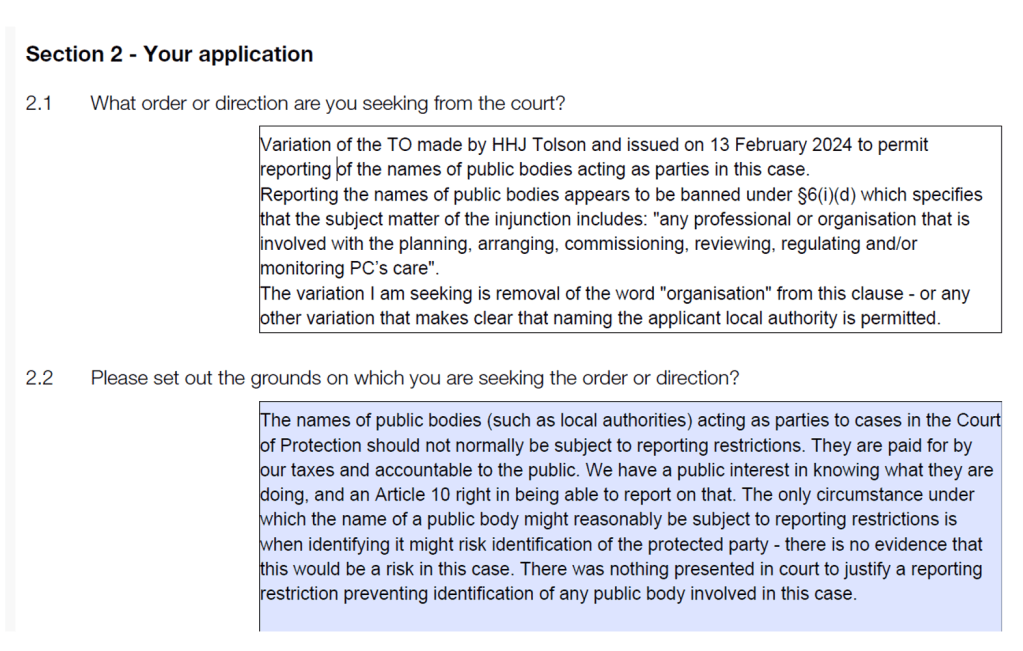
Sebastian Elgueta, of Garden Court Chambers, has represented the applicant local authority, the London Borough of Lambeth. The Transparency Order previously prohibited me from identifying the local authority but, after applying to the court, Mr Justice Keehan amended the Order so that I could. You can read about that application in this blog: “Prohibitive Transparency Orders: Honest mistakes or weaponised incompetence?

B’s mother (JB) was initially acting as a litigant in person. Following the hearing in January 2024, she has been represented by Alison Harvey, of One Pump Court. JB has some difficulty in understanding information, and has been assisted by an intermediary. There is also an expectation that the other parties make some accommodations in their communication with her (such as filing position statements at least two days in advance of a hearing). 

B’s representatives (instructed by her litigation friend, the Official Solicitor) have changed throughout the year. 

The first section of this blog addresses the concurrent closed proceedings, including issues of accidental disclosure. The second and third sections concern two hearings with two separate applications for the same outcome: moving B from Placement 1 to Placement 2. 

In writing this blog, I have been greatly assisted by the position statements that the parties have consistently sent me. 

Closed proceedings 

Closed hearings are not the same as private hearings. When a Court of Protection case is heard in private, members of the public and (usually) members of the press are excluded from observing. However, all the parties are invited (or ordered) to take part.Closed hearings are different in that, while they do often exclude members of the public and press, a party or parties (and their legal representatives) are also excluded – and may not even know that the hearing is taking place.

Closed hearings came to the attention of the Open Justice Court of Protection Project when it transpired that a blog post we’d published was “inaccurate and misleading”, because it was based only on information provided in open court.

It later emerged that decisions had been made in closed proceedings (and subsequently implemented) of which the bloggers were unaware. In that case, members of the public, the protected party’s mother, and her legal team were not informed about the closed proceedings. 

This case was different in that everybody knew about the closed proceedings, and that they related to a police investigation. Following an application by the Metropolitan Police, heard by Mr Justice Keehan on 8th May 2024, closed proceedings were commenced alongside the open proceedings. It is my understanding that several observers had joined the link for this hearing only to be very quickly removed. 

The observers were told that this was a Public Interest Immunity (PII) application. This is a mechanism by which the police can apply to not disclose certain information on the basis that it would ‘create a real risk of serious prejudice to an important public interest’. 

At an open hearing on 22nd May 2024, it became clear that a solicitor instructed by the local authority had accidentally disclosed an unredacted bundle, containing information about these closed proceedings, to JB and her representatives. I don’t know what was disclosed but the judge was clear it must not happen again, and Counsel for the local authority apologised to the court.

At a hearing on 16th July 2024, Mr Justice Keehan heard submissions in open court as to whether he should continue to hear some proceedings in closed court. In particular, he heard submissions as to whether JB should continue to be excluded but some level of disclosure could be granted to the local authority and the Official Solicitor. This was opposed by Counsel for JB but the judge approved the application, and so the closed proceedings continued.  

It’s now clear to me (given the information discussed in a hearing on the 27th September) that the closed hearings concerned an investigation into the alleged discovery of sexually inappropriate images on B’s devices. 

On 28th August 2024, I requested to observe (and was sent the link for) another hearing in this case.


The start of the hearing began on a different note to what I was expecting: it had been listed as for hearing in open court but was actually part of the closed proceedings. I was the only observer present and, after clarifying who I was, the judge permitted me to stay and observe. 

As far as I am aware, I am the only member of the public ever to have been permitted to observe a closed (rather than private) hearing. I haven’t shared the details of the hearing with anybody, and nor do I intend to. The fact that the judge allowed me to observe demonstrates his view that members of the public can be trusted to observe closed hearings without jeopardising the integrity of a case. 

In any event, as was explained in a public hearing at the end of September, the police investigation had concluded, and it had been decided that no further action was to be taken. That meant the closed proceedings were concluded, and the parties should now (according to the Guidelines) receive full disclosure.  

 The unsuitability of Placement B – “I do not find it in the best interests of [B] to move”: A hearing in May 2024

This hearing (on Wednesday 22nd May 2024) concerned an application by the local authority for B to move from Placement 1 (where she was residing) to Placement 2. This was opposed by JB, B’s mother, as well as the Official Solicitor. On this occasion (and for the first time as far as I am aware) Alison Meacher, of Gatehouse Chambers, represented B by her litigation friend, the Official Solicitor. 

On behalf of the local authority, Counsel submitted that the decision for B to move from Placement 1 will eventually need to be made. Placement 1 is a respite placement, and had only agreed for B to reside there on a temporary basis.  On the other hand, Placement 2 “is a longer-term placement for the residents there, so the staff are much more familiar with assisting residents to visit their family”.

It was further submitted that “[Placement 2] is a longer-term placement and the emphasis and focus is on developing skills…Overall, we think that [B] will fit in much better at [Placement 2]”. Furthermore, Placement 2 is actually closer to her family, which would help to facilitate further contact. 

The judge was however concerned because he had met B, and she seemed “happy and settled at [Placement 1] and has expressed no desire or wish to leave. And what concerns me at the moment is permitting the local authority to move from [Placement 1] to [Placement 2], when at a final hearing she may be moving somewhere else”. 

Counsel for JB had a number of objections to the proposed move. She had concerns (which were also shared by the Official Solicitor) that the draft care plan had “large chunks of information missing”. For example, as Counsel for the Official Solicitor highlighted, the care plan makes no mention that B “has two siblings and a mother who loves her dearly”.  Concerns about this were exacerbated by the fact that the proposed new Placement had a low CQC rating. 

Of great concern, which was again shared by the Official Solicitor, was that the move would result in B losing all of her professional contacts because Placement 2 was in a different area, covered by a different NHS Trust. In particular this would mean the loss of her speech and language therapist, who has helped B to make progress in communication.

As Counsel for the Official Solicitor put it, the loss of her professional team, particularly the speech and language therapist, “outweighs the proximity of [Placement 2].…Nothing can be done to assuage the need to entirely change [B’s] professional team”. 

While acknowledging that this is a “finely balanced application”, the Official Solicitor considered a change in speech and language therapy team to be “very counter-intuitive”, and that this means that the balance “very much falls in the favour of [the judge] refusing this application”. 

The judge did indeed accept the force of these submissions. Given what happened at the subsequent hearing, his words are worth quoting in full: 

[B is] happy [at Placement 1], she’s told me she’s happy there, she’s told other people she’s happy there. The prospect of what may be a temporary move that she would lose her speech and language therapist and other healthcare professionals whom she knows, and importantly know her, is a factor that weighs very heavily with me. The fact that the Official Solicitor is not satisfied, on the evidence currently available, that [Placement 2] is not the appropriate placement, is a very significant and very powerful factor. Along with the other factors set out…leads me, I regret to conclude, that I do not find it in the best interests of [B] to move from [Placement 1].

 “This puts all parties and this court in a difficult position”: A hearing in September 2024

This hearing (on Friday 27th September 2024) was, in effect, the same application but in a very different context. By this time, B’s mother was aware (to some extent) of what the police investigation concerned. 

A hearing had been listed for Thursday 3rd October 2024, before Mr Justice Keehan. It seems it was anticipated that, at this stage, he would consider whether it was in B’s best interests to move to a long-term placement or move back home. 

However, Placement 1 had made it clear that B would have to leave on Monday 30th September 2024. In the words of the judge (on this occasion, Mr Justice Peel), this was “apparently for financial reasons…They have been unequivocal and inflexible. I have to say that I have found their conduct disappointing, not in the best interests of [B], and short-term-istThis puts all parties and this court in a difficult position”. 

The position statement of the local authority explains that Placement 1 had “incurred legal costs owing to disclosure obligations arising from these proceedings which it (presumably) cannot sustain”. Despite requests for an extension and explanations that further disclosure will be minimal, Placement 1 refused to change its position. 

As a result, the local authority made an urgent application to the court to ask it to authorise B’s move from Placement 1 to Placement 2 (that’s the same placement that Mr Justice Keehan previously found not to be in B’s best interests to move to). The local authority had attempted to find another placement but had not received a response from them. 

On this occasion, the Official Solicitor (this time represented by Chiara Cordone, of 39 Essex Chambers) supported the application. JB, B’s mother, opposed the application, and asked the court to authorise B’s move back home instead. 

The local authority objected to this latter proposal because it continued to have ongoing safeguarding concerns. Despite the fact that the police investigation had concluded, Counsel told the court that this “does not mean that the safeguarding concerns have gone away…There is a context to the original incidents”. 

Mr Justice Keehan had previously made an order for the Metropolitan Police to file a statement explaining the decision to take no further action, as well as disclosure of relevant documents. The deadline for this was the 13th September 2024, but the local authority still hadn’t received them (two weeks later).

Due to the apparent failure to comply with this order, the local authority was not in a position to establish whether or not  its safeguarding duties had been satisfied. While it was not ideal, Counsel submitted, the court should authorise the move to Placement 2. 

The judge was keen to understand exactly why the local authority did not feel B could return home, and asked why (as was being proposed by JB) she couldn’t return home “with practical measures at the house. For example, regular checks on devices, and round the clock care as well?

The local authority opposed this suggestion because “we don’t think it’s sufficient. The index incident was one of making images – we don’t know the context of when they were made or whyWe don’t know the extent of the concerns”. 

Even if the safeguarding concerns could be satisfactorily concluded, this does not mean that the local authority would de facto see a move home to be in B’s best interests. This is because of historically difficult relationships between JB and professionals, which was described as “fractious”.  If this continued, there is a risk that the placement at home could break down. 

Counsel for JB (Alison Harvey) rigorously opposed these submissions. I do not know what she and JB know about the closed hearings, though I think they had been given some information, In my opinion, this was some of the most impressive advocacy that I have ever observed. Her submissions were measured and precise. 

They did not rely solely on JB’s own position, though this was expressed clearly and articulately. As I will show, Alison Harvey frequently referred back to JB’s position, presenting it not just as JB’s position but also as representing an objective analysis of B’s best interests. 

The submissions also employed the position of the other parties (expressed or implied) to construct the argument that B should return home to her mother. This spoke to a very impressive level of preparation, and it was clear that Alison Harvey was very familiar with the papers. This was all the more important given that the judge hearing the case was doing so for the first time. 

Counsel first drew the court’s attention to a care plan from Placement 1 which read: “PLEASE NOTE – supervision is not needed while [B] spends time with her family. Supervision is not needed while [B] has phone conversations with her family”. 

This, Counsel stated, demonstrated that the local authority was happy for B to have unsupervised contact with her family, implying that they did not believe B’s mother to pose a risk of harm to her. In fact, “there is no suggestion that her mother has done her harm; the police didn’t even speak to her during their investigation”. Later in the hearing Counsel for the Local Authority agreed with this but explained that their concern was whether JB “kept her daughter safe” – an important distinction. 

Counsel for JB made the case that it was in B’s best interests to return home with 24-hour care from carers who were familiar with her. The agency who would provide this care had signalled they would be available, and this (it was submitted) would surely act to prevent any further safeguarding issues. 

Counsel told the court that “[B] lived for 29 years at home – the home is wholly purpose-built, it has a lift, you can drive a car right up”. This was a useful demonstration of JB’s level of care and dedication for her daughter. It also acted as a pertinent reminder that the last nine months represent a total fracturing of what B is accustomed to. She has not simply moved away – she has been removed from a familiar environment.   

Counsel also raised serious concerns about the way in which JB was being communicated with. In her words: 

We are once again in the position – partly because of the urgency but not totally – where the interim ground rules have not been respected. There is a steadfast ignoring of the best way to communicate with JB and we say that that is at the root of the original concerns that the local authority had about communication, keeping appointments, etc. They have not distinguished between unwillingness and inability. Again, a live-in carer ensures that some of those timetabling difficulties can be picked up.”

Counsel for JB then directed the court’s attention to the position statement of the Official Solicitor, which was filed for the hearing in May. The position then was that the move was not in B’s best interests (in part) because she would not have continuity of healthcare. This lack of continuity was confirmed in the local authority’s position statement for the same May hearing. That hasn’t changed.   

In other words, moving B to Placement 2 would disrupt the continuity of healthcare considered essential by the Official Solicitor (and the judge) in the last hearing – so clearly a move to Placement 2 remains not in B’s best interests. Instead, Counsel submitted (again) that she should move home, which has been adapted for her needs. 

This is further supported by the fact that, while at Placement 1, B (who is usually a “happy, well balanced, sociable person”) has “deteriorated since the beginning of June”. She has been pulling out her hair, increasingly distressed, and acting aggressively towards care staff. Counsel submitted this is because she was not in a home environment, and that there was a real risk her behaviour would continue to deteriorate at Placement 2.

After hearing submissions, the judge gave an ex tempore judgment. He found that while “some of the points made on behalf of [JB] have validity”, it would be “inappropriate to authorise a return to home in circumstances where there are still lingering questions about the images on [B’s] devices”. 

He therefore authorised B’s move to Placement 2, but stressed that this was “very much for an interim, short-term, period”. The judge thought it appropriate, and the parties agreed, that the case should come back before Mr Justice Keehan on Thursday 3rd October. 

A final surprise from the Official Solicitor

It is worth repeating that the parties, particularly the local authority, felt they were at a disadvantage because the police disclosure of documents relevant to their investigation, and a statement explaining the decision to take no further action, had not happened. This is in spite of Mr Justice Keehan’s order that it must happen by the middle of September. 

In his judgment, Mr Justice Peel commented that “Disclosure by the police of further evidence was due to have been given by the 13th September which should have addressed this matter. That however has not taken place. That is highly regrettable because it would have left the parties in a clearer position today. The consequence, the local authority say, is that there is no clarity as to the concerns, and they point out that safeguarding does not rely on police investigations but on a general overview”.

Indeed, the judge expressly stated that, in his consideration of whether B should move to Placement B or move home, “the main point in my judgment is the question of safeguarding”.

Except, it transpired at the end of the hearing that, in fact, the police had complied with the order of Mr Justice Keehan. 

The order about disclosure had made accommodations for the Official Solicitor to see the materials first, who would then decide whether they should be disclosed to the other parties. 

As the judge was asking for any final comments from the barristers, Counsel for the Official Solicitor shared that the police disclosure was sent to the Official Solicitor. She (that is, the Official Solicitor) has reviewed the documents, and is now happy for them to be shared with the other parties. 

The judge was clear they must be shared prior to the hearing on 3rd October 2024. Surprisingly, he had nothing to say about the fact that (it would appear) the Official Solicitor had received the documents from the police prior to this hearing but had not yet disclosed them.

Of course, I don’t know when the disclosure was made to the Official Solicitor. Given that this was an urgent hearing, it’s possible that the Official Solicitor was planning to process the documents before the hearing at the start of October.   

However, I do find it vanishingly unlikely that during the course of this brief hearing (less than an hour), the Official Solicitor received the documents, reviewed them, and was satisfied that they could be shared with the other parties. 

It strikes me as self-evident that the hearing could have been conducted entirely differently if this disclosure had taken place just a day before. Whatever these documents say may not have changed the view of the local authority, and it may not have changed the judge’s decision. 

But we can’t know that, can we? 

Final thoughts

This case, as Mr Justice Peel put it, concerns “sensitive and emotional matters”. 

B was removed from the family home to a placement where she was initially settled. She has become increasingly distressed, all against a backdrop of a police investigation. 

The plan was for hearings in October to consider B’s best interests in relation to her long-term residence and care. These plans were put on the rocks when Placement 1 refused to accommodate her any later than Monday 30th September 2024, despite only being asked to extend the stay to the end of that week. 

Now, the court has authorised a move to a placement that it had previously declared was not in B’s best interests to move to. Of course, this is only for the short-term. However, it is highly likely that she will have to move yet again, either home or to another placement (one has been identified by the local authority). That will be her third move in about ten months. 

The behaviour of Placement A has been “unequivocal and inflexible”, and this is “apparently for financial reasons”.  Mr Justice Peel described this behaviour as “disappointing”.

I initially thought that these words didn’t quite capture the sorry nature of Placement 1’s behaviour, but Celia suggested that a judge describing your behaviour as “disappointing” is a very serious matter indeed. Far from being “light-touch”, it can be reasonably understood as a judicial reprimand. 

So, “disappointing” might not be the word I’d use. But I don’t have to rely solely on that word because I’m not a judge. 

In my view, the events at the end of September are once again an example of financial interests steering the Court of Protection ship. It appears to be only money that means the court has had to revisit a previous best interests declaration, and essentially renege on its original position in order to endorse a move to Placement 2. 

Of course, it isn’t only in the Court of Protection that this happens. 

Budgetary constraints and financial concerns mean that, every day, local authorities and NHS Trusts are limited in what they can offer a person.  Sometimes the funding for a package of care, assessed as being in a person’s best interests, is withdrawn. The person’s best interests haven’t changed; the pot of money available has changed. 

When this happens, those providing support have their hands tied. That includes judges – they cannot compel a private business to do something that it says it cannot afford.

So, when a respite placement decides to evict a person living there (as in this case), a judge can only prevent that from happening when the placement has acted unlawfully. All a judge can do (in the words of Sir James Munby P) is engage in, “rigorous probing, searching questions and persuasion”.

I imagine that, when this case returns to court, Mr Justice Keehan will do just that. 

Daniel Clark is a member of the core team of the Open Justice Court of Protection Project. He is a PhD student in the Department of Politics & International Relations at the University of Sheffield. His research considers Iris Marion Young’s claim that older people are an oppressed social group. It is funded by WRoCAH. He is on LinkedIn, X @DanielClark132  and Bluesky @clarkdaniel.bsky.social.

Why can’t a 91-year old return home to her son? 

By Celia Kitzinger and Kim Dodd, 30th September 2024

We both watched this hearing (COP 20000918) on 30 September 2024 before HHJ Robertshaw in Bristol concerning a 91-year-old lady (P) who has been deprived of her liberty in hospital for several months, as a “social admission” (i.e. there’s no medical reason for her to be there). 

She had been living with her son, who was providing care – the care package provided by the Local Authority having largely broken down due to the reluctance of both P and her son to accept their intervention. 

It’s not clear to us what (or who) precipitated admission to hospital, but the Local Authority and the Official Solicitor agree that the home is unhygienic and unsafe: they referred in particular to stairs without a banister and the risk that poses to P who has visual impairments. Their position is that it’s in P’s best interests to go into a care home, at least for the short-term while they make further investigations about her property, her finances, and her capacity to make her own decisions (she has “cognitive impairment”).  They say there is reason for the court to believe on an interim basis (s. 48) that P lacks capacity to decide where to live, and they’ve identified a care home that is able and willing to take her, and they’ve included a “conveyance plan” in the bundle for the court. But P has made it clear she objects to being deprived of her liberty and wants to go home.  

It was said in the introductory summary that her son would also like her to return home, but in the course of the hearing he expressed no opposition, in principle, to a care home for his mother.  He did, however,  strongly object to the particular care home proposed because it is a long way from his home and takes about two hours to get there by public transport.  He has been visiting her around twice a week and would find it (he said) “impossible” to continue to do so under these circumstances.  Relocation to that care home  was, however, what the judge authorised – on an interim basis – after ensuring that the local authority would provide financial assistance to the son to enable him to visit his mother once a week.

It was quite a painful hearing to watch.  We have each separately reflected on the case and our reactions.

Reflections from Celia

My first reaction was that mother and son were being separated against their wishes, and that intervention by the state to “protect” P’s safety against her wishes was a gross invasion of her right to privacy and family life.  As another judge once said, “What good is it making someone safer if it merely makes them miserable?” (Munby J §120 Local Authority X v MM & Anor (No. 1) (2007)). 

But the situation was rapidly made more complicated, with allusions to “safeguarding concerns”  (never fully specified) that seemed to extend well beyond the possibility of P falling downstairs at home. 

The son, who was in court, had applied to be joined as a party.  Counsel for P via the Official Solicitor (Hannah Haines) raised concerns about this, saying that there were documents in the bundle detailing some of the “allegations” against him “and there may be, if he were to be a party, arguments as to whether or not all of those documents ought to be disclosed to him or whether they should be redacted or withheld”.  This pointed to the possibility of a “closed material” hearing – of which there seem to be far more than was originally believed before the existence of Guidance regulating their use.  

The question of whether or not parties (and the son is not – yet – a party) should be prevented from having access to documents and information on which other parties rely is a challenging one. It’s something I’ve considered in some detail after we published misleading information about a case in which there were parallel open hearings (which we watched) and closed hearings (which we were not aware of).  In that case, P’s mother (who was a party to the case) was not informed that her daughter was being covertly medicated.  Her arguments to get her daughter home, on the basis that she would be able to persuade her daughter to take the medication she was refusing, were therefore otiose.  It felt like a huge betrayal of the whole idea of a ‘fair trial’ and of the very idea of ‘open justice’ to learn that the court had misled us (both the observers and P’s mother) in this way.  We wrote about it here: “Statement from the Open Justice Court of Protection Project concerning an inaccurate and misleading blog post” and “Reflections on open justice and transparency in the light of Re A (Covert Medication: Closed Proceedings) [2022] EWCOP 44)”).

Although there can be good reasons for closed material hearings (and closed hearings), the effect – always, I think – is an element of unfairness and inequality.  How do you defend yourself against arguments you haven’t seen or heard?  How do you advance your own position in a convincing way when there are relevant matters being kept secret from you?

The judge in this case was obviously alert to the issues.  She said, crisply,  “It wouldn’t be just or fair if the court were  asked to make a significant decision and was asked to place reliance on allegations placed before the court when [the son] was in ignorance of those allegations and unable to put his position before the court”.  Well, yes.  Exactly so. 

As it turned out, it didn’t come to that, not least because the son wasn’t arguing for his mother to return home, and because the placement was “interim” and not intended to be permanent (albeit that she’s 91 so the notion of “permanence” is somewhat precarious).  Instead, the argument at the moment turns on the physical risks of the home environment in terms of banisters and hygiene; there’s apparently no need to draw on any additional risks from the son in making an argument for P to be kept from her home: “so the issue for the court is whether it’s in her best interests to remain in hospital or to go to a care home”.  And as there was only one suitable care home available, that decision seemed inevitable under the circumstances.

There was also a proposal (not yet before the court) to appoint a Finance Deputy to assess whether she has sufficient money to ensure her house is made safe –  “if she doesn’t, then other issues concerning Son wouldn’t arise and so it wouldn’t be necessary for him to join and be given all that information” (Counsel for P).  

The son did not engage at any point with the references to allegations against him.  He seemed calm and composed.  He said: “I do not have a problem with my mother being placed in a care home except that it must be accessible …  [Placement A]  is impossible for us to get to….. it’s a million miles away – as far away as you can get and still be in [County]  – there’s no bus, and train transport is appalling and then it would require a taxi drive from the train station to [the Placement]. It would be impossible for me to afford that.”

The judge took this seriously and asked counsel to “direct me to the page numbers in the bundle where options for alternative care homes have been set out and the reasons why the Official Solicitor and the Local Authority have reached the conclusion that this care home is the most suitable”.  Other care homes had been approached but only one other offer received and that was from a care home rated by the CQC as “Requires Improvement”.   The social worker (also in court) was consulted about any outstanding possibilities. It seemed there were none.

The issue of the son visiting his mother became quite fraught.  The judge asked what support the son could expect from the Local Authority with visiting his mother at the proposed care home.  In response, counsel for the Local Authority (Rachel Baker) referred the judge to “§15 of the attendance note from the meeting with P in August” – apparently to support an implication that the mother might not wish the son to visit and/or that it was not in the best interests of the mother for her son to visit.  I don’t know exactly because I haven’t seen this document, or the use made of it in the local authority’s position statement.  Nor had P’s son – as the judge pointed out.  “You are giving me reasons that make no sense to [P’s son]” said the judge, re-asking her original question.  

Judge: “What exploration has the Local Authority had with [P’s son] regarding supporting visits by him to his mother if she was at [Placement A]?”

Counsel for Local Authority: Those explorations have not taken place.  The intention is first to get capacity assessments regarding contact. 

The son said the new placement was “unacceptable” because it was too far away. “Given my mother’s age she is very distressed that I am not visiting more often, but it’s impractical for me at the moment. I don’t know if you understand that I have cancer and am slightly limited in my activities.

The judge asked Counsel for the LA again what support she anticipated the LA would offer to enable the son to visit his mother.  Counsel for the LA repeated that “there would first of all need to be clarity with regard to capacity to make decisions regarding contact”.  

Please answer my question”, said the judge.  “I know you’re seeking clarity about that,  but at the moment [the son] is visiting his mother on regular basis […], so what is proposed in next 2 months if P is discharged from hospital to [Placement A].

Counsel for the LA said she would need to take instruction on that. The judge called a 30-minute adjournment – following which Counsel for the LA reported that the LA was willing to pay for one visit per week (either by taxi, community transport or public transport) on an interim basis until the next hearing.  

Counsel for P then expressed some concern about how these visits would take place.  Visits in the hospital have been supervised (on whose authority we don’t know).  “Given P will be in a private room once she’s moved if that is the order of the court, there would need to be some urgent consideration as to how those visits would be managed”.  She also raised the point that – given the “safeguarding concerns” alluded to darkly in this hearing – “if there were restrictions in place and P didn’t agree and she wanted visits with family privately in her room, then that would require capacity assessments to be completed.”  (Presumably the same must have applied to render lawful the supervision of visits in hospital?)

The judgment seemed inevitable under the circumstances.  Everyone recognises that there’s no medical need for P to remain in hospital, where she’s been for many months.  It’s not a good environment for her: she’s in a shared bay with little privacy, and she’s vulnerable to hospital infections there.  There’s a dispute as to whether or not it’s  safe and in her best interests to return home where she would continue to be looked after by her son – but both the Local authority and the Official Solicitor say there are  sound and valid reasons why it’s not in her best interests and – given the state of her home – it’s also unsafe.  The son also did not oppose a care home. There’s only one suitable care home – and although it’s difficult for the son to visit his mother there, the Local Authority will pay for him to go once a week until the next hearing.  The judge was satisfied that it was in P’s best interests to be discharged from hospital and move to Placement A. She approved the transition plan and the making of the DOLS order.  She did not approve contact restrictions (and counsel did not pursue this). The judge will consider the son’s application to become a party at the next hearing, which will be by Teams at 11am on 9th December 2024, for two hours.

After the judge’s decisions had been communicated, counsel raised another matter: our requests for their Position Statements.  Both of the represented parties’ Position Statements contain material they don’t want made public.  For example (said counsel for P), paragraph 19a.  The judge read it silently, then asked: “What is your concern if that paragraph were disclosed?”.  Counsel for P replied that “it conveys information which, if [P’s son] was joined, there may be an application made to restrict disclosure of that information and if this is reported it will obviously make that application otiose”.  The judge told both advocates to formally file the paragraph numbers that they wanted to redact “bearing in mind that the balance is on disclosure rather than non-disclosure so please identify the relevant paras and please state WHY you want to redact them”.

So, we will probably not get to hear what the allegations are against P’s son – and he will not get to know them either, at least not in the immediate future. He may learn eventually, though, as there were suggestions of a possible future ‘fact-finding’ hearing.  

A final caution: it’s quite possible that parts of this report are wrong, because it was perfectly clear that information was being withheld from P’s son, and therefore also from us, and we’ve not been sent Position Statements yet because of counsels’ wish to redact them. We’ll ask for the approved Order in addition to the Position Statements, and if it becomes obvious that we’ve made mistakes when we receive the Position Statements (assuming we do) and the approved Order (which we probably will get as we are entitled to it by law), then we’ll make (tracked) corrections to this blog post.  But I suspect we’ll be left in the dark about what’s going on for a while yet.

Reflections from Kim

I’d sent requests to observe four different hearings that day, all of which  had been vacated or moved to an ‘on the papers’ exercise, so I had just about given up hope of finding a hearing to observe. I was glad I hadn’t given up because this two-hour hearing was fascinating and depressing in equal measure. 

The case was raw for me personally, as it seems to be following a similar trajectory to my dad’s CoP proceedings earlier this year. The conclusion of this hearing –  which is that, at least for now, a woman who probably doesn’t have very long to live is being moved (against her will and that of her son) into a care home far away from her own home and family – was difficult to hear. I hope it ends better for P than it did for my dad, who having been forced into care against his will then lost the will to live, and died last month. 

As always, this hearing left me with many more questions than answers. Compared to criminal and civil hearings, it seems to me that CoP hearings leave observers almost completely in the dark about the real backstory to the chain of events which led to the jurisdiction and powers of the CoP being invoked in the first place. 

While counsel talked about the improvement work necessary for P’s own home to be a viable alternative (adopting an overly paternalistic view that risking falling down your own stairs in your later years while living in your own home, being cared for by your loving son, is somehow much worse than being placed in institutional care), it was not clear who owned the property and to what extent the Local Authority were responsible for the maintenance / safety of her home. Much of the discussion in the hearing centred on who would pay the travel costs for P’s son to visit his mother in the care home in the ‘interim’ period (10 weeks) which suggests both P and her son lack funds. I did a back of a cigarette packet calculation on the rough cost of the hearing (assumedly at the taxpayers’ expense) and worked out that the costs of the directions hearing alone could have covered a taxi to the moon and back (and /or a gold banister for P’s stairs).  

It seemed to me that the ‘home-repairs’ were just the LA’s holding position until they could organise themselves to fully address the ‘elephant in the room’ in this case – the ‘allegations’ against the son which have triggered the need for supervised contact and a need for the LA to do further work to ascertain whether or not P has the capacity to decide who she has contact with. I found it disconcerting that P’s son was at the hearing when such a big life-change for his mother was decided upon (albeit, theoretically at least, temporary) whilst his application for joinder as a party was not yet being decided upon. Until he is joined as a party (if ever) this leaves him in the precarious position of not seeing any of the court documentation – neither the all-important bundle which is shared with all parties, nor the Position Statements which Celia and I requested and may get, at least in redacted form. This state of affairs is arguably contrary to the Rule of Law on which our constitution is based. 

What was even more surprising for me was the absence of any objection from P’s son. I suspect the poor gentleman was overwhelmed by the whole case and the proceedings themselves (though I noted he took Her Honour’s rebuke of his vaping mid hearing well). I believe, based on my experience both personally and as an observer, that litigants in person are often treated shabbily by the court system. I expected him to ask why there was to be a proposal for a financial deputy, as having cared for and lived with his mum for ten years he surely knew of his mum’s financial position and could easily answer the question of whether she was in a position to fund any necessary improvement works or not. 

Even more, I expected him to ask what allegations of safeguarding issues they were referring to. I think he was the only person in the room who didn’t understand the implications of what will be coming next in terms of proposals for restricted, if any, contact with his mother after December this year. The impact of the move, and the potential for further restrictions on the contact between mother and son, are huge. As a member of the public, I feel the need to see a much more robust argument from the LA and the OS to justify such a significant interference in P’s rights and freedoms. 

In the meantime, this hearing felt like the start of a drama about to unfold and I am hoping that I can follow the case again at the next hearing on 9th December 2024.

The hearing of 9th December 2024 was vacated (cancelled). Sadly, this was because P had died. So the Court of Protection is no longer involved in her affairs. What Kim describes as “a drama about to unfold” is now finished. There will be no further hearings, so no “closed material” fact-finding hearing.

The other development is that (finally!) I received a Position Statement on behalf of Surrey County Counsel, redacted as approved by the judge. This assists considerably with understanding why there was more opposition to P’s return home than seemed explicable on the facts as we knew them at the time of the hearing and when we wrote the blog.

Some salient facts which address some of the concerns we raise in the blog post include the following:

  • A care package at home was attempted in Autumn 2023 but was unsuccessful because the son often turned staff away from the property and P herself also told carers to go away.
  • P has struggled with mental health issues all her life and in Autumn 2023 was concerned about the KGB spying on her and the neighbours shooting her.
  • In February 2024, P’s son was arrested on suspicion of assaulting her (and other matters in relation to her). He was bailed with conditions not to go to the property and not to contact his mother.
  • An earlier inquiry (there’s no indication by whom) concluded that financial abuse had taken place involving another family member. P’s son has not complied with the LA’s request for financial information. It’s said that he tried to remove his mother’s bank cards from the ward without her knowledge or consent and he disclosed that he has removed money from her account (which he should not have done)

This new (to us) information needs to be taken into consideration in reading the blog post above. It illustrates the value for observers in receiving Position Statements (although we were disappointed to get only the one from the LA and have heard nothing from the OS).

I feel very sad that P died in a hospital she didn’t want to be in, rather than at home with her son as she wanted. If I put her wishes centre-stage, then (still, even knowing what I now know from the Position Statement) I would have wanted her to have the opportunity to return home for her last few weeks of life. I suppose if the court had known that she would be dead in a couple of months, they might have made a different decision at this hearing: that’s what seems to have happened when Ella Lung, also in her nineties, also desperate to return home to her son, finally received a terminal diagnosis – the safeguarding concerns melted away in light of P’s wishes (and Ella had only 20 days at home with her son at the end).

Perhaps I’m simply writing with the benefit of hindsight – but as I wrote at the time, for anyone in their nineties, future plans are necessarily precarious: supporting a protected party to do as they wish – even with the identified risks attached to their preferred course of action – would seem (to me) the kindest way forward and the one which most respects a person’s right to autonomy and to family life.

Celia Kitzinger is co-director of the Open Justice Court of Protection Project. She has observed more than 560 hearings since May 2020 and written more than 100 blog posts. She is on LinkedIn (here), and also on X (@KitzingerCelia) and Bluesky @kitzingercelia.bsky.social)

Kim Dodd has previously blogged for the Open Justice Court of Protection Project (“A newly addicted observer’s reflections“) under the pseudonym of “Jean Louise” as she was at the time a respondent in her dad’s CoP proceedings and subject to a Transparency Order preventing her from identifying herself as a family member of a protected party. That TO  has only just been discharged as a result of her dad’s death (the order had effect “until further order of the court OR the death of P“).  Having retired early from her own corporate career and studied for a Master’s of Law, Kim has developed her interest in law generally and particularly in the area of the law on coercive control. Kim is currently writing a book about the workings of the Court of Protection. She is on LinkedIn (here).

Can a Turkish Guardianship Order be recognised in England and Wales? 

By Daniel Clark, 29 September 2024

This case began as an urgent application to the Court of Protection in August 2023. It wasn’t until May 2024 that it came before a judge. 

In August 2023, XY (who resides in Turkey) was visiting the UK with her brother, CD. She has done this many times but, on this occasion, became unwell and was admitted to hospital. 

When in hospital, CD found it very difficult “to be taken seriously as [XY’s] representative” (in the words of his Counsel) by members of hospital staff, despite the fact that he is recognised as XY’s guardian in Turkey. He therefore made an urgent application to the Court of Protection, asking for recognition and enforcement of the Turkish Guardianship Order.

The case never went to court. The Office of the Public Guardian had to confirm that the Turkish Guardianship Order was valid and, after a 7-day admission, XY was discharged and returned to Turkey.

After an almost 9-month delay (it’s not clear to me why there was such a long delay) the application was listed for hearing before the Vice-President of the Court of Protection, Mrs Justice Theis, on 2nd May 2024. 

Despite the delay, CD expressed his wish for the application to proceed so that XY can still visit England with him regularly. At the moment, he does not feel comfortable doing so given the possibility that XY may experience the need for another hospital admission. 

The case (COP 14129463) was then transferred to Senior Judge Hilder, and it was finally listed before her on 17th July 2024. She was sitting remotely, via MS Teams, so that CD could participate in proceedings from Turkey. While XY was with her brother throughout the hearing, she was discharged as a party to proceedings in accordance with guidance in cases of this kind (which I discuss below). 

CD was represented by Victoria Butler-Cole KC of 39 Essex Chambers and  Rhys Hadden of Serjeants’ Inn Chambers,  acting pro-bono, having been instructed via the charity Advocate. Its front page explains that they ‘match members of the public who need free legal help with barristers who are willing to donate their time and expertise in deserving cases for those who are unable to obtain legal aid and cannot afford to pay.’

Cases that concern the recognition of orders made in a foreign jurisdiction are quite unusual, and I’ve only been able to find three blogs[i] on the Open Justice Court of Protection Project website that deals with the issue. All of them concern an application made by the Health Service Executive of Ireland and related to one-off decisions (whereas this was recognition of an Order). 

This case is novel for two reasons. First, the position statement states that ‘there are no reported decisions concerning the recognition and/or enforcement in this jurisdiction of foreign protective measures made in Turkey’. Second, the case is novel in that the XY was not currently in the jurisdiction of the court, and only visits England for limited periods of time. 

This therefore could have been a very difficult hearing to follow. However, my understanding was assisted by a very detailed opening summary, as well as the position statement of CD, which he was happy for the barristers to share with me. 

Transparency matters: “Doing a public service job”

As is usual for this judge, the hearing started with her asking me to confirm that I was in a private place, and that I had received (and understood) the Transparency Order. 

The judge was also alive to the fact that it may be odd for CD to find that a random member of the public was observing the hearing, particularly given that the court in Turkey is not as open as the Court of Protection.  She assured him that members of the public, ‘can watch what the court is up to. Really what they’re interested in is what I’m doing, they’re not here for some surveillance of you…They’re doing a public service job keeping an eye on the court and [the protected party’s] privacy is protected by the Transparency Order’.  

After observing the hearing and reading the position statement, it struck me that the specific details of the case could inadvertently reveal, to those who know them in the UK, the identities of XY and CD as a party to proceedings.

I have therefore taken the unusual step of giving them both random initials in this blog. There are also other identifying features that I have decided not to mention. By this I mean no disrespect; I simply wish to ensure that I make good on the judge’s assurance that the privacy of XY (and indeed that of CD) is protected. 

The situation in Turkey

When I saw the case was listed as concerning ‘Recognition and enforcement of Turkish Guardianship Order’, I was intrigued. In preparation for the hearing, I attempted to find out whatever I could about what a Turkish Guardianship Order actually is. Unfortunately, (an admittedly hurried) Google search was not as forthcoming as I would have liked, and a search of my university library also did not give me much. 

I was however able to find multiple references to guidance by Mr Justice Mostyn, published in Health Service Executive of Ireland v Florence Nightingale Hospitals Ltd. In this case, the judge was considering whether to declare that protective measures made in the High Court of the Republic of Ireland could be recognised in England. 


To assist his thinking, the judge constructed a “checklist” of 22 questions. These, in theory, could be used for all cases where a foreign court has made orders in respect of a person. They are concerned with confirming that the foreign made order will be compliant with law in the United Kingdom. It is in this judgment that Mostyn J confirms that a protected party can be discharged as a party, unless there is an overwhelming reason for them to be added as one.

It turned out that this also guided the discussion in court, though I do not go through it step-by-step in this blog. 

With that in hand, I felt like I was more ready than I initially was. 

During the hearing, it was explained that CD had helped to look after his sister for many years. In 2013 he was advised to apply to be appointed as XY’s legal guardian, pursuant to a Guardship order, and this resulted in CD making an application to the Court of Peace (the name for the civil court in Turkey). This application involved an independent medical assessment of XY, as well as several checks on CD for criminal convictions or a conflict of interest. 

In 2014, the Court of Peace made CD the legal guardian for his sister. It authorises him to make decisions about her ‘health (including medical treatment), her welfare and any financial decisions’. 

As Counsel remarked during the hearing, the powers are “a bit more like an LPA which doesn’t tell you what an attorney can or cannot do”. There are, however, some importance differences. CD is not allowed to move XY into a care home or authorise her receipt of a large sum of money – this would require the authorisation of the court. 

Furthermore, the guardianship is renewed every two years: it is not assumed that a person appointed a guardian in one year will still be suitable to act as such in two years’ time. 

Are the documents valid?

Counsel recognised CD as possessing expert knowledge, and included him in explaining various issues to the judge. This struck me as eminently sensible (after all, it is CD who lives in Turkey). I also thought that this must have been quite empowering for CD. After a bad experience last year, he was now being recognised as somebody who can assist in understanding his sister’s circumstances. 

The judge also took great pains to ensure that CD felt at ease: after all, the Court of Protection is not an adversarial court. For example, she joked that, “I’m afraid your English is much better than my Turkish, so I need some translation of your Turkish court documents”

The first issue that the judge dealt with was whether the Turkish documentation she had in front of her was valid. In particular, she was concerned that the person to whom an oath of translation (certifying the translations were accurate and complete) was not the same person who had translated other documents. 

It was clear that the judge did not want this case to become long and protracted but it was also necessary for her to understand how the documents were translated. As she put it, “it’s really important that if the court is going to recognise a document from a foreign court that I have a proper understanding of what the court says.”

Rather than put proceedings on hold, she decided to ask CD some questions following an affirmation that his evidence would be truthful. He confirmed that the translation was accurate, and he could see no errors in it. The judge was happy with this, and gave a mini-judgment that “notwithstanding that I don’t have an oath of translation, I am satisfied” that the translation is accurate. 

What about best interests?

The judge had seen evidence, and was satisfied, that XY lacks the capacity (under the meaning of English law) to make decisions about her care and treatment, as a result of what the Mental Capacity Act 2005 rather crudely describes as ‘an impairment of, or a disturbance in the functioning of, the mind or brain’. 

However, the judge was concerned that, “there’s nothing here that requires the guardian to make decisions in the best interests of the subject”. 

CD offered that, in actual fact, there is provision in Turkish law that, “I must act in her best interests, and because they are in the law I accept these conditions”.

This did not, however, resolve the problem for the judge, who remarked that “I very much doubt that a harassed doctor in an overcrowded ward would have any awareness of that”. 

The issue, therefore, needed some thinking through. In the view of the judge (and I agree), it is unreasonable to expect those in England and Wales providing care for XY to familiarise themselves with Turkish law. While she did not doubt the veracity of CD’s claim that he must (and in any event would) act in XY’s best interests, she also needed to take as many steps as possible to ensure that there would not be a repeat of the previous year’s experience.

As a result, she wrote into the order that CD can only exercise the Guardianship Order in compliance with the English law principles as set out in the Mental Capacity Act 2005. In order to ensure that this would be understood, the judge explained the principles of the Act, and how best interests decisions are reached. 

Furthermore, if it was the case that the Guardianship Order was revoked in Turkey, the Order recognising its legitimacy in England and Wales would be automatically revoked. In other words, CD could only exercise powers in England and Wales that he could also exercise in Turkey.

At the conclusion of the hearing, the judge declared that the Turkish Guardianship Order could be recognised in England and Wales, and so CD can make decisions on XY’s behalf (if needed) while in the country. She was however clear that “the ultimate decider is the court”, and this does not preclude further hearings if medical teams disagree with the decisions that CD is taking. 

Final thoughts

This hearing has made me wonder whether England can learn a thing or two from Turkey.

I can’t imagine that the Turkish system is under-burdened. Despite this, there is still a 2-year renewal period of a Guardianship Order. There are also much stricter limits on the decisions that a Guardian can make (such as whether a person can move to a care home) in comparison to the decisions an LPA or Deputy can in England and Wales, as well as strict limits on what a guardian can authorise. In particular, I wonder how many abuses of the LPA system could be avoided if it was a requirement that this is reviewed.

I think it’s worth emphasising again that the barristers acting in this case did so pro-bono, which is work undertaken on a voluntarily (and unpaid) basis. Each year the judiciary publishes a pro-bono recognition list, which “recognises barristers and solicitors who gave 25 hours or more pro bono legal assistance over the last year”. Both Victoria Butler-Cole KC and Rhys Hadden feature in this list. 

I was also impressed with the judge, who took every possible step (from explaining my presence in court to the principles of the Mental Capacity Act) to ensure that CD could participate fully in the court process. 

In a recent blog about a case concerning the authorisation of an Irish court order, Celia Kitzinger notes that these type of cases often, “seem, by comparison with the usual standards in the Court of Protection, terribly cursory and not very person-centered”.

This wasn’t the case here. 

XY was present throughout, and the judge recognised this. Towards the end of the hearing, she noticed that XY appeared to have fallen asleep, and she joked that, “I’m sure [XY] isn’t the only person attending my hearings who falls asleep but it’s lovely to see it”. 

There were also numerous references to what XY enjoys to do, and these were also referenced in the position statement. For example, XY enjoys socialising, shopping, and listening to music. Despite the fact that XY was not a party, the judge and barristers ensured that this hearing did not become coldly clinical or simply concerned with a point of law.

All in all, this hearing struck me as an example of some of the best elements of the Court of Protection: rigorous, committed to the law, and never losing sight of the real people at the centre of it.

Daniel Clark is a member of the core team of the Open Justice Court of Protection Project. He is a PhD student in the Department of Politics & International Relations at the University of Sheffield. His research considers Iris Marion Young’s claim that older people are an oppressed social group. It is funded by WRoCAH. He is on LinkedIn, X @DanielClark132   and Bluesky @clarkdaniel.bsky.social.


[i] ‘From Prison in Ireland to Care Home in England’ by Adam Tanner (14th August 2020) – https://openjusticecourtofprotection.org/2020/08/14/from-prison-in-ireland-to-care-home-in-england/

‘Irish cases in the Court of Protection’ by Jack Thorold & Chiara Cordone (11th June 2024) – https://openjusticecourtofprotection.org/2024/06/11/irish-cases-in-the-court-of-protection/

‘Another Irish Schedule 3 case: “An oddity in the Court of Protection”’ by Celia Kitzinger (11th September 2024) – https://openjusticecourtofprotection.org/2024/09/11/another-irish-schedule-3-case-an-oddity-in-the-court-of-protection/

Judgment: An update to “A Catch 22 situation for P or Hobson’s Choice?” (and how access to court documents helps transparency and open justice)

By Amanda Hill, 24th September 2024

I’ve now been sent the (as yet unpublished) judgment in the case of “London Borough of Lambeth v CT & North Central London ICB” (issued 21 August 2024, additions made on 4 September 2024).  This is the case I observed and blogged about last month: “A “Catch 22” situation for P or Hobson’s Choice?  Disagreement among professionals as to whether P has capacity and a finely balanced decision for the judge

The hearing I described in that blog post (COP 14251478, 20th August 2024) was about the finely balanced decision HHJ Beckley had to make as to whether P, to whom I shall now refer using the pseudonym ‘Georgio’, had the capacity to make decisions about his residence and care. Both Georgio’s Litigation Friend, the Official Solicitor, and the Local Authority argued that he did. The NHS Trust disagreed. The hearing ended without a judgment.  The judge said he would let the parties know his decision the next day.

At the end of the blog, I wrote that I’d asked for a copy of the approved order and that I hoped I would receive it as I was really interested in what HHJ Beckley decided. 

I have since received the approved order (sent to me on 10th September) and on top of that, unsolicited, on 4th September I also received a copy of the judgment (not yet published) from HHJ Beckley. I’ve also been sent a copy of the position statement from P’s litigation friend, the Official Solicitor, via her representative (received 6th September, after I requested it from the Official Solicitor). These documents have been enormously valuable as they enable me to make transparent what I’ve learnt from them, which is much more than from simply observing the hearing. The position statement in particular provides more information about Georgio. They show how important it is to have court documents in making sense of what happens in court.

Most importantly, the judgment reveals that HHJ Beckley decided that Georgio did not have the capacity to make decisions about his care and residence. 

The judgment made reference to a possible appeal against that decision and the approved order included a listing for another hearing on 17th September 2024 – but this hearing did not take place, and I’m not sure whether or not an appeal has been made. In this update I will explain what I learned about Georgio from the position statement, in order to provide more context for the reasons the judge gave for his decision. I will then outline other aspects of the judgment that I found interesting, as well as confirming who the parties were and which  counsel represented them, as was clarified by both the judgment and the approved order. I will then outline the process of the judgment being issued, as I think it gives an insight into what can happen ‘behind the scenes’.

More about Georgio 

The judge referred to Georgio by his real name throughout the judgment, saying that “the use of initials can be de-personalising”. I am still bound by the Transparency Order of course, which forbids me from identifying P. But I will take a leaf out of the judge’s book and so I am using a pseudonym here (rather than initials or the generic “P”) to refer to him. The following information was provided in the position statement I received.  

In the original blog, I wrote that Georgio was “a man who looks to be in his late 60s or early 70s.” I read in the position statement that he was in fact much younger – 55 years old. He was born in London and has lived there his whole life. He suffered a head injury when he was 12 and has had epilepsy ever since. Following the death of his mother, he started drinking alcohol and using drugs, lost his business and eventually lost his home as well. The position statement makes no reference to any other family members. He now suffers from ill health, recently acutely. His physical illnesses and health problems include Chronic Obstructive Pulmonary Disease (COPD), Polysubstance and opioid dependency, epilepsy, chronic back pain, arthritis, and osteoporosis. He is partially sighted due to vitamin B12 deficiency, and has a “mixed type” cognitive impairment. The position statement reports that Georgio uses a wheelchair but is unable to use his arms to move, due to pain. He only has the use of one leg and uses that to move himself backwards in the chair. He has said that he would not use a wheelchair if he moved back onto the streets. He also says that he is in constant pain. Psychiatrically, he has suffered from Post-Traumatic Stress Disorder, has suspected antisocial personality disorder or emotionally unstable personality disorder, a history of psychotic depression and Dysexecutive Syndrome and polysubstance use, with alcohol and opiate dependence, for which he has been intermittently prescribed methadone. Learning this about Georgio laid bare in very stark terms the poor state of his health. 

The judge’s principle reasons for deciding that Georgio did not have capacity to make decisions about his residence and care 

The judgment goes into a lot of detail about the judge’s reasoning. But the key points that I took from it related to the relevant information. Everyone has to agree on what the information is that Georgio needs to be able to understand, retain and weigh, and then they have to determine if he does in fact understand, retain and weigh it, in order to determine his capacity.  In this case the judge says that one thing that hadn’t been included in the “information”, which he thinks should have been, is that Georgio has mental impairments that create care needs and affect his decision-making ability.  He then goes on to say that this in particular is something P can’t currently weigh. Paragraph 24 of the judgment spells this out:

“Ms Bicarregui (Counsel for the OS, representing Georgio) submitted that a pretty good list of the relevant information that [Georgio] needs to understand, retain, use or weigh and communicate is set out (in the) completed DOLS Form 3. I agree, but I consider it misses an important piece of relevant information, namely that [Georgio] has a number of mental impairments (which are listed in the judgment) and that those impairments lead to specific care needs and affect [Georgio’s] decision making ability in relation to physical care needs and residence.”

The relevant information that the judge doesn’t consider Georgio is able to use or weigh is set out in paragraphs 33 and 34 of the judgment. Specifically, he doesn’t consider that Georgio “is able to use or weigh the fact that he has mental impairments and that these lead to specific care needs and impact on his wider decision-making ability.” Further, he considers that Georgio’s “lack of awareness of his mental impairments means that he is unable to weigh his own impulsivity, lack of planning ability and lack of foresight when he is making decisions about his care needs. If he had such awareness, he could make further attempts to consider the likely outcome of a decision or seek the assistance of another to look at what the likely outcome might be.”

The judge also made clear the fact that capacity is time-specific and that with greater support Georgio could recover capacity and the judge feels that work “should be prioritized”. He also wants a less restrictive placement to be sought. 

Other interesting aspects of the judgment 

Reading the judgment, although much of it is standard legal explanation, I felt that HHJ Beckley made quite an effort to take Georgio as a person into consideration. From the start, at paragraph 2, some of the contents seem to be specifically aimed at Georgio. This started with the judge stating that he would refer to ‘Georgio’ by name. In paragraph 3 the judge confirmed that he wanted to issue a judgment as soon as possible because it would be “unfair to [Georgio] to have to wait longer for his decision”. 

The rest of the judgment follows a more typical format, explaining the legal basis for the decision, including “Formulation of the matter”, “The relevant information”, “Using or weighing the relevant information”, “Relevant information that I don’t consider [Georgio] is able to use or weigh”, and “Next steps”. There was a specific discussion about “The fire setting” (Georgio had set fire to a previous placement).

I find that grasping the importance of the ‘relevant information’ when making capacity assessments and decisions is a concept that is hard to understand for lay people such as myself. Despite the judge’s best efforts to make the judgment accessible to Georgio, I imagine that his legal team will have to work hard to try and explain it to him. 

Information to supplement the original blog

During the initial hearing, I couldn’t identify who counsel were ,but the judgment and approved order clarifies that. Tony Harrop-Griffiths was counsel acting on behalf of the applicant, the London Borough of Lambeth.  Anna Bicarregui was counsel acting on behalf of Georgio, instructed by the Official Solicitor and Mungo Wenban-Smith was acting for the South London and Maudsley NHS Foundation Trust (a non-party). 

The documents also clarified the situation with regards to who the parties were and were not. The Transparency Order I had been sent was issued on 14th May 2024 and listed King’s College Hospital NHS Foundation Trust as the applicant and ‘Georgio’ as the respondent. But the judgment listed the parties as London Borough of Lambeth (applicant),  Georgio as 1st respondent and North Central London ICB as 2nd respondent. Paragraphs 7 and 8 of the judgment shed light on the situation: 

The approved order clarified that the attendance of North Central London ICB had been “excused by order of the Court” which was why there was no legal representation for them. 

Once again, having access to the court documents greatly enhanced my understanding of the hearing and shows the value of them being made available to observers and helping proceedings to be transparent. This was also illustrated by the judgment making clear how the final document came to be issued. 

The process of the judgment being finalised and issued                  

The judgment makes clear the process by which it was finalized. The judge emailed his decision to the parties the day after the hearing of 20th August 2024, as he said he would. When the judgment was emailed to the parties, the judge asked the parties to let him know if there was “anything that doesn’t make sense or needs greater explanation”. Following that, the Applicant and Official Solicitor filed a joint ‘request for further detail following the note or judgment”. Subsequently, the judgment included additional information which was distinguished from the original judgment by the use of italics. The additions were made on 4th September 2024 (as noted on the judgment) and the revised judgment was then sent to the parties. I received a copy on 4th September, the same day. With this process highlighted in the final judgment, I was able to follow what was in the original judgment and what had been added as a result of the further information which had been requested by the legal teams. This gave added insight into what can happen in finalizing judgments. I haven’t seen anything like this before, as usually I only see published judgments on Bailli. This is the first time I have received an unpublished judgment. I hope that the judgment is published eventually, so that everyone can see the process of decision making in action. 

This hearing has opened my eyes even further as to the difficult decisions that the Court of Protection faces. I feel that HHJ Beckley placed Georgio at the forefront of the case, something that was possibly helped by the fact that Georgio was fully present and engaged in this hearing. The dearth of suitable supported care placements, as well as the basic principles of capacity, including the possibility of making unwise decisions, were also highlighted. 

I will keep an eye on the listings for any future hearings in this case.

Amanda Hill is a PhD student at the School of Journalism, Media and Culture at Cardiff University. Her research focuses on the Court of Protection, exploring family experiences, media representations and social media activism. She is on LinkedIn (here), and also on X as (@AmandaAPHill) and Bluesky (@AmandaAPHill.bsky.social)

Another Irish Schedule 3 case: “An oddity in the Court of Protection”

By Celia Kitzinger, 11th September 2024

She’s an Irish citizen in her early twenties, with schizophrenia and a “mild intellectual disability”, currently detained in an acute unit at an Irish psychiatric hospital under an order of the Irish Court.  It’s not an appropriate placement for her.  

Everyone agrees she needs a homely environment where she can practice and improve her living skills, but there’s nowhere in Ireland that can provide this with the level of security that’s also needed (she’s absconded from previous placements and been sexually exploited).

The President of the Irish High Court, Mr Justice Barniville, has made an order for her to move from Ireland, where she is ‘habitually resident’, to a placement in England that’s been identified as suitable.

The relevant legal framework is Section 63 and Schedule 3 of the Mental Capacity Act 2005 which give effect to the central provisions of the 2000 Hague Convention on the International Protection of Adults as a matter of English law.  

Two lawyers have written an ‘explainer’ blog which outlines the relevant law here: “Irish cases in the Court of Protection”; and we’ve also published a blog post reporting on another Irish Schedule 3 case we observed: “From Prison in Ireland to Care Home in England” a few years ago.

In cases like these, there is no requirement to provide capacity evidence – although  it was in fact made clear in this hearing that the evidence before the Irish High Court was that the young woman is a person who ‘as a result of impairment or insufficiency of [her] personal faculties, cannot protect [her] interests’  – which is how Schedule 3 defines what we’re used to thinking of in terms of s.2(1) Mental Capacity Act 2005 as someone who lacks capacity to make particular decisions due to an impairment of the mind or brain.  

Additionally, the Court of Protection is not free to conduct its own best interests assessment.  This is not a hearing about best interests.

Instead of making assessment of either capacity or best interests in the usual way, the court is restricted to checking that procedural requirements and basic rights have been complied with by the Irish (or other foreign) court. The ability of the Court of Protection to refuse to recognise and declare enforceable foreign protective measures is very limited.

These cases are ‘an oddity in the Court of Protection’ and require “a very significant gear shift” for the Court. This was apparent in the hearing I attended.

The hearing

The case (COP 20001355) was heard before Mrs Justice Theis  on 12th August 2024, sitting in the Royal Courts of Justice.  The judge and the lawyers were robed – i.e. wore their gowns and wigs.  The hearing lasted only 40 minutes and I got the impression that it would have been dealt with more quickly if I’d not been observing, since some of the explanation of the case and the relevant law seemed to be provided for my benefit as an observer. 

I was given a clear and helpful summary of the case by Henry Setwright KC, who (with Lucy Logan Green – both of 4PB Family Law Barristers) was representing the Health Service Executive (HSE) of Ireland in this case.  

I’ve watched this barrister before in similar hearings: he’s been described as “a go-to silk on international cases”.  He’s methodical, articulate and unhurried in his submissions, and lays out the law with admirable clarity – and I’m also grateful for the HSE’s Position Statement, which I have used to check the accuracy of this post. Having introduced the case with some care, he said: “That is a general outline of the process as is well-understood by My Lady, but it doesn’t happen so often that members of the public might understand”. 

The gist of the introductory material was an explanation of the role of the Health Service Executive of Ireland and assurances that the Irish legal framework “contains safeguards and deference to human rights which we say is really the equal of this jurisdiction and ensures – and did so in this case – that P is properly and fully represented and their voice is fully heard”.  This latter comment was significant because there was nobody to represent P in this hearing.

According to Henry Setwright KC, Schedule 3 allows the English court to recognise the Irish court’s order for compulsory detention “on strict conditions”.  Those conditions “have become synthesised to a high degree of sophistication in a checklist by Mr Justice Mostyn, which is made available to Irish judges and which they do consider, and that contains the points which English judges have been concerned to ensure are properly made up”.  This checklist is appended to a judgment which can be found here: Re SV [2022] EWCOP 52

The judge in this case went through the checklist and identified compliance of each point (e.g. P was an adult, P has an impairment in her mental faculties and cannot protect her own interests, P had a proper opportunity to be heard in Ireland, P would be at risk without protective measures in place, and so on).  If there is compliance with the checklist then, in effect, that’s all that’s needed or (I think) permissible under Schedule 3, and the Court of Protection should normally go ahead and implement the Order.  

Once the Order is implemented, the Irish court will continue to “maintain a very close continuing watch” on P, and the English Order lasts for as long as the Irish Order lasts.  Counsel added that “when P is based in England there is no charge on the NHS for English tax-payers.  The Irish pay.”

In her judgment, Theis J gave a little more background: “P has had a history of mental health difficulties, having moved between her parents’ home, various residential placements, and supported living.  She’s engaged in risk-taking behaviour and substance misuse.  She has been exposed to chaotic childhood experiences….”  The judge then went through the “Mostyn checklist”, in the course of which she relayed P’s own views about moving to a care home in England: “she’s understandably anxious but is keen to know more and interested to ask questions about when she will move and times of flights.  She has had  a very proper and effective opportunity to be heard before the High Court of Ireland, so there is no necessity for this court to consider whether she should be joined or heard in this court”.    The judge made the order as drafted. And that was that.

Reflections

It’s an odd experience to watch these hearings – I think this was the third I’ve observed.  They seem, by comparison with the usual standards in the Court of Protection, terribly cursory and not very person-centered.  I understand the reasoning that this is because the more usual process (or the Irish version of it) has already been done in the Irish court and this is simply about getting arrangements authorised cross-nationally.  On that basis, it would be terribly wasteful of everyone’s time, and create unacceptable delay, to go through the whole process all over again in a second (English rather than Irish) court – hence a relatively straightforward checklist rather than a full hearing. And the English court can decline, and has done previously, if the checklist isn’t complied with (as described here: “Irish cases in the Court of Protection”). But from the point of view of observers, it does require us to trust that the Irish hearing (which of course we haven’t seen) was just and fair.  I have no reason to think that it wasn’t – in this case or any other – but the whole point about the Open Justice Court of Protection Project, of course, is that we don’t take the justice system (any justice system) on trust alone: that’s why we’re observing.  So, these are frustrating hearings to observe from that perspective: they’re at one remove from where the actual decisions about what’s best for P – the decisions we really want to observe – are being made.

Those interested in learning more about these cases might like to read the article by Alex Ruck Keene KC (Hon) and Chiara Cordone (“Distributed rights protection”) published in the International Journal of Law and Psychiatry, which engages with some of the challenges and opportunities they present.

Celia Kitzinger is co-director of the Open Justice Court of Protection Project. She has observed more than 560 hearings since May 2020 and written more than 100 blog posts. She is on LinkedIn (here), and also on X (@KitzingerCelia) and Bluesky (@kitzingercelia.bsky.social)

Bromley is outsourcing property and affairs deputyships: Is it lawful?

By Georgina Baidoun, 6th September 2024

At 2pm on 2nd August 2024 I watched a hearing before HHJ Hilder, the Senior Judge of the Court of Protection.  Here’s how it was listed: COP 140287761, BJ v London Borough of Bromley “To consider property and affairs deputyship – discharge functions through contractual arrangement”.

Noting that this was an attended (i.e. in person) hearing, I emailed the previous evening asking for a video link if it was possible to provide one. I received a link and attached transparency order (normal practice in my experience when observing hearings at First Avenue House) at 12.20pm, in plenty of time to get myself prepared. When I entered into the court room, I was happy to see that things were set up in such a way that I could clearly see the judge and the two lawyers who were in attendance. The sound too was very good, except that one of the lawyers did tend to lean back from his microphone; I imagine that the intimacy of only three people being in such close proximity made the microphone seem redundant. In fact, at some point in the hearing, the judge had to chastise the participants for beginning to turn it into something more resembling a conversation!
I am afraid I didn’t hear the names of the two lawyers, one representing the Local Authority and one representing the Office of the Public Guardian

The hearing

I have always found HHJ Hilder very supportive of open justice. She started by checking that I had received and agreed to the transparency order and then gave a brief summary of the case so far. 
As was clear from the transparency order, the case had not started off as a property and affairs application but was originally listed as “Varying or terminating an urgent or standard authorisation under the Deprivation of Liberty Safeguards”. I guessed that the property and affairs matter had arisen during the course of that application as this was the second time I had encountered such a change of direction and was aware that, when a case changes direction, it keeps the same COP number throughout.
HHJ Hilder confirmed that, during a challenge relating to deprivation of liberty, issues had arisen as to how the Local Authority handled deputy appointments, particularly the contractual arrangements it had made with a commercial provider. She said that it was well established that deputy functions should not be delegated and that the only body that could give directions in such matters was the court. The fundamental principles of  “empower and protect” that underpinned the Mental Capacity Act 2005 were essential here.

The Public Guardian had, of course, not been part of the deprivation of liberty application but had now been joined as a party by the court in order to represent P, who must have previously been judged to lack mental capacity to deal with such matters. However, the case had now been widened to include all those Ps for whom the LA had been given authority by the court to act as deputy. It seemed that the documents the judge had in front of her were confusing as to number and details. She said 46 cases had now been joined to these proceedings but that 5 deputyship orders were missing and some repeated. Considerable corrections would be needed before the next hearing.

The judge then asked what the Public Guardian’s position was, hoping it was not neutral. The Public Guardian representative replied that it was indeed neutral and as they were not aware of any irregularities. The judge said this was missing the point, as the concern was whether the scheme was even lawful. She was “pretty convinced” it wasn’t. The upshot was that the Public Guardian representative then agreed that he would take a position. (I thought it was interesting that he didn’t need to take instruction before making such a major change of direction.) The judge then said she would record this (leaving no room for afterthought!).

The rest of the hearing was taken up by arrangements necessary for the next and, the judge hoped, final hearing. This was a little hard to follow because it was about the paperwork in front of the court to which, of course, I had no access. However, it seemed that there was as yet no information available as to the nature of the contract between the LA and the company to which they had outsourced the deputyship work. The judge said that she needed to see a copy of a signed and dated contract. An important part of her concern was that of accountability. There was a guarantee bond in place (an insurance required for all deputyships) but it wasn’t clear whether it applied to the LA or the company. 

For the next, and hopefully final, hearing the judge wanted:

  • A narrative of when and how the contract had come into effect
  • A narrative of how the private company was involved in these arrangements i.e. the terms of engagement and other documents such as any ‘code of expectations’ applying to the implementation of these arrangements
  • A narrative explaining the route of accountability with details of the insurance bond and how it would apply.

There was then detailed discussion of timetabling, during which another issue arose. The Public Guardian representative said that he would want to give a narrative of his own as to how the current contractual arrangements were experienced by P. The judge agreed to this suggesting that one thing that might be explored was whether P ever saw anyone. (A deputyship normally requires that P should be visited at least once a year and this  goes into the annual report.) The LA representative seemed unhappy about this as it raised issues beyond the contractual. 

The judge suggested the parties should have a round table meeting before the next hearing so that dates could be changed if the issues became wider. The date for the next and, still hopefully, last hearing was fixed for Monday 25 November. I hope I shall be able to observe it.

After the hearing I made some interesting discoveries with some internet searches which I’ve added below as an “Afterword”.

Georgina Baidoun was the lay Court of Protection Deputy for her mother’s Property and Financial Affairs until her mother died in 2021. Because of the difficulties she experienced with several applications to the Court, and with the Office of the Public Guardian in connection with her annual report, she has retained an interest in these areas, including attending Court of Protection Users Group meetings. She is keen to share her experiences in the hope that she can help others who have to engage with these institutions with very little help or guidance. She tweets as @GeorgeMKeynes

Afterword

Internet searches produced the following.

Balancing open justice and P’s right to privacy: A protected party says NO to a public observer “and her voice shall be heard”

By Eleanor Tallon, 3rd September 2024

I was not able to observe this hearing because the protected party, N, said she did not want an observer as “she doesn’t know who they are or what their ethics and values are”, and the judge ruled that a public hearing was not in N’s best interests.

The case (COP 1030276T) was listed as a public hearing (see screenshot below). I gained access via the link sent by court staff at precisely 10am on 22 August 2024.

My observation was limited to hearing submissions about restricting public access to the hearing and an ex-tempore (oral) judgment. The judge’s decision was based on a report of N’s distress at having an observer attend, and the fact that the Official Solicitor acting on behalf of N, did not agree to my attendance. I was asked my position on the matter, before the judge ruled that it was not in N’s best interests to continue the hearing in public, so it became a private hearing, and I had to leave.

This blog will go through the judgment (on public access to the hearing), with a reflection on the challenges of balancing P’s privacy with the values of open justice. I will also discuss the court rules in relation to public and private hearings, which differ between the Civil Courts and the Court of Protection. It seems that even judges can sometimes misapply the rules. Finally, I will consider why advance planning is important when deciding whether proceedings should be made private – not only for the benefit of the protected party, but also to avoid a false impression of transparency being given to the public.

The hearing

I requested access to the hearing by email at 7.52pm on 21st August 2024. I then followed this up with a further request marked ‘urgent’ at 9.08am on 22nd August, as I hadn’t received the link or a transparency order. By 10.00am I still hadn’t received anything, so I telephoned the court, but while waiting for the phone to be answered, I saw the link to the hearing pop up in my emails. I quickly gained access to find 12 attendees waiting for DJ Matharu to join, including the following:

  • Barrister Varsha Jagadesham (who I later learnt was counsel for N via the Official Solicitor)
  • Barrister Mungo Wenban-Smith (who I learnt was acting for the first and second respondents, and I assumed from the email addresses that the respondents were the local authority and the ICB, and this was later confirmed)
  • Legal professionals from Hampsons and Bindmans (presumably the instructing solicitors)
  • Various professionals from the local authority, one from health and one from a care home organisation

The protected party, N, was not present, and I was the only member of the public attending.

At 10.10am, DJ Matharu came on screen. She explained that she had just spent some time communicating with Ms Jagadesham (counsel for N) about an observer wanting to join. She elaborated: “I have had conduct of this case for a number of years, through which N has been actively involved in her own case. It was important for counsel to inform her that an observer request had been received. Ms Jagadesham you have informed N, what is your view?” Before counsel responded, the judge emphasised that the starting point was that this was a public hearing. 

Counsel for N replied: “I have spoken to N and she said no, she does not want a public observer attending as she doesn’t know who they are or what their ethics and values are. There is the potential for distress and the Official Solicitor does not consent to an observer. This is an unusual position. The Official Solicitor is concerned that public attendance would not be in N’s best interests, given it could cause real distress. N is already fairly heightened. The social worker assisted her to speak with me and she needed support to calm her down. It took a few attempts to close the call. Given that N would be very unhappy with a public observer, and she’s already upset that the court has been invited to conclude the matter today, having a public observer could be more upsetting. We are not opposed but the Official Solicitor does not consent, and it must be considered whether it would be in her best interests under section 4 of the Mental Capacity Act.

The judge then turned to Mungo Wenban-Smith (counsel for the respondents), pointing out that he had been involved in the case long-term and she asked what his position was. He said:  We wouldn’t oppose an application to exclude observers, and listening to the submissions on behalf of N, distress is likely. I refer to your consideration, but we wouldn’t oppose a private hearing, should this support a smooth hearing and N’s best interests.

The judge then addressed me: We have an observer, Ms Tallon. We have discussed the paramount considerations: what do you say? I wanted to say that I was observing as a volunteer with the Open Justice Court of Protection Project, and that my ethics and values are aligned with the focus of the Project – to ensure people are being treated fairly by the court. However, I wasn’t expecting this to happen, and I had not anticipated the need to champion open justice under such circumstances. I also didn’t want to distress N or delay the hearing further and I was acutely aware of the discomfort I would have felt, if the judge had allowed me to observe against N’s wishes. I responded: “Good morning judge. I don’t wish to cause any distress, and, on that basis, I am happy not to observe the hearing“.

The judge then continued: “I have to give a judgment as to the rules and I will be brief because I’m conscious of the agitation of N if there is delay. The case is concerning N, and it’s been before me many times, supporting judicial continuity. A public observer request was made late last night. This is a public hearing and it’s important to notify the legal teams of such requests. This is in the knowledge of N being actively involved in the case with regular and frequent participation. Counsel for N and the Official Solicitor feel that distress will be heightened. She does not want an observer in this case, and this would displace the presumption of a public hearing.  I need to take the court rules into account, and I must have regard to N’s best interests. Her best interests would not be served by an observer attending the hearing. N is a private lady, she’s treated with dignity, and her voice shall be heard and is often heard. There are finely balanced outcomes. N was going to participate, but this caused her anxiety. Ms Tallon has been gracious. Having heard that, she is willing to withdraw. Yet I have to give my judgment. The facts are that the court welcomes observers, but on the facts of this case, it is not in N’s best interests. The Civil Court rules are imported into the MCA and the hearing must be public unless one or more of matters at CPR 39.2 paragraph (3) apply. At subsection (c) it involves confidential information and personal matters, and at subsection (d) it would not be in the best interests of the protected party, if anyone was to observe. The observer is not opposed. Do you have anything to add Ms Tallon?

I responded: “No, thank you, judge. I will remove myself from the link now“.

I left the hearing at 10:24.

Balancing the right to freedom of information (Article 10) and the right to privacy (Article 8)

As an Independent Social Worker, I am regularly instructed to provide expert opinions on mental capacity and best interests. My approach to this always centres around enabling decision-making capacity, and failing that, supporting the person’s participation in decision-making and aligning decisions with their wishes and feelings as far as possible. Yet there are times when there are competing values. Often this is in the context of protecting a person from risks of harm versus protecting their autonomy, but here the situation was different. 

The balance was between, on the one hand, the ECHR Article 10 right to freedom of information and the value of open justice (which also offers a further level of quality assurance that the courts are operating fairly) and, on the other, N’s ECHR Article 8 right to privacy, and her sense of dignity and participation in the proceedings. It was a natural response to willingly concede to the hearing being made private, as it went against the grain for me to be the very reason N did not participate in her own hearing, regardless of how well intentioned my reasons were for wanting to observe.

A similar case before Hayden J

Having the discussed the course of events with Celia Kitzinger, co-director of the Open Justice Court of Protection Project, she drew my attention to a previous blog, which reports a hearing before Hayden J,  in which the protected party ‘Ms P’ “strongly objects to members of the public being present” (“Privacy, capacity and the judge’s communication skills”). That case was different, in that counsel (including Ms P’s counsel), were content for the hearing to be in public, and  Mr Justice Hayden refused Ms P’s request for the hearing to be held in private. He explained the Transparency Order to her, and said that her name and identity could not be revealed, and highlighted the importance of open justice. The judge said: “Like many cases that come to the Court of Protection, the applicant Trust is asking the court to declare legal a course of treatment that is highly invasive concerning an adult whose capacity is in issue.  This sort of case is of human importance in a mature, civilized, democratic society and it manifestly engages issues of civil liberties.  In society at the present time, every day, a whole gamut of civil liberty issues are raised and I cannot think of any period when it’s been more important for the court to be vigilant to maintain civil liberties.”  (Mr Justice Hayden, as reported in the blog post)

Although Hayden J communicated sensitively and reassured Ms P in an exemplary manner (and she did in fact participate fully in the hearing), the public observers still felt a tangible level of unease and guilt whilst attending a hearing against the wishes of the protected party where the person felt her private affairs were laid bare.

I reflected on what I experienced in the small part of N’s hearing I attended, and I completely empathise with N. On a personal note, if I was subject to decisions being made about my life by professionals within a court arena, it would fill me with an intense feeling of anxiety and powerlessness, which would only be increased by having unknown public observers watching from a virtual gallery. 

Yet, from a professional perspective, I’m also mindful that there can be errors made, closed cultures and a (sometimes devastating) misapplication of the MCA within all professional domains. 

The Court of Protection is the responsible body for setting the legal precedent and providing rulings which direct wider practice under the MCA. Open justice is therefore vital to safeguarding the rights of individuals, exposing abuse of power, and allowing for public scrutiny over decisions made.

Court rules and practice directions

I was puzzled by the judge’s use of the Civil Procedure Rules (CPR 39.2) in the Court of Protection. This perplexity was based on my understanding that the Court of Protection Rules and Practice Directions would apply.

With Celia’s help, I researched this (thank you Legal Twitter/X), and it was confirmed by lawyers that the Court of Protection Rules 2017 are the primary procedural rules of the Court of Protection. 

The Civil Procedure Rules are incorporated into the Court of Protection to fill in any ‘gaps’ in the COP rules, as necessary (see Rule 2.5 of the Court of Protection Rules, copied below).

So, it seems that the Civil Procedure Rules can be applied in the Court of Protection but only in situations where the Court of Protection Rules don’t provide for the issue.

But the Court of Protection Rules do cover decisions about making hearings public or private (at part 4.3).  

This is what  Practice Direction 4C says:

2.1. The court will ordinarily (and so without any application being made)—

(a) make an order under rule 4.3(1)(a) that any attended hearing shall be in public; 

and

(b) in the same order, impose restrictions under rule 4.3(2) in relation to the publication of information about the proceedings.

2.5. (1) In deciding whether there is good reason not to make an order pursuant to 

paragraph 2.1 and whether to make an order pursuant to paragraph 2.4 instead, the court 

will have regard in particular to—

(a) the need to protect P or another person involved in the proceedings;

(b) the nature of the evidence in the proceedings;

(c) whether earlier hearings in the proceedings have taken place in private; 

(d) whether the court location where the hearing will be held has facilities 

appropriate to allowing general public access to the hearing, and whether it would be 

practicable or proportionate to move to another location or hearing room;

(e) whether there is any risk of disruption to the hearing if there is general public 

access to it;

(f) whether, if there is good reason for not allowing general public access, there also 

exists good reason to deny access to duly accredited representatives of news 

gathering and reporting organisations.

It appears that the judge made an error in applying the Civil Procedure Rules where the Court of Protection Rules should have been applied instead.  

It’s quite possible that the outcome would have been the same regardless of which set of rules were applied, but the court should, nonetheless, be clear and accurate about the basis on which decisions are made.  

Of course, not all judges are Court of Protection specialists, and I imagine that it isn’t easy to move between different courts, with a myriad of applicable laws, rules and regulations depending on the type of case. 

This apparent legal error also points to the value of having an observer in court who can detect a potential misapplication of the law, research the matter with guidance from experts, and report on it, thereby (hopefully) improving the justice system. 

It is also a credit to open justice that there are lawyers who are supportive and instrumental in helping public observers and bloggers to understand the law and who are willing to contribute directly in a very pragmatic way, to enhance public knowledge and advance the judicial aspiration for transparency. 

Further reflections

I admired that DJ Matharu held N’s privacy and dignity in high regard, and she was clearly committed to N’s participation. 

Yet with reflection on the court rules, it may have been less stressful for N if the court had thought ahead and made the hearing private in advance, rather than this being triggered at the point of an observer request being received – particularly as observer requests can usually only be made after about 5pm on the evening before the hearing at the earliest (please see this blog post which explains why: Why members of the public don’t ask earlier to observe hearings (and what to do about it)).

Given that N had been such an active participant in the hearings over some years, discussions about whether or not there should be public observers and the principle of open justice as it applied to this case could have been held much earlier in the proceedings. Then if N objected to observers, her counsel could have prepared a formal application to make the hearing private. It felt to me that this hearing was, under the circumstances, inappropriately designated as public. Forward planning would have also allowed for clarity as to which rules to apply and made for a ‘smoother’ hearing for all concerned.    

In PBM v TGT & Anor [2019] EWCOP 6,  Francis J made the hearing private because “(f)rom the outset, PBM expressed considerable concern about the possibility of members of the public being present at this hearing”’ – so it seems that in that case, someone raised the matter of public observers with the protected party early on (“from the outset”), meaning that the hearing was listed as private and the situation that arose in this case was avoided entirely. The Court of Protection Handbook also remarks that there are some situations in which insufficient focus has been paid to the impact upon P of (in effect) broadcasting – or at least, narrowcasting – a hearing (my emphasis). It seems in this case that ‘insufficient focus’ was given until I asked to observe, which really was too late.* 

To conclude, when a judge makes a decision to change the status of a hearing from public to private, there has to be a significant rationale and a careful balancing exercise between ECHR article 8 (right to privacy) and article 10 (freedom of expression). It is not solely a ‘best interests’ decision, as seems to have been implied in the course of this hearing. Ultimately, I believe in this case the right decision was made based on N’s strongly expressed wishes – but advance planning and preparation could have avoided the distress to N, the discomfort I felt having been admitted to a hearing that N didn’t want me to observe, and the hasty misapplication of court rules to the matter. Finally, whether or not a final judgment was made to authorise a deprivation of N’s liberty, I hope that N can find some peace with the outcome, and that her voice continues to be heard.

Eleanor Tallon is an Independent Social Worker, Expert Witness and Best Interests Assessor. Eleanor can be contacted via email eleanor@mcaprofessional.co.uk or through her website mcaprofessional.co.uk and found on LinkedIn or X(Twitter) @Eleanor_Tallon


* I am grateful to Daniel Clark for drawing my attention to this case law and to the Handbook commentary.