Challenging a Transparency Order prohibiting identification of the Public Guardian as a party

By Celia Kitzinger, 24th May 2024

I have just submitted my Position Statement (as a litigant in person) for a hearing, listed for one hour, about my application to vary the Transparency Order to permit identification of the Public Guardian in a recent case in the Court of Protection.

I am dismayed that it’s been necessary for a member of the public to make a formal COP 9 application and to be required to attend a hearing about this matter, which could (surely!) have been dealt with swiftly by a judge on the papers, on the grounds that this prohibition is unlikely to be compatible with open justice. But here we are. Perhaps there is something of which I am unaware that will cast a different light on the matter.

Here’s the statement I’ve submitted to the court – redacted, since it would breach the Transparency Order to let you know the case to which this prohibition applies. Everyone knows the Public Guardian is often involved in Court of Protection hearings, of course, so I can’t be breaching the Order by letting people know that I am involved in one such case. I simply can’t tell you which one. I will report on the outcome in due course.

POSITION STATEMENT

By applicant, Professor Celia Kitzinger, co-director of the Open Justice Court of Protection Project for a hearing at XXXXXXXXX Court before HHJ XXXXXXX. via CVP

  1. This is an application for variation of the Transparency Order to permit identification of the Public Guardian as a party in this case. The variation would involve deleting the initials “OPG” (Office of the Public Guardian) from §6(i)(c) of the sealed Order made by XXXXXX. dated and issued on XXXX 2024.
  2. I make this application as a person affected by the Order in my role as co-director and blog editor of the Open Justice Court of Protection Project.  The Project was set up in June 2020 to support the judicial aspiration for transparency by encouraging members of the public to observe hearings and to blog about them.  We have supported more than a thousand members of the public to observe Court of Protection hearings and published nearly 500 blog posts. 
  3. A member of the public (GXXXXX ) observed a hearing in this case on XXXXXXXXXX 2024 and has sent me a blog post about it which I cannot publish because it identifies the Public Guardian as the applicant.  On the basis of my reading of this blog post, I believe it is is impossible, in practical terms, to write about the proceedings without identifying the Public Guardian’s role.
  4. I am submitting this Position Statement without having seen a Position Statement from the Public Guardian explaining why they sought protection of their identity from the court (if they did) and why they oppose (if they do) my application to vary the Transparency Order.  As a Litigant in Person, I would appreciate knowing in advance of the hearing what their position is and the arguments they advance to support it, since I am already at a significant disadvantage as a non-lawyer representing myself.  It is difficult to challenge arguments I haven’t yet been made aware of, and at present I cannot envisage any circumstances under which it could be necessary, proportionate or in accordance with the principle of open justice to prevent the public from knowing that the Public Guardian was involved as a party in the Court of Protection. Nor, having read GXXXXX’s report of the hearing, can I see any reason why we have been ordered to conceal the Public Guardian’s involvement in this particular case.
  5. I raised the general principle of anonymising the Office of the Public Guardian (or the Public Guardian) at the First Avenue House COP User Group meeting on 23rd April 2024 and was told, by a representative from OPG, “The OPG doesn’t routinely, and very rarely, seeks to be anonymised. It is likely that any such transparency order has been made without OPG input.” At my instigation, GXXXXX has recently attempted to seek input from the Public Guardian about this matter in relation to this case in particular, but without success.  

The reasons I am advancing for varying the Transparency Order are as follows:

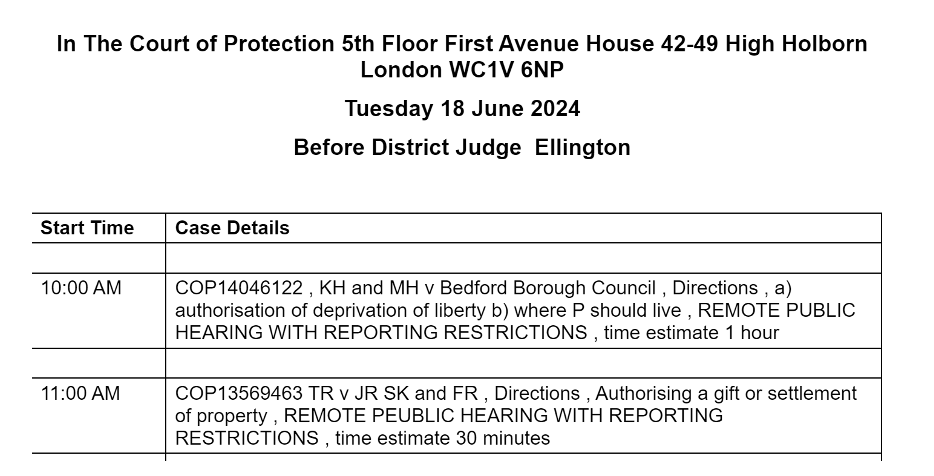
6. The information that the case involves the Public Guardian as applicant is already in the public domain. The hearing on XXXXXXXX 2024 was listed in Courtel/CourtServe as below – and the screenshot of this listing was circulated by the Open Justice Court of Protection Project on social media, including X (formerly Twitter), where we have over 6k followers). Since posting this information pre-dated the Transparency Order, and Transparency Orders cannot act retrospectively, we have not deleted this information. When information is already in the public domain, it makes no sense for Transparency Orders to seek to suppress it. 

7. Transparency Orders are not designed to protect the identity of public bodies. Under the terms of the Transparency Pilot 2016, now incorporated into routine Court of Protection practice, the purpose of the Transparency Order is to enable hearings to be held in public in accordance with the principles of open justice and Article 10 rights to freedom of information, while protecting the Article 8 privacy rights of the person at the centre of the case (P).  Protection of public bodies was never an intended goal.

8. There is no evidence that identifying the Public Guardian risks identifying P. The is only circumstance in which I have seen judges order that the identity of public bodies cannot be reported is when so doing makes it “likely” that P could be identified, via a process of jigsaw identification.  This is rarely the case – but does occasionally arise (e.g., with small NHS Trusts with only one specialist centre at which someone with P’s medical condition could be treated).  It is highly unlikely that identifying the Public Guardian as the applicant in this case carries a risk that people could identify the protected party.  The onus is on the applicant who seeks anonymity, and the court that grants that anonymity, to explain how it would be “likely” to do so. No such explanation has been offered.

9. I have seen no evidence of a careful balancing exercise of P’s Article 8 right to privacy with the public’s Article 10 rights to freedom of information. The Court of Appeal in Abbasi v Newcastle upon Tyne Hospitals NHS Foundation Trust [2023] EWCA Civ 331 has confirmed the need for an intensive fact-sensitive evaluation and balancing exercise when curtailing freedom of speech to safeguard Article 8 rights. I am not convinced that any such balancing exercise has taken place in this case  or that if such a balancing exercise were to be undertaken, the outcome would be in accordance with the current reporting restrictions.

10. One consideration weighing heavily in favour of varying the Transparency Order as per my application, is the draconian consequence of concealing the identity of the Public Guardian, which is that in reality the case cannot be reported at all.  This seriously compromises the freedom of expression of the member of the public who observed the hearing, who cannot have her blog about it published, and my own freedom of expression as blog editor, as I cannot publish her blog post.  It also compromises the public’s right to receive the information we are prohibited from publishing –and this is information concerning a public body engaged in matters of legitimate public interest.   

Celia Kitzinger, 24th May 2024

Celia Kitzinger is co-director of the Open Justice Court of Protection Project. She has observed more than 500 hearings since May 2020 and written more than 100 blog posts. She is on LinkedIn (here), and tweets @KitzingerCelia

A private hearing before DJ Glassbrook

By Claire Martin, Celia Kitzinger, Peter C Bell and Kim Dodd, 22nd May 2024

A few months ago, we published an audit of “private” hearings – that is, hearings that appear as “private” in the lists on Courtel/CourtServe. 

What we found is that at least 50% of those “private” hearings had been wrongly listed as such.  The judge actually intended them to be public.

Since then, Celia has been systematically sending emails to each of the judges whose hearings are listed as “private”, asking if that’s really intended.  Replies often come too late to be useful, and we’ve missed many hearings intended to be “public” because the mistake in the listings was only corrected after the hearing had taken place.  

By contrast,  DJ Glassbrook got back in a timely manner on 9th May 2024 when asked about his hearing in Northampton the following day (COP 13982390): “This is a s.21A and would appear to be suitable to be [a public hearing]  with the benefit of a Transparency Order, albeit I can’t actually see such an order”. He explained he would ask for submissions on the matter and would need to ask observers to leave if he was persuaded it should be held in private.  In the event, that’s actually what happened – which makes this an interesting case for open justice. 

The hearing

Celia (who was not herself able to join the hearing due to previous commitments) alerted the core team to the possibility that this “private” hearing would in fact be in public, and also posted on X about it.  Claire Martin attended from the core team, and so did two other observers: Peter C Bell and Kim Dodd.  What follows is based on Claire’s contemporaneous notes of what happened, checked by Peter and Kim (who were admitted to the online platform a couple of minutes sooner than Claire). This transcript is as accurate as we could make it, given that we are not allowed to audio-record hearings, but is unlikely to be 100% verbatim. Counsel were Lucinda France-Hayhurst of St John’s Buildings for the protected party and Zoe Whittington of Cornerstone Barristers for the Local Authority.

Judge: Yesterday I received an email from Celia Kitzinger. Frankly, once a case gets going it’s not something I’d considered. There’s no Transparency Order (TO). I agreed with Professor Kitzinger if she wanted to observe I’d need to get a TO.  I would need to hear submissions from parties. There is no TO. No party may publish anything. If it becomes a public hearing, there is a draft TO and I should check the observers are aware of the standard terms.

Claire was joined to the video-link at 10.13am.  

Judge:  Dr Martin I know you’ve just joined – unfortunately the requests arrived late – well this morning they were sent over. [Mentioned reporting being restricted in ‘usual way’] You can’t name any party or accommodation of P. 

DJ Glassbrook then asked counsel for P for her view on observers being present at the hearing. 

Counsel for P: I don’t have instructions so I’m minded to ask you, judge, to apply caution.

Judge: Why? 

Counsel for P: Why?

Judge: Yes, why more caution, and let’s face it  […]  what I do in the vast majority of cases is to make, first, directions that this is subject to a Transparency Order (TO) and from memory I don’t think I have ever heard it argued that it should THEN become private. So, it’s routine for a TO these days, isn’t it?

Counsel for P: It certainly is …

Judge: So, if you say that shouldn’t hold in this case, I need to know why … I think it was simply an error on my part at the beginning …. [the judge was suggesting that the hearing being listed as ‘Private’ from the beginning was an error on his part]. 

Counsel for P: Nevertheless, I have no doubt that it would be the expectation of the ALR (Accredited Legal Representative) that proceedings should be in private – and whether in error or not it was listed as private  […] What I say may give rise to […] we have a potential criminal investigation, the Local Authority will provide information before the next hearing . We don’t have information at present and until we have it, we don’t know whether there will be a concurrent prosecution. The facts of this case are very sensitive, jigsaw identification [may be possible] …. We are at a point in P’s life during a move … it’s an extremely febrile time for P. If jigsaw identification were to come about […] I am asking you to consider the position for a short period to allow the ALR to weigh in and for information from the police. A careful review before the next hearing, and if in the ALR’s [view] it should be in public, there will be a TO.

Judge: I am bringing up the draft … [reading a draft TO – possibly the template from the Transparency Pilot, here or a version of it prepared for this particular hearing but not yet approved].  What I am looking at is the subject matter of the injunction in the draft TO. It’s in the standard form. The subject matter: (reading) “any information that identifies or is likely to identify that SR is the subject of proceedings, or that any person who is a member of the family or that any material that identifies or is likely to identify where any person lives.” […] We could add a line that it includes where P will move to.

Counsel for P: It’s not the geography, it’s the nature of her conditions, and given that we are at a particularly sensitive moment … There are of course times where court uses discretion….

Judge: OK. Miss Whittington?

Counsel for LA: The Local Authority remains neutral, [it is] content for it to be made public with a TO. [?Happy to] hear other submissions – we wouldn’t object to it, but judge we are in your hands.

Judge: If I pick up what Miss France-Hayhurst says and if we consider particular characteristics of an individual and there is to be some criminal case, which reveals those characteristics of the individual, that’s the end of it isn’t it? It’s out there then?

Counsel for LA: Yes, that’s right

Judge: And do you say we can phrase the TO protect against that?

Counsel for LA: I would say so, yes. Obviously the TO is phrased to deal with concerns.  I don’t think the Local Authority would be concerned with a sufficiently robust TO.

Judge: Is that something we are able to do now? If it’s the particular characteristics of P that are the issue, I suppose it would be possible to include within that, paragraph 6 ‘don’t disclose matters that are particular characteristics of the individual’. But that makes it nigh on impossible to report ANYTHING. So, a  characteristic – what is that? A certain age? Yes. Is […. ….] all sorts of characteristics … that would help identify the individual. What I am trying to do here is not tell you I have made my mind up, it is to force engagement with arguments from Miss France-Hayhurst.

Counsel for LA: Yes, and essentially the Local Authority position is that it is content with the TO in standard terms. It prevents reporting in any event….

Judge: It doesn’t prevent reporting. It expressly ALLOWS reporting.

Counsel for LA: Yes, what I mean is it prevents identification of P, that’s Miss France-Hayhurst’s concern. I think that’s covered by the TO in any event. I have an update from my client. The information the Local Authority has from the police is that there isn’t going to be a police investigation. That might assist.

Judge: OK! Miss France-Hayhurst, I appreciate that getting that information right now isn’t especially comfortable for you, or for me. So, it seems the main risk of identification is that if there are similar characteristics published as part of criminal proceedings and someone puts two and two together. Were it not for that we’d have a TO wouldn’t we?

Counsel for P: Well … judge it’s impossible to say if we would or wouldn’t. I am in the position of not having instructions ….

Judge: Well, I feel quite entitled to lean on both of you here as advocates with a duty to the court to assist, regardless of instructions. You’re both experienced in Court of Protection matters. This isn’t a matter for instructions, they will express an opinion. […] Part of the fun of being an advocate is being put on the spot now and again …

Counsel for P: It certainly reduces the possibility of jigsaw identification.  […] The court also has to consider the potential impact though. I appreciate it would be sensitively reported by these observers. … But P is likely to be moved to a different area and it’s likely to be a challenging time [it needs a] period of time and adaptation for P, so the last thing they would need is jigsaw identification. I would urge the court to exercise caution TODAY. [Counsel’s emphasis]

Judge: [thinking] …. Any observers have anything to say? 

(Kim suggested a temporary ban on reporting and allowing us to observe, and pending a TO we could later report.  Claire agreed and said that she was going to suggest a  temporary ban on reporting.)

Counsel for P: Surely there’s no point of observing if you can’t report? 

Judge: What would be nice would be if we had all had …. and I don’t make this observation as a way of criticising anybody at all – if we’d all had lots of time to look at it and consider it, it would be undoubtedly more comfortable.

(By this point it’s already 10.37am)

Judge: Let’s face it, I’m not good on reporting restrictions practice.  I imagine if I got the civil procedures rules out there may well be more in that but [I don’t have] time for me to go through that, [it] would be such that, in practice, we would simply be adjourning this hearing, and it would be for nothing. I admit reporting restrictions are not my normal thing.

Peter: […] Open justice – I would ask the court to adopt the least restrictive approach. [There is] an additional point about observing but not reporting. Obviously if we can observe and not report we are then able to make submissions about the reporting restriction to ask for it to be lifted. I have come across temporary ban on reporting  – I think Open Justice Court of Protection has examples – so there are precedents.

Judge: OK let me tackle this now. This is a hearing about an individual who has particularly unusual characteristics. It’s a welfare hearing. In the large majority of these hearings as indicated by the relevant practice direction, the hearings will be under a TO which imposes some restrictions. Yesterday I had an email asking whether this hearing should be in private, and I readily admit that this isn’t something that I had given any great thought to. I may have done early on in the proceedings, I don’t remember. The norm is undoubtedly for there to be public hearings with a TO. I have heard submissions from advocates and brief submissions from three observers as well. I have to balance. I accept it might be possible to impose a reporting ban pending any further decision. I need to be careful here because the general principle is not transparency above all else, but transparency and rights of the protected party. I am told that at one stage there may have been criminal proceedings, and I am told today that might be otherwise, I haven’t seen a document [saying this is so]. The police giving indication doesn’t prevent that being reviewed. In those cases where another party has an interest, they can ask for a review. Criminal procedure is not my specialist area either. I would need some more information. The particular issue is that criminal proceedings are normally public and the press can publish whatever they like and potentially track back. If they do so and this is put together with the characteristics in the Court of Protection matter, it would not be challenging to put the [two together] and I can appreciate, knowing what I do about the protected party, that would be damaging. How am I going to deal with this? No party is going to be in a position to put submissions … We’ve used three-quarters of this hearing on just this issue. I would like more time – I want to study [more]. I believe that this hearing is to remain private. If required, then we can have another hearing to discuss just this issue … if we then have a decision that subsequent hearings should be public with a TO then the subject matter becomes public. The effect of that is not to deny transparency but to delay it, and I believe that is a proper way of doing it. Miss France-Hayhurst, Ms Whittington, is there any reason that what has happened TODAY should not be reported. [Judge’s emphasis]

Counsel for P: No

Counsel for LA: No

Judge: So, the observers are free to report, should they wish to, the outcome of this hearing so far today. I am going to ask you to leave unfortunately. If there is a further hearing then the three of you can be sent the link or it can be published on CourtServe. 

Counsel for P: I would advise in the interim that if publication of what we have discussed today is permitted, this should be subject to a TO.

Judge: That makes sense. Miss Whittington and Miss France-Hayhurst, can I ask you to look at that and send it to the three parties. I am sure between us we can find out the email addresses. Whilst observers are free to report what’s happened, that may not be done until the TO has been received, and it will be subject to that TO. 

Peter: We are now needing to make submissions without knowing the facts – how do we get round that?


Judge: You know there are specific characteristics and there may be criminal proceedings and I don’t think it’s [necessary?] for the particular characteristics to be known, for you to be aware that they are such that it would be easy to equate the two cases. I have ten minutes to deal with this hearing, so I have to deal with the hearing itself. I can’t let transparency completely scupper the hearing; it’s come close to it already. When you have the TO the three of you will be subject to it. Unfortunately, I am now going to have to ask you to leave. 

The observers left at 10.50am

Reflections

We don’t doubt that this judge shares the broader judicial commitment to transparency in the Court of Protection, but in practice there are clearly problems.

The system is supposed to work by the judge making a decision at the outset of the case about how the hearings are to be listed, and – if they are to be in public – by  simultaneously making a Transparency Order. 

If there’s no Transparency Order, court staff routinely list cases as “private” – even when the judge has not considered the issue and has certainly not made any decision that a hearing should be held in private.  If a judge has decided (or simply assumed) that a hearing will be in public, but hasn’t made a transparency order, the hearing will be listed as “private”.

Then (as seems to have happened here) when observers ask to attend, the judge thinks (despite the listing) that the hearing is probably public, but a situation can arise where at least one party is under the impression that a deliberate decision may have been made to list it as private. It sounds as though it’s appeared in the lists as a “private” hearing before (though we don’t have evidence of that).  

The advocates were then bounced into having to make arguments on the fly, not having expected this to become an issue, and with the judge having (apparently) assumed it was likely to be a listing error rather than reflecting anyone’s view that the hearing should actually be held in private.

Since there is now (it seems, pending instruction from the ALR) an application to hold the case in private, Celia will be making an application to act as Intervenor to help the judge with considering how a Transparency Order can be made that balances P’s Article 8 privacy rights with the public’s Article 10 rights to freedom of information.  

The messiness of this hearing could have been avoided, of course, if the basic principles of whether the hearing was to be private or public (and what reporting restrictions could enable a public rather than private hearing) had been considered at the outset of the case.

Claire Martin is a Consultant Clinical Psychologist, Cumbria, Northumberland, Tyne and Wear NHS Foundation Trust, Older People’s Clinical Psychology Department, Gateshead. She is a member of the core team of the Open Justice Court of Protection Project and has published dozens of blog posts for the Project about hearings she’s observed (e.g. here and here). She tweets @DocCMartin

Celia Kitzinger is co-director of the Open Justice Court of Protection Project. She has observed more than 500 hearings since May 2020 and written more than 100 blog posts. She is on LinkedIn (here), and tweets @KitzingerCelia

Peter C. Bell is a law student at the Open University. He tweets @dolphinpcb

Anorexic woman gets to make her own (incapacitous) decisions, says Hayden J

By Celia Kitzinger, 19 May 2024

It does not follow that when a judge is satisfied that the presumption of capacity has been rebutted that it is automatically incumbent on the court to take decisions for the protected party…. Sometimes it is in the best interests of the protected party to take decisions for themselves, even when they cannot weigh all the factors into the balance in the way the capacitous can.”  (Hayden J, in oral judgment)

At this hearing before Mr Justice Hayden, “Pam”, a woman in her 40s who has received treatment for anorexia against her wishes under the Mental Health Act for more than twenty years, pleaded with the judge to be allowed to leave hospital.  She wants to be discharged from the Mental Health Act and allowed to return home. She does not want to engage any more with the Eating Disorder Services, but is happy to access symptom management to alleviate the consequences of not eating sufficiently and to improve her quality of life.  

She was, as Mr Justice Hayden said, “a powerful and eloquent advocate on [her] own behalf”.  He made declarations that she should, in future, receive treatment only in accordance with her wishes.  

My original intention was to focus on Pam’s role in the hearing and simply link to the published judgment for the details of the case. But two months later there is no published judgment, and I don’t know if there will be one, so I have revised my original draft and written a fuller report than I originally intended.

The judgment is important because it (again) pushes forward the boundaries on decision-making for the incapacitous, as Hayden J has done previously and most obviously in two other cases: Rotherham and Doncaster and South Humber NHS Foundation Trust and NR [2024] EWCOP 17  and Avon and Wiltshire Mental Health Partnership v WA & Anor [2020] EWCOP 37.  (See also our blog posts about these two cases:  A rock and a hard place: Abortion decision for an incapacitous and conflicted P“What is he saying to us?” The ‘voice’ of a hunger-striking man in a best interests decision about his medical treatment.).

In those two earlier cases, Hayden J found the protected party to lack capacity to make the relevant decisions (to consent to or to refuse an abortion [NR]), to consent to or to refuse clinically assisted nutrition and hydration [WA])).  But the judge nonetheless left the decisions up to the protected parties. The judge made clear his view that it is in the protected parties’ best interests to be free to choose for themselves and to assert their own autonomy. 

Judgments like this have  been described – by eminent lawyer and commentator Alex Ruck Keene – as “creative”, or even “odd”:

On the face of it, it might seem somewhat odd for the court at the same time to conclude that the person lacks capacity to make the decision in question, but that it is in their best interests for them to decide what should happen (or perhaps, to be more precise, for their choice to be respected as determinative).   It might also seem somewhat odd for the court to decline, expressly, to make any best interests decision, given that a key part of its statutory raison d’être is to make such decisions on behalf of individuals unable to do so.” (“Exercising legal capacity and termination: A creative approach by the Court of Protection”)

In the context of decisions about treatment for anorexia, however, it is perhaps less surprising. We have seen similar decisions from other judges who have likewise made decisions that it is not in the anorexic person’s best interests to be given forcible treatment against their will, and the choice as to whether or not to accept treatment (or to eat) is left with the person themselves.  For an expert overview of the court’s approach to these cases of severe and enduring anorexia see Expert witness in anorexia cases[1].

The hearing

It was an in-person hearing before Mr Justice Hayden sitting in the Royal Courts of Justice on 26th March 2024.  All the parties (including Pam) were in the physical  courtroom,  but a link was available for the witnesses, who included the independent expert appointed by the Trust and the treating psychiatrist (both of whom gave oral evidence) and others including the GP and palliative clinician (who did not give evidence).

The position of the parties was as follows:

Applicant Trust position

The applicant Trust (Southern Health NHS Foundation Trust, represented by Nicola Kohn of 39 Essex Chambers) was seeking declarations that Pam lacks capacity to make the relevant decisions and asked the court to approve its proposal to cease treatment of Pam’s anorexia against her will and to implement a care plan for palliative care in the community.

Since her anorexia diagnosis in 2004, Pam has never achieved a body weight above 38kg (BMI 14.7). The Trust summarised a long list of admissions to treatment units from 2005 onwards, none of which has been effective in curing her anorexia (though they did of course keep her alive).  “With a heavy heart”, they say that “further treatment is likely to be futile, harmful and is not in accordance with [Pam’]s wishes”.  

Official Solicitor position

Pam was represented, via her litigation friend the Official Solicitor, by Parishil Patel KC of 39 Essex Chambers.  The Official Solicitor had considered the available evidence, including in particular Pam’s own articulately expressed view that she has capacity both to conduct the proceedings and to make decisions about her treatment for anorexia.  The Official Solicitor’s view, however, is that Pam lacks capacity in both areas “because her ‘anorexia cognitions’ mean that she is unable to use and weigh the relevant information in making a decision”.  There is, said the Official Solicitor, “a significant risk” that discharging Pam from detention under the MHA and providing only treatment that she accepts and complies with, “will lead to her death”. Nonetheless, Pam’s beliefs and values (albeit distorted by anorexia) “should be afforded significant weight” and the proposed care plan “promotes [Pam’s] autonomy and gives her the best chance of peace and comfort in her life”. 

Cygnet Healthcare Limited position

Pam’s current care provider, Cygnet, was represented by Francesca Gardner of 39 Essex Chambers. They’d had input into the formulation of the care plan and provided input, via the treating clinician,  into current clinical opinion as regards further inpatient treatment for Pam.  The treating clinician had considered the  independent expert report from Dr Pelosi and agreed with his conclusions, specifically that Pam lacks capacity to make the relevant decisions, and that the chances of any specialist eating disorder unit being able to achieve full weight recovery in Pam’s case were remote.  They also referred to Pam’s own statement (also referenced by the other two parties) that if her weight were to fall below 30kgs (she currently weighs 30.6kg, BMI 11.81), then she would accept a brief admission to hospital for refeeding on condition that it was a voluntary admission and that treatment under the Mental Health Act was “off the table”.  Although joined as a party for this hearing, the care provider played a modest role in proceedings.

Professional Witness Evidence

Dr Anthony Pelosi described Pam as “highly articulate, highly intelligent” but said her ability to use and weigh relevant information “is entirely occluded by her preoccupation with her weight”. She is, he said, unable to weigh any information about her anorexia “because of the distorting and all-consuming effects of anorexic psychopathology on discussions about her health and wellbeing as they relate to her nutritional status, her body weight and the shape and size of her body”.  He had considered the possibility of feeding Pam (against her will) up to a BMI of 20, in the hope that this might ameliorate her anorexic psychopathology, but reported that she’d found refeeding to a BMI of 15 as “traumatic in the extreme”, and said that it was very unlikely that she would choose to sustain improvement after discharge from hospital.

The Trust psychiatrist was asked by the counsel for the Trust to explain the basis on which Pam’s refusal of weight gain “is not simply a decision she makes, and an unwise one, but a decision she is unable to make because of an impairment in her mind or brain”.  In response, the psychiatrist described the “severe trauma and suicidal thinking” that Pam experiences when her weight goes above 30kg.  “She understands that she could potentially die, but she’s not able to understand that in a way that those without this level of psychopathology would be able to.  She can’t really comprehend the consequences of not maintaining her weight above 30kg […]. She says she doesn’t want to die, but can’t prioritise that as a more important factor compared with maintaining the weight she wants to maintain”.

Pam’s evidence

Before the lunch break, the judge addressed Pam, saying: “ We’re all talking about a really important decision about your life.  You are an intelligent, articulate woman.  I’d quite like to hear what you have to say about this. I will make the process of giving evidence as relaxed as I can and I’m not going to make you go into that witness box against your will. It’s up to you and you can let me know what you decide when we return at 1.30”.

When the court reconvened, counsel told the judge that “Pam would like to address the court” – and she was sworn in to give evidence.  I’m not sure that what protected parties say in court is technically “evidence”, but in the context of this hearing, with this P, it felt absolutely appropriate that she should be able to address the court, in public, in the same way and with the same formality and gravity as pertained to the doctors who had given evidence about her.   

Pam described what she called the “merry-go-round” of admissions to Eating Disorder Units and coercive treatment.  

Pam:  My weight dips, I stop ticking the boxes that the GP needs me to tick and I’m sent to an Eating Unit under the Mental Health Act. In the Eating Unit I undergo coercive feedings and suffer the despair and depression that brings. They keep you in there until you’re a higher weight and make you do whatever they want you to do. As my weight goes up, my despair and panic goes up. As soon as I’m discharged, I can’t cope at that weight and my weight goes down.

Judge: What does getting your weight up involve?

Pam:  There’s a menu plan, and if I don’t comply with that there’s the NG tube which I’ve been given forcibly because I wasn’t following the menu plan.

Judge: What is involved?

Pam: Six to eight members of staff – they hold your head, arms, middle and your legs, and then another member of staff forces- You’re restrained on a large bean bag and then they take the tube and with some force and effort insert it into your stomach and test it and then they put feed into your stomach while holding you down.  When they did it at [care provider] it took about an hour and a half.

Judge: Did you resist?

Pam: Yes.  And say you’re supposed to have 100mg and you only have 90mg, they give you the whole thing again

Judge: After they did it at [care provider] did you comply with the menu plan?

Pam: I felt I had no choice. I had PTSD from when I was forcibly NG-ed at [earlier care provider], so even though [this care provider] knew I had significant trauma, they put me through that NG now.  If I don’t follow the menu plan that they give me, then I go through the trauma of being forcibly NG-ed, so I’ve been following the menu plan only to avoid that horrendous experience.

Judge:  The treatment for anorexia [inaudible] difficult to understand and get the balance right. If you look back over the treatment you’ve received over 20 years and I were able to make you Professor of Psychiatry, what would you do?

Pam: I think when you are at the start of anorexia, if you can have full weight restoration the first couple of times – treated quite aggressively and, yes, forced NG-feeding, then I think they stand a really good chance. That’s when it’s not so ingrained. Over time, anorexia becomes more and more you. It becomes your new normal.

Judge: Why did that not happen in your case?

Pam: Uhm (silence) I don’t know the answer to that.

Judge:  Why is it too late now?

Pam:  I’ve been trying for the last 10 years or so, being pushed through different weights while being told “if you get to this weight, you’ll feel different” – and it hasn’t happened.  I was pushed to the dizzy height of 38 kilos, under which I felt I was suffocating and unable to leave the house.  Anorexia isn’t about thinness. It’s not about me wanting to look thin. It’s about how it makes me feel inside. It’s about being able to accept myself. It’s about being at peace with myself.

Judge: What is it about being – let’s be blunt – emaciated that makes you feel at peace with yourself.

Pam:  I feel that (silent)…. It…. It makes me feel safe in that…. (silent)…. I’m not taking up too much room in the world. 

Judge: Yes, I’ve heard quite a few women say “it makes me feel disappeared”.

Pam: It’s not that I’ve got a death wish.

Judge: No, I don’t mean that.  Invisible.

Pam: Yes.

[…]

Judge: As I read the care plan now, it is essentially to put you entirely in control of your own destiny.  Wrapped up in different words, but that’s what I read it to be.  When I look back on your prior history, I can’t see a time when you’ve been completely in control.

Pam:  I had an interesting conversation with a lady who’s recovered.  She left the Unit at a reasonably low BMI. What changed her was, all monitoring was off the table, but she said she was sat on the sofa watching her children playing in the garden and she thought, “you know what – I’d really like to play with my children”. And she gained weight.  Weight is at the forefront on my mind. There’s a constant fear that I’m going to get dragged back to the Unit again. If that fear’s removed and I’m sat at home, it’s a sunny day, I can hear people having fun, walking around having fun… It would come from me wanting to get a bit stronger to do that, or go see my mum, or go out shopping with my sister.  It would be coming from me, instead of all this constant anxiety […]. It’s almost terrifying because I don’t know what’s going to happen.  I just know that for the last 20 years I’ve been in and out of Units, none of which has helped in any way, and I would just like the fear and despair to stop now – the fear of being detained in a Unit and forcibly fed.  I would like to have some quality of life. I would like to do what might seem little things to people with a full life, but to me they mean a lot, and I would like to do those things in the comfort of my own home, and with some dignity.

Judgment

Mr Justice Hayden gave an oral judgment in court – no written judgment has been published.  I’ve captured it as best I can here. As always, we are not allowed to record court hearings so this is based on my contemporaneous touch-typed notes.

For twenty years, nearly half her life, Pam has lived with the burden of this condition. In 2011, such was its progression that she was diagnosed with osteoporosis.  She has a long and enduring history of self-induced vomiting and laxative misuse and weight manipulation.  During the course of this short hearing, she gave evidence before me.  As I said to her when she was in the witness box, I found her to be a compelling and articulate advocate – on her own behalf and further, given that this is a condition which the Court of Protection encounters with some frequency, she added greatly to the sum of my understanding and thereby served a purpose for other women in her circumstance.  

Pam is one of three sisters.  Her older sister, Annie, has been interviewed by the Official Solicitor, and during the course of that interview it was clear that she had some considerable insight into her sister’s condition.  Plainly to some degree she’d had problems of her own, which she’d overcome, and throughout her statement was her own almost palpable distress at the prospect of losing her sister – something which I suspect she’ll have lived with for some time, although it becomes more real for her in these proceedings.  The two sisters are obviously close, and although Annie finds each of the available options for her sister to be unattractive in some way, her prevailing wish is that those concerned with her care should not, as she puts it, “give up on her”.  I hope that the declaration I’m going to make shortly will do nothing of the kind. Its objective is different altogether from the anxieties reflected in Annie’s interview. 

I have mentioned Annie’s feelings because hers is the only discordant voice at this stage as to what in the future is in Pam’s best interests.  Those treating her, and the expert instructed to provide a second opinion, have all been able to agree today.

Pam has never in all those 20 years of treatment achieved a body weight above 38kg.  When her weight has been increased during the course of hospital admissions, it has a powerful impact on her sense of well-being. In the witness box, and given a moment or two of hesitation to reflect, she told me her condition is not about wanting to be thin: it’s about wanting to be at peace.  And she finds peace by making herself feel unobtrusive and small. And she agreed with me when I used a word I’ve heard used by other women with her condition – “invisible”.  It is not easy, as Dr Pelosi foreshadowed, to understand the psychology of this – why she would wish to feel invisible or slight.  But in many ways that scarcely matters.  It is that which is the driving force.

Pam has been a hospital inpatient, under s.3 of the Mental Health Act, since June last year.  Recently she has been on s.17 leave and that has allowed her to visit her home…. Those tentative steps back into what we might call the ‘real world’ have, I’m told, gone reasonably well.  

There is a care plan before me with the essential aim of restoring to Pam control, absolute control, over her condition.  The stated aim of the plan is to maximise her autonomy in the community.  Palliative care, as it is termed, is intended to manage her symptoms – and care is available to provide her with support when or if she chooses to engage. 

It would be wrong to think of what has gone before as failure, but the alternative regime has had its own burdens – and saying that doesn’t come close to doing justice to Pam’s lived experience.  The alternative of imposing treatment – in particular force-feeding Pam – is properly described within the documentation as ‘abhorrent’.  I accept that subjugation to that force would be corrosive of her dignity.  More than that, I’m entirely persuaded that such a course would be likely to render life for Pam so traumatic as to be simply unacceptable to her. In blunt terms, if the choice was death or force-feeding, she would rather choose to die. I have no doubt about either the sincerity of that view, or the strength of it.

Mr Damian Cullen, one of the lawyers with the Official Solicitor, met with Pam on 13th March and did some creative and sensitive work. Pam told him that she believes there were three options to be considered.  First, a community care plan which would, in her terms “stop the merry-go-round”; second, for the merry-go-round [of admission-discharge-readmission] to continue; and third, full restoration of her weight.  In relation to that third option, Pam said if that were to happen, it would bring about her death much quicker.  On the last occasion Pam was subject to force feeding, it was necessary for her (weighing something like 30kg) to be restrained by six people while she was forcibly fed for an hour and a half and resisting throughout.  She described herself as having suffered PTSD from this episode.  Manifestly, and entirely understandably, that episode of prolonged coercion has factored heavily into her decision-making processes in relation to her treatment.  If that is so, it caused me to wonder, despite a heavy and recent professional consensus to the contrary, whether she had capacity to take treatment decisions for herself.

I have heard from Dr Pelosi and from the lead clinician. The nature of anorexia is that it comes to overwhelm almost everything else. That, in simple terms, is what Dr Pelosi and [treating clinician] were saying.  […]

The care plan is at pains to highlight the distinction I’ve been grappling with – that is to say between palliative care, and a diagnosis of dying and the management of the dying process.  This plan is not motivated by an objective to minimise Pam’s care at the end of her life. It is motivated, as I’ve emphasised, by giving her choices for herself.  To choose, I suppose, in effect, whether to live or die.  Because while she may not have sufficient insight into her condition to have the capacity to make decisions about treatment, she is entirely aware of the risk of dying. On this point I do not have any doubt at all.  She is manifestly an intelligent woman. She has – until she was unable to work – an impressive employment history, doing an important job she clearly enjoyed….[…] She finds solace and comfort in her hobbies: cross-stitching, cryptic crosswords, and a keen fascination with modern Russian history.

I asked Pam if she thought the care plan which offered to put her in the driving seat for her own future stood any chance of working in terms of enabling her to establish an eating regime that gave her body sufficient to live on and her mind and brain sufficient to achieve….  She told me she’d spoken to another woman in her circumstances who, when presented with similar options to her, was free to take up responsibility for her own care.  Pam identified the motivation for this woman – seeing her children playing in the garden and wanting to be part of that.

I found her analysis of her own situation cogent, reflective and impressive. In essence, she does not know – as she told me – what the future holds.  But that there are options for the future, and that she recognises that, is plain.  

For all these reasons, I have no hesitation at all in endorsing the care plan.  I consider it to be lawful and in Pam’s best interests to receive treatment, including feeding and weight restoration, ONLY, I emphasise, in accordance with her wishes, and for her to be treated in accordance with the care plan of 26th March.

I have not found it necessary to read the law and the legal framework into the judgment and I don’t propose to overburden it with that.  […]

It does not follow that when a judge is satisfied that the presumption of capacity has been rebutted that it is automatically incumbent on the court to take decisions for the protected party…. Sometimes it is in the best interests of the protected party to take decisions for themselves, even when they cannot weigh all the factors into the balance in the way the capacitous can.

I do not underestimate the challenges of the future and take this opportunity to wish Pam the very best.  This judgment removes a sword of Damocles she believes to have hung over her head for many years.  

Transparency matters

The hearing ended with a brief discussion about the rather draconian Transparency Order applying to this case (made by Mrs Justice Theis on 9th February 2024), which prohibits reporting the name of the applicant NHS Trust, as well as the names of not just professionals but organisations caring for Pam “or involved with the planning, arranging, commissioning, reviewing, regulating and/or monitoring [Pam’s] care”.   I had emailed counsel about the terms of this Transparency Order during the course of the hearing and was told it was under discussion. 

Clearly recognising Hayden J’s commitment to transparency, Nicola Kohn raised the matter of the Transparency Order with the judge by saying, “Not to tilt at windmills, but it provides for the anonymisation of the Trust and Cygnet”. 

As expected, Hayden J responded robustly. “We go in this court to enormous lengths to seek to dispel the canard of secrecy…” he said, referring to “the litter of anonymisations” which reinforce the “spectre of secrecy”.  The judge ordered that the Trust, the care provider, and the expert (Dr Pelosi) should all be named (but not the treating clinicians).  He added: “I don’t think the medical profession should shrink away from this conclusion, which is progressive and patient-focussed and one they should be proud of”. 

Celia Kitzinger is co-director of the Open Justice Court of Protection Project. She has observed more than 500 hearings since May 2020 and written more than 100 blog posts. She is on LinkedIn (here), and tweets @KitzingerCelia


[1] We’ve  also blogged about anorexia cases here: 

A chaotic start to a hearing – and assessment of Mum as carer ordered

By Amanda Hill, 17 May 2024

“Open justice is a fundamental principle in our courts”.

That is the standard line included in many of the court listings. This means that members of the public, like me, can observe hearings. Sometimes, obstacles are put in our way. In this hearing, certain members of the public were excluded from the hearing despite being admitted. This time it was for a good reason though and I will explain what happened and how to avoid it happening in future. 

I would also like to focus on two particular elements of the substantive matters in this hearing –an ageing mum whose ability to care for her son is being questioned, and record keeping by professionals. 

Background to the hearing[1]

The protected party in this case (COP 13337913) is S, a man in his late twenties who has autism spectrum disorder and global learning disability, and can display challenging behaviours. He has lived for a number of years in a supported living placement. 

The applicant is the London Borough of Islington, with S as first respondent and his mother (M) as second respondent. 

S’s mother lives over 2 hours away from S but – according to the position statement sent to me by her legal representative, Rosie Scott, M provides not only a lot of practical support to S but also a great deal of emotional support.  She’s been very concerned about the placement for a long time and believes it to be unsuitable for him for various reasons, not least that she believes S is very unhappy there. One of the options that the court was being asked to consider in this case was whether M’s home is suitable for P – in other words, could S move back home. 

Open justice – cock up not conspiracy 

The case was listed as follows: 

I think that District Judge Jackson was sitting in retirement in order to ensure judicial continuity in this case. Although the listing didn’t indicate that a link was available,  I emailed the court to ask if I could observe remotely[2] (which I later realized the mother did too). 

I did not get a reply to my initial email, so I phoned the court just over an hour before the hearing was due to start at 2pm and a little over 10 minutes later I received an email with the MS Teams link asking me to join 5 to 10 minutes before the start time. I also received a copy of the Transparency Order. So far, relatively straightforward. 

I clicked on the link a few minutes before the hearing and as is usual was placed in the “waiting room”. After a few minutes I was allowed in and I could see an empty courtroom. I was surprised to find that the court clerk wanted to check who I was and if I was at the right hearing. I confirmed the case number and she seemed happy. In the event there was a 30-minute delay to the hearing starting because the parties had asked for more time. 

The problem was that there were a lot of other people in the waiting room during this wait and the clerk did not know who they all were. As I had been admitted, I could observe the chaotic goings on behind the scenes before the hearing started. The legal teams eventually entered the physical court room and the clerk was trying to ascertain who was who in the waiting room in order to admit them to the hearing. The clerk explained to those in the physical courtroom  that I was the only observer who had received the transparency order but that there were other people in the waiting room who wanted to observe. Some people were authorized to attend as people impacted by the case, such as M and somebody else from the local authority. M logged on and then lost connection. 

The court rose at 14.35 but then the judge left 3 minutes later to wait for M to reconnect. 

At this point there were a lot of chaotic connection problems. Somebody was admitted, who turned out to be the mother of a different “P” from another hearing I blogged about here. She was asked by the court who she was and she replied that she was from the Stolen Lives campaign. She had requested the link but not received it. She was then told that she could not observe because, essentially, she had not received an official link. So, she was ejected from the hearing. Another person joined by Teams but then by telephone due to connection problems. It seems that they were a supporter of M. At one point there was a discussion between the remote LA representative and this person, trying to find out what was happening. A member of the legal team had to intervene to remind them that this was still a courtroom and they should not be speaking. I think this experience shows the difficulty of remote hearings using MS Teams. Some of the formality is removed. However, it can also be intimidating – I stayed a silent observer with my camera off throughout all this.  

Other people who I had seen waiting before the hearing started had disappeared and were not re-admitted at all. 

I gathered afterwards that the problem was that the link for the hearing had been sent to one person and then sent on by them unofficially to other people who wanted to support M, when they did not receive it directly from the court. 

As stated on the Open Justice Court of Protection Project  website, “If you haven’t received the link in a timely manner, re-send it with URGENT in the subject and forward it to us (openjustice@yahoo.com). We can’t share the links but we might be able to help.”

Unless a judge specifically allows it, links cannot be shared with other people. Whilst this can seem frustrating to those who want to observe, it is so the court knows who is observing, has email addresses for them, and can ensure that they have received the Transparency Order (at least in principle – in reality the track record of the court sending out Transparency Orders is rather patchy). 

 What probably felt like the court obstructing open justice in this case was simply that the official process had not been followed. 

That said, I think that there is scope for making the official process more efficient. It can be hard for court staff to manage (I could tell the clerk in this case was doing her best to do things correctly) and it can also be frustrating for would-be observers. I assume that in this case the link was shared because those wanting to observe had not received the link when requested. And I had needed to telephone the court staff to receive it. That takes up court staff time too. 

So I think all this was cock up rather than conspiracy but it does not help the reputation of the court in terms of its commitment to open justice.

The hearing finally started properly at 3pm. 

“None of us are getting any younger”

M wants her son to move back home with her and her other son.

Counsel for the local authority, Lee Parkhill, set out at the start of the hearing that steps were being taken to consider that, as well as alternative placements in care homes that would be closer to the mother’s home.[3]

When this was discussed during the hearing, the judge stated that she had asked “some time ago” for an assessment of the viability of M caring for her son at her home. She continued by saying that it had been a long time since M had cared for him (in 2013), and he had gone from a teenager to a grown man and “none of us are getting any younger”. The judge wanted to know if M would still be able to care for him, to see how able she is as a carer as she is “not getting any younger”. She wanted to see something of this nature, to “find out more about that”. 

Rosie Scott pointed out that there would be a care package in place and that M would not be caring for him on her own. The judge went on to say that she would like that aspect to be dealt with to avoid expensive renovations (which it had been outlined would have to be made to M’s house to allow S to return home). The judge asked how M handles S’s behaviour, that she would like to know more about that “as it’s important”, that it might show a way forward. The judge asked for more information about M’s role currently and what she would want to do. There was talk of a “trial” of M doing more for S and by mid-July an assessment of how it had gone with the mother’s interventions and S’s reactions to them. A carer’s assessment of M as a carer was also needed. 

It should be said that the judge wanted to ask M about this but it had been explained at the start of the hearing that although she was attending remotely, she was ill with laryngitis and could not speak. She had in fact appeared on camera at the start of the hearing at the judge’s request, and she was lying down in bed. This was unfortunate given the judge’s focus on her physical ability to care for her son. 

The judge’s concern also led me to reflect on the many unpaid carers looking after loved ones who are just quietly getting on with it without any input from the court. And the wheels of justice can move very slowly. This felt to me an additional pressure on M – I would hate to be questioned as to whether my own age and health could prevent me caring for a loved one, especially as a team of carers would be in place. Many protected parties in the COP want to go home and are indeed allowed to, with a team of appropriate carers in place. 

Record keeping 

There were question marks about the record keeping at S’s placement and the need for accurate record keeping was in the draft order. Asma Niazi, counsel for the OS and S’s litigation friend, addressed the gaps in record keeping that had been identified. For example, M says that S asks to go home with her each time she visits but the records don’t record that. M wants access to the records. The judge came back to this issue later. She said that it never ceased to amaze her that “professionals don’t record things properly”. She stressed the importance of recording things properly and there was a discussion about methods of communication. The judge asked “Why can’t they (the placement) just provide a detailed account?”.  This exchange made me reflect on how important record keeping and access to records are, the duties of professionals and also a parent wanting to know exactly what was being written about their son. 

A further hearing in this case was scheduled for 22nd August 2024. 

Amanda Hill is a PhD student at the School of Journalism, Media and Culture at Cardiff University. Her research focuses on the Court of Protection, exploring family experiences, media representations and social media activism. She is on X as @AmandaAPHill


[1] Rosie Scott, Counsel for the second respondent, kindly sent me her position statement, which greatly helped my understanding of this case.  I also asked for the other two position statements but did not receive them. 

[2] The Remote Observation and Recording (Courts and Tribunals) Regulations 2022 (in Practice Direction on Remote Observation of Hearings, June 2022) empowers judges to “allow remote observation of in-person and hybrid hearings” as well as remote ones (§3).  

[3] It is forbidden to record any part of a hearing and I don’t touch type so my notes will not be 100% accurate.  

Centenarian challenges deprivation of liberty – and judge manages transparency failings efficiently

Celia Kitzinger, 16 May 2024

There are more than 500 centenarians in Devon, and she’s one of them.  

Until September 2023, she lived at home with her daughter.  

Now she’s deprived of her liberty in a care home, where she’s been for around six months, following discharge from hospital after a fall.

She wants to return home.

But now she’s been diagnosed with vascular dementia and assessed as lacking capacity to make decisions about where she lives and receives care, and who she has contact with.  

There seem to be some question marks about the adequacy of the capacity assessments and that’s “in abeyance” pending receipt of care home records which will enable consideration of her presentation on a day-to-day basis.

The problem with a return home is that the applicant local authority, Devon County Council, has received safeguarding concerns – hoarding and clutter, and her daughter restricts access and is alleged to be “coercive and controlling”. The local authority is of the view that it’s in her best interests to remain at the care home.  Her three sons agree.  Of course, if she has capacity to make the decision for herself, then the court has no jurisdiction.

Meanwhile the court is looking into a possible return home  – either because she may capacitously choose it, or because it may be the outcome of a best interests decision. They are investigating what a care package would look like.  This is proving difficult because the daughter is declining to engage.  The social worker (who was also in court) has tried to visit and “gain cooperation” but without success.  It seems that the daughter believes she should be the sole carer for her mother.

The judge, DJ Eaton-Hart, sitting at Torquay & Newton Abbot County Court, expressed concern about the delay “especially with a lady of her age” but reluctantly accepted that another directions hearing would be needed before a final hearing, and has asked for the case to return before him on the first available date after 26th July 2024.

Transparency Issues

There’s been a history of listing problems with cases before DJ Eaton-Hart.  They’ve been appearing in Courtel/CourtServe without any descriptors to indicate what the issues are before the court, and also without any contact information – which makes it very difficult for would-be observers to obtain links.  

But I was pleased to see that on Wednesday 15th May 2024 it all looked correct – so I selected a case (COP 14203764) about “Where P should live and receive care” and “authorising a deprivation of liberty”.  According to the list, the hearing would be a “directions hearing” , held via “Teams” and last for “ 1 hour”.  And the Bristol hub email address was provided for contact. So far, so good.

I received an email with the Teams link, and with the Transparency Order as an attachment. This was continuing well.  

But then, on downloading the Transparency Order (ten minutes before the hearing was due to start), I was dismayed to see that P’s name was spelled out in full on the face of the Order, and also appeared five times, in full, in the text of the Order itself.  The Order also prevented reporting the identity of the local authority.  The Order had been made by a different judge (DJ Smith) earlier this year.

Here’s part of the offending Transparency Order.  In every Transparency Order there’s a paragraph called “The subject matter of the Injunction” (usually, though not always, paragraph 6) which sets out the “Information” we are prevented from reporting.  It’s the paragraph I always turn to first of all.  In this case, as you can see below, it forbids us from publishing anything that identifies or is likely to identify the protected party (P) – the centenarian whose name is actually given in full (I’ve obscured it with those blue rectangles).  It also prohibits (in 6(i)(c)) from saying anything that identifies or risks identifying the Local Authority – that’s Devon County County Council (not spelt out in full!).

I immediately emailed the court.

Please could you alert the judge to my concerns about this TO as follows:

1. P’s name should NOT be given in full on the TO – it’s both on the face of the TO and in the body of the TO.

2.  It is not usual for the Local Authority to be covered by the information (see 6(i)(c)).  In exceptional circumstances, where the judge has decided there is a risk that identifying a public body risks identifying P, a public body is sometimes anonymised – but only after anxious consideration of other ways of protecting Article 10 rights (e.g. restricting aspects of P’s identity from public reporting to minimise risks of jigsaw identification).  Can the judge confirm that the Art8/Art10 balancing exercise has been carried out and other ways of protecting Article 10 rights considered?

The judge raised this with counsel at the beginning of the hearing: “Why does the Transparency Order name P? And why does the Transparency Order prohibit reporting of the identity of the local authority?”.  Counsel asked for a pause to take instruction which was arranged for later in the hearing, after the substantive issues had been addressed.  

After the 10-minute adjournment, both counsel and the judge agreed that the naming of P on the Order “shouldn’t have happened” – that it was “an oversight”.  Counsel for P via the Official Solicitor said naming P on the Order was “obviously wrong” and that “the Order clearly shouldn’t have been sent out”.  He asked what could be done to stop this from happening again.  Also, Counsel for the local authority said they had “no issue with the local authority being named”.  

The judge was clearly troubled that “something’s gone wrong with the Order” and wanted to “acknowledge my role and Judge Smith’s role in not spotting that earlier”.  He said there were “learning points for those involved in drafting – and also I have to say, those approving – the Order.  This is not the proudest moment of those involved in this case, I should think.  Please file a new Transparency Order, and I’ll take steps to raise this with the COP hub”.

I was impressed with the way counsel and the judge handled the problems with the Transparency Order.  They swiftly acknowledged that it wasn’t as it should be, and they fixed it there and then, without delay (albeit without, so far, having sent me a new TO). This speedy response contrasts favourably with several cases recently in which delay has been caused to reporting by observers being required to fill in and submit COP 9 forms, or write position statements: decisions about transparency orders very like this one have been postponed to future hearings, months ahead, even though nobody has made positive arguments for protecting the identity of a public body. It’s as if once the mistakes have been made, it’s painfully cumbersome to unpick them – and so unjustified prohibitions have remained in place for many months. This really concerns me. Open justice delayed is open justice denied.

Another impressive feature of this case was that the judge accepted judicial responsibility for the errors in the Transparency Order (even though it was a different judge who had made the Order). He referred to those who had drafted the Order but acknowledged that it was a judge who had signed it. He was also clearly committed to making sure that it didn’t happen again.  

My understanding, from discussions at Court of Protection User Group meetings, is that the applicant solicitor is the person who usually drafts the Transparency Order.  Busy judges seem to be signing off on the Orders without checking them.  Of course, judges should not be “rubber-stamping” Orders, but equally it would be helpful if legal practitioners drew up Transparency Orders correctly in the first place.  

In a case earlier this year, another member of our core group, Daniel Clark, similarly wrote to the judge (DJ Geddes, Lead Judge for the North-East-East Court of Protection Regional Hub) about a problematic Transparency Order.  She, too, responded robustly and swiftly:

Before we go any further, I’m not sure whether the message was relayed [to Counsel] that there had been a request to vary the Transparency Order, quite rightly because it’s wrong, or at least appears to be wrong, in that it includes…a prohibition on revealing information that Wakefield is a party to these proceedings, which shouldn’t have been included ordinarily. Does anybody object to me varying [that section] to that draft order? [nobody objected] Okay…I put out a plea to practitioners again – just stop doing it. It’s always difficult for it to be picked up when gatekeeping draft orders and the more that are right, the less time we have to spend on them when there’s much more important things to be thinking about including the actual facts of this case.” (Judge approves P’s conveyance (against his wishes) to a care home – and tells lawyers to “just stop!” routinely anonymising public bodies in draft Transparency Orders)

We are finding that a significant minority of Transparency Orders prohibit identification of public bodies (local authorities, integrated care boards, health boards, NHS trusts – and even the Office of the Public Guardian) for no apparent reason.  When we point this out, lawyers and judges seem genuinely surprised to find the extent to which their Orders have restricted open justice and rarely seek to justify them.  Almost always the prohibitions are simply removed – but sometimes not for days, weeks or even months after the hearing.

And it does worry me that the task of ensuring the appropriateness of the Transparency Order seems to be falling squarely upon members of the public – not all of whom have the knowledge and/or confidence to challenge these prohibitions in court.  

Best of all, of course, is when Transparency Orders are appropriately drawn up and there is no need to challenge them. But when they’re not, we really appreciate those judges, and advocates, who’ve read the Order in advance of the hearing, understand what it says, have identified the problems, and address them proactively in public court.  It’s immensely reassuring to see lawyers and judges engaging with the open justice implications of Transparency Orders – and thereby pre-empting our challenges.

Victoria Butler Cole KC set a good example recently when sitting as a Deputy High Court Judge at the Royal Courts of Justice (COP 14002430).  Right at the outset of the hearing, after establishing who was in court, she made sure everyone was aware that the TO prohibited reporting that risked identifying P and P’s family, where they live or are cared for and their contact details.  “But,” she said, “it also says that the Local Authority cannot be identified”.  Parishil Patel KC, the barrister representing both Leicester City Council and Leicester and Rutland Integrated Care immediately responded by saying, “We will amend that and will not be seeking anonymity for the public bodies”.   Perfect1.  The judge and the lawyers took responsibility for ensuring open justice and I didn’t have to intervene.  More like this please!

Celia Kitzinger is co-director of the Open Justice Court of Protection Project. She has observed more than 500 hearings since May 2020 and written more than 100 blog posts. She is on LinkedIn (here), and tweets @KitzingerCelia

  1. Well, not quite perfect. It would have been even better if anyone had actually sent me the Transparency Order, but I’ve no record of ever having received it – either the original version forbidding mention of the local authority, or any subsequent version. The judgment, however, has been published here: Re HC [2024] EWCOP 24 (and it does name the public bodies).

    Capacity and sexual relationships – an ongoing challenge and some cautionary notes

    Ruby Reed-Berendt and Beverley Clough, 13 May 2024

    This blog is a summary of a recent article published in the International Journal of Law and Psychiatry, as part of a special issue on mental health and borders. You can read the article in full here

    Peter (not his real name) is nearly 20 years old and has been diagnosed with mild learning disability, ADHD and possible OCD. Peter suffered sexual abuse as a child, and whilst he was a teenager he was convicted of a serious sexual offence against a young child. After this conviction, Peter was placed under the care of the local authority and is currently being looked after in a supported living placement. There are ongoing concerns regarding his sexual behaviour and in July 2021 he was assessed by a neuropsychiatrist as posing a “very high risk of committing harmful sexual acts towards others” due to intrusive sexual thoughts. He has a girlfriend, Jenny, who is also considered vulnerable and has social workers (employed by a second local authority). He and Jenny are not allowed to be alone together, but Peter has expressed a wish to live with her and to have a sexual relationship. Proceedings were commenced in the Court of Protection regarding Peter’s capacity in relation to a number of decisions, including deciding who he can have contact with, and engaging in sexual relations. 

    The case was heard by HHJ Burrows in 2023 (A Local Authority v ZZ [2023] EWCOP 61). He held that Peter lacked capacity to make decisions about contact but that he had capacity to make decisions about sexual relationships. He found that Peter could understand the physical act of sex, the risks involved, and the requirements of consent. Whilst he accepted that Peter is unable to control his urges, he concluded that this was not relevant to the question of his capacity. However, this was overturned on appeal by Mrs Justice Theis (Re ZZ [2024] EWCOP 21), who held that his “sexually disinhibited behaviour” needs to be considered as part of Peter’s ability to use or weigh the question of consent. 

    The case in many ways demonstrates the complexity of the issues surrounding capacity and sexual relations and the challenges that arise when these matters come to court. Central to both judgments was the application of the Supreme Court decision in A Local Authority v JB  [2023] UKSC 52, which was the focus of our article. This case recast how capacity to make decisions about sexual relationships should be assessed, and provided guidance as to how capacity in general should be assessed under the Mental Capacity Act 2005 (MCA). 

    The court’s ruling – that the person’s ability to understand the need for consent from a sexual partner is a key part of assessing capacity – was met with a mixed reception (and you can read some initial reactions to the decision here). For some, it was an important recognition of the centrality of consent to sexual relationships, and a decision that would help protect women and girls at risk of gender-based violence. For others, the decision represents a problematic restriction on the sexual expression of disabled people. This means the case can be seen as a clash between the interests of the disability movement in promoting the freedoms of disabled people, and those of feminists who resist violence against women. 

    In our article, we seek to challenge this framing. We argue that the direction the case law is taking should be a concern for feminist and disability movements. We draw on literatures from feminist theory, Black feminist theory, and disability studies to point to problematic features within the Supreme Court judgment – and case law in this area more broadly. We suggest that to realise both goals – moving towards disability equality and combatting sexual violence against women and girls – there is a need for dynamic conversations involving both movements, which carefully consider how apparently progressive social justice developments can leave behind those on the margins. This requires us to think about how the law is responding in these cases and the wider implications and consequences of such responses. 

    We begin by looking back on the histories of legal responses to mental disability. This story is one of restriction and control, where people with cognitive and intellectual impairments were denied any right to form sexual relationships. These early approaches tended to see disabled men as hypersexual and dangerous, and disabled women as asexual, childlike, vulnerable, and in need of protection from sex.[1] Despite changes in the last 100 years, we point to the ways in which these ideas of risk and vulnerability reappear in the assessment of capacity and sexual relations under the MCA. Indeed, if a person is considered to lack capacity to make decisions about sexual relations, then the local authority responsible for their care must prevent them from forming sexual relationships. At the very least, this shows the ongoing legal regulation of disabled people’s sexuality. 

    Turning to the JB judgment itself, the first key concern we raise in the paper is how the judgment approaches the issue of equality. The barrister representing JB argued that:  “…to include as part of the information relevant to the decision the fact that the other person must have the capacity to consent to the sexual activity and must in fact consent before and throughout the sexual activity imposes a discriminatory cerebral analysis on the potentially incapacitous”. (JB, para 96) 

    However, Lord Stephens rejected the submission, agreeing with the Court of Appeal that “amongst the matters which every person engaging in sexual relations must think about is whether the other person is consenting”. The submission of discrimination was rejected on a similar basis, with Lord Stephens emphasising that the standard could not be viewed as discriminatory given the requirement of consent applied to all in society.  

    We challenge this approach to discrimination and equality. We argue that the dismissal of concerns about discrimination overlooks the ways that disabled people experience law, as well as the reality that the MCA is specifically focused on those with a cognitive impairment (section 2) and is therefore not present in the lives of non-disabled people. Those who do not fall within the scope of section 2 will not have their capacity assessed or run the risk of having sexual relations and opportunities for them severely circumscribed through close supervision. Similarly, they are not routinely dependent on gatekeepers such as support workers to allow or question the development of potential sexual relationships. 

    We further raise concern about the extension of the concept of protection within the case. Usually in mental capacity law, and these cases in particular, decision-making is said to be a balance between promoting a person’s sexual autonomy and protecting them from harm. Lord Stephens made clear that when capacity is assessed, the reasonably foreseeable consequences of making or failing to make a decision can extend to the consequences for others. He noted that in the context of JB: “there are reasonably foreseeable consequences for JB of a decision to engage in sexual relations, such as imprisonment for sexual assault or rape if the other person does not consent. There are also reasonably foreseeable harmful consequences to persons whom JB might sexually assault or rape” (JB, para 73). 

    This expansion of the foreseeable consequences to consider the consequences for others was justified as providing protection to the public, with the Supreme Court confirming the MCA is not confined to only protecting the person. This aspect can be viewed in a positive light, in that it opens up the concept of harm to consider broader harms which can eventuate from decision-making. However, we suggest that court’s use of the language of protection, and the framing of JB that this entails, has worrisome implications and may extend the scope of mental capacity law, blurring the boundaries between mental capacity and mental health law or criminal law, but without the formal checks and balances that these other legal frameworks provide. The MCA is, in many ways, heavily informal, based on discretionary power and ideas of reasonableness. 

    Much of the earlier case law on sexual relations in the Court of Protection involved disabled women thought to be ‘vulnerable’ and at risk of sexual exploitation or abuse. In many ways, these more recent cases which are tending to involve P’s who are male raise important questions around gender. By making reference to the potential risks posed to the public by JB, the Supreme Court appears to make an implicit judgment in relation to JB’s dangerousness. This calls back to histories noted above, where disabled men were seen as a threat which required legal control. We can also see a blurring between vulnerability and dangerousness in this protectionist approach. JB is positioned as simultaneously vulnerable to becoming an offender, and dangerous to others by virtue of being a potential offender. He is simultaneously at risk, and a risk, he and others like him, perceived to present a threat to others, are cast back into this framing of disability as dangerous and deficient. 

    The underpinning of the decision – to prevent violence against women and girls – is undoubtedly a laudable one. But feminists have long argued that tinkering with the law on sexual offences does not address underlying social inequalities and attitudes which underpin these problems. Indeed, as we see in the ZZ case, the decision in JB has by no means settled this area of law. In another case, Mr Justice Poole has also cautioned against a ‘protective imperative’, suggesting that the court’s desire to protect others should not drive the assessment of capacity (Re PN [2023] EWCOP 44). Challenges continue about where ‘capacity’ ends and where unwise decision-making begins, especially in the context of significant concerns about risk. We need to keep questioning whether the MCA – given the concerns we raise – is the right method to tackle this important problem. 

    For many of us, a decision to have sex with another person is among the most private and personal we make. However, as we have seen, this is not necessarily the case in the context of mental disability, where state control and enforced celibacy remain a strong possibility. There is a continued struggle to properly consider and account for the sexuality of disabled people within the MCA’s legal framework. When thinking about this in the context of tackling sexual violence, we need to think and look differently, keeping feminist and disability aims in conversation with each other throughout. As Black feminist Angela Davis reminds us, we need to look to “lift as we climb” – to take seriously the struggles of all marginalised groups in seeking equality.

    [1] See Sandland, R. (2013), ‘Sex and Capacity: The Management of Monsters?’ Modern Law Review,  76: 981-1009. ttps://doi.org/10.1111/1468-2230.12045 

    Ruby Reed-Berendt is a PhD researcher at Edinburgh Law School. Her PhD provides an intersectional critique of mental capacity law and draws on Black feminist theory, critical disability studies, and critical race theory. She tweets @rubyreedberendt 

    Beverley Clough is a Professor in Law & Social Justice at Manchester Law School, Manchester Metropolitan University. Her work focussed on the intersections of health and social care law through feminist legal theory and critical disability studies. She tweets at @bev_clough 

     Open justice fails again: This hearing wasn’t publicly listed – then the judge denied us remote access, and never sent the approved order 

    By Celia Kitzinger, 12 May 2024

    Last week, Mr Justice Nicklin was announced as the chair of the judiciary’s new transparency and open justice board.  He gave a speech welcoming  “a new breed of court reporters” – and the “hugely valuable contribution” made by members of the public who tweet or blog from court.

    It’s lovely to feel “seen” and valued like this – especially in a context where I often feel anxious about the time and trouble we cause to court staff, lawyers and judges who are trying, desperately and against the odds, in an under-resourced system, to administer open justice with a listing service, a set of rules, and video-technology none of which are really fit for purpose.  I’m very pleased that Mr Justice Nicklin appreciates what we do – and even more so that he acknowledges that he’s “vulnerable to the charge that ‘talk is cheap’. It is easy for judges to talk loftily about the importance of transparency and open justice” (§35).

    Over the past few years, since we launched the Open Justice Court of Protection Project, I have listened to a lot of fine words from the judiciary about open justice. That’s nice – but what I really want is concrete action. And I would like the judiciary – and in particular the members of the judiciary’s new transparency and open justice board – to understand what public observers (and journalists) are up against.  So please read on.

    This blog post is about the dismal reality of trying, and failing, to observe a hearing in  an important case – a  hearing that never even appeared in any public listing.  I can’t tell you anything about what happened at the hearing because half an hour before the hearing was due to start, we were refused a link to observe remotely – and then, despite twice asking for the approved order, it’s never been sent.

    Background

    Peter (not his real name) has been the subject of previous court proceedings before HHJ Burrows, and there’s a published judgment (PH v A Clinical Commissioning Group & Anor (Dismissal of proceedings) [2022] EWCOP 12).

    Back then, in March 2022, Peter, who has diagnoses of Autistic Spectrum Disorder, moderate learning disability and Tourette syndrome had been detained under section 3 of the Mental Health Act for several years, in fact for most of his adult life.  The judgment says: “He is subject to very considerable restrictions on his liberty beyond those detained patients usually experience. No one believes him to be in the right place. Everyone seems to believe he ought to move to somewhere which meets his needs much better. It is anticipated that place will be outside a hospital setting.” (§1)

    Peter’s mother made an application to court under s. 16 of the Mental Capacity Act 2005, seeking declarations as to what residence and care options are in Peter’s best interests.  The judge, after carefully considering the respective roles of the Mental Capacity Act 2005 and Mental Health Act 1983, and the interaction between them, decided that the Court of Protection had no useful role to play at this stage: “I am unable to see how this Court has any useful and proper function in this process at this stage” (§24).  He dismissed the application.  

    This case is important because Peter is one of more than 2,000 autistic people and people with learning disabilities who are detained as inpatients in mental health hospitals in England (Assuring Transformation NHS Digital data). The overwhelming majority (92%) of autistic people and people with a learning disability who are detained in hospital are put there, as Peter was, using the Mental Health Act 1983.  It is very rarely the case that living in hospital is in their best interests. 

    So, when we learnt that the case was back before HHJ Burrows in Preston on 25th April 2024 (COP 12717426), and that the hearing would be held ‘in public’, we were keen to observe it and I made enquiries (for myself but also on behalf of Daniel Clark, another member of the core team of the Open Justice Court of Protection Project).

    Open justice fails

    Neither Daniel Clark nor I was able to observe this hearing, or to find out afterwards what had happened at it.  

    There were three fundamental failures of open justice.

    1. The hearing did not appear on any public list

    We heard about the hearing informally through one of our contacts  – so we only found out about it late the day before and had minimal information. All hearings in the Court of Protection are supposed to appear on public lists (in CourtServe).  That’s part of what open justice means. The public should be informed that a hearing is taking place.  That’s pretty much a bare minimum requirement.  There’s no chance of observing a hearing if we don’t even know it’s happening. 

    A (very helpful) member of court staff speculated that it didn’t appear on the public list for Thursday 25th April (which is published at around 4.30pm the afternoon before) because it had only been added to the judge’s list on the morning of the day the list was published (“It may be because it was added on Wednesday and the list may have already been sent in, prior to me listing it in his honours diary that morning”).  He later confirmed that was indeed the problem.  So, although the CourtServe list indicates that it’s updated regularly (often every half hour or so), it seems to be just a fact of life that a case  scheduled on a Wednesday morning for a hearing on Thursday morning (i.e. around 24 hours later)  is ‘too late’ to be included.  This makes me concerned about how many hearings never, in fact, appear in the lists at all.

    2. HHJ Burrows refused permission to observe remotely.  

    There was an earlier indication from court staff that we would be sent a link to observe it, but then at  9.30am on the morning of a hearing due to start at 10am,  we were told: “Unfortunately, we are not sending any links out this morning as his honour has directed this to be a fully attended hearing. Anyone may come and observe in person (Including Mr Clark) but the court cannot send out teams links for remote attendees, I am sorry this is the case and would try to urge you to send someone to come and observe in person if you have the capacity to do so.” (Court Clerk, Preston)

    Had we known earlier that the hearing could only be observed in person, one of us might have made the 1-2 hour journey to Preston to observe it.  But the judicial decision not to provide links to this hearing was conveyed to us way too late to make this possible – and this must surely have been evident to the judge if he’d given it a moment’s thought.

    Under these circumstances, I believe that open justice could only be served by issuing links to members of the public who wanted to observe  – or, I suppose, by delaying the start of the hearing to allow us to attend in person, though that would seem a very expensive option, and one unlikely to be compatible with the judge hearing other cases in his list in a timely fashion that day. 

    Of course, sometimes it’s simply not possible, especially in regional courts, to provide video-access to fully in-person hearings because courtrooms aren’t supplied with the appropriate equipment or there are no staff available to set it up.  Requests for remote access can impose intolerable burdens on the court or its staff.  But in this case, the non-availability of a video-link was attributed not to resource problems but to a judicial decision simply not to provide it.

    I find this baffling. 

    The whole point of the much-vaunted Remote Observation and Recording (Courts and Tribunals) Regulations 2022 (see Practice Direction on Remote Observation of Hearings, June 2022) was to empower judges to “allow remote observation of in-person and hybrid hearings” as well as remote ones (§3).  The regulations (and underlying statute) include as a “mandatory consideration” for judges making a decision about whether or not to  provide remote links for observers, the importance of open justice.

    When there has been a failure to publicly list what was intended to be a “public” hearing and members of the public have learnt about it informally and have asked to observe, then – in my view – that strongly supports the provision of remote access.  Conversely, to tell us half an hour before the start of a hearing that we can only observe if we attend in person is, in effect, to decide on a private hearing. It’s not clear to me, then, how HHJ Burrows’ “mandatory consideration” of the issues here resulted in a decision not to provide remote links.

    Against a general backdrop of judicial support for and practical facilitation of open justice, I’m very disappointed that HHJ Burrows  – who is Lead Judge for the Court of Protection North West Region –  decided against permitting remote observation under these circumstances.

    3. No response to my requests for the approved order

    The hearing from which we were excluded was listed (it says in the Transparency Order) to consider:  

    After the hearing, I emailed the judge (via his clerk and via the ordinary COP.Manchester@justice.gov.uk email address) asking for the approved order from this hearing so as to be able at least to report accurately on the decisions of the court.   

    We’re entitled to the approved order from “public” hearings under COP rule 5.9 

    Open justice is not a “bolt on”

    I was pleased to read Mr Justice Nicklin’s statement that: 

    The Lady Chief Justice and the Board want to move away from regarding transparency and open justice as a ‘bolt on’; something to be regarded as additional to the administration of justice. We need a recalibration: to make openness and transparency an essential feature of delivering justice. Many already do so, but every Judge, Magistrate and Tribunal Member should be thinking about the ways in which s/he can promote transparency and open justice when sitting. That can be as simple as ensuring that those people who are watching the proceedings can actually hear them, that they have the skeleton arguments to which reference is being made, and can find out the result of the case. (§33)

    The case I’ve described here doesn’t even begin to meet these aspirations.  We weren’t able to access the hearing due to a listing failure, and we’ve not been offered skeleton arguments (or “Position Statements”) nor have we received the approved order which I have twice requested and am entitled to receive. 

    The three elements of which this failure is composed are all familiar to me.  We’ve no way of knowing, of course, how many hearings never appear in public listings, but I do know that when we learn about hearings from family members and others involved in cases, and then go to find them in the lists, we can’t locate them around 50% of the time.  (We blogged about one case here: A ‘secret’ hearing on life-sustaining treatment).  Judges don’t often refuse to send links for “public” hearings (I can think of very few other cases) – but often quite frequently nobody responds to our requests for the links so we don’t receive them anyway (and there have been previous inexplicable judicial decisions not to admit particular would-be observers, e.g. A disappointing failure of open justice: DJ OmoRegie says no)).  Finally,  I am normally sent approved orders when I request them (albeit at a cost of £5 from one judge) – although it sometimes takes several reminders and I can think of one other case where repeated requests have failed to elicit it. So, yes, this hearing before HHJ Burrows was an exceptionally comprehensive failure of open justice, but the elements of which it’s composed are familiar.

    As Nicklin J also said, quoting the Lady Chief Justice: “The greatest threat comes not from direct attack on the principle [of open justice], but rather from careless – sometimes inadvertent – failures to protect its ideals.” (§45) 

    I think the judiciary’s new Transparency and Open Justice Board will have its work cut out for it.  We look forward to participating in the Judiciary’s promised stakeholder engagement. 

    This particular case will be back in court again on 16th August at 2pm before HHJ Burrows sitting at Preston (with a time estimate of 2 hours). I am still hoping that open justice might prevail. 

    Celia Kitzinger is co-director of the Open Justice Court of Protection Project. She has observed more than 500 hearings since May 2020 and written more than 100 blog posts. She is on LinkedIn (here), and tweets @KitzingerCelia


    Crisis point – is hospital a viable option for P?

    By Amanda Hill, 9th May 2024

    The protected party in this case (“L”) is a man in his twenties with “significant learning disability”, autism and complex physical disabilities. He had been living at home with a care package in place until July 2021, when his care package broke down and he was moved to a new placement after an application by the Health Board to the Court of Protection. This was supposed to be a temporary emergency placement, but L is still there nearly three years later because, over the years, suitable alternative arrangements have not been found

    Now a placement needs to be found urgently.  Following a long period of notice, his current placement is threatening to withdraw care if he does not leave immediately. The problem is that the only options before the court are either a sub-optimal placement an hour and a half  away from the community and family he loves, or hospital admission, which nobody seems to accept would be in his best interests. 

    Background to the hearing

    This hearing, listed for three hours on 19 April 2024, was the latest in a long running case (COP 13290314) before HHJ Porter-Bryant[1], sitting in Newport, Wales. Celia Kitzinger has blogged about one aspect of the case from an earlier hearing here. There are also two judgments, from December 2023 here, and an appeal upholding that judgment (CL v Swansea Bay University Health Board & Ors), published a few days before this hearing. 

    As noted in the earlier blog post, this is “a very complex and long-running case – and one that is causing immense distress to the mother”. Over time, the relationship between L’s mother ‘C’ and various professionals has broken down, to such an extent that she is prevented from visiting L at his placement. Various allegations have been made about C’s behaviour and C was discharged as Personal Welfare Deputy for L. In order to move things forward, protocols to do with medical clinical appointments, contact in the community, and care planning have been agreed between C and the Health Board. The initial objective of this hearing was to consider those protocols, as well as to consider the long-term residence, care and contact options for L, but, as the judge said[2] in oral judgment at the end of this hearing, matters have taken a turn and the situation has moved on rapidly. 

    Things have reached a crisis point. 

    The placement – having given L notice to leave in September 2023 – has now enforced the notice. The staff are at the “end of their tether” with the notice period and it is now “D Day”. They’ve said “enough is enough” and they will care for L no longer. The placement manager is off work with stress and there is a threat of union involvement and action. There are fears that the staff would even walk out “and that fear seems to be justified” according to the judge.

    Two options have been found by the Health Board: H, a private supported living placement that has a vacancy for L, or hospital. 

    Rosie Scott , counsel for the applicant Health Board, set out the matters before the court:

    1) Is it in L’s best interest to reside at H, or another placement? 

    2) C’s contact with her son

    3) Care planning protocol 

    In the event, there was no time to discuss the care planning protocol and most of the time was devoted to the first issue of residence. 

    Residence options for L

    There was only one available community option offered by the Health Board, “in the sense both that there is a vacancy and that the Health Board has determined that it will commission a place there”.

    The Health Board had considered other community options before coming to its commissioning decision. One was another supported living placement, which was ruled out because it would result in “overprovision” for L: 2 to 1 support 24 hours a day (he’s assessed as needing only 12 hours a day) and ‘non-negotiable’ clinical support from people like an Occupational Therapist. During the hearing, Counsel for the Health Board conceded that cost was a factor, but said that L’s autonomy weighed more in the commissioning decision. Domiciliary care options (proposed by his mother) were also considered but ruled out. 

    The only alternative to this community option was a “bed within the acute admission unit” of a local hospital. This would mean a much more restrictive environment – and L does not need treatment.

    Despite the stark alternatives, there were concerns about the proposed placement – including the space available and particularly whether there is a fire risk for L, due to the size of his wheelchair. Other issues include the compatibility of L and the other residents, and the fact that the placement is an hour and a half away from L’s home town, where he has lived all his life. 

    There has been a high level exploration with L about moving to H. When shown photos of H, he reacted positively to some of them but he didn’t like the photos of the bedroom. He wants to stay where he is (which isn’t an option) and wants to see his mum and dad more, which would be difficult with a placement so far away. 

    In his summing up the judge said “Community is of magnetic importance to L, he is a (home town) boy”, echoing submissions by Counsel for the father of the  “magnetic importance of family” for L and “being where he is familiar”. It is also an issue for L’s parents, as it would make contact with L more difficult. 

    Counsel for the Health Board stated, however, that the placement is suitable, available and can meet L’s needs. She acknowledged that a closer placement would be ideal but stated that the search for a placement had been a national search and they were “lucky” that it was (only) an hour and a half away. She argued that it was in L’s best interests to move there. It is the only option in the community and they would be asking the court to authorise L’s deprivation of liberty at this placement. She proposed a 6-week review and raised the prospect that it could become more than an emergency placement; it could be a long term placement for L. The “bottom line” or ‘stark fact” is that no other options (in the community) are being considered by the Health Board. This was partly due to questions about L’s needs but also due to financial constraints. L’s Litigation Friend (represented by Nia Gowman) does not, in contrast, see H as a long-term option, but agrees with the Health Board that it is the only option for now. 

    The alternative to H before the court is hospital. But there was discussion about how viable an option for L this really is. Neither counsel for L or for his mother considered it an option. Even the Health Board proposing it did not seem to think that it was an appropriate option, unless a community option was not available. Rosie Scott stated “I suspect it is not necessary to say that a clinical environment in hospital is not suitable for L” if a community option is available.  She continued that it would take a long time to find somewhere else and it would not be quicker if L is in hospital. She emphasised that “going to hospital does not mean another option will become available”. In other words, if L was placed in a hospital, he could be there for some time.[3] Counsel for L did not consider hospital to be a viable option and was surprised that the Health Board was even considering it. With a hospital admission there was no concept as to how L would be cared for.  

    At some point during the discussions, the judge made a comment (which I didn’t catch) which implied that hospital had only been put forward as an option by the Health Board in order to cast the community option in a better light. Rosie Scott took umbrage at that. She stated that she “must push back on the idea that hospital is being put forward as a black art to shine light on [the community option]” and the judge accepted that it was an “unwise comment on my part”. He referred to this again in his oral judgment, stating “I had suggested disingenuously that a cynic would say that the [community placement] was presented as an alternative to hospital to make it more attractive but I was not suggesting that it was inappropriate. It is what it is, there are only two options”. He continued by saying that little is known about the ward apart from it is in hospital in [home town], little is known about whether L would have his own ward, or contact, or community access…. “it is a hospital setting and not a home. It is a setting for those with difficulties different to L’s, it is a medical environment……..it is however close to home…….Much of the evidence for a placement is not before the court because the Health Board do not consider it a viable option. I agree”. He stated that it is hard to see that it would be in L’s best interests. 

    Not surprisingly under the circumstances, the judge decided that it was in L’s best interests to move to the community placement. The current predicament was that in his current placement staff could walk out on L, he could be evicted, which could lead to him going to hospital. Therefore, it was in his best interests to move to H on a short-term basis, whilst accepting that there were still concerns. In particular, a fire evacuation plan should be prepared before L moved there.  

    Everyone seemed to hope that the new placement would provide the opportunity for a “fresh start” and, despite all the problems relating to contact in the current placement, the Health Board was not seeking contact restrictions: “At present there are no restrictions sought by either the Health Board or the owners of [community placement] in terms of [the mother’s] presence at [community placement] or in contacting staff. It is hoped that none will be necessary in this fresh start”. 

    The judge acknowledged that the start of the relationship had been positive.  Imposing restrictions could have the opposite effect (to that intended) to the extent that the relationship would start on a “poisoned basis”. He stated that it was a difficult balancing exercise such that if he got it wrong, “we could go back to the beginning” and be in a worse position. “I stress to the court that the placement needs to work. If it is put to me that the relationship is deteriorating, I will put measures in place to ensure that the placement is retained”. 

    The judgment concluded with the judge stating that the search for a long-term residence should continue. For example, domiciliary care could be met if the Health Board could fund it, or another suitable placement. However, he said that he didn’t wish to make that a requirement for the Health Board, “I appreciate the significant resources that have been given over to this case already. We aren’t there yet”. He acknowledged there may be further developments. Could the drawbacks of this placement be mitigated? If L becomes happy at the placement, that would be a significant factor. 

    Finally, there was a brief discussion about C allegedly breaching the Transparency Order. She had sent an email in mid-April to her member of the Senedd, apparently wanting their involvement as she was not happy with the Health Board’s commissioning decisions. The Health Board alleged that this breached the Transparency Order because it “identified that C is the mother of a P involved in Court of Protection proceedings to somebody who is not involved in proceedings or involved in L’s care or support”.The judge stated that he realised C wanted help (from her Senedd member): “C, I know you reached out for help, but those orders are there for a reason, you can get yourself into trouble. I’m aware why you did it”.

    The hearing concluded with another hearing set for July, to consider how the placement is working and the protocols that were initially due to be covered in this hearing. 

    Reflections

    A shadow hanging heavily over this hearing was the fact that hospital was being considered an option even though that would be a clinical environment and not suitable for his needs. It seemed to be posited as a residence of last resort for L – but still a possibility if there was no community placement for him. The paucity of options is an extremely sad state of affairs. 

    As the judge stated in his December judgement, he recognises that C feels very strongly about trying to ensure that L obtains the right care: “I have never lost sight of her love or strength of feeling and determination to do all that she can to secure what she feels is the best outcome for P”.  She has had her personal welfare deputyship taken away, even though there were no findings of wrongdoing. She wants her assembly member to help her challenge the Health Board’s commissioning decisions but is unable to contact them due to the transparency order in place. And now her son is being moved an hour and a half away from her to a placement that she doesn’t feel is approriate, but is the only viable option. And a sword of Damocles is hanging over her: in effect, “don’t rock the boat or you won’t be able to see your son”. 

    I should say that L’s father was also represented in this hearing, and the dynamics of the relationship between him and C are also a factor in decisions about contact. I feel that it can be very difficult for families, who have to tread a fine line if they feel their loved one is not receiving the approriate care.  At the same time I know that professionals are placed in difficult situations too. That said, if a placement can turn around and say they won’t care for somebody anymore, then the odds are certainly stacked. It’s a very difficult situation to navigate. 

    Finally, the discussion at the end of the hearing about the Transparency Order highlights, in my opinion, the practical difficulties faced by families whose freedom of speech is restricted by a Transparency Order, and whether the restrictions are really proportionate and necessary. I understand why restrictions are in place, to protect P, but I do wonder if there is not some balance to be struck as the restrictions are very onerous for families practically. These orders are generally in place until the court orders otherwise and, rying to get a Transparency Order varied (changed) can be extremely difficult.

    Amanda Hill is a PhD student at the School of Journalism, Media and Culture at Cardiff University. Her research focuses on the Court of Protection, exploring family experiences, media representations and social media activism. She is on X as @AmandaAPHill


    [1] I am grateful to the clerk at Newport court who facilitated access and tried to help when I encountered sound issues, which was frequently. I was the only observer on the link and this was a fully in-person hearing. Thank you too to Rosie Scott and Nia Gowman for sharing their very helpful position statements.

    [2] It is forbidden to record any part of a hearing and I don’t touch type so my notes will not be 100% accurate.  

    [3] People in the United Kingdom with learning disabilities can end up staying in hospitals for a very long time.  This is a recent report from BBC Scotland: https://www.bbc.com/news/articles/ck5k91j6g00o?fbclid=IwZXh0bgNhZW0CMTEAAR32TFS2o5y3TuHB-WSWTcLbYhxr6JkDcv4qQJbjqqmRDdglltMdmFJ88Ag_aem_AboDYaAZGAMIfFosrnwD0YwJhlpfUM4gX2YT_Q01QtZ2Su91fxtncBEvlu53aCgU5_frI5bRMLcvLhDcwwCOXI-N

    And it is an issue in Wales too: 

    A day in the Court of Appeal

    By Cliodhna Carroll, 8th May 2024

    On 30th April 2024, having cancelled my day due to a bad cold and looking like Rudolph the reindeer, I reached for my iPad to find something to entertain me and remembered that the Open Justice Court of Protection Project had tweeted about an appeal hearing which was being held that day following the Court of Protection decision in Re A before Mr Justice Poole. I knew it concerned a young woman who was deprived of her liberty in a care home (against her own wishes and those of her mother) in order to ensure she received medication (covertly).

    I have wanted to attend a Court hearing for many years, but never seemed to be able to prioritise this, and on the one previous time I tried to join a hearing, the case did not go ahead. So, this seemed a perfect way to spend my ‘sick day’. 

    The post on X from the Open Justice Court of Protection Project provided clear instructions on how to join the hearing. Two clicks later and I was on the judiciary YouTube channel watching the live-streamed hearing in the Court of Appeal. 

    On first impressions, I appreciated that there were two camera angles, one towards the three judges and one towards the open courtroom where the solicitors and legal representatives were seated, and possibly family members or other members of the public, though this was not clear. Having read a number of previous blog posts about attending Court remotely in the Court of Protection (via MS Teams or cloud video platform), I was glad to be able to hear all speakers and appreciated the anonymity of my attendance (e.g that I did not have to introduce myself nor state why I was present)

    I had read previous blog posts about this case which I had received as I am on the mailing list from the Open Justice Court of Protection Project, so I was aware of the background to the case, which meant that it was relatively easy for me to follow along. You can find the previous blogs here[1]:

    P’s case has been before the Court of Protection for a number of years. She is a woman in her 20s who has diagnoses of “mild learning disability”, “Asperger’s”, epilepsy and a medical condition affecting her ovaries which impacted on her reaching puberty. She has been living ‘temporarily’ in a care home for a number of years where she has received medication to induce puberty, which (since she repeatedly refused it) was given covertly. Reading previous blog posts, it seems that A’s mother was not aware for a number of years that A had been given medication covertly. It was not clear from what I heard, though I may have missed it, what had prompted the move to a care home, though I gathered that there was a belief that P’s mother had influenced A to refuse medication. 

    A has consistently expressed a wish to return home to live with her mother. There are a number of concerns regarding her mother’s ability to care for A including the ongoing provision of medication. There were a number of references to there being an “enmeshed relationship” between P and her mother. There were discussions about P’s mother being the person she trusts most in the world and that her mother is best placed to support her with agreeing to take medication, which she needs to take for life. There were discussions about telling P about receiving medication covertly and if she is told that she was covertly given medication this may lead to a distrust in professionals, which could impact future treatment, care and support. 

    Further details of the background to this case are available in Mr Poole’s judgment from 20 March 2024 A, Re (Covert Medication: Residence) [2024] EWCOP 19  – which is the judgment being appealed. It makes for quite sad reading. 

    I gather from previous blog posts and from my observations that Katie Gollop KC represented the local authority and Sam Karim KC acted for the Official Solicitor representing A. Joseph O Brien KC represented the NHS Trust.  A’s mother was represented by Michael O Brien KC. 

    The local authority and the Official Solicitor were both appealing Mr Justice Poole’s decision that it was in A’s best interest to return home whether or not she independently agreed to take medication. From the current hearing I gathered that there was a directive within Mr Poole’s judgement for parties involved to develop a plan to consider how to support P with accepting medication, with the assistance of her mother. I gathered that part of the appeal was the Local Authority’s claim that this plan was simply not feasible and was associated with both short-term and longer-term risks to A.

    I was struck by the compassion and consideration shown to A throughout the discussions. The legal representatives all indicated a long relationship with A’s case and demonstrated their knowledge of her journey over the past few years, particularly in relation to her health, treatment, relationships and social / community life, along with a reflection on her level of cognitive functioning and ability to make decisions. 

    I was touched by the thoughtful reflections to aid the understanding of A’s mother’s perspective, provided by Michael O Brien KC within the hearing. Whilst we did not hear directly from A’s mother in the appeal hearing, Michael O Brien certainly brought parts of her story to the proceedings, which felt very important given that there could be a tendency to judge some of her behaviours, particularly regarding choices she has made for her daughter. This understanding of A’s mother felt crucial in many ways. As a clinical psychologist / neuropsychologist, thinking systemically is key to working with families and the wider systems around A, and having an understanding of all parties within a system is essential, particularly in the event that there is a need for things to change (e.g. understanding a medical condition, ensuring appropriate treatment). 

    It was reassuring to hear repeated discussions about the legal framework and the mental capacity assessments at the heart of this matter. Whilst there are limitations to the Mental Capacity Act (not least related to the frontal lobe paradox), it does provide a relatively clear legal frame (at least from a clinician’s perspective). The process of best interests decision-making was returned to a number of times within this hearing, and it certainly felt that A was being held at the centre of things. 

    I am curious as to where this case will go; and appreciate the need for  Judges to hold on to multiple perspectives to aid with decision-making, and to support with guiding best interests decisions for A. 

    Reflections 

    There were a number of things which stood out to me during this hearing. Firstly, was my feeling of discomfort and anxiety. I work as an expert witness in clinical neuropsychology and have completed assessments of capacity with people regarding a number of decisions and provide neuropsychological opinion to inform the Court regarding people’s neuropsychological functioning and rehabilitation needs in personal injury claims. To date, I have never had to attend Court, so I was definitely noticing the worrying thoughts and stomach flips when thinking about what it might feel like to be speaking in a courtroom to provide evidence. This certainly made me appreciate the thought, skill and composure of the legal professionals and the judges in considering all that was shared and heard in the room, without looking nervous. My mind tells me that they are human and that they too must experience some nerves in this scenario!

    One of the things which really stood out for me was the rhythmic movements from considering the big picture to the details and vice versa, and the considerations given to a number of options in the hope of finding a workable solution for all involved. I enjoyed, despite the aforementioned nervous feelings, hearing the questions, discussions and debates between the judges and the solicitors providing evidence.  

    One other thing which stood out to me was that there were four barristers, each making their client’s case to the judges, and that there was little interaction between them in the courtroom, except via the judges. I’m not sure why this stood out as I have seen enough courtroom dramas to know that this is how it works, but I guess as a clinical psychologist I am more used to sitting in a circle with people and sharing viewpoints together to mediate towards change, and instigating change felt like it was central to this case. 

    This was a long (at least to me, as a new observer) hearing, running from 10am – 1pm and from 2pm – 5pm. I was incredibly impressed, particularly as a clinical neuropsychologist, by the attention, focus, working memory, memory and executive skills (reasoning, organisation and co-ordination) demonstrated by all involved over a prolonged period. It certainly provided me with enhanced respect for legal professionals.

    Dr Cliodhna Carroll is a Consultant Clinical Neuropsychologist working with Allied Neuro Therapy Ltd providing community-based neurorehabilitation following acquired brain injuries. She has an interest in mental capacity, particularly related to the frontal lobe paradox. Her current NHS post is as a Specialist Paediatric Clinical Psychologist at Great Ormond Street Hospital, providing psychological interventions with young people with neurological conditions and their families. 


    [1]

    “Substantial disagreement” about whether P should return home 

    By Daniel Clark, 6 May 2024

    Mrs F has a diagnosis of schizophrenia, and has been detained under the Mental Health Act 1983 on a number of occasions. She is currently residing in a mental health hospital.  She is medically fit for discharge and subject to a standard authorisation under the Deprivation of Liberty Safeguards. The local authority wants her to move to a care home; her family want her to come home.

    This case (COP 14229945) was heard before District Judge Davies, sitting remotely (via Cloud Video Platform) at Derby Family Court, on Friday 19th April 2024. 

    The applicant local authority, Derbyshire County Council was represented by William Balmer.  Mrs F was represented by her son as her litigation friend. The NHS Trust was represented by Ben Troke of Weightmans. Mrs F’s husband also appeared as a litigant in person, and was added as a party to proceedings during this hearing. 

    This hearing

    Counsel for the local authority explained that Mrs F previously resided at home with a care package of 3 hours a day, and 10 hours of respite a month. From the point of view of the local authority, Mrs F is ready to be discharged from hospital. A move to a care home had been assessed as being in Mrs F’s best interests, and her social worker had identified one that was suitable. 

    However, in a turn of events that sounded like it occurred in the run up to this hearing, the care home rescinded its offer. The social worker has identified two more potential care homes but, currently, “there is nowhere for [Mrs F] to go upon being discharged”. 

    Why the local authority had come to the view that moving to a care home (rather than returning home) was in Mrs F’s best interests was not clear, though brief reference was made to previous strain on her husband, as well as some “factual dispute” about her previous care arrangements. 

    On Mrs F’s behalf, her son submitted that it is in Mrs F’s best interests to return home: this is also the view of her husband. However, neither of them thinks that she is medically fit for discharge. 

    To add a further level of complexity, in contrast to everybody else, Mrs F’s husband thinks that Mrs F might actually have the capacity to make decisions about her residence and care. 

    The judge could not resolve any of the matters at this hearing. He was simply approving an Order that would allow the local authority to submit more evidence with regards to the other care homes, a balance sheet assessing their advantages and disadvantages, and a draft care and support plan. I know this because the judge, acknowledging that I hadn’t seen the order, asked Counsel for the local authority to go through all of the directions that the Order was making. 

    Given the level of disagreement present at the moment, the local authority sought for the matter to be re-listed for a one-day hearing in June. The judge, however, was very clear his diary was such that he could not offer a full day hearing until October or November, which was clearly too far away: Mrs F cannot stay in hospital until then. 

    The judge also seemed quite keen that Mrs F’s son and her husband should receive some formal legal advice. He pursued this line of thinking with Mrs F’s son in particular – but he did not seem very enthusiastic about this. The exchange went a little like this:

    Judge: The one question I have of you is whether you intend on seeking legal advice on behalf of your mother. I think I know that an order was made allowing the Official Solicitor to be made litigation friend. Have you thought about that? There may well be legal aid to assist you putting forward your mother’s voice.

    Son: I haven’t participated in engaging with that but I may take that up.

    Judge: I think it’s a good idea. Mr Balmer [Counsel for Local Authority], you will know firms. You could share them.

    Counsel for Local Authority: That’s already been done Judge.

    I’ve never seen an exchange quite like this before, but I’m told that it’s not particularly unusual for family members to decline offers of legal representation (either for themselves or for P). Litigants in person sometimes believe that they can do a better job than lawyers at representing family members – because they know them best, because (unlike lawyers who are ‘hired guns’) they truly care, or because they feel disappointed and let down by lawyers in the past. 

    It might also feel as though the only way to ensure your mother’s voice is truly heard is by representing her yourself. As we know, such as in Laura Wareham’s case, the Official Solicitor sometimes takes a position that is contrary to the expressed wishes of the protected party. 

    On the other hand, the court process can be confusing and intimidating, despite the adjustments made by legal teams and the judge (see the Equal Treatment Bench Book). “Anna” has explained that being joined as a party helped her mum’s case “to be conducted in a positive spirit”.  

    However, acting as a litigant in person for oneself is very different to acting as a litigant in person as litigation friend for a protected party. There is a risk, which I think is what the judge was getting at, that Mrs F’s best interests may be hard to discern or advocate for in the absence of legal advice. 

    These type of difficulties are precisely why the Open Justice Court of Protection Project is keen to support many different people who want to observe hearings, including those who are acting (or who may be acting soon) as litigants in person. It’s very helpful to see the court in action before you’re thrust into its limelight. 

    I aim to observe this hearing when it returns to court in June.                       

    Daniel Clark is a member of the core team of the Open Justice Court of Protection Project. He is a PhD student in the Department of Politics & International Relations at the University of Sheffield. His research considers Iris Marion Young’s claim that older people are an oppressed social group. It is funded by WRoCAH. He tweets @DanielClark132.