Still no exit plan and “we are some way away from the ideal scenario”: Re A (Covert medication: Closed Proceedings) [2022] EWCOP 44

By Celia Kitzinger, 12th November 2023

At the centre of this case is a very unhappy, vulnerable young woman, diagnosed with “mild learning disability” and “Asperger’s Syndrome”.  She has been deprived of her liberty for four years. She’s been unhappy in the care home, which she recently described as “this hellhole”.  From the outset, and repeatedly over the last four years, she’s been asking to return home and live with her mother.

She was taken into care  – and contact with her mother restricted – largely to ensure that she received medication for her Primary Ovarian Insufficiency. Her mother, the court found, was discouraging her from accepting medication.

But four years later, she’s still refusing medication, despite daily requests from staff and repeated attempts to ‘educate’ her and convince her to take it.  She doesn’t trust her treating clinician, Dr X, and continues to say, as she’s said for years, that she would like an independent second opinion. Her mother has also consistently  asked for this – she says it’s the only thing that would convince her daughter to take the medication.  Up until this hearing, the court has refused a second opinion on the grounds that it’s not “necessary” (the legal test for appointing an independent expert) because the existing evidence that the medication is in A’s best interests is overwhelming and uncontroversial.

What this young woman (referred to as “A” in the court documents) doesn’t know is that she’s being covertly medicated.  Every day, tablets are ground up and put in her food.  That’s how it’s been possible for her to achieve puberty, which would not otherwise have happened. Ironically, the fact that she’s achieved puberty, without medication as far as she knows, has also led her to insist that she doesn’t have Primary Ovarian Insufficiency, and so doesn’t need the tablets they are trying to persuade her to take. 

The judge has repeatedly asked for a move from involuntary to voluntary medication, i.e., someone should explain to her what’s been happening and persuade her to take the tablets voluntarily in future.  

She’s going to need endocrine medication, doctors say, for around the next 30 years. 

It’s not practical, reasonable or proportionate to detain A against her will for decades, simply in order to supply her with covert medication.

Now that she’s achieved puberty, there’s also a question about A’s capacity to make her own decisions about where to live, and what medications to take.  The capacity assessments are now quite old, and the court has ordered new ones.  If she does have capacity to make her own decisions in these domains, the court cannot continue to deprive her of her liberty or to covertly medicate her.  If she doesn’t have the relevant capacity, then the court has to make best interests decisions on her behalf.

This is a report of the latest hearing in this long-running and very worrying case.  We’ve been observing hearings since 26th May 2020 – originally before HHJ Moir and more recently before a more senior judge, Mr Justice Poole (HHJ Moir is now retired). There’s a list of our previous blogs about this case at the end of this post.

The case has raised major issues about covert medication, the right to family relationships, law, practice and ethics relating to closed hearings, and open justice.  It also prompted major new Guidance on closed hearings from the former Vice President of the Court of Protection.

First, I’ll provide a summary of the case so far, highlighting the reasons why I’m so concerned about it, particularly in relation to the closed hearings.

Second,  I’ll report (as promised in my last blog post) on Mr Justice Poole’s reasons for refusing the mother permission to appeal against HHJ Moir’s decision to hold closed hearings. I’ve already reported in the last blog post that he refused her permission at the hearing on 13th March 2023, but I didn’t attempt to summarise his reasons then, because he said he would provide a transcript of them, which obviously helps with accurate reporting.  I’ve only recently received that transcript.

Third, I’ll update the case with an account of the hearing I observed on 9th October 2023, again highlighting why I remain concerned about this case, as it moves towards the final hearing at the end of January 2024.

1. Summary of the case so far

A woman in her twenties, A, diagnosed with “mild learning disability and Asperger’s Syndrome”, has been covertly medicated (contrary to her expressed wishes) for more than two years.  

In order to accomplish this, she was removed from her mother’s care in April 2019 and placed in a care home – because the court came to the view that her mother was influencing A to refuse treatment (something the mother has always denied). 

The hope was that with education about her medical condition (Primary Ovarian Insufficiency) and support to take the medication, she would agree voluntarily to treatment.  

She did not agree to take the medication.  The court attributed this to the control and undue influence exerted over her by her mother – so the judge restricted and then suspended contact with her mother.  She still refused to take the medication.

Then, on 25th September 2020, at a secret ‘closed’ hearing from which the mother and her legal team were excluded (and which they didn’t even know was happening), the judge, HHJ Moir, authorised covert medication for A.  She would be given the treatment by having the tablets crushed up and put in her food. This order was reviewed (in further closed hearings) on 20 May 2021 and 4 March 2022.

The hearing at which HHJ Moir made the order for covert medication was in private, but publication of the judgment was later arranged by Mr Justice Poole: A local authority v A & Ors [2020] EWCOP 76.  In that judgment, HHJ Moir says she is “uncomfortable” (§10) about considering covert medication in the absence of A’s mother, but considers that if A’s mother knew about it, “she would seek to warn, by whatever means, A about the proposed plan” (§9) and “seek to subvert the medical treatment” (§11).   Given that the judge found it “unarguable, unassailable” (§20) (on the basis of medical evidence) that receiving the treatment was in A’s best interests, she considered the matter of covert medication in private, without A’s mother knowing about or being involved in the hearing (hence a “closed” hearing) and she approved the plan for administering the medication covertly.

Mr Justice Poole (the judge who took over the case when HHJ Moir retired) points out in a subsequent judgment (§13, Re A (Covert Medication: Closed Proceedings) [2023] EWCOP 48), that HHJ Moir did not expressly consider in September 2020:

 “… the impact of her decision to hold closed proceedings on further case management issues, including the conduct of open proceedings whilst the closed proceedings were ongoing in parallel. She did not make a plan as to when circumstances might arise for [A’s mother] to be told of the use of covert medication, or how the open proceedings could continue without all parties knowing about the medication, for example”. 

In my view, the impact of HHJ Moir’s decision to hold closed proceedings was disastrous for further case management issues, and for open justice.  I don’t know that it need have been, if the parties and the judge had properly considered the issues and planned ahead.  But they didn’t.  There was no ‘exit plan’ for informing A and/or her mother about what had been done, and although nobody can have imagined that A could be detained, deprived of her liberty and covertly medicated for the next 30 years, nobody seems to have planned for any alternative. The judgment from Moir is silent on these matters.

There were no plans about how to manage open justice either. The judge should really (in my view) have been alert to this, as I’d already watched one of the public hearings in this case, on 26th May 2020, a few months before this secret ‘closed’ hearing about covert medication.  And I’d described what I’d seen in a blog post (here). Then, almost two years later, on 25th and 29th April 2022, HHJ Moir admitted another member of the public, Claire Martin, to observe what was listed as the “final” hearing in the case. How did the judge (or counsel, for that matter) imagine we would make sense of what we were hearing as public observers, and what implications did they think it would have for transparency in the Court of Protection?  I can only assume it wasn’t considered at all at the time. 

When Claire and I discussed the April 2022 hearing in conjunction with my notes from the May 2020 hearing, we were completely baffled.

We are ‘baffled’ … because it was absolutely clear at the hearing in May 2020 that the local authority, P’s social worker and P’s endocrinologist were strongly committed to ensuring that P should receive endocrine treatment, and this was endorsed by the Trust and by the Official Solicitor. Although we haven’t seen the judgment, we’re almost certain that this must also have been the conclusion reached by the judge. […] But nearly two years later, it seems that endocrine treatment has not been given, and there is discussion of P returning to her family home …. in the hope that (after all this!) her mother will then be able to persuade her to have it.” (“Medical treatment, undue influence and delayed puberty, 2nd May 2022)

In retrospect, we now know that our understanding as expressed in that extract – that endocrine treatment had not been given – was wrong, and so of course we were baffled.  We were wrong about the facts because there had been a deliberate attempt on the part of the judge – and so also by the barristers representing the Official Solicitor and the Trust –  to disguise and obscure the true facts of the case, in particular, that A had been receiving covert medication.  We misled our readers. In a subsequent judgment Poole J refers to that blog post as having conveyed “false information” (§73): it was  “based on only partial information – through no fault of the authors” (§84). This was very disappointing for us at the Open Justice Court of Protection Project – but more than that, the conduct of proceedings in this case undermined the Court of Protection’s own stated commitment to open justice and transparency. As I wrote to Mr Justice Poole, “It makes a mockery of transparency if members of the public are admitted to hearings in which information is deliberately withheld from us such that we then publish information that is not accurate or true” (Reflections on open justice and transparency in the light of Re A (Covert Medication: Closed Proceedings) [2022] EWCOP 44). 

The court’s main intention at the May 2022 hearing was not to deceive us (we were collateral damage) but rather to withhold the information about covert medication from A’s  mother.  At that hearing, A’s mother was advancing an argument that her daughter should be allowed home because then she’d be able to persuade A to take the medication,  but what A’s mother didn’t know (because it was withheld from her) was that A was already taking the medication. This seems very unfair on A’s mother, since she was clearly not on an  “equal footing” (rule 1.1(3)(d) COPR 2017) with the parties who knew what was going on.  Her arguments were bound to be ineffective under the circumstances. One legal commentator pointed out:  “The party excluded from the closed proceedings litigated from a place of ignorance *engineered by the Court*”: another described the mother as “set up for failure here by not being privy to covert treatment” (Reflections on open justice and transparency in the light of Re A (Covert Medication: Closed Proceedings) [2022] EWCOP 44). 

It was HHJ Moir’s decision to hold the covert medication hearing without her knowledge and involvement, as a ‘closed’ hearing, that the mother sought permission to appeal at the hearing in March 2023.

2. Refusing permission to appeal against decisions made at the closed hearing – Poole J

At the last hearing I observed (on 13th March 2023), Poole J refused the mother permission to appeal against the decision made by HHJ Moir to hold a closed hearing on 25th September 2020, excluding the mother and her legal team from the application about covert medication. 

I completely understand why the mother would want to appeal this decision, and I would too in her situation. It feels unjust and unfair, both to exclude her (and not even to let her know she was being excluded) from a key decision about her daughter, and then to involve her in a ‘fake hearing’, making arguments in court about bringing her daughter home that were doomed from the start because the relevant facts had been concealed from her.  From my perspective, the mother (and her legal team, and the public observers) were deceived by the court. When the lawyers and the judge denied that they had “misled” A’s mother, I experienced what they said as disingenuous, equivocation and ‘bad faith’.  It opened up for me a moral chasm between my own perspective on truth-telling and the rather more flexible approach displayed  by the court on this occasion.  (I’ve spelt this out in more detail in §6 in my Submission to the Rules Committee.) In the mother’s position, I’d feel furious, upset and betrayed.

I also understand why Poole J refused the mother permission to appeal against what had been done to her. I’ve delayed writing about it until I had a copy of the judge’s decision in writing. I received this, after chasing it, on 10th November 2023 but it’s not I think yet available on BAILII or The National Archive.  It’s Re A [2023] EWCOP 48.

First, there’s a 21-day time limit for appealing court decisions, and the decision to exclude the mother from the closed hearings was made around two years ago. But obviously the mother couldn’t have made an application appealing the closed hearing until she knew about what had happened, which wasn’t until Poole J told her about it in September 2022, two years later.  So, it would be totally unreasonable  to deny her permission to make an appeal on the grounds that she was out of time – and that wasn’t the reason Poole J gave.  Instead, he considered the merits of the appeal.

The mother was not seeking to appeal against the decision to covertly medicate her daughter, but rather against the decision to exclude her from the hearing at which that was decided, and to run parallel open hearings at which she was clearly disadvantaged by not knowing about the administration of covert medication. 

But all that is in the past.  It ended very soon after Poole J took over the case. The mother is no longer excluded from decision-making about her daughter: “I took the decision in September 2022 to open up the closed proceedings to [the mother]… Insofar as [she] seeks to appeal the decision to allow open proceedings to run in parallel with closed proceedings, the effect of that ended six months ago when I brought an end to the closed proceedings” (§14, Re A [2023] EWCOP 48).

So, what difference would an appeal – even a successful appeal – make to the situation of the mother and daughter in this case?

The judge took the position that “the purpose of any appeal against the decision to exclude [the mother] from the application regarding covert medication would not be to make any change to A’s treatment or circumstances. It would not re-set the case. It would not enhance, now, [the mother’s] rights, nor would it make any difference to A’s circumstances or best interests determinations” (§16, Re A [2023] EWCOP 48).

There is of course the fundamental principle at stake about excluding the mother and the resulting ‘fake hearings’.  But those principles have been addressed by the then Vice President of the Court of Protection, who – prompted by this very case – set up a subcommittee of the Court of Protection Rules Committee and then issued guidance on closed hearings and closed material hearings.  On that basis, Poole J rejected the suggestion that it was necessary for the appeal to be heard in order to give or confirm guidance since “without false humility” (§24 Re A [2023] EWCOP 48), the opinion of an appeal judge would carry no more weight, and probably less weight, than the guidance already published.

Moreover, having read HHJ Moir’s judgment of 25 September 2020, Poole J considered that the judge had properly considered the mother’s rights, and had good reason to exclude her from the decision-making about covert medication because -at that time – there was a real risk that she would subvert the decision by telling A about the medication.  “Judge Moir clearly considered, as set out in her judgment, that A’s best interests justified, in the particular circumstances, the sacrifice of openness at that time, and the Courts have recognised in rare circumstances that may be a justified position for the Court to adopt” (§20, Re A [2023] EWCOP 48).  Based on the facts insofar as I know them, I cannot say that HHJ Moir or Poole J are wrong about that.

I think in the mother’s position what I would want is some acknowledgement that I was deceived by the court, and some expression of regret that deception was considered necessary.  I am not arguing that it was the wrong decision to exclude the mother from the covert medication application.  I am arguing that even if it was the right decision, it had moral costs, and caused harm to the mother. People who feel they have been wronged quite reasonably look for some way of righting that wrong – and in courts of law an appeal against a decision you consider unjust is the rather blunt instrument available. 

I hope the mother in this case knows that the members of the public who observed this hearing recognise the harm caused to her, and that this was part of my motivation for writing about the case and for making a submission to the Rules Committee, in which I explicitly raised the problem of moral injury caused to excluded parties (and to their legal teams) in closed hearings.  I’m only sorry that there’s no reference to or discussion of that issue in the Guidance.

3.  Hearing of 9th October 2023:  “We are some way away from the ideal scenario”

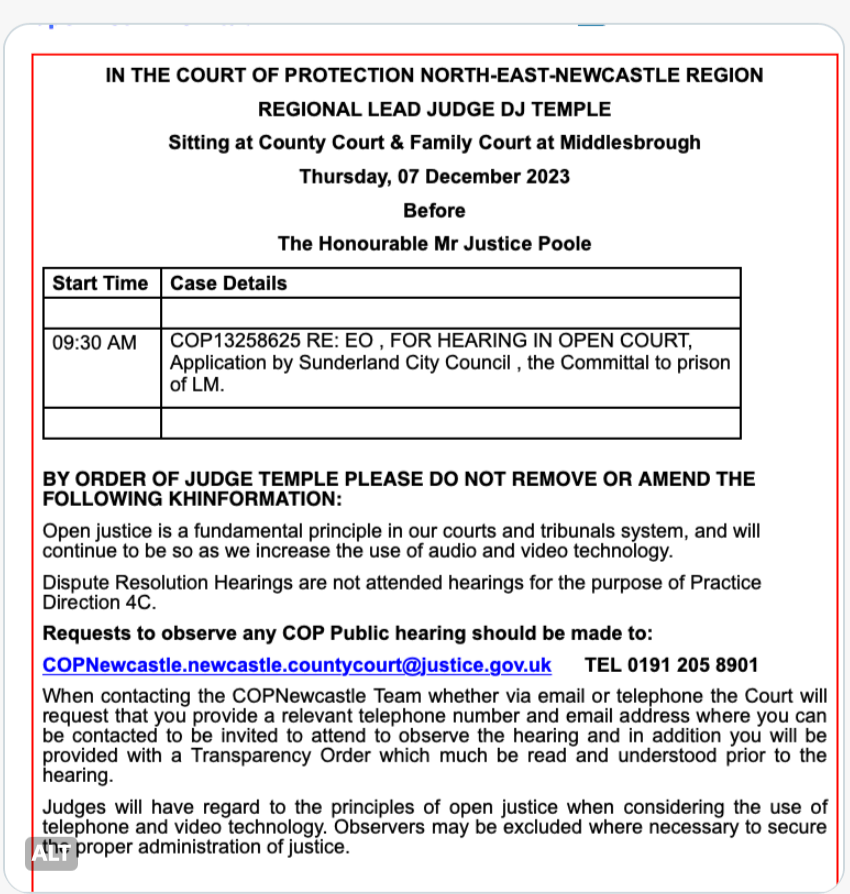
The case was heard, remotely, at 10.30am on 9th October 2023 before Mr Justice Poole, sitting in Leeds. It was focused on preparation for the final hearing, which is planned for late January 2024.

In terms of transparency, things got off to a bad start because the hearing had been incorrectly listed – as is often the case when Tier 3 judges (who normally sit in the Royal Courts of Justice) hear cases while ‘on circuit’ in the regional courts. The case wasn’t listed in the Court of Protection list on Courtel/CourtServe, and when looking through the listings on Friday evening to decide which hearings I might want to watch on Monday, I’d missed it.  I only learnt about it later over the weekend when someone involved in the hearing told me that “the covert meds case” was back in court – and even then, it took me ages to locate it, hidden deep in the Leeds daily cause list.  I’m sure this was cock-up and not conspiracy, but it’s particularly ironic that this case – of all cases – should be incorrectly listed. I was later told by HMCTS staff that “unfortunately it was an oversight of a relatively new staff member that the list wasn’t published correctly”, and as usual there was a promise to address the training need identified.  That didn’t work.  The same thing happened on 9th October in relation to another of Poole J’s hearings in Leeds, and then just a couple of weeks later (23 October 2023), Poole J was again hearing a COP case in Leeds, which was again incorrectly listed in exactly the same way. (And the same listing error also arose when another Tier 3 judge, Mrs Justice Lieven, was hearing a case in Worcester on 20th October 2023.) I understand that the Court and HMCTS are working to solve this problem. I was disproportionately thrilled to see Poole J’s hearing in Sheffield correctly listed on 2nd November 2023.

At this hearing, the applicant local authority was represented by Katie Gollop KC.  As previously, the young woman at the centre of this case, A, was represented, via her litigation friend the Official Solicitor, by Sam Karim KC, and her mother (who was also in court) was represented by Mike O’Brien.  The NHS Trust is usually represented by Joseph O’Brien KC, and it was he who had prepared the Trust’s Position Statement, but he was unavailable today and his place was taken by Lorraine Cavanagh KC.  

The opening summary went something like this. (As usual, we are not allowed to audio-record hearings, so this is based on contemporaneous touch-typed notes and is unlikely to be entirely verbatim but is as accurate as I could manage.)

The case concerns a young woman, A, who on current evidence lacks capacity to make decisions about where to live, who to have contact with, and to make decisions about medical treatment for an endocrinological condition.  Her body doesn’t produce various hormones as a result of which, without medical intervention, she wouldn’t have achieved puberty.  The case relies on a previous fact-finding hearing before HHJ Moir.  For two years before June 2019, Mum was provided with many opportunities to engage with health and social care professionals while A was in her care, and living with her, in connection with the fact that she’d not achieved puberty.  That engagement did not materialise.  There followed a set of legal proceedings and court involvement.  The court declared it was in A’s best interests to be removed from Mum’s care, with restrictions on contact.  Since contact was reintroduced in May 2022, the mother’s relations with health and social care agencies has been mediated and managed by the team to an extent very unusual in the local authority’s experience. Even with that mediation, A’s mother engages only because of the legal proceedings. A difficult and rare decision was made to covertly medicate A, and that has been happening for some time, and A has now achieved puberty.  In an ideal world, A would be told that she has this endocrinological condition and that puberty has happened as a result of being given medication secretly.  But that information hasn’t been provided to her.  There has been a considerable amount of health education work done – not weekly, but there have been meetings – but it has not had the desired effect.  A is still resistant to believing that she has the condition she has, and resistant to believing there are important benefits to her in taking the medication in the long-term.  We are some way away from the ideal scenario.  We are now looking to the future.  A is living in a residential placement and sees her mother once a week.  She would like to see her mother more.  She would like to go home.  She is not in the least restrictive environment, and so where she lives and who she has contact with is likely to be before the court, once we have updating on capacity.  Where she lives is also bound up with the care she receives,  which includes one medication tablet every day.  The court is not well-placed to make a final decision about residence at the moment. There are three options: (1) She could return to her mother’s home and care, and receive no more medication and that would be the price of having her home; (2) Her mother could deliver covert medication at home, but her mother is refusing to have anything to do with that; (3) Carers could deliver covert medication at home – which would be unusual; this normally only happens in highly regulated environments such as care homes or hospitals.”

For me, there were several surprises here – and in other information that emerged during the course of the hearing.  I have done my best to capture the key issues that were raised and discussed and to report them accurately, but given the wide-ranging nature of the issues raised, the shared knowledge of the parties – from an earlier advocates meeting – that may not have been made explicit in court, and the manifest disagreements between the parties about matters of fact, it’s quite likely that one or more (or all) parties may find things they consider inaccurate or misleading in this report – or that they will fundamentally disagree with the way I’ve presented the facts, or my opinions about them. I think, in this case, that comes with the territory – and of course am willing to consider corrections if they are proffered.

Covert medication is continuing

A is still being covertly medicated, despite the judge having made clear in October 2022 – a year ago! –  that “long term continuation of covert medication is unsustainable” and that “A’s best interests are served by exploring the most effective way of transitioning from covert to open medication and/or ending covert medication in a way that is likely to cause the least harm to A” (§38, Re A (Covert Medication: Closed Proceedings) [2022] EWCOP 44).

In response to the news that medication is still covert, the judge stated (as he has done before) his “overall anxiety” with the situation – that “the risk I identified some time ago seems to me to persist, and indeed even become more acute – the risk of inadvertent disclosure or awareness on the part of A, leading to the loss of any residual trust she does have in professionals, and – in the worst case scenario – leading to her refusing food, which I know she has done on one occasion… Covert medication shouldn’t continue a day longer than it’s necessary”.

According to Katie Gollop, “no party contends that A should be told she’s been receiving covert medication at present”.  I’m not sure what the plans are to stop covert medication, now or ever.  There was some discussion about the fact that if A returns home without having been told about the covert medication, the risks and benefits of informing her may be different from the risks and benefits of telling her while she’s in the care home. That issue was shelved for the final hearing.

No expert capacity assessment

I was surprised to hear that there was still no expert (re)assessment of A’s capacity in the relevant domains.  At the last hearing, in March 2023, the Official Solicitor had recommended this because there was a possibility that A might have gained capacity. Back in 2018, an independent expert had expressed the view that “may gain capacity having regard to her young age, and if a range of support structures are in place to empower A, including increasing her skill-base and knowledge”. The expert also said that “achieving puberty may improve cognitive maturation and help her to gain capacity”. At the last hearing,  the judge accepted that it was “necessary” to appoint an independent expert on capacity, and  decided to appoint the one who assessed her previously – despite the mother’s view that A would not cooperate with the previous expert and that “a new set of eyes” were more likely to elicit her cooperation.  There’s now no capacity assessment because A had refused to see the expert she’d taken a dislike to.  I think the proposal was to try again with the previously-appointed expert, but if that didn’t work out, counsel for the mother was seeking permission to appoint someone else so as to ensure that there would be capacity evidence before the court in January.

No weekly meetings for health education purposes

It had been agreed (and recorded as a recital in a court  order) that there would be “weekly face to face sessions” involving A, her mother and two nurses “over a period of 6-8 weeks” with the aim of “persuading” A to take the medication.  Only one such meeting has taken place.  

The problem seems to be that the mother is being instructed to use a particular form of words to communicate with her daughter during these meetings, including (and this may be the sticking point) apologising to her daughter for having been wrong about her daughter not needing medication (something the mother has consistently said was never, in fact, her position).  The treating clinician, Dr X, has demanded that the mother “has to unequivocally apologise to her daughter and clearly admit that she got it wrong”, and this view is supported by the MDT, who proposed a form of wording which the mother did not accept. The mother then proposed an alternative form of words that wasn’t acceptable to the MDT. They finally reached a compromise form. 

Counsel for the mother describes a “humiliating” process whereby, in preparation for these weekly meetings,  A’s mother was:

 “ …. given lessons about POI [Primary Ovarian Insufficiency] and then the nurses insisted on testing how much she remembered, as if she were at school… The nurses were also very anxious to control precisely what she said to A, so she was asked to recite her lines as though an actress.  This behaviour was unexpected and demeaning.  [She] was concerned that during the meeting she would be unable to react normally to her daughter and her daughter would suspect that she was merely reciting lines given by the authorities.  [She] nevertheless cooperated.  All this took months.  Then the nurses required her to attend further education sessions with specialist endocrine nurses before a meeting with A. She refused because this would just be another delay to starting the weekly meetings.  At this stage she still believed there would be weekly meetings” (from the mother’s Position Statement). 

When the one-and-only meeting did take place (on 25th July 2023), the mother apparently deviated from the prescribed wording.  I don’t know what that wording was, but what she actually said (as quoted in the Trust’s Position Statement) was “… you were just a child back then, in any case I should have done more to encourage you and I’m sorry that I didn’t. I’m sorry darling I apologise”. She also said that she wanted A to be in the best health, which is why she should take her medication, including the endocrine medication to help ensure that A would have a healthy heart and bones as she grew older.  The mother also attempted to remind A about the diagnosis of Primary Ovarian Syndrome but A indicated a couple of times, as she has many times before, that she wanted a second opinion before accepting her diagnosis and the need for medication. The Trust reports that Dr X noted that although the mother didn’t always stick to the agreed narrative, “her involvement in the joint health promotion meeting was felt to be positive overall”. 

But, according to the local authority, the multidisciplinary team is “still not convinced about [the mother’s] reliability and ability to constructively discuss these issues with A in future, without supervision and clear direction from others”.  They say, “the health education sessions with A that [her mother] has attended have been sufficient for the MDT to reach the conclusion that [the mother’s] continued attendance is not going to help A”.

They say there will be further health promotion sessions for A, but without the mother’s attendance. 

Proposal for a second independent clinical opinion

The local authority is now proposing a second independent clinical opinion from an endocrinologist, in the hope of convincing A to take the medication  – and the NHS Trust and Official Solicitor support this. 

This was the proposal rejected in 2019 when A’s mother raised it. I heard her raise it, and heard it dismissed, at several earlier hearings.  She now made clear (via her counsel) that she is pleased that “four and a half years later, there is now some serious consideration being given to a second opinion in order to convince A.  She acknowledges that her daughter is stubborn and a second opinion might help change her mind”. According to the mother, it should involve an in-person meeting (not a paper-based exercise) with someone completely independent of Dr X, the treating clinician A does not trust.

The local authority view is: “The chances of this being effective may be slim. However, the applicant’s view is that there is little harm in trying… It is, perhaps, the only thing that has not been tried that could be tried. And it is what A wants”. 

The judge made clear that this second opinion was “not necessary as further evidence for the court, to be honest, but it is a means by which it may be possible to unlock the resistance A has to taking medication.  It’s important she feels some agency in the selection of that individual”. 

Increased contact between mother and daughter

The current contact arrangements are two supervised telephone calls a week of half an hour each, and a supervised weekly visit in person (which mother and daughter usually use for walking into town and having a meal out).   The mother asked for more contact so that she could take her daughter to indoor bowling sessions and to take part in dances that A had enjoyed before being deprived of her liberty.  She also wants carers to ‘back off’ during supervised contact.  “They stand within the body space of mother and daughter and make notes about what is said. It’s intimidating… the invasion of personal space is concerning her. Is there some way in which those who carry out supervision can do so in a way that is less intrusive?” (counsel for the mother). 

The judge said he was minded to approve some extension of contact with a second face-to-face weekly contact, but without being prescriptive about what happens in that contact.  It seemed the local authority needed more time to consider this, and the judge asked for a response within 14 days. ( I don’t know what happened subsequent to the hearing and whether extension of contact was approved or not.)

Orders and declarations

The judge was satisfied, he said, that it was necessary and in A’s best interests to continue with endocrine medication and for this to be administered covertly.  This was an interim measure, to be revisited at the hearing in January.  Contact will continue as before, with the possibility of extension on receipt of further representation from the local authority.  A request from the mother to be included in MDT meetings was refused, but there should continue to be engagement with the mother in terms of A’s health education – although he appreciated there were “some difficulties”.  A’s deprivation of liberty at the care home is also necessary, proportionate, and in her best interests. 

Issues for the final hearing: A ‘precarious’ application

As the mother’s counsel said, “in reality, little has changed in the last year” since Poole J broke the news to the mother that her daughter was being given covert medication.  

The young woman at the centre of the case still doesn’t know she’s achieved puberty as a result of covert medication, still doesn’t believe her diagnosis, still refuses to take the relevant medication, and still wants to return home to her mother.  All the health education, charts, cards, and pedagogic aids developed by care home staff, learning disability nurse and paediatric endocrine specialist nurses over the last four years  have “brought her no closer in accepting her diagnosis or the necessary treatment” (treating doctor, quoted in position statement by Counsel for A).

Counsel representing A via the Official Solicitor considers it unlikely that A will ever accept the diagnosis and need for medication, or that her mother will ever help to shift A’s thinking by clearly communicating to A that her historic position on diagnosis and medication (as determined by the judge) was wrong.  Accordingly, he says, “this application is in a precarious position, and a decision is needed as a matter of urgency” (Position Statement – emphasis in original).

Given how things stand now, the reality is that, in preparing for the final hearing, the court will need to consider the possibility that it may not be possible to administer medication at all if A is discharged (as she wishes) back home, since the mother refuses to give covert medication herself, citing issues of “trust” in her relationship with her daughter. The court may have to balance up whether the benefits of maintenance medication are outweighed by the current restrictions to which A is subject; or, whether a move to a less restrictive  placement (including returning to live with her mother, as she wishes), outweighs the benefits of maintenance medication if that can only be delivered covertly and in such a placement. The judge raised questions that would need to be addressed such as: how might cessation of medication be managed (sudden or gradual)? Is there any possibility of administering medication in some other manner (e.g. patches rather than tablets). Would it be possible for carers to visit daily and administer medication covertly (which the mother is content to permit) and how would that work? Counsel for A raised the possibility of a ‘trial period’ at home.

These are all issues that will be addressed at the final hearing.

This has been a challenging case to witness and to communicate about.  I think it’s been a challenging case, too, for A, for her mother, and for the health and social care professionals.  Counsel’s view that “we are some way away from the ideal scenario” is something of an understatement. People’s lives and relationships are messy and complicated, and it’s not always possible to achieve an “ideal scenario”, but I very much doubt that the professionals involved in this case from the beginning would have wanted, or anticipated, being in a situation like this, four years on. Hindsight is a wonderful thing, of course, but I suspect that there might be  “lessons to be learnt” from a serious case review. 

I can imagine an ”ideal scenario” in which A has received an independent expert report, discussed it with her mother, accepted her diagnosis and the need for medication and says she’ll voluntarily take it from now on, expressing gratitude to the health care staff who inform her that they’ve been delivering it covertly until now.  It seems vanishingly unlikely that anything like that “ideal scenario” will come to pass. I hope I am wrong.

Celia Kitzinger is co-director of the Open Justice Court of Protection Project. She has observed more than 490 hearings since May 2020 and written more than 100 blog posts. She is on LinkedIn (here), and tweets @KitzingerCelia

Appendix: Previous blog posts about this case

In reverse chronological order – start with the blog at the bottom to read ‘from the beginning’

Judge’s order sold for £5: Monetising open justice

By Celia Kitzinger, 8th November 2023

Fortunately it seems to have been a one-off, but I was very surprised to be asked to pay £5 for a copy of an approved Order made by a judge at a public hearing.

We’re entitled to receive these Orders under Court of Protection rule 5.9, which concerns “Supply of documents to a non-party from court records”. It says:

5.9.—(1) Subject to rules 5.12 and 4.3(2), a person who is not a party to proceedings may inspect or obtain from the court records a copy of any judgment or order given or made in public.

Court of Protection rule 5.9,

In practice, it’s common for judges to make clear oral judgments or orders in court, and I often don’t ask for a written version. But when I’m unclear about what a judge has decided, or when – on the basis of what is said in court – I might want to express concern about or criticism of a judicial decision, it’s important for me to be able to obtain the written version and make sure that I understand correctly what the judge has done.

In this case (COP 13960342 before District Judge OmoRegie, sitting at Dartford County and Family Court on 11th October 2023) I was concerned by what seemed – in the hearing – to be an inadequate response to parental concern about possibly unauthorised restraint of their son. Both parents were in court and expressed dismay about an incident in which (they said) their son had been restrained by untrained personnel, leaving him “traumatised”.  What I gathered from the hearing was that the judge’s response was point out that there was provision for a Round Table Meeting at which the parents could raise their worries about this incident. I asked for the Order because I was concerned about the apparent lack of judicial oversight of restraint in this case. And when I got the Order, I found that in fact the issue of restraint had been (in my view) properly addressed – as I report in an earlier blog post (“Judge concerned about “restraint regime” for learning-disabled man prohibits naming public body).

In response to my request for a copy of the approved Order, I received an email from an administration officer with His Majesty’s Courts and Tribunal Service (HMCTS) saying, “In order to receive the order you will need to pay a £5 fee, this can be done via cheque or if you provide us with a phone number to contact you on we can take the payment over the phone“. She helpfully provided me with a link to a pdf explaining the fees payable (here: https://assets.publishing.service.gov.uk/media/61547ac5e90e0719827b8ebe/COP44_0921.pdf)

And I paid up. I did so because I was really concerned about this case and wanted to find out what the judge had ordered (and because I can afford £5 without hardship – something that isn’t true of all members of the public observing hearing). The Open Justice Court of Protection Project is unfunded, so we won’t often be asking for Orders if we have to pay for them, since the fees would come out of our own pockets.

It took about an hour to sort out payment because I couldn’t get through the automated system to a real person able to take my credit card details and spent ages getting cross listening to muzak. When I emailed complaining, they kindly called me back very promptly. I paid and I got the Order.

But I also asked journalists whether they had to pay for Orders and discovered they did not. Press Association journalist Brian Farmer told me that although the press does sometimes have to pay for some documents, Orders from public hearings are not amongst them. Freelance journalist Louise Tickle tweeted publicly:

So I wrote to HMCTS as follows:

I’m concerned that you may be operating a policy whereby members of the public are charged for court orders but journalists are not.  Is this so?  Is it a formal policy and if so please can you send me a link to somewhere it exists in writing?  Can you explain the justification for this policy (if it exists) please. If there is no such policy (formal or informal) please can you explain how it came about on this occasion please that I was charged for a court order. I’m concerned because my request was motivated solely by my wish to report accurately on what I had observed in court and the judicial decision, and it has a chilling effect on open justice to charge us for checking our facts.

Email from Celia Kitzinger to Deputy Service Manager, HMCTS (14:50, 17 October 2023)

The response was to send me a copy of the “fees leaflet for COP” (COP44 – Court of Protection – fees (publishing.service.gov.uk) and the comment that journalists shouldn’t be getting the Orders for free “as I understand the fees apply to all, the fee has been in place for a long time now and isn’t dependant on who is requesting a copy“.

But it seems, in fact, that the fee is, in practice, dependent on who is requesting a copy. Journalists tell me they receive them without having to pay and a former member of the HMCTS staff told me privately that it was routine to ask members of the public to pay, while supplying documents to journalists for free.

Meanwhile, lawyers started to debate whether or not an Order is “a document filed” as per the wording of the “fees leaflet”. It seems it all depends what you mean by “filed”: an Order is not filed by the parties for attention of the judge (like applications or witness statements) but, in principle, emanates from the judge for the attention of the parties; on the other hand the draft Order – whether agreed or contested – could be considered to be “filed” by the parties for the judge to consider, since it is regularly part of the court bundle submitted by the applicant. Last I heard, legal opinion was divided on this matter.

But leaving aside legal arguments about the meaning of the word “filed”, it’s inevitable that charging for Orders would have a chilling effect on open justice – whether charges apply only to members of the public or to journalists as well.

I’ve since made a Freedom of Information Request (no response yet) asking about policy and practice of charging journalists for Orders.

And I’ve asked for eight more Orders from a range of judges, including High Court, circuit and district judges across different hubs (including the Reading hub which charged me on this occasion). The good news is, the subsequent eight Orders have all been sent for free. Nobody has asked for any more £5 fees!

I’m now aware, however, that HMCTS could, in principle, charge me (and journalists) for Orders, and that the “fees leaflet for COP” provides for that – so it’s at someone’s discretion when the fee is not levied.

I’m not sure that requiring a fee for an approved Order from a public hearing can really be justified.

Of course other court documents can cost a great deal more. There has been a lot of publicity recently about the high costs of court transcripts, e.g. one rape survivor said she was quoted £7,500 for the transcript of her trial (“Court transcript costs are exploitative – victims“).

The outrageously high cost of transcripts doesn’t negate my concern with having to pay £5 for an Order. Unlike transcribing potentially weeks of a video-recorded hearing, and then getting a judge to check it for accuracy, an Order already exists as a document approved by the judge and sent to the parties. It doesn’t have to be created from scratch – whether at public expense or charged to a party. The only extra work required when I ask for an Order is to send it to me. And it comes as a pdf attached to an email The days are long gone when someone had to photocopy and distribute a paper copy of the Order by snail mail or fax (remember fax machines?) which I can see would increase the costs – although given that Orders are rarely more than five or six pages, £5 still seems exorbitant.

I’m grateful to Daniel Cloake (aka @MouseInTheCourt) for drawing my attention to Lord Wolfson’s argument that “enhanced fees, meaning they are set above the cost of the service” are appropriate and that it’s “considered correct for those who can pay more than the actual cost of the process to do so” as “fees are the main source of direct income for courts“. Obviously, I don’t agree that enhanced fees are appropriate from the perspective of open justice. And in any case, if it’s “those who can pay more than the actual cost of the process” who are being targeted to subsidise the crumbling justice system, then it’s surely professional journalists (via their employers) and not ordinary members of the public who should be paying!

I’m pleased this seems to have been a one-off. I hope it remains so.

Celia Kitzinger is co-director of the Open Justice Court of Protection Project. She has observed more than 490 hearings since May 2020 and written more than 100 blog posts. She is on LinkedIn (here), and tweets @KitzingerCelia

Bournemouth, Christchurch and Poole Council named as “secret” body in restraint case

By Celia Kitzinger, 6th November 2023

I reported recently on a case in which both the judge and the family expressed concerns about the physical and chemical restraint of a learning-disabled autistic man (“Judge concerned about ‘restraint regime’ for learning-disabled man prohibits naming public body”).  But I wasn’t allowed to name the responsible local authority. 

I am now allowed to name them.  

It’s Bournemouth, Christchurch and Poole Council (BCPC).

It’s important to name the responsible local authority because restraint of learning disabled and autistic people is a legitimate issue of public concern.  The BBC File on 4 programme in 2018 first uncovered the fact that reported restraint had risen by 50% between 2016 and 2017 (“‘Inhuman’ use of restraint on disabled patients“). Then just last year (2022), the CQC said there was still “a continued over-reliance on restrictive interventions” and that people “were too frequently subjected to practices that are about containment and are not therapeutic” (“Restraint and seclusion ‘still too common’ warns CQC”).  

Moreover, there was press interest in the restraint of learning-disabled and autistic people specifically in the Bournemouth, Christchurch and Poole area.  The Bournemouth Daily Echo reported just under two years ago that “restrictive interventions were used roughly 805 times on around 120 Bournemouth Christchurch and Poole patients with learning disabilities, autism or in secondary mental health services in 2020-21.  Of these, 20 instances saw patients put in the prone position, where they are physically pinned face-down against the floor or another surface – a practice which is said to carry a serious risk of death” (“Mental health patients subject to ‘traumatising’ restraints” Bournemouth Daily Echo, 30 December 2021)

So, when I heard the concerns expressed in this hearing, I was keen to be able to name the responsible Council.

Here’s what the father told the judge about a recent episode of restraint:

The restraint used was not in accordance with the processes described in the plan… It seemed to be rather ad hoc…. [Our son] was extremely traumatised in this period.  There were three adults, including myself, trying to control him.  I don’t have any training and at least one of the carers had no training. It was all rather difficult… It didn’t seem to conform to any plan”.

Given the subject matter raised in the hearing, and the extent of public interest in the topic, I was surprised and dismayed to be sent a Transparency Order (on 11 October 2023) that prohibited me from naming the local authority responsible for this man’s care.  The Transparency Order explicitly said that amongst the information I was forbidden to report was the fact that “BCPC is a party to these proceedings”.  

The Transparency Order

I’ve now received THREE different versions of the Transparency Order for this case.  

The first two Transparency Orders (11 October 2023 and 16 October 2023) were injunctions explicitly preventing me from naming the Council.  They had identical wording saying that I was forbidden to report that “BCPC is a party to these proceedings” – and that if I did so, I may be found guilty of contempt of court and may be sent to prison, fined, or have my assets seized.

The third Transparency Order (issued on 3 November 2023) doesn’t say I’m forbidden to report that BCPC is a party to these proceedings. That paragraph has been deleted.  And there’s a new paragraph that explicitly says (under the heading “What the Injunction does not prevent people from doing and does not apply to”) that nothing in the injunction prevents me from naming Bournemouth Christchurch and Poole Council as applicant (§8(i)(f)).

What changed?

I wish I could say that it was my fearless advocacy in defence of the public’s Article 10 rights to freedom of information that resulted in permission to name the Council. 

But it wasn’t.  

I did try – up to a limit.  I did what I usually do when there’s an order that (inexplicably) forbids naming a public body: I ask the judge why that prohibition is in place, and suggest that it might need (re)consideration in light of the public’s Article 10 rights to freedom of information. The Transparency Order says we “have the right to ask the court to vary or discharge the order”, so that’s what I do.

The most efficient way to ask the judge about varying the Transparency Order is to do so during the course of the hearing, while all the parties are there and can express their views to help the judge make a decision.  But on this occasion, I found it hard to “interrupt” the hearing and missed the opportunity to intervene, so I wrote to the judge (DJ OmoRegie) afterwards.  That’s what I usually do if I’ve not been able to raise it in court.

But on this occasion, I was told by the court staff, and then by the Lead Judge for the Reading Hub (HHJ Owens), that I would need to make a formal application “following the procedure set out in Part 10 of the COPR and under PD10A”.  I looked at what this entailed and realised it would take me ages to figure out how to do this – and I honestly couldn’t see why it should be necessary.  

As I wrote to the HMCTS administrator: “ I’ve never done this before and I’ve asked for dozens of TOs to be varied.  It looks very complicated and time-consuming for a non-lawyer so I doubt that my commitment to transparency will extend to following through on this”.

If the judiciary is truly concerned to ensure open justice and transparency, I would hope that they might be willing (as I have previously found that they are) to address concerns about the anonymising of public bodies however those concerns are brought to their attention.  Requiring me to follow what I experience as a burdensome procedure before considering my  – as it turned out, entirely reasonable – concerns has a chilling effect on open justice.  After various communications with  DJ OmoRegie, HHJ Owens and Senior Judge Hilder – none of which solved the problem and all documented in my previous blog post – I simply gave up.

The judge sent me an injunction forbidding me from naming BCPC not once (which might have been “inadvertent” apparently, according to HHJ Owens), but twice.  After which it felt impossible, really, to get back to him and say, “Are you sure?  Do you really mean I can’t name BCPC?”.  I felt I had to assume the judge knew what he was doing, and meant what he said in his Order.

I gave up hope of getting permission to name the Council.  

I published a blog about the case without naming BCPC.  

I conceded defeat: “I’m not going to make that formal application.  So, probably nobody except the people involved, and me, will ever know the name of the public body involved”.

The Bournemouth, Christchurch and Poole Council application

But then, after the blog was published,  a couple of lawyers contacted me (independently) to suggest that I might get in touch with the lawyer for the Council, Peggy Etiebet of Cornerstones, suggesting that she should be offered the opportunity to contact her client in relation to this issue. So, I sent an email to Peggy Etiebet, saying “I don’t know if you are aware that the TO prevents me from naming your client?” and providing a link to the published blog post. 

Peggy Etiebet responded promptly to say that she would seek instructions from her client (BCP Council). Later the same day, she told me that BCPC do not think it likely that publication of the identity of the local authority would lead to identification of the protected party and that they would make an application “… to assist the Court of Protection to support open justice”. 

The following day the judge ordered that a fresh Transparency Order should be made.  The paragraph saying I was forbidden to name BCPC must be deleted.  A new paragraph must be added saying that I am not forbidden to name BCPC.

Success!

Well, success of a sort.  We got the right result in the end.  

But why, oh why, was it so difficult to correct what I now believe to have been an “error” in both the first and the second version of this Transparency Order.  

It’s depressingly common for Transparency Orders to say that we can’t name public bodies.  Almost always, that turns out to be “inadvertent” (to use HHJ Owens’ terminology), or an “error” (as in the case before Theis J).

The upshot is repeated instances of “inadvertent” and “erroneous” failures of transparency.

This case illustrates, yet again, cock-up and muddle, not deliberate secrecy. But for a court that repeatedly states its commitment to transparency, it’s really not good enough.  

I’m hoping that the recommendations of the Rules Committee working party on Transparency Orders, likely to report early in 2024, will go some way to sorting out the mess.

Meanwhile, a big thank you to Bournemouth, Christchurch and Poole Council, and to their barrister Peggy Etiebet,  for their commitment to transparency in this case.

Celia Kitzinger is co-director of the Open Justice Court of Protection Project. She has observed more than 480 hearings since May 2020 and written more than 100 blog posts. She is on LinkedIn (here), and tweets @KitzingerCelia

Observing a Failed Re X hearing: “it sounds like ‘Cassie’ is being unlawfully deprived by contact restrictions”

By Eleanor Tallon, 31st October 2023

My previous blog post on ‘Failed Re X’ described the legal meaning of the term, and the processes whereby these cases get to court.  This blog post follows up on that by reporting on a ‘Failed Re X’ hearing (COP 13266959) I observed on 9th October 2023 before District Judge Hart, sitting remotely at First Avenue House in Holborn, London.    

As I explained in my previous blog post, ‘Re X’ is the term used to refer to the streamlined process through which the Court of Protection (CoP) can authorise a ‘Deprivation of Liberty’ (DoL), as established in the case of Re X and Others (Deprivation of Liberty) [2014] EWCOP 25.

Essentially, the streamlined process is designed for non-contentious cases which allow for judicial review without an oral hearing (or ‘on the papers’). 

Sometimes, though, ‘Re X’ applications are made and the court decides, upon reviewing the evidence, that this streamlined process is not appropriate and the case needs to be heard. According to the listing, that’s what happened in this case. It’s listed as a “Failed Re X”.

The aim of this blog is to provide readers with a more in-depth understanding of the sort of case that may be ‘called in’ for further enquiry in a “Failed Re X” procedure. I will go through my observation of the hearing, followed by a reflective summary of the main issues which arose. 

The case concerns a protected party, initialised as ‘CLG’ in the listing above, who I will refer to as ‘Cassie’ (not her real name). 

The Local Authority (London Borough of Barnet, the ‘Applicant’, represented by Deanaloy Grant) was seeking an order from the court to authorise “a deprivation of liberty in relation to care and residence arrangements”.

Cassie was joined as a party to the proceedings (1st Respondent), represented by Lucinda France-Hayhurst on behalf of the Official Solicitor. 

Ms H (Cassie’s mother) is also joined as the 2nd Respondent and represents herself as a litigant-in-person.

Limited information was provided on the background to the case, but during the hearing I learnt that Cassie has Learning Disabilities, lives in a single occupancy flat and is supported continuously by her service providers (which includes support in her home and at a day centre). 

Ms H is unhappy with the care provided, the lack of support provided for Cassie to go out in the community; and she objects to restrictions placed on contact with her daughter.  

Her verbal evidence contradicts the Local Authority’s position, which is that there are no restrictions on contact between mother and daughter.  They have not sought legal authorisation for restrictions around Cassie’s contact with Ms H.

Lucinda France-Hayhurst (Counsel for Cassie) highlighted to the Judge that “it sounds like Cassie is being unlawfully deprived by contact restrictions. A statement in this regard is needed in a timely order so that this can be discussed at the round table meeting and a consent order sought”.

The Judge agreed and directed that a statement must be filed within a week, with a further application made within the 3 weeks, to request authorisation of any contact restrictions imposed. 

Due to the severity of implications around unlawful contact restrictions, this was to be acted upon as a priority, but this was one of several thorny issues to be scrutinised during the proceedings.  

The disagreements and challenges manifest in this hearing make it clear why this case was not suitable for a streamlined “Re X” decision ‘on the papers’.

The hearing

The start of the hearing was delayed allowing time for the Official Solicitor to consider the Position Statement from the Trust and the Draft Order, which was then submitted (“in essence, agreed”) to the Judge.  

When the hearing started at around 11.40am (unfortunately, without an opening summary as advised by the former Vice President of the Court of Protection), Counsel for Cassie went through the Draft Order (not least for the benefit of Cassie’s  mother), explaining that it sets out the following:

  • The signposting for the next hearings.
  • Details on the background to the application and why it was brought. 
  • That there are no restrictions on Cassie’s contact with family. 
  • That the court directs a separate disclosure of social care records. 
  • An interim declaration that it’s in Cassie’s best interests to live where she is living, subject to the arrangements, until further exploration of the circumstances can be taken into account, and that the issues raised by Ms H can be explored. 

Counsel for Cassie then went on to discuss further details around evidence gathering, namely the disclosure from the Local Authority, which would need to include minutes of care planning and best interest meetings held with Ms H in 2023, and other relevant social care records. It was agreed that the date could be amended to the 13th of November 2023 for the disclosure. 

Counsel then explained that the Order would also seek evidence from Ms H by the 30th of October 2023. It was highlighted that Ms H had filed a statement previously, but a further statement was being requested in response to the application sought to authorise the care arrangements with any comments on Cassie’s welfare. 

Counsel emphasised the point that: “Ms H has the opportunity to set out her concerns within the statement, rather than in a large volume of emails going back and forth and providing piece meal evidence” and she then turned back to the evidence required from the Applicant.

The Local Authority has an obligation to file a statement which refers to:

  • The staff ratios, as it is unclear as to the appropriate ratios needed to ensure safety and quality of life. 
  • The local authority would need to provide recommendations on community access and who will support Cassie on trips, and they are to provide a timetable and activity planner. This would provide a better idea of when it is best for Cassie to be visited. 
  • Also, an update on her presentation and how to optimise her time at the placement. 
  • A plan on how to optimise the use of her mobility car, which ought to be used for trips and drives. 
  • An update on diet, which was an issue raised by Ms H, and the provision of a meal plan. 
  • An analysis of quality regarding her personal care, again, Ms H has raised hygiene concerns. 

She further explained that an approval was sought for a third-party disclosure for records on “the complaints made by neighbours about Cassie sounding distressed at night and any fallout in relation to the tenancy”.

She then went through additional points to be addressed by the Local Authority:

Counsel for Cassie: There would need to be consideration of multiple occupancy options, taking account of the level of the level of care that Cassie needs, and an exploratory search for alternative options. The search should include opportunities for Cassie to live with others as she is sociable and gets on well with peers and this should be included in the bundle of options with a best interest recommendation given. The plan is for a round table meeting to be arranged for the week commencing the 13th of November, this would be after the assessments, updates and disclosure have been provided. 

Judge: That date may have to go back due to the Local Authority disclosure date.

Counsel for Cassie proposed that the round table meeting could go ahead on the 13th November as the disclosure request shouldn’t affect their ability to engage in a round table meeting. She then requested a further hearing date for the 18th of December 2023.

The Judge inquired as to the disclosure requested from the Local Authority: “Would that show discrepancies as to the planning for activities in the community and the actuality of it?

Ms H indicated that she was unclear as to what the Judge was asking, so the Judge further explained her comments: “It’s one thing to have a plan in place which I can approve of, but it’s in the ability, day-to-day, to carry out that plan. That I think is where the success will be carried out in this case”.

Counsel for Cassie: The idea is a 3-pronged approach. The care provider records will show to what extent the plan is working whereas the assessments and care plans from the Local Authority may not inform entirely if the plan works. The Local Authority thinks things are going well and the two to one support is being provided. But we’ve heard differently from Ms H. The Local Authority disclosure would provide information as to whether the planned support needs to change. It would inform as to what decisions were made and as to why the restrictions were required.

Judge: My concern is around what is actually going on at the moment. The disclosure needs to encompass what’s actually going on. It must be in the records. Will it include records of trips out? 

Counsel for the Applicant: I would believe that should be the case.

Judge: The care planning and the best interest meetings minutes will be useful, but will the social care records include day-to-day records from the providers? My concern is we need to get to grips with what’s going on, on the ground.

At this point Ms H intervened with her concerns.

Ms H: How I know that Cassie wasn’t going out is there was no petrol being bought for the past nine months and the mileage hadn’t changed, so she’s not using the car for accessing the community. OK, people say there are no restrictions, but I can only visit on Saturdays as that’s the only day she has two to one care apart from Wednesdays. But I work and I have to visit her in the property. No carers can come out with us as they haven’t been out with her before. I feel incarcerated with her in the tiny flat and I’m nervous about being in the flat with carers when false accusations have been made against me.I feel vulnerable. I would like to take Cassie out. I know she has the option to come out with me, but the carers have never been out with her, and I don’t want to have to supervise 2 university students. I’d prefer to take her out with just one carer, in case I struggle, but I don’t want to have two carers accompanying us. I also have two other children and my mother isn’t well, so my time is limited.

Judge: I understand the matters are to do with practicality. Clearly the car is a good example. If carers don’t have driving licences, the car isn’t going to be used.

Ms H: Can I give Some background.

Judge: I don’t think you need to at this stage. I’m trying to focus at the moment on whether the disclosure will give useful evidence. 

Counsel for the Applicant: I’ve just had an update that the disclosure from the learning disability team will include records from the provider.

Judge: So that confirms it. We also need to get updated statements from the parties to ensure we can all consider evidence in a structured manner. Are you content with the order Ms H?

Ms H: Apart from the fact that I do have limited contact. 

Counsel for the Applicant: Ms H is able to visit around her daughter’s activities. Ms H says due to working and other commitments she cannot attend on the other times.

Ms H: Cassie goes to the day centre every day other than Wednesday, but I could pop in after 5pm during the week. 

Counsel for the Applicant: Cassie has wind down in the evening, where she gets ready, showered, and prepared for bed. So, it may not be appropriate.

Ms H: She goes to bed as soon as she gets back from the day centre and then when she goes to bed at 8pm, she’s up all night because she’s had long naps after the day centre and the carers use drugs to sedate her. She sleeps in the day because there’s no activities. It’s out of boredom and she’ll take herself to bed. If I visited after 5pm my visits would benefit her and stimulate her, she may sleep better at night. 

Judge: I understand, but it’s not something we can sort out at this hearing. Discussions are needed with those at the placement to try and resolve what is needed. For Cassie, she needs structure and reliability. On the part of the placement, they need to offer some degree of flexibility.

Counsel for the Applicant: My client informs me that the arrangements are that Ms H can visit through the week, but she must call prior to any visits, and that they are not drugging her.

Ms H: Not anymore, because I complained. I want to take her out with a 1 to 1 carer, not two to one. 

Judge: I don’t think this is very productive for today.

The Judge’s screen then freezes. Court admin attempts to address the technical issues and after a few minutes the Judge is rejoined by video link. 

Judge: There were some technical problems at my end, but essentially it sounds as if the best way forward is set out in the Draft Order and there will be an opportunity to discuss the issues and Ms H can put forward her views in formal evidence.

Dates were then discussed for a further hearing to take place in January, court admin proposed the 16th of January 2024 at 2pm. This was agreed by all parties. 

Ms H: It’s just very sad that I’ll have another Christmas where I can’t see my daughter.

Judge: There will be two round table meetings before then, which gives you the opportunity to work with those involved to try and see if you can identify ways to move forward. Is there anything else we need to cover today?

Counsel for P: There is one other thing. I was under the impression that there were no restrictions on contact between Cassie and Ms H, but the position appears to be different. The local authority has suggested it is right that Ms H should call in advance of any visits, and there needs to be two to one staff present while she is in the placement due to the previous issues raised. That appears to be restrictive. I think we need something in a timely order by way of a statement from the Local Authority. 

Ms H: I’ve hardly seen Cassie in 2 and half years and it’s only going to be me that takes her out. (Ms H becomes visibly upset). 

Judge: I want this issue to be looked at. The order says there are no restrictions on contact.

Counsel for the Applicant: My client is happy to reword the position on contact in the Draft Order and that queries on contact will be addressed within a statement if that’s needed.

Ms H: I was told that Cassie is going to begin doing activities on Saturday. That’s my one day a week to see her.

Judge: Everyone will get together within the round table meetings and decisions will be taken as to what’s needed regarding her support, activities and contact. Ms Grant, you need to be clear to the court as to what the restrictions actually are. Let me look at your evidence. 

The Judge reviews the papers and reads from the evidence: ‘An update on family contact and freedom to visit’. 

Judge: There needs to be a statement to address any restrictions on contact and the reasons why these have been put in place. You need to address the history so the court can consider (a) what the position is and (b) why this is the position. 

Counsel for Cassie: I do apologise, but if I may make a further comment. It sounds like Cassie is being unlawfully deprived by contact restrictions. A statement in this regard is needed in a timely order so that this can be discussed at the round table meeting and a consent order sought. It would be more appropriate for this to happen before the 13th of November.

Judge: I can see the need for the Witness Statement but whether it can be done prior to the 13th of November?

Counsel for Cassie: I would hope that it could be addressed in a quicker time frame.

Judge: Ms Grant, when could that be done by?

Counsel for the Applicant: I’m awaiting instructions… (short pause whilst instructions are taken). In one week, the local authority shall file the witness statement. 

Judge: The statement will be provided by the 16th of October, which sets out any restrictions on contact with Cassie, and the reasons that those are in place. Ms H will have that before she is due to put her Witness Statement in.

The Judge addresses Counsel for Cassie: Are you content to file a COP9 application? 

Counsel for Cassie: It would be appropriate for the local authority to issue the COP9, and they would need to consider Cassie’s capacity around contact if that’s not already been done.

Counsel for the Applicant: I will need to check the position on capacity around contact.

Judge: So, the Local Authority will issue a COP9 application to seek authorisation on restrictions around contact and that is to be supported by relevant capacity evidence, no later than the 30th of October. Does that then deal with everything?

Counsel for Cassie: I’m just wondering whether we can push back the Witness Statement from Ms H so she can consider the application on contact restrictions.

It was agreed that Ms H would have until 6th of November 2023 to file her Witness Statement. 

Ms H: What should I include in my statement?

Judge: Well, two things really. It’s acknowledged that there are restrictions on contact. And this has to be dealt with formally by application to the Court. I hope that provides some reassurance. The Witness Statement also needs to include anything you want to say about the arrangements being authorised, including the restrictions on contact. So essentially, is the placement right for Cassie?  Is the care regime appropriate? Your views on activities and outings and any restrictions on contact, put all of that down if you can. 

Ms H: They now want an automatic car. Which will take three months to purchase, and they will only have one driver. This is the problem… 

Judge: That’s something you can put into your witness statement. The date to file it is the 6th of November. I think we may finally be here in terms of things that need to be raised this morning. Thank you very much to everyone and I’m now going to leave the hearing. Good day everyone. 

At 12:36 the hearing ended.

Reflective Summary

There are four main points which stood out to me when observing this case, and these are the areas I will focus on in terms of my reflections:

  • Contact restrictions
  • Care plan scrutiny
  • Participation of Cassie and Representation for the 2nd Respondent (Cassie’s mother)
  • The case of London Borough of Barnet v JDO & Ors [2019] EWCOP 47

1. Contact Restrictions

It struck me that there were various decisions about care and contact being overseen by the Local Authority (such as the need for 2 carers to be present for Cassie’s visits with her mother) which understandably from her mother’s perspective, created a barrier for her to have contact with her daughter. 

It seems that this 2:1 arrangement followed ‘accusations’ being made. It’s unclear what the nature of these were, but clearly Ms H has also raised several concerns and the relationship between Ms H and the provider did not appear to be a positive one.

Sadly, Cassie’s views were starkly absent within this hearing, so I was left wondering what Cassie’s thoughts were around contact with her mother. Would Cassie prefer ‘wind-down’ time in the evening or more opportunity to see her mother? Would this cause disruption to her routine or make her happier? 

A capacity assessment in this regard may shed some light onto these questions, and it would clarify the basis on which a decision could be reached. Without capacity on the decision established, there would be no legitimate best interest decision made and no liable defence for any restrictions in place.

I was impressed by the tenacity of Cassie’s Counsel in advocating Cassie’s rights, and by the Judge’s response in ensuring the Local Authority brought an urgent statement to outline the details of the restrictions imposed; to consider Cassie’s  capacity to decide on contact arrangements; and to ensure that the necessity and proportionality of any restrictions could be fully investigated. 

The restrictions which are imposed as part of a person’s support arrangements may trigger Article 5 right to liberty (ECHR), due to the level of supervision and control over movement and freedom. Where this amounts to a Deprivation of Liberty (DoL), legal authorisation for the DoL must be sought.

However, being deprived of liberty, invariably impacts on a person’s opportunity for contact with family and the outside world. In some cases, providers make specific decisions that restrict contact, for example, where there are safeguarding concerns and the person lacks capacity to decide on contact with a specific person, such contact might be entirely prevented by the provider in the person’s best interests.

But specific restrictions on contact can only be implemented with the authority of the court (save for emergencies where an application is being sought).

Furthermore, contact restrictions are not covered by a DoL authorisation. Restrictions on contact fall under Article 8 (ECHR):

Right to respect for private and family life 

1. Everyone has the right to respect for his private and family life, his home and his correspondence. 2. There shall be no interference by a public authority with the exercise of this right except such as is in accordance with the law and is necessary in a democratic society in the interests of national security, public safety or the economic wellbeing of the country, for the prevention of disorder or crime, for the protection of health or morals, or for the protection of the rights and freedoms of others.

Ruck Keene (2018comments on the case of SR v A Local Authority [2018] EWCOP 36, which concerned a woman whose contact with her husband was restricted by the Local Authority with no court authorisation to do so:

It highlights, or should highlight, the thinness of the legal ice afforded to public bodies seeking to restrict contact without the authority of the court given the clear interference with the Article 8 rights of those subject to the restrictions. Although “Article 8 of the Convention contains no explicit procedural requirements, the decision-making process involved in measures of interference must be fair and such as to ensure due respect of the interests safeguarded by Article 8”.

The case of Re Briggs (Incapacitated Person) [2017] EWCA Civ 1169 also illustrates the significance of contact with family, and how failing to facilitate regular contact can tip the balance in terms of whether a placement is in the person’s best interests:

95.  Contact, for example, is an issue capable of going to the heart of whether being detained is in a person’s best interests; it may be that in an ideal world P’s best interests would be served by a deprivation of liberty in the form of her living in a care home properly looked after, where the appropriate medication regime will be adhered to and P will have a proper balanced diet. Desirable as that may be, and such a regime may well provide the optimum care outcome for P, but it may also be the case that unless, regular contact can be facilitated to a particular family member, the distress and confusion caused to P would be such that it would be no longer in her best interests to be detained, and that what might amount to sub optimum physical care would ultimately be preferable to no, or insufficient contact….” 

Cassie’s case certainly serves to reiterate the point that providers and public authorities need to be diligent and follow all due processes, whilst considering the full spectrum of the person’s rights – including their right to family life, which needs to be safeguarded. 

2. Care Plan Scrutiny

When a Deprivation of Liberty is identified, the process of independent review of the care arrangements cannot be a ‘light touch’ approach. As the Judge emphasised, there must be an explicit breakdown of what restrictions are imposed; the identified risks which make these necessary; and what else has been considered to minimise the risks, which would be less intrusive on the person’s rights (proportionality).

This entails a thorough analysis of the severity and likelihood of harm, and why the proposed restrictions are the only foreseeable, sustainable way of maintaining safety and well-being.

The care and support plan drawn up by the Local Authority is not the operational care plan, it focuses on the person’s assessed needs and the outcomes which they wish to achieve. Where the person is receiving formal care to meet their needs, a ‘day to day’ support plan is produced by the provider, which should explicate what, when and how care is provided to achieve those outcomes. Additionally, risk assessments should be in place which evidence the rationale behind restrictive care practices.

Therefore, it is imperative that the Judge has access to this level of information, which goes beyond what may normally be available in the statutory care and support plan. The Judge needs to see the grainier details “to get to grips with what’s going on, on the ground”.

To some, it could be seen that the court is tasked with micro-management of a care plan, and there may be some debate as to whether this is best use of court time, as it should be the responsibility of the provider and the commissioning body to ensure that the care plan meets the legal and statutory requirements around care standards and human rights.

But in practice, support plans may fall short of this, and often it is these types of cases that come to the attention of the court for further scrutiny.

If solicitors and the court asking questions about a care plan amounts to micromanagement then what is the point of them being involved at all? If the court is simply going to agree with the professionals without any probing of the evidence then how is it any protection at all against inappropriate use of public powers? If that argument was followed through then all the court could do is ask if there is a care plan (Local Authority Lawyer, 2022).

I was reassured that the Judge in Cassie’s case was intent upon seeking specific evidence to address the discrepancies between the care planning and the actual implementation. In effect, it was highlighted that a support plan may sound wonderful, but the real question is whether the plan is being carried out effectively.

The proof is in the pudding.

It seems that the initial application made by the Local Authority did not provide the level of detail required for the Judge to reliably review the arrangements. It also seems that the guidance provided by 39 Essex Chambers (in reference to making appropriate use of the Re X application process) was not followed: 

The public body making the application will therefore have to make sure that it has obtained (and where necessary worked with the care provider to improve) the care provider’s care plan before making the application so as to ensure that it addresses the matters set out above. Given that a more restrictive care regime will need to be sanctioned by the court, applicants may want to consider incorporating contingency arrangements into the care plan so as to minimise the need for judicial micro-management (39 Essex Chambers, 2022)

3. Participation of P (Cassie) and Representation for the 2nd Respondent (Cassie’s mother)

Cassie was represented by the Official Solicitor, which may have been the case due to there being no one else considered appropriate to act as her Litigation Friend. It appeared to me, that Cassie’s mother would have been willing to act, given that she was a party to the proceedings, but the issues around ‘allegations being made’ against her could have ruled this out.

It was unclear what Cassie’s wishes and feelings were about her support and living arrangements, though it was mentioned that complaints had been made by neighbours about Cassie sounding distressed at night. Without further explanation provided, I queried whether this could be interpreted as an objection to some elements of the care plan, or as an objection to the entirety of the placement?

The Official Solicitor “isn’t pushing for a move”, but other options were being explored. Additionally, round table meetings were due to take place to review “what’s needed regarding her support, activities and contact” which would hopefully take account of Cassie’s wishes and her mother’s views.

Although Ms H was not acting on behalf of Cassie, her input provides a valuable dimension in terms of giving further insight into the arrangements (and potentially Cassie’s wishes and feelings), from someone who knows her well. 

I acknowledge that Ms H was representing herself and there was a visible power imbalance when considering Ms H’s unfamiliarity with the court processes, and her emotional investment into the hearing. It was positive to see that both Counsel for Cassie and the Judge were accommodating and attempted to explain things more clearly, though this had to be balanced with retaining a focus on the subject matter at hand.

It seemed that Ms H would have benefited from a formal legal representative to support her, but this may not have been at her disposal, possibly due to the costs involved for appointing a legal professional.

To give an example of the costs involved in Court of Protection proceedings, I have referred to research by Series et al (2017), although the costs are likely to have increased since this was published:

Using data on the median costs of in house legal staff, independent experts and counsel, we estimate that local authorities could expect a typical s21A DoLS review to cost them in the region of £10,000, and a personal welfare case in the region of £13,000. Our findings do, however, indicate that the cost of Re X streamlined procedure applications are substantially lower than other kinds of welfare case. This may be because of the streamlined procedure itself, but it could also be because such applications should be non-contentious. 

The Ministry of Justice told us that the median cost of a legal aid certificate for a medical treatment case was £7,672, for a non-medical case was £20,874 and for a deprivation of liberty case was £7,288. For self-funding litigants, who would pay a higher rate for legal advice and representation, the costs of welfare litigation are likely to be substantially higher than this. 

The high public and private cost of welfare litigation in the CoP is a major barrier to accessing justice and is likely to have a significant chilling effect on bringing disputes and serious issues before the CoP.

4. The case of London Borough of Barnet v JDO & Ors [2019] EWCOP 47

In my previous blog on ‘Failed Re X’, I referred to the  case LB Barnet v JDO & Ors [2019] EWCOP 47 which provides an example of a case where a Local Authority was heavily criticised for their failure to provide accurate information to the court.

It was interesting that the ‘Failed Re X’ case I observed related to the same Local Authority (London Borough of Barnet). 

I reflected that had this case not been screened as unsuitable for the Re X process and subsequently heard in court, it may have been that the issues raised around unlawful contact restrictions would have been left unaddressed. At the point of the directions hearing the Local Authority had maintained there were no restrictions on contact, and it was only through judicial scrutiny that these restrictions were acknowledged.

I wondered whether Cassie’s mother’s objections to the arrangements had been made explicit when the Local Authority filed their original COPDOL11 (Re X application)? Certainly, applicants are obligated to consult with those interested in the person’s welfare and should be forthcoming around any known concerns: 

Paragraph 33 of PD11A reflects these principles:

· it specifies that the duty extends to “all facts and matters that may have an impact on the court’s decision whether to authorise the deprivation of liberty”; 

·  it directs the applicant to “scrutinise the circumstances of the case” and “clearly identify” factors needing particular judicial scrutiny or suggestive that proposed arrangements may not be in P’s best interests or the least restrictive option or otherwise indicative that the order should not be made; and

· it specifically includes a requirement to explain why persons of a relevant category have not been consulted.

In Re X (Court of Protection Procedure) [2015] EWCA Civ 599, Black LJ identified (at para 100) potential problems with the streamlined process:

It depends entirely on the reliability and completeness of the information transmitted to the court by those charged with the task.In many cases, this will be the very person/organisation seeking authorisation for P to be deprived of his liberty and the possibility of a conflict of interest is clear. 

To conclude, the ‘Failed Re X’ case I observed gives a further example of why a full and frank disclosure is required when making an application to the court to authorise a Deprivation of Liberty. The application must contain a detailed, up-to-date description of all the measures that restrict the person’s liberty, autonomy, and any wider implications. Most critically, the Applicant must be clear and honest.

Eleanor Tallon is an Independent Social Worker and Best Interests Assessor. She can be contacted via her website mcaprofessional.co.uk and found on LinkedIn. She also Tweets @Eleanor_Tallon

Judge concerned about “restraint regime” for learning-disabled man prohibits naming public body

By Celia Kitzinger, 29th October 2023

This is yet another case where a judge has signed off on reporting restrictions that prevent the naming of a public body, for reasons that are wholly unclear to me. 

Neither counsel nor the judge has – to my knowledge – suggested that identification of the local authority involved could lead to identification of the protected party, which is the only basis on which such prohibitions are regularly made. 

Generally, there is no prohibition on naming public bodies when we report on Court of Protection hearings.This is because the Court accepts that it’s in the public interest for us to know what public bodies are doing with our taxes and in our name. It’s a part of open justice.

And when – as in this case – both the judge and the family express concerns about the physical and chemical restraint of a learning-disabled autistic man, it is normally the case that the public has a right to know the name of the public body in relation to which those concerns are being expressed.

During the course of the hearing,  an obviously distressed mother prompted her husband (both were visible on screen) to raise, in his formal role as their son’s representative, the issue of physical restraint – which, she said, had left their son “traumatised”.  

The father then described an incident of physical restraint which he’d personally witnessed, and indeed participated in.  He said: “The restraint used was not in accordance with the processes described in the plan… It seemed to be rather ad hoc…. [Our son] was extremely traumatised in this period.  There were three adults, including myself, trying to control him.  I don’t have any training and at least one of the carers had no training. It was all rather difficult… It didn’t seem to conform to any plan[i].  The incident had left their son “upset” and refusing to see his mother. 

The judge, too, had earlier (in an Order of 2nd October 2023) expressed his concern that there was no adequate consideration of threshold or staged escalation in relation to either physical or chemical restraint, and no adequate consideration of “how often the chemical restraint is reviewed in the support plan filed[ii]

In the approved Order that resulted from this hearing, the judge decided:

  • If a change or changes to the care and support plan and positive behaviour support report [which] render them more restrictive, has or have as a matter of urgent necessity been implemented the applicant must apply to the court for an urgent review of this order on the first available date after the implementation of such changes. 
  • If a change or changes to the care and support plan and positive behaviour support report which render them more restrictive are proposed (but are not required as a matter of urgent necessity) the applicant must apply to the court for review of this order before any such changes are made.                                                                  [iii]

The use of restraint on people with learning disabilities and autism is an ongoing issue of public concern, especially following the BBC 2018 File on 4 programme that first uncovered the fact that numbers of reported restraint had risen by 50% between 2016 and 2017 (see “‘Inhuman’ use of restraint on disabled patients“). Updating that report just last year (2022), the CQC said there was still “a continued over-reliance on restrictive interventions” and it found that people “were too frequently subjected to practices that are about containment and are not therapeutic” (“Restraint and seclusion ‘still too common’ warns CQC”).  When I googled the local authority’s name, I turned up a couple of disturbing press reports relating to restraint and safeguarding in their area.

I’m concerned that the Court of Protection has issued an injunction that prevents all of us – but especially people who live in the geographical area covered by this local authority – from learning about this case.  People living in this region of the country have the right to know there are (new) concerns about the way this local authority is managing restraint in relation to a man with learning disabilities and autism. 

They may also be reassured that a judge in the Court of Protection has taken measures to consider the matter of restraint in a hearing (as opposed to simply endorsing it on paper), has raised questions about restraint and listened to family concerns, and has made clear in his Order that more restrictions beyond those approved in a care plan and positive behaviour support plan, cannot be imposed (as the family say they have) without review by the court. This might encourage more families to come forward and express concerns about restraint in the expectation that the Court would be responsive to them.

I was also worried about the Transparency Order preventing me from naming the public body because I thought (probably wrongly, as it turns out) that this may have have been an “error”, as was the case in a previous hearing before Mrs Justice Theis, which I blogged here: Varying reporting restrictions to name Kent County Council in “shocking” delay case”.

Here’s what happened.

The hearing

This case (COP 13960342) was heard by District Judge OmoRegie, sitting at Dartford County and Family Court on 11th October 2023.  The hearing was listed for 3pm as below. 

I sent my request to observe at 12.31pm on the day of the hearing.  The link was sent to me at 2.07pm and the Transparency Order (in a separate email from HMCTS) shortly thereafter, at 2.10pm – which meant that I had time to read it before the hearing.  

As soon as I received the Transparency Order I checked the reporting restrictions and found this:

(5) The material and information (the Information) covered by this Injunction is:

(i) any material or information that identifies or is likely to identify that: 

(a) AN is the subject of these proceedings (and therefore a P as defined in the Court of Protection Rules 2017), or that 

(b) any person is a member of the family of the subject of these proceedings (namely AN), or that

(c) [XYZC] is a party to these proceedings; and

 
(ii) any material or information that identifies or is likely to identify where any person listed above lives, or is being cared for, or their contact details.

Transparency Order, 11th October 2023 COP 13960342, DJ OmoRegie (subsequently revised on 16th October 2023 to put the name of the XYZ Council spelled out in full on the face of the Order – with the wording here left unchanged.

It’s a ‘standard’ Transparency Order that protects the identity of the person at the centre of the case (5(i) (a)) and their family (5(i)(b)) – albeit without specifically listing the latter, as is common. But 5(i)(c) was unusual in seeking – I assumed – to prevent me from publishing anything identifying a public body. I took it that the initials I have pseudonymized above as “XYZC” were the initials of the applicant council, where the final ‘C’ stands for ‘Council’  – although this wasn’t 100% clear, since on the front of the transparency order the applicant’s initials were given as “XYYZC “(note the extra repeated letter). 

Once the hearing got going, the applicant counsel introduced herself as representing [X—-, Y—- and Z—–] Council”, giving its name in full – so at that point I was fairly confident that, yes, despite the typo, the Transparency Order did have the effect of preventing me from naming the council concerned.

Peggy Etiebet of Cornerstones was counsel for the applicant local authority whose name I am not allowed to reveal. When invited by the judge to do so, she provided a clear and succinct summary of the issues (and she also sent me her Position Statement on request, which was very helpful) – but at no point did she offer an explanation as to why her client’s name should be kept secret.

The case concerns a man (AN) who is in his thirties and has long-standing diagnoses of learning disability and autism, plus a recent diagnosis of Post-Traumatic Stress Disorder (PTSD).  He’s been living at a supported living placement for some years – originally (but no longer) run by the Royal Institute for the Deaf, and (according to AN’s father), “the service provider is no longer capable of meeting AN’s needs”. In any case, the parents have recently moved about 200 miles away and they (and AN) would like AN to live closer to them.

There was an agreed position between the parties today.  

They agree that it’s in AN’s best interests to move to be closer to his parents – and things seem to be progressing to make that happen.  The local authority has been looking for suitable placements in the new locality over the course of the last six months.  They’ve found one that has recently assessed AN and confirmed they can meet his needs, and they’re planning to support AN to visit the placement within the next month.  

It’s very common for hearings to be vacated when, as here,  all parties agree the draft order. At the beginning of the hearing, the judge acknowledged that it may have “taken the parties by surprise” to find themselves in court today, “but I wanted more information about the restraint regime, as opposed to authorising it on paper”.  

At the request of the judge, counsel for the applicant then summarised the position on restraint, and detailed the evidence they had already provided, or would shortly provide, to the court. The local authority has now filed their positive behaviour support report.  Methods of restraint in AN’s house and in the community are different, she said: in the house it’s a “hands-off” policy and distraction techniques are always used first. Most of the sedating medications are part of AN’s “normal everyday meds” to deal with his anxiety and PTSD.  The only “chemical restraint” as such is Promethazine used as a PRN (an initialisation for the Latin phrase ‘pro re nata’, meaning ‘when required’).  This is administered when AN is in “a heightened emotional state” or “dysregulated”, and he’s been given it on 12 occasions in the last six months. It relaxes him and he often goes to sleep an hour or so after it’s been administered.

The local authority sought a declaration that it was in AN’s best interests to remain at the current placement and to receive care in accordance with the current support plan and positive behaviour support plan.  There was also some mention of an application for Continuing Health Care Funding and for a deputyship for the parents (not opposed by the local authority).  None of this seemed contentious.

The proceedings seemed to be winding down and about to end when the mother prompted the father (their son’s Rule 1.2 representative) to raise the issue of physical restraint (as described above) – to which the judge listened carefully.  It was clear that both parents were dismayed by what had happened, and by what seemed to them to be the unplanned and unauthorised restraint of their son by untrained personnel.  The effect of this incident on their son worried them greatly. They both used the word “traumatised”.  I don’t know whether the recent diagnosis of PTSD relates to this incident. It seems possible that it does.

At the time, the judge said only that there was provision for a Round Table Meeting at which the parents could raise their concerns about this incident, leaving me wondering whether or not he was going to address it in his Order (which is why I asked for the Order – and he does).  

After the hearing

There was no opportunity for me, as a member of the public, to raise the question of why the Transparency Order prohibited me from naming the local authority. I wasn’t addressed by the judge on the matter of the TO and I especially didn’t want to cause any further distress to AN’s mother by derailing the proceedings into a discussion about open justice.  I did turn on my camera and my audio at the end of the hearing hoping to attract the judge’s attention  – but too late, the judge had left.  

So, I wrote to Deputy Judge OmoRegie (via the hub email address) later the same day.

3:47pm, 11th October 2023: Email to DJ OmoRegie

4:38pm, 11th October 2023: Response from HMCTS administrator

In response to my email, an HMCTS “administration officer” sent me an email explaining: “You need to make an application to vary the existing transparency order.  You need to follow the procedure set out in Part 10 of the COPR and under PD10A which includes applications normally being served upon the respondents”.

I googled “Part 10 of the COPR”, which I know stands for “Court of Protection Rules”, and “PD10A”, which I know means “Practice Direction” 10A (how many members of the public would know that?!) but the legalese defeated me.  I wrote back to the administration officer:

“Gosh – I’ve never done this before and I’ve asked for dozens of TOs to be varied.  It looks very complicated and time-consuming for a non-lawyer so I doubt that my commitment to transparency will extend to following through on this.”

If a Transparency Order says that a public body cannot be publicly identified, my hope is that the judge will draw attention to that prohibition at the beginning of the hearing, nd explain why they’ve made that decision in balancing the public’s right to freedom of information against the protected party’s right to privacy.

 If they don’t offer that explanation, I try to ask – either by raising it during the hearing (which is often challenging) or via an email subsequently.  This usually leads (as in cases reported here and here) to the judge changing the Transparency Order. I’ve adopted this approach under the mentorship of PA journalist Brian Farmer, who is the only journalist – and often the only other observer – in most Court of Protection hearings.  It’s what he does too.

I understand that, technically, the advice I was given by the administrator is correct – because the Order has been made, and usually an application has to be made to vary it. But in fact I’ve never had to make a formal application following the procedure set out under PD10A before. What judges have been doing in practice, I think, is simply to dispense with all the requirements – as they are allowed to do under the broad case management powers that they have – and to treat my emails as though they were an application under Part 10 CPR. That makes sense – in a court committed to open justice and transparency, why would you put unnecessary barriers in the way? So I was taken by surprise to receive the formal, technically correct, response in this case.

I wrote to HHJ Hilder, who is the Senior Judge of the Court of Protection, based at First Avenue House in London.   (I meant to copy in the administrator who had advised me to make the formal application, but I forgot and sent it off without cc.-ing her. I forwarded it to  her just a few minutes later – at 5.20pm – apologising for not having copied her in.)

5.17pm, 11th October 2023: Email to the Senior Judge of the Court of Protection

10:00am, 12th October 2023: Response from Lead Judge of the South-East Regional Hub

I received a response via the administrator who’d recommended following “the procedure set out in Part 10 of the COPR and under PD10A“. She’d referred the email I’d written to HHJ Hilder (which I’d belatedly forwarded to her) to the lead judge for the Court of Protection “hub” to which Dartford County Court belongs, the South-East Regional Hub based in Reading. The lead judge for this hub is HHJ Owens.  (For more information about Court of Protection hubs, you can see a list of all seven of them, with contact addresses here.)

What I was sent reads more like an internal memo than a message directly for me and I experienced it as rather dismissive.  HHJ Owens said she had already referred my concerns to Senior Judge Hilder – and also to the judge whose hearing I had observed, District Judge OmoRegie, to find out whether the prohibition on naming the public authority was “deliberate or inadvertent” (which does at least acknowledge the possibility that the judge might have made an error).  She made two points which did not help me (numbered §3 and §4 in the original email):

(3) She said that if I wanted to vary a Transparency Order I needed to follow the same procedure as everyone else (lawyer or not)  – i.e. the formal application process via Part 10 of the COPR and under PD10A – and that to treat me differently would not be fair.

(4) She said that if I had concerns about the “accuracy” (her word) of a Transparency Order at any future hearings I “must” (again, her word) raise it during the course of the hearing.  

Since it seemed likely that HHJ Owens had also made these points to Senior Judge Hilder, I sent a further email to the latter, responding to those two points in particular.

9.12am, 13th October 2023: Second email to the Senior Judge of the Court of Protection

4.32pm, 16th October 2023: A revised Transparency Order from DJ OmoRegie

The next working day, I received a revised Transparency Order.

The wording is identical to the wording of the earlier Transparency Order except that the initials on the face of the original order have been replaced with the full name of the local authority I am forbidden to name.  

It still says, at §5(i)(c) that I am not allowed to identify that “[XYZC] is a party to these proceedings”.  

The reason for revising the Transparency Order is that the judge says (the administrator told me) that it was “a typo in the original transparency order to have initials for the applicant”.

This is really bizarre.  The judge fixed the “typo”, but didn’t engage at all with my concern about identification of the public body.

I’m still prohibited from identifying the local authority – but now that prohibition is contained in a document that names the local authority on its face – which is counter to Court of Protection practice, since Transparency Orders are public documents.  It’s true that I can now match the initials in §5 of the Transparency Order against the name of the local authority provided in full on its face, and so I am now absolutely sure that the Order prevents me from naming it, whereas the former discrepancy caused me a niggling doubt. I suppose that qualifies as an improvement of sorts.

I have received no reply to my subsequent, frustrated, one-line response:  “Thank you – so that confirms that the intention is to anonymise the public body. My question is whether it is necessary to do so.

Reflections

This has been a bruising experience. 

It’s taken up a great deal of time for me and several other very busy people for something which should surely have been – as it has been in other cases – a relatively simple matter.

And all to no useful purpose it seems. I still don’t know whether, or why, it is necessary to keep the identity of the public body a secret. The outcome of all this correspondence is that identification of the local authority is still prohibited – as confirmed (I have to assume now “deliberately not inadvertently”) by DJ OmoRegie in his most recent communication – and I still don’t know why.

Nobody has sought to explain or justify why it is necessary to keep the name of this public body a secret – and it was very far from apparent in the hearing. I can’t believe that knowing the name of the local authority would enable anyone to identify the person at the centre of this case.

But the only route I’m permitted (in this case) to further understanding why this restriction is in place, or to challenging it, is to make a time-consuming and expensive application – at the cost (I think) of £234.  That’s a very effective barrier to open justice. I’m not going to make that formal application.  So, probably nobody except the people involved, and me, will ever know the name of the public body involved.

The hearing I observed indisputably raises matters of public interest.  

People are concerned about the use of restraint – especially if it is happening in their area.

Residents in the region covered by this local authority already know that many hundreds of learning-disabled and autistic people were subject to restraint in their geographical area just a few years ago (2020-2021) – because the local newspaper reported it, following the publication of NHS Digital statistics nationwide. They have the right to know that it’s still continuing in their area, and to learn something about the reasons for, and conditions placed on, its use – as revealed in this particular case.  

It’s important for people to know that Court of Protection judges are concerned about the use of restraint too – and that they will call in a hearing and interrogate the use of restraint, even when it appears there is agreement between the parties. And they will listen to families and – as I saw from the Order require reviews. 

Of course, I can write about all of this in a generic sense, without naming the local authority – but it’s a public body with public accountability, and the story has a potential for local journalism, and (the point I keep returning to) there seems to be no Article 8 (privacy) reason to set in the balance against the Article 10 (freedom of information) right.

It’s a disappointing outcome – and I have to say it’s quite unlike all my previous experiences of querying or asking for variations of Transparency Orders.

If I didn’t know better, I might almost believe – on the basis of this experience alone – that the Court of Protection didn’t aspire to open justice.

Celia Kitzinger is co-director of the Open Justice Court of Protection Project. She has observed more than 480 hearings since May 2020 and written more than 100 blog posts. She is on LinkedIn (here), and tweets @KitzingerCelia


[i] Unless otherwise indicated, quotations are based on my contemporaneous touch-typed notes of what was said during the hearing. They are unlikely to be entirely verbatim, as we are not allowed to audio-record hearings, but they are as accurate as I can make them. 

[ii] I am grateful to counsel for the applicant, Peggy Etiebet, who sent me her Position Statement from which this quotation is taken. At §12, she attributes these words to Paragraph 3 of the order of 2 October 2023. 

[iii] Quoted from §3 & §4, Order of 12 October 2023. When I requested this Order I was told I would need to pay £5 to receive it.  The requirement to pay for a court Order is unprecedented in my experience before and since (and also in the experience of journalists I’ve discussed this with). I was sufficiently concerned about this case to get my credit card out and pay over the phone (the alternative was payment by check and snail mail) because I wanted to find out what the judge had ordered with respect to restraint. But the matter of being required to pay for sight of an Order is something I will address in a later blog post.

Another case of s.21A delay (with a happy ending)

By John Harper, 27 October 2023

On Thursday 19 October 2023, I observed a remote hearing (COP 13627234) before Theis J, Vice President of the Court of Protection, sitting at the Royal Courts of Justice. An earlier hearing in the case was blogged here: “A s.21A challenge for a restricted patient: A ‘shocking’ delay”.  

The case concerned a challenge by Mr N to the Local Authority’s deprivation of his liberty on the grounds that it did not meet two qualifying requirements of s.21A(2) of the Mental Capacity Act 2005, namely (1) the mental capacity requirement and (2) the best interests requirement (see Sch. A1(3) para. 12(1)). 

Mr N has a diagnosis of treatment-resistant schizoaffective disorder and has been living in a care home following discharge from hospital. He is also a restricted patient under ss.37 and 41 of the Mental Health Act 1983.

Procedural history

The s.21A application was made in October 2022 but was not heard until 5 July 2023 (and even then, a determination was still not reached). At the July hearing, Theis J made her dissatisfaction known: “It’s shocking, frankly. Here we are 8 months later, effectively having the first hearing” and, “all I can do is express my despair. There’s delay building on delay” (quoted from the earlier blog). 

One reason for the delay was that Kent County Council was originally of the position that the Court of Protection did not have the jurisdiction to discharge a DOL authorisation for a restricted patient under s.21A, and instead such an application ought to have been made to a Mental Health Tribunal. However, this position was withdrawn following a roundtable meeting immediately prior to the 5 July 2023 hearing.

At the July hearing, an order was made directing that expert evidence on Mr N’s capacity was to be obtained, as well as Mr N’s wishes and feelings regarding the placement, and it provided for a further directions hearing (the one I observed) to be listed before the final hearing.

The hearing on 19 October 2023

This brings us to the hearing I observed. In relation to ease of access, it ran fairly smoothly on this occasion. I emailed both rcj.familyhighcourt@justice.gov.uk and rcj.familylisting@justice.gov.uk at 10.15 and received a reply about 30 minutes later attaching the link for the hearing which was listed for 2pm. 

The only hitch was that a Transparency Order was not sent to me. I requested this in another email to the rcj.familylisting address, but there was no reply (and I understand from the Open Justice Court of Protection Project that it is vanishingly rare for a Transparency Order to be obtained from that source: if it is sent – and it isn’t always – it is usually sent by one of the advocates). It was important I received the Transparency Order because the July hearing had given rise to some discussion regarding the naming of Kent County Council (see “Varying reporting restrictions to name Kent County Council in “shocking” delay case”).  Upon reading the blog, I was reassured that Kent County Council could be named, but I would of course liked to have seen the Transparency Order myself to confirm this. 

Although the hearing I observed was a case management hearing, it led to the proceedings being concluded because the two qualifying requirements in contention had been resolved. 

First, the expert’s opinion (accepted by all parties and by the court) was that Mr N does not have the requisite capacity in relation to deciding where he should reside. Second, shortly after the 5 July 2023 hearing Mr N had moved residence, and it was agreed between the parties that his new placement meets the best interests criteria. Mr N is settled and content in his new residence as shown by him engaging well with activities and seeing his mother more frequently. It was also agreed that the restrictions on his liberty were necessary and proportionate. If he were free to go out into the community on his own, he would be very vulnerable because of his poor road sense, his behaviour towards others, and the risk of exploitation. The new care home has available the required support to keep him safe.  

The Official Solicitor’s position was therefore that Mr N should continue to be deprived of his liberty at his current residence, subject to review in the usual course of events (due in April 2024).  As such, the Official Solicitor was content for the application made in October 2022 to be dismissed and for the final hearing to be vacated, bringing these proceedings to an end.

Mr N attended the hearing with a support worker, and Mr Storey called for a slight pause during his own submissions when Mr N got up and briefly went out of frame. Upon his return, the support worker said they were just “adjusting themselves”. Mr N being accommodated in this way gave the positive impression that his attendance in the proceedings was valued. Also noteworthy was Mr N’s reaction to Theis J’s summing up of him being content in his new residence, to which he held up his hand signalling “ok” to confirm that the new residence was an improvement for him. This was nice to see and served as a reminder that, as always in COP proceedings, there is an individual at the core of proceedings who is affected by the decisions of the court.

The question of delay

Despite the good news regarding Mr N’s change of residence, Theis J was focused on trying to figure out what caused the delay in getting the application heard.  As requested at the previous hearing, an agreed chronology of events had been sent to the court. 

Counsel for the Official Solicitor (Mr Scott Storey) and counsel for the Local Authority (Ms Alison Harvey) both gave submissions on this. 

It was put forward by Mr Storey that “in a nut shell, a number of factors culminated to cause the unsatisfactory delay in this case,  but the jurisdictional was significant”.  The OS’s position statement (sent to Celia Kitzinger, but not to me), reads as follows:

  • “The Official Solicitor acknowledges that there appear to have been various overlapping factors which culminated to cause delay in progressing Mr N’s section 21A application, which all involved in these proceedings can take stock of. That said, the Official Solicitor submits that an unnecessary hurdle (which otherwise may have progressed the proceedings more promptly) was KCC’s jurisdictional challenge. This was misguided (for the reasons advanced in the Official Solicitor’s position statement dated 4 July 2023 [A7-13]) and was effectively abandoned by KCC at the hearing on 5 July 2023 [D74]. This was not a discrete legal point but a jurisdictional challenge (as reflected in KCC’s position statement dated 21 March 2023 [A1- 4]) therefore, in essence, a challenge to whether the court could hear, and thereby exercise powers within, the proceedings at all. Further, it engaged the interface between the 2005 Act and the 1983 Act, the complexity of which Charles J commented upon in Secretary of State for Justice v KC & Anor [2015] UKUT 376 (AAC) at [9]: “[i]n particular in respect of a deprivation of liberty, the relationship between the MHA and the MCA is not straightforward”. This required the Official Solicitor to obtain full advice; for Mr N’s solicitors to apply for Legal Aid funding for junior and leading counsel; and for the Official Solicitor to carefully consider her position, given the effect of KCC’s application was a challenge to Mr N’s fundamental right to have the lawfulness of his detention speedily reviewed pursuant to Article 5(4) of the European Convention on Human Rights (‘ECHR’), as incorporated into domestic law by section 21A of the 2005 Act.”

The Official Solicitor’s view was that where a party seeks to challenge the court’s jurisdiction to hear a s.21A application (which engages P’s fundamental right to have the lawfulness of his detention speedily reviewed pursuant to Article 5(4) of the European Convention on Human Rights (‘ECHR’)), that party should file a COP9 application clearly setting this out in accordance with Practice Direction 13A at the earliest opportunity.

By way of reply, Ms Harvey explained that the Local Authority has acted on advice throughout the proceedings and had sought a Roundtable Meeting with the Official Solicitor to discuss the jurisdictional issue. Ms Harvey conceded that there had not been parallel planning, such as resolving of the question of capacity while the jurisdictional issue was ongoing. 

It also became clear that the delay in listing the hearing was caused by counsel unavailability, albeit possibly via the court erroneously asking for such availability. What ensued thereafter was (said Theis J) “a merry-go round of correspondence … which built in yet further delay so that, when a date was offered, somebody said they could not do it and then there was more correspondence regarding availability. So, the hearing intended to take place soon after the order of Her Honour Judge Cophey on 22nd March 2023 did not get listed until 5thJuly 2023“.

Theis J firmly reminded the parties’ representatives that, “it is not, save in exceptional circumstancesfor court orders to be disregarded in this way. The directions are for the first date of court availability and are not subject to counsel availability. Please could this be fed back to your legal teams – to list the matter is to list the matter as to when the court is available, not for when counsel is free.” 

Theis J, in bringing the hearing to a close, said “where there is a court order listing a hearing on the first available date for a Tier 3 Judge, that is what it means, and it is not subject to anybody’s availability unless that is specifically provided for in the order. The legal representatives in particular should have reminded the court of that. Then there would have been a much earlier hearing date. … It is regrettable that the delay is there. Fortunately, in this case, I don’t think it has been too detrimental for Mr N other than having the uncertainty about the ongoing proceedings.

Reflections

I was surprised that the court remained determined to figure out the reasons for the delay in getting the application heard despite there being a positive development since the last hearing, such that the case could now be concluded. 

My immediate reflection on the exploration and complaints made by Theis J was that they were to remind those in court, and to signal more widely, that matters in the Court of Protection must be dealt with expeditiously because they relate to such serious issues like deprivation of liberty. Theis J’s comments seemed not just to be the venting of judicial frustration but came from a sincere concern for the detrimental effect delays could have on a protected party (P). 

It is clear from other blog posts published by the Open Justice Court of Protection Project that there has been judicial dissatisfaction over delay in other s.21A cases too.  

A post called “Justice delayed” documents delays in obtaining an appropriately qualified psychiatrist to assess P’s capacity, and further delay caused by adjournments in order to allow the Local Authority more time for a possible placement for P to be identified. The judge, in expressing their frustration, recognised that P “must be wondering whether the court cares”. 

A post called “Delay in a s.21A challenge to the capacity requirement” describes a substantial delay in collecting evidence on P’s capacity and, in that case, it was brought to the court’s attention that the delay had been harmful to P. An outcome in which he merely continued to be detained while waiting for another hearing would cause “great distress” to P. In response, the judge requested best interests to be considered in parallel with dealing with the question of capacity.  

As the former Vice President of the Court of Protection has repeatedly stated and in many contexts (including but not limited to medical contexts) “delay will invariably be inimical to P’s welfare” (e.g. here).

Furthermore, in the case of s.21A challenges in particular, these delays prevent P from exercising their right under Article 5(4) of the Human Rights Act 1998 to “take proceedings by which the lawfulness of his detention shall be decided speedily by a court and his release ordered if the detention is not lawful.”

It has been an interesting learning point for me to observe Theis J take time to analyse the causes of the delay and make her concerns known in the hearing, and also to learn of similar previous instances of judicial complaint in the face of unreasonable delay alongside the legislative provisions which expressly stipulate against it. It is good that judges are giving short shrift to unreasonable delays due to inefficient management of cases and going to some lengths to express why it is not acceptable. However, one cannot help but feel discouraged when similar cases keep coming along with substantial delay, requiring judges to express their concern over and over again. It gives the impression that the Local Authorities and other parties are not taking heed of such judicial comments, or – if they are – that there are apparently insuperable practical barriers in the way of implementing judicial advice, meaning they are ultimately in vain. 

What this ultimately means is that there will be case after case in which protected parties will once again be left wondering whether the court cares.

John Harper is an Advocate at DAC Beachcroft and an aspiring barrister. He is interested in Court of Protection and hopes to build a practice in this area when at the Bar.

Tampering with equipment or failings in care? A fact-finding hearing (Part 2)

By Amanda Hill (Anna), Pippa Arnold, John Harper, Gail Heslop, Ellen Lefley, Celia Kitzinger, Claire Martin, Tess Saunders and Ann Wilson (co-ordinated and curated with an introduction by Celia Kitzinger), 25 October 2023

Introductory Editorial Note

This is the second collective blog post about a fact-finding hearing before Mr Justice Hayden, observed (in part) by more than 30 members of the public. The first collective blog post is here: “Tampering with equipment or failings in care? Part 1”.  The case has been the subject of two previous judgments by Mr Justice Hayden:  Re G [2021] EWCOP 69 and Re G[2022] EWCOP 25.  They provide essential background.

Fact-finding hearings arise when one party makes allegations against another that are of significance and will impact upon decisions that need to be made – in this case, where the vulnerable person at the centre of the case (G) will live, and the contact she’ll have with family members. The ICB (Integrated Care Board) is making serious accusations against the family, including that they’ve tampered with G’s medical equipment, putting her at risk of harm. The family have made counter-accusations saying that staff at the care home don’t provide safe or adequate care.  For more information about the background to this case, and for some responses to the first part of the hearing,  do read the earlier blog post. We’ve also documented aspects of this case in two previous blogs: see A judicial embargo and our decision to postpone and Fact-finding hearing: “Little short of outright war”

This collective blog post is composed of a  kaleidoscope of 9 different pieces from people who observed the second part of the hearing (in late July or, after the adjournment, in October 2023).  Each presents a different ‘snapshot’ of what they experienced of the hearing from a range of perspectives, including that of carer, family member of a vulnerable person, social worker, justice policy expert, former litigant-in-person in the Court of Protection, psychologist, and paralegal.  The case is still ongoing at the time this blog is published and it’s likely we’ll be publishing further reflections on the closing statements and eventual judgment.

Where we’ve quoted from the hearings, we’ve relied on contemporaneous notes and they’ve usually been cross-checked with at least one other observer.  They are as accurate as we could get them but as we’re not allowed to audio-record hearings, it’s unlikely that they are entirely verbatim – especially as (as various bloggers note) the audio was of poor quality for parts of this hearing for people watching remotely.

1. Representation and dignity for disabled people

By Ann Wilson

Thank you for providing me with the opportunity to observe yesterday’s  court proceedings.

I was heartened to see the judiciary expertly at work and doing justice in open court.

The family have tragically overcome many difficulties and travelled a long way on their sad and fraught  journey with their daughter in care.  l hope they will find comfort and  continued strength to achieve the best outcome for their precious daughter and can hereafter tenderly care for her safely at home. I trust the court will help this young woman, and her family, following what must have been a very harmful and distressing time for them.

Like so many families, I know the pain of seeing your relative neglected in care and unable to move without the assistance of others. Care homes, in our family’s experience, are profit-making businesses mostly staffed by poorly-paid untrained staff struggling to make ends meet. I have seen totally false allegations made by care home staff/ manager to protect themselves against families and to justify neglect when funding has been reduced and one-to-one care removed by the Integrated Care Board.  Court protection is vital.

.Thank you for all the Open Justice Court of Protection Project has done to help us show the world of care for the disabled. They need representation and dignity.

2. A total breakdown of the relationship between those caring for G and her family

By Pippa Arnold

I observed the sixth day of this hearing via MS Teams (25th July 2023 – all day). The Open Justice COP Project provided a summary of the case so far, and I was keen to observe given that  it centred medical treatment (which is my primary interest in COP proceedings) and the serious nature of the allegations being made by the care home. Moreover, Mr Justice Hayden had been quoted in a newspaper article (here) as having said “in 10 years, I have never had to try a case like this in the Court of Protection” which intrigued me.

Ms Khalique KC (Counsel for the Applicant – the ICB and care home company) informed the court that there were 3 witnesses to give evidence that day. 

The first was a senior healthcare assistant at the care home. When giving her oath, I noticed how nervous she was, as she was shaking and taking deep breaths. I had presumed that this was because giving evidence can be a daunting task, but I later realised that G’s father (who she had alleged purposely intimidated her, shouted at her, and singled her out whilst she was caring for G) was also in court. We later found out that the witness now only cares for G at night times as she was suffering from panic attacks when G’s family attended during the day. Furthermore, the witness clearly cared for G stating that she “loves caring for [G], she’s an amazing young woman”, and so, it was difficult for her to talk about these times when she was very unwell. 

This witness’ evidence took approximately 3 hours and so, the court did not break for lunch until nearly 2.00pm. When she was being cross-examined by Mr Patel KC (Counsel for G’s father), I thought that Mr Justice Hayden was very supportive of the witness. For instance, one of the main issues related to an allegation that G’s father had tampered with her medical equipment. Mr Patel KC had established that G was taken to hospital around 9am that morning and visitors were not allowed into the care home until 10am. Consequently, he stated that G’s father never went to the care home on the day in question and instead, went straight to the hospital. The witness responded timidly with “ok”. Mr Justice Hayden then told the witness not to give into Mr Patel KC and if she thought what he was saying was wrong, she should say so. The witness took this onboard and subsequently told Mr Patel KC that she was “100% certain” that she had seen G’s father at the care home that day. 

When the witness finished her evidence, Mr Justice Hayden said that he hoped she did not have to go through a hearing like this one again, which acknowledged the distress it had caused her and demonstrated how unusual fact-finding hearings are in the COP.   

This was my first experience of observing a COP hearing where witnesses were cross-examined. I found it interesting as the nature of cross-examination differs from the COP’s usual collaborative approach. Despite Counsel and G’s grandmother (as she acted as a litigant-in-person) having to ask difficult questions and challenge the witness’ credibility, they were not unduly harsh and were conscious of her emotions. For instance, Mr Patel KC acknowledged that the witness was getting upset and so he stated that he did not want to sound as though he was criticising her, before asking if she would like to take a break. G’s grandmother also told the witness that she knew that she cares for G very much. 

The facts of this case were upsetting, as it demonstrated a total breakdown of the relationship between those caring for G and her family. I will be interested to see how this matter progresses and what Mr Justice Hayden concludes as, in my opinion, Counsel did cast doubt on the accuracy and credibility of the Applicant’s witnesses’ accounts on the day I observed. 

3. The importance of accurate record-keeping

By Gail Heslop

As a social worker, I often read court judgments to inform my practice. Many of these key judgments are made by Mr Justice Hayden, so after reading an overview of this case before Mr Justice Hayden (Fact-finding hearing: “Little short of outright war”), I was intrigued – and keen to experience for myself the court process on the basis of which he arrives at his judgments.  

I emailed the Open Justice Court of Protection Project and received the video-link promptly, along with some information about joining with my camera and mike turned off, and the fact that there was a Reporting Restrictions Order which would be sent to me by the court staff (and I received it the next day).

It was a multi-day hearing and I watched just the morning of Tuesday 25th July 2023 (the sixth day of the hearing). The main event that morning was that a Senior Health Care Assistant from G’s care home was in the witness box, giving evidence relating to the family’s alleged tampering with equipment. Her written evidence had been submitted to court and now she was being sworn in (or affirmed) and cross-examined about it by each of the parties in turn – mainly by counsel for G’s father, Mr Parishil Patel (PP).  Some of her written records were put up on the court screen for everyone to see while she was being asked details about what happened.

As I start writing about the experience,  I am reflecting on all the different perspectives I am writing it from. 

  • As a social worker, Deprivation of Liberty Safeguards Assessor (and former carer).  I am currently a social worker who has been in practice for 13 years.  Before this, like the witness, I was a carer for 7 years. In this time, and in both roles, I have written lots of records myself and also overseen other workers’ written records. In fact, I now train people on the importance of keeping accurate written records and being clear about the difference between fact and opinion. As a social worker, I often come across complex safeguarding concerns involving paid carers and family members being accused of wrongdoing which has put the person at risk. 
  • As an expert witness in the Crown Court  (and I’ve also prepared evidence for the Court of Protection). I recall that, even as a professional, I was ill-prepared for my first time presenting evidence in a Crown Court as an expert witness. Unlike this witness, I was merely being asked for my professional opinion – my own practice and the accuracy of my written records was not in question. It was really only on arriving at the court that  I realised the gravity of what I was actually being asked to do. Counsel for the prosecution advised me what to expect and that was the first time it dawned on me who would be in the court room; the defendant and their family, the victim’s family, the judges, court staff and all the various counsel. I was told I would be at the centre of the court on an elevated stand before the judges (plural in the case I attended) and any others in attendance and that I would be cross examined by the defence, who quite frankly would be trying to discredit any evidence that I gave which went against their client. I had some really good advice from colleagues beforehand which was if you don’t know,  say you don’t know. This might seem obvious but when you are under pressure there can be a temptation to try to guess, but you’re in a court room which is relying on you to be as accurate as possible.

On the morning I observed,  the witness was extremely nervous. She was visibly shaking, hyperventilating, and at times crying, making her hard to understand or even inaudible. As a social worker, I’m  trained to empathise and build up a rapport with the people I support, so I was interested to see if the judge and counsel would pick up on this and how they would respond. I was pleased to see that Mr Justice Hayden stopped the witness on several occasions  – at one point stressing that her role in the care home was ‘much more demanding than what’s going on in this court room’. He gave practical advice to support her to reduce her anxiety, and patiently gave repeated prompts for her to speak up. I also noted the counsel acting for G’s father was patient and showed no outward signs of frustration, despite a very long examination where the witness needed support to find documents (one of the junior barristers came to the witness stand to help her): and she also needed to have a 15-minute break due to her distress. 

I found myself wondering what preparation and support this witness had had. Had her manager come to court with her today? Was she given (paid) time to prepare for giving evidence? Did she  have the opportunity to come and look around the court before the hearing? (Many courts offer this in recognition of how stressful being a witness is.) In my experience, many people who are anxious will begin to relax as they focus on the questions, but I observed that this witness did not –  despite everyone’s support. I felt that everyone in the court was very mindful of this and when it became too much for her, they took appropriate steps to support her as much as possible.

At the start of the cross-examination, the witness was asked about her written record of an incident whereby she recorded that the wet circuit for G’s ventilator (the ventilator plugged into the wall in her room in the care home) “appeared to have been tampered with” and pieces “seem to have been swapped over”. It was on a day when G was taken into hospital.  The family had been in G’s room at the care home to pick up some of her things, and the witness had concluded that the parents must have tampered with it. 

Counsel for G’s father (Mr Parishil Patel [PP]) pointed to evidence (from other care home records) that the parents could not have tampered with the equipment because they were not in the care home that morning: “Let me put to you that they were not there that morning. That they went directly to the hospital having been telephoned and told that G was being transferred”. The witness reacted by saying “okay”. The judge intervened to say: “Don’t say ‘okay’ and give in to him. Did you see them?” “I’m 100% sure” she said, and the judge replied:  “Stand up to him. Don’t just cower. I know you’re nervous, but stand up to him”.

Witness: From what I recall, on that day they came to collect her belongings when G wasn’t there.

PP: They did, but that wasn’t until 8.30 in the evening. Could it be that you’ve misremembered this incident completely

Witness: Not completely, no.

PP: Maybe you’ve misremembered the date.  What stuck out in your memory that day was the circuit in G’s room was wrongly set up and you have gone from the fact it’s wrongly set up to “[the parents] must have tampered with it”. And there are other explanations aren’t there, other than [the parents] tampered with the equipment?

Later (after the witness had taken a break to deal with her extreme anxiety), Counsel for the father returned to the question of “other explanations” that might account for the equipment being wrongly set up.  

There were questions about the checklist that the care home use to do checks on equipment and to ensure appropriate infection control. At one point Counsel suggested if something was not on the checklist it is unlikely to have been done. However, from my own experiences of working in care, I know some things are done automatically without the need for a checklist, due to experience. So, it does not seem unlikely to me that something not on the checklist might have been looked at and checked, especially if it involved something as serious as oxygen delivery. 

As questioning continued, more written records completed by the witness were viewed, including an occasion when G’s sats (oxygen saturation levels) had dropped below safe levels while she was being hoisted in her room and G’s father intervened to help his daughter. The father is someone – everyone accepts – who has developed expert knowledge about his daughter’s medical care over the last 28 years, and he’s her primary family carer, and has developed a great deal of skill in dealing with her needs.  The witness said he was ‘man-handling’ G:

PP: You say dad was “manhandling” – six lines up from the bottom – is that what you really mean? I put to you that suggests he was rough with her.

Witness: Not rough – but it  would have been safer to do it with the hoist, the equipment that was right in front of him

PP: You’re not allowed to manually move her, are you?

Witness: No

PP: That doesn’t mean that [Father] hasn’t worked out over the years that’s a safe way of moving her. 

Witness: The sling and hoist equipment were there ready to use. We could have handled that situation

PP: What was necessary was for her position to be corrected as quickly as possible?

Witness: Yes, but there was equipment there. It could have been done more safely. It’s not a criticism of [Father] but it’s how we’ve been trained – to use the equipment that’s there.

I was struck by the witness’  lack of empathy for G’s father at the time of the incident, when he was observing his daughter clearly in distress and acting to relieve it.  The witness did not seem to recognise the impression using the term “man-handling” would give to others. For me, I view man-handling as inappropriate contact with another person, perhaps roughly without good reason or consent.

Counsel moved on to ask about written records relating to an ambulance journey to hospital. This was a confusing interaction and I am not entirely sure what was being claimed or counter claimed.  According to G’s father, the oxygen had not been properly delivered to his daughter during this ambulance journey.  In her written report, the witness had stated (three times) that the oxygen used was care home oxygen and that it had been properly checked – but she now said that it was the paramedics’ oxygen

Witness: She went on paramedic oxygen. I’m 100% sure. We don’t do that.

PP: You saw that with your own eyes, did you?

Witness: I did yes.

PP: So why did you put three times in your records that it was [Care Home] oxygen that was used

Witness: That was clearly an error on my part – at the end of a 13-hour shift when I was feeling upset.

//

PP: Being on oxygen means being connected to it, the valve being turned on, and the dial, the flow meter, being turned from 0 to something. And you can’t say, can you, that before she left [the Care Home] that all of those three things were done.

Witness: All I can say, is the paramedics were doing it.

PP: So, is your evidence, NOW –  because the paramedics weren’t part of the original note – that you didn’tcheck the connection?

Witness: It’s their equipment. I’m not going to check someone else’s equipment. 

When the judge intervened to say “I think it’s being suggested to you that G’s oxygen would have been off all the time from the Care Home to the Hospital”, the witness said she thought that can’t have been the case because if so, “I don’t think she’d be here today”.

I was only able to observe for the morning, but I feel this gave me a really good insight into the evidence as presented by one witness.

 On the basis of what I saw, I was left with the sense of either one of two possible scenarios.  This could be a case where G’s family had tampered with equipment in ways that might have harmed her, but poor record-keeping was likely to make this difficult to prove.  Or it could be a case where inaccurate and unfair record-keeping had resulted in G’s family being unfairly accused and deprived of contact with their daughter.  Either way, the person at the centre of this, G, was likely to be suffering.

Observing this case has really reinforced my recognition of the importance of accurate record-keeping. I will definitely be using examples from this case in my training sessions to support workers to recognise what can happen when we don’t record factual, accurate information and consider the language we are using in doing so. 

It has also made me reflect on how much we expect from care staff. The witness may well have had some basic recording training, but I doubt very much there was training around recognising her own biases. 

This Senior Health Care Worker does not work in isolation.  She is part of a team. Where was her supervision, her debriefs and where was the support she needed to recognise the importance of accurate record keeping and how to do it properly? Even if these structures were in place, it is clear from the situation in court that these were not enough. I have no doubt the witness will take away learning from this experience  – but at what cost to her own wellbeing and to that of G and her family?

4. Perspective from a justice policy expert

By Ellen Lefley (@JUSTICEhq  LinkedIn)

I used to practice as a barrister in the North East of England, where I had a mixed common law practice working in family, civil, and criminal courts, but not in the Court of Protection. I now work for JUSTICE, a law reform and human rights organisation which aims to improve the justice system to make it fairer, more accessible and more equal.

I watched the hearing for the whole day on 27 July 2023. I decided to do so because at the time JUSTICE was responding to the Ministry of Justice’s consultation on Open Justice, which closed in September 2023. (We highlighted the work of the Court of Protection Open Justice Project in our response.)

The hearing started in the middle of the care manager’s evidence, which had clearly begun the day before. I was able to pick it up and follow, and I’m not of the opinion that time should be used to explain everything from scratch each day, just in case someone new is listening. There has to be some responsibility on the observers to either attend the whole case, or to expect to have to pick things up as they go. There are limits to this of course – e.g., very specialist jargon or abbreviations may be worth re-explaining a few times during a case, if it is important to understand what is going on and it’s not inferable what it means. In this case there were already two previously published judgments and a summary of the issues before the court (and details about the parties involved and their representatives) available from the Open Justice Court of Protection Project website

I’m going to make comments about 3 areas: (1) remote justice (2) cross examination (3) the judge.

1. Remote justice

Getting the link from the Open Justice Court of Protection Project was straightforward, more so than when I have had to, in the past, get a link with only a generic court email address. 

In comparison to previous remote hearings I have attended, the main setback seemed to be the audio. The audio was unclear in parts, and at times there was a slight lag. Sometimes it cut out completely, namely when people spoke over each other. I winced a few times when the witness was cut off mid-sentence, and the audio for both witness and advocate suffered. The fact that the judge was quite interventionist also made it more difficult, with advocate, judge and witness talking over one another. However, the judge is a little different – when he cuts off the witness to tell him that he wasn’t answering the question, you can understand it more. When the barristers did it, it was a little more frustrating – they had asked the question and I wanted to hear the answer!

Viewing the documents in the case on the screen, as they were referred to in cross-examination, was excellent. I understand this was done to ensure remote witnesses could participate, but as an observer I was very grateful to benefit, even if unintentionally. The number of times as a law student – and sometimes as a pupil – I sat in hearings in which paperwork was referred to which I didn’t have, and I disengaged as a result! So much in cases these days is written and never read aloud in court, particularly in civil proceedings. There is also something more engaging about seeing the handwritten notes on screen.

During the period I was watching, there was a disruptive episode of note: someone had accidentally unmuted themselves and was loudly talking. The judge, witnesses and advocates paused, and it became clear that the remote observer was discussing someone’s care. The microphones were then disabled by the court – it said on my screen “you can no longer unmute” – suggesting that all observers had originally had the opportunity to unmute themselves and disturb proceedings in the first place. Perhaps to disable microphones for observers from the start in future would make a lot of sense? But I suppose the court hoped it wouldn’t be necessary. Also, I don’t think the learning point is that someone accidentally unmuted, but rather that remotely observing a hearing will be treated, by some, less seriously than attending in person. Someone clearly just had the hearing on in the background and wasn’t listening, and was in fact talking about other things – very private things – presumably in their line of work. This is not to be unrealistic about how busy people working in social care are: however, there is clearly a potential for remote attendance and observation to be treated casually, and this can impact the proceedings negatively.

2. Cross-examination

I was observing the care manager’s evidence: he was a witness for the applicant (the ICB).  There was a clear lack of patience with him from some of the barristers, one of whom was cross-examining quite curtly. Some things written down look neutral, but when said in a harsh tone can be quite sharp: “I can’t hear you you’re going to have to speak up. // If you don’t know you don’t know – don’t guess”. I understand this tone – it is a strategy with witnesses to send a message to them – they mustn’t think they can squirm away from difficult questions – they must answer them and it’s a no-nonsense exchange. It didn’t feel inquisitorial though, but very adversarial – a bit like we were in the criminal courts, not the Court of Protection. That may be in part because this is a fact-finding hearing. And when you have institutional witnesses making allegations against family members, and you are for the family, I do understand that style of advocacy. But the problem was that it made the witness quite defensive. At one point the judge had to step in – “you are not on trial here“. After he did that, you could see the witness relax and get more confident in saying simply: “I don’t know”. This was really important, and after the judge said that, he less often said “I would have, I must have, etc.” and instead produced more precise recollections, or admitted he could not recall. I wondered what the value of more reassurance earlier on would have been, or a different style of questioning. 

The grandmother, who was a litigant in person. also cross-examined the witness when I was watching. I always struggle with litigants in person cross-examining because it’s just so rarely ever fair. And unfairness makes me upset. This time I found it extremely moving – not for my usual reasons, but because she questioned clearly and with grace. The judge didn’t over-intervene, but tried to assist her to get to the point. And, yes, she did do that thing where in asking a question she was really making a submission – but frankly, so did the trained legal advocates. At the end, she made a really powerful point when questioning the use of the word “thriving” in G’s records, pushing back on the idea she was thriving both medically and emotionally. The judge even remarked on her having a gift for asking succinct questions. I think this was part kindness, but also part truth. I left the hearing in awe of her composure given the subject matter and the difficulty of the task. 

3. The judge

Finally – the judge. You could tell he was interested in the humans at the centre of this case and their relationships. He made remarks about personalities, asked about the morale of the care staff in the centre of the case (“rock bottom“), and remarked that an outing arranged by the care staff with the family – I missed the occasion, perhaps a birthday? – was “one glimmer of light in an otherwise miserable case”. He was obviously concerned by the level of conflict in the case between the family and the care staff, in which clearly polarised positions have become entrenched. 

I wouldn’t be surprised if the judge had in his mind a case of his from 2 years ago: Lancashire County Council v M and others (Lancashire Clinical Commissioning Group intervening) [2021] EWHC 2844 (Fam). This was a family court case but with similar entrenched conflict between professionals and family, in which the judge actually had the benefit of a psychologist report. Among other things, the psychologist (Dr Kate Hellin) explained that the high needs of the child, their complex care, the high stakes of life and death, the pressures on care resources (exacerbated by the Covid-19 pandemic) had all impacted the emotional climate. As a result, the system around the child, including professionals and parents, became 

“… sensitised and inflamed. Feelings have run high and perspectives have become polarised and entrenched.[ M] and [F], individual professional staff and their organisations have become stuck in polarised beliefs about each other. It has become difficult for the parents and for professionals to respond moderately in ways that sooth rather than exacerbate the dynamic tensions between the different parts of the system.” (§16 Lancashire County Council v M and others (Lancashire Clinical Commissioning Group intervening) [2021] EWHC 2844 (Fam).)

In that case, the psychologist’s analysis did not apportion blame. It recommended therapeutic “system theory” intervention, and noted that the court as a neutral authority, had in fact “diluted the emotional intensity of the polarised ‘them and us’ dynamic which previously existed between the parents and the health/care providers”.

Given this is a fact-finding hearing, and there are live allegations still in play, I don’t know whether the court can have the same effect here, nor if it should if any of the allegations are found to be proven. 

It is perhaps too early to be contemplating the court having a diluting effect on the conflict in this case. But I’m sure this judge, if he has the chance to and it is appropriate, will be more than willing to try.

5. Updates from the RCJ in-person  from 27th and 28th July 2023 

By John Harper (@JohnLHarper_)

I’m an Advocate at DAC Beachcroft and an aspiring barrister, interested in Court of Protection and hoping to build a practice in this area when at the Bar. I observed several days of this hearing in person in the Royal Courts of Justice.

Thursday 27th July 2023

  • There was a transparency issue on Thursday. The fact that I observed in person meant that I knew that Hayden J was going to sit again at 5.30pm. This was not made clear to those observing remotely because Hayden J rose and left it to Ms Khalique and her team to sort out, as it was their witnesses that had to confirm they were able and happy to give evidence that evening. If I hadn’t overheard counsel arranging this, then – like those watching remotely for whom the court sound was muted – I would not have known the court was going to resume that evening, and would not have been able to update Celia and for word to be spread around via Twitter.
  • The fact that Hayden J has consistently sat late in this hearing show his, and all parties’, unwavering commitment to keeping this hearing on track, undoubtedly mindful of the impact of this hearing on the family. 

Friday 28th July 2023

  • Before the hearing started, I noticed how courteously the parties treated each other. For example, I saw the parents speaking cordially with the representative of the Official Solicitor. This made clear to me that, even though each party comes to the hearing with a different perspective and aim, proceedings which about such serious and contentious issues can nevertheless be conducted amicably. This surely makes the whole experience a more positive one, or at least less negative. 
  • The examination-in-chief of G’s father was unusually lengthy. Hayden J granted Mr Patel 30 minutes, but it in fact lasted around an hour and a half. Most of this time was Mr Patel and Hayden J asking questions about the Father’s relationship with G and the contextual landscape on which this hearing lies. Although I imagine the reason for doing this was not for the benefit of those observing, it nevertheless proved to be so. While the Father passionately spoke about his daughter, I noticed that there was a distinct quiet in the courtroom. It seemed that the utmost respect was given to the Father to talk about his daughter uninterrupted and with everyone’s undivided attention.
  • Another thing that struck me was how much Hayden J appeared to put his cards on the table. He admitted to the Father, who has recorded over 100 hours of his visits to G’s care home and the conversations he has had with staff, that he “cannot think of a single occasion when covert recordings have not damaged the case of the person who advances them”. Furthermore, he intervened quite heavily during Ms Khalique’s cross-examination, directly challenging the Father on the truth of what he was saying. For example, the Father spoke positively of the working relationship with hospital staff when G was a patient there prior to moving to the care home and Hayden J questioned him by saying that there was actually great deal of conflict there. The Father insisted that this was only towards the end. Hayden J disputed this and said the conflict lasted years. I think Hayden J’s interventions were useful because they showed the parents and their counsel the size of the hurdle they must overcome in order to prove their side of the story in this fact-finding hearing. This, possibly in a counter-intuitive way, levels the playing field in my view because the parties have more of an idea of Hayden J’s current position and the points on which he must be persuaded.

6. Reflections on facts, emotion, and the limits of collaborative care

By Tess Saunders

I am an assistant psychologist working within the Older Adult Psychology team. When my clinical supervisor, Dr Claire Martin (a member of the core team of the Open Justice Court of Protection Project) suggested that I come along with her to observe a hearing, I remember feeling a mixture of excitement and trepidation. 

In my role as an assistant, I have had limited experience of legal issues within healthcare and I was extremely unsure of what to expect from the day. Claire explained to me that this was a fact-finding hearing, the purpose of which is for the judge to consider whether allegations made by the parties are true. Claire also reported that this case had been ongoing for a long period of time and she had observed previous hearings in which care home staff had given evidence. It was only then that the significance of this case began to dawn on me. My nerves only built when Claire informed me that I would be observing the cross-examination of P’s father. I didn’t imagine I would be able to observe such a notable part of a hearing and I felt extremely lucky to do so.

Having remotely observed a different hearing at First Avenue House a few days earlier, I had expected this hearing to be much the same. The judge was alone on the call in the previous hearing and the other parties were also attending remotely.  However, in the current hearing on Friday the 6th of October 2023, the court met in person. Having never been into a courtroom before, remotely or in person, it reminded me only of a film set. I reflected that this ignorance of the justice system was likely indicative of my privileged position in society, having been fortunate enough to have never experienced the Court of Protection in a personal capacity before this exposure in a professional context. I was also surprised at the level of respect that the judge commanded.  I had underestimated the strict power hierarchies which the court follows.

At the beginning of the hearing, I felt like I was trying to catch up with all the information that I had missed. Despite reading a blog post about the case so far (“Adjournment and interim judgment – Hayden J’s fact-finding hearing”), I felt like I had a lot to catch up on.  The summaries that the barrister gave of the incidents they were focussing on helped me get up to speed. 

During the hearing I was particularly struck by the sheer level of conflict between the family and the care home staff. Throughout the day the disputes between the two parties were evident, with the father referring repeatedly to “counter allegations” being waged between the groups. Working in mental health services, I have seen the value of collaborative working between families and care staff and I felt concerned about the implications of this conflict on P’s care. I believe that the best care results from joint working between families and carers to achieve shared goals, and it seemed hard to imagine that P was benefitting from this. The incident that Nageena Khalique KC (counsel for the ICB) raisedwith the allegation that P’s father had tampered with P’s oxygen, particularly prompted these reflections for me. The atmosphere of suspicion between the care staff and P’s parents became apparent to me as this incident was described and I began to realise the extent of the barriers to collaborative care in this case.

This antagonism was further emphasised when a covert recording of an interaction between care staff and P’s parents was played to the court. In the formal and solemn environment of the courtroom, I found this recording extremely powerful and it emphasised to me the emotions behind this hearing. Working in psychology, I am familiar with people expressing their emotions, but in the court-room it appears that facts are given priority over feelings. For the purpose of the hearing this made complete sense, however I wondered how this felt for the P’s father during his cross-examination. I imagine it must have been extremely painful to relay the facts of these incidents without expressing the fear and anxiety that they must have evoked. I wondered what the impact of holding back these emotions might be on people giving evidence to the court and what the repercussions of this would be. I could only imagine that having to remain composed for the court would lead to a release of emotions later on. 

In the recording, we heard care staff becoming frustrated at P’s parents for not leaving the unit and for “intimidating staff”. In my work in a children and young people’s service, I have experience of the parents and guardians of service users enacting behaviour which could be interpreted as threatening. Therefore,my first instinct was to feel empathetic for the care staff trying to complete their work in a challenging environment. However, on further reflection I considered the impact on P’s father of being  labelled as ‘intimidating’. Might this limit his ability to raise concerns about P’s care or to ask questions about issues he does not fully understand? I was impressed by P’s father’s composure, both in the recording and during the hearing, and reflected that he is likely to be a strong advocate for his daughter and that this might be viewed as a threat by some care staff.  

During the examination P’s father directly contradicted and denied the accounts given by nursing staff:

Nageena Khalique: … You hadn’t told the staff about this [the need for G to be suctioned] had you?

Father: No, that’s not correct. 

NK: So that’s the difference. 

Fa: On that day we were repeatedly asking staff for suction …

NK: Well let’s look back at the records for that day [found records – on view – read out notes, referred to meeting held between nursing team and family and that P needed monitoring.] You were recorded as asking throughout the shift but in fact [unclear] …. at that point you had not raised concerns to staff, that’s right – isn’t it?

Fa: No that’s not right.

It appears that a great rift has come between the family and staff and I wondered whether such a rupture in this relationship can possibly be repaired. At the end of the day’s observation, I was left feeling somewhat pessimistic about any resolution between the two parties. 

This also emphasised to me the extremely difficult job facing Mr Justice Hayden to weigh up all the relevant, and often contradictory, information in this case and to process this into a coherent judgment. In terms of how Mr Justice Hayden managed the hearing, I admired the way he allowed P’s father  space to explain his point of view and I was also particularly moved by his final words of the day: “I think it would be helpful if you enjoyed what may be our last weekend of sunshine this year and took some time off from this case”. I felt reassured that Mr Justice Hayden was considering the emotional and physical toll of participating in the court for all parties and encouraging them to take care of themselves. 

My experience of observing this hearing has given me a new-found respect for the courts and the role they play in disentangling these complex situations about a vulnerable person’s care. This case has made me reflect on the power dynamics between service users, their families and care staff and consider the limits of collaborative care when these dynamics are in place.

7. The tables are turned: A litigant in person is cross – examined 

By Anna (@AnnaJonesBrown)

She “is a litigant in person, a powerful advocate in her case, one of the most articulate lay persons I have heard in quite some time”. That’s what Mr Justice Hayden said about P’s nan (N) at the end of this day’s hearing, on Monday 9th October 2023. 

I have blogged before about my experience of watching N cross-examine medical staff in this tragic case. I was very impressed with how she conducted herself. So, I wanted to see what would happen when she appeared in the witness box to be cross-examined herself. I was particularly interested because I had been a litigant in person in my mother’s COP case (and blogged about it here: “’Deprived of her liberty’: My experience of the court procedure for my mum”.  I found it very stressful, despite the efforts of the legal professionals to put me at ease. But my situation was nowhere near as difficult as this case. N had the task of cross-examining witnesses and was now being cross-examined herself. And she was being accused of tampering with her granddaughter’s medical equipment.  It should be stated that nobody is suggesting that she did this to cause her granddaughter harm. It seems to be clear to everybody that she cares deeply for her. The suggestion by staff at the care facility where G is being looked after is that she did this to make them seem incompetent, because the family are not happy with the placement, and want G to come home.

N was on the stand for over 2 hours on this day. She was cross-examined by Nageena Khalique KC, Counsel for the ICB, although the judge himself interjected very frequently (and will be further cross-examined by other Counsel at a future hearing). I noticed that something in her demeanour had changed since 21st July 2023, almost three months previously, when I had observed this case before. N retained her spirit under cross-examination, remained polite and respectful and clearly still fighting for what she believed was right. But she seemed less hopeful. More downhearted. Older. Sometimes she couldn’t hear. At one point she said “my eyes and ears aren’t what they were” as she asked Nageena Khalique KC to repeat a question. She also struggled occasionally to find the right document in the court bundle. This was a reminder that this litigant in person (LIP) was not a legally trained professional (as far as I know) but a family member who seemed to be post state retirement age. Maybe this change was due to the situation of being in the witness box rather than at the end of a computer line, as she had been for the previous hearing. And now she was the witness and didn’t know what questions were coming. And she was representing herself. I know from my own experience how much being involved in a COP case can impact a family, and it would be hard to argue against the view that, given the circumstances of this case, a family’s experience could be much harder. Maybe the change was because three months had passed without resolution, despite the urgency mentioned back in in July. And also, something had clearly happened the weekend before this hearing, which was referred to just after she had taken the oath.

She was asked by the judge whether there was anything she wished to say in addition to her witness statement. She replied that everything continues to happen, especially last weekend and it was traumatic for G. The judge reminded her that this hearing was a factual enquiry and that he was “not going to open that box at all”, that it was important she concentrated on herself. N replied that she was concerned for G’s safety and wellbeing. This exchange reflects the tone of the afternoon: N conveying how her primary concern was G’s safety and wellbeing and the judge focussing on gathering facts. This was, after all, a fact-finding hearing. The problem is that the facts are disputed. 

In this blog I will focus on certain aspects of the cross-examination I observed:

  • What I learned and discerned about N as a litigant in person 
  • How N feels about G
  • N as a family member of a “P” in the Court of Protection
  • The judge and counsel addressing N

The reason I have decided to focus on these aspects is that I want to get behind the type of person this LIP appeared to be, what came across as important to her as a family member and how I felt she was treated by the legal team. 

N as a litigant in person 

I had already formed a certain view of N from seeing her in the hearing back in July. In my eyes she had performed impressively as a LIP. I wondered who the person behind the litigator was. I learned a bit more about her background in this hearing. For example, at one point in the hearing, Nageena Khalique KC was reporting that staff felt undermined and how staff morale could be negatively affected because N stayed in the room when a staff member was training another staff member with an aspect of G’s care (hoisting). The judge was keen to understand whether N could see how staff could feel undermined in that situation. He asked N about her experience of training. She mentioned that she had been a UK training manager. She said that her motto had been “always catch them doing something right”. The judge also asked N how she would feel if she was the manager and this was her staff. She replied that she would feel as though she had let them down with their training and for the fact that they felt understaffed. These exchanges gave me an insight into the type of manager that N might have been, caring about her staff and wanting them to succeed. Not the type of manager that I have sometimes seen, who blame staff for mistakes and who don’t show them positive values. 

The judge seemed to accept that N’s managerial experience meant that she could answer some in-depth questions about choices. He even said:  “If you were a barrister, I would be asking….what the long-term options are”.  He suggested to her that she was aware of resources and options, so what were her thoughts? At this point there was a glimpse of how exasperated she must have felt, because she replied that with the amount of resources the whole case had cost, G could have been home. I didn’t catch the judge’s reply but her response to him was  “I didn’t mean to be disrespectful”. I should say that she didn’t become over-emotional at any point and this was one of the very rare times when her composure slipped slightly.  

Another comment that revealed something of N’s character was when Nageena Khalique KC showed her a statement from a member of the medical team and the person had written something that N disagreed with. Counsel asked: “Do you agree that this statement is clear about how your presence in G’s room undermines the staff?” N replied: “Those are the words she has written down. I would not have said ‘are you calling me a liar’, I would have been more articulate.” And I could believe that she would have been.  

After the glimpse of N as a manager, it was also very clear that N had spent a lot of time caring for G. She stated that she had been involved with G’s care for years, and had spent two days a week with her during the time that G had been in hospital. This demonstrated her dedication to G and in my eyes why she felt that what she had to say about G’s care should be listened to. 

I don’t feel that many people could successfully challenge N’s knowledge of aspects of the case.  At one point Counsel said that two nurses had separately said that they had checked the oxygen. Quick as a flash, N replied “I don’t believe that (X) is a nurse” (it seems she was a Health Care Assistant).  Not only did she know this, but she was careful in her language, saying “I don’t believe” rather than “She isn’t”.

Counsel pursued a line of questioning leading N to consider how the oxygen could have come to be off when it was supposed to be on. Counsel suggested that there were only three possibilities: 

  1. That there were repeated errors by different members of staff
  2. A rogue staff member
  3. G’s Dad or N had tampered with it. 

Counsel asked N to agree that these were the only three options. At this point the judge noted these possibilities down and repeated them to N. Nobody came up with any other possibility. Counsel asked: “Can we discount a rogue member of staff as being highly unlikely?” N agreed. Counsel then suggested that it is extremely unlikely that it is (caused by) repeated errors by professional staff. N said that she didn’t agree, and that it could be an explanation. Counsel asked for confirmation: “you think there are multiple errors by different staff members?”  N said, yes, it could be a common error in procedure. And she repeated something she had said earlier to the effect that  ‘nobody ever saw me tamper with the oxygen, I was never alone in the room’.

N was also not frightened of voicing serious concerns about the evidence. When one of the observation documents had been shown on the screen, she mentioned that there was something about it that was troubling her. There was an empty space in the middle of a paragraph and then a side note, written by a staff member, about N and oxygen. The exchange was along these lines:  

Counsel:          “what are you suggesting?” 

N:                    “I’m saying that it looks as if the note had been changed.  

And: 

Counsel:          “Are you suggesting that’s not true?” 

Nan:                “That oxygen was off when I walked in the room”

The judge seemed shocked by this exchange: “Are you saying she is stitching you up?…It is a fabrication? This note, “suspiciously in the margin “ is a fabrication, untrue? A stitch up?

N replied that it may be a defence by them (the staff). 

The judge carried on: …. “but is therefore an attack on you?  An extremely experienced nurse is fabricating evidence?” 

N replied that it was the same nurse who swore in front of G she hated the family. 

The judge will have to decide the facts about this episode. I noticed that N was examining each document very carefully.  I could see how conscientiously she had prepared for her role as a Litigant in Person, and the preparation must have helped her in her role as a witness.   

At one point, the judge questioned N about an account by a staff member. N replied by listing four members of the medical team, and saying that they all have different accounts, so which account is the true one? The judge replied by asking: “Well, if they are all against you, they aren’t getting their story straight, are they?” to which she replied instantly: “No, M’lord”.   

How N feels about G

To my mind, anybody listening to N can tell that there is a real sense of urgency about this case and how it is resolved. Time is ticking on. And N clearly believes that the situation is worse now than it was in July for G. 

At one point my notes say (N speaking): “My sole focus was keeping her safe, when you see her now, a shadow of her former self…..I’m petrified for her safety …..when I take her back she starts crying when I ring the bell…..she hates it there”.

Another exchange involved the judge getting N to concede that the staff cared for G and were trying to do their best by her. The exchange went along the lines of: 

Judge: Do you remember that nurse, I can’t remember her name, who said, “when I see G, I see a woman of my own age, and I think “what would I like to be doing ?” What do you think? 

N:  The OS went to visit and they (the nurses) said they wanted to do a lot of things, like take her out shopping, take her to Blackpool. But in the last 12 months they haven’t done them. We’ve phoned and we say ‘what has G done today, has she sat up?’ and the answer is ‘no, she’s been in a bed all day’. 

Counsel suggested that the medical staff were trying to help G, not harm her 

Nan replied: “I have never accused anybody of doing anything on purpose.”

The judge then stated that it is “still your belief”.

N replied that she didn’t believe they were doing it “on purpose”, but were “negligent, and getting worse in terms of cleanliness”, and that couldn’t be in G’s best interests. 

When asked what she feels G needs, she said, she needs the input of family, freedom to go into the community. “Her whole life is upside down”. And she should be moved to a place of safety with access to family (There is, of course, an injunction restricting the amount of time the family can spend with G.)

N as a family member of a ‘P” in the Court of Protection

N clearly feels that the family’s view and experiences have not been taken into account enough when decisions have been made about G, and what is in her best interests. This aspect really resonated with me, I must admit, even though there wasn’t as much at stake for us.  My siblings and I felt that we had not been consulted enough as part of the s21A Deprivation of Liberty appeal that went to the COP. Decisions were being made by professionals who had very limited knowledge of my mum.  

Counsel asked N whether she could approve of the new move (when she moved to her current placement after a number of years in hospital) “in a dispassionate way”. N replied that she had cared for G for years, including 2 days in hospital every week “and nobody consulted me at all”.

N also said that she was never consulted as to P’s care despite being a main carer. “I’ve read the Mental Capacity Act and it talks about consulting family and what should happen, least restrictive (etc).” She added: “she (G) was discharged without consulting with family”.  

Counsel also asked her: Did that make it, do you think, difficult to accept anything that the staff suggested, and follow that request? 

N replied: not if it was in G’s best interests. I found it hard when staff who didn’t know her said “don’t rub her tummy like that”. This particular insight into the intimate care N provided for G touched me. 

One line of questioning that came up multiple times, from Counsel and the judge, was that N was questioning G’s care by experienced medical staff when she wasn’t medically qualified herself.  For example, Counsel asked N if she believed her opinion was better than the clinicians? Nan replied: “yes, based on my experiences with G”. At one point, the judge pushed her on the fact that she has had no medical training, to which she replied, “I’m not medically trained but I can spot when things go wrong”. And at another time, Counsel stated that something was “a clear example of you refusing to accept the decision of a medically trained professional.” 

The judge and counsel addressing N

I would like to end by making some observations on how Counsel and the judge treated N. Firstly, there was, of course, robust questioning of N by Nageena Khalique KC. She pushed N very hard. At times, to me, it felt almost like how I imagined a criminal court would be. But of course, I am a lay person. I’m not sure I would have handled the questioning as well as N did. She never lost her temper or seemed defensive. Towards the end of the cross-examination, Counsel persistently pushed N to admit that she challenged medical decisions, with an example of which hospital G should be admitted to when she fell ill and was in severe pain. N stated that she wasn’t challenging, she was asking questions. The exchange continued until Counsel stated: “you were challenging the decision because you thought you were right, rather than step back and let the staff do their job”. At which point, in her final words before the cross-examination ended and after a long day in court, N said “Yes, I did challenge the decision.

As for the judge, I felt he was doing his best to understand N’s position, even if he didn’t agree with her. Some of the statements he made along the way were: “I’m trying to understand your beef”; “Why would she do that? I don’t understand Mrs N, I really don’t

“Everybody wants the best for G, but we differ in our views”. 

At one point, when N stated that “nobody has thought about the effect of this on G and on the family”, the judge reacted strongly: “I have ensured that people think about G.”

He seemed to me to be hinting that the family could have changed the way they acted in order to achieve their goals. For example, he said: “have you thought of other strategies?”and “Did it ever occur to you to suggest to {Father] that you should back off, let the medical staff get on ..?”  This was around the issue of compromise and collaboration with medical staff. 

The judge also stated: “Mrs N, sometimes when I listen to your evidence, you question professional decisions and there is never the slightest doubt in your voice that you are right”. 

These last exchange did make me feel a little uneasy. Should a family have to “play the game’, adopt ‘strategie’s, if they are truly concerned for their loved one’s safety and well-being? Or is it just a necessary part of the fight? Clearly, for the family in this case, it is a question of life and death. 

Conclusion

I am fully aware that I watched this cross-examination with the particular perspective of a family member who has acted as a Litigant in Person in a COP case, and that viewing the case through this lens influences how I see it. 

At the heart of this case is a family who have cared for a loved one with multiple complex needs for much of her life, and on the other side there are trained and experienced medical professionals, who don’t have the same intimate knowledge of the patient they are looking after. Clearly the relationship between the two sides is irreconcilable. As the judge mentioned there has been a “colossal breakdown”. It is a bleak situation for G and her family. 

As a family member of a P (protected party in the Court of Protection) myself, it is hard not to put myself into the shoes of the family. The judge will decide on the facts. I admire the way that N conducted herself. Towards the end, she said about P: “all her life it’s been a battle to get help”. In my opinion, N could not have fought any harder or behaved with more dignity in such very difficult circumstances. 

8. Who are the ‘experts’ in G’s care? A care system and family at an impasse. 

By Claire Martin (@DocCMartin)

A key aspect of the conflict in this case is about who has proper expertise in G’s care.  Is it the family, who have cared for her – including delivering medical interventions for which they’ve been trained for her individually – for over 13 years?  Or is it staff with professional qualifications and experience in G’s medical condition and treatments.

In this blog contribution, I reflect upon the positioning of ‘expertise’ in this case – the overall balance of which seems to reinforce professional over family expertise.

Where is ‘experience’ and ‘expertise’ located? 

Mr Justice Hayden has published two previous judgments about this case:  Re G [2021] EWCOP 69 and Re G [2022] EWCOP 25.  

His judgments acknowledge “the huge input” (§57, [2021] EWCOP 69) this family makes into G’s care: she receives “devoted round the clock support and care from her parents” (§2, [2022] EWCOP 25).  In the earlier judgment (but not the later one) he acknowledges the dedicated involvement and medical understanding of G’s father in particular. For example, he “is at the hospital every day, often early in the morning and participates in [G’s] medical care” (§47 [2021] EWCOP 69)and “his grasp of the medical issues of this case is impressive” (§43 [2021] EWCOP 69).  The judge also notes that, since G’s father had taken over the care of G’s catheter in hospital, she had experienced ‘no further urinary infection’ (§48 [2021] EWCOP 69).

However, when I searched the two published judgments for the words “expert” and “experience(d)”, I found these terms always indexed the staff or other professionals and were never used with reference to the family. 

The “experts” mentioned are “neurologists” (§12), and Dr Andrew Bentley, a Consultant in Intensive Care and Respiratory medicine” (§25) – rather than the family (both quotes from [2021] EWCOP 69). 

And people with “experience of G’s condition” are “the local hospital” (§19)Dr D “a Consultant in Respiratory Medicine and Clinical Lead for Ventilation at B NHS Trust” who “has over 25 years’ experience of managing long-term ventilation in the community and 12 years’ experience of dealing with tracheostomy ventilated patients involved in the transition from child to adult medicine”.   The local hospital has “significant experience of G’s condition” (§19) and the carers at G’s current “experienced nursing home” (§67)  “are all experienced with the techniques required in ventilatory support” (§52) (all quotes from [2022] EWCOP 25).

During the part of the hearing I observed on Friday 6th October 2023, when the Father was cross-examined, the expertise of the staff was continually highlighted.

Both Nageena Khalique (NK), counsel for the Integrated Care Board, who was cross-examining G’s father) and the judge, Hayden J, repeatedly referred to staff as ‘senior’ or ‘experienced’. For example (addressing G’s father): “a very experienced nurse with a long history of working in ICU” (NK); “extremely experienced nurse” (NK); “an incredibly senior doctor” (Judge); “a very senior experienced nurse” (Judge); “this undoubtedly experienced nurse” (Judge). 

The following Monday (9th October 2023), Anna (author of the previous section of this blog post) observed the Grandmother (N) being cross-examined and she notes the emphasis placed on the expertise of  “experienced medical staff” by contrast with the experience of the family members who aren’t medically qualified.

One line of questioning that came up multiple times, from Counsel and the judge, was that N was questioning G’s care by experienced medical staff when she wasn’t medically qualified herself.  For example, Counsel asked N if she believed her opinion was better than the clinicians? Nan replied: “yes, based on my experiences with G”. At one point, the judge pushed her on the fact that she has had no medical training, to which she replied, “I’m not medically trained but I can spot when things go wrong”. And at another time, Counsel stated that something was “a clear example of you refusing to accept the decision of a medically trained professional.” (from Anna, above) 

Later, on 17 October 2023, Jenny Kitzinger observed G’s mother giving evidence (and shared her notes with me) and again I saw the same pattern (e.g. addressing G’s mother: “You’d agree [nurse] is a highly experienced, qualified, excellent nurse at [care home]?” (NK))

I wondered why there was this repeated emphasis on the expertise and experience of the staff.  Was it to position G’s father (in particular, since he takes a more active role in G’s medical care) as less experienced or less expert in the care of his daughter? Was it to indicate that the health care professionals were the ‘real experts’, above scrutiny and criticism due to their experience and seniority? Was it being suggested that senior and experienced professionals are unlikely to make mistakes in the care they provide? 

Here are some examples: 

Suction equipment

An incident had occurred which led G’s father to raise a concern that G’s tracheostomy suction equipment was not correctly set up. 

NK: [There is] an allegation that staff failed to set up her suction. The evidence from [member of staff] … she gave a reasonable explanation that she left it in a sterile bag. You did not accept her clinical judgment and the reasons she gave, did you?

[The nursing notes were on view for the court – and observers –  to see.]

Father: What we’d encountered …. it wasn’t just the final piece [of equipment]… what we’d always been told in our training … in an emergency, it would be too long. [I lost some parts of what P’s father was saying but the father is talking here about training that he and G’s family had received from the hospital where G had been an inpatient for thirteen years. He was expressing a view that the piece of equipment was not readily available – because it would need to be removed from the sterile bag before it could be used – and his belief from the training he’d been given was that it should have been removed already, in case of an emergency.]

NK: She’s a very experienced nurse with a long history of working in ICU (Intensive Care Units). She said the tube was next to bed and ready to go when needed, literally seconds …. You don’t accept that was a good clinical decision, do you?

Father:  [Responded by describing more nuance to the incident than was being presented by the care home team

Record Keeping

There was also an issue with the ‘authoritative’ (or otherwise) nature of care home records completed by the “experienced” professionals. The father repeatedly said that he did not accept the accuracy of the care home nursing records for when the family raised concerns.  

On the day in question, for example, “we were repeatedly asking staff for suction’” he said.  But Nageena Khalique showed several entries from care home records stating that the family had not raised this issue until around 5pm. 

Judge: [Father’s name] you say that you had repeatedly mentioned the need for suction. Are you saying that on this occasion, despite your request …. there were no notes written up on those requests?

Father: Yes

Judge: You have accused an incredibly senior doctor … of dishonesty … a very senior experienced nurse of [lost] … you say the purpose … [lost]. 

Father: When I say she behaved dishonestly, was where she had planned discharge for two years without informing the family. That’s very different. [Referring here to a hospital consultant where P was a long-term inpatient, not a current doctor in P’s care]

(Later)

NK: Contemporaneous records on the day show this. I’m not going over that again with you [Mr – Father’s surname]. The second incident on [date] in relation to the safeguarding referral on the same day – we are still dealing with [nurse X] evidence –  [Nurse X] is an extremely experienced nurse, [she is] fastidious in carrying out her checks. There is no reason that she would have missed [lost] ….. do you agree?

G’s father did not agree, and his evidence rested on what he described as repeated errors in G’s care, noticed and raised by the family, that he asserted he and his legal team had evidenced in the hearing. 

Mother’s reliance on Father’s expertise [drawn from Jenny Kitzinger’s notes]

Judge (to mother):  Is there anywhere in these statements where you’ve preferred the view of nurses or carers against [Father] and [Grandmother].

Mother: No. 

NK: There’s a difference between being able to understand and use medical language and being a medical practitioner. [Grandmother] rates [Father’s] understanding of [G’s] medical needs up there and sometimes surpassing the knowledge of medics. Do you share this view? 

Mother: [G] wouldn’t be here without [the] doctors and nurses.

NK: If [Father] with all his experience says X is better for [G], with all my experience … and a medical professional says ‘I hear what you are saying but actually I think Y is better’, whose opinion would you defer to?

Mother: I can’t answer that because I know there are times when we go with what the doctor says is right.

G’s mother expressed a view that one particular nurse at the care home ‘had it in for’G’s father, saying:  “She felt threatened by his knowledge from day one – she felt intimidated by it”.

NK: You (?) interfered with equipment to paint a picture of highly experienced staff as incompetent.

Mother: No

NK: [reading from nursing notes: ‘Dad challenged … regarding decision not to get her in her chair. Staff didn’t think that appropriate as she’d only just got back from hospital’] Did you accept the clinical decision?

Mother: [explanation of why father was right and staff were wrong]

Judge: Just answer the question!

NK: You’d agree that [nurse] is a highly experienced, qualified, excellent nurse at [care home]?

Mother: That’s what they say, yes.

NK: Any reason to disagree with it? 

Mother: That’s what they say [partly inaudible]

Judge: That just sounds childish and petulant [and judge then went on to underline nurse’s vast experience and expertise]

Mother: There are things she’s not told the truth about. 

So, this is a family whose members insist on their own experience, skill and expertise in caring for their daughter.  While accepting that G is dependent on medical care from doctors and nurses, they feel in a position to assess and to criticise the quality of that care, from their own knowledge base, and to point out errors.  

While this may be an extreme example of such dynamics, tension or conflict between staff and the parents of children with complex needs seems very widespread. 

Research on parents of children with tracheostomies and complex needs shows that parents are properly considered ‘experts’

G in this case is now an adult. However, she was in hospital for 13 years, including during childhood and her parents moved their lives to be with her (she was in hospital nowhere near their original home) and her father (and mother) has been trained in her care. This seems not to be unusual in cases such as these. There is quite a lot of research about ‘expert parents’ and the experience of parents and professional teams needing to share their experience and care for children with these complex needs.

I have looked at three research papers, from 1984, 2001 and 2023.

The experience of stress in parents of children hospitalised with long-term disabilities” by VE Hayes and JE Knox, 1984, Journal of Advanced Nursing 9(4): 33-41

Negotiating lay and professional roles in the care of children with complex health care needs” by S Kirk 2001, Journal of Advanced Nursing 34(5): 593-602

Providing care for children with tracheostomies: a qualitative interview study with parents and health professionals” by Hall N, Rousseau N, Hamilton DW, et al. . BMJ Open 2023;13:e065698

Depressingly, they all point to the same repeating tensions over the forty-year period.

The 1984 research shows how parents’ detailed understanding of their own child’s needs can come into conflict with that of ‘experts’:

The paper from 2001 explicitly refers to how parents (like G’s father in this case) are trained in the care of their own child to a very high level. 

And this, recent 2023 paper exploring the experience of both health care professionals and parents caring for children with tracheostomies reiterates earlier research that parents often become experts in their own children’s care. G’s father, in the hearing I observed, frequently referred to ‘training’ he had received from the hospital. This is echoed below in the interviews from parents and health care professionals: 

I wonder how ‘expert’ in G’s care (in particular)  the ‘senior’ and ‘experienced’ staff at the care home are? The HCPs’ quotes above would suggest that adequate training for staff, even otherwise very experienced staff, is often lacking, and that parents are often the ‘experts’ in their own child’s care. There is a seniority and experience to this parental role. 

“Tracheostomies can be associated with potentially fatal risks such as airway obstruction, mucus plugging, tube displacement, bleeding and infection. Parents, professional healthcare providers (HCPs) and other carers must undergo a comprehensive training programme and competency assessments in order to manage required aspects of care, including providing suction, stoma care, tube changes and resuscitation. Training, knowledge and confidence in delivering this type of care can remain a challenge for parents and HCPs alike.”

Given the research indicating the precariousness and complexity of this kind of care, it seemed to me to be rather cavalier of the ICB (and the local Safeguarding Lead) to suggest that there are “normal things that are missed day to day”. Especially since their own protocols (discussed during the hearings) are for two members of staff to sign off a checklist that each step in G’s care has been completed. I might have misinterpreted the evidence – and perhaps things being missed regularly in this kind of care is usual and expected – but I can understand why the family might be vigilant to any such errors. I can also understand how a staff group might become exasperated by repeated ‘raising of concerns’ – though an alternative response to such concerns might be to trigger a review of skills to identify gaps in training. 

Is there something else as well, though? Caring for someone is not just about tasks. This case, and the research, highlight the relational nature of such complex care. Health care staff need to have the interpersonal (as well as technical medical and nursing) skills and ability to see themselves as partners – colleagues almost – of parents who are trained in their relative’s very specific care. Professionals need to be able to accept that they might not always be the ‘expert’ (as would an ‘expert parent’ of course). 

Throughout this hearing, I felt uncomfortable listening to the repeated statements about different professionals being ‘very experienced’ or ‘very senior’. The fact they are ‘experienced’ and ‘senior’ seems irrelevant to me. It felt as if seniority was being presented in order to exempt them from scrutiny or criticism, or to claim that it makes it unlikely that they will make mistakes. I don’t think that’s helpful to the professionals themselves. I understand that counsel for the ICB would be aiming to elicit admissions in cross-examination that would undermine the witnesses’ statements. I was surprised, though, that I observed the judge also emphasise (to P’s mother and father) the professionals’ expertise yet did not (in the hearings I observed in July 2023) emphasise the father’s expertise to the care home staff when they gave evidence. 

Wherever ‘expertise’ lies in this case, what I observed in court led me to form the view that the relationshipbetween the family and the health care team as reached such a point of attrition that nothing the family does (or the health care team does) is viewed in good faith, and both sides ‘see’ only the errors of the other. 

The family repeatedly stated that they regularly feared for P’s welfare (and this has been a feature described in previous judgments). Health care teams can be formidable for families. Though this family (in particular P’s father) was presented as ‘intimidating’ to staff, it is always important to remember that, no matter how we (professionals – and I include myself in this as an NHS worker) might feel, health care professionals have a lotmore power than families do. We have our ‘expertise’ to refer to, and organisations to back us up. Having to leave someone you love in the care of others is often difficult, even when things are working well. When you are terrified for their wellbeing (whether that is because of a view that the care being offered is inadequate or just due to the life-threatening nature of their condition, or even worse, both) it must be extremely difficult. 

This is a family that has given up their lives and livelihood to be with G at the hospital, daily, for thirteen years. I think the ICB’s case rests on the suggestion that the family are so driven by their distrust of the care home’s skills, and that because the family is so knowledgeable about P’s care, they would somehow carefully calibrate interference withG’s equipment so as not to put her life at risk (e.g. knowing F would be okay on room air for a period of time) but to make the care home look incompetent, in the hope of achieving their goal for G to be allowed to live at home. Parishil Patel (for G’s father) had previously noted though, that there was always a staff member observing G, and no one had seen any family member tamper with her equipment. As an observer, I found my responses and inner questions see-sawing. 

I don’t know whether G’s family has been tampering with her equipment in order to cast the care home as negligent and secure a move home for her. If they have been, they would all (G’s father, mother and grandmother) have colluded in potentially putting G’s life at risk by interfering with her life-sustaining equipment. Of course – both could be true: the family could have been tampering and the care inadequate. 

Perhaps the question facing Mr Justice Hayden is not who has most expertise in caring for P, but rather whether G is most at risk from the care home’s relative lack of experience and inadequacy in caring specifically for G (if established as fact), or from the expert family’s campaign of tampering (also if established as fact) to get her away from the inadequate care home. 

Somehow the trust between this family and the entire system involved in G’s care has completely broken down. Everyone seems utterly worn out by the current impasse, whatever the rights and wrongs, and I very much hope that a resolution can be found that means that G is well cared for and has contact with the family that loves her. 

9. How does a judge decide on the “facts”?

By Celia Kitzinger (@kitzingercelia)

This is a fact-finding hearing.  The judge has undertaken to pronounce on which of the competing accounts of the witnesses in this case is factually accurate.  To take just two examples from the plethora of allegations and counter-allegations in this case:  

  • Is it a fact that (as the care home allege) G’s father tampered with her oxygen on the dates claimed? 
  • Is it a fact (as the family allege) that the care home allowed G to be transported with a dangerously cracked part to her ventilation equipment? 

We hope and expect that judges will get it right when they decide that this or that did or did not happen, but as Lord Bingham[i] says: “judges are not, on appointment, invested with some magical gift of second sight; they are not clairvoyants; they were not there when the disputed events took place… All they can do, coming to the case well after the disputed events, is to try to piece the story together and attempt, on the basis of all available evidence produced in court, to reach a sound factual conclusion”.  I’m curious as to how judges set about this task.

I’ve listened to roughly half of the evidence provided over the multiple days of this hearing, and having heard so many variant accounts from different witnesses,  I have to say that I don’t know how I would go about deciding what happened in these – and all the other  – incidents under dispute.

The judge is charged with making a decision about the “facts” in accordance with the civil standard: that is “on the balance of probability”.  To find that something is a “fact” it has to be (in his opinion) more likely than not that it happened.  It doesn’t have to be “beyond reasonable doubt” that it happened (that’s the criminal standard).  Defining “facts” in this way is unsatisfactory, of course, to seekers after “truth”, but it’s a pragmatic compromise in situations where – as in a case like this – fact-finding even to this civil standard seems a daunting enterprise.

Obviously, Mr Justice Hayden has listened to all the evidence, and he has access (as we observers do not) to a lot of written statements by the people who gave evidence, and also – I believe – from people who didn’t give oral evidence in court.  He’s also had the opportunity to ask questions of the witnesses.  There are audio-recordings of some interactions (many more, I think, than have been played in court) and pages of care records and medical notes – all of which have some claim to independence from the witnesses’ reconstructed memories of past events.  

There are still written closing statements to come from all the parties, in which they’ll lay out the evidential basis they see as relevant to their positions, and they’ll also present them orally in court, and no doubt Hayden J will interrogate them.  But then the judge will have to decide what is “fact” and what isn’t.  And I’m puzzling about how judges do that, and what special skills they might bring to the fact-finding exercise.

According to Sir Mark Hedley, an eminent former Family Division judge, judges are fallible and the truth is elusive.  He acknowledges that judges may get it wrong: “our system is constructed on the basis of fallible judges evaluating fallible evidence given by all too often fallible witnesses” and “the pure whole truth is not always accessible… we cannot directly read the hearts, minds and consciences of those who appear before us[ii].  Judges just do the best they can, but “however conscientiously we apply ourselves, we are bound to get some cases wrong.  I have heard myself saying to new judges that if you can’t hack the idea of getting a case wrong, this is not the job for you.  What is more, we will rarely, if ever, discover which ones they are”.[iii]

According to practising barrister, Andrew Goodman, “many judges admit to a fairly strong intuitive approach which develops with experience.  They will fit the facts to a gut feeling of whether someone is lying, or of where the justice in the case rests” (Goodman, 2018, p. 15). I have watched many judges in action, and I have no doubt that the “intuition” of one judge might well differ from the “intuition” of another – and that both might have intuitions different from members of the public watching a hearing, especially those with experience as a care provider or care service user or a family member of a vulnerable person.

In assessing witness credibility (should we believe what a witness says?) judges are advised consider questions like these[iv]:

  • Is the witness a truthful or untruthful person?
  • Is he, though a truthful person, telling less than the truth on this issue?
  • Is he, though an untruthful person, telling the truth on this issue?
  • Is he telling the truth as he sees it, i.e. has his memory registered events correctly?
  • Is his memory subsequently influenced by unconscious bias or wishful thinking or by conversations with others?
  • Has his memory become fainter or more imaginative with the passage of time?
  • What is the probability that he was mistaken?
  • Is his evidence motivated by hope of gain, the desire to avert blame or criticism, or misplaced loyalty to one or other of the parties?
  • Is the witness’s evidence consistent with what is agreed or clearly shown by other evidence to have occurred?
  • Is the evidence self-contradictory or otherwise inconsistent with a previous statement of the same witness?

It’s widely acknowledged that – even under oath or having made an affirmation to tell the truth – witnesses do lie, often about peripheral issues as much as the substantive matter of the case. They may lie out of shame, panic, fear, distress, or emotional pressure: this has to be considered as part of fact-finding, without assuming that because a witness has lied about some things, this mean they’ve lied about everything else.[v]

Judges are warned against being too influenced by a witness’s “demeanor” – a term used as a legal shorthand to refer to the appearance and behaviour of a witness in giving oral evidence as opposed to the content of the evidence.  Historically, “demeanor” was seen as key to judicial decision-making:”Witnesses … may have in their demeanour, in their manner, in their hesitation, in the nuance of their expressions, in even the turns of the eyelid, left an impression upon the man who saw and heard them which can never be reproduced in the printed page[vi].”

Since then, it’s increasingly been recognised that it is “usually unreliable and often dangerous to draw a conclusion from a witness’s demeanour as to the likelihood that the witness is telling the truth[vii]. Lord Bingham quotes, with approval, Mr Justice MacKenna on this matter: “I question whether the respect given to our findings of fact based on the demeanour of the witnesses is always deserved. I doubt my own ability, and sometimes that of other judges, to discern from a witness’s demeanour, or the tone of his voice, whether he is telling the truth. He speaks hesitantly. Is that the mark of a cautious man, whose statements are for that reason to be respected, or is he taking time to fabricate? Is the emphatic witness putting on an act to deceive me, or is he speaking from the fullness of his heart, knowing that he is right? Is he likely to be more truthful if he looks me straight in the face than if he casts his eyes on the ground perhaps from shyness or a natural timidity? For my part I rely on these considerations as little as I can help.”[viii]

From what I’ve read of an admittedly limited literature on judicial fact-finding, I can’t say that I’m full of confidence about the process.  It seems quite likely that there are many occasions when there’s a disparity between what a judge has determined are “the facts” of a situation, and the actual truth of the matter. As one analyst has put it, the judge’s findings of facts represent the judge’s subjective reactions to the witnesses’ stories in conjunction with whatever other evidence is presented.  Facts are ‘made’ by the judge and may be “hopelessly incorrect”.[ix]  Moreover, these judicially created “facts” are very hard to displace subsequently – they form the bedrock of the case on which later decisions will be made, and subsequent appeals to them heard.

The problem is that there doesn’t seem to be a better way of proceeding.  Best interests decisions for vulnerable people – e.g. whether (as in this case) they should have contact with their families and under what circumstances, whether they should live at home or in a placement – depend on the “facts” of the case.  And when those are disputed, someone has to decide on what those facts really are.  

Taking evidence from witnesses or inspecting documents and, failing agreement, subjecting that evidence to the assessment of an independent and impartial arbiter, is the only system we have for then arriving at findings of fact.”[x]

Footnotes


[i] Bingham, T.  2000.  The Business of Judging. Oxford University Press p. 1

[ii] Hedley, Mark 2016 The Modern Judge: Power, Responsibility and Society’s Expectations. LexisNexis, pp. 27, 28.

[iii] Hedley, Mark 2016 The Modern Judge: Power, Responsibility and Society’s Expectations. LexisNexis, p 28.

[iv] The first eight questions are taken from Lord Pearce in Onassis v Vergottis [1968] 2 Lloyd’s Rep 403 at 431, cited in Goodman, A. 2018 How Judges Decide Cases (Second Ednt) Wildy, Simmonds & Hill. Pp.19; the last two from Lord Bingham, also cited in Goodman.

[v] see R v Lucas [1981] QB 720

[vi] Lord Shaw in Clarke v Edinburgh & District Tramways Co Ltd 1919 SC (HL) 35, 36

[vii] The Queen on the application of Sri Lanka (SS) [2018] EWCA Civ 1391, 36

[viii] Quoted in Bingham, T.  2000.  The Business of Judging. Oxford University Press p. 9.  It’s also widely observed that the reasons for distrusting reliance on demeanour are magnified where the witness is of a different nationality or cultural background from the judge and is either speaking English as a foreign language or is giving evidence through an interpreter – see the Equal Treatment Bench Book for further reasons to be concerned about the supposed judicial capacity for deciding credibility from the appearance and demeanour of a witness. 

[ix] Frank, J 1973 Courts on Trial. Princeton University Press

[x] Thomas EW 2005 The Judicial Process Cambridge University Press p. 323

Application to appeal the finding that Andy Casey is dead

By Daniel Clark, 24 October 2023

Andy Casey was 24-years-old when he was punched in the head in a pub beer garden, and suffered a catastrophic brain injury and minor neck spinal fractures. He was admitted to a Neurointensive Care Unit, and began to receive organ support. Given his deteriorating condition, the hospital suspected that his brain stem had died, which would mean he was medically dead.

His family did not agree to brain stem testing taking place and consequently – although it’s not clear that they needed to (see Alex Ruck Keene’s commentary on this point here) – the Trust applied to the Court of Protection for permission to carry out brain stem testing.  Testing was authorised by Mr Justice Peel on 16 July 2023. Late that evening, after the tests were appropriately carried out, death was diagnosed. Death was then confirmed by the tests being repeated early on 17July 2023. However, the family believed they saw signs (mostly hand movements and an attempt to breathe by himself) that were incompatible with brain stem death.

The Hospital Trust therefore made an application to the court seeking a declaration that Mr Casey had died on 16 July 2023 at 11:51pm, and that it was therefore lawful for life-sustaining medical intervention (including mechanical ventilation) to cease. Since doctors considered Mr Casey to be dead, this application was made to the Family Division (not to the Court of Protection).

The case has been widely covered in the media, which identifies Andy Casey and his family members, which is why the family’s names can be used in reporting this case (see: “‘The horse has already bolted’: Transparency in a case of ‘brain stem death‘”).

In his judgment, the High Court judge, MacDonald J, stated that, “I am also satisfied that what the family are seeing are in fact well recognised base reflexes that can survive brain stem death. Cruelly, the flattering voice of hope convinces those that love Mr Casey that these are signs that Mr Casey is not dead”.* He ruled that Andy Casey died on 16 July 2023 at 11:51pm, and that it is lawful for all medical intervention to cease. 

This appeal, before Lord Justice Peter Jackson and Lady Justice Asplin in the Court of Appeal, was brought by Andy’s brother and sister, and Andy’s mother. It was heard on 27 September, 2023. Anyone interested in watching the recording of the hearing can do so on YouTube: just click here.  

Representing the parties were: Bruno Quintavalle, for Andy’s mother, Samantha Johnson; James Bogle, of 10KBW, and Paul Diamond, for Andy’s brother, Joe Casey, and sister, Christine Casey; Abid Mahmood, of No5 Barristers’ Chambers, for St George’s University Hospitals NHS Foundation Trust; Claire Watson KC of Serjeants’ Inn Chambers, instructed by the Official Solicitor, acting as Advocate to the Court.

Hearings in the Court of Appeal
When a judgment is appealed from a Tier 1 or Tier 2 judge in the Court of Protection, the appeal is heard by a more senior (Tier 3) Court of Protection judge – but appeals against decisions by Tier 3 judges (i.e., those sitting normally in the Royal Courts of Justice) are heard by the Court of Appeal (whether they originate in the Court of Protection or – as here – in Family Division of the High Court). That is what happened in this case.

The primary focus of the Open Justice Court of Protection Project is cases that are heard in the Court of Protection, but we also try to follow cases that begin in the Court of Protection (as this one did for determination of death) as they proceed through subsequent hearings and the appeal process – which sometimes also extends to the Supreme Court, as we blogged about in this case: Capacity to engage in sex: Nine responses to the Supreme Court Judgment in Re. JB.

We’ve blogged about two previous hearings in the Court of Appeal.

The first (“The most complex Covid patient in the world: Planning for a re-hearing after a successful appeal”) concerned discontinuation of ventilation for a woman who was diagnosed as being in a minimally conscious state. On that occasion, the appeal was granted, the original judgment of Mr Justice Hayden ‘set aside’, and the case returned to Mrs Justice Theis in the Court of Protection

The second (“How not to do open justice in the Court of Appeal”) also concerned an appeal against a decision of Mr Justice Hayden, this time for a young woman with anorexia. On that occasion, the conditions were not amenable to open justice, as skeleton arguments were refused to the public. Again, that appeal was allowed.

Many hearings in the Court of Appeal and the Supreme Court are live-streamed – but this can be patchy, and it’s not always clear in advance which ones will be live-streamed and which can only be observed in person.  Celia Kitzinger recently attempted to observe a hearing in the Court of Appeal only to be told on the day that it would not be live-streamed and (after it had started) that she could not observe via a remote link – despite the fact that a remote link was set up for one of the family members: the subsequently published judgment (Re VA [2023] EWCA Civ 1190) is no substitute for actually observing justice-in-progress.  We don’t know how it’s decided which hearings are live-streamed and which are not, but have submitted a Freedom of Information request to find out (it’s here).

Transparency matters

Live streaming created a major difference between this Court of Appeal hearing and the type of hearings I’m used to observing in the Court of Protection.  Also, unlike the Court of Protection, the recording has been made publicly available (here: https://www.judiciary.uk/live-hearings/re-ac/).

Usually, when we want to observe a hearing in the Court of Protection, we have to email the Court to ask for the link. Quite often, we get no response and have to follow up that request with further emails and a phone call. Sometimes we are never sent the link – there is simply no reply. The effect of live-streaming was that this stress was taken away, which meant I had time to comfortably re-read the judgment under appeal prior to the hearing beginning.

Like Court of Protection hearings, Court of Appeal hearings can also be subject to reporting restrictions – although these are comparatively few in this case (as explained in this blog).  However, the identity of the treating clinicians is protected by a Transparency Order. Given this hearing was live-streamed, and there was therefore no list of attendees, the judge began the hearing by way of clarifying that the treating clinicians are not to be identified. It is also reiterated in the published judgment.

An appeal cannot be made on the basis that a party thinks a previous judge got it wrong (I imagine in many cases there’s a party that think the judge is wrong). According to the government’s website, a party can only appeal if a decision was wrong because of a procedural or legal error in the original judgment. New evidence may also be ground for appeal, and this appeal took into account all three. 

This meant that there were lots of legal and procedural issues raised. I will not cite every legal reference made, but anybody interested can find them in the published judgment or by watching the hearing online.

On admitting new evidence

Before getting to the grounds of appeal, the judges took some time to consider whether or not to admit new evidence that had been submitted late the day before. First, there was a letter from the sister of Lewis Roberts – a young man who had been incorrectly diagnosed with brain stem death, and who is making a significant recovery. Second, there was a new video that Andy’s family stated showed him moving his hand – something that they argue is incompatible with a diagnosis of brain stem death. Finally, there was an email from an expert that the family had found, who had agreed to examine Andy. 

The judges rose to look at the evidence, and in the brief break I searched online for Lewis Roberts’ name. There is a plethora of articles about his continuing recovery (e.g. “’Miracle’ teen recovering after Leek van crash”) and I could understand why Andy Casey’s family would cite his case as proof that brain stem testing is not a reliable means to diagnose death. 

However, as was later made clear in the judgment (at paragraph 29), the case of Lewis Roberts is very different from Andy Casey’s: he recovered after four days, and in that time period he had an operation. 

Nevertheless, the judges agreed to “admit the statement of Ms Roberts out of respect for her and her family, even though it is doubtful whether it strictly meets the test for the admission of evidence on appeal”.  However, the judges declined to admit the video evidence and the email from another doctor because “it adds nothing to information that was already before the judge or this court”. 

Five grounds of appeal

Very early in the hearing, Jackson LJ remarked that “it seems to me there are 5 issues”, which he listed and reproduced in the published judgment. I cannot be sure whether he did this solely to ensure he had understood the written submissions or whether he also did this to assist any public observers in following the rest of the hearing. Either way, it certainly did make the hearing easier to follow than it would have been amidst all of the legal technicalities.

I am going to take each of grounds of appeal in the order that the judge identified. Counsel for Andy’s mother agreed with grounds 2-4 and appeared to align himself with 1 and 5 but did not speak in depth on them.

It is worth pointing out that in their written and spoken judgment, the judges made it clear that “amid all the legal arguments, we have not lost sight of how much Mr Casey’s family and friends care about him”.  I thought that this was a very clear and important reminder of the human side of this case, and kept Andy (and his family) at the centre – despite all of the complex legal arguments.

Ground 1: The proceedings were not fair because the judge refused to allow the family to instruct another expert


It was argued by Counsel for Andy’s brother and sister that, because they objected to the diagnosis of death, “it was logical for them to seek a second opinion”. He argued that it was “wrong in principle” for this to be refused because it was central to the question before the Court: namely, is Andy dead?  Without this expert, they had not been able to make their case. The result was to “tie their hands”. 

The judges refused this ground of appeal because “the test for the admission of expert evidence is whether it is reasonably required to determine the proceedings”. However, in this case, multiple opinions had been sought from within, and outside of, the treating Trust. Furthermore, the family had received advice from another doctor but they did not call him as a witness. 

The judges therefore stated that “this was not a request to be allowed to obtain a second opinion…In reality, the application was made in the hope that something else would turn up”. 

In essence, they were satisfied that the Trust had sought multiple opinions to safeguard Andy against a potentially erroneous declaration of death. 

Ground 2: The proceedings were not fair because Mr Casey was not represented by a litigation friend
In the initial proceedings in the Court of Protection, Mr Justice Moor had added Andy as a party, and appointed the Official Solicitor as his litigation friend. 

The Official Solicitor argued that this was of no effect because she had not agreed to act, though MacDonald J did invite the Official Solicitor to act as Advocate to the Court. The Official Solicitor further submitted, as explained in MacDonald J’s judgment, that it is not ordinarily the case that a person is added as a party in instances when they have been declared dead following testing. 

The argument from Counsel was that the Court had effectively pre-judged the fact that Andy was dead – which was wrong because this was precisely the matter that the Court had to determine. This, it was argued, was a violation of his Article 2 (right to life) and Article 6 (right to a fair trial) rights. 

The judges refused this ground of appeal too. They stated that “the argument is in any case a purely formal one and there was no serious procedural error warranting intervention by this court”. The participation of his family and “the surveillance of the Official Solicitor as Advocate to the Court” ensured sufficient safeguards were in place. Furthermore, this was an issue that MacDonald J addresses in his judgment. 

Ground 3: The judge was wrong in law to treat brain stem death as the legal test for death

Andy was declared dead as a result of brain stem testing. Counsel for Andy’s mother reminded the Court (and informed those observers, like me, who didn’t know) that the brain stem test is formed of two parts. First, there are bedside tests, such as testing for responses to stimuli. Second, there is an apnoea test, which involves ventilation being withdrawn to see if the patient will attempt to breathe independently. 

Counsel went on to argue that the apnoea test was contraindicated by the presence of a spinal injury, though this seemed (at least to me) to be dismissed out-of-hand during the hearing because further opinions had been sought on the nature of his spinal injury. It had been agreed that the nature of his spinal injury was not such that it would make the results of the apnoea test invalid. 

Regardless of this, given that there is not a statutory definition of death, it was wrong (the Applicants submitted) for the judge to treat brain stem death as if it were a legal definition. The judges did acknowledge there is a lack of statutory definition, but they pointed out in their judgment that the approach “reflects a widely accepted consensus in this country for almost 50 years and that brain stem death, correctly diagnosed, is the proper indicator of death in the legal sense.” 

They also considered the fact that the Code of Practice for brain stem testing is being reviewed, and that Lewis Roberts had been declared dead incorrectly. However, they did not think either fact had relevance to this case. First, MacDonald J had confirmed with the consultant chairing the review that the content of that review did not affect this case. Second, the circumstances of Lewis Roberts’ recovery were very different: “he revived four days after his injury and following a head operation: the position of Mr Casey is sadly very different”. 

Ground 4: The judge was wrong in law to use the civil standard of proof when making a finding of death
This argument was quite easy to follow. Given the seriousness of the issues to be decided – namely, whether somebody is dead – the court should use the criminal, rather than civil, standard of proof. That is, the judge must be confident beyond reasonable doubt that somebody has died, rather than somebody has died on the balance of probabilities. Both Counsel put forward that MacDonald J was required to engage in ‘anxious scrutiny’ of the issues, and this would be achieved by applying the criminal standard of proof. 

In their judgment, the judges acknowledge that the idea of arriving at a decision after anxious scrutiny “is not so much a principle of law as a statement of the obvious”. They had no doubt everybody treated this “as a question of profound importance”. Nevertheless, they ruled that MacDonald J was right to apply the civil standard of proof.

Furthermore, they also ruled that “in reality the evidence went well beyond” the civil standard “and would in my view have satisfied any standard of proof”. This is because Andy had not just undergone brain stem testing: he had also undergone various brain scans, in an attempt to demonstrate to his family the accuracy of the diagnosis.  

Ground 5: The judge was wrong in law not to have carried out a best interests assessment, and thereby he effectively reversed the burden of proof
The judges succinctly put it in their judgment that this argument was that “a best interests assessment should always be carried out to ensure that individuals are not denied essential legal protections”. In my mind, I connected this argument with Ground 2, concerning Andy’s lack of litigation friend.

During the hearing, Asplin LJ probed this suggestion further. She asked Counsel whether what they proposed was entirely circular: that “even taking the best interests route, you arrive at the same place – whether it’s in his best interests to ventilate…Are they not, in this case, entirely bound up?” 

Counsel for Andy’s brother and sister disagreed, arguing that there was doubt in this case and therefore the most appropriate option was to make the hearing one concerning best interests rather than declaration of death. Further probing from Asplin LJ made it clear that Counsel felt this approach circumvented the need for the court to determine the “controversial” issue of whether somebody is dead.

Again, this ground of appeal was refused. In the case of Re M, which was referred to throughout the hearing, Sir Andrew McFarlane ruled it was “plainly correct” that a best interests assessment need not be undertaken where the weight of the medical evidence finds that the person has died. 

Given the rejection of all of these grounds, the judges concluded that:  “The evidence before the judge that Mr Casey had died was complete, reliable and compelling. It overwhelmingly led to the conclusion that he was no longer alive and a declaration of death was the only decision the judge could properly have made. I recognise that this outcome is hard for Mr Casey’s devoted family and friends, but I would refuse permission to appeal”.

Concluding remarks
At the end of the hearing, there was talk of the fact that Andy Casey’s family would lodge an appeal with the European Court of Human Rights.

Accordingly, the Court of Appeal granted a brief stay on their order (i.e. it would not be implemented immediately). This was important because, without that stay, the life-sustaining support may have been withdrawn only for the European Court to find that the order was unlawful. By the point of that (hypothetical) finding, it would be too late, and the ruling of the European Court would have no practical application. 

Celia Kitzinger and I were not able to find any information about this on the Court’s website, and I therefore got in touch with one of the barristers, who confirmed that an application was made but it is understood that this was not accepted. 

This means that there are no further legal avenues for Andy Casey’s family to turn to, and it is likely that his organ support has now been withdrawn. 

This case sheds light on the difficult issue of ‘brain death’ and the wider question of what it means to be “dead” – explored in detail by Victoria Butler-Cole and Benjamin Tankel here: “Brain death and the law”.  

When I first heard about this case, I was deeply moved by it: my own brother is around the same age as Andy Casey was, which was a connection I couldn’t shake from my mind. This case has been desperately sad, the pain of which I cannot begin to imagine. 

I hope that Andy’s family and friends can find some comfort in his memory. 

Daniel Clark is a member of the core team of the Open Justice Court of Protection Project. He is a PhD student in the Department of Politics & International Relations at the University of Sheffield. His research considers Iris Marion Young’s claim that older people are an oppressed social group. It is funded by WRoCAH. He tweets @DanielClark132.

*Author’s note: Quotations not in italics are taken from the published judgment of Lord Justice Peter Jackson and Lady Justice Asplin, unless otherwise stated (St George’s Hospital NHS Foundation Trust v Andy Casey and others [2023] EWCA Civ 1092). Quotations in italics are from my own contemporaneous notes taken during the hearing.

A ‘good news story’: Kidney dialysis trial for 17-year-old with learning disabilities

By Avaia Williams, 22 October 2023

Sana, a 17-year-old girl, is at the centre of this case. She has Joubert Syndrome, a rare genetic condition that leads to abnormal brain development. In Sana’s case, unfortunately, this has also led to her suffering with Stage 5 kidney failure, and, without haemodialysis, Sana will die within a matter of days or weeks.

Sana has severe difficulties with understanding and communicating information, especially that regarding complicated medical procedures that are being proposed and she is not able to give or to withhold consent to treatment. There are concerns from her doctors that treatment would be burdensome, that Sana would find the process hard to tolerate, and that she might interfere with a Central Venous Catheter (“CVC”), a tube usually inserted into the neck or chest to facilitate dialysis, and require restraint for dialysis to take place. The hospital was therefore reluctant to treat her without a court order. They brought the case to court because the provision of life-sustaining treatment in this case was one they considered to be “a finely balanced issue” – and under these circumstances an application should be made (as per the Supreme Court’s decision in NHS Trust v Y and subsequent guidance).

The Hearing

This case (COP 14158703) was heard remotely in the Royal Courts of Justice before the Vice President of the Court of Protection, Mrs Justice Theis, on 18th October 2023. This was the substantive hearing following urgent directions and arrangements on Monday 15th October 2023.

The applicant was the Northern Care Alliance NHS Foundation Trust, the Trust responsible for Sana’s care. They were represented today by Vikram Sachdeva KC of 39 Essex Chambers.

Sana was the first respondent and was represented (via her litigation friend, the Official Solicitor) by Ben McCormack of Garden Court North Chambers (pictured above) and Damian Cullen from the Office of the Official Solicitor. Also present were GCN’s current pupil barristers, Helen Peden and Alexa Thompson.

Sana’s mother, Maryam Nogourani, the second respondent, was represented by Victoria Butler-Cole KC, also of 39 Essex Chambers.

Sana’s father, Majid Hosseini, was also present, but not officially represented – although it was said by Counsel for Sana’s mother that he shares the mother’s views.

Sana’s parents were both assisted by an interpreter who was present throughout the hearing on the video platform translating the proceeding via a separate phone-line which the parents held between them.

 Pre-Hearing Discussions

Interestingly, prior to the hearing formally beginning, all parties were present via MS Teams for some ten minutes or so and took the opportunity to discuss some administrative points – such as confirming the existence and details of reporting restrictions, amending draft orders and discussing next steps. Such discussions, at least when courts are sitting in-person, tend to take place outside the watchful eye of the public –  in the robing room or whispered between advocates sitting on counsels’ row. 

The advocates were ironing out of the details of the (agreed) draft substantive order.  What many lay observers may not be aware of is that, in many public law hearings, the lawyers draft the orders which they want the judge to make, and the judge goes through these orders during the hearing, making minor (or sometimes major) changes. In this case, finalising the draft order seemed to include arranging the next hearing date, the agreed plan going forward, and minor procedural matters due to an earlier consideration that the mother may not have been entitled to receive legal aid (an issue which, as it turned out, proved irrelevant as such aid was available). 

Counsel for the Trust (Vikram Sachdeva KC)

Providing a very useful summary for the benefit of the observers present, Counsel for the Trust gave an overview of Sana’s diagnosis, explaining that this has led to end stage kidney disease and learning disabilities, which make it hard for Sana to understand what is happening. Particularly, she struggles to understand why a CVC line would be inserted and why she would then have to sit still, for up to four hours, three times a week, on dialysis for the rest of her life (subject to her receiving a transplant). He expressed that she “has had some behavioural reactions to needles” as well as the fact that “nurses’ uniforms are enough to distress her.” The hospital has proactively begun desensitisation therapy in order to get Sana used to these procedures, but due to the urgency of the treatment required, this has not been completed.

Counsel for the Trust went on to explain that “the nature of this treatment is such that the tube cannot be pulled out due to risk of […] bleeding and infection” further pointing out that “it is possible that some restraint might be required during dialysis […] It is not a small undertaking.” He explained that all parties have effectively agreed to this treatment provided a follow up review takes place with the court in a matter of weeks once it is clearer how Sana is reacting to the treatment. Anticipating possible complications, Counsel stated that “if it appears that she [Sana] needs significant sedation requiring an anaesthetist, we need to consider whether that is appropriate”.

Following this, Mrs Justice Theis inquired about the practicalities of making this order, asking “what will happen on the ground […] is the CVC line going to be put in this week?” Counsel confirmed that, provided the order was made, the line would go in on Friday and dialysis would start shortly after. Further, he confirmed that Sana would stay in hospital during this period to ensure there is oversight.

Mrs Justice Theis, showing concern for Sana, asked about the measures which would be taken to reduce and manage the risk of the CVC line being knocked or ripped out. In response, Counsel for the Trust read out relevant parts of the draft substantive order and capacity declaration for the benefit of the observers, referring to bespoke clothing items that would be used to support Sana to keep the CVC undisturbed.  (It is often the case that all parties other than the observers will have copies of such papers and so advocates regularly proceed on the assumption that there is no need to go over these in any detail or will simply refer to “paragraph X of the order” – this makes it incredibly difficult for observers to follow proceedings.)

Before Counsel for the Trust or Mrs Justice Theis could clarify further, one of Sana’s clinicians who was present for the hearing (and one of the few people whose name is confidential by virtue of the Transparency Order) stepped in to clarify the matter regarding the clothing, saying that the garments had not yet been obtained but that “a charity […] has been contacted to obtain these.” Mrs Justice Theis was quick to ask whether the charity in question were “aware of the request and the urgency.” The clinician clarified that they “had not yet had a response as of coming onto the call today, it may be that if that charity cannot assist, we might be able to find a seamstress through a different pathway.” The court’s concern around the clothing was alleviated with the clarification that “A tight fitting high neck top is sufficient” whilst Sana is in hospital and “the bespoke clothing is more relevant when [Sana] is feeling better and more active”.

Counsel for the Mother (Victoria Butler-Cole KC)

Counsel for Sana’s mother opened her brief submissions by noting that both parents were eager to begin the dialysis, saying they “are very enthusiastic about dialysis and more confident than the doctors that Sana will be able to tolerate it well”.

In response to the submissions of Counsel for the mother, Mrs Justice Theis raised two points. First, she made clear that she was very aware of the real person at the heart of this case, noting that she “had the pleasure of seeing the video of Sana dancing, she clearly enjoys dancing”. (She may have been referring to the video reproduced in this Mail Online article.) The mother was smiling and nodding at this point.  The judge commended “the creativity of the Trust in being able to, what has been termed desensitise, which may not be the right word, but help Sana get used to what the treatment may involve”.  This work, she said has been “impressive”, noting that the Trust have gone so far as to provide a miniature dialysis machine for Sana’s favourite doll, Mario (shown with Sana in the picture above).

There was also an application from the mother for the standard Transparency Order that applies to Court of Protection cases (which prohibits identification of the person at the centre of the case, and their family) to be lifted. “There may come a time when an appeal is made for a live organ doner”, said Counsel, “and this is much more likely if the family’s names can be used”. She added that similar cases (e.g. the William Verden case, reported here by his mother) showed that “there is no negative impact on families from coverage of these sorts of cases: it’s a good news story.  Someone needs treatment, and they’re going to get it!”. Mrs Justice Theis made clear her view that removing anonymity in this case would pose “no particular concern”.

Counsel for Sana (Ben McCormack)

Counsel for Sana (via her litigation friend, the Official Solicitor) stated that they “consider this to be a case where the proposed treatment is in Sana’s best interests” and that “this isn’t a finely balanced decision at all, it is fairly straightforward.” He went on to recognise that “Nobody’s mind can be closed to the fact that dialysis is a form of treatment that has a lot of ups and downs and it might have ups and downs for Sana in particular ,who might not understand what is happening or why”, but reminded the court of the person in this case and that it is “manifestly in her best interests that this treatment starts. Part of the best interests decision is the court trying to work out who the person is. What are her feelings […] what are her values […] for any of us who come along to Sana’s life late in the day […] it is extremely helpful to have videos and the words of people who know her like her mum […] it really brings her to life for the court. What it shows is somebody who is happy despite her illness, who is in good spirits, who is able to adapt and handle quite a lot of what has been thrown at her.  She is sitting in a hospital bed, but she is retaining her joy and happiness […] Nobody wants to ignore the fact that she has some difficulties…but we also have a happy joyful young person.” With this, Counsel explained that they welcomed the hospital’s agreement to start treatment.

In respect of the Transparency Order, Counsel for Sana informed the court that the Official Solicitor herself, Sarah Castle, had taken an interest in the case and agreed that discharge of the Transparency Order in respect of Sana and her parents is something that should be done. As to whether the Trust should be named, the Official Solicitor took a neutral stance.

Response from Counsel for the Trust (Vikram Sachdeva KC)

Providing brief input, Counsel for the Trust noted that the most up-to-date version of the Transparency Order (as edited during the hearing) prevents only the identification of any of Sana’s specific treating clinicians. No party opposed this variation.

Input from the Press Agency (Brian Farmer)

Also present in the hearing was Brian Farmer, a reporter with the Press Association. Mr Farmer had turned his camera on at this point and indicated that he wished to speak. Mrs Justice Theis allowed this and – at least in the eyes of somebody entering the legal profession, one steeped in tradition and formalities, especially in the Royal Courts of Justice – a rather casual conversation between an accredited reporter and a High Court Justice took place. Whilst I understand Mr Farmer frequently intervenes in proceedings, raising concerns regarding reporting restrictions, experiencing this for the first time did, admittedly, throw me. 

Mr Farmer explained that he wished to raise several points that he “seem[s] to raise regularly, and I would like to ask you [Mrs Justice Theis] because it is you [i.e. the Vice President]. Why can’t we name the clinicians? I know about the Abassi case and  I understand in cases like Charlie Gard and Alfi Evans where clinicians are being harassed. But in this case, it’s nothing but good news. You’ve praised medical staff for good work. Why on earth would the clinicians or medical staff be at risk? The family should have the chance to praise them?”

Responding, Mrs Justice Theis stated “I take on board what you have to say Mr Farmer, but we are at the very early stages of what is going to be difficult treatment. Everybody will want it to go one particular way. We don’t know how it is going to go, and – without speaking for Mr Sachdeva –  I imagine that is what lies behind that position. If you want to be able to name the clinicians it is better to be dealt with at the review hearing […] I would be reluctant to do anything at the moment.”

Mr Farmer then raised another interesting question, the answer to which many lay observers may find useful: “is there any reason why we can’t see witness statements?”.  Mrs Justice Theis explained that  “within the rules […] the order can be seen but the evidence cannot be seen without the leave of the court. If there is agreement to that, in circumstances, as long as all the parties have the opportunity to make representations and the court has considered those, then in principle that could be done. But each case is different.” (So, we can see witness statements if we ask to and the court decides to authorise it.). Counsel for the Trust interjected that it is Rule 5.9 of the COP Rules which states:

‘(1) Subject to rules 5.12 and 4.3(2), a person who is not a party to proceedings may inspect or obtain from the court records a copy of any judgment or order given or made in public.
(2) The court may, on an application made to it, authorise a person who is not a party to proceedings to—
(a) inspect any other documents in the court records; or
(b) obtain a copy of any such documents, or extracts from such documents.’

Finally, Mr Farmer checked that images of Sana – if provided to the press by the parents – could be used. They could, and they now appear in the press, credited to the Press Association for which Brian Farmer works, alongside his articles.

Reflecting on this interaction between Mr Farmer and Mrs Justice Theis, I found the interventions that Mr Farmer raised to be not only relevant, but also very concisely and succinctly put. (Mr Farmer would not make too bad an advocate!). Mr Farmer allowed the court, through his questions, to explain WHY the restrictions regarding reporting the identity of the clinicians were in place and to identify the law preventing routine access to evidence. In all cases, but especially in a case with such a serious subject matter, as Lord Hewart famously said: “justice must not only be done, but must also be seen to be done” (Rex v. Sussex Justices, [1924] 1 KB 256).

Input from the Father

Finally, Mrs Justice Theis was aware that, although it had been submitted that the father shared the views of the mother, he was not formally represented by Victoria Butler-Cole KC, and that she “should ask the father for his views“. Through the family’s interpreter, the father said that “Yes, I agree with everything”.

Judgment

Mrs Justice Theis delivered a brief yet clear judgment. (It’s not been published at the time of writing.) She first noted that it was agreed by all parties that the previous versions of the TO, which prevented Sana or her family from being identified, should be varied as agreed by counsel. She then continued: 

“It is in Sana’s best interests to undertake the procedure to insert the CVC line this Friday and then soon after start the haemodialysis treatment. The dialysis will involve Sana sitting still for three to four hours up to three times per week in order to receive the necessary treatment […] It will require enormous support, not only by her parents but also the medical team that will support her.” Mrs Justice Theis noted that the risks of Sana interfering with the CVC would include “bleeding, air embolism, and [the] inherent risks of infection.”

“I would like to commend this particular Trust for the enormous care that they have taken. They have engaged with a dummy dialysis machine and a dummy CVC line […] and have also replicated that for her favourite doll, Mario, so she has been able to see that Mario has the same procedure as she will.” She finally ruled that “the treatment proposed, as difficult as it may be, has the best chance of success. Whilst there are inherent risks in relation to this treatment […] it is quite clear that those risks are heavily outweighed [by the chance of success]. I agree with the Official Solicitor, this is not a finely balanced best interests decision. It is a clear decision on the evidence that the order now sought is in Sana’s best interests.”

In her closing words, Mr Justice Theis again demonstrated the humanity in this case, “I sincerely hope that the treatment this Friday to put in the CVC and the dialysis that follows goes well and I hope that I shall be reading positive evidence by the time of the next hearing.” 

Reflections

This hearing, quite literally, concerned life or death matters. At the heart of the case was a teenager, whose best interests were evidently considered by all parties. The fact that this case was a non-contentious matter, that being one where all parties, in principle, agree on the proposed course, was extremely interesting to see put into action, advocates coming together to act as a cohesive and supportive unit, with the interests of Sana clearly the only driving force.

Despite the case being non-contentious and there being clear agreement by all parties, I have still learned numerous things by attending this hearing.  One which I hope to carry forward is the confidence and ability to challenge matters such as overly restrictive Transparency Orders. Being able to raise these concerns during the course of a hearing is in the best interests of all:  it allows the advocates to make immediate representations and allows for the judge to amend the order immediately – principles which surely support open justice. For a case which demonstrates the implications (particularly with respect to costs) of not facilitating journalists (or indeed other public observers) concerned with transparency issues) see Celia Kitzinger’s reflections in N v Kent County Council (also a case heard by Mrs Justice Theis).

What was also striking about this case was the humanity involved. Everybody was clear that this matter was about a real person. For me, the anecdotes about her dancing, her interests, her existence, were constantly reminding all that this wasn’t a moot or a game of playing lawyer: the submissions and decisions made would decide the fate of a human being, a 17-year-old girl. It can be easy to become hardened to such matters when you see then so often, but Sana’s case reminded me of the lives, the stories, the feelings, and the wishes which are present in every case in every court across the country.

I am hoping to attend the review hearing in Sana’s case on the 13th of November 2023 and would encourage anybody who is able to do so to also attend. The interests of justice are served not only by advocates and judges, but also by observers ensuring that justice is seen to be done.

Avaia Williams is an unregistered barrister and founder of the Nightingale Rights Initiative. He will begin his pupillage next year at Parklane Plowden Chambers where he will practice in the Family Courts and Court of Protection. He regularly tweets @AvaiaLaw

Tampering with equipment or failings in care? A fact-finding hearing (Part 1)

By Deborah Airey, Amanda Hill (Anna), Jordan Briggs, Nikki Bowsley, Febienne Green, John Harper, Daisy Long, Gill Loomes-Quinn, Claire Martin and Tom McBride (co-ordinated and curated with an introduction by Celia Kitzinger)18 October 2023

Note: This blog post was ready to publish on 24 July 2023 but publication has been delayed until today because we wanted to ensure that all witness evidence was complete before we published anything. The hearing was adjourned on 31 July 2023 due to illness of one of the advocates with the father not yet having finished his witness evidence, and without witness evidence from either the grandmother or the mother. The hearing resumed after the court break on 9 October 2023 and the family have been giving evidence over the last few days. Evidence is now complete. Our decision to delay publication until all the witnesses had finished giving evidence is discussed in two earlier posts: see A judicial embargo and our decision to postpone and Fact-finding hearing: “Little short of outright war”. Because I felt uneasy about publishing this blog post back in July as originally planned, I selected out an edited version of just the Introduction and published that alone – along with an account of why I felt unable to publish the whole thing. So if you think you’ve read the Introduction before, you probably have – and that’s why. I’ve retained the same Introductory text here (with just a few minor amendments and corrections) because I originally wrote it to introduce the 10 blog contributions that follow, and I want to maintain the integrity of the original design of this blog post. You could read the Introduction again to refresh your memory about the background to the hearing – or just skip to new material which starts two paragraphs above the first subheading indicating the beginning of the blog contribution by law student Tom McBride (1. From abstract legal principles to emotion in the courtroom).

Introduction

Fact-finding hearings are relatively rare in the Court of Protection – certainly before Tier 3 (the most senior) judges. We’ve previously published only one blog post about a fact-finding hearing (before HHJ Tindal, here: “Abuse and coercive control? A fact-finding hearing and exoneration”) – plus another about a fact-finding hearing that was abandoned (before HHJ Lopez, here:  Fact-finding, ‘magnetic importance’, and the consternation of colleagues: A final hearing adjourned).

Fact-finding hearings arise when one party makes allegations against another that are of significance and will impact upon decisions that need to be made – like where the vulnerable person at the centre of the case (P) will live, or the contact they will have with family members. 

In this case, the ICB (Integrated Care Board) is making serious accusations against the family.  

They say the parents have been intimidating, threatening and challenging to staff and used rude or abusive words to them (thereby breaching injunctive orders from a previous hearing).  

They say both parents and the grandmother have tampered with G’s medical equipment, including the equipment used to deliver oxygen, suction and feeding, and that they’ve placed G at risk of harm by interfering during her medical care.

There are counter accusations from G’s father, supported by the mother and grandmother.  He says that staff at the care home have placed his daughter at risk of harm by failing to provided proper care.  He says they’ve not properly maintained her airway and lungs, her oxygen supply, her tracheostomy, or feeding tubes.  He says they’ve failed to ensure she has adequate equipment which is properly set up, and that they’ve failed to maintain her personal hygiene, have used unsafe secondary ventilator settings, and failed to administer essential medications.  

These are all very serious allegations – both those by the Care Home and ICB against the family, and those by the family against the Care Home.

The outcome of this hearing will be that the judge, Mr Justice Hayden, will decide the facts of the matter – and those “facts”, as determined by the judge, will have a profound impact on future decisions made for G: on where she lives, who cares for her, and the time she spends with the three closest members of her family.

G is 28 years old with a progressive neurological condition. She is in a low awareness state, has a tracheostomy and ventilator, and requires skilled 24/7 care.  She moved from Hospital (where she’d been for the previous 14 years) to a Care Home in mid-August 2022.  Clearly, things have not gone well in the last 11 months.

Her family wanted her to come home rather than move to a care home, but in a previous judgment (in December 2021)  Hayden J ordered she should move to the Care Home because an immediate move home was “fretted with risk” and “might set G up to fail” so that that “she would have no further chance to return to her parents’ care“.  The move to the Care Home was intended, initially, as a step-down from hospital care “to smooth out the transition to any return home” (from the December 2021 judgment, Re G [2021} EWCOP 69).

An unusual feature of this case is that G’s father has made audio-recordings on his telephone when he has visited his daughter in the Care Home.  Some of these have been played in court.  They provide powerful contemporaneous evidence of what was said on particular occasions  – listening to them helps to determine who said what and whether or not (for example) a family member was screaming or shouting at staff, whether they were “rude”, how long it was before someone reported a fault with equipment, and so on.  Memories and records of these events provide one source of evidence. The recordings provide another.  There are also contemporaneous – usually handwritten and initialled- care records maintained by the Care Home, which provide another source of evidence about what happened.  Some of these care records have been displayed on screen in the course of the hearing.

The hearing is taking place in a courtroom in the Royal Courts of Justice.  There is also a video-link and some people are participating remotely.  This includes G’s grandmother and some of the witnesses.

The lawyers are all in the courtroom and the barristers are easily recognisable as such because they are wearing wigs. If you join a few minutes before the hearing starts, you’ll often see them putting them on (sometimes their jabots, too) – and complaining about them being “itchy”.  Their instructing solicitors sit behind them, usually alongside their clients. Both parents are in the physical courtroom.  So are some observers (right at the back) – and sometimes the PA journalist, Brian Farmer, appears for parts of the hearing.  He wrote an article about the case after the first day of the hearing which appeared in The Independent: “Parents and grandmother accused of ‘tampering’ with woman’s medical equipment”.

The barristers addressing the judge (so-called “Leading Counsel” in this case) are:

If you click on the links, you’ll see photos of them – though they look a bit different dressed up in court (“robed”). 

The grandmother does not have a legal team. She appears as a litigant in person, which is why she is able to cross-question the witnesses – whereas the lawyers do the cross-questioning for the other members of the family.

Other people visible in court if you join by video-link might include: 

They are “junior” only in the sense that they are not (yet) KCs – “Kings Counsel” – i.e. those barristers (or solicitor advocates) and who’ve been recognised for excellence in advocacy, who are seen as leaders in their area of law, who generally take on more complex cases requiring a higher level of expertise.  Junior counsel have a very important but less visible role to play in this hearing, and they support senior counsel (the KCs) in court – for example by finding the correct material or references as witnesses are examined, allowing senior counsel to focus more on formulating their questions.

The witnesses – so far including the Safeguarding Lead, some health care workers, the clinical lead from the care home and some nurses –  are sometimes in the physical courtroom, and sometimes on the remote link. There are more witnesses to come.   

Each witness is ‘sworn in’ or asked to make the (non-religious) ‘affirmation’ that they will tell the truth.  Each has submitted one or more written statements and is asked to confirm they are true – or make any corrections.  Then they are questioned about what they’ve said to “test their evidence” – and sometimes their statements are compared with what they or others wrote at the time in the care home records,  or with an audio-recording. It’s clear from watching that this is a very stressful experience for them. The judge is trying hard to reduce their stress and explain to them how the process works.

The evidence and questions are focussed around a few specific events.  For example, there has been a focus on a couple of occasions when G’s oxygen was not reaching her and there are different views about how that came about. Another concerns an occasion when G was transported from hospital back to the care home with a cracked piece of ventilation equipment: the nurse says it was a “hairline crack”; the father has a photograph (which was displayed on screen) showing a piece of equipment completely broken through.  On another occasion, the parents returned late from a day out with G and the night nurse asked them to hand over G at the front door rather than admitting them into the Care Home: she alleges that G’s mother shouted at her and (deliberately?) injured her foot with the wheelchair by continuing to push G’s wheelchair into the building.

In this blog post, ten people who’ve watched part of the hearing (none of us has managed to watch all of it) write about their experience.  For some, it was the first time they’d ever observed a Court of Protection hearing.  Others are seasoned veterans.  Some have a legal background –  as law students or paralegals. Many have personal or professional experience in relevant areas – e.g. as a disabled disability rights activist, a Safeguarding Adults Practitioner, a family member and litigant-in-person of a different P in another case, a trainer for court witnesses, and a psychologist.  What is gathered here is a kaleidoscope of different responses, from a range of perspectives, from members of the public who watched this hearing and reflected on it.

For me, the ten accounts gathered here demonstrate unequivocally the value of transparency in the Court of Protection. They demonstrate, in particular, why transparency should not be limited to journalists and “accredited lawyers” (as is the case under the Family Transparency Pilot at the moment).  These are accounts by members of the public about their experience of seeing justice being done, at first hand, and their reflections on that.

Bear in mind that these reflections were written after the first four days of a projected nine day hearing (added note: which has in fact continued, so far, for 14 days, with at least two more days to come, for final submissions) They cover only some of the witness evidence relied on by the ICB and nobody had – at the point this pieces were written – heard any witness evidence from the family. This is a hearing in progress – and it’s possible that we may all change our minds about some matters, or develop different (perhaps more nuanced) perspectives as the hearing progresses. These are simply snapshots of the hearing-so-far on the particular dates and times when the observers were watching it. We will be publishing a second blog post like this one with diverse views from people who have watched the second half of the hearing – and probably some more sustained reflections from observers commenting on the hearing as a whole.

1. From abstract legal principles to emotion in the courtroom

By Tom McBride 

This was my first time observing a Court of Protection hearing. Having just finished my second year studying law at University, I’d had a few brief encounters with the concept of the court: I knew it was set up by the Mental Capacity Act 2005, and that it makes decisions on behalf of those who lack the mental capacity to do so for themselves. Overall, however, my understanding was entirely abstract, and lacking in depth; my university course had so far favoured a rigorous education in the more traditional legal disciplines like tort and contract over an exploration of more contemporary (though no less important) topics like the Court of Protection.  

As a result, I’m not sure what to expect as I wait at my desk to be admitted to the Microsoft Teams meeting on the morning of Friday 21st July 2023 (day 4 of the hearing). After a few minutes, I’m let in, and I watch through my laptop as the courtroom slowly fills up. This was a hybrid hearing, taking place in a physical courtroom whilst simultaneously being viewed by online observers (and one party, plus some witnesses) via Teams. The screen, split up into three different video feeds (showing the witness box, the judge’s chair, and the remainder of the courtroom), gradually becomes busier as barristers, witnesses, observers and staff enter through a door in the corner of my screen. I hear bits and pieces of hushed audio through microphones set up in the courtroom, though nothing is clearly audible. Initially, I assume this is because the remainder of the microphones are yet to be turned on; later, I learn that it is in fact only this microphone which works, which becomes apparent to me when a barrister asks a witness to speak more loudly so that her audio can be picked up.  

It’s not long until Mr Justice Hayden crosses my screen, disappearing from the edge of one video only to reappear in another as he sits down, and the hearing commences. We’re launched straight into the action as a barrister begins to cross-examine the witness, a healthcare worker previously involved in an encounter with the protected party (G)’s father, in order to determine the sequence of events that had taken place during the interaction. At times, the cross examination is tense: the witness has difficulty recollecting certain events; the barrister disputes whether certain statements are true; and questions often revolve around small yet significant details, like G’s oxygen saturation levels or the likelihood of administering certain treatments to a patient. Factoring in occasionally choppy audio, piecing together the interaction becomes a daunting task, and I’m left with a sense of uncertainty which lingers long after I stop observing the hearing. 

And yet, in the midst of the confusion, one thing does remain perfectly clear: the proceedings in this court are deeply personal, and deal with matters touching upon core elements of the human experience. 

Occasionally during the cross-examination, Mr Justice Hayden redirects questioning towards how the witness felt in the presence of G’s father: the emphasis should not be on what he did, but how he made her feel. His motivation for doing so is to maintain the focus of the hearing on what might be best for P. The question at the heart of this case, we are reminded, is to determine what is in the best interests of a young woman who is unable to make this decision for herself. 

At one point, we listen to a recording of the interaction. Amid several panicked voices and frantic hospital alarms, we hear a father’s soothing voice as he tries to calm his daughter during what is an undeniably stressful medical situation. The judge acknowledges that G is not yet at the end of the process of neuro-degeneration, and might be able to recognise her father. The witness admits that G occasionally responds to her father’s attempts to placate her. On this occasion, she says, she became visibly less anxious in his presence. Once again, we are reminded of the humanity of those involved in the hearing (not least the young woman at its very centre) and the significance of the matters at stake. 

My experience of observing was a moving one, and this wasn’t something that I’d expected. Maybe I was naïve. Or maybe I’ve just spent too long studying law in the abstract, blissfully ignorant of the highly emotive matters raised in courts like these on a daily basis. 

After observing the hearing for a few hours, I’m left with no sense of certainty as to what course of action would be in G’s best interests. What I am left with, however, is an urgent sense of hope that the judge is able to get it right. 

2. A disability rights perspective: When ‘service user voice’ is like walking a tightrope

By Gill Loomes-Quinn (@GillLoomesQuinn)

I have lots of experience of observing Court of Protection hearings, having previously spent time in the Court of Protection (CoP), at First Avenue House in London, as part of my PhD research; and then observing in my role as co-director of the Open Justice Court of Protection Project (including observations before this judge). This means that I have prior experience of observing how the court engages with the lives of disabled people deemed to lack mental capacity to make specific, often significant, personal decisions. I am aware of the (sometimes draconian) outcomes of Court of Protection proceedings, and the ways in which these can constrain and circumscribe the fundamental rights and freedoms of those at the centre of such proceedings. I have also observed Court of Protection judges go to considerable lengths to ensure that the ‘protected party’ (as the person at the centre of a CoP case is typically called) is given opportunities to participate in proceedings, and that decisions they make reflect that person’s values, wishes, feelings, and beliefs.. And, as a disabled person and user of social care myself, I inevitably interpret my observations through the ‘lens’ of my own experiences of health and social care services, and the treatment of disabled people by wider society. 

The part of the hearing I observed (on the afternoon of Friday 21st July 2023) examined the evidence of a nurse working as part of G’s care team. Unsurprisingly, it was difficult to join the proceedings at this point – after three and a half days of witness evidence had already been presented – and make sense of the details, and this was exacerbated by the fact that (to me, at least) the sound quality via the remote link was suboptimal.  But what quickly became apparent to me was the complexity of G’s care needs and the gravity of the events around which the parties were in dispute. 

I was especially concerned by an exchange between the witness and G’s grandmother concerning the management of G’s ventilation, when the oxygen supply had apparently been found by G’s grandmother to be off, and the witness was being questioned as to assertions that G’s grandmother may have been responsible for this – seemingly with the alleged aim of casting aspersions on the abilities of the staff to care for G. It is hard to think of a need more profound than that of ventilation, and the potential catastrophic consequences of failure in this regard highlight G’s vulnerability. 

I was therefore surprised by the demeanour of the witness when answering questions – particularly those of G’s grandmother. I say ‘particularly’ firstly because a prolonged exchange between the witness and G’s grandmother took up most of the afternoon’s proceedings, and secondly because I would perhaps have expected a demonstration of more emotion – and ‘care’ – when discussing such potentially serious events with a member of G’s family. Giving evidence in court is likely to be a daunting and stressful experience, and witnesses may not perform in the witness box according to their everyday character or demonstrate the ways in which they may typically interact with G while caring for her. However, the witness came across to me as glib and often defensive in her manner; as well as having a poor, under-prepared, recollection of the events in dispute. For example, when asked if G had particularly ‘complex’ care needs, representing challenges that may lie outside of the witness’s prior experience, she answered in the negative – indicating (in tone and body language as well as word choice) that G’s care was quite routine and within her skillset. It was only on further and more specific examination by G’s grandmother that she acknowledged a novel aspect of G’s care routine – i.e., moving between the ventilation circuits in bed and in her wheelchair. It worried me that she seemed to show such a casual attitude towards complex care needs. I found the witness’s seemingly unfounded certainty and lack of reflexivity profoundly troubling and it reflected on the social context underpinning the incidents being discussed.  

It is hard to put into words the everyday ‘tightrope’ reality of relying on paid strangers to meet one’s basic needs. My own situation is in many ways far removed from that of G and her family – G has clinical needs, and (from what I could ascertain during the hearing) intellectual and communication impairments that I do not; and much of the time I am able to advocate for myself, so my family is fairly minimally involved in my social care. However, elements of what I observed touched some rather sensitive nerves. 

My reflections on the hearing centred mostly on what it revealed about the power relations between ‘service users’ and our families, and the paid staff and service providers on whom we rely for our treatment and care. Hearing the witness talk about the incident with G’s oxygen, I was struck by how easy it appeared for her to maintain the belief that a grandmother might deprive her disabled granddaughter of oxygen purely to make a point. I observed how certain she appeared in her assertion that she had undertaken routine checks when coming on shift – as she put it: “I can’t understand because I always check the oxygens, always, especially G…” and later  “…and if someone else is in the room I always get them to check it”. I recognise that stress can encourage defensiveness, but in someone with such a degree of responsibility for a profoundly vulnerable disabled person, I would hope for a more rigorous, robust, and reflexive approach to practice, and an ability to consider that a mistake may have been made. 

I also put myself in the position of G’s family. I was reminded of times when I have been anxious or unhappy about aspects of my care. I have had carers who have made me uncomfortable and scared in my own home; and while service providers advertise “person-centredness” and “choice and control”, I know from experience that it is possible for ‘professionals’ to pathologize discomfort, distress, anger, and fear; and to locate any ‘blame’ for the breakdown of care packages in the people who use services, rather than those who work within them. And I am painfully aware that I need them exponentially more than they need me – that is not a comfortable position from which to be seen to be ‘making a fuss’. I felt these power dynamics underpinning the proceedings on Friday, and while I am obviously aware of how little I know of the facts of this case, and how abstracted that knowledge is, I imagined the incidents discussed in court in the context of this fundamental power imbalance and saw things stacked against G and her family.

I find the opportunity to observe CoP hearings such as that of Friday afternoon invaluable in helping me to incorporate into my own disability rights politics and activism the experiences of disabled people and families – in very different circumstances to my own but experiencing intersecting, overlapping oppressions, walking the same ‘tightrope’ as me, though wearing very different shoes. I know that such insights make my activism more inclusive and socially just than it would otherwise be, and I consider that a moral imperative. 

3. A safeguarding perspective

By Nikki Bowsley

I am a Safeguarding Adult Practitioner and I have been attempting to observe a hearing in my area of interest, safeguarding, for several months and have until today, been unsuccessful for a number of reasons including not getting a response to my request to observe, hearings being vacated, and my own work commitments not allowing me the time.

After a speedy response to my request (sent to the Open Justice Court of Protection Project rather than the RCJ) to observe the case being heard at 10am on Wednesday 19th July 2023 (the second day of the hearing) I received an MS Teams link and joined the proceedings. 

Having never observed a Court of Protection case before, I was fascinated by the questioning of the witnesses by the barristers and the judge’s role of ensuring that witnesses understood what was being asked, keeping barristers on track and to time, and taking on board all the information being presented in order to help him with his own decision-making.

The hearing itself was complex with allegations of family members tampering with G’s medical equipment and being aggressive to staff caring for their daughter (or granddaughter) and although I only managed to observe a snapshot (3 hours) of the case as a whole, which was running over a number of days and which is not yet complete, I feel I gained a valuable insight. 

In my role as a safeguarding adult practitioner, I provide safeguarding advice and support for health practitioners working across a variety of health services including community nursing, general practice, and rehabilitation units. We have had a number of cases where clients have been under the Court of Protection, and I have recently supported a practitioner in completing healthcare plans requested by the court. Observing the court proceedings for this case gave me a clearer understanding of how those individuals deemed to be incapacitated are supported via best interest decision making.

4. A Bar course student perspective

By Deborah Airey (@airey_deborah)

On Tuesday 18th July and Wednesday 19th July 2023, I unexpectedly found myself with an empty calendar. As I was keen to use the time productively, I decided to observe a Court of Protection hearing. I scanned the Open Justice Court of Protection Project twitter feed (@OpenJusticeCoP) and came across this case due to be heard by Hayden J. 

I was drawn to this hearing in particular as it was starting that morning (Tuesday 18th was Day 1 of the hearing) which meant I would understand the context. 

Moreover, as the case features four King’s Counsel (KC) I considered it an excellent opportunity to observe expert cross-examination. 

As it was the eleventh hour, I contacted Celia Kitzinger directly and was provided with the Microsoft Teams link. Subsequently, I observed the first two days of the hearing and found the case insightful. There are four comments I wish to make.

First, counsel for the applicant provided an introductory summary. This was not for the benefit of counsel or the Judge as they were familiar with the matter. Rather, Hayden J emphasised that it is important for observers to understand the case. As a first-time observer in the Court of Protection, this provided useful context to the hearing and allowed me to follow the examination and cross-examination of witnesses.

Second, I was impressed with the video and audio quality of the hearing. As the hearing was hybrid, some parties and witnesses attended court in person and some attended via Microsoft Teams. From my perspective as an observer, this worked effectively as the parties could see and hear the witnesses and vice versa. Where the audio was unclear, questions and answers were clarified by counsel or Hayden J. This meant that no one was disadvantaged by the hybrid nature of the proceedings. Although those observing online initially could not see the witnesses giving evidence in person, this was remedied by the second day of the hearing. As a result, online observers were able to see Hayden J, most of the advocates and all witnesses giving evidence. This brought the case to life and made it easy to follow. Moreover, there is only one Teams link for the entire proceedings, allowing ease of access over all the days of the hearing.

Third, the cross-examination by counsel, notably Parishil Patel KC, did not disappoint. As a Bar Course student, I have recently completed the cross-examination module. Although this was in the context of a criminal trial, cross-examination was used in the Court of Protection to the same effect, namely, to challenge the reliability of witness evidence. This is precisely what I observed.. Parishil Patel KC asked concise questions, followed up when witnesses did not answer the question asked, and challenged inconsistencies in the evidence. As a result, this was an invaluable learning experience for any aspiring barrister.

 Finally, and most importantly, I was struck by the humanness of the case. During my LLB degree, I studied medical law, so I had some awareness of the subject matter. However, as this was an academic study, I had limited experience of the emotional aspect. In opening the proceedings, Hayden J acknowledged that this case is ‘incredibly sad’. This comment demonstrated from the outset that although Judges make legal decisions, they are also human. Furthermore, the emotions of some witnesses ran high during cross-examination when much of their evidence was undermined. Importantly, Hayden J reassured the witnesses that it is the role of counsel to ‘test the evidence’ and ask difficult questions. Once again this demonstrates the humanity and sensitivity of Hayden J. It is important for the public to see this side of Judges as it aids understanding and adds credibility to judicial decisions.

Overall, I would encourage anyone, but particularly Bar Course students, to observe a Court of Protection hearing. Not only is it an excellent learning opportunity, but it is vital that the public have the opportunity to see how these important decisions are made.

5. An opportunity to watch cross-examination in practice

By Febienne Green (febiennea1999@gmail.com)

I had the opportunity to remotely attend a Court of Protection hearing in front of Mr Justice Hayden, sitting at the Royal Courts of Justice on 20th and 21st July 2023 (the third and fourth day of the hearing).  I witnessed four healthcare professionals giving evidence and being cross-examined in a fact-finding hearing.

It was especially interesting to see the cross-examination skills utilised throughout the hearing both by counsel and by a Litigant in Person. 

From one barrister, I witnessed the methodical breaking down of a witness’s evidence to both guide the witness towards the barristers’ intended point whilst simultaneously making the witness’ evidence seem unreliable. During a line of questioning regarding intimidation from the father towards healthcare staff, the barrister established what the father was doing in the room with his daughter, the answer being – holding her hand. His questions included ‘is holding his daughter’s hand, intimidating?’ and ‘is comforting, intimidating?’ thereby establishing his intended point that the father was not intimidating and that the witnesses evidence was unreliable.

This made an interesting comparison with another barrister’s use of limited and succinct questions to quickly establish the existence of a positive professional relationship between a family member and healthcare staff therefore completing his line of questioning. 

Finally, I was impressed by the cross-examination conducted by a Litigant in Person (P’s grandmother), who displayed a thorough analysis of the electronic and paper bundles. She utilised nurses’ notes to guide the witnesses through questions regarding multiple accounts of tampering with medical equipment. She established who was in the room at certain times and therefore whether it would have been possible to tamper with medical equipment unnoticed. 

As I aspire to practice as a barrister, I found observing this hearing especially interesting, due to its demonstration of cross-examination skills by five parties, four of which were legally represented. 

6. A view from the Royal Courts of Justice: Attending in person

By John Harper (@JohnLHarper_)

I observed this hearing on Thursday 20 July 2023, in person, in the Royal Courts of Justice, Court 45. (It was Day 3 of the hearing.)

It was very easy to observe in person. I arrived at the RCJ in plenty of time, I checked with the desk in the main hall whether I am okay to observe this hearing and asked for directions to the courtroom.  I knew from the RCJ Daily Cause List which is linked to from the Open Justice Court of Protection Project home page that the hearing is in Court 45. I then waited outside until all parties were let in by the court usher just before 10.30am.

I am a Healthcare Litigation Paralegal and aspiring barrister. Court of Protection is an area of law in which I would hope to build a practice when at the Bar. I therefore wanted to observe this hearing because it involves eminent KCs and fascinating issues. In particular, I was interested in seeing how the advocacy differed from other areas I have seen during mini-pupillages such as personal injury.

This day of the hearing involved evidence from nurses and healthcare staff involved in P’s care. While watching the proceedings, I focused on the following: (1) How explicitly will importance be given to P’s welfare and best interests? (2) How will the fact that “the processes of the Court of Protection are essentially inquisitorial rather than adversarial” (Cheshire West and Cheshire Council v P [2011] EWCOP 1330 [52]) impact the barristers’ examination of witnesses? (3) In a hearing which is dealing with such sensitive and serious issues, what will the atmosphere be like in court?

Here are my thoughts on each point in turn.

1. The protected party is at the centre: As this is a fact-finding hearing which relates to conduct between G’s parents and healthcare staff, I expected the importance of putting the protected party at the core of matters to be merely implied.  This was not the case. Rather, it was constantly clear that G’s best interests were at the heart of this hearing. This was most noticeable during Ms Sophia Roper KC’s examination of each witness. As she appeared on behalf of G (by her litigation friend, the Official Solicitor), the thrust of Ms Roper’s questions addressed whether and how the alleged “tampering” and intimidatory conduct of the parents have impacted the ICB staff’s ability to care for G. Ms Roper’s examinations, which came after all the other parties’, always served as a potent reminder that at the centre of the issues before the court lies an individual for whom it is crucial to ensure the best quality care is upheld. The importance of putting focus on G was further highlighted by Hayden J. One example which struck me was when a witness admitted that it was hard to tell how G responds to care when her parents are present compared to when they are not. Hayden J brought the witness back to her previous comment about being able to “bond” with G and suggested to the witness that that surely is a two-way thing which implies involvement from G. The witness agreed and was then able to expand on her answer about building a relationship with G – how it is easier on days the parents do not visit. Hayden J’s comment reassured me that the court is adamant to put G at the focus of matters, painting the most complete picture of her in order to come to the most informed decision on the issues in hand. 

2. Cross examination in an ‘inquisitorial’ court: I do not think the form of the barristers’ examinations differed greatly from other (adversarial) jurisdictions I have observed. This, I thought, may be because the hearing is dealing with alleged breaches of an injunction. As such, this possibly means that counsel for the parties against whom the accusations are made must adopt a more adversarial approach than would otherwise be needed.  I thought Mr Parishil Patel KC (who is acting on behalf of G’s father and undertook the majority of the cross-examination) treated each witness with respect and courtesy, but also with forensic rigour. For example, when he had to push for an answer from a witness who addressed a question other than that which was asked, Mr Patel would bluntly say “you’ve not answered the question I asked” and “that’s a different question. Can I ask you to answer to the question I’ve asked?”.  He also explicitly challenged some accounts given in the witness statements (e.g., “that’s not right, is it” or “that’s not correct, is it”). Even though these remarks put the witness under pressure, in my opinion this robust examination was appropriate for Mr Patel to represent his client to the highest standard as it allowed him to accurately and effectively pinpoint inconsistences in the witnesses’ statements. 

3.  Atmosphere in court: The demeanour of counsel and Hayden J surprised me. They were all dealing with serious issues concerning an extremely vulnerable patient, but the mood in court did not always match that same seriousness. For example, when Ms Roper asked the remote witness whether she could see her on the video-link, she replied “yes, I can see you there in the corner” to which Ms Roper quipped “that’s where they keep me.”  I thought such instances of humour were a really positive aspect of the hearing because they relaxed the witnesses and provided everyone a brief respite before sensitive details of the witnesses’ accounts were once again explored. I understand that others may hold different views on occasional banter in court. For example, in one hearing P’s daughter felt it undermined the impartiality of the court’s process by displaying how ‘pally’ some professionals are with one another, leaving others (and her) feeling like outsiders (“Remote Justice: A Family Perspective”).  On the contrary, I believe that familiarity benefits the court’s process. In the small world of the Bar, practitioners will be against each other time and time again and will undoubtedly develop firm friendships with opposing counsel. Rather than seeming “pally” and therefore risk ostracising others, intermittent informality can actually help them feel more welcome, calming a witness’s nerves and preventing observers feeling like they are intruding on a strictly private matter. I can attest to the latter. Also noteworthy are the exchanges Hayden J had with each witness after they gave evidence. Two examples I noted were,

  1. He told one witness that, although he must listen to many people in this hearing, her voice has been heard as loudly and as clearly as anybody else’s.  
  2. He commented to a witness nurse how lovely it is to hear her speak so eloquently and warmly about G’s care, and that it is no doubt a good thing that G has been able to experience that with her.

These remarks were sincere, personable and reassuring. Moreover, Hayden J rotated his whole body each time towards them on screen (and away from the lawyers in the courtroom) – giving them his full personal attention. This undoubtedly made a visual impression to all that each witness was valued.

I took away a great deal just from the one day I have observed of this hearing thus far. In sum, I learnt that (1) should the type of hearing require it, the advocacy from counsel can put witnesses through their paces and firmly challenge their evidence; (2) not every second of the hearing must be of utmost seriousness and that occasional informality can make the process seem more human; and (3) above all is the constant effort from all parties to place P at the centre of discussion.

7. A different voice – cross-examination by a family member

By Anna (@AnnaJonesBrown)

I didn’t quite know what to expect when I asked to observe one afternoon, Friday 21st July 2023, Day 4 of a 10-day hearing before Mr Justice Hayden. I’ve observed COP hearings before but not one like this, with cross-examination of witnesses.

The case is a very sad one, with family and care workers accusing each other of not caring for P properly. The afternoon I observed, there was just one witness, a nurse involved in the care of P. I watched with interest as three barristers representing different parties, all in the same physical court room as the witness was, taking turns to question the witness. But what really took me by surprise was the representative of the fourth party questioning the witness, appearing remotely – it was G’s grandmother (N), representing herself as a Litigant in Person (LIP). 

I was an LIP in my mother’s hearing. I’ve described the experience in a blog post here: ‘Deprived of her liberty’: My experience of the court procedure for my mum – and I am writing under the same pseudonym I used when I wrote that post, because I am bound by the court’s Transparency Order in relation to anything I say publicly about my mother’s case. 

 My role involved having an opportunity to speak in the hearing and make sure my family had a formal voice in proceedings. But I didn’t have to cross examine witnesses, so I was really interested to see what would happen.  

What a cross examination! N had clearly prepared diligently and thoroughly for this case.  I don’t know what career N had before, but to my lay person’s eyes she could have been a qualified barrister. 

Despite the fact that she must have had a lot of emotions whirling around inside her, she stayed calm and focused. She used the witness’s name frequently, a touch which made the relationship between the two of them personal: they had come across each other many times before. She forensically went through the evidence, gently but effectively challenging the witness as to a number of events and how they had been recorded. The fact that she had been present at those events herself no doubt added to her knowledge, although the same could not be said of the witness, who frequently seemed unable to recall the events herself. N had expert knowledge of the complex medical interventions which G needed. She never once seemed angry or upset, despite the fact that she herself had been accused of tampering with her granddaughter’s medical equipment. When she was pushed by the judge, for example to be clear about what her question was, she remained polite and courteous, always calling him “My Lord”. At one point when the witness was having difficulty finding the evidence, N asked “Do you need a bit of time (Name)? ” and then “You seem to want to accuse me”, very matter-of-factly. I find it hard to believe that I would have stayed so reasonable in those circumstances. It was very impressive!

From reading the judgment from an earlier hearing in this case, I knew that G’s family now have very restricted contact with her as a result of a previous court order due to problems with their behaviour, including N’s behaviour. It’s easy to develop an opinion of what the family is like from reading a judgment like that. 

All I can say is that I saw a woman who seemed to care deeply about her granddaughter, who came across as completely credible and who wanted to see her granddaughter looked after as best as possible.

Hearing somebody from the family cross-examine one of her granddaughter’s carers, as opposed to a cross-examination through the filter of a legal professional, brought home the fact that the case is about real people and real people’s lives, with profound consequences for them.  

My opinion is only based on one afternoon observing an extremely complex case and it has made me appreciate (yet again) the difficult job a judge in the Court of Protection has to do. 

8. A Litigant in Person attempts cross-examination: Telling your story and access to justice

By Jordan Briggs (@JordBriggs)

I observed cross-examination in this hearing during the afternoon of Thursday 20 July 2023 (Day 3 of the hearing).  I saw the cross-examination of two nurses – witness one (“N1”) and witness two (“N2”) – both by professional barristers, and by a litigant in person (G’s grandmother).

I am a paralegal working in the Court of Protection department of a London law firm, and will undertake a specialist Court of Protection pupillage with Doughty Street Chambers in October 2024. I have previously observed COP hearings and blogged for the OJCOP Project, including on cross-examination.  Here, I will limit my reflections to the nature and purpose of cross-examination, to supplement my remarks in the blog I wrote arising from the William Verden hearing.

As background to allow analysis of what follows, I remind (or inform) the reader that, conventionally, cross-examination has three purposes. First, to elicit evidence in support of your own case. Second, to undermine the witness’ credibility or evidence. Third, to challenge disputed evidence. 

Sometimes multiple purposes are discharged simultaneously. For example, a question might cast doubt on a witness’ evidence (i.e. purpose two) and, in so doing, create conceptual space for us to prefer the evidence offered in support of our own case (i.e. purpose one). Nevertheless, these purposes are advanced in professional cross-examination.

With this in mind, I will briefly analyse a few examples of the cross-examination conducted by the barristers and by the litigant-in-person. In summary, whilst the barristers discharged two of cross-examination’s conventional purposes, the litigant-in-person did not. This risks an inequality of arms and unequal access to justice, albeit a minor risk in this case.

First, the barristers. The barristers deployed commonplace tactics to undermine witness’ credibility – eliciting that the witness had not directly perceived an event, meaning their account of that event should be given less weight. For example, on behalf of the father, Parishil Patel KC addressed N1 on the re-hoisting of G. N1 said re-hoisting would have been done safely. Mr. Patel KC asked “You weren’t in the room for re-hoisting, were you?”. The witness answered “No”. This was done to suggest that, because N1 did not directly witness re-hoisting , we might doubt her account that it was done safely. This opens the door to our believing the father’s account; that re-hoisting was unsafe.

Similarly, on behalf of the mother, Joseph O’Brien KC addressed N2 on the checking of G’s oxygen. Mr. O’Brien said  “In your witness statement, it says the oxygen was checked. Did you check it?”. The witness said “No, no, I wasn’t in the room, but I was under the impression it was checked”. Mr. O’Brien said “Let’s be more precise. ‘Being under the impression’ either means it was always done [that way] or you were told it was done [in this instance]. Which was it?”. The witness said “It may well be that I presumed”. This was done to suggest that, because N2 did not witness oxygen being checked, checking might not have occurred at all. This supports the mother’s allegations of mismanagement. 

We turn to the litigant-in-person, namely G’s grandmother.  She was polite, calm, focused and clearly knew her way around the bundle. But her cross-examination was very different from those conducted by the barristers. For example,  G’s grandmother addressed N1 on G’s oxygen circuit. The grandmother said “Can you remember who set that up, [witness one]”?. N1 said “No”. The grandmother said “I remember you saying ‘That was me’. Do you remember that?”. N1 said “No”. The grandmother said “Well, I remember that”. N1 said “Okay”

What was the purpose of this questioning? I think it crystallised when the grandmother asked “Can you understand that I might have been concerned about that – that, even though someone experienced had set up [the oxygen circuit] it was still incorrect?”. To me, this implied the grandmother was using cross-examination to tell her story, or to seek its validation. In other words, the grandmother was sincerely worried about what she perceived had happened to G, and sought validation that her response was not irrational. 

The same inference could be drawn when the grandmother draw attention to a photograph in the bundle, displaying a red wound on G’s skin. The grandmother referred to witness one’s evidence, saying “You said that the skin looks slightly discoloured. Would you say it looks slightly discoloured?”. N1 said “it looks excoriated. I might have used the wrong wording.” The grandmother agreed, then took the point no further.

If the grandmother felt the hearing was a podium from which to tell her story, I can sympathise. However, this tactic does not automatically get one’s desired outcome in litigation. There is some evidence suggesting that judges can be persuaded by narrative stories, such as those litigants-in-person can provide (see: “(Dis)passionate law stories” by Blix and Minissale in Journal of Law and Society).  However, there is also evidence that judges can overlook litigants-in-person’s stories because litigants-in-person lack the ‘discursive competence’ of trial lawyers (see: “The importance of being heard” by Tatiana Grieshofer in Language and Law). In this case, I felt the latter was a risk. The grandmother’s cross-examination was less piercing and convincing than the barristers’, which made her case feel rather weak. Sometimes, such inequality of arms creates a risk of unequal access to justice (i.e. if you can’t put your case persuasively, a judge might not give it the weight it deserves). However, in this case, I think the risk is minimal because the grandmother’s concerns were shared by the mother and the father (who were legally represented) and because, wholly characteristically, Mr. Justice Hayden treated all parties in this case with respect and dignity.

Nevertheless, the difference between the barristers’ and the grandmother’s cross-examination was stark. It provides an opportunity to reflect on the three conventional purposes of cross-examination, and on the need for heightened judicial circumspection to minimise inequality when litigants-in-person attempt to perform the art.

9.  Do your homework or shoot your own credibility down in flames

By Daisy Long (@DaisyDosses) 

I am a former social worker – now director of DCC Interactive which is an independent training and development organisation: I’m also a Visiting Fellow at Bournemouth University. Over 25 years of practice and teaching, I have been to courts of various descriptions and trained many professionals in preparing for the experience of providing statements.

There are two key things that I always make sure I do.  First, I do my homework. Preparation for giving evidence should never be optional and I always make sure I revisit my own statements and know what evidence is going to be put to me as far as is possible. Speculation and presumptions never go down well with our colleagues in the justice system.  Second, I always show my ‘working outs’ in any statements I make. I often joke in the training room that it’s a bit like long division at school (pre-calculator days!): the working outs are the important bits, the bits that show you are credible, balanced in your view and which support the credibility of any professional judgement being offered. 

Unfortunately, the witness I observed on this occasion seem to have done none of these things and it was a masterclass in looking defensive and unprofessional, the very things we focus on preventing in the training room! Training is available from us and other quality providers – I would encourage anyone who is going to court for anything as a professional to seek some out!

I observed the hearing before Mr Justice Hayden on 21st July 2023 from 10am until 4pm (Day 4 of the hearing).

The biggest reflection for me from this part of the hearing was the value for health and social care professionals of doing your homework before giving evidence as a witness in the Court of Protection.

I watched a witness being cross-examined – a nurse involved in G’s care. Her evidence was scheduled to last for just an hour but as it turned out lasted all day.

The witness didn’t appear to have done her homework and the barristers were taking no prisoners around that.  A key message I give to trainees is “always be prepared and show your workings out” and this was a master class in how not to do it! 

While the witness was clearly anxious about being sat in the box, she also was unprepared and was unable to answer basic questions which slowly chipped away at any professional credibility that she may have started with that morning.  

The witness described difficulties in practice – saying that family members are ‘difficult’ ‘intimidating’ and ‘aggressive’. She has accused Dad of tampering with vital medical equipment and therefore not acting in P’s best interests, which if true is a serious claim on behalf of the care-provider. However, what became clear, through the course of the multiple hours the witness was examined, was that no one had actually seen anything, and that the conflict between the parties meant that presumptions and inferences had dictated actions rather than a factual account of what had actually taken place. Was the equipment on in the first place? That was a very real question and the witness said first that she had checked, then that someone had assured her it was on. The audio recording in which she was exclaiming that it was off was played, and it seemed that she hadn’t seen what she said she had, and when she stated that her staff had said the equipment was on, the barrister for G’s father (Parishil Patel) rightly queried whether that meant she trusted her staff more than G’s family members – a daunting position to be in when in the witness box.

 As one of the barristers bluntly pointed out when the witness stated that in her opinion the family member had tampered – ‘it is not a matter for your opinion: did you or did you not see him tamper with the equipment?’. 

This cross examination was obviously difficult for the witness. We watched her slouched on the stand, contradicting herself, denying statements which were available in audio-recording evidence, and she seemed to me to become angry several times at the line of questioning, and I think I saw her pointing forcefully at the barrister in one of her responses in the morning examination (though two other observers I’ve checked this with didn’t see that).

Her evidence really didn’t provide reassurance that she was credible or competent in her statements or claims, and although the witness was not on trial (it was a civil case and she is not a respondent or party in her own right), the lack of preparedness and professionalism overshadowed any actual points she may have had. I am curious to hear from other witnesses to balance what is currently a pretty damning view of a nursing team and their ability to work alongside families who take an active role in their relative’s care and support.

A good statement and accurate case records are worth their weight in gold, for making sure the protected party’s best interests are kept at the centre, and also for our own accountability and defensibility as professionals. This hearing was a blueprint for how to shoot your own credibility down in flames.

10. Troubling witness evidence

By Claire Martin (@DocCMartin)

I am a clinical psychologist in the NHS. I work with older people, including people living in care homes. So, I was interested in this hearing as I knew (having read the two previous judgments) that G was very likely now living in a care home and there would be exploration of what exactly was happening in G’s care.

I observed the hearing for most of Thursday 20th and the afternoon of Friday 21st July 2023 (Days 3 and 4 of the hearing). I observed five witnesses (and took detailed notes for the latter four of those witnesses): a Safeguarding Lead, three registered nurses and one senior health care assistant, all of whom were part of G’s care team at the care home. 

In my view, the care home team’s witness evidence was roundly dismantled by counsel for G’s parents, and by G’s grandmother (who is a Litigant in Person). I was astonished at how easily it was shown that the witness statements, for key occasions in contention, did not align with contemporaneous notes at the time. And further, that the witnesses had not properly checked this, either before signing their witness statements or before they appeared in court. The cross-examinations that I observed suggested to me that the ‘system’ around G may have colluded (not necessarily consciously or deliberately but as a result of staff culture) to implicate the parents and the grandmother as disruptive agents. I don’t think they expected their records to come under the level of scrutiny that a court hearing brings to bear – and as I watched the hearing unfold, the credibility that they started with slowly dissolved. 

Here are some examples taken from the cross-examination of witnesses by counsel for G’s father, Parishil Patel KC.

Nurse A witness evidence – Thursday 20th July 2023 

Counsel for father (Parishil Patel – PP) asking Nurse A about an incident transporting G back to the care home from hospital, when there was a crack in G’s equipment that ensured oxygen reached her tracheotomy. The court was shown a photograph of the cracked equipment, so the fact that it happened was established in court: 

PP: He told you there was an issue about transporting G back with a broken port and said ‘I don’t know if I can speak to you or someone else’.

Nurse A: I can’t recall.

PP: You said ‘I will go and see [manager] and come and find you’.

Nurse A: I remember saying ‘I will get a manager to speak to you’.

PP: What he didn’t say was that YOU personally had put G’s life at risk.

Nurse A: That’s how I perceived it. I don’t know who else he would have been accusing – it was me who brought her back with my two colleagues.

PP: Can I suggest to you that was what you perceived rather than what he said to you.

Nurse A: I can’t recall exactly what conversation was used.

PP: What we were told was that [G’s father] then went to G’s room.

Nurse A: Yes.

PP: And you went back into the office.

Nurse A: Yes.

PP: And then [manager] came down to see [father and mother]. 

Nurse A: Yes, I think she did.

PP: And what she told them was that you’d been left upset by the conversation with them and needed a bit of time to compose yourself and couldn’t work on the unit at that point and that you said he’d accused you of putting her life at risk and was hostile and intimidating.

Nurse A: Yes, I felt intimidated by him.

PP: Is that your perception?

Nurse A: Yes.

PP: You were probably upset that they thought you and your team had put her life at risk.

Nurse A: Can you repeat? 

PP: You were upset, weren’t you, because what was being said to you, and what [father] wanted to say to [Manager] was that something serious had happened in relation to the respiratory port.

Nurse A: Yes

PP:  And because you were upset you perceived [father] as being hostile and threatening and intimidatory to you.

Nurse A: He wasn’t aggressive. It was more-  He spoke calmly, but it was the things he was saying to me.  It was the accusation of putting G’s life at risk. I remember being taken aback and I couldn’t speak. I was quite taken aback. I don’t think I said anything much to him. I said ‘I’ll get a manager to speak to you’.

PP: You’ve had a lot of interaction with [father and mother]

Nurse A: Yes.

PP: And your relationship is quite cordial and civil.

Nurse A: Yes, I’ve had quite pleasant interactions with them.

PP: And general chit chat, and what they’d been up to.

Nurse A: Yes. I will always try to keep atmosphere bright for G.

This exchange was interesting to me. In her witness statement, Nurse A had said that the father was ‘intimidating and hostile’, yet on the witness stand she said ‘he wasn’t aggressive – it was more-  He spoke calmly’. She acknowledges that it was simply the raising of the serious concern (about G’s equipment being faulty on a journey from the hospital – a potentially life-threatening situation for G) that she found upsetting. 

It left me wondering exactly how – if it WAS the case that G’s equipment had been faulty – the father could possibly have raised his concern without the nurse’s feelings about the concern taking precedence, as the manager’s response indicated. 

Senior Health Care Assistant (SHCA) witness evidence – Thursday 20th July 2023 

(Cross-examination about the same incident as Nurse A was questioned about above. Parishil Patel referring to the SHCA’s witness statement)

PP:  You are about to receive a plan of the building.

SHCA: Yes, I have it.

PP: Look at the bottom set of rooms. … That’s where they were standing when you were in the dining room.

SHCA: Yes.

PP: It has doors. Were they closed or open?

SHCA: Open

PP: What you say is that you heard [father] talking to [Nurse A]. You say his ‘tone of voice was very hostile and intimidating’.

SCHA: Yes.

PP: When we heard from her today, she said the tone was NOT intimidating, although she felt intimidated. 

SHCA: I can’t speak for her.

PP: Does that change your evidence?

SHCA: No. I can’t comment on how she felt when he was talking to her.

PP: It didn’t change your perception.

SHCA: No.

PP: You wrote this statement in January this year.

SHCA: Yes.

PP: You then wrote a second statement … in April, three months later. 

SHCA: Yes.

PP: When you wrote the second statement, did you check any records or look at any documents?

SHCA: Erm I was looking through my previous statement, yes, and relevant documents.

PP: Right, because when you refer to THIS incident in April your account is different: ‘He was forceful and blunt’.

SHCA: Yes

PP: That’s not the same as intimidating and hostile, is it?

SHCA: I think it can be the same.

PP: Would you say there’s anything wrong with someone making a direct, forceful point?

SHCA: It depends on how it’s delivered. If it makes people feel uncomfortable, then it’s not okay, no.

PP: That’s different – that’s how it’s being received – would you agree?

SHCA: No. The way I heard it, it was intimidating to [Nurse A]. 

Again, what I observed was the focus being on how Nurse A felt (as Parishil Patel said, ‘how it’s being received’) rather than what actually happened – either the original concern about care or the manner in which it was raised. I continue to wonder when, in this care home, a relative can ever raise a concern in a direct way without that being received as ‘intimidating and hostile’? 

Nurse B (20th July 2023) and Nurse C (21st July 2023) witness evidence

Both Nurse B and Nurse C had written in their witness statements that they had seen things that, under cross-examination, it turned out they had not seen and it transpired were assumptions: 

Nurse B 

PP: I am going to ask you to turn to your witness statement at [reference]. When you wrote it, did you look at other contemporaneous records?

Nurse B: I think I had before I wrote it. I didn’t have it with me when I wrote it.

PP: The events of 9th December 2022. You were on shift looking after P.

Nurse B: Yes, with a colleague.

(Parishil Patel described an occasion when P had to be taken to hospital by ambulance, and P’s father arrived soon after. Nurse B had referred to this occasion in her witness statement – in particular to the oxygen provision to G, which was in contention. ) 

PP: You talk about what happened when [father] arrived at the hospital. Is it the same oxygen cylinder as in the ambulance?

Nurse B: I don’t know as I was doing the handover with the doctor on site.

PP: So, you can’t tell us if she was on same oxygen cylinder as at [the care home].

Nurse B: They are connected to paramedics’ oxygen in the ambulance, then reconnected when we arrive, but that will be the hospital oxygen.

PP: I want you to focus on what happened, rather than procedure.

Nurse B: Okay.

PP: P had been struggling with SATs all day.

Nurse B: Yes, that was one of the reasons we were sending her in. 

PP: So, the ambulance is called. At that point is she on the oxygen she has been on?

Nurse B: No. She was on the wall oxygen until paramedics came. We wouldn’t change that until we knew the clinical decision.

PP: At some point the paramedics put her on the stretcher –  or you?

Nurse B: It would have been our staff.  I was with Nan [P’s grandmother] as she requested to speak to staff.

PP: What you say is ‘once she was ready to be transferred, staff completed all usual checks prior to transfer’.

Nurse B: Yes, we check. We have all the equipment needed to take to hospital. It’s not the daily checklist.

[…]

PP:  You say [in your witness statement] that her oxygen was checked at this juncture. Did you check it?

Nurse B: No, I wasn’t in the room.

PP: So, this is what you’ve been told?

Nurse B: Yes, I was under the impression.

PP: Either this is normally what happens or you were TOLD it did happen? 

Nurse B: It may well be that I presumed. That is what we do when we transfer a patient. It would have been the paramedics who would have put the oxygen on.

PP: So even though it is your care staff transferring her to stretcher, are you sure that it was the paramedics responsible for changing her oxygen? 

Nurse B: You’d have to ask the paramedics.

(The judge clarified where Nurse B was at this point (not in the room with G).)

PP: Am I right in saying that the rest of paragraph 11 is what you’d assumed again, rather than direct knowledge?

Nurse B: Well … I would keep an observation as a duty of care

PP: Please be careful – I am talking about being in the room before she goes in the ambulance. You were not monitoring her SATs machine.

Nurse B:  No, not in the room. But I was in the ambulance.

Judge: Can I take you through this very carefully so I know what you are saying precisely. Were you told- did you see … or not … the procedures?

Nurse B: No,  the other checks I was presuming they would have-

PP: So ‘would have’ is not ‘did’. Did you SEE the usual checks prior to transfer?

Nurse B: No.

PP: The oxygen you said was checked at this juncture – did you see it was checked?

Nurse B: No.

Nurse C

PP: You said before lunch that [father’s] modus operandi is that he points out what’s wrong because he’s tampered with the equipment. … You say that there are occasions in which the family pointed out there was less water than there should be [in the cup of the oxygen equipment] and that they tampered with it?

Nurse C: I’m not saying deliberately, but if they checked the cup then… 

PP: What do you think they’ve done, taken a syringe? 

Nurse C: I don’t know. There’s no accounting for it.

PP: So, what have they done? It is your field [of expertise]

Nurse C: I don’t know. I can’t accuse someone can I?


Judge: Well, you are doing. You are accusing them [unclear]

PP: How is it you say they take the water out?

Nurse C:  A syringe. 

PP: Have you seen them do that?

Nurse C: There are syringes about.

PP: P is always on observations, isn’t she? Have your staff members ever said that they suspect they have used a syringe to take the water out?

Nurse C: No.

PP: So, this is speculation.

Nurse C: Yes

All in all, I was astonished that what looked to me like speculation and assumptions, and witness statements that weren’t supported by contemporaneous notes had been put forward as evidence in a court hearing.

For me, the evidence of all four care home staff seemed unreliable and this casts doubt on the claim that family members are tampering with equipment.  

If, in fact, family members ARE tampering with equipment, then the unreliability of the staff evidence is very dangerous to G.

Either way, I found what I observed over these two days very troubling indeed. 

*****

This hearing continues with more evidence from staff at the care home, and from P’s father, mother and grandmother. We hope to publish future blog post covering these developments, as well as the final submissions from the parties and the final judgment.

Celia Kitzinger, who curated and introduced the 10 contributions above, is co-director of the Open Justice Court of Protection Project. She has observed more than 450 hearings since May 2020 and written more than 100 blog posts. She is on LinkedIn (here), and tweets (or X-es) @KitzingerCelia

Footnote: All material purporting to be direct quotation from the hearing derives from contemporaneous notes made by individual contributors to this collective blog post. Everyone has tried to be as accurate as possible, but because we are not permitted to audio-record hearings, they are unlikely to be 100% verbatim. Where possible we have cross-checked quoted material against the notes of one or more other observers.