Trial of living at home – successful so far

By Celia Kitzinger, 9th July 2022

A woman in her nineties who’s been “trapped [in a care home] by some Kafkaesque nightmare” for more than a year, has finally returned home.

The judge has yet to determine whether it’s in her best interests to stay there: this is a “trial at home” to see how it works out.  But it’s been going well – despite some glitches.  

Most importantly, she’s “happy” and “content” to be home – having previously been “extremely unhappy and distressed” about being compelled to live in the care home.

Background 

The story began in August 2020 when the woman at the centre of this case (T), who’d been living alone in her own flat, was admitted to hospital after a fall.  

When she was ready to leave hospital, she agreed to be discharged to a care home to see if she would like it.  She did not – and started asking to go home within a few weeks.  She was deemed not to have capacity to make her own decision about residence and care and has remained in the care home ever since, pending the outcome of the ongoing Section S21A proceedings.

She was placed [in the care home] by the NHS as a means of getting her out of hospital. Nobody chose this placement for her. She was put there for an assessment and then left there. It was a short-term expedient in which she’s got trapped by some Kafkaesque nightmare”. (Christine Cooper of Field Court Chambers, instructed by Amy Butler of Atkins & Palmer as T’s  Accredited Legal Representative

Section 21A proceedings were issued on 22nd April 2021 and slowly progressed through the court, eventually resulting in a direction that a “trial at home” should begin on 17th June 2022.  I blogged about the two most recent hearings here:

The trial at home actually started five days after it should have, on 22nd June 2022, due to the wrong type of transport having been booked for her journey home on the planned date – yet another delay in the long series of delays that has beleaguered this case.

This hearing on 7th July 2022

This hearing (COP 13744224 before DJ John Beckley on 7th July 2022) was listed, as is usual for remote hearings, as a “PRIVATE HEARING NOT OPEN TO PUBLIC” (upper case as in the listing).  I mention this because most members of the public, not surprisingly, think this wording means we’re not allowed to observe hearings, and so don’t ask.  It doesn’t mean that at all – and the wording has a chilling effect on open justice.  I am in discussion with Her Majesty’s Court and Tribunal Service (and the relevant judge) about how this can be fixed. For more information about why this misleading wording is used, see my blog here: “Why are so many Court of Protection hearings labelled “PRIVATE”. As usual for hearings so designated, I was admitted without anyone suggesting that I could not be. 

 At this hearing, no party disputed that it was in T’s best interests for the trial of living at home to continue.

This was a relief after the submissions from the Local Authority (then represented by Thomas Boden) at the last hearing.  They had argued that it would be “too great a risk to be borne” and “reckless”  for T to move homebecause“ it may leave some of T’s basic needs unmet”.  

One of the local authority concerns was the proper management of T’s diabetes: they wanted more time to ensure that T’s blood glucose monitoring would be done correctly at home, and that carers would have appropriate training and experience.  In fact, this seems not to have been a problem at all.  Counsel reported that “the nursing team say that in terms of diabetes care, things are going well.  They are able to take readings, and she’s not objecting – they say there’s ‘implied consent’, so she’s holding her finger up so they can do the test, and lifting her skirt so they can inject her” (Lucy Lodewhyke, representing what used to be the Clinical Commissioning Group (CCG), now the Integrated Care Board (ICB)).  The district nurses were praised by T’s friend (and Health and Welfare Attorney), M, who said they were “really very helpful and very supportive with me. They come on time and wait for her to be okay when the sugar level is on the boarder. They gave me their telephone number so I can be in touch with them. I’ve very pleased with them, and I’m very grateful”.  

Another local authority concern was related to mobility issues in T’s home, including “transfer” between seating and standing positions and using the toilet, as well as entering and leaving the flat (there are steps).  At this hearing, now that T has returned home, here was no mention of any mobility difficulties inside the home (although apparently a chair lift is going to be fitted), but I got the impression (it wasn’t explicitly stated) that T has not been able to leave her home since returning there.  This was implied by M (T’s close friend and Health and Welfare Attorney) who reported that:

T has been sitting in the window looking out and luckily for me, for us, it’s been raining and windy and there has been nobody in the street – her home is on a cul de sac – so we are telling her it is too cold and too raining to go out.  She’s content. She’s playing cards, watching TV, listening to music.

While we were in the virtual courtroom waiting for the hearing to begin, there was a discussion between counsel about how to get hold of a wheelchair as quickly as possible Carol Knotts, representing the local authority, said she had family experience with the Red Cross wheelchair service.

A third concern raised by the local authority at the last hearing related to provision of care. The local authority asked for (but I think did not get) assurances that a second nominal carer would be identified in case of the illness of the nominated live-in carer. This last concern turns out to have been prescient, since the mother of T’s live-in carer has become ill and T’s carer wants to return home to her country of origin to visit her.  She and M thought they had successfully arranged cover with a former colleague of the live-in carer, but have run into difficulties because this colleague is not a UK-national, but comes from the same (EU) country of origin as T, M and the live-in carer.  She has no UK bank account or national insurance number.   The local authority was clearly not being obstructive in raising a concern about this.  Rather as counsel said, “this raises questions for the local authority in relation to the legality of that person working in the UK. All the local authority is seeking to ensure is that the employment laws of this country are complied with”.  As the judge pointed out, “Pre-Brexit it would have been fine for [an EU] national to come and work in this country…”. (I think it’s still possible with a “Health and Care Worker Visa”, but the website says it takes 3 weeks to get a decision after submitting a visa application, so I doubt that will work for T’s live-in carer). The current live-in carer has delayed leaving to see her mother (“She’s saying she can’t abandon T” , said M). It’s unfortunate that there wasn’t a nominated second carer in place, thereby avoiding these last-minute emergency decisions. “Please God, fingers crossed, her mother doesn’t get worse”, said M. “We are still looking for someone to cover for her”.  If cover is not found, then M and T’s other friends will step in to fill the gap (as they had previously promised).

At the time of the hearing, T was actually in hospital being treated for a urinary tract infection (she’s incontinent which increases her risk of UTIs).  This was described by M (not a first-language English speaker) as “a little stone in the way” of the otherwise generally positive experience of T’s return home.  She said, with obvious affection, that she’d visited T recently and found her “fully awake and getting better”:  “today she said she’s hungry and why they are not feeding her?  The doctor laughed and said, ‘okay, order some breakfast for her’ She’s saying she wants to go home again, because in the hospital they don’t treat her properly, she says”.  She’ll be discharged soon: “the doctor said maybe keep her today and then tomorrow do another test. If she’s still infected, they will keep her another couple of days”. 

Money

The biggest obstacle at the moment to T remaining in her own home is financial. 

Counsel for T (Christine Cooper) raised a raft of financial issues that needed to be resolved

(1) Direct payments

The local authority has not yet confirmed that the shortfall paid by T for her live-in carer is “disability related expenditure”.  She said, “Direct payments are capped at the level the local authority would pay for a residential care-home, but subject to a contribution based on ability to pay.  If the local authority sees the shortfall as disability-related, T doesn’t have to pay it.  If they don’t, she does – for T it’s about £100 per week –  and that has implications for the financial viability of care at home. […]. It seems to me an unanswerable case that paying a carer to deliver the care that is in your care plan is ‘disability-related care’.”

Judge: Who arbitrates on the question if the local authority were to consider it’s not disability-related, and obviously T and those representing her say that it is?

Cooper: If the local authority decision appears wrong as a matter of law, this court would be asked to authorise a judicial review on T’s behalf. One hopes the local authority will take account of the most recent case law and it won’t come to that.  But the point is that it’s not a quick process and can’t be left to the last minute.

(2) The amount the local authority will pay for her placement from the date upon which her assets (other than her home) fell below the upper capital threshold and the date upon which that occurred

The local authority accepted (in a statement on 24th May 2022) that T was a temporary resident in the care home pending the determination by the court as to whether she should return home. Until then, it had treated her as a permanent care home resident.  Initially T’s placement was funded by the NHS under the discharge to assess policy, but that funding ended in December 2020 when the continuing healthcare assessment was completed – and since then M has paid the care home from T’s savings, until they were depleted.  Because it treated T as a permanent resident, when her savings were exhausted the local authority expected T to sell her home, or enter into a deferred payment agreement, to pay the care home.  The position of T’s counsel is that T was a temporary resident and that the local authority should have started to provide funding when her other assets (i.e. excluding the property) fell below the upper capital threshold of £23,250.  (For information about care home fees, click here).

(3) Reimbursement for T

Counsel for T said a decision was needed “on how much the local authority should reimburse T for the care she paid for when it was treating her as a self-funder, rather than as a temporary resident”.  I understand that the local authority has indicated that the care home T was in was more expensive than its usual rate (it charges £1,312 per week) and it intends to limit any reimbursement to its usual (lower) rate: “but we say they didn’t offer her an alternative placement that was within their usual rate, so therefore they’re going to have to reimburse the whole cost”. Again, this is a significant decision for T because: “if the local authority apply the law in the way we think it should be applied, it does look as though living at home could be a viable option, and the court could decide that remaining at home is in T’s best interests.  But our concern is that she gets to the end of the trial and is in the situation of being at home with a carer who can’t be paid [… ] and it all collapses for reasons that shouldn’t have had any impact on it.” 

(4) Funding to extend the trial – and for long-term care at home if the trial is successful

The local authority has agreed to fund the 4-week trial, but there is no decision about funding after that.  

The judge said: “If the local authority makes the decision that it’s not financially feasible for the trial to run beyond the four weeks originally agreed, T would be returned to the care home, on 2-days notice, on the Monday. That’s not a good position to put T in”.  

Final Order

I haven’t seen a copy of either the draft order or the final order, but my understanding (based on what was discussed in court) is that the judge directed the local authority to make a decision about whether or not it’s going to continue to provide the direct payments that T needs for the trial to continue within seven days (so by 15th July 2022).  If the local authority decides not to continue the payments, then T’s counsel is authorised to investigate the merits of an urgent application for judicial review. 

He also directed the local authority to make and communicate decisions about the disability-related payments and reimbursements by 18th July 2022.  Those decisions are needed before the final hearing, because the judge can’t make a best interests decision for T to return home without knowing that it’s an available (i.e, affordable) option.

The judge asked for an emergency application to be submitted for the day he returns from vacation (3pm on 19th July 2022) if those decisions have not been made and communicated or if the local authority declines to provide any more funding for T’s trial at home.  

Otherwise, the trial of living at home will continue to run (if everything goes smoothly) until the final hearing, listed for 10.30am on Wednesday 31st August 2022.  This will be an in-person hearing in First Avenue House in London, with oral evidence from M and from the local authority.  

The CCG (now ICB) asked to be discharged as a party (saying that it has no responsibility in relation to this patient) and there was some disagreement about whether it was necessary and proportionate for them remain as a party in relation to “some unidentified and speculative risk that we don’t know anything about and may never transpire”.  The judge directed they should stay as a party but excused their attendance at future hearings (unless he received seven days notice from another party setting out their reasons as to why the CCG/ICB should attend).

There were some challenges in fixing the date for the final hearing and unfortunately Christine Cooper (T’s counsel via her ALR) has said she won’t be able to act for T on this occasion, so there will be a different barrister for T in her place.  Whoever takes over from Ms Cooper has a hard act to follow: she’s crisp, incisive, clear, utterly committed to her client, and skilful in her presentation of forceful arguments – certainly someone I’d like to advocate for me if I were ever in T’s position!

I hope T is discharged from hospital soon and gets to enjoy her time at home between now and the end of August.

Celia Kitzinger is co-director (with Gill Loomes-Quinn) of the Open Justice Court of Protection Project. She tweets @kitzingercelia

Mental capacity assessment and transition plan for a man with schizophrenia and ulcerated legs

By Diana Sant Angelo, 4th July 2022

I am a Best Interests Assessor and I wanted to observe a hearing in the Court of Protection because I have always been interested in law – and now as a BIA, I am working in the overlap between the care and legal systems. 

On a more personal note,  I trained in a long stay learning disability hospital where people had no rights. Although there were staff who did their very best in a dreadful situation and felt affection for the residents, I saw gross abuses of people’s liberty, privacy, dignity, and health. The people who lived there were not valued by society. I vividly recall some of those people who had no chance of a decent life. We have come a long way and the existence of the Court of Protection is to be celebrated.

The hearing I observed (COP 133883671, via MS Teams) was before Mrs Justice Theis on 23rd June 2022.  It turned out to be a short hearing of only 40 minutes, starting at 3.10pm and ending at 3.50pm. 

It was a case that has been previously blogged by Claire Martin of the Open Justice Court of Protection Project, so I already knew some of the background to the case.

At the beginning of the hearing, counsel for the local authority, Ulele Burnham provided a short summary for the public observers.  She said that the protected party at the centre of this case (referred to as ‘Mr M’ in our blog posts) was conveyed to hospital in February 2022. No force was required. He was treated by the vascular team and needs no further invasive treatment. He is fit for discharge.  The question now is where he would be discharged to and the concern that if he returns to his flat, he would fall back on his previous refusal to accept care for his ulcerated legs. After a “protracted search” for a placement, a nursing home has been identified where he can get wound care. All parties agree that the placement looks appropriate and he could move on 7thJuly 2022.  The issue now is whether a decision to move him to the placement can be made in his best interests, or whether he has mental capacity to decide for himself where he lives and receives care.  A mental capacity assessment is needed.

Capacity Assessment and Mr M’s views

Counsel for Mr M via his litigation friend the Official Solicitor, Katie Gollop,  asked for evidence of Mr M’w current lack of mental capacity to decide about residence and treatment, given that no placement had been identified at the time of the last assessment.

It was reported that Mr M has expressed ambivalence about the nursing home and the NHS Trust has asked a doctor to do another mental capacity assessment prior to the move on 7 July 2022.

There was no expansion of what was meant by Mr M’s “ambivalence” and no reporting to the court of what his views are.

Discussion then took place to the effect that a mental capacity assessment needs to be completed by 1st July 2022 and reported back to Mrs Justice Theis. 

The judge  could either decide on 2nd July 2022 that the draft order can be approved, or it will go on to a hearing on 6th July 2022.

Counsel for the hospital confirmed that Mr M is fit for discharge and said that discharge planning should involve staff from his new placement as he has formed relationships with current nursing staff and needs to make relationships with new staff if the placement is to succeed. A discharge planning meeting is needed by 1st July 2022.

Counsel for the CCG asked if the doctor is actually available to do the mental capacity assessment by the anticipated date (concerned that – for example – he might be on holiday). 

Counsel for Mr M, Katie Gollop, said that they would like to see evidence of work done to help Mr M understand that his options are limited, i.e. he can’t stay in hospital and his only option is to go the nursing home.  I inferred from this that Mr M has now got used to being in the hospital and likes it. Again, it would have been useful at this point to know how he has got on in hospital – what have been the benefits to him of being in hospital? Has he responded well to the staff and having daily care?

Questions were raised about whether the doctor is going to include education in his capacity assessment.  Is Mr M going to be shown the care home as part of supporting him to make a decision about moving? Katie Gollop referred to s 3(2) Mental Capacity Act and the principle requiring that support should be given to make a decision.

Mrs Justice Theis asked who is going to do this education and Katie Gollop said that the Official Solicitor would want educative work in the Order.

Ulele Burnham, counsel for local authority, reported that the social worker had emailed her (during the hearing) and offered to do the mental capacity assessment.

All agreed (having got advice by emailing other parties during the hearing) that the social worker would be an appropriate person to do the assessment as it is a normal part of their remit to do this. The only question was whether the element of the treatment of his ulcers might have made a doctor a more appropriate person. The fact of the social worker offering to do the assessment was more compelling to those present and his offer was accepted.

The judge said she would like to have an outline for the mental capacity assessment.

Transition plans 

The judge said she does not like contingent orders and if there were any ambiguity she would go for another hearing.  She then asked Katie Gollop about the transition plan (i.e. how Mr M’s physical move from hospital to nursing home would be accomplished).  Katie Gollop replied that the previous order (moving Mr M into hospital) had included authorisation for the use of force and the presence of the police. In fact, the police had not been needed. Mr M now knows the security staff at hospital, and she suggested that the move take place when they are on duty. 

Mrs Justice Theis said that she needs to know precisely what is going to be done during the move, e.g. police presence, use of medication, use of restraint.  Ulele Burnham (for the local authority) suggested this could be discussed at the discharge planning meeting.  Mrs Justice Theis said that, regardless of how this is agreed,  it needs to be recorded in the transition plan for her to approve at the next hearing.  

The judge then thanked the social worker for offering to do the mental capacity assessment and noted that continuity was beneficial rather than having a new person completing this. She said the outcome of the mental capacity assessment was to be with her by 2pm on Monday 4th July 2022, with the next hearing listed for the afternoon of Wednesday 6th July 2022.

Reflections

As is commented on in previous blogs, Mr M’s own voice did not really come through in this hearing.

There was no mention of Mr M’s illegal drug use and I infer that he is not using illegal drugs now, as he has been an in-patient for 3 months. It would have been helpful and have given Mr M a presence in the hearing (if indirectly) if we had heard how he is now. For example, has his drug misuse been treated, how is his mental health, and what does he want for himself?  

Also in the last blog there is reference to Mr M’s drug misuse as being a factor affecting his mental capacity to make decisions. I wonder if he is on a therapeutic substitute, and if his cognitions are now more ordered, such that he may have regained capacity to make his own decisions about residence and care.  If he has regained mental capacity – what next?

If his illegal drug use has not successfully been treated, how much is there a risk that he will try to get drugs again? 

The social worker has really stepped up to help. I wonder if he will have the time to do the educative work needed to help Mr M understand the information needed to make the decision.

I got the impression that the barristers were going through the process of the hearing as if they knew what was happening for Mr M when I infer that, in fact, they did not know much detail about his daily life. 

This was an interesting hearing to observe because I have come across a person in my past professional experience who also had leg ulcers which they refused to have dressed. This case demonstrates that there are legal means to help people in similar situations – situations that can be challenging for health and social care staff to respond to.

Diana Sant Angelo is an Independent BIA/ Registered Nurse working in Hampshire. She tweets @DianaStAngelo

A first experience of observing in the Court of Protection

By Georgina Baidoun, 30th June 2022

I had no intention of becoming an observer of any of the Court of Protection cases so admirably reported by others, although I read most of the reports on the Open Justice Court of Protection blog avidly and am fascinated by both the individual stories and the principles raised. 

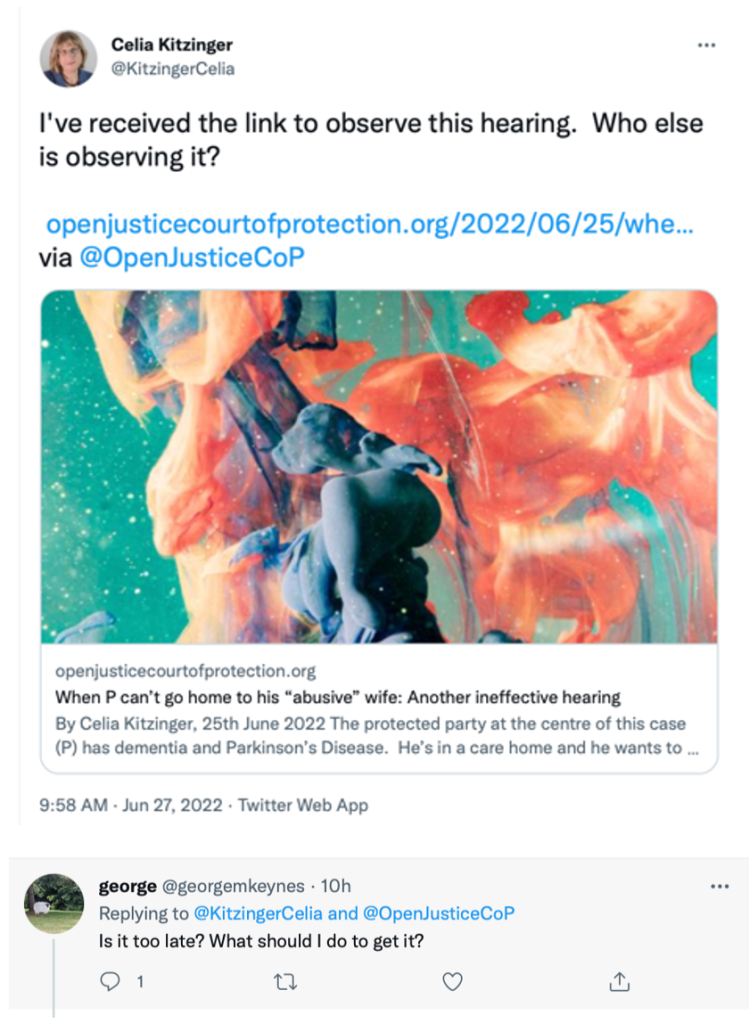
But I found myself waiting for the next instalment of the case of the allegedly abusive wife whose husband (with dementia and Parkinson’s)  was in a care home. The local authority was asking the judge to rule that she must move out of “the matrimonial home”, so that her husband could move back and live there without her (“When P can’t go home to his “abusive” wife: Another ineffective hearing).

So, when I chanced to see Celia’s twitter post that the hearing (Case number COP13861341 before Mr Justice Francis on Monday 27th June 2022) was about to start, I couldn’t resist giving it a go. Without Celia’s instant replies to my calls for help, and the fact that the hearing was delayed, it wouldn’t have been possible but technically it went without a hitch.

Several things about the case intrigued me. The first was that the Court of Protection apparently had the right to order a wife to leave her marital home so that her husband could return to it. Celia explained that the Court of Protection Judge was also sitting as a High Court Judge in the Family Division. That made sense but was quite a surprise.

The second was what possible grounds could there be to order a wife to leave her marital home? It had been reported that there were children involved who had already been removed from the home and that the wife was accused of being abusive. I wanted to hear more about this, and the social worker was due to give evidence.

Also, I was intrigued by the wife. She apparently needed an interpreter to understand English. She also refused to engage a lawyer, even though the costs would have been paid by her husband through his Court of Protection Deputy for Property and Financial Affairs. And yet, by somehow not engaging with the court, seemingly because of various problems including lack of money for transport, she had managed to obtain more than one ‘stay of execution’. I sort of admired her for that!

But probably most of all, I was struck by what happens when someone whose English is limited and who  knows still less, presumably, of English law, marries and settles down here and then finds herself engaged with the authorities, in this case social workers and the courts (and no doubt others outside of this story). I’m not sure how aware we are generally of how different family law is in other countries, even countries as close to us as France (I am thinking of their inheritance law in particular). The wife in this case originated in the Far East (as we think of it!) and I can only imagine how different things are there.

Anyway, to some extent I was disappointed by today’s hearing as it turned out to be short and uncontested. The delayed start was caused not by the wife not turning up again, as I suspected, but by all the parties having at last met each other in person (previously the wife had attended only by phone with an interpreter on another phone!) and reached agreement. (She would move out of the house, but continue with contact by letter and phone and the situation would be reviewed in 3 months).

It was, nonetheless, an interesting experience to observe law in action.

And I can add a postscript.

After the hearing had ended and it had been agreed that the wife would vacate the family home and possibly return to her country of origin, almost everyone left the courtroom except the wife, her husband, still on screen sitting in his care home, and me (Celia too had gone). The wife remained for quite a while, looking at the screen, waving and eventually blowing kisses to her husband. I’m afraid I didn’t manage to see if he waved back but he certainly appeared to be smiling whenever I looked at him.

Georgina Baidoun, is a sometime Court of Protection Lay Deputy for Property and Financial Affairs. She tweets as @georgemkeynes

“Abusive” wife agrees to move out of “the matrimonial home” with continuing (albeit restricted) contact with P: An agreed order

By Bridget Penhale, 28th June 2022

After reading previous OJCOP blogs on the circumstances of this case (the most recent is here, and there are two earlier ones) I was keen to attend this hearing (COP 13861341 before Mr. Justice Francis) on Monday 27th June.

It concerns a protected party (P) who has dementia and Parkinson’s Disease. 

 According to the previous blog post, he’s in a care home and he wants to return home.  

The difficulty is that his wife, who lives in the house of which he is sole owner, is (allegedly) abusive and subjects him to coercive and controlling behaviour. She also impedes the delivery of care to him. The applicant local authority is asking the court to make orders that P’s wife (W) must move out of the house, and that her contact with him should be restricted. The local authority believes that it’s in P’s best interests to live at the property, but not with W – whose influence over him is such as to overbear his capacitous decisions about contact and residence.” (When P can’t go home to his “abusive” wife: Another ineffective hearing)

P’s wife was contesting the order. She wants to remain living in P’s house, and will not voluntarily leave (despite being offered alternative accommodation paid for by her husband) and she wants unrestricted contact with P.  

So, this hearing was expected to be a contested hearing, with a social worker giving evidence about W’s behaviour towards P – her abusive, coercive and controlling behaviour – in support of the local authority’s application.

 I have a particular professional interest (from a social work perspective) in matters relating to older people and capacity, including those involving alleged or potential abuse. I was therefore interested to hear more about this aspect of the case, especially as abuse against older men happens less often than against older women. Much of my academic career has been spent working on issues of violence, abuse, neglect and exploitation, with a particular focus on elder abuse and intimate partner violence and older people. (For more information about these interests and selected publications check out my webpage.)

Gaining access to the hearing was relatively straightforward – an email sent the previous evening requesting access was responded to shortly before the hearing was due to begin. After a short wait in the ‘lobby’ I was admitted without any further checks. 

The hearing

The start of the hearing was delayed by some 40 minutes, without any explanation to the observers, and online observers were left watching a largely empty court-room and P, the only person visible on screen, as he waited for the hearing to begin. 

In the event, once it started the hearing was brief and it again evidenced the work that can take place outside of a hearing, in the shadow of impending judgment.

Counsel for the applicant (Michael Paget), for the local authority, thanked the judge for the extra time before the hearing, and announced that a potential agreement had been reached.  

The represented parties (the local authority, and P via his litigation friend the Official Solicitor, Sian Davies), who were in agreement at the previous hearing, had now slightly amended their position after discussion with P’s wife – the second respondent and a Litigant in Person – just prior to the hearing. And they had secured her agreement to an amended draft order.  

So instead of hearing evidence and launching into a contested hearing, there was an agreed draft order to be discussed.

The original draft order had prohibited all contact between P and W, but this was now to be modified with the addition of “save by letter or phone contact and must seek a prior agreement from the applicant for any face-to-face contact”.  There was also provision to undertake a review in three months to see how contact arrangements were working and to review P’s care package at home.

The judge was clearly pleased about this turn of events and, as he had been the judge in earlier hearings, was knowledgeable about the circumstances of the case and keen both to pursue and endorse the positive outcome. 

The judge did not address P directly, other than to confirm that P could see and hear the proceedings from the outset, and thus P’s involvement was via his legal representative Sian Davies. She said she was “supportive of there being an agreed rather than an opposed order, because an imposed order brings with it the potential of it not being complied with.  The OS considers there is a greater prospect of success if the order is agreed, rather than with an unwilling respondent”.  She said that P currently receives phone calls from his wife “and that doesn’t appear to cause him any difficulty, so stopping phone calls may be a restriction too far”.  She said that contact with his wife was also “in keeping with P’s wishes[1].

 It was pleasing to see the care Francis, J took to ensure the wife’s participation in the hearing (through her interpreter).  This level of involvement was needed for the judge to satisfy himself that P’s wife was aware of, understood and in agreement with the terms of the order before a decision was reached by him to (as he put it) “give the order my blessing”. 

Care was also taken to explain to P’s wife what the penal notice attached to the injunction that was to be made meant. The judge said: “I’m being invited to make an order which has a penal notice attached to it. The effect of a penal notice, if a judge were to decide that there had been a deliberate breach, could result in an application being made to the court, and in some very serious circumstances a judge can send someone to prison for breaching an order.  Have you had that explained to you?”.  She said she had.  

The judge also explained that W would continue to have the right to seek legal advice and representation in future. 

I know on two previous occasions I encouraged you to seek advice from a lawyer – and it was made clear to you that the costs of that lawyer would have been met.  When the review comes up that Mr Paget referred to a moment ago, you may then want to speak to a lawyer.  If you do need a lawyer, or want a lawyer, then you should ask those representing P or the local authority or those managing his affairs.”

At this point the sound quality in the courtroom dipped but it seemed that W indicated that she might know someone able to offer her such representation in future (in a few months) to help resolve the issues. 

The discussion about the order also included the Deputy’s difficulties in obtaining access to P’s finance through his bank (which led the judge also to make an order requiring the bank to comply).

The judge’s courtesy and his personable and human approach – yet with necessary attention to detail – was evident throughout this brief hearing.

This hearing took around 30 minutes and the judge concluded the proceedings by stating that he hoped that he would not see the matter before the court again (as this would mean that the issues were satisfactorily resolved). 

I was left feeling somewhat less optimistic. Despite being a latecomer to this case, previous information (from blogs) had strongly suggested that this was far from being an easy and straightforward set of difficulties to resolve and that problems had been a long time in the making. For matters to have reached the Court in the first place indicates a certain level of intractability. The apparent ease with which agreement was eventually reached (as presented in the course of this hearing) appeared to me to be somewhat unlikely to be maintained in future. My unease was particularly in relation to knowledge and experience of issues relating to abuse, coercive control and contact arrangements.

I also felt a sense of an agreement being reached for a specific purpose but one that was likely to be far more difficult to put into practice and sustain than anticipated. I hope I’m proved wrong!

Bridget Penhale is Reader Emerita at the University of East Anglia, Norwich and an independent consultant on elder abuse, adult safeguarding and adult social care. She tweets @bpenhale


[1] We are not allowed to audio-record hearings, so all quotations from what was said in court are based on notes made at the time and are unlikely to be entirely accurate.

‘Micro-management’ or appropriate case management by the court for a ‘dangerous young man’?

By Claire Martin, 27th June 2022

The protected party at the centre of this case, ED,  is 27 years old.  He is autistic and has a learning disability and epilepsy.  He has been detained under Section 3 of the Mental Health Act 1983 since April 2018. 

Before then he lived with his mother (with paid carers to help with his care needs). He was initially in a psychiatric intensive care unit, and then moved to long-term segregation, which is where he currently remains. 

These proceedings began in June 2021, seeking court approval for ED’s deprivation of liberty in the community when he was discharged from hospital. The applicant is ED (via his Litigation Friend). 

A hearing on 23rd September 2021 before DJ Davies required two respondents (the CCG and the Local Authority) to provide evidence about plans for ED’s care in the community. ED has been ready for discharge for some time and a court order dated 1st December 2021 states the Trust’s position that he was ready to be discharged back then. Plans for discharge have been ongoing since early 2022. At this hearing, final care plans were still not available for the court. 

I observed a hearing for this case (Case No: 12611795) on 13th June 2022, before Her Honour Judge Matthews QC. It was due to start at 10.30am and got underway, for various reasons, at 11.27am. 

The judge asked counsel for ED (Victoria Butler-Cole, QC) to provide a ‘pen picture’ of the case, since there were observers present. As ever, this is extremely helpful in setting its context and history.

There were four parties in the hearing: ED (via his Litigation Friend, his mother), the CCG, the Local Authority and the NHS Trust which is currently caring for ED under the Mental Health Act.  The proposal (from the NHS Trust and the Local Authority) is that ED will initially be discharged to a designated home with round the clock carers, under Section 17 of the MHA 1983

It’s the circumstances and clear plans to enact this discharge that were the subject of this hearing. 

What are the issues to be decided about ED’s discharge from hospital?

Victoria Butler-Cole QC clearly outlined three main issues:

1. What CCTV arrangements should be in place for ED?

2. What should the contact arrangements be for contact between ED and his father and (separately) between ED and his mother and sister?

3. The plans for discharge from Section 17 of the MHA and transfer to a Deprivation of Liberty authorisation from the Court of Protection. 

The CCG, reportedly, was disputing aspects of the draft order, which I don’t have, so it wasn’t always obvious to observers during the hearing, what exactly was the position of the CCG. HHJ Matthews QC was concerned about the time available to the court and the fact that there was still dispute between parties and that ED needed to leave hospital not least because, as Victoria Butler-Cole QC had stated, there have been: 

“… recent incidents where he has suffered physical injury with what has been described as inappropriate physical restraint. One report has stated that ED is not safe in hospital. I raise it because it is critical that everything is undertaken thoroughly and comprehensively in good time, so that he DOES leave hospital with no further delay.” (Counsel’s emphasis)

In her Position Statement, there is more detail about both the physical injury and about the context in which it took place.  

An Independent Care and Treatment Review panel had concluded a couple of months ago (at the end of April 2022) that ED was ‘inappropriately placed in hospital’. ‘Red level’ concerns were raised about whether ED needed to be in hospital, whether he was receiving the right care and treatment, whether he was involved in his care and treatment and whether there was a clear, safe and proportionate approach to risk management. There were questions about whether ED’s rights and freedoms were being upheld. 

Then in May 2022, there were three incidents in which ED was physically restrained and sustained injuries. An independent medical review carried out by Dr Chris Ince (a Consultant Psychiatrist working in specialist autism services) on behalf of NHS England reported that ED was ‘not safe within his current environment’. There is currently a pre-action response awaited from the NHS Trust. Some staff have been suspended or removed from working directly with ED, and the CQC is going to carry out an unannounced inspection. It sounds like ED is not in the best place to meet his needs, to say the least.  

The following exchange[i] then took place, between counsel for the CCG (Samantha Broadfoot, QC) and HHJ Matthews: 

Broadfoot:  Good morning My Lady. I will be brief. The context is that ED is potentially a very dangerous young man. He has a history of highly challenging behaviour. He is a risk to himself and others – attacks on staff, property. [Psychiatrist’s] September 21st report details this [lists paras] and [further psychiatrist] report. The CCG is the commissioner. Everybody agrees he’s not getting the best care in the current setting. The proposal is that he is moved to a purposely adapted, extremely expensive placement. The care provider is an autism specialist. He can be extremely dysregulated and engage in challenging behaviour – there is evidence that change is a matter that can be upsetting and difficult for him. The reason we as the CCG say the orders sought are premature is because it is for the care providers to work out, especially with his mother, the plans regarding contact etc. [There is] a danger that court processes are being used to micromanage the process. The vast majority of discharges happen without the involvement of the court. Given the background to this, it is proposed that there is a risk it’s going to alienate the provider by micromanaging an iterative process. We accept that everybody involved in this should be engaging. [Care provider] is committed to this. The orders at paragraphs 7 & 8 [in the draft order – I am not sure of the details of those orders] are micro-management and we have serious concerns about that. On CCTV,  point specifically [care provider] will be data controller and they will work out what is necessary and then seek consent. If that consent is not forthcoming [care provider] will have to decide whether to proceed on a different basis. At this stage we just don’t know. At this stage those orders are premature and unnecessary. 

Judge: So you’re not agreeing to all of paragraph 10  ….. What do you see the point of the hearing on 21st July being?

Broadfoot: It might have to make a decision on some of these matters. We don’t know at the moment.

Judge: Why are you agreeing to this hearing then?

Broadfoot: By the 21 July, if there’s no dispute, then we’d be saying we are happy for the court to decide.

Judge: I am trying to follow the logic. You are objecting to the gathering of evidence?

Broadfoot:  The process … what we object to is the directions as to the service of evidence which assumes that there’s going to be dispute.

Judge: It raises the possibility, but equally, as is often the case in the COP, it sets out matters on which people can agree. It will be a matter for the court on 21 July to decide, and obviously ED needs to be safe. 

Broadfoot: One point on paragraph 9 on Deprivation of Liberty in future. It is safe to say at this stage, it’s very very uncertain what the timing framework will be for ending of S17 leave and mid-August is only one possible date. 

Judge: Thank you.

Rhys Hadden (counsel for the NHS Trust) confirmed that the Trust’s view was that it was uncertain when it would be appropriate to discharge ED from the MHA section (which can recall ED back to hospital if deemed necessary): 

“The best guess is 6-8 weeks from the end of July, it may be shorter or longer, it depends on how he settles in to new placement. The responsible clinician will be responsible for this. I am not commenting on the future. The agreement from the other parties is that NHS Trust involvement on 21st July is not going to be necessary. We are asking for our clients to be excused at the next hearing. The order is essentially agreed.” (Rhys Hadden, counsel for NHS Trust)

The issues (and a concern) were starting to firm up in my mind at this point.

ED’s legal team wants some clarity about the detailed plans for his move to the care home, the considerations relating to the decision to discharge from the Mental Health Act section (and transfer to a Deprivation of Liberty authorisation) and the proposals for use of CCTV and family contact.

Counsel for the CCG argues that this is ‘micromanaging’ the case.

I was also very struck by the CCG’s use of language to frame and describe ED. Ben McCormack (counsel for the Local Authority) addressed my emerging thoughts: 

“Two things. The CCG. ED was described as a ‘dangerous young man’. We don’t agree and don’t think that’s helpful. The aim is to get him out of hospital. We don’t think characterising him as such is helpful – of course he needs some care, needs looking after, but that’s the plan and what’s proposed. The Local Authority have their obligations. The second point – is this micromanagement or is it case management that the court needs to decide about? In most cases before the COP, the court has to clear the ground and understand everything before it. In the Local Authority’s view, there are many routes to agreeing a dispute. It’s not certain, he may be on s17 leave for some time, but if not, he’ll be deprived of his liberty by August or September. What’s the point in discharging these hearings only to step them up again? … Contact with family. How can the court decide without some evidence about this? We see it as a proper … we don’t think the other parties are asking too much of us, that’s why we agree it.” [Ben McCormack, counsel for Local Authority, Counsel’s emphasis]

I was relieved to hear Ben McCormack comment on the language used by the CCG to describe ED. I don’t know the extent of ED’s distress and how this might lead to ‘dangerous’ behaviours. It did not seem material to the issues before the court, however, which were about detailing plans for leaving hospital, monitoring and contact when he had left hospital.  It might be the case that both he and others are at risk when he becomes distressed. As Ben McCormack pointed out, however, all this means is that ED ‘needs some care, needs looking after’. Framing the issues around ED being a ‘dangerous young man’ served no purpose here in my view, other than to cast him in a pejorative light. I can’t see much difference between this, and the (regular, in my experience) casting of all of someone’s actions and ‘behaviours’ being attributed to their ‘personality’ – usually in the context of the professional concerned looking for a way out of having to think more about how they might need to adapt in order to help. We all act and behave as we do because of our ‘personality’, mediated by our life experience, the environment we are in, how we are treated and the relationships we form. The (often throwaway) label of ‘personality’ explains nothing, really, other than to locate the problems in the person, and thus nothing to do with us! 

HHJ Matthews QC gave a brief ex tempore judgement: 

“The draft order is a proper use of the court’s powers. It is not micromanaging. The court would wish to know what the arrangements are likely to be. I understand this is complex care planning, I have no wish to frighten away the care provider. What’s being asked is not inappropriate or extensive. The court needs to know what the dispute is. It may assist to resolve issues. It may be helped by a round table meeting, and the court wishes to know how things are proceeding. The court needs to know that things are being handled better than in the past. The court has no wish to be premature or inappropriate but with that information the court will be in a better position on the 21 July. … I will adjourn but may determine it should be dismissed on 21 July.I agree the Trust can be stood down at this stage. If it is appropriate then [ED’s mother] should sign the tenancy agreement. It is for the Local Authority and the CCG to decide [refers to paragraphs in the order].With the benefit of more information and time I may dismiss the application.”  [Judge’s emphases]

I couldn’t have agreed more with this judgment.

I didn’t hear evidence that the care agency was being ‘frightened away’. I am not sure why a care agency would object to transparency about detailed care plans for a person who needed good, carefully arranged and executed plans to facilitate as smooth a transition and settling-in period as possible. We heard that, for ED, change itself is frightening and challenging to him. Why not do everything possible to make sure that this is planned out in detail?

I have observed many hearings now, ‘case management’ and ‘directions’ hearings, where exactly this sort of detailed planning is considered the business of the court. It has seemed to me, often, that without orders of the court, good intentions might not translate into actions, plans can go awry and Ps’ care can end up very badly handled.

As HHJ Matthews stated: The court needs to know that things are being handled better than in the past.

I am unable to attend the next hearing – if it happens – on (21st July 2022) and hope that someone can observe it to see how ED is getting on and report back. 

Claire Martin is a Consultant Clinical Psychologist, Cumbria, Northumberland, Tyne and Wear NHS Foundation Trust, Older People’s Clinical Psychology Department, Gateshead. She is a member of the core group of the Open Justice Court of Protection Project and has published several blog posts for the Project about hearings she’s observed (e.g. here and here). She tweets @DocCMartin


[i] Dialogue is reported as accurately as possible. We are not permitted to record hearings. It is possible that some words are missed, or misheard and reported inaccurately. 

When P can’t go home to his “abusive” wife: Another ineffective hearing

By Celia Kitzinger, 25th June 2022

The protected party at the centre of this case (P) has dementia and Parkinson’s Disease.  He’s in a care home and he wants to return home.  The difficulty is that his wife, who lives in the house of which he is sole owner, is (allegedly) abusive and subjects him to coercive and controlling behaviour. She also impedes the delivery of care to him.

The applicant local authority is asking the court to make orders that P’s wife ( W ) must move out of the house, and that her contact with him should be restricted. The local authority believes that it’s in P’s best interests to live at the property, but not with W – whose influence over him is such as to overbear his capacitous decisions on contact and residence.

The hearing I observed (COP 13861341, before Sir Jonathan Cohen, 13th June 2022, via MS Teams) was supposed to be a final hearing.

There have been two previous attempts at a final hearing for this case – one in May 2022 (blogged here) and one at the beginning of June 2022 (blogged here), both via MS Teams.

Neither got off the ground, largely because of concerns that W was disadvantaged by not having legal representation. It was also obvious that a remote hearing would not work well due to interpretation issues.

W was not represented at this hearing either – because she’d declined the offer of legal representation (to be paid for by her husband’s Deputy).

In fact, she wasn’t initially planning even to attend it.

When the case was called on at 10.56 (a 26-minute delay caused by “unavailability of staff at the court”), W was not in court, and nobody knew where she was.  

Although W was eventually located, and she joined the hearing with her interpreter shortly before noon. the hearing was abandoned shortly before 1pm as it was agreed that it could not be effective. The judge said:

I’m sorry for P, and sorry for all the professionals involved, that as a result of W not attending court, and not telling people in advance that she was not attending court, that we are now going to have to put the case over.”

The failure to hear this case, for the third time, means that P remains in the care home instead of returning to his house as both the Official Solicitor and the local authority believe is in his best interests.  He’s been in the care home for nearly 6 months now.

The next hearing – again, a “final” hearing – will be in-person (or ‘hybrid’, i.e. in-person, but with only P attending remotely from the care home) at the Royal Courts of Justice on Monday 27th June 2022.

What went wrong?

It was very unfortunate – though nobody’s ‘fault’ – that arrangements for hearing this case were changed at short notice such that it was moved from an in-person to a remote hearing (and from a full-day hearing to a half-day hearing).

This was bad news for the case, for which specific arrangements had been made to ensure an in-person hearing (and an all-day hearing to allow time for the interpretation).

According to counsel for the applicant local authority (Michael Paget of Cornerstone Chambers) the plan had been that this hearing would be in person, in the Royal Courts of Justice, before Mr Justice Hayden.  

Then, on the Friday before this Monday morning hearing, parties were notified that Hayden J was tied up with a part-heard case: the hearing would instead be before Sir Jonathan Cohen.  It would be held remotely because, as Cohen J explained at the beginning of this hearing, he was working from home due to “isolating following COVID-19”.

The solicitor for the local authority sent a letter, translated into W’s own language, by way of a process server, delivered at 7.50pm on Saturday evening.  It explained the changed arrangements and asked W to attend Mr Paget’s chambers instead of the RCJ. 

The plan was to provide her with a conference room and a computer link in chambers so that she could attend the hearing on the video-platform (instead of via telephone as previously).  As counsel for the local authority said, “face to face would be most appropriate and it’s unfortunate that it was modified, but a video-platform is the next best option”.  

The interpreter had also been asked to go to Cornerstone Chambers, so that she would be present in the same room as W to enable interpretation to run more smoothly (see previous blog for the problems of interpretation at earlier hearings). 

But at the start of this hearing, neither W nor her interpreter had arrived at Cornerstone Chambers.  The interpreter was on the video-platform, but was not able to say where W was.

The judge asked a member of the court staff to “check whether she’s in the RCJ – outside Mr Justice Hayden’s court or outside my court”, adding: “Can someone explain to P what is going on – he must be wondering what on earth is going on”. (P was on the video-link, attending from the care home).

At 11.06, we received the news that the staff member had not found W outside either courtroom.

She may be at Number 15 [P’s home]” said counsel for the local authority. “So, the next step is for someone in my team to go there”.

There was then some discussion about how long that would take and that’s the point at which it emerged that – contrary (as I understand it) to the original plan – the hearing was listed only for the morning, and Sir Jonathan Cohen had another hearing at 2pm.  The hearing was adjourned for half an hour (until 11.45am) in the hope that W could be found.

Cohen J seemed sceptical that W’s non-attendance could be attributed to these changed arrangements. 

It wouldn’t be satisfactory going ahead with this case when there’s an absence and there’s been a change of circumstances – though whether the change of circumstances has anything to do with her absence is another question.” (Judge)

Deciding that a hearing today would be ineffective

At 11.45, W was on the platform, as before via phone and as before without any other channel of communication with her interpreter.  

There was then a wait to get the interpreter back online.  The hearing resumed at 11.59am.

It was established that P’s wife was “attending via phone at the property” (i.e. Number 15, P’s house).  

The judge asked her why she had not attended the hearing at the listed start time.  (His method of questioning was unusual compared with other judges I’ve watched in that he often addressed the interpreter directly, referring to W as “she”, instead of speaking directly to W through the interpreter).

Judge: (to interpreter) Can she tell us please why she was not available at half past ten.

Wife:  Half past ten today, do you mean?

Judge: That is when the hearing was due to take place.

Wife: Because I told them that I don’t have money to travel to the court and someone gave me a card to withdraw some money but when I tried to withdraw the money, there was no money on the card.

Judge: (to counsel) How are we going to deal with this, given it’s now 12 o’clock and I have another case coming in at 2pm for an hour, and everything is being interpreted in a manner that means everything is going to have to stop for W.

Wife: I’m sorry about that. That’s because I didn’t have money so I could not travel there. I didn’t have another choice.

Judge: Can we have an effective hearing?

Paget: The hearing can’t be effective, and it’s suggested it be relisted as soon as possible for an attended hearing.

Judge: That won’t deal with the problem of interpretation. It’s not an effective use of time if every time you say something there has to be a break while there is a translation.

Paget: Yes, My Lord, it will be slow, but that is a consequence of having an interpreter, and that has been factored in in asking for a one-day hearing.  We would ask for it to be relisted in short order.

Judge: How are we going to avoid the problem next time of her saying she doesn’t have the money?

Paget: We don’t accept that, but we can make sure she has a taxi organised, so that if she chooses to, she can attend.

Judge: Will she be coming alone or will someone from the local authority escort her.

Paget: We can arrange for a taxi to be organised or make an alternative practical arrangement like local authority personnel going with her. She may not want that, but we can offer it.

Judge: Madam Translator, can you interpret that.

The judge then asked Sian Davies, counsel for P via his litigation friend the Official Solicitor, whether she also “accepted this matter will have to go off” (i.e. not be heard today).  She did – and added that it should be listed as an attended hearing (or hybrid, so that P can attend).  “It wouldn’t have made the slightest bit of different if it hadn’t been changed, would it?” said the judge.  Counsel’s response was tactful.

Davies:  Unfortunately, we haven’t had the full day allocation, for reasons I’m sure are understandable.  The Official Solicitor reluctantly accepts this hearing is not able to proceed today. W is disadvantaged by being on telephone, and interpretation makes it complicated.  This is a matter of concern. P wishes to go home, and further delay is not consistent with the wish he’s expressing. But for practical reasons as outlined, the matter can’t proceed today.

P’s daughter, who was also present (but not a party) was asked for her views and said she agreed with the Official Solicitor.  “I would like to proceed quickly, because my father would like to move, but I see why we can’t today”.

Legal representation for W

While the court was waiting as the judge’s clerk contacted Listings to see when another day could be found to hear this case, Sian Davies raised the issue of W’s legal representation.

W had said at the last hearing that she did not wish to have legal representation, despite the fact that the local authority, in its role as P’s interim Deputy, had confirmed that it would fund it. 

The local authority had given W a translated letter explaining that she should seek legal advice and providing the contact details of specialist firms (who would be paid by the Deputy).  She has declined.

 “The fact that this matter has been adjourned gives her the opportunity to reconsider”, said Sian Davies, “and I would invite the local authority to confirm that funding is still available”.  “It is”, said Michael Paget, for the local authority.

The judge checked whether the funding was for advice only, or for advice and representation (the latter) and then engaged with W (via the interpreter).

Judge: Let me ask you, W. You were offered the chance to obtain legal representation. Would you like to have legal representation at the next hearing?

Wife: No, I prefer everything simple. 

Judge: Well, it’s perfectly simple having a representative speak for you, and it’s being offered to you without you having to pay for it.

Wife: I know about that, but I am receiving lots of support from the government and I don’t want to waste the money from the government. If I need help, I will ask.

Judge: You’re not wasting money from the government. (To the interpreter) It’s a matter entirely for her, but most people benefit by being represented.

Wife: Yes, I understand that. I know. I understand everything and I also understand what I am doing and where I am. For that reason, I would like to say thank you to the people who are supporting me, and thank you to the family who are taking care of my children.

Judge: I’m not sure I understand the answer in relation to representation.

Interpreter:  “I understand everything and I also understand what I am doing and where I am. For that reason, I would like to say thank you to the people who are supporting me, and thank you to the family who are taking care of my children.”

Judge: (to interpreter) The question I asked is whether she would like to have a solicitor and barrister to speak for her.

Wife: My answer is no.

Judge: Okay.

Arranging the next hearing

My clerk comes bearing news”, said the judge.  

The clerk reported there were two possible dates for the next hearing: 23rd June or 27th June.

It turned out that there was only one witness to be called – the social worker – and there was then some delay as her availability on one or other of those dates needed to be ascertained.  It wasn’t straightforward to reach the social worker since it was she who had travelled across London to the property where W is living to enable her to join the hearing. (“She’s in transit, is she?”, asked the judge. “I’m not sure…” said Michael Paget.)

While attempts were being made to contact the social worker, the judge outlined what he wanted included in the order.

Judge: I want a recital that [Social Worker] is anticipated to be the only witness, other than [Wife].  I assume the daughter hasn’t filed a statement? [No.]. I want a statement that a final declaration has already been made as to capacity.  And a recital that this hearing has been frustrated by W not attending the hearing, and having only been ascertained to be at home shortly before midday, claiming that she did not have the funds to attend in central London.  There will be an order that the local authority must make arrangements for transporting W to the RCJ for her to arrive at the RCJ by 10am on whatever date it is.  And that the second respondent [W] must attend, and that if she does not, an order may be made in her absence.  If only I can be told on what date.

Paget:  I’m sorry I haven’t received that confirmation yet.

And then the confirmation came through from the social worker. The next hearing would be on 27th June 2022.

The judge repeated for W’s benefit the information that the local authority would arrange “an Uber or a taxi or some other means of transport to get her to the hearing and will likewise provide her with a means of money to get back at the end of the hearing”.  He added, “I am ordering that she attends the next hearing. If she does not attend, then she will be in breach of a court order.  I think it would be sensible for the local authority to make sure W knows the identity of the court number the day before. Simply dropping someone at the RCJ is not necessarily an easy experience for those who are completely unfamiliar.”

The wife’s response was to protest that she “was never against the law – it was just because I didn’t have money” and to say that she needs more money.  “Everything is broken. I need support in terms of finance on a daily basis.  I know what I am doing, where I am going. The only thing I want support with is to open my husband’s bank account so I can use it for my daily essentials.

P himself also spoke to the judge saying, “W needs money, and I don’t need money. Can you get her some funding?”. (He also asked to see the bundle of documents before the next hearing.) The judge said: “I understand your concern about your wife not having any funds and that will be a subject of discussion with the local authority to sort this out”. 

The judge ensured that W knew the name of the interim Deputy and how to contact them for money.

He also urged the parties to make sure that the court has booked an interpreter for 27th June 2022 (to attend in person in the court).  

He was clearly concerned to do whatever he could to ensure that the next hearing – unlike the three preceding it – should be effective.

Comment

I was dismayed to witness a whole morning of court time before a Tier 3 judge with so little achieved.

The cost to the public purse of this ineffective hearing (and the two ineffective hearings preceding it) included the time and labour of: a senior judge, two barristers, two solicitors, a social worker, an interpreter, a care home worker (supporting P’s access), a court clerk and court staff.

The cost is not only financial.

P remains stuck in a care home he doesn’t want to be in and which nobody thinks is in his best interests.

The judge at this hearing was clearly frustrated.

The barristers displayed meticulous forbearance but were obviously disappointed (given what had happened at the previous two ineffective hearings) to find themselves yet again in an MS Teams hearing with wildly unsuitable arrangements for interpretation. 

The solicitor for the local authority seems to have done everything he could (in terms of contacting W and trying to arrange for her to attend via video-link from chambers) – and this must have involved some frantic work over the weekend.   All that effort to no useful end!

It was pretty clear from the outset that the revised arrangements for this hearing were not going to work.  It’s deeply unfortunate that it was ever transferred from an in-person to a remote hearing.

It’s all very well to say, as the judge did, that this hearing wouldn’t have worked even if it had been in person as originally contemplated, since, in his view,  W would not have attended the RCJ for the same reasons she failed to attend the video-hearing via a link in chambers.  But the late change in arrangements makes it hard to hold W solely responsible for the ineffectiveness of this hearing.  

The next hearing will no doubt be a slow and frustrating process, not just because of the need for time-consuming interpretation, but also because of W’s decision to decline the offer of legal representation.  

I have not heard anything from her which amounts to an effective argument for her position – which I understand to be that she wishes to live with her husband in what an earlier judge in this case referred to as “the matrimonial home”.  

If W had a legal team representing her, counsel would no doubt mount an Article 8 argument about the way in which the draft order interferes with her (and her husband’s?) right to family life.  

Counsel for W would also have the opportunity to challenge the allegations against her that she has abused P physically, emotionally and financially.  These allegations form the basis of the applicant local authority’s “pattern of behaviour” document, which is relied upon in support of its application for an injunction excluding W from the property.  (“Controlling or coercive behaviour” is defined legally as taking place “repeatedly or continuously” and courts may look for a “pattern of behaviour” established over a period of time rather than a few isolated incidents.)

There has so far been very little said in court about this alleged abuse. I think the social worker will give oral evidence about it at the next hearing, and there was some discussion (at a previous hearing) about the opportunity for W to cross-question the social worker’s evidence.  It is apparent that cross-questioning a witness is something W is ill-equipped to do as a Litigant in Person, and that the opportunity for a fair trial  would be massively improved if counsel could do this on her behalf.  But since she has refused legal representation, that won’t happen.

In an earlier blog post about this case, I reflected on the importance of “Fairness in court for a Litigant in Person”.   I quoted from the Equal Treatment Bench Book to illustrate the responsibility judges have, when faced with unrepresented parties, to ensure that they are treated fairly.  In my experience, judges do this exceptionally well, but it’s time-consuming and involves a great deal of work from judges and counsel alike. 

In my view (I said)  “the solution to the problem of unfairness for Litigants in Person must be to stop them being Litigants in Person by ensuring they get legal representation”.  But in this case, that’s been tried – and it’s failed because W has declined legal representation.

When W said she didn’t want lawyers because she “prefer[s] everything simple”, I was immediately struck by how complicated her decision will make the next hearing, both for counsel and for the judge.  

Assuming, of course, that she attends.

Celia Kitzinger is co-director (with Gill Loomes-Quinn) of the Open Justice Court of Protection Project. She tweets @KitzingerCelia

Photo by Dan Cristian Pădureț on Unsplash

“She is religious and she is a fighter”: Three perspectives on best interests decision-making in the Court of Protection from ‘Compassion in Dying’

By Jemma Woodley, Zach Moss and Upeka de Silva, 23rd June 2022

Editorial Note: The judgment has now been published: Imperial Healthcare NHS Trust v C & Ors [2022] EWCOP 28

We are three people who work for Compassion in Dying, a national charity that supports people to make their own decisions about end-of-life care in line with the Mental Capacity Act 2005.

We promote the rights of capacitous people to document their care preferences using Advance statements, Advance Decisions to Refuse Treatment and/or Lasting Powers of Attorney for Health and Welfare. 

We also promote the rights of incapacitous people to be treated (or not to be treated) in accordance with these documented preferences or in their best interests taking into consideration their past and present wishes, feelings, beliefs and values. 

Sadly, our free nurse-led information line often receives calls from individuals and family members anxious about not getting the treatment and care that is right for them and their loved ones, in line with the law. 

We watched a two-day hearing before Mr Justice Hayden, in person, in the Royal Courts of Justice on 15thJune 2022 (Jemma) and 16th June 2022 (Zach and Upeka).  

The hearing (COP 13933678) concerned LC, a 77-year-old woman who had suffered hypoxic brain injury following cardiac arrest (and eight cycles of cardio-pulmonary resuscitation) in hospital in January 2022. The Trust and two independent external experts report that LC is now in a prolonged disorder of consciousness.

The judge had to consider whether LC’s wishes were being properly taken into account in continuing to give her mechanical ventilation, and whether or not an attempt should be made to wean her off the ventilator with a tracheostomy. An application had been made by the Trust to use a tracheostomy, but the family were adamant she wouldn’t want this.

Helping to resolve disagreements about medical treatment between family and clinicians and ensuring that the person remains at the centre of the deliberations goes to the heart of what Compassion in Dying deals with every day.  

My reflections on observing my first CoP hearing, By Jemma Woodley

As I walked through the airport style security, the excitement which I had woken up with had quickly turned to apprehension. The weight of what I was about to listen to started to feel real. I felt intrusive and hesitant as I walked towards the court room. The intricate details of P’s life were about to be laid out for anyone to observe, I felt heavy with the weight of the decision which needed to be made. 

As I waited with Celia outside the courtroom, we discussed the details of confidentiality, and I was introduced to expert witnesses and practitioners. I felt privileged to be able to attend and grateful to the Open Justice Court of Protection Project. I watched as the family, lawyers from all parties and expert witnesses spoke to each other outside the courtroom, waiting for the case to begin. The court was delayed as a video had been shared by a member of the family. I watched as all parties stood around a small mobile phone, watching a poor resolution clip of LC, trying to determine whether she was blinking in response to the family member’s request or whether this was merely a reflex. My apprehension eased. I no longer felt as if I were the only one unprepared to enter the hearing. 

As the hearing started, I was immediately grateful to Mr Justice Hayden. He ensured a detailed summary was given before proceeding with the case. As the opening summaries began, I was taken aback by the sheer number of interruptions from the judge. It was clear to me he was disappointed with the sizable amount of medical jargon which was used. I was confused, I don’t have a clinical background and therefore the jargon which was used was unfamiliar and perplexing. I can only begin to imagine how this language on top of the emotional weight of the impending decision must have felt for LC’s family who were in attendance. I was grateful for Mr Justice Hayden’s interruptions, calling the practitioners out for their use of medical terminology. He stated, “When we have lay people and family members in court,  it’s just helpful to explain”.

I was also pleasantly surprised with how the judge interrupted the proceedings at one point to usher two family members to the front of the room. As we had entered the courtroom, the family looked fearful and had taken a seat on the back row. With Mr Justice Hayden moving them directly to the centre of the room, to me, this felt almost symbolic. By physically placing LC’s family at the centre of the room, the importance of LC and her family’s wishes to the decision being made were emphasised.   

As the hearing proceeded, I couldn’t help but watch Mr Justice Hayden attentively. It was evident how heavy the weight of this decision was on his shoulders. A decision to move LC to palliative care was clearly a serious one. I was reminded of how traumatic the death of a loved one can be. Mr Justice Hayden asked the doctors who were giving evidence about their experience with Post Traumatic Stress Disorders following Intensive Care. He wanted to know about the repercussions for LC, if she were aware of her surrounding, and for the family. I was grateful for the time he took to listen and understand this. 

A final reflection I had was a personal one. At Compassion in Dying, the majority of our callers want support to refuse treatment they don’t wish to receive. We support and advocate to help treatment come to an end, for those who wish it to. This case challenged my personal values and previous experience. The family emphasised throughout the hearing how important sanctity of life was to LC and how strongly they knew she would wish to continue fighting and receiving every treatment possible. This was not something I had personally come across in the six months that I have been at Compassion in Dying. I am grateful for the opportunity to better understand the breadth of people’s end of life wishes and it served as a good reminder that my own personal values should always remain personal when supporting people to express what matters to them. What mattered in this courtroom was not my own feelings (or Mr Justice Hayden’s or anyone else’s) but what was important to LC and what she would want to do. 

This thought process was something that was subsequently emphasised further by attending the Judging Values and Participation in Mental Capacity Law Conference this week. I listened to the likes of Baroness Brenda Hale and Sir Mark Hedley speak openly about how they negotiate their values in decision making. I was struck by the responsibility that judges bear. 

I was sorry not able to attend the second day of the hearing, but I am very grateful to the Open Justice Court of Protection Project for the opportunity to attend on the first day (and support in doing so) and I look forward to attending more hearings in the future. 

Dieu et mon droit –> God and my right, By Zach Moss

During the hearing, I kept wondering what the French writing meant (Dieu et mon droit) which adorned the The Royal Coat of Arms above the judge’s head in the courtroom. It translates to “God and My Right” which would prove fitting given the eventual judgment in this hearing. Mr Justice Hayden, who was presiding over the case, seemed to signal that his decision would rest on what weight to give LC’s faith.

My first time observing a case

As someone who has followed the Open Justice Court of Protection Project for some time, it was exciting to attend the Royal Courts of Justice on Thursday 16th June 2022 to view an in-person hearing. 

Through my work at Compassion in Dying I’ve often heard about how some people might theoretically end up in the Court of Protection after a disagreement or dispute about a medical treatment, but to actually be there watching a case unfold was memorable. It may seem silly to say, but the responsibility of those involved in the case and that of the judge to ultimately make the decision was palpable.

The time to be heard

Day two of the hearing (which I attended) was entirely about LC. I’m not quite sure what I was expecting in terms of process and questioning – but hearing Mr Justice Hayden probing LC’s three sons and daughter, I was struck by the incredible thoughtfulness of his approach. It felt to me entirely unconventional – but entirely appropriate. Hayden J after all, as he mentioned a few times, was the one ultimately having to make the very difficult decision. 

I got the sense that the two family members present, and the two others who joined remotely by phone and video were nervous. Entirely understandable, given the context and intimidating environment at the court. Looking on from the viewing gallery though, I was seriously impressed with the way Mr Justice Hayden was able to put the family members at relative ease. The questions he asked of them were deliberately open, authentic and not in any way tokenistic – he allowed LC’s children to build a rich picture of their mother. These weren’t questions to ‘break the ice’ or to set the scene – they were critical to the process, to in effect bring LC into the courtroom.

            “Who was LC closest to?”

            “What was her favourite food?”

            “Did she join in when you watched the football? Who did she support?”

There was a memorable moment (amongst many) which had the courtroom break into laughter when Hayden J was speaking to LC’s daughter JC on the phone. She had, I think, prepared a list of things she’d wanted to talk about – and each time the judge thought she’d finished, she’d say “oh and one more thing…”. There was a level of desperation from JC getting her chance to convey her feelings as clearly as possible but the time, patience and space Hayden J was able to give her will stay with me for quite some time.

There is an undeniable sense of dignity in this process: the family is there in court to be heard. This is surely what the Court of Protection is about– this perhaps being the first time a family feeling able to tell their story. 

You could feel that this detailed discussion and exploration of LC’s wishes just simply had not occurred before – for whatever reason.

Reflecting on this, it feels like this forensic and compassionate approach is entirely missing from the medical discussion. I fear that even with the best intentions, there is no space for this in an NHS under immense strain.

I even at one point imagined whether a world where a medically trained Mr Justice Hayden was the potential answer? Do we perhaps need to turn medical training upside down and start with social first, and medical second?

The role of religion 

It was clear from all the witnesses that LC’s Christian beliefs played a significant part in LC’s life and that, because of this, she’d be “up for the fight”. Even faced with some bleak medical evidence about what this ‘fight’ might mean, each of the children in their own way believed she’d want attempts to be made to wean her off the ventilator despite the poor odds of success. I thought Mr Justice Hayden was very careful to properly define what ‘success’ in this case might mean, both medically and also framing it in terms of what LC would not return to, as it seemed the children still clung to some sort of hope of a fuller recovery than the medical evidence suggested.

Ultimately, Mr Justice Hayden concluded LC would “be up for the fight.” She was, and had been, a woman of conspicuous courage. Given the all the medical evidence, I thought it touching for him to say that LC and her family would need that courage in the weeks ahead.

Reflections

My overall feeling is that I am impressed. Mostly I think by the compassion, skill and forensic ability of Mr Justice Hayden to place LC in the heart of the courtroom for 2 days and to decide what is in her best interests. 

I think I am convinced – at least on the basis of this one hearing – that the Court of Protection provides a way to settle disagreements about medical treatments. 

I am left with some questions though. Mr Justice Hayden in his (oral) judgment said this case should have been brought to court by the Trust far sooner – it is only in court where LC will “find expression”.

This left me wondering why exactly it hadn’t. It also made me realise how important the work of the Open Justice Court of Protection Project is.

I wonder how both sides of this hearing reflect on what has happened: How does the family of LC reflect on what they’ve gone through? They may have got the outcome they were seeking, but their experience is sadly not over, and it sounds as if their relationship with the Trust is perhaps irreparably broken. 

I wonder too how the Trust will reflect on this? There will be many people who were involved, but how do they perceive these cases in the Court of Protection? Perhaps as a headache or a cost? How do the clinicians reflect on what has happened – does it make them more fearful of medical litigation? Or do they view it as a practical, compassionate option to work through medical disagreements for their patients and their families?

The perception of the Court of Protection and these cases is important. For us working at Compassion in Dying, we often hear from people and families with concerns about medical treatments and potential disagreements . We need to know how we speak about the Court of Protection as a genuine option. How might we de-mystify the process?

I am very much looking forward to observing another hearing.

 “It is because she matters that we are all here”, By Upeka de Silva 

Thanks to the Open Justice Court of Protection project, I had observed hearings remotely before (blogs hereand here) but to be in the Royal Courts of Justice; in the presence of Mr Justice Hayden; discussing decisions at the end of life, a topic I feel passionately about, was particularly meaningful.

After what was reported to be an anxious and stressful first day, day two was about bringing LC into the court room through the evidence of those who knew her  – the very essence and value of the Court of Protection. 

Mr Justice Hayden had requested to hear first from M, one of LC’s sons, because he said he had observed how, unlike the other brother in attendance who had seemed more upset and agitated, M appeared to have been engaging more fully with the previous day’s discussions.  I was in awe of his ability to make such an astute observation during what must have been an intense day of deliberation.

Guided by Justice Hayden’s thoughtful questions about what LC’s life was like and his acknowledgement that there will be “very few occasions in life when you are called up on to assist in something as important as this,” LC’s three sons and daughter brought LC into the court room. We learned about LC’s devotion to her family and faith, love of cooking and soap operas, her support for Liverpool FC, and her work for the NHS delivering the very equipment that is keeping her alive. 

I wondered if any of her clinical team knew this about her. Would it have helped in their decision-making? Or is the Court of Protection the only place where the “protected party’s” voice finds expression”?

Honesty and respect

Callers to Compassion in Dying have told us how appreciative they are of clinicians taking the time to engage with them honestly and respectfully about a loved one’s care. Equally, we receive regular calls from family members desperate for support because they are being excluded, dismissed and patronized by health and care professionals when they have tried to engage with their dying loved one’s care. I couldn’t help but think how vastly the quality of end-of-life care might be improved if all clinicians were able to engage with family members the way Mr Justice Hayden did. 

He was brutally honest about the clinical options available; 

  • “ She won’t ‘make it through’, or she will have a minimal level of awareness and be more vulnerable to pain”
  • “Has this fighter earned her rest?”
  • “I may be protracting her death rather than prolonging her life – would she want that?”
  • “We are not contemplating a future where LC will be able to cook or play with her grandchildren”

He was incredibly respectful of the family members’ voices and their brave and honest evidence. He commended them on bringing LC to the court room in “glorious technicolor”. He reassured them that what had happened to LC “was tragic but it doesn’t eclipse her remarkable life”.

From my experience with speaking with family members on our information line, I can confidently say that this is the sort of conversation family members value having with those caring for their loved ones – and it’s often missing in healthcare settings. 

With increased focus on person-centered care and shared decision making, might this be achievable?

The decision

In an ex tempore judgment, Mr Justice Hayden concluded that the evidence was that LC would opt to “fight” and would consider it a part of her faith to do so. This meant it was in her best interests to try weaning her off the ventilator and assess her ability to breathe independently. He observed that LC was a woman of conspicuous courage and that the family would all need this courage in the weeks ahead.

While I understood this to be what the family preferred, I was left uncertain about whether the trust that had been broken between the clinicians and the family over the last few months would be sufficiently mended so as to move forward in collaboration. 

What I took away

  • A reminder that cardio pulmonary resuscitation may be ‘successful’ in restarting your heart but still do more harm than good.
  • Conversations about care preferences are invaluable. The option of a tracheostomy was not on the table because helpfully, she had clearly stated in conversations with her family that having seen a friend with one, it was not something she would wish to have. 
  • Recording these conversations in an Advance Statement and/or an Advance Decision would perhaps be even more valuable when faced with challenging choices at the end of life.
  • When there is a disagreement about what is in someone’s best interests, an application to the Court of Protection should be made without delay. Both clinicians and individuals should necessarily be aware of this avenue of dispute resolution and not be overly fearful of the court process.

Jemma Woodley is Information Support Officer at Compassion in Dying and tweets @JemmaWoodley2

Zach Moss is Digital Manager at Compassion in Dying  and tweets @_zachmoss

Upeka de Silva is a Policy Officer at Compassion in Dying and tweets @de_upeka

Compassion in Dying tweets @AGoodDeath

Sisters’ dispute over Deputyship – and a concern about open justice

By Daniel Cloake, 20th June 2022

Two feuding sisters (Ms J and Ms E) have asked the Court of Protection to pick one of them as a deputy after their father lost capacity to manage his finances following a series of strokes.

The hearing I observed was listed on the “Daily Hearing List” on the court’s website as follows: Friday 10 June 2022, Before District Judge GROSSE, 2:00pm COP 13824233, Directions, Property and Financial Affairs , Attended , PUBLIC HEARING WITH REPORTING RESTRICTIONS , time estimate 2 hours , Court 22.

The court heard that Ms J, whose identity is protected by court order, applied to act as a so-called Property & Affairs Deputy for her father in August 2021.  This would enable her to “do things like pay the person’s bills or organise their pension” 

Her father, P, is in his seventies and resides in a care home.  The court was told he enjoys listening to Reggae music when family come to visit.   

District Judge Grosse explained the use of the initial P to describe him “it’s the way the Court of Protection talks about persons who are incapacitated.  It’s not meant to be derogatory in any way”.

The exact details were not shared with the court, but it is understood that following the mother’s death in December 2021, there were “concerns” within the family about how Ms J handled the estate.  “The trust has broken down” is how Karen Reid, the barrister representing the sister Ms E, explained it.

She added: “Really this comes down to the lack of transparency that’s come from [Ms J].  That makes [Ms E] understandably suspicious as to what her intent is in becoming her father’s deputy.“

An incident that occurred at the care home, when both sisters visited at the same time, was also referred to.

DJ Grosse explained that the court had various options available in choosing a deputy but emphasised that “what the court has to consider is what is in the best interest of your father, not the parties: he is the number one”.

Appointing the sisters either on an individual or joint basis was considered along with the use of a paid professional known as a Panel Deputy. 

In support of her appointment, Ms J, appearing unrepresented (as a Litigant in Person), told the court that prior to the loss of P’s capacity she “was doing everything for Dadall I want is to make sure that Dad’s finances are looked after and there is something for his end of life.”

For the other sister, Ms Reid explained that her “client is willing to act as a deputy; nobody is saying she is not in a position to be able to act, to manage fairly limited affairs.  She is not interested in the money; she wants his care to be conducted properly…she would be ideally placed to act as his deputy“.

In handing down her Judgment, District Judge Lorna Grosse said that the “Court is required to consider the views of those nearest to P and to consult the family.”  She cited Section 16 of the Mental Capacity Act 2005 and explained that “the court has power to appoint a deputy if it feels it’s in the best interests of P.

The concern in this case is that there is friction in the family” and – after citing the decision in Re: BN [2015] EWCOP 11 (02 March 2015) –  DJ Grosse concluded that “where there is friction in the family the court should consider departing from a close family member” but “to have his estate [of £18k] really diminished by professional fees… is not in his best interests”.

Not only would P not want his funds depleted, “neither would he want his children squabbling … he would be very upset if he knew there was a difference of opinion in the three people he loves best in all the world” said DJ Grosse, including a brother, who was not present, in the picture.

As there are no issues in respect of the competence and integrity” of both of the sisters “but there are issues with the two working together”, the judge decided to appoint just one.  Explaining that Ms J had made the application, paid the fee, and “done a great deal of leg work in respect of her father, the court takes the view she should be appointed as the deputy.

The court would urge her to liaise with her siblings.  It’s really for the benefit of her father, if she can’t do it for herself.

The Judge concluded this 57-minute-hearing by telling Ms E to “just enjoy his last period of his life and be glad you’re not doing the donkey work.  It’s not great fun being a deputy.”

Open Justice

As seems to be normal at First Avenue House, some information about the issues before the court  was mentioned on the Daily Cause list.

I noted when I went into First Avenue House in Holborne, where the hearing took place,  that none of the COP lists were displayed on the board adjacent to the main entrance. This meant members of the public passing wouldn’t have seen there was a 2pm “PUBLIC HEARING WITH REPORTING RESTRICTIONS”.

Upon arriving at the COP Enquiry counter on the fifth floor, I was asked to sign a sheet confirming I had received the Transparency Order.  The first two rows contained the names of the sisters, and I was asked to put my name, reason for attending and my home address.  The sisters had managed to avoid putting their addresses down, a strategy I sought to copy – “I’d rather not put my address”.  “But this is a public hearing” came the response.  I still don’t follow the logic.  

I was told they would check with the Judge and a few minutes later I was approached by the Clerk in the waiting area who confirmed “you will need to provide an address to observe the hearing”.  We agreed that I could put my address on the second page so at least it wouldn’t be immediately visible to others. 

I have a few concerns about this and not just from the GDPR/data protection angle.

I take the view that any derogation to the principle of Open Justice can only be justified by the test of necessity, particularly a requirement which has been introduced, seemingly, without consultation or jurisdiction from an authority.  

Derogations to Open Justice can be a slippery slope and if it’s accepted that a home address is required to be given, then it’s a short step to having to verify the address with photo ID and a utility bill.

The then Master of the Rolls Lord Woolf warned against the erosion of open justice and that “the need to be vigilant arises from the natural tendency for the general principle to be eroded and for exceptions to grow by accretion” (§4 T (A Firm of Solicitors), R (on the application of) v Legal Aid Board [1998] EWCA Civ 958 (10 June 1998)

Further enquiries will be made with the court as to the source and justification of this supposed rule. 

Daniel Cloake is a blogger and news gatherer with a keen interest in Open Justice and the niche and the nuanced. This post was originally published on his own site, “The Mouse in the Court” (where you can read his many other blog posts).  He tweets @MouseInTheCourt

Photo by Robert Keane on Unsplash

Resisting Care: An unsuccessful s.21A challenge from a ‘feisty’ 94-year-old

By Celia Kitzinger, 19 June 2022

It was a week after the Queen’s Platinum Jubilee celebrations (this becomes relevant later!) and District Judge Searl was making a decision about a 94-year-old woman (“Hattie”) who lives in a care home but wants to return to her own home.  

The law

It was a challenge under s.21A of the Mental Capacity Act [MCA] 2005.  These challenges take place when there’s a standard authorisation restricting a person’s liberty under the Deprivation of Liberty Safeguards, and the person is objecting to their placement.  When this happens, there’s a positive obligation on local authorities to assist the person to challenge their deprivation of liberty (Re AJ [2015] EWCOP 5)

The starting point is Article 5 of the European Convention on Human Rights (incorporated into domestic law by the Human Rights Act 1998, s. 6 (1)) which says that everyone has the right to liberty and security of person and that no one shall be deprived of their liberty save in specific cases (which includes cases involving persons of unsound mind) and in accordance with a procedure prescribed by law. Article 5(4) provides:

“Everyone who is deprived of his liberty by arrest or detention shall be entitled to take proceedings by which the lawfulness of his detention shall be decided speedily by a court and his release ordered if his detention is not lawful.”

Article 5(4) European Convention on Human Rights

The court has jurisdiction to make a decision about where Hattie lives because it has already been determined, in an earlier hearing, that she lacks capacity to make that decision for herself (s.3 MCA 2005).  So, the judge must make a decision on her behalf, in her “best interests” (s.4 MCA 2005).  

In arriving at a decision, the judge must consider Hattie’s “past and present wishes and feelings” (s.4(6(a) MCA 2005) and the “beliefs and values that would be likely to influence [her] decision if [she] had capacity” (s.4(6)(b) MCA 2005).  

The judge must also take into account the views of “anyone engaged in caring for the person or interested in his welfare” (s.4(7)(b) MCA 2005).  At this hearing, a key person was Hattie’s niece, Mrs Jones (all names are pseudonyms), who was also her Litigation Friend and had instructed a barrister to represent Hattie and to bring the s.21A challenge.

The outcome

At this hearing (COP 13719647) before District Judge Searl sitting at Newcastle Civil and Family Court, the judge ultimately decided, after hearing all the evidence, that although Hattie has “a firm, consistent and strongly maintained view that she wishes to return home”, it is not in her best interests to do so.  

The context (elaborated below) is that previous trials of living at home had failed,  the local authority did not support a move home, and the Litigation Friend (Hattie’s niece) was ambivalent.  

The main obstacle to Hattie moving back home as she wishes is that she’s unwilling to accept care. In her view, she doesn’t need it.  She can manage on her own.  She doesn’t want people intruding into her private space to provide care.  

This will resonate for many of us. A desire for independence is often a core value that leads older people (both with and without capacity) to refuse home care, much to the frustration and dismay of their adult children.  

And it often backfires: it seems quite likely that if only Hattie were willing to accept the care being offered, she would be supported to return home and would not remain deprived of her liberty, against her will, in the care home.

This is a recurrent challenge, it seems, for professionals working in care of the elderly (including those presumed to have capacity to make their own decisions on the matter): “On the one hand is the denial of need so evident to us and service workers. On the other hand,  there is a deep concern … about remaining independent and staying out of nursing homes …  [which] could be solved or alleviated by existing services, the very services the elderly say they don’t need.” (The reluctance of the elderly to seek help)[1]

The hearing

The hearing opened with introductions of the people on the video-platform.

Acting for Hattie, who was the applicant (via her Litigation Friend, her niece) was Sophie Allan of Kings Chambers. The local authority was represented by Jade Furguson of Parklane Plowden.  Other people on the video-platform included Hattie’s niece, a social worker and an instructing solicitor. Hattie herself was not present.

District Judge Searl then greeted Hattie’s niece by name and said she recognised “how difficult the position is you find yourself in today” before asking her – rather anxiously, I thought – whether she had any concerns about my presence as an observer and explaining the transparency order. “That’s absolutely fine. No problem at all!”, said the niece.

The judge said she’d “not had the privilege of dealing with Hattie’s case prior to now”, and checked that “Hattie” (rather than “Harriet” or “Mrs Smith”) was an acceptable way to refer to the person at the centre of this case. (It was.)

She then summarised the issues before the court.

Hattie is 94 and lived in the same property all her adult life until December 2020 when she was admitted to hospital following a fall and reports of increased confusion, irregular sleep patterns and verbal and physical aggression (she has dementia).  She was then discharged to the care home in July 2020.

Since then, she’s twice been discharged home with a package of care, but was both times readmitted within a short period.  Problems have included Hattie declining care and refusing entry to care staff – in part, says her niece, due to shortcomings in the previous care agency.  But the root of the problem is that Hattie feels she doesn’t need assistance.  She’s also refused assistive technology because she doesn’t feel she needs it and it’s an invasion of her privacy.

This hearing is to determine whether Hattie should be supported to have (another) trial period of living at home to see if it can be made to work.

Counsel for Hattie

On behalf of Hattie, counsel took the position that the risks of a trial return home “must be balanced with Hattie’s very firm wish to live in her home of more than 70 years: in terms of wishes and feelings, she could not be clearer”.  

Despite being relatively “settled” at the placement, she’s clear and consistent that she wants to go home.  She told her legal representatives she is “dying to go home”.  She can be ‘triggered’ by other residents or staff members talking about home, becoming disturbed and distressed.  When Hattie’s niece and Litigation Friend, Mrs Jones,  visited Hattie last week, she found Hattie upset and insisting on going home; she had packed all her bags and clothes and had them stacked in her room.  She desperately wants to return to her house. 

Hattie has not been, historically, a sociable person: “she’s kept herself to herself; she’s not someone with a wide social circle, and she doesn’t benefit particularly from social activities and social contact in the placement in the same way that other people would do”.  

Moreover, “notwithstanding her age, she’s remarkably able and capable.  Her care needs are surprisingly minimal for someone of 94She’s independent in almost all tasks.”

The local authority’s concerns are “understandable and come from a place of wanting safety for Hattie, but the evidence suggests perhaps the local authority has adopted a risk-averse approach in considering what Hattie’s care needs actually are.  In their first witness statement in June last year, the assessment was for 24-hour care, which is simply not borne out on the evidence”.

Moreover, “there is a helpful OT [Occupational Therapy] assessment that very much supports Hattie’s fervent wish to go home.  OTs are often cautious about the safety of returns home, but this is a remarkably positive assessment”.  On a brief visit to the property, Hattie “was oriented to the rooms, to the property and to the tasks the OT described as familiar, including operating the gas fire and appliances, mobilising over steps and using the stair lift”. The OT recommends carers four times each day, a key safe and the connection of an emergency monitoring and response service.

The local authority social worker had raised three key concerns: risk of falls, Hattie’s failure to use assistive technology and whether she’ll accept care at home.

On falls: Hattie was assessed as at high risk of falls 9 years ago, but continued to live at home for 6 more years.  The OT has identified some loose carpeting in an upstairs room  –  a trip hazards that can be removed.

On assistive technology: She doesn’t feel she needs it, but the Litigation Friend believes that Hattie would accept this if it was explained to her that a return home was conditional upon its use. 

On care:  “We have to acknowledge she’s previously refused care. She declined entry to care staff during a previous trial at home.  She feels she doesn’t need assistance and does lack some insight in that regard.  But there’s no record of her not being compliant with care in the care home, so we think there’s a good chance she’ll be receptive to the limited amount of care she needs.”

Finally, “I won’t quote Mr Justice Munby” said Sophie Allan, “but we all know what he said“.  (He said: “What good is it making someone safer if it merely makes them miserable?” Local Authority X v MM & Anor (No. 1) (2007)).

Counsel for the local authority

The key concern for the local authority was that Hattie is “resistant to care”.  

To the extent that Hattie accepts care at the care home, this is a consequence of careful management by the care home.  

Everyone says she’s a fiercely independent lady. She maintains the view she’s able to manage everything independently. She’s resistant to carers coming into her private room at the care home – so if we’re looking at a trial at home and carers coming into her private house, it is likely that she’s going to be resistant.  Care records do show she’s become less resistant to care over the last few months and that may be because she’s becoming more settled there.  She’s been there more than a year now, and built up a rapport with some carers, and they know not to come into her private room.  But at her home there’s no communal area – it’s all her private home.”

Counsel described how, when Hattie refuses care, the carers leave and return a little later to try again, but “the disengagement and return technique wouldn’t be possible with scheduled visits at home”.  

When Hattie doesn’t get on with a particular carer, the care home swaps to a different carer for a few days, but the agency providing care at home doesn’t have that flexibility.

The OT report prior to the last return home was “very similar to the report in the present case” and it broke down because Hattie wasn’t engaging with carers – which turned out to mean that she wasn’t letting them into her home, sometimes – as her niece explained – because agency staff were not turning up at the allotted times, and she was “really upset and didn’t know who was knocking at the door”.

Since assessment by OT, Hattie’s mobility has declined but she tries to walk without her walking stick, which increases the risk of falls.  

Also, it’s likely she’d unplug the assistive technology.

The local authority added that there is also evidence of further decline in her dementia – and a problem with the previous return home was that Hattie had been visiting her neighbours and complaining they’d been waking her up husband (who died many years ago). 

It would be “a very serious and distressing situation” if there were another breakdown in care at home, and it would take a long time to “settle” her back in the care home in the way she’s currently settled.  
Hattie has repeated on many occasions she wants to return home and the local authority isn’t trying to downplay that, but at the moment she is settled and enjoys her current environment. She takes part in communal activities and has built a rapport with some staff. The local authority view is that a trial at home would not be in Hattie’s best interests.”

Hattie’s niece (and Litigation Friend) – Mrs Jones

Counsel for Hattie (instructed by her niece, Mrs Jones) said several times that “in terms of best interests this is difficult case”.  She said “the Litigation Friend acknowledges that and feels it very keenly”.  She accepted that the local authority has “reservations” about Hattie returning to live at home and said that “Mrs Jones has reservations herself”.    

I thought Sophie Allan did a nice job of presenting, on the one hand, the best possible case for Hattie to return home (thereby representing her client’s wishes and feelings) while also acknowledging the reservations and ambivalence of Hattie’s niece, who was instructing her in Hattie’s best interests.  

Mrs Jones feels acutely torn. She wants to facilitate Hattie’s wishes and thinks there’s a reasonable chance that it could be successful. She’s effusive when describing Hattie’s independence throughout her life. But she’s cautious at the same time. She feels reassured that Hattie is safe and warm and provided the regular meals at the moment, and watched over, and she bears that in mind, which is why she’s inviting the court to make the decision today.  Mrs Jones is not coming down strongly on one side or the other, but on Hattie’s behalf, she’s very clear about what Hattie wants.”

In the Position Statement, Sophie Allan adds that Mrs Jones feels that it would be “a betrayal” of her aunt to “write her off” or “dump” her in a placement that she does not want. 

There was an additional complication, which must have been anxiety-provoking for Mrs Jones.  This application had been made more than a year ago and Mrs Jones’ circumstances had changed. Whereas before she would have been able to visit Hattie very frequently (for example, to ensure the carers gained admittance), now her work commitments had increased and she was no longer able to do so.  She was still hopeful that she could “drop in” on Mondays to Wednesdays each week, but no more.

The local authority was concerned that this “lack of oversight” from Mrs Jones would increase the risk to Hattie, but Sophie Allan pointed out that “this was never a case where family said they’d provide specific care”.   

The judge was also careful to point out that although the informal support arrangements were no longer as extensive as earlier in the proceedings, “that is a fact of life and the care package was never predicated on more than informal support”.  The court was concerned (it seemed to me) to avoid any implication that the niece’s changed circumstances had any bearing on the outcome, which was sensitive to the burden of guilt that informal carers can feel in situations like this.

When offered the opportunity to address the court, Mrs Jones thanked everyone for their “professionalism and care”.

Judgment

In her oral judgment, District Judge Searl reminded herself that “the Act requires we do not make a determination on the basis merely of a person’s age”, and that’s when she referred to the Jubilee celebrations and our “96-year-old monarch”. Just a week or so after the Platinum Jubilee, said the judge, we should be clear that “the age of a person is nothing to do with their capabilities“.

Mental Capacity Act 2005

The court has jurisdiction, said the judge, by virtue of the previous declarations that Hattie lacks capacity to make her own decisions about where she lives and the care she receives.

In making a best interests decision, the judge had to consider Hattie’s “wishes and feelings, values and beliefs and all other relevant factors”.  The judge said she had built up a picture of Hattie as “if I may use the term, ‘feisty’”: I’ll come back to that word “feisty” later.  She described Hattie as “a 94-year-old lady, loved and admired by many people”, “very house proud”, “remarkably independent and mobile” and as expressing “a consistent wish to live in her own home where she lived for 70 years”.

The judge described what had happened on the previous trials at home.  On one occasion Hattie was readmitted to the care home on an emergency basis having lost 2kg in weight over a three-week period at home because she was refusing food.  She’d also struck out at a (pregnant) care worker with a stick, and flooded her house due to turning off her washing machine mid-cycle.  She doesn’t accept her limitations and attempts to undertake tasks in the home that are beyond her physical abilities (e.g. changing the curtains).  She does not have insight into her difficulties and minimises the impact they have on carrying out activities of daily living and the risks associated with that.  

It was also likely, said the judge, that Hattie would refuse access to the carers.  She becomes “agitated” if they don’t arrive at her home at the specified time – and “in the circumstances in which she and we live, provision of care at set times cannot be guaranteed”. 

It’s also impossible to keep her safe because “she is rather charmingly of the generation and ilk that went around turning off electrical devices before she went to bed, so the assistive devices would be non-effective She also sees them as intrusive of her privacy and has a strongly held view that she does not need them”.

The judge accepted “without hesitation” the position of the Litigation Friend as being “torn” and said it was a “finely balanced” decision which she doesn’t “come to easily”.  On balance, though, weighing on the one hand Hattie’s strong with to return home (and her niece’s desire to support her in that wish) and, on the other hand, the risks of the care package breaking down “with significant detriment to Hattie”, the judge decided it was not in Hattie’s best interests to return home.

District Judge Searl ended by reassuring Mrs Jones that she (Mrs Jones) was not responsible for the decision:  “this is my decision not hers. In no way should she take any of the evidence I’ve heard today as meaning that her aunt is being ‘abandoned’ to the care home. It’s with regret that I do not find it in her best interests to give effect to her wishes”.  

Reflections

Many of us, watching this hearing, would resonate to the issues being addressed.  We may have elderly relatives who are declining care at home, or refusing to consider residential care, or asking to return home.  We may be thinking that this could be us in five, ten, twenty years.  

There’s an academic literature about managing older people’s resistance to care, some of which has found its way into blogs and online resources for the general public (e.g. Understanding your ageing parents: Why they refuse help;  How to deal with resistance when you’re caringRedirecting resistanceSix ways to help elderly loved ones overcome resistance to home care).  Many of the “tips and hints” about overcoming resistance to care appear on the web pages of businesses offering home care, supported living facilities, and residential care homes.  

A much-cited research article from the Journal of the American Geriatrics Society (Overcoming Reluctance to Accept Home-Based Support from an Older Adult Perspective) is based on focus-groups with 68 adults (average age about 74 years old). The authors found that reluctance to accept home-based support was associated with difficulty coming to terms with the fact that they couldn’t do things for themselves anymore; perceptions of being a burden; lack of trust in others to provide non-exploitative care; and lack of control.  Other articles locate the roots of resistance in: hostility towards being dependent on the state;  pride in fending for oneself; denial of need; fear of ageing; anxiety that relatives will visit less often if adequate professional care is in place; and diminishing cognitive capacity resulting in reduced coping strategies and rigid thinking.  Suggested strategies for overcoming resistance (or “non-acceptor syndrome”!) include tactful discussion of the notion of “interdependence”, focusing on what the person can still do for themselves and what positive contribution they can make to society, and encouraging shared decision-making. 

The problem of older adults refusing care is sufficiently endemic to have attracted professional training in negotiation and dispute resolution specifically in relation to older adults’ refusal of care (“Training Hospitalists in Negotiations to Address Conflicts with Older Adults around Their Social Needs”; “Negotiation Training for Case Managers to Improve Older Adult Acceptance of Services”).  

When older people refuse the care that everyone else can see that they need, and insist on their ability to look after themselves, thereby putting themselves at risk, those of us not (yet) in that situation can feel a complex mix of exasperation and admiration. Wanting the best for someone we love is fretted with guilt and frustration.

There was some (appropriate) hesitation from the judge in using the word “feisty” to describe Hattie.  But I could see what she meant.

Dictionary definitions of “feisty” offers synonyms like: fiery, spirited, active, bold, courageous, and determined (all of which seem to describe Hattie).  But “feisty” has also been criticised as a term “used to put women down”, an ostensible compliment predicated upon the assumption that women (and other powerless people) should behave submissively and be grateful for what they are given, rather than demanding something else. 

Feisty is typically used for people (or animals) believed to be small, weak and powerless but behaving as if their wishes mattered.  The Women’s Media Centre (citing examples of female politicians who’ve been branded “feisty”) quotes Michael Geis (The Language of Politics):  “one can call a Pekinese dog spunky or feisty, but one would not, I think, call a Great Dane spunky or feisty.”  According to the Guardian, “A woman is only identified as “feisty” because she isn’t behaving in the way all women are expected to”.  “Like Helen Mirran, I hate being called ‘feisty’ – can’t women stand their ground without being labelled?’ asks the Independent.  

In the context of this particular Court of Protection hearing, the word “feisty” embodies a recognition of Hattie’s relative powerlessness and the fact that she’s insisting on what she wants against the odds.

In using “feisty”, the judge expressed both affection and admiration for Hattie’s assertively stated determination to return home, even as she issued a judgment which frustrated that wish.

I have watched many protected parties in the Court of Protection trying to ensure that their wishes about where they live are respected: bargaining, pleading, begging, trying to prove themselves worthy and capable of a return home.  They do so from a position of relative powerlessness, in a context where they are deemed not able to make that decision, and the outcome lies in the hands of a judge.

Unlike the Queen, who despite her failing health, commands the wealth and power to live in her own home until the end of her life, Hattie does not.  

But even Queen Elizabeth II has been described as ‘feisty”!

Celia Kitzinger is co-director (with Gill Loomes-Quinn) of the Open Justice Court of Protection Project. She tweets @KitzingerCelia


[1] It’s sometimes suggested that resistance to accepting help is a generational (rather than age-related) problem, but the article cited here is 40 years old and still (sadly) rings true today.

Happy Second Birthday to the Open Justice Court of Protection Project

By Celia Kitzinger, Gill Loomes-Quinn, Claire Martin and Kirsty Stuart, 15th June 2022

It’s two years ago today since two of us (Celia and Gill) launched the Open Justice Court of Protection Project, at the beginning of the pandemic.

It was born of our passionate belief that “publicity is the very soul of justice” at a time when it seemed that the public health emergency was closing down the opportunity for people to observe the court in action.

We didn’t expect to be still going strong (with now two more core group members, Claire and Kirsty) two years later.

Launching the Project

When the COVID-19 public health emergency first began (in March 2020), Court of Protection hearings moved from physical courtrooms to ‘remote’ hearings via telephone and video-platforms.  For months, Celia had been supporting someone through the best interests decision-making process about whether life-sustaining treatment was in her father’s (P’s) best interests. It had just reached court – and it turned out to be the first all-remote hearing of the pandemic. It was a brutal experience for P’s daughter, as Celia describe here: Two years on: A postscript to remote justice.   Seriously concerned that all remote hearings would be equally alienating for P and their family, Celia decided to watch other remote hearings,  tweeted about her experience, and found others were interested.  Gill spotted the opportunity for a wider project and created the website, and we launched the project, on 15th June 2020.  We said: 

A key aim of the project is to raise awareness of the work of the Court, and its social impact. Blog posts covering observations by Public Observers, analyses of published judgments, and other social and legal commentary will be at the heart of how we go about achieving this aim. (Welcome Page 15 June 2020)

We had no funding, and no institutional backing (then or now).  We were just people who cared passionately about open justice in a court which makes draconian decisions in relation to the human rights of some of the most vulnerable people in society.  

It didn’t occur to us to “ask permission” of anyone to set up the Project (which we imagined would be something of a niche interest). If hearings were open to the public then we would go along, and encourage others to attend, and we’d write about them -subject to reporting restrictions.  We couldn’t have anticipated the extent to which simply doing something that seemed to us quite basic and straightforward would have such a ripple effect throughout the Court of Protection and beyond.

What’s been achieved?

Over the last two years, our website has attracted nearly 260,000 views from more than 134,000 unique visitors, from up to 151 countries.  The majority of our hits – not surprisingly since we cover a court with jurisdiction over England and Wales – are from within the UK (131,895 hits so far in 2022, and 233,958 hits in all-time).  This looks like more than a ‘niche’ interest!

We’ve supported thousands to people to observe Court of Protection hearings – many health and social care professionals but also, crucially, family members of people who are, or might be, Ps in the future. For a recent example, see: A section 21A hearing: Impressions from a veteran observer and the daughter of (a different) P in a s.21A case). 

We’ve published 264 blog posts in two years – that’s about one every three days!  They’re written by social workers, best interests assessors, case managers, psychologists, nurses, doctors, midwives, medical ethicists, policy officers, academics, journalists, people working in advance care planning,  law students, paralegals, lawyers, a birth rights activist, a care worker, a speech and language therapist, a court interpreter, an intermediary, a police officer, school students wanting work experience in relation to medicine and law, and family members of potential or actual “P”s.  They’ve opened up public awareness of the Court of Protection as never before.

We know that our blog posts attract a similarly broad readership.  Family members of P read them to learn about “their” judge, or to better understand how a decision might be made.  People working in health and social care see them as contributing to their professional development. Lawyers (including those we write about) have told us they support reflective practice.

We’re increasingly asked to contribute to training and speak at conferences, drawing on our experience of open justice in the Court of Protection: you can check out our slides and resources on the PAST EVENTS tab of our website and see future events on our FORTHCOMING EVENTS page.

Through watching hearings and blogging about them, we’ve highlighted concerns about the way disabled people are treated in health and social care.  Delay is recurrent theme: cases are getting to court too late – predictable applications for caesareans in the ninth month of pregnancy, when it’s clear that the applications could have been made sooner (here); applications for decisions about whether continuing life-sustaining treatment is in the best interests of people in prolonged disorders of consciousness, many years after family members have raised doubts that continuing is in the person’s best interests (e.g. here). And what we hear in court about the background to the case reveals delays in all sorts of other areas – from criminal charging decisions (here), to delays in treatment for people with disabilities (here), delays in determining whether or not a person has capacity – leading to their continued deprivation of liberty against their will (here), and repeated delays in finding suitable places for people to live (e.g. here, here, here, and here),

There’s often a belief that as long as the courts are open to journalists, that’s sufficient for open justice: they can act as the ‘eyes and ears of the public’.  But the information flow has been from us to journalists in some cases. One of our stories (Secure Accommodation for Young People: “A well-known scandal”) was picked up by the Guardian national newspaper (Council paid £60k a week for ‘wholly unsuitable’ place for vulnerable girl, 27th April 2022) and a story about Open Justice in The Times drew on an interview with Celia (Fair Trials at risk with online courts).  We attend hearings in county courts that never see journalists. In fact, we rarely encounter journalists – except Brian Farmer from the Press Association  – even in the Royal Courts of Justice.  

We’ve covered really important hearings that journalists don’t seem to know about: for example Mr Justice Hayden’s criticism of the  Royal Hospital for Neuro-disability in Putney, London for adopting an institutional “ethos” of care that appeared (in the hospital’s view) to trump the law, resulting in  decision-making processes that were  “both poor practice and ethically misconceived.” (“’Burdensome and futile’ treatment and dignity compromised: Poor practice at a leading UK hospital”)

Even when journalists do cover the same hearings that we do, the way we see them and write about them can be very different.  Partly that’s because we often write about the process of decision-making, rather than simply the outcome.  But it’s also because of the range of expertise that public observers bring to watching hearings. Take for example a hearing that attracted a lot of media attention: was it in the best interests of William Verden, a teenager with a learning disability, autism and ADHD, to have a kidney transplant. Media reports (e.g. here) were short, pithy, factual, and aimed at a general readership.  But members of the public who observed the hearing and blogged about it did so from specific professional and personal viewpoints and presented sustained and in-depth examination of the issues involved: from the perspective of a medical ethicist and mother of an autistic child (Imogen Gould); as an academic researcher on kidney donation (Bonnie Venter); and as a trainee barrister focusing on advocacy in the court (Jordan Briggs). 

We know, because barristers tell us, that open justice means improved practice in the Court of Protection (How being watched changes how justice is done), and overall we find much to admire about the dedication and hard work of the lawyers and judges in the court.  When we have concerns about what we see, we publish those too (e.g “Conditions on contact between mother and son: Missing P’s voice ”; A man with a diagnosis of schizophrenia can be conveyed to hospital against his wishes for assessment of his ulcerated legs).

We’re proud of what we’ve achieved. We even won an award – the 2020 ‘Mobilising Research into Action’ category of the Real Impact Awards (Emerald Publishing)!

Challenges

The biggest ongoing challenge is listings. We can’t observe hearings if we don’t know they’re happening because they’re not in the Court of Protection lists – or, sometimes, not listed at all, anywhere (A ‘secret’ hearing on life-sustaining treatment).  It’s also difficult to encourage people to observe hearings when (a) they are labelled PRIVATE despite the fact that the public are welcome to attend; and (b) we have no information as to what they’re about because the lists don’t say.  We’ve  written (and tweeted) extensively about these problems and raised concerns at Court of Protection User Group meetings.  There have been some positive developments (#BeMoreLikeNewcastle)  and some meetings with senior managers, which we hope will bear fruit.  (For details about the listing problems see: When family members apply to become parties: A hidden and “private” (but not sinister and secret) hearing and Why are so many Court of Protection hearings labelled “PRIVATE”?)  

Over the course of the last year there have (still) been problems with busy staff not responding to email requests to observe, and links being sent after the hearing is finished.  There have been issues with transparency orders – often we don’t get them, occasionally they render “private” information we think should be public (e.g. at one hearing this included the nature of P’s impairment; at another we were initially prevented from naming a putative ‘expert’)  and there was one (abandoned) attempt at a ‘retrospective’ transparency order.  We imagine that things like this will continue to crop up and we will need to keep challenging them. The price of open justice is constant vigilance.

The core group of the Project – Celia, Gill, Clare and Kirsty – is composed of four very different people, each contributing to and benefitting from the project in different ways.  

We close with our own individual voices.

Celia Kitzinger

When Gill and I set up the Open Justice Court of Protection Project, we did so independently of either of the two universities we are associated with.  It’s not an ‘academic’ project, and after four decades as an academic, I am overjoyed to be free of the institutional restraints of academia and to be able to organise my own scholarly research, writing and political activism without reference to it. 

The Project was launched in a fit of enthusiasm – without ‘permission’, without funding, without institutional approval: on a wing and prayer!   It’s developed organically to become what it is today.  We’ve done very little advance planning. We’ve never laid out our aims and objectives for assessment against SMART (Specific, Measurable, Achievable, Relevant and Time-Bound). We’ve never had to justify and explain what we’re doing to senior managers determined to slot our work into their “Vision” or “Ten Year Strategic Plan”.  I’m no longer chafing against institutional demands to publish in prestigious academic journals with high citation indices; or compelled to demonstrate how my work complies with the requirements of the Research Excellence Framework. 

The skills I developed as an academic – researching, writing, editing, mentoring, supervising, lecturing, public speaking – are all relevant to this Project, and it’s joyful and liberating to be able to use these skills in the service of something I really care about.  The Project has become a  labour of love – an expression of some of my deepest values about justice, fairness and human rights.  I feel incredibly privileged to be able to do it.  

Thank you to everyone who is part of it:  Gill, Claire and Kirsty (obviously!); all the observers and bloggers; the lawyers who support open justice and help with transparency; the judges who ensure we can come into their courts and make real efforts to help us to follow what’s going on; the court staff whose administrative burden I know that we add to; the managers and administrators who are liaising to sort out the listing problems; and the families whose lives we encroach on.  

I am entering the third year of this Project with optimism and undiminished commitment to open justice.

Gill Loomes-Quinn

Disabled feminist activist, Jenny Morris, describes the injustice of the political invisibility of disabled people’s experiences in her foundational text ‘Pride Against Prejudice’, where she writes:

Disabled people – men and women – have little opportunity to portray our own experiences within the general culture, or within radical political movements. Our experience is isolated, individualised; the definitions which society places on us centre on judgements of individual capacities and personalities (Morris, 1991: 10) 

I see the work of the Open Justice Court of Protection Project as contributing to and continuing the political work of making the experiences of disabled people – the good, the bad, and the ugly – visible within more mainstream cultures, especially those with power in our lives. 

It is very often the case that the court is one place where ‘P’ (the disabled person at the heart of a case) is able to “portray [their] own experience” on a public platform (as we covered here). Indeed, this is one function of the court that is not available when best interests decisions are made about disabled people’s lives ‘behind closed doors’ – in Local Authority offices or care home meeting rooms. And when ‘P’ is not afforded a ‘voice’ in court, the public nature of the proceedings means we can observe and comment on this (as here). It is for these reasons that I am so pleased with the number of people with professional backgrounds in health and social care, law, and the family members and other advocates of vulnerable people we have supported to observe and write about their observations of the Court of Protection in action.           

There is so much more to be seen and understood in observing the court in action than one can access by reading a published judgment – the relationality, the emotion, the humanity of a case. And this matters for multiple reasons. First, and most fundamentally, disabled people have a right to be visible within society – to be seen and recognised as part of society. But further, I believe that social change to improve the circumstances of disabled people – especially those of us who depend on social care and the support of our non-disabled advocates and allies – depends on those outside ‘the movement’ grasping the nature of the issues we face. I don’t pretend this is all that is required. But I see it as an essential component of such change.

You can read more of Gill’s thoughts on the project’s contribution to disability politics in this blog (of which the above is an extract).

Claire Martin

Thinking back over the past year, since Kirsty Stuart and I joined the OJCOP project as core team members, I realise that, unconsciously and on a very personal level, being part of this has helped me to feel connected to others during the lockdowns of the pandemic. 

Observing hearings, writing for the blog and the thrill of going through the editing process and final publication, meeting and sharing thoughts with other observers, getting feedback and having dialogue and challenge, has been an enriching and grounding experience. 

Looking back, deliberately going beyond my immediate experiences, at a time where everything felt to be closing in, was sustaining. Scary (especially having to speak on camera in court) but sustaining. The bonus has been vastly improving my knowledge of the values, principles and application of the Mental Capacity Act 2005! 

I work in a mental health service for older people in the NHS and consider myself a jobbing clinician – so was pretty surprised when Celia and Gill invited me to join the core team of the project. It started, as for others who have become regular observers with seeing a call to arms on Twitter, and observing a few hearings. I thought I’d just like to see what happens in the Court of Protection, go to a couple of hearings and then get on with daily life. The first two hearings I attended were by telephone and were really hard to follow. There was no summary of the case, by phone you obviously can’t see who is who, and I was pretty lost. What I noticed though, was that on the whole everyone involved was trying their best in the challenging and unexpected circumstances of remote ways of working. I saw (and heard) that the person at the centre of the hearings was genuinely attended to in terms of who they were as a human being. It made me reflect on how services – ‘care’ services in health and social settings – can often be so bound up in their own systems, sense of duty, worry about risk and repercussion, that the person ‘P’ as an individual can, and often does, get lost amongst people’s and services’ attempts to do what they think is right. I realised that learning more about contested capacity and best interests’ situations would be very helpful for me in my work and that I could share that knowledge and have discussions with the people I work with. I am hooked by the court’s endeavour to be fair – a value that has always been so important to me.

Being able to do that remotely from my own home makes it possible, alongside the day job. I have now observed around 40 hearings and written and contributed to many blogs and it has been so exciting to do so. As things change again, and we return to more in-person hearings, it makes me wonder about the effect on Ps and their families in the CoP – what would they want? Is it helpful to have hearings remotely or to have the option of a hybrid hearing? The feedback that we have had is that some people value being able to attend remotely – and for some it simply makes attending possible. I have observed several hearings where people have attended from abroad. I hope that this accessibility is not lost – and of course it makes open justice more achievable, as observers (many of whom would not be able to be released from their jobs for days at a time to visit court) can spend an hour or two of CPD time watching from work or home. 

My colleagues on the project are brilliant – even though we have not met in person as a group, and actually don’t meet very frequently at all, the collegial spirit is huge. The project remains unfunded – it is quite an undertaking, managing the website, compiling the listings every evening, editing and publishing blogs, attending to emails. Celia and Gill do most of the hard work. It’s clearly a ‘labour of love’, as Celia describes earlier, and I share that enthusiasm. The courts are here for all of us – they need to be seen, discussed, talked about, reflected upon, commented upon by critical friends and, more than anything else, known about. How better to do that than be part of observing and telling people about it? 

Kirsty Stuart

Birthdays always seem like a good time to reflect on how things have been and the last year of the OJCOP project is no different. 

I was so honoured to be approached a year ago to join the core group of the Project and wanted to use it as an opportunity to develop my skills as a lawyer working in this area. 

I am an associate solicitor working in the public law and human rights team at Irwin Mitchell and a lot of my work involves representing families and those at the centre of Court proceedings to ensure their voices are heard and represent them. 

Pre-COVID,  I recall going to an in-person hearing and being shocked if an observer was present. It only ever happened in the Royal Courts of Justice in London and was usually a journalist following a case. Although I knew the hearings were public, this seemed more of a formality and not the reality. Fast forward to the pandemic, and all hearings becoming remote and the creation of this amazing Project, and I see observers on a regular basis. 

For me, I am interested to see from the lawyer’s perspective how it changes things to have observers in court.  As others have said (How being watched changes how justice is done), there are a lot more introduction and opening summaries by barristers.  Also, I find I check CourtServe a lot more to see how hearings are listed.

And the opportunities for learning and development for more junior colleagues to observe and write blog posts has been great. I am always keen to develop others and encourage them to shine and writing a blog and ‘getting your name out there’ is a wonderful way to do this. I have and continue to encourage any law students or those who want Training Contracts to do the same. I have spoken to those who have observed to help with their understanding of the issues and am more conscious of Transparency Orders and what they mean for observers. Of course, it isn’t to say that I wasn’t before, but from helping others to write blogs, I see them in action and how they affect what can be said. 

I love that the Project shows that the Court of Protection is not a secret court and that anyone can come and observe a hearing and really start to understand decision-making in the Court of Protection and see behind the headlines. 

I am so grateful to Gill and Celia for co-founding this and have loved watching it grow from strength to strength and cannot wait to see what the next year has in store.  

Celia Kitzinger, Gill Loomes-Quinn, Claire Martin and Kirsty Stuart are the Core Group members of the Open Justice Court of Protection Project, which tweets @OpenJusticeCOP