Very like London buses – several ‘property and affairs’ hearings all at once

By Georgina Baidoun, 16 July 2023

I have become lazy about looking for hearings in my area of interest, which is property and affairs and particularly Court of Protection deputy issues, because there are so few listed and those few tend increasingly to be held in person or to be vacated/cancelled. The advent of good weather and the demands of the garden also played a part! This week it rained and I decided to try – with a little extra prodding/help from Celia – to re-engage.

On Monday I asked to observe a hearing in Walsall that was taking place at 3.00pm. I got a message back at 11.00am saying it had been vacated.

On Wednesday, Celia had found two hearings for me, one at First Avenue House at 10.00am and another in Sheffield at 12 noon. I got an email from First Avenue House at 8.55am (very impressive) to tell me that that hearing had been put back to 12 noon. Given the chances of the Sheffield hearing being vacated, I was tempted to hold both options open but decided that would be too nerve wracking. The First Avenue case did at least sound as though it would happen but good manners told me I should go with Sheffield. Virtue had its reward and the Sheffield connection worked like a dream; I got a link at 10.37. There was a bit of a false start, but more of that later.

On Friday, I asked to observe two consecutive cases in Bradford, one at 11.00am and one at 12 noon. The point of contact for both Bradford and Sheffield is Leeds (because both are part of the North East-East Regional Hub – for more information about Regional Hubs check out this page) and the Leeds contact had worked so well on Wednesday that, when I had heard nothing by 10.15, I imagined the delay was with Bradford and therefore emailed them directly. When that produced nothing, I rang Leeds. As I thought, they had forwarded my request but were also able to tell me that the 11.00am was likely to be vacated. They said if I rang them closer to the start of the 12 noon hearing they would try to help but didn’t discourage me from ringing Bradford. So, towards 12 noon, I rang Bradford. I made such good choices out of the telephone options that I was immediately talking to someone who was able to tell me that they were waiting for the judge’s approval and he was in a hearing – the one I was told was likely vacated? More of that one later too.

So, two out of five, of which a little more below.

1. Validity of a Lasting Power of Attorney: COP 13977278 before DJ Roebuck

Having been given the link so early, it was up to me when to join. I believe it is courteous to join early so I was in the court well before noon. Almost immediately there was someone else on the screen who was clearly not part of the court staff and was extremely surprised to see me. He said he thought he must be in the wrong place and that he would log off and come back later. I did my best to reassure him that I was an observer and that he should stay where he was. Luckily others (family members it turned out) then appeared and they started talking among themselves. After a few minutes the clerk and judge joined us. I have not had that experience before.

It turned out that my presence was also a surprise, and not a welcome one it seemed, to the barrister, Mr Alex Lawsonof 33 Bedford Row, who was representing the Public Guardian. When the Judge introduced me, she asked if there were any objections. He immediately replied that he had not been expecting an observer. The judge replied that she had only heard about my existence a little while earlier while she was in another hearing. Mr Lawson did not look very happy but did not pursue an objection. I’m afraid this tended to confirm a suspicion I have that the Office of the Public Guardian does not like observers.   

I never did find out who any of the parties were. I was not served with a Transparency Order, which would have given me this information and it didn’t become clear to me in the hearing, which was very brief. (I have since asked the court and Mr Lawson to provide me with a TO but have had no response.)

The hearing turned out to be an emergency hearing for the judge to make an order about medical records. For this reason, I wasn’t surprised that no summary of what had gone before was provided, although Celia says I should have been and referred me to the (former) Vice President’s memo saying so (here). Not having an introductory summary meant that I had to engage  as so often, in a bit of a guessing game. It seemed that there was a dispute between members of the family about the validity of an LPA and that P’s wife and some children were on one side of that dispute and one child on the other. None of them had legal representation. The validity of the LPA hinged on whether P had had capacity to make the LPA at the point when he made it. The OPG had seen medical records from his GP (which might or might not have included records from a dementia clinic also involved in P’s care) and had presumably been happy to accept at that stage that P did have capacity, since they had then, as required by Data Protection law, destroyed them. Now one of the children was questioning this acceptance and was requesting access to the records. This required the judge to make a ‘third party order’ for the GP to again release the records prior to the full two-day hearing, which had been scheduled for next week.

Clearly the records were not going to be obtained immediately and the judge and Mr Lawson were both of the opinion that a delay of 6 weeks would now be necessary. This delay was opposed by at least one family member because P, who was now terminally ill, would probably not be alive by the time the case was resolved. The judge asked Mr Lawson for confirmation that P’s death would result in the case being closed; he agreed, I thought a little uncertainly, that it would be. It left me wondering what would happen next, if there had been, for instance, a misapplication of assets. I guess an expensive civil suit would be the only possibility, which makes you realize how relatively cheap the Court of Protection can be.

An interesting issue was to whom the GP should send the records, especially as it seemed they would probably need to be redacted. Mr Lawson agreed that the OPG would be the appropriate recipient as they had had the records before. Another issue was that the judge mentioned that she was applying to the Courts and Tribunals Service for an interpreter for one family member whose views had previously been interpreted by another family member. I wonder why this was thought to be necessary as the whole family spoke the same language and any disagreement about translation was hardly likely to be avoided even if the interpreter was an impartial outsider. 

2. Appointing a Court of Protection Professional Deputy: COP 14036507 before DJ Foster

This was another typical case of wondering whether or not to give up. As I have learned from my experience and that of others, it’s almost never too late to find yourself thrown into a hearing having waited well beyond the start time. If you hang on, you need to be prepared to be surprised. I was sitting at my desk with my laptop in front of me doing some work and occasionally glancing at my phone to see if a link had at last been sent when, 40 minutes after the noon starting time, I heard my landline ring. It was the first invitation I had ever had to join a telephone conference and I was so tempted to simply put the phone down. Instead, I pressed the buttons as instructed and was almost immediately being addressed by the judge. It seemed that the hearing had already started and the judge was interrupting it to welcome me and also to ask if I had received a Transparency Order, which he believed should have been the case. I answered that I had not had a TO but that I understood the generality of its contents. He asked me what my understanding was and was clearly relieved by my response, allowing him to proceed without my further involvement. 

The recorded message at the beginning of the session instructed me which buttons to press to mute myself but I was too worried I’d press the wrong ones to use them; I just kept very quiet! I think one of the other participants did make that mistake because the judge noted that he had left the conference and another participant then reported that he was trying desperately to return, which is apparently impossible. The judge had explained that the telephone was being used because of ‘significant technical problems’, which also meant he didn’t have access to on-line files. Fortunately, he had access to the ‘consent order’ which he said was sufficient.

The hearing itself was very straightforward, although I think there had been bumps along the way to get to the agreement that was reached. This was that several members of a family would support the appointment of a Court of Protection professional deputy for the property and financial affairs of P, another family member. It seemed that they had come to the conclusion that this was in the only way to avoid conflict with other family member(s), although it would not otherwise have been their choice, not least because of the costs involved in employing a professional. 

The judge’s role seemed only to be to check that they all understood the consequences of their decision. He also checked with the proposed appointee that his firm had sufficient indemnity to cover any losses and talked about the insurance bond that would need to be purchased after P’s assets were known. Finally, he reassured them that the professional deputy would have to report on all expenditure to the Office of the Public Guardian.

Reflections

Both of these cases involved several close family members and it stands to reason that the bigger the family the more likely they are to disagree. In the second case, the problems could only be resolved by appointing a professional to take over. In the first case it seems likely that the problems would not be resolved at all during the father’s lifetime. My way of trying to resolve these problems would be to name a professional (solicitor or possibly accountant) in the LPA, along with one or more family members. It would be interesting to hear what others think.

Looked at as a whole, I can only say that the experience of engaging with the Court of Protection is anything but predictable. It is also clear that the people working in the system often do a remarkable job in the face of considerable adversity. And timing is a real problem. Ideally you want to decide what to observe once the lists are completed at the end of a working day. That means your request reaches the court offices at the start of the day when staff are at their most busy. But when it works well it is impressive.

Georgina Baidoun was the lay Court of Protection Deputy for her mother’s Property and Financial Affairs until her mother died in 2021. Because of the difficulties she experienced with several applications to the Court, and with the Office of the Public Guardian in connection with her annual report, she has retained an interest in these areas, including attending recent Court of Protection Users Group meetings. She is keen to share her experiences in the hope that she can help others who have to engage with these institutions with very little help or guidance.  Georgina is the author of many previous blog posts including: A property and affairs application: Observations about P’s role and who should pay costsOffice of the Public Guardian steps in when attorneys don’t agree; and Unusually, this applicant had to pay costs in a Property and Financial Affairs case – the penalty for wasted work. She tweets as @GeorgeMKeynes. 

Cancer investigations – with restraint authorised if required

By Celia Kitzinger, 16 July 2023

Mr D is in his fifties, and he’s currently in a psychiatric hospital, with a longstanding diagnosis of paranoid schizophrenia and a suspected mild learning disability.  

He’s lost a lot of weight recently, and blood tests show a range of inflammatory markers indicative of potential cancer. Doctors say he needs a full-body CT scan and further blood tests to investigate this.

The problem – up until shortly before the hearing – was that he was “flatly refusing” to have a CT scan, and also refusing to engage in discussion about the issue. 

By the time of the hearing, however, Mr D seems to have changed his mind.  

The  applicant Trusts wanted the court to make  declarations that Mr D lacks capacity to make decisions about investigations and treatment, and that it’s in his best interests to undergo investigations for what might be an “aggressive cancer” (with sedation and restraint if necessary).

This is not an unusual scenario in the Court of Protection. 

There are many cases where people deemed to lack the capacity to make their own decisions about investigations and/or treatment say that they do not want medical interventions or treatment[1].

The parties

This case (COP 14099629) was an urgent application before Mrs Justice Theis, Vice President of the Court of Protection, in the Royal Courts of Justice, via MS Teams on Friday 23rd June 2023.

The applicant Acute Trust and Mental Health Trusts were represented by Rhys Hadden of Serjeants’ Inn. The Devon Partnership Mental Health Trust is responsible for Mr D’s examination and potential treatment, and the Mental Health Trust is responsible for his care while he’s a detained patient.

Mr D, as first respondent,  was represented (via his litigation friend the Official Solicitor)  by Elizabeth Fox – also of Serjeants’ Inn. Mr D was also present in (virtual) court, accompanied by a solicitor.

Mrs D, Mr D’s mother, was present at the hearing but did not wish to be joined as a party.  She didn’t speak at the hearing.

Transparency Matters: Position statements and Transparency Order

I requested Position Statements from both the Trusts and from the Official Solicitor.  I am grateful to the Official Solicitor for sending her Position Statement.  

I did not receive a copy of the Transparency Order and am assuming that it is the ‘standard’ order as summarised (orally) by Mrs Justice Theis in the course of the hearing. She said it prohibited anything that might “directly or indirectly identify [P] or his family”.  She said (as this judge – only! – usually does): “If anyone requires to see a copy of the order, then they should immediately communicate with the court[2]. I’ve not been sent a copy, but the OS’s Position Statement refers to the draft order and says it “provides that no person shall publish any information that might lead to the identification of [Mr N], his family or the clinicians providing him with care”.   So, it seems that, in fact, there is more in the Transparency Order than simply the prohibition on identifying P and his family – the identity of clinicians is included in the information we are prohibited from publishing. There is a danger in oral summaries from judges (or counsel) that they do not always adequately capture the scope of the Transparency Order, and so it is good practice for judges to ensure that the injunction is served on all observers (whether we believe ourselves to “require” it, or not – since we may not be best placed to make that assessment).  

One additional sentence of the OS’s Position Statement struck me: “The order currently lasts ‘until further order’ but this will likely need to be altered to a firm date in light of the recent decision in Abbasi v Newcastle upon Tyne [2023] EWCA Civ 331”.   This is a reference to a case heard by the Court of Appeal this year.  It concerned the principles to be applied when a court considers an application to vary or discharge a Reporting Restriction Order (“RRO”) made long before in end-of-life proceedings in the High Court”.  The current practice is to grant indefinite anonymity orders (‘until further orders’) and this was not seen as acceptable by the judges in the Court of Appeal.  In his Mental Capacity Law and Policyblog, Alex Ruck Keene comments:

it is clear on the basis of this judgment that in any case going forward – whether in relation to children or adults with impaired decision-making – that:

(1) as ‘refined’ a focus as possible is required by both the relevant parties and the court upon those individuals most clearly requiring protection;

(2) that the protection may be required to ensure the continued anonymity of the subject of the proceedings / their family; to maintain the integrity of the proceedings; or to secure against a risk of harm to a professional;

(3) that the focus may need to be refined as matters continue to unfold (and, in particular, in light of any relevant social media activity of concern);

(4) any application to continue the RRO after the end of the proceedings on the basis of continuing risk must be based upon clear evidence as to the nature of that risk; and

(5) indefinite RROs (at least in respect of securing the anonymity of professionals, rather than the person or their family) will very much be the exception rather than the norm.

“Reporting restrictions and serious medical treatment cases – a difficult (evidenced) balance” by Alex Ruck Keene, Mental Capacity Law and Policy, 31 March 2023 (my bold emphasis)

This means that if we are sent Transparency Orders – at least those relating to serious medical treatment – which grant anonymity for an indefinite period of time, we would do well to query them with the court and request that they are varied in line with the Court of Appeal decision in Abbasi.

The hearing

The first thing that happened after joining the video-platform was that we were all asked to log off again because Mr D had said he’d like to meet with the judge privately, and she wanted to use the same link.

When we logged on again, the judge provided a summary of their conversation.

The technology worked really well. We were able to hear each other. He clearly understood what the issues were that I was being asked to consider.  He wanted a CT scan to his head.  I said what was wanted was to scan other parts of his body, and he indicated he agreed with that as well.” (Judge)

Mr D nodded, apparently showing his agreement at this point.

The judge continued:

He understood it is on the same site.” (Judge)

At the time, I wasn’t sure what this meant, but the Position Statement from the OS made it clear.  The radiology department, where it is proposed that the CT scan and blood tests will be done, is in the same hospital grounds as the ward where Mr D is currently detained under s.3 of the Mental Health Act 1983. 

He requested a vehicle to take him He also agrees and understands about the blood test and agrees to that being done.  I initially thought he was asking me to deal with the blood test, but he realised the blood test would be done by someone at the hospital.  Ideally, he would like for this to be done today.  But he accepted it might need to be on MondayI can see that Mr D is doing a thumbs-up so I hope that means I’ve accurately summarised what he said.” (Judge)

Mr D did another thumbs up. It seemed he agreed!

Counsel for the Trusts introduced everyone in court and then provided a very helpful brief introductory summary of the case (as recommended by the former Vice President of the Court of Protection – click here).

He explained that prior to being detained in hospital under s. 3 Mental Health Act about six months ago, Mr D had been living in supported accommodation in the community for more than twenty years, and was stable. His medications have been changed and it is possible that he may regain capacity to make his own decisions about investigations and treatment.  For now, however, the applicants are seeking a declaration that he lacks the requisite capacity and that it’s in his best interest to undergo investigation and treatment.  However, the next available appointment was two weeks away.  

Trusts:  There is the potential for Mr D to be scanned on an emergency basis, and we can explore that further in the light of what he Mr D has said today.  Radiography, the anaesthetist and the relevant nursing staff are all available on 30 June.  But in light of what Mr D has said today, I’m trying to take instructions on whether that can be expedited.

Judge: I know that any delay would cause him anxiety and concern.

The ward doctor was in court and put up her hand at this point. She explained that the problem with an earlier appointment was that the anaesthetic department couldn’t guarantee their support at an earlier date, “because if there was an emergency that would take precedence”.

The judge addressed Mr D, saying: “Well it sounds like next Friday. What next Friday would do is it would give you certainty of who is going to b there and the arrangement would be fixed, rather than an uncertain appointment”. 

But Mr D was shaking his head, saying he wanted Monday not Friday and asking to address the judge again, privately, on the matter of the date.

We were asked to leave the hearing again (but this time to rejoin immediately and wait to be admitted in the virtual ‘waiting room’). When we were readmitted 15 minutes later the judge gave a short oral extempore judgment.

Judgment

“This is an urgent application made by Devon Partnership NHS Trust in relation to Mr D.  the court is being asked to make orders to the effect that it is in Mr D’s, who it is said lacks capacity, best interests, to have a CT scan and a blood test.  Mr D has joined this hearing, and I’ve had the very great benefit of being able to speak to Mr D across the court screen, and he’s set out his position and indicated very clearly to me today that he would agree to those procedures taking place.  He would like them to take place sooner, rather than later – today, or on Monday. But the position at the moment is that Dr X, the relevant doctor on the ward, gave the information in the hearing that the first fixed appointment is next Friday, 30th June 2023.  The court had the opportunity to discuss that with Mr D as well.  He repeated his wish for the scan to take place sooner, but recognised in the worst-case scenarios that next Friday would be it.  I urge the hospital to keep looking at the possibility of doing it earlier.  It will ease his understandable anxiety.  Up until today, Mr D was resistant to those procedures taking place.  Just dealing with the position of Mr D. He is currently on the hospital ward, subject of a provision under s.3 Mental Health Act since the beginning of this year, prior to which he lived for many years in the community.  He has psychosis and learning difficulties.  He recently deteriorated in his accommodation in the community. He was not looking after himself. He had angry outbursts. He was losing weight.  He was admitted to hospital and blood tests indicated that further investigations were necessary.  The court has the benefit of Mr A and Mr B – Mr A is the responsible clinician.  He sets out his capacity assessment and it is clear to me that Mr D is unable at the moment to weigh in the balance the relevant factors in making an informed decision.  His medication has been changed and by the middle of July he may have regained that capacity.  But he lacks now decision-making capacity for medical issues and for litigation. This is accepted by the Official Solicitor.  Turning now to the relevant legal framework.  I am satisfied that Mr D lacks capacity. There has been a discussion in the Position Statements as to whether there should be an interim s.48 declaration, or s.15 as sought by the applicants. The court accepts s.15 at this stage on the basis it’s clear in the order that this is on the basis of the evidence the court has at the moment.  Both parties will keep this under active review.   So, the court needs to consider whether the scan and the blood tests are treatments that meet Mr D’s best interests.  Whilst I recognise there has been a history of Mr D not wishing to consent to such treatment, that changed this morning.  I am alive to the fact that the position may change again.  This case will come back to court again in late July.  The care plan I am asked to authorise sets out a very careful, considerate and staged approach in relation to this treatment – starting out with Mr D agreeing, to having support systems in place and stepping up medications needed to calm Mr D’s anxieties, and the possibility of any restraint […]. Beating in mind the nature of the investigations, and concerns about what they may reveal, and the imperative need for Mr D to have these investigations, I am of the view that the care plan as set out should be authorised by the court.  But I hope that Mr D having been able to hear what the court has said, and having been able to express his view to the court, will mean that not all elements of the care order will need to be implemented.  The case will return in the middle to end of July to consider what the next stage is.  (To Mr D) That concludes the case, and I’m sorry it’s taken as long as it has, but we now have a plan going forward.” (Judge)

And with that, the judge left the hearing.

Celia Kitzinger is co-director of the Open Justice Court of Protection Project. She has observed more than 450 hearings since May 2020 and written more than 100 blog posts. She is on LinkedIn (here), and tweets @KitzingerCelia


[1] For some other cases we’ve blogged about involving application to conduct investigations/administer treatment contrary to P’s wishes see these blog posts.

[2] We are not allowed to audio-record hearings. Material presented as direct quotation from the hearing is based on my contemporaneous touch-typed notes and is as accurate as I could make it – but it’s unlikely to be 100% verbatim.

Covert medication, the ‘causative nexus’ and (yet again) issues with the Transparency Order

By Daniel Clark, 14 July 2023

A man in his 60s, living with an acquired brain injury is refusing medication for the management of his diabetes. 

The applicant local authority has applied to the court for the approval of a covert medication plan.

In the previous hearing (which I blogged about here), Theis J had requested further evidence as to P’s capacity to consent to or refuse medication. 

Unless the presumption of capacity is rebutted, it is not lawful to medicate someone who is refusing the medication. 

 It turned out there was an issue with rebutting that presumption because the “causative nexus” was not proved.  I’ll explain that below.

This case (COP 14023716) was heard before Mr Justice Peel via MS Teams on Friday 2nd June 2023, at 10:30am.  Representing the parties were Avril Rushe (counsel for the applicant  Local Authority) and Varsha Jagadesham (counsel for P via his litigation friend, the Official Solicitor), both of No5 Chambers.  

Opening the hearing

Unfortunately, there was no opening summary as advised by the former Vice President

This stands in stark contrast to the last hearing of this case on Friday 26th May 2023 by the current Vice President, who suspended the in-progress hearing when I joined the video-platform (late, through no fault of my own), to ensure that I received a summary introduction of the case. 

In this hearing, counsel for the Local Authority simply reported that “we had extensive pre-hearing discussions and happily we can report that we have an agreed order subject to confirmation by the Official Solicitor. It’s hoped that it won’t be controversial”. 

Following review of the witness statement of P’s GP, both Counsel had converted it into a format that “was more accessible” for the staff supporting P. This plan includes both details of the covert medication plan itself, and a plan should P enter into a medical emergency – for example, what staff should do if his blood sugars become dangerously high. Worked into the plans was what to do should P refuse “his breakfast with the crushed medication. His GP says retreat and approach him again with a snack later on”. The plan is that, if P discovers he is being covertly medicated, the staff will be honest with him, and that the GP and social worker will explain that they were trying to act in his best interests. Furthermore, he will have a blood test in a certain amount of time, to ensure the medication is working. 

At the previous hearing, the Official Solicitor was not satisfied that P lacked capacity to make his own decisions about medication. Now, counsel for the Local Authority explained that both parties are satisfied P lacks capacity to make this decision – the position statements both detail the expert witnesses’ evidence, where it is quite clear that P does not believe he has diabetes, that he perceives the symptoms of his diabetes to be side-effects of medication, and that he does not want to take medication because it can be addictive. 

The position statement of the Official Solicitor acknowledges that it seems P’s wishes and feelings are that he does not want to have medication, and has expressed hostility to medication generally. P’s social worker notes that, although this has consistently been the case, P has never expressed a preference for dying over receiving medical treatment. In the social worker’s view, P has a quality of, and interest in, life, which justifies covert medication as being in his best interests. 

However, the Official Solicitor’s position statement identifies that there is no exit strategy from the covert medication, and there was no mention of such a strategy being formulated. This is, of course, concerning. 

As I wrote in my blog about the previous hearing, the administration of covert medication can affect the relationship between the carer and the cared-for person because a level of deception is introduced into it. In my opinion, not drawing up an exit plan, however sketchy, implicitly suggests that P has entered a realm wherein he will have to be deceived for the rest of his life. 

The ‘causative nexus’

Despite this agreement between the parties, the Official Solicitor was asking the neuropsychologist for clarification on the causative nexus. The causative nexus is established in s2(1) of the Mental Capacity Act, states ‘a person lacks capacity in relation to a matter if at the material time he [sic] is unable to make a decision for himself in relation to the matter because of an impairment of, or a disturbance in the functioning of, the mind or brain’ (my emphasis). This means that, for somebody to lack capacity to make a certain decision, there must be a link between somebody’s ‘impairment or disturbance’ and their inability make a specific decision. 

Interestingly, the actual term ‘causative nexus’ is not found anywhere in the Mental Capacity Act 2005 but was established in the case of PC & NC v City of York Council [2013]. In this case, the judge in the Court of Protection thought that there was a link between ‘PC’s impairment and the inability’, and therefore ruled PC lacked capacity with regards to choosing to live with her husband. However, the judges in the Court of Appeal were not satisfied of this link, and found that she did have capacity to make this decision. The causative nexus is a very important factor in deciding whether somebody lacks capacity to make a certain decision or is, rather, making an unwise decision. 

If, in the case I observed, the causative nexus was not established, the Court could not make a declaration that P lacked capacity, and therefore could not make a declaration that covert medication was in his best interests because P’s decision-making would not be within the jurisdiction of the Court. In other words, P would be making an unwise but capacitous decision not to take his medication. 

However, counsel for the Local Authority explained that both parties “agree that the causative nexus is there”, with the judge commenting that “I’d be surprised if the report doesn’t confirm that but I can see why one would need to be cautious”. This therefore meant that the judge could still make an order to begin covert medication but that this order would first need to be made under section 48 of the Mental Capacity Act, which makes provision that the Court may give an Order where there is ‘reason to believe that P lacks capacity in relation to the matter’ and the Order is in P’s best interests. Then, when the clarification from the neuropsychologist comes back, it can then become a section 15 order. This is the section of the Mental Capacity Act that means ‘the court may make declarations whether a person has or lacks capacity’ and ‘the lawfulness or otherwise of any act done, or yet to be done, in relation to that person’

After a break, while he finished reading the documents, the judge said he was quite satisfied that P lacks capacity to make the decision about the management of his diabetes and that it is also in P’s best interests to have a covert medication plan in place. This plan was to be put in place from the day after the hearing. 

The Transparency Order

It was just prior to this break when something happened that surprised me. The judge directed that he wanted counsel to consider the Transparency Order, expressing “a concern that P may discover the fact of covert medication being administered. I wonder how that fits into the transparency order….Observers may want to report or publish matters after this hearing but I think we need a balance. There is a right for the public to know how covert medication is done but, on the other hand, there is a need to ensure that if such matters are published in any way, that does not generate a risk of it coming to the attention of P. I don’t know whether he reads the newspapers or goes on the internet….I want you to think about that“.

When the hearing resumed 15 minutes later, counsel for the Local Authority explained that “the chances are somewhat low that he may have sight of a report on this but there are certain features of this case that are specific.” 

After some discussion between counsel and the judge, the Transparency Order was amended to include that I cannot publish anything that will identify, or is likely to identify P and that this includes: P’s actual initials, the identity of the local authority, P’s GP, and the expert witness instructed in this case, (counsel for the Official Solicitor explained this was because P had recently met the expert). There is also another salient fact about P that I cannot publish. 

It was during the course of the discussion between counsel and the judge that it became clear that there are other Court of Protection proceedings taking place that P (apparently) knows about. This complicated things even further, and the judge proposed that “any publication be delayed for a period of time…This is an abundance of caution that if P learns there was a hearing about covert medication and finds out that hearing was today, he may identify himself…maybe waiting a couple of weeks might sever the immediacy”. 

The judge then asked for opinions of observers. This was, again, quite nerve-wracking: not only on account of the fact that I was addressing the judge but that I was essentially needing to immediately respond to a round of quick-fire information.

I explained that I was quite happy with the terms of the Transparency Order but, with relation to the two-week delay, informed that judge that I had already written a blog about this case – as it happens, although I was aware of some of the information now restricted in the new Transparency Order, but not in the old one, I’d not reported it in that blog post (on this previous blog, the judge said “that’s out there, that’s done). I said that I could follow the reasoning of the court, and therefore had no objections, and the judge confirmed that “I’m minded to order that nothing be published for 2 weeks, after which time you’re free to publish as you like Mr Clark”. (It is now well past the 2-week mark.)

Having subsequently had a discussion with Celia Kitzinger, I do now have an objection to not being able to identify the Local Authority. After all, how likely is that it that ‘diabetes + brain injury + Local Authority’ would result in P identifying himself, especially given all of the other information that has been covered by the Transparency Order? It was not until after the hearing that I was alive to this line of reasoning, and would (in future) challenge a Transparency Order that restricts identification of a public body.

It’s my view that it is in the public interest to know that a public body has made an application to medicate someone against their will. Some people will be glad that their Local Authority is ensuring people receive the medication they need; others will be disappointed that their Local Authority is medicating people against their wishes. However, without knowing the identity of the Local Authority, this cannot be discussed at a local level. In this recent blog, Celia Kitzinger discusses the issues that arise when the Transparency Order restricts publication of the public body, and details how she successfully asked for the Order to be varied.

As Celia Kitzinger has pointed out, there is also a potential problem with the logic of the restriction. It’s within the realms of possibility that any male with diabetes and a brain injury who is currently refusing medication and resides in England and Wales, may now read this blog and suspect their local authority of covertly medicating them. Every single of those men could become suspicious of the carers or, indeed, stop eating. 

Despite the fact that the Transparency Order had been updated quite considerably during the hearing, it took over a week for me to receive it, after I had asked for it. There was a further delay when, out of an abundance of caution, I asked permission to share the Transparency Order with Celia Kitzinger (given that she is also bound by the Injunction). And, to top it all off, I never actually received anything in writing that told me I could not publish anything for at least two weeks.

All of this I found rather strange: nowhere have I seen it in print that there had to be a delay in publication. For all I know, there’s an Injunction floating somewhere that I haven’t been sent, perhaps because the person who was going to do so is off work due to illness, or perhaps because everybody thought somebody else had done it. Alternatively, the judge may have assumed that an oral direction would suffice.

Furthermore, I know there were at least two other observers in this hearing. Neither, to the best of my knowledge, received a copy of the Transparency Order – I had to ask for it. In the end, both counsel for the Local Authority and counsel for the Official Solicitor sent me the Transparency Order, for which I am grateful. 

However, the situation is not helped by judges saying things like ‘the Transparency Order should be sent’ (as in this case) or ‘ask for the Transparency Order if you want it’ (as happened in another case, a blog which I’m working on at the moment). This creates confusion about who has what responsibilities for the Transparency Order and, in the past, I’ve not received any replies to my request for a copy of the Transparency Order (or position statements) from the parties.

Finally… 

The order approved by the judge at the end of this hearing was unsurprising: during the previous hearing I got the impression that both parties were, so to speak, on a one-way train in the sense that both agreed that covert medication should be used as detailed in the order they wanted the judge to approve. However, the amendments to the Transparency Order did take me by surprise, and I think the way it was executed demonstrates that there’s still work to be done on ensuring reporting restrictions are accessible, timely, and cover all of the relevant information.

Daniel Clark is a PhD student in the Department of Politics & International Relations at the University of Sheffield. His research takes seriously Iris Marion Young’s claim that older people are an oppressed social group, and is funded by WRoCAH. He tweets @DanielClark132.

The logic, law and language of Lasting Power of Attorney: A case before Hayden J

By Clare Fuller, 12 July 2023

Advance Care Planning is something I care passionately about.  

As a nurse specialising in Palliative and End of Life Care I have seen first-hand and too often what can happen if appropriate plans are not in place. 

Advance Care Planning means thinking ahead, not waiting for a crisis and much of my work as an Advance Care Planning Consultant and Advocate is ensuring this message is heard.  

One key element of Advance Care Planning that everyone should consider is making a Lasting Power of Attorney. 

I attended an in-person hearing at the Royal Courts of Justice which addressed some of the challenges encountered by people making Lasting Powers of Attorney.  

I’ll begin by explaining what a Lasting Power of Attorney is and the process every Lasting Power of Attorney will go through to become a registered document. 

Then I’ll set out the background before moving on to describe the hearing. 

I’ll end with an account of the judgment and close with how it might influence my practice. 

1. What is Lasting Power of Attorney?

A  Lasting Power of Attorney  is a legal document that enables a someone (the donor) to nominate a person or persons (the attorneys) to act for them if they ever lose capacity to make decisions for themselves. Loss of capacity is often associated with a degenerative disease such as dementia, but can also occur as a result of a sudden accident or an acute ill health event.  If more than one attorney is nominated, the donor must choose whether they will act jointly, jointly and severally or jointly for some decisions and severally for others. 

There are two different types of Lasting Power of Attorney, one for Health and Welfare and one for Property and Finance.  A Lasting Power of Attorney for Health and Welfare will enable decisions about things relating to care (see https://www.gov.uk/power-of-attorney)

A Lasting Power of Attorney for Property and Finance will enable decisions relating to money and property. (see https://www.gov.uk/power-of-attorney)

A Lasting Power of Attorney can be created in three ways; a document can be created independently, with a Lasting Power of Attorney Consultant or with a solicitor, something I blog about in more detail here. A Lasting Power of Attorney can be created using paper forms or the  on-line service from the Office of the Public Guardian.  The on-line service means that the documents are created on-line but must be printed and signed as hard copies.

Whether a Lasting Power of Attorney is made on-line or by paper it has to be sent to the Office of the Public Guardian for checking and registration.

The checking process of a Lasting Power of Attorney 

A Lasting Power of Attorney must follow correct process to become a legal document. This includes ensuring the details contained within it are accurate and lawful. The legal framework which applies to Lasting Power of Attorney is in section 9 of the Mental Capacity Act 2005.

A Lasting Power of Attorney application may be rejected by the Court of Protection, or the Court may rule that a part of the document is not valid.

The term “severance” is applied when a Lasting Power of Attorney is found to have invalid instructions. The Court removes or “severs” the invalid instructions so the Lasting Power of Attorney can be registered. (Click here for more information.)

The process of checking the lawfulness of and validating a Lasting Power of Attorney is completed by the Office of the public Guardian and takes approximately twenty weeks. Each application will progress through four distinct steps from waiting to processed.

This is an example of what can be seen when checking the progress of an application (applicable to on-line applications only).

 An example of what a registered Lasting Power of Attorney looks like is provided by the  Office of the Public Guardian and shown below.

Before writing in detail about the hearing I attended and the central theme of this blog, I will take a moment to highlight the process and the time it takes because many people believe a Lasting Power of Attorney can be created when it is needed. This issue was highlighted by Which? and something I raised awareness of in the blog Changing Fears to Facts

As you need to have capacity to complete a Lasting Power of Attorney, it would be too late to complete when needed, or in other words when you had lost capacity. In the case of sudden accident there is simply no warning or time to begin a Lasting Power of Attorney. For some people, any delays can mean the window of opportunity to make a Lasting Power of Attorney could be lost.

The hearing I attended concerned nine Lasting Power of Attorney applications and the delays they are experiencing. The delays are happening because the Office of the Public Guardian and Court of Protection are wrestling with challenges in what I will describe as the logic, law and language in making a Lasting Power of Attorney.

2. The background to the hearing I observed

I was alerted to the hearing by Celia Kitzinger, co-director of the Open Justice Court of Protection Project.  Celia had previously attended a previous on-line hearing in January 2023 to address challenges made to Lasting Power of Attorney applications, specifically whether what has been drafted by applicants is: “compliant with the law, i.e. does the Mental Capacity Act 2005 permit it.”  You can read the  blog ‘Test case’ on Lasting Powers of Attorney – with troubling delay which describes what happened and imagines what could constitute a concern .

Whilst the specific detail of the challenges was not set out in the hearing Celia attended, it appeared that questions had been raised by the Office of the Public Guardian. 

Counsel for the Public Guardian, Neil Allen, said: “These LPAs have been carefully chosen by the Public Guardian as test cases to illustrate the legal issues requiring the court’s determination and guidance”.  

In his opening summary he said that the people whose applications have been consolidated for this case “have either tried to create a lead attorney or provide for a majority rule or organise for the replacement of replacement attorneys. This raises validity issues, and whether any provisions need to be severed.  There are over 100 similar cases which the Public Guardian is considering and will be affected by judgment in this case”.

‘Test case’ on Lasting Powers of Attorney – with troubling delay

In her blog, Celia states:

I don’t know the details of what the people whose forms are now before the Court of Protection were trying to do in their applications – but whatever it is, their forms have raised questions for the Public Guardian about whether what they want is compliant with the law, i.e. does the Mental Capacity Act 2005 permit it.  

‘Test case’ on Lasting Powers of Attorney – with troubling delay

Celia continues to suggest what some of the concerns could be and writes: 

I’m trying to imagine what people have done to cause the Public Guardian these concerns, and what that would look on the completed forms (which of course I haven’t seen).  Maybe people have tried to complete the forms to achieve effects like these (examples invented by me!). 

  • “I appoint my three daughters, A, B and C as my attorneys to act jointly and severally but in any situation where they are acting jointly and they can’t agree, I want my daughter A’s decision to be final”
  • “I appoint my three daughters A, B and C as my attorneys to act jointly and severally but in any situation where they are acting jointly and they can’t agree, I want the majority decision that any two of them agree on to be final”
  • “I appoint my three daughters A, B and C as my attorneys to act jointly and severally, and my son D as a replacement attorney if any one of them becomes unable to act. If D is also unable to act, then I authorise A to choose another replacement attorney.”
  • “I appoint my three daughters A, B and C to make decisions jointly and severally. Any decisions about life-sustaining treatment must be made jointly, and other decisions can be made severally. Decisions about where I live and am cared for must be made only by A, and decisions about my religious worship and diet must be made only by B.  

These are entirely invented examples and I’ve no idea whether they accurately reflect the problems before the court.  I will learn more (I hope) at the next hearing.

‘Test case’ on Lasting Powers of Attorney – with troubling delay

It is relevant to note that the applications in question were not “mistakes”, but that they were drafted in such as way that the lawyers could not confirm as would have legal effect in the way the donors seemed to intend.

The hearing I attended in April 2023 had been set as a directions hearing to explore the causes for concern and issues at the heart of the delays. 

3. The hearing

I have attended previous hearings[i] as an observer however this was my first experience of attending in person. I arrived at the Royal Court of Justice in plenty of time to navigate the security checks and identify where the hearing was to be held. Other than the information available to me in the earlier blog I had no background to the hearing, this can make it difficult to pick up and quickly follow what is being discussed in Court. I was most grateful for Position Statements from Counsel for the Public Guardian Neil Allen, sent to me via email with the Transparency Order prior to the hearing, and the Official Solicitor Ruth Hughs for providing me with a Position Statement later in the day (both documents required anonymity to protect people at the centre of the hearing). A point of learning for me was to ensure connectivity to the Court of Protection Wi Fi before proceedings began as I found I was unable to connect and access the relevant email from Neil Allen until later in the day. 

From the Position Statements I was able to gain a better understanding of the issues for consideration at the hearing which were:

A) Lead attorneys
(1) Whether it is lawful to give primary power to one attorney ahead of other attorneys
when appointed on a joint and several basis;

(2) Whether it is lawful to have joint and several appointments with instructions for
attorneys to deal with separately defined areas of the donor’s affairs or include
restrictions which have this effect;


B) Majority rule

(3) Whether it is lawful to instruct multiple (original or replacement) attorneys to act on
a majority basis;
(4) Whether ‘should’ or similar words constitute a binding instruction or a non-binding
preference on the part of the donor;


C) Replacement attorneys
(5) Whether it is lawful for the donor to replace a replacement attorney;
(6) If not, whether it is lawful for a jointly acting replacement attorney to be reappointed
to act solely.

The hearing began with Counsel for the Public Guardian Neil Allen setting out some background information. A summary of the key issues for discussion was provided which I found extremely valuable as at this point I did not have access to the Position Statements. For further context, Mr Allen informed the Court that there are “six million LPAs [Lasting Power of Attorneys] registered” and “five thousand applications are received per day. The vast bulk of which are entirely non-contentious.”

Discussion followed around the use of language and terminology which included:

  • Donor (a person making a Lasting Power of Attorney)
  • Donee (a person to whom authority is given to act on behalf of another)
  • Attorney (a person to whom authority is given to act on behalf of another. This appeared to be considered more with Enduring Power of Attorney, which was replaced by Lasting Power of Attorney).

Mr Justice Hayden commented on the “archaic language” and reflected that it was not immediately accessible to members of the public. Some time and debate followed concerning the “obscurity of the language” and an agreement to use the word “donee” rather than “attorney”, however I noticed that the terms were used interchangeably during the hearing. 

There appeared to be agreement between Counsel for the Public Guardian and the Official Solicitor on whether or not it is lawful for one attorney to be a “lead” when multiple attorneys are nominated to act jointly and severally. Common ground was agreed in stating that this was not possible to give “primary power” or lead to one attorney.

Regarding the second question, the Counsel for the Public Guardian and the Official Solicitor also agreed that answer is no, it is not lawful to have joint and several appointments with instructions for attorneys to deal with separately defined areas of the donor’s affairs.

Continuing his background information, Counsel for the Public Guardian stated, “as for majority rule, we are both of the view it ought to continue”. 

Moving on to whether ‘should’ or similar words constitute a binding instruction or a non-binding preference on the part of the donor generated detailed discussion. The issue at heart here is section 7 of the Lasting Power of Attorney form which allows a donor to state any preferences or instructions. Section 7 includes the wording, “most people leave this page blank – you can just talk to your attorneys so they understand how you want them to make decisions for you.” 

 The example is from an existing Lasting Power of Attorney and one where nothing specific has been documented.

Instructions for completing section 7 can be found on LP 12, the guide to making a Lasting Power of Attorney: 

Here’s the link to view this information online:

https://www.gov.uk/government/publications/make-a-lasting-power-of-attorney/lp12-make-and-register-your-lasting-power-of-attorney-a-guide-web-version#a7

Interpretation of language then followed, specifically the words “should and “must” and the implications of using these words in the preferences and instructions section. Later in the hearing, the Official Solicitor commented on the “mismatch between language and the forms.” I understood, from later discussion, that “conditions and restrictions” have previously been used in Lasting Power of Attorney instruments, and that the “forms were re-designed after user testing which called for simpler language” – but this simpler language has led to some tension between the forms and the statute. 

I was struck by more potential confusion of language on a point that Mr Justice Haydon requested clarity on later in the hearing; namely the use of the letter “P”. The Mental Capacity Act states:

“A lasting power of attorney is a power of attorney under which the donor (“P”) confers on the donee (or donees) authority to make decisions about all or any of the following—

(a)P’s personal welfare or specified matters concerning P’s personal welfare, and

(b)P’s property and affairs or specified matters concerning P’s property and affairs,”

The interchangeability between the word donor and letter P was reflected on with Lord Justice Haydon stating: “It doesn’t help if we have a web of inaccessible nomenclature.”

Replacement Attorneys

Regarding replacement attorneys, this was described as the “meat” of the hearing.  The decision being sought concerned whether a person making a Lasting Power of Attorney can make a successional replacement attorney. At present there is no space on the form to do so, a donor can choose to appoint an attorney(s) or replacement attorney(s); it would appear that donors have tried to use the existing form to express this wish.

Discussion followed regarding specific cases brought to the court and of previous hearings including Re Boff . Without background knowledge I found this part of the proceedings a little hard to follow, but what I have learned since from the archive records is Judge Lush “held that the meaning of s.10(8) MCA 2005 was clear and prevented the appointment of a further replacement attorney. A replacement attorney can only replace an original attorney.”

The judgment in Re Boff highlights the tension between guidance produced by the Office of the Public Guardian and legislation.

Leaving the hearing in April I felt mindful that, for some people, any delays could mean losing a window of opportunity to create a Lasting Power of Attorney. I found the discussion of great interest and had not before appreciated the tensions between logic, law and language in creating a Lasting Power of Attorney. A judgment was initially expected in July. As it turned out, however, judgment was handed down on 9th June 2023. 

4. The judgment

A judgment for the hearing was released on 9th June 2023.

You can read it here: In the Matter of Public Guardian’s Severance Applications [2023] EWCOP 24  

I will summarise my understanding of the key points and outcome below.

The judgment acknowledges the number of Lasting Power of Attorney applications that the OPG receive every day (between 5,00 and 6,000). When the Mental Capacity Act came into law in 2005 there were fewer than 10,500 applications for an entire year.

Acknowledgement is made of the situation each case presented, and that the nine cases were representative of enough similar cases for the OPG to request clarity.

The points the OPG requested clarity on were situations relating to lead donees, majority rule and replacement donees. 

The mismatch between the language and the LPA has previously triggered judicial comment to the effect that ‘it may be that those responsible for drafting forms will wish to reconsider these changes’. (Re Public Guardians Severance Applications (2017 EWCOP 10. Hayden J repeated this concern, saying that, “The donor who constructs their instructions around the language of the forms, rather than the language of the statute, risks invalidating the LPA altogether” and  “The words of the form may become a siren voice dragging the donor’s preferences onto rocks which prevent the instrument from operating as a valid, lasting power of attorney” (#42).

  • With regard to lead donees, Justice Hayden held that primary power cannot be given to one donee ahead of others (when donees are appointed jointly and severally). He held that primary power cannot be given to one donee ahead of others when appointed on a joint and several basis. He noted that if a donor appoints more than one attorney on a joint and several basis, then equality prevails
  • Whether it is lawful to have instructions for jointly and severally appointed donees to deal separately with different remits of responsibility (e.g. requiring a jointly and severally appointed attorney to make decisions only relating to, for example, ‘my business affairs’ or ‘my personal affairs’) was declared more challenging. Mr Justice Hayden held that the current wording of the statutory provision does not support such interpretation and acknowledged the “dangerous” divergence between language of the statute and wording on the forms. That said, Mr Justice Hayden recognised that there is nothing to prevent the donor from creating two LPAs, each appointing an attorney to deal with certain powers.
  • Regarding the issue of majority rule, Justice Hayden declared that this is inconsistent with statutory provision. There was consideration whether a purposive approach to interpretation of the statute could be legitimate; however, he stated:

“Ultimately, however, I cannot conclude that it is, without compromising the logical

integrity of my earlier analysis. The provisions of Section 10(4) are drafted so tightly

that they leave very little, if any, scope for a purposive approach.”

  • Interpretation of the word “should”, Justice Hayden declared was case specific. For the case of Ms B, (one of the cases brought for consideration), Justice Hayden could not see grounds for severance.

“The word ‘should’ is defined as ‘suggesting that something is the proper, reasonable, or best thing to do’. I recognise that this does not sit comfortably within the wording of Section 10 because it is potentially ambiguous. Unfortunately, the form poses a number of alternatives, the first of which is expressed as “decisions attorneys should make jointly” (my emphasis).”

He continued:

“I am not intending to signal any wider guidance as to how the word ‘should’ is to be interpreted. It is highly fact specific and its significance and force will be dependent on context. I am, however, signalling that its use will not automatically give rise to severance. It is the wording on the forms that generates the ambiguity.”

  • On replacement attorneys, Mr Justice Hayden ruled that a donor is entitled to choose an attorney to replace a replacement attorney.  He accepted that section 10(8)(b) MCA 2015 was slightly ambiguous but also added that this section states a secondary replacement attorney is allowed and “a scheme which prohibited the appointment of a secondary replacement might, equally logically, conflict with the objectives of the legislation.” He decided he was “satisfied that an interpretation which permits the appointment of a secondary replacement attorney, is to be preferred.”, explaining that the MCA 2015 requires that the choice of donee is always to be that of the donor in line with promotion of autonomy. 

Mr Justice Hayden closes his judgment recognising the potential for “legislative amendment,” and an awareness that this will not be possible in the “near future”.  But “the clarifications required to the LPA forms do not, as far as I can see, provide quite the same difficulties. The amendments that they require are limited in scope and ought easily to be manageable.”

5. Making sense of the judgment

In section 2 of this blog post, I wrote about the background to the hearing and I quoted Celia Kitzinger’s imagined examples of the kinds of dilemmas the OPG was facing from would-be donees.

Drafting this blog, with the benefit of the judgment has provided an opportunity to revisit the imagined examples,  and time for both Celia and me to articulate how we have interpreted the judgment. I am going to return to the examples now and offer our views alongside an invitation to lawyers for commentary. 

I’ll reproduce the examples again, followed by our view in light of the judgment. 

1.   “I appoint my three daughters, A, B and C as my attorneys to act jointly and severally but in any situation where they are acting jointly and they can’t agree, I want my daughter A’s decision to be final”

Our understanding, in the light of the judgment, is this would not be permitted and would be severed. It’s Qi (‘Primary power”) addressed in the judgment: “It is clear that if a donor appoints more than one attorney on a joint and several basis, it must be understood that equality prevails. Thus, a provision such as “in the event of disagreement, A is to defer to B” or “B’s decision will be final” is irreconcilable with the phrase “jointly and severally” (§39). This appears clear, no one donee has greater power than another.

2.   I appoint my three daughters A, B and C as my attorneys to act jointly and severally but in any situation where they are acting jointly and they can’t agree, I want the majority decision that any two of them agree on to be final”

Once again, we understand that thiswould not be permitted and would be severed.  It’s (“Majority rule”) Qiii addressed in the judgment. Hayden reluctantly says this isn’t allowed at §45:  “Before me, both Mr Allen and Miss Hughes agree, that a ‘majority rule’ provision, as they have termed it, must be severed as they contend that it is inconsistent with the statutory provision. Though they are agreed on the point, I have, as with the previous issue, considered whether a purposive approach to the interpretation of the statute might be legitimate. Ultimately, however, I cannot conclude that it is, without compromising the logical integrity of my earlier analysis. The provisions of Section 10(4) are drafted so tightly that they leave very little, if any, scope for a purposive approach. This said, I find myself sympathetic to the frustration effervescing in DJ Eldergill’s judgment.” (§45). We understand that a majority rule approach will be severed.

3.   “I appoint my three daughters A, B and C as my attorneys to act jointly and severally, and my son D as a replacement attorney if any one of them becomes unable to act. If D is also unable to act, then I authorise A to choose another replacement attorney.”

Our interpretation of the judgment, in this too is not permitted. It is permitted to appoint a replacement attorney (D in the example above) – but not for the donor to attempt to authorise a donee (A in the example above) to choose a successor replacement donee if the replacement donee nominated by the donor is unable to act.  This would be severed as inconsistent with statute.  Section 10(8) prohibits the donee from appointing a substitute or successor: “The MCA requires that the selection of the donee is always to be that of the donor. That is consistent with the promotion of autonomy. Any selection of a donee by an existing donee is expressly prohibited because that is not consistent with promoting the autonomy of the incapacitated person. It takes decision making entirely out of the donor’s hands(§52). However, the donor could say:If D is also unable to act, then I want E to be my replacement attorney instead – because E would be a “replacement replacement attorneys” and our understanding is that it is permitted for a donor to have “replacement replacement attorneys” in a Lasting Power of Attorney. 

4.         “I appoint my three daughters A, B and C to make decisions jointly and severally. Any decisions about life-sustaining treatment must be made jointly, and other decisions can be made severally. Decisions about where I live and am cared for must be made only by A, and decisions about my religious worship and diet must be made only by B.

In Celia’s final example the question of whether attorneys can make some decisions jointly and others jointly and severally is posed. We both found this one more challenging to interpret and welcome commentary, here are our thoughts. This relates to Q (ii) in the judgment: “Whether it is lawful to have joint and several appointments with instructions for attorneys to deal with separately defined areas of the donor’s affairs or include restrictions to this effect“. We believe the answer in §41 is that this can’t be done – but that maybe (maybe?) the donor can achieve this using two separate LPAs. Adding complexity, we note from LP12 Make and register your lasting power of attorney: a guide that the following information is given.  

Health and care LPA examples:
If you choose ‘jointly for some decisions, jointly and severally for other decisions’, you should make a statement like one of these on Continuation sheet 2:
My attorneys must act jointly for decisions about where I live and may act jointly and severally for everything else.
My attorneys must act jointly for decisions I have authorised them to make about life-sustaining treatment and may act jointly and severally for everything else.

We think, therefore, that the first part would be permitted (“I appoint my three daughters A, B and C to make decisions jointly and severally. Any decisions about life-sustaining treatment must be made jointly, and other decisions can be made severally”) but that the second would not be permitted (“Decisions about where I live and am cared for must be made only by A, and decisions about my religious worship and diet must be made only by B”. )  

I am happy to admit that following some of the logic, law and language of the judgment has been hard at times and I still am not sure if I completely understand all elements of the judgment.  I am looking forward to reflections and commentary from lawyers to check my understanding.

How this will influence my practice

I am grateful for the opportunity to attend the hearing and see first-hand the challenges of law and language that are wrestled by the Office of the Public Guardian and the Court of Protection.  I have gained greater confidence in answering clients’ questions as a result, e.g. since attending the hearing a number of clients have asked about appointing “lead attorneys”, for example, and I can tell them with certainty that this is not possible. 

I have observed in my recent discussion with clients an assumption that some attorneys carry more weight than others, typically a spouse for example, above children. I note from the language people use such as “the main” or “the first,” that there can be a tendency for people to think, erroneously, that the order in which they document attorneys carries meaning. Attending the hearing gave me an opportunity to learn about some of the tensions that can occur in the wording of a Lasting Power of Attorney; I also have greater understanding of dilemmas that people can wrestle with in creating these important forms.

Reflecting honestly on how comfortable I feel drafting documents with replacement of replacement attorneys, I can see how that would be drafted in the LPA however would still feel anxious about submitting to the OPG. I feel I understand the principle but am mindful of the caution on the form “the more specific the instructions, the greater the chance that they will not be able to be followed.” 

Regarding separate LPAs to address separate issues, this is something I would like to have greater understanding of. The divide between Health and Welfare and Property and Finance is easily comprehended and to draft a Business LPA to deal with business rather than domestic assets also makes sense; I am less clear how multiple or sequential Health and Welfare LPAs would work.  Overall, attending the hearing has been an interesting and highly informative experience. Seeing the challenges of applying existing law to current forms highlighted pitfalls I hadn’t previously been aware of and gave me a greater understanding of the logic, law and language associated with making a Lasting Power of Attorney.  There remain, however, some elements of uncertainty for me.  

Clare Fuller RGN MSc is a registered nurse with a career dedicated to Palliative and End of Life Care. She is an advocate for proactive Advance Care Planning and provides EoLC Service Improvement and bespoke EoLC Education. Clare hosts the weekly podcast Conversations About Advance Care Planning. She is also a  Lasting Power of Attorney Consultant and director of Speak for Me . Connect with Clare on Twitter @ClareFuller17


[i] Previous hearings I’ve blogged about are:

Bearing Witness: Anorexia Nervosa and NG Feeding

Lasting Power of Attorney: Across Borders

Capacity to make a Lasting Power of Attorney

Reflecting on Re MW and Advance Planning: Legal frameworks and why they matter  

What happens when Lasting Power of Attorney goes wrong?

Decision-making with clarity and compassion: Validity of LPAs and appointment of Deputy

Just another failure of open justice: DJ Bland in Lancaster County Court

By Celia Kitzinger, 11 July 2023

I’m so weary of this sort of thing.  

I can’t summon up the energy, three years on, for outrage about the routine, mundane, banal failure of the Court of Protection, despite its best intentions, to implement transparency for its hearings.

In theory, yes, the doors of the courtroom are open.  

In practice, the barriers placed in the way of even experienced public observers like me can be insurmountable.

Here’s what happened – in 5 dismal steps.

1. Yesterday, I found a hearing I wanted to observe in Lancaster in person: it should have been, but was not, in the COP list

Yesterday evening, I was browsing the Court of Protection list in Courtel/CourtServe and there was nothing that particularly caught my eye as something I wanted to observe.

I know that – despite efforts to fix this over several years – Court of Protection hearings are often not included in the Court of Protection list, so I opened the “Daily Cause” lists for some courts near me.  It’s always interesting to see what’s going on in my own geographical area – especially if it enables me to attend an in-person hearing.

Lo and behold – a Court of Protection hearing in Lancaster at 2pm the next day.  In person!

That’s not too far.  A half hour drive to Penrith train station.  A half-hour-plus train journey.  A 15-minute walk to the court house.  Allowing time for delayed trains and the challenges of getting through airport-style security, I’d be fine if I left home mid-morning and caught the 11.48 (arrives 12.26) or 12.23 (arrives 12.57).  Hurrah!

I emailed the court to check that the wording (“Restricted”) didn’t mean I wasn’t allowed to attend – and also asked what the hearing was about (there should have been ‘descriptors’ in the listing) and for a confirmation that it was going ahead.  So many hearings are vacated (i.e. they don’t happen) – and I didn’t want to travel to Lancaster only to find that this hearing wasn’t going to take place.  

I pointed out, too, that I’d found the listing in the Daily Cause List, when it should actually have been in the Court of Protection list (which didn’t include Lancaster at all).

2. On enquiry, I was sent “the correct list”, which stated the hearing was “IN PRIVATE – NOT OPEN TO THE PUBLIC

I received a prompt and courteous response (at 09.37) from a member of the Lancaster court staff, apologising that the “COP list was missed when the others were sent to Courtel” and attaching “the correct list”.  Here’s what “the correct list” said.

Okay, so “IN PRIVATE – NOT OPEN THE PUBLIC”.

A normal member of the public would have given up at this point.  But then, a normal member of the public wouldn’t have been poking about looking for COP hearings ‘off-piste’ in the Daily Cause list, and wouldn’t have ever seen this Lancaster hearing in the first place.

Also, I know that ‘IN PRIVATE – NOT OPEN TO THE PUBLIC’ doesn’t mean the public can’t be admitted.  I know that’s counter-intuitive.  I know that takes a leap of faith – but trust me on this. I’ve seen it many times before.

So, I wrote back to the nice member of staff who’d sent me the list, to check:  “It says “IN PRIVATE – NOT OPEN TO THE PUBLIC”. It is unusual for COP hearings to be in private and for the public not to be able to attend.  Is this correct?”

He replied, reasonably enough: “This is the information we had from District Judge Bland. Unfortunately we are only a hearing venue and have no information about COP cases or hearings, we can only go off the information provided by the Judge“.

So, I asked the same question again (plus, what’s the hearing about) and sent it back to Lancaster County Court and to Manchester COP (the regional hub), marked “Attnt: DJ Bland COP 14094090”.  It was now 10.21am.  I would need a reply within the hour to ensure I had time to get the train to Lancaster.

3. On asking the judge whether the hearing is really “private”, I’m told I can attend as ‘an accredited blogger’ (which I then explain I’m not)

At 12.04 I received a response from the Lancaster Court staff:  “I have forwarded your email to District Judge Bland who has replied that the court has no objection to an accredited blogger observing the hearing”.

But I’m not an “accredited blogger”.

I don’t think there is such a thing as an “accredited blogger” in the Court of Protection rules.

When hearings are otherwise “private”, in the sense of not being open to the “public”, the Family Court rules permit people to attend if they are “duly accredited representatives of news gathering and reporting organisations” (i.e. journalists) or “a duly authorised lawyer attending for journalistic, research or public legal educational purposes” (sometimes referred to as “legal bloggers” for shorthand). 

The role of “legal bloggers” in the Family Courts has become more prominent since the introduction of the Pilot Scheme (in Leeds, Carlisle and Cardiff) which allows lawyers and journalists to observe Family Court cases and write about them, without having to make an application to do so – as long as it is anonymised (see “Legal blogging and the transparency pilot”).  This is a positive step for the Family Court – to which members of the public do not have any right of access.  But since the Pilot Scheme started in the Family Court, it has sometimes backfired on members of the public wanting to attend Court of Protection hearings, as judges (seemingly unaware of the differences between COP and Family Court transparency rules) have required assurance that we are “legal bloggers” before granting admission to “public” Court of Protection hearings. 

But the confusion in relation to DJ Bland’s hearing was that it seemed to be listed (on “the correct list”) as a private hearing. There was no objection, the judge said said, to my attending as an “accredited blogger” – but I don’t know who would “accredit” me, or what that term means in the Court of Protection. I’m not a lawyer, so I don’t meet the requirements to be a “legal blogger” (i.e. “a duly authorised lawyer attending for journalistic, research or public legal educational purposes” ) for the Family Court.  

I wrote back (at 12.07):

Thank you – but could you let DJ Bland know that I do not qualify as an accredited blogger under the Family Court rules (I’m not a lawyer).  I was really asking whether this hearing was open to members of the public, not accredited bloggers!”

4. Court staff sent (without my asking) the Transparency Order – which said the hearing was “PUBLIC”

At 12.17, the administration officer from the Manchester COP Regional Hub sent an email attaching the Transparency Order for DJ Bland’s hearing “just in case you decide to attend”.  This was enormously helpful.

The Transparency Order had been made (and sealed) by DJ Bland on 7 June 2023.

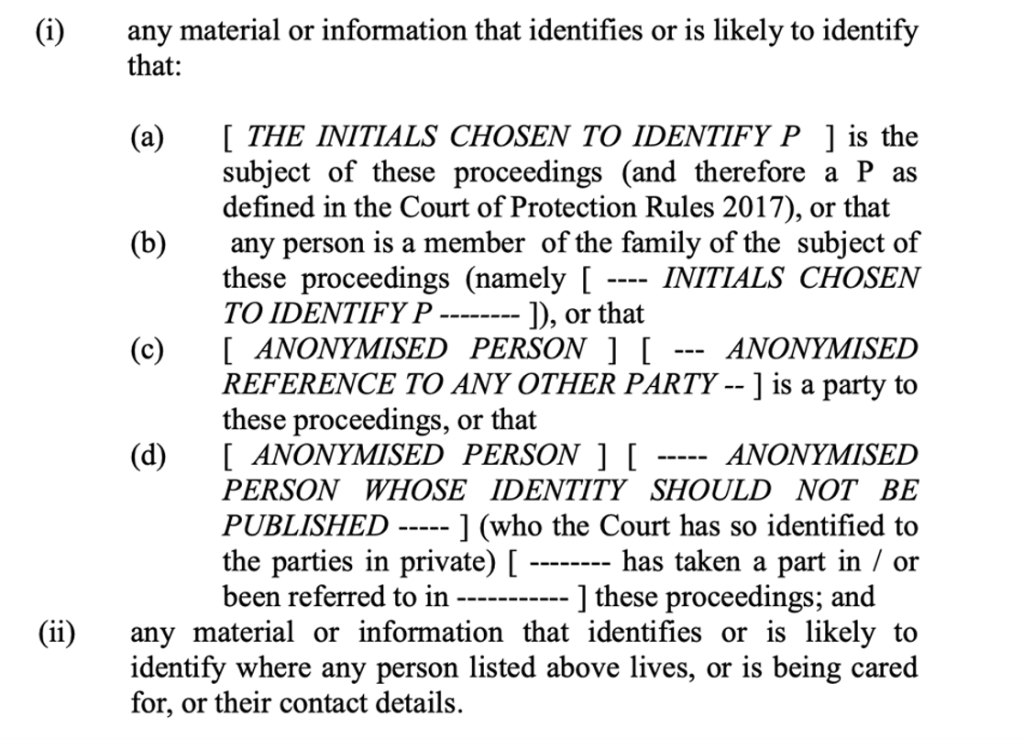
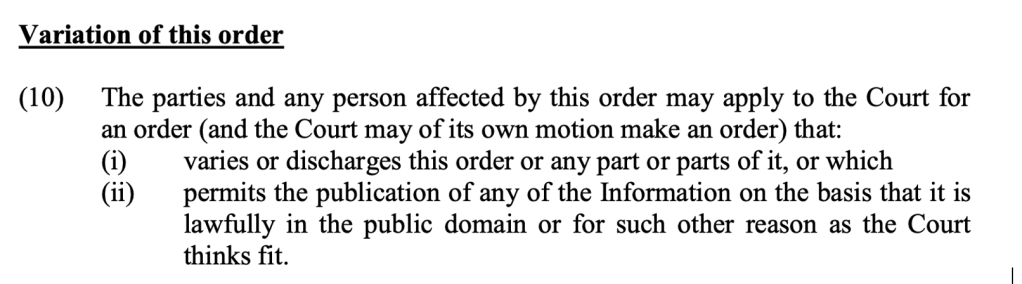
The usual warnings appear on the front page (about being sent to prison and the like) and then the usual statement that it appears to the court that “Practice Direction 4C to the Court of Protection Rules 2017 should tact apply” (I don’t know what “tact” is doing there – I think it’s a typo). Practice Direction 4C is headed “Transparency” and it says that the court will ordinarily make an order that attended hearings “shall be in public” (§2.1.(a)).  

The second page of DJ Bland’s Transparency Order begins like this:

IT IS HEREBY ORDERED that: 

The direction that hearings are to be in public 

(1)  This application be set down for an attended hearing at the Family Court at Lancaster on 11th July 2023 at 2pm with a time estimate of 2 hours at which the Court will consider the following issues:  (a) P’s capacity to make decisions as to contact and care,  (b)  P’s best interests in relation to contact and care 

(2)  Subject to further order of the Court that attended hearing and all further attended hearings of this application are to be in public PROVIDED ALWAYS THAT the Court may exclude from an attended hearing any person (other than a party) on the grounds that it is in the interests of justice to do so (for example if that person refuses a request to sign a document recording their attendance and that they are aware of the terms of this order). 

Wow!  It looked as though this hearing is supposed to be in public – so it should have said so, and I should have been entitled to attend as a member of the public1

And yet it was listed as “IN PRIVATE – NOT OPEN TO THE PUBLIC” and a direct approach to the judge yielded only the information that I could attend if I was an “accredited blogger”.  

I supposed it was possible that DJ Bland had subsequently revoked that Transparency Order, made just over a month ago, and made a new one – and I’d been sent the old one by mistake.  

Or perhaps it was supposed to be in public and the listing was wrong, and the judge had been mistaken in implying that I could attend only in the role of an  “accredited blogger”.

5. Less than an hour before the start of the hearing, I’m told the judge says I can attend – but it’s now too late to get to Lancaster in time

At 13.02, a different member of the court staff from Lancaster sent an email: “Further to previous email correspondence, District Judge Bland says you may attend the hearing at 2pm today”.  

That still doesn’t answer my question as to whether the hearing is “public” (as stated in the Transparency Order I was sent) or whether it is indeed “private” but I was being given some kind of special permission to attend a private hearing (as has happened previously).  

In any case, it was now too late for me to get to Lancaster in time for this hearing.  

I’d already said so in an email I’d sent to everyone involved in this correspondence, and to my contact at His Majesty’s Courts and Tribunal Service (HMCTS) with whom I’ve been raising problems with listings for ages, and which she’s been trying (with mixed success) to address.

My letter to Lancaster County Court staff, Manchester COP Regional Hub staff, and DJ Bland (plus HMCTS)


Thank you for sending me the Transparency Order.

I’m now completely baffled!  The TO seems to have been made by DJ Bland earlier this month [note added for blog: my error – it was last month!] and it has a direction saying that the hearing is to be “in public“. (It also says what the issues before the court are which was another question I was asking and not getting an answer to, and which information should have been included in the listing).

The TO I’ve just received says:

…. the hearings are to be in public
(1) This application be set down for an attended hearing at the Family Court
at Lancaster on 11th July 2023 at 2pm with a time estimate of 2 hours at which the Court will consider the following issues:
(a) P’s capacity to make decisions as to contact and care,
(b) P’s best interests in relation to contact and care

Given this Order, I have the following questions:

(a) Why was a hearing that the judge ordered to be heard in public listed to be heard in private?

(b) Why did DJ Bland say I could attend as an “accredited blogger” (which isn’t a term in use for COP hearings as I understand it, and which in any case is a term that doesn’t apply to me). Surely his order means that I should be able to attend as a member of the public, even though I’m NOT an accredited blogger in Family Court terms.

(c) Why didn’t the listing include the issues before the court?

(d) How can this sort of listing problem (and subsequent confusion) be prevented from happening in future?

Sadly it is now too late for me to get to Penrith for a train that would get me to Lancaster in time to attend this hearing, so this listing error will likely mean that the case is heard effectively “in private” (unless any other members of the public turn up).  This does not support the judicial commitment to transparency.

I’m also personally sad about this since there are relatively few COP hearings I can easily observe in person from rural Cumbria, and this is one I would have liked to have attended.

I hope the concerns I have raised can be addressed.

Reflections

There is some good practice in amongst this chaotic experience.  

The court staff – both at Lancaster and at Manchester – responded promptly and courteously, with as much information as they had access to.  I’m particularly grateful to Manchester court staff for supplying me with the Transparency Order (which I hadn’t thought to ask for, and was very helpful).  

I believe that my contact at HMCTS will take what happened seriously and investigate, and do what she can to prevent it from happening again. She always does.

But the problem, ultimately, is that this will be treated as just another “one-off” experience of the failings of transparency, attributable to particular local contingencies.  

I don’t write a letter to HMCTS, much less a blog post, about each of the transparency failings I experience in trying to get access to COP hearings. It’s tedious to document them, and boring to read.  It takes time I’d far rather spend doing something else.  But, believe me, they are multitudes.

And similar problems are also faced by many other public observers – some of whom come to believe it’s somehow their fault that they can’t get admittance to court, or even that it’s “personal” and someone is trying to prevent their access (especially likely when would-be observers are caught up in their own COP hearings), or that there’s a widespread conspiracy to prevent open justice. This sort of thing is very bad public relations for a court with aspirations for transparency.

Each time I do write a letter expressing concerns about one of the multitude of “one-off” failings like this, I get a courteous and concerned response, expressing regret about the failure and an aspiration for improvements in future. I’m often given some reasons why something went wrong on each occasion: someone who was on leave so their job was done by someone else who needs training; sickness and understaffing in the office; an technology upgrade causing temporary disruption; or once in a while just someone who made a mistake (we’re all human!). And then it happens again. And again. And again.

The cumulative effect of these routine, mundane “one-off” experiences is to erect a virtually impenetrable barrier to transparency in the Court of Protection.  

If the judiciary is serious about transparency, the whole system needs a thorough overhaul. (Yes, I know – where is the money for that going to come from?)

I’m pretty confident it wasn’t a conspiracy to exclude me from the hearing in Lancaster today.  

But the effect is just the same as if it was.

Celia Kitzinger is co-director of the Open Justice Court of Protection Project. She has observed more than 450 hearings since May 2020 and written more than 100 blog posts. She is on LinkedIn (here), and tweets @KitzingerCelia

1 I take the reference to the “Family Court” in the TO at §1 to be a short-hand way of referring to the physical building in Lancaster where the hearing is to take place: it’s formally called ‘Lancaster Civil and Family Court’. This is clearly a COP case, not a Family case.

Restricting family contact, and family ‘abuse’ of staff: An adversarial Court of Protection hearing

By Claire Martin, 11th July 2023

One of the most draconian decisions the Court of Protection can make is to restrict contact between people who love each other and want to be together.  That was the issue in this hearing.  

The Health Board was seeking urgent court authorisation for an extension to an order restricting contact between the protected party at the centre of this case (Laura Wareham[1]) and her parents. In fact, they wished to stop all contact (face-to-face, telephone, FaceTime) for a period of twelve weeks, to ‘aid Laura’s mental health recovery and allow her to be discharged from hospital as soon as possible’ (from Position Statement kindly shared by Emma Sutton, counsel for the Health Board). They also proposed to vet all letters between Laura and her parents.  

As Laura and her parents made clear, they saw this as violation of their human rights – most especially Article 8, respect for their private and family life.  

On the basis of this, and similar, cases it’s clear that, in some future scenario if one of my daughters were to lose capacity to make her own decisions about contact with me, that the Court of Protection could, in theory, declare that I am harmful to her and prevent me from seeing her. That possibility fills me with dread. It’s important for us all to understand how this can happen.

Contact restrictions

The court can restrict contact between the protected party (P) and someone else when P lacks capacity to make their own decisions about that contact and the court decides that having contact with them is not in P’s best interests – even if they desperately want it.

When someone is admitted to a care home, the effect may often be to restrict that person’s contact with family members. This was an issue for many people during the height of the COVID-19 pandemic when people could not travel to see loved ones, and visiting was either banned altogether or severely restricted to video-calls,  ‘window contact’, or short meetings in gardens. The ‘right to family life’ (Article 8 of the Human Rights Act) was one of the most painful casualties of the public health emergency and was contested in court (e.g. “Right to family life in a care home during a pandemic”). The care home a person moves to is sometimes some distance away from the family home, and this too can make visiting difficult (see, for example, “What God has put together, let no man put asunder”).

But sometimes reduced contact is not a ‘side-effect’ but a deliberate court-ordered strategy because contact is declared not in the person’s best interests.  

For example, in one case the court made a final order that there would be no contact at all between P and a man whose companionship she craved – on the grounds that he was exercising coercion and control over her and manipulating her with the intention of securing financial benefits (specifically a ‘predatory marriage’).  

More often, contact is restricted, rather than banned altogether, in the vulnerable person’s best interests. For example, the judge ordered that a wife who was said to be abusive, coercive and controlling of her husband (who has dementia and Parkinson’s) was to have contact with him only by letter or by phone, and that face-to-face contact would be possible only with the prior agreement of the local authority (“Abusive” wife agrees to move out of “the matrimonial home” with continuing (albeit restricted) contact with P: An agreed order).  Similarly, contact between Mrs M (who has dementia) and her son was restricted to supervised contact only, i.e. they can only see each other if a member of staff is present to observe them.  This was ruled to be in Mrs M’s best interests because the judge found that the son was opposed to Mrs M taking her prescribed medication and was persuading her not to do so, and was also “exhibiting challenging behaviours with professionals” which “upset his mum” (see “Conditions on contact between mother and son”).

Applications for restrictions on contact often relate to family members alleged to have been abusive to care staff and professionals, and to have challenged the treatments or care plans in place for their relative.  As one blogger, who found when she read her own sister’s medical records that she had been characterised as “difficult”, “vociferous” and “obsessed with the Mental Capacity Act” (!) wrote: “”family members who have views about a person’s treatment which strongly differ from those of healthcare professionals may sometimes be framed as unreasonable, aggressive or not having their relative’s best interests at heart”.  Sometimes, as in the case she observed and blogged, the outcome of the hearing is that the judge entirely exonerates them and declines to restrict contact.

But contact restrictions are a more common outcome – and of course it can feel to families as though they are being punished for seeking better treatment for their loved one, and that fundamental human rights to family life are being violated.

We’ve blogged several such cases, e.g. a case where a judge ordered that a man could continue to visit his son but that the visit would be ended immediately if he were abusive to staff (here) and a case where a man who was coercive and controlling was prohibited from having direct face-to-face contact with his wife (here).

In another case (one I watched and blogged about myself), a mother was banned from seeing her daughter, who desperately wanted to come home,  because she was a bad influence on her daughter and (the court said) was encouraging her to refuse her medication. (See Medical treatment, undue influence and delayed puberty: A baffling case).

It’s clear from these court decisions that Article 8, which protects your right to respect for your private life, your family life, your home and your correspondence is “qualified” – i.e. the state can interfere with these rights to protect the rights of another person, or the wider public interest. And that’s what happened in this case. 

The hearing

It was an urgent application made by the Health Board, heard (via MS Teams) on Monday 12th June 2023, before Mr Justice Francis (COP 1397774T).  When I joined, there were thirteen people on the link waiting for the hearing to begin. 

The court clerk, at just gone 2 o’clock, said ‘Is everyone here?’ Laura (the protected party) replied ‘I’m here despite best efforts to the contrary’[2]. Her voice was strong and confident. I had read all of the earlier blogs and newspaper articles about Laura’s case[3], and seen her television interview, so I knew that she was very able to speak up for herself.  Her mother called out ‘Love you Laura’.  Laura replied: ‘Love you mum’. 

I knew that it was entirely possible that Laura hadn’t had in-person contact (or had had minimal contact) with her parents prior to this hearing, because Celia Kitzinger’s blog, in February this year, reported that an outstanding issue was ‘whether and how face-to-face contact between Laura and her parents can happen, given that in-person visiting arrangements have been suspended at the request of the Health Board due to her mother’s behaviour towards health care staff’

So, I was aware that the rest of us on the link might have been witnessing the first time that Laura and her parents had seen or spoken to each other for some time. That felt uncomfortable. 

I imagine most of us, the general public, would think that it would never happen that we would be prevented by the state from freely seeing the people we love, who sustain us and who we want to see. I was very interested to observe how the court would deal with this.

Background

Laura Wareham has been in hospital since April 2022. An earlier blog provides this summary: 

“A woman in her 30s [who] has “a hugely complicated medical background”, including a rare inherited disease, and a diagnosis of “autistic spectrum disorder”.  According to Emma Sutton, who represents the applicant Health Board (Betsi Cadwaladr University Health Board), she has “at least 19 different physical conditions”.  The mother said there were far more. In addition to intubation and ventilation, she is receiving treatment for an acute kidney injury and sepsis.”

There have been several hearings for Laura in this contentious case. There is significant dispute between Laura and her parents on the one hand, and the Health Board and social care services on the other. Both the Health Board responsible for Laura’s care and Laura’s father, Conrad Wareham, have been the subject of judicial criticism (by different judges at different times) as reported in September 2022:

“Mr Justice Francis [the judge at the hearing I observed] made no criticism of specialists or the board, but said Dr and Mrs Wareham had been “interfering” with Miss Wareham’s treatment in a way that was “detrimental”.

He said the medical team treating Miss Wareham, who comes from Sheffield and is being cared for at a specialist unit run by the board, was entitled to treat her in the way it thought she should be treated.

Another judge had earlier criticised the board [Betsi Cadwaladr Health Board] after considering a different case, involving a man in his 40s, at another Court of Protection hearing.

Mr Justice Hayden said the man’s needs had been “substantially unaddressed”, “unacknowledged”, “unidentified” and “neglected”.

He said “so much” had gone wrong” and spoke of “substantial and alarming failures”.

P’s voice: ‘I am not being heard’

Judge: Can you hear us?
Laura: I can hear.  I am not being heard, that’s the difference.
Judge: Good, that’s a good start.
Laura: Well, that remains to be seen.

This hearing was peppered with exchanges like this between Laura and the judge. Laura was not happy to have been found to lack capacity to speak for herself and did not accept that she needed a litigation friend (in the form of the legal team provided by the Official Solicitor). ‘It would be much simpler if I could just speak for myself’ she said. 

Because Laura has been found to lack capacity to litigate this case, she is represented by the Official Solicitor, which means her ‘best interests’ (as the Official Solicitor sees them) are represented – but Laura herself is not represented in the way that legal teams usually represent their clients (see “Litigation friends or foes: Representation of P before the Court of Protection”).   Any of us could be in this situation – if a judge deems us not to have capacity to conduct litigation. Then it is down to someone else to argue what they see as our best interests – which might or might not align with our own views. That’s quite a scary prospect to me. 

And it presents the court with a tricky situation when P is in court, and when they can and do speak up for themselves and when their own view is different from that of “their” lawyer.  It was clear that Laura very much wanted to be heard in her own right. 

I have observed several hearings when P was in court. At this hearing I observed, with a woman who had ‘cognitive impairment’, the judge made a lot of time for her voice to be heard, even thought she had legal representation. That was not the case at this hearing. 

Several times, Francis J said ‘We need to do it in turn, you will be heard I promise you.’ Adding at times, ‘I can mute the sound but I don’t want to do that’. However, Laura didn’t really get ‘a turn’

On a couple of occasions, when the judge let her speak, the focus quickly diverted to someone else, like in this exchange: 

Laura: I have had my hand up [Laura’s ‘digital’ hand was up throughout the hearing] …. Nothing about me without me.
Judge: I will give you your turn in a moment. …. 

[Judge finished talking to counsel]

Judge: [to Laura] I can see you want to speak – don’t forget you are represented…
Laura: No, I am not. So far, it’s a breach of my human rights.

Judge: Which?

Laura: Freedom of expression, and religious belief, psychological torture. 
Judge: Which religious right? 
Laura: Freedom to pray with chosen people. 
Judge: Let me go back to Mr Fernando

The ‘turn’ did not return to Laura. 

I had wondered whether it might have been helpful, at the start, for Laura to know when she would be invited to speak in proceedings. I kept wondering when it would be her ‘turn’, and feeling anxious that her turn seemed to be like jam tomorrow. 

Laura is autistic and it might have been reasonable to operate on the basis that some predictability could be helpful for her.  At the same time, I could see that Laura wanted to speak at all times (with her virtual hand up throughout the hearing) – though this could have been because she didn’t know when she would be allowed to speak. 

Why is contact between Laura and her parents being restricted? 

The reason for this application, says the Health Board (represented by Emma Sutton), is because contact with her parents causes Laura to become very distressed and violent (for example, damaging property at the hospital, such as punching holes in walls, or staff ending up with their glasses broken). Following telephone contact with her mother recently, Laura had been detained under the Mental Health Act, and moved to a psychiatric ward for a period of time. 

The Health Board also reports that Erica Wareham (Laura’s mother) has been ‘verbally abusive to a treating nurse’, though I don’t know the details of that allegation. 

Laura (represented, via the Official Solicitor, by Grainne Mellon) and her parents (represented by Pravin Fernando) vociferously oppose this application, and, as I will report, contend that the Health Board and hospital staff’s allegations are ‘factually inaccurate’ and that ‘correlation is not causation’

There are likely to be many issues of which I am unaware in this complex case, on all sides. I have had the benefit of being able to read the Health Board’s and Laura’s parents’ Position Statements prior to writing this blog, and would have liked to have read the Position Statement for Laura. I requested it from Laura’s counsel, but have not received it. This might mean that this blog is biased or misses important information, and I will do my best to reflect the hearing accurately, as well as reflect upon my own responses to that hearing, from my perspective as an observer, parent and NHS worker. 

The Health Board’s position was supported by an independent expert psychiatrist (Dr Camden Smith), who assessed that Laura’s parents ‘contribute to her help-seeking behaviour’ and that, ‘on a balance of probabilities, Laura’s parents’ behaviour has a negative impact on her’. 

Laura’s parents’ position statement states that Dr Camden-Smith only met Laura on one occasion. They challenge the conclusions reached as ‘reductive’ and note that Dr Camden-Smith was not going to be present at the hearing to have her conclusions scrutinised by the court. Moreover, they have not seen Laura in-person since November 2022, and have had no contact at all since 7th May 2023. 

However, the Health Board was, Emma Sutton said: “… asking for a pause in terms of face-to-face contact. The Health Board is aware that there needs to be a careful approach. There needs to be some outside help – Dr Camden-Smith is an expert in autism and mental health and can give us a toolbox. We need to instruct an expert to help move this forward”.

My understanding, from that piece of information, is that the Health Board was suggesting that (after Laura has already spent 14 months as an inpatient) there is a need for an independent expert in autism and mental health to assist the hospital with how they care for Laura. And that this assessment needs to be conducted in the absence of any contact or involvement from Laura’s parents. I wasn’t sure what was proposed to happen with Laura’s care during the no-contact period that would ‘move this forward’ as the details weren’t discussed. 

I don’t know all of the contentions made about Laura’s parents’ behaviour (or the details of the ones mentioned in the hearing) and cannot know whether what the Health Board says, or what Laura’s parents say, is accurate. 

However, what I could see in the hearing is that Laura herself wants contact with her parents, and appears very distressed that she does not have this contact. Given that distressing Laura is what the Health Board says it is trying to avoid, I felt dubious about the likely success of an expert engaging Laura under these conditions. 

Laura’s counsel, Grainne Mellon said ‘we want to agree a less restrictive form of contact – no more than four to five weeks.’ She mentioned needing to see a ‘clinical plan’, and Pravin Fernando said:

The application is for 12 weeks [and] was said to be required for a period of reablement. The Health Board provides no rationale or plan as to what that would look like. You are being invited to restrict contact entirely without a plan – we don’t know anything.”

It wasn’t clear, at all, what the treatment plan was from the Health Board that necessitated the total absence of Laura’s parents from her life in order to be successful (i.e. to end up with discharge). It seemed as though there might be two reasons for the Health Board’s request: the parents’ behaviour towards staff at the hospital (described as, at times, ‘abusive’) and, more directly, potential ‘harm’ to Laura, as suggested by the expert witness in the form of ‘contributing to [Laura’s] help-seeking behaviour’ and the judge as ‘… to put it bluntly, her mother is winding her up’. 

As I said, I don’t know the details of incidents presented as evidence of harm, either to the health care staff or to Laura. The Health Board, expert witness and judge were all observing a link between contact with her parents and Laura’s distress being exacerbated. I assume evidence was provided in the bundle (which I could not see). 

Reflections on ‘abuse’ of NHS staff

This is a situation where balancing of the costs and benefits of contact is required. This is the first hearing I have observed for this case. I am new to the situation, and know a lot less than the Warehams and the services involved.

I have worked in the NHS for 30 years though. The NHS Staff Survey in 2021 reported:

14.3% of NHS staff have experienced at least one incident of physical violence from patients, service users, relatives or other members of the public in the last 12 months”.

Collins English Dictionary definition of abuse is “extremely rude and insulting things that people say when they are angry” and “cruel and violent treatment”. In relation to workplace abuse, the Royal College of Nursing says:

The RCN supports the Health and Safety Executive’s definition of work-related violence as any incident in which a person is abused, threatened or assaulted in circumstances relating to their work.  This can include verbal abuse or threats as well as physical attacks (Health and Safety Executive 2021). The RCN acknowledges that in health and social care, the approach to tackling work-related violence is nuanced and that ways of reducing the risk of harm to staff may vary in different clinical environments and with different client groups.”

NHS organisations often have a ‘zero-tolerance’ policy in relation to abuse and violence. And of course, it is completely unacceptable to be subject to ‘abuse’ in your place of work. 

I sometimes think that the definition of ‘abuse’ can be quite wide, however. If, for example, a patient or family member raises their voice or shouts because they are frustrated or upset with the service or member of staff, is this always ‘abuse’? Discounting physical assault and discriminatory verbal attack, the interpretation of a person’s behaviour as ‘abusive’ can, I think, be in the eye of the beholder, as well as (or instead of) an objectively observable fact. 

I am not expressing a view one way or another about Laura’s mother’s behaviour. I do not know what she did. I don’t know how people responded to her. I am expressing a view as a person first, and as a long-serving NHS clinician second. 

What I am suggesting is that responses to others’ behaviour can vastly differ. I have seen this myself, time and again, working in mental health services in the NHS. My own (sometimes inner) responses vary, depending upon what is going on for me that day or at that time in my life. 

Sometimes people are upset. Sometimes that is because they are receiving a terrible service. Sometimes the service is fine but they are frantic with worry about someone that they love and the usual social niceties go out of the window. Sometimes, it is because they might anyway lack the emotional, social and communication skills to address what is upsetting them. Sometimes, health care staff bring their own ways of responding to challenging situations, which might or might not be helpful. It’s complex. 

I have witnessed occasions where patients’ and relatives’ behaviour has tipped into verbal or physical threat – and witnessed times when the NHS ‘system’ or individual staff response to people could have been significantly better. Some NHS staff (especially ambulance staff) are at regular, high risk of assault, just because of the area that they work in. This report details the rise in violence towards NHS staff, especially during and since the pandemic. 

Both things can be true – that abuse does happen to NHS staff, and that others’ behaviour is sometimes framed as ‘abuse’ when it is not, really. 

The RCN’s acknowledgement of ‘nuance’ is helpful. Sometimes things are in that grey area. Sometimes I think staff can adopt what they think is ‘zero tolerance’ when more ‘nuance’ is called for. For example, I have seen entries in patients’ notes which have caused me some concern. One entry stating that X ‘raised their voice’and the health worker recorded that they told the patient ‘I am not here to be abused’. Context is important. What was the person raising their voice about? Could their distress/anger/raised voice be understood differently, other than as ‘abuse’? That particular example was the wife of a man living with dementia who (reading through all of her notes) seemed simply at the end of her tether. 

I have been on the receiving end of people’s anger, frustration and distress. It’s never pleasant, but it is not always ‘abuse’. I am not talking about anything physical here – nor minimising the impact of verbal attack. I am saying that how we all communicate with one another is complex and nuanced. Often, just by virtue of being in receipt of healthcare, patients and relatives are subject to a power dynamic that already places them in a vulnerable position. Sometimes, it could be helpful to try to understand this relational complexity, and to see ourselves as part of the dialogical pattern that might contribute to their ‘behaviour’. It’s a difficult area, and I am in no way suggesting that discriminatory verbal or physical abuse should be tolerated or ignored. 

I had a quick look at policies to protect staff from abuse in the NHS. This one, referencing zero-tolerance, says:  “Staff should not be left upset and distressed following an interaction with a patient”. That feels like an impossible target to achieve. The same interaction could upset some people and not others. This aspiration also places the emphasis on how staff should have a right to feel, rather than an objective measure of acceptable and unacceptable actions from others. I think this target runs the risk of all staff thinking that they are entitled not to be upset! How can that be helpful for those areas of ‘nuance’?

Final Submissions and Judgment

There had been an adjournment in the hearing for counsel to confer to see if they could reach a compromise position. The judge also had two other hearings waiting and had been frank that this hearing had not been listed for long enough, and he had not been given sufficient reading time. 

When I rejoined the link, I could see that Erica Wareham was crying and Laura was also crying and wiping her eyes. They were mouthing and gesturing to each other. It was quite difficult to witness and I was fully aware that they knew everyone could see them when they might be feeling very vulnerable, yet this was their only means of contact at the moment. Erica Wareham was also talking to her husband animatedly. Conrad Wareham was sitting back in his chair (and had been throughout the hearing) looking thoroughly fed up, whereas Erica Wareham was often leaning into the screen, and sometimes seemed to be shouting (though on mute). 

The plan that the advocates had agreed, and asked the judge to order, was for half an hour contact per week between Laura and her parents, via MS Teams, on the basis that it would be recorded and transcribed. This was to ensure that communication remained, in the view of the Health Service, ‘appropriate’ – again a position firmly challenged by Laura’s parents. 

“The court will recall that Dr and Mrs Wareham have not had any contact with Laura since 7 May 2023 so how does the Health Board attribute Laura’s ongoing fluctuating negative presentation to Dr and Mrs Wareham? The Health Board attributes too much responsibility to Dr and Mrs Wareham for Laura’s presentation, rather than consider that her personality and behaviour is a manifestation of her.” Laura’s parents’ Position Statement (kindly shared)

Certain topics were not to be discussed between family members.  Emma Sutton proposed that ‘if Erica Wareham and Conrad Wareham start talking about the proceedings or if they do not redirect when medical issues or controversial issues are raised, the Teams call will be terminated’

Contact would be increased to one hour per week, if all went as agreed. 

Then counsel for the parents raised what must have been a difficult topic:

Counsel for Parents: There is one last issue to raise. I am instructed to request – to find an alternative Tier 3 judge to preside over this matter. I am in an invidious position. Some orders you have made and recitals you have made reflecting your opinion – they are of the view that you have taken a specific stance on their conduct and way of engaging that is likely to impact the way future decisions are made, particularly in the context of specific things from today like neurodiversity and Mrs Wareham’s autism. Their preference would be for another Tier 3 judge to look at this with fresh eyes.

Judge: Thank you for the tactful way you have done this. What is the timescale? Have we got a final hearing set down yet?  [after discussion about court and judge availability] What I will say – effectively this is an invitation to recuse myself – I will do the next hearing and if you are going to make an application for me to recuse myself, set it out with the reasons. If the judge has lost the respect of parties, that’s one thing. On the other hand parties can’t just request a different judge when they want. I will hear it at the next hearing. A whole day, certainly half a day at least – effectively today your one hour has become half a day.

Laura: It may be a day for you but it’s over a year of my life that’s been stolen.

Pravin Fernando submitted that the Health Board’s treatment of Mrs Wareham was ‘indirect disability discrimination’ due to her autism. The judge noted:  

I am aware that Mrs Wareham … it has been said has her own things that need to be protected. I have talked about the Local Authority owing her a duty – the Wellbeing Wales Act – I have to pay extra attention to make sure that if Mrs Wareham is suffering from any condition that she is protected by [the court].”

In his judgment, Francis J said that he would ‘adopt the Trust’s position for the next few weeks’, i.e. no face-to-face contact between Laura and her parents.  His reasoning was that, if in-person contact were to be allowed then the parents “inadvertently or intentionally, will wind Laura up and create a situation akin to the one before”.  He authorised the MS Teams contact (to be recorded).

Francis J acknowledged that Laura’s own position was not that taken by the Official Solicitor, and that the reason the court was sitting was because Laura ‘lacked capacity to make her own decisions”.  Laura and her mother were visibly upset and Laura continued to speak out: “I do not lack capacity.  I will not be silenced – nothing about me without me – please stop telling people to mute me.

The judge left the link.

Laura: ‘I love you mum and dad. (Crying) You don’t respect my human rights.

Laura was still shouting out as the line was disconnected. 

Draconian Decisions 

Clearly, preventing family members from having contact with one another is a very serious decision to make and it’s hard to watch the distress it causes protected parties and their families in court.  This hearing for Laura was an acute example of such an awful situation. That does not necessarily mean the decision is not justified. 

I don’t have access to more detailed views of Laura. The phrase ‘correlation is not causation’ was said several times, both by Laura and by her mother. I took that to mean that they acknowledged that Laura might be upset after contact with her mother (at one point Laura said she’d had a ‘meltdown’) but that it wasn’t the case that the contact caused the distress, or that stopping contact would lead to improvements for Laura. 

Pravin Fernando, counsel for the parents, cast doubt on even the correlation, describing what he thought was a ‘troubling’ lack of evidence from the Health Board that Laura’s behaviour had improved following no contact with her parents. Emma Sutton firmly disputed this and evidenced several citations in the bundle from the medical director of the hospital. 

I was left with a sense of niggling anxiety after this hearing. I think that was about what seemed like a lack of an exit plan (perhaps that will come) and a family and system at absolute loggerheads. Observing Laura, I could see that she is very unlikely to join in with a care plan recommended by an expert in autism to ‘move things forward’, knowing full well that this care plan is predicated on the absence of contact with her parents. Especially, perhaps, a care plan based on that expert’s advice to remove Laura’s parents from the picture entirely (albeit for a period of time). There seems to be an impasse, that I wasn’t convinced would be resolved by adopting the Trust’s position for a few weeks. Maybe the interim judgment wasn’t designed for that. Pravin Fernando is considering an application to instruct (perhaps jointly) an independent expert, which could offer a way forward. 

The next hearing (also before Francis J) is likely to be mid-July 2023.

Claire Martin is a Consultant Clinical Psychologist, Cumbria, Northumberland, Tyne and Wear NHS Foundation Trust, Older People’s Clinical Psychology Department, Gateshead. She is a member of the core group of the Open Justice Court of Protection Project and has published several blog posts for the Project about hearings she’s observed (e.g. here and here). She tweets @DocCMartin


[1] The Transparency Order permits us to name Laura Wareham (and her parents, Conrad Wareham and Erica Wareham) but not the hospital where she is being treated, or any of the professionals involved in her care.  

[2] All quotations are based on contemporaneous notes and are as accurate as I can make them, given that we are not allowed to audio-record court hearings. They are unlikely to be 100% verbatim.

[3] ‘I am fearful for my daughter’s life: serious medical treatment in a contentious case’‘Stand-off about the appropriate expert: a pragmatic judicial solution’‘Judge criticises consultant concerned about how doctors are treating his daughter at Welsh Health Board’‘Retired nurse tells judge her daughter is not safe in Betsi Cadwaladr Health Board hospital’‘Rotherham woman with rare condition steps up life-changing surgery campaign’

Removing P to another country to evade the orders of the Court

By Celia Kitzinger, 9th July 2023

If you believe the authorities are acting against the best interests of your vulnerable relative, you might contemplate escaping with them to another country, in the hope of taking the person outside the reach of the Court of Protection.  I often hear conversations about this.  

For most people it isn’t really practical, but sometimes – especially when people have family members living abroad – they find a way to put that plan into effect.  That’s what seems to have happened in this case.  

The mother has taken her 21-year-old daughter – I’ll call her Miranda – to Jamaica.  One of Miranda’s two (adult) sisters has travelled out to Jamaica with them. 

They flew out of the country on the very day that the Local Authority was due to remove Miranda from the family home in England, following a court order authorising this for the purposes of carrying out assessments.  

Her mother has taken Miranda away “seemingly to evade the involvement of social care professionals”, says the Official Solicitor.  

According to Miranda’s father, who’s still living in the family home along with Miranda’s other sister, the family has been “harassed by our neighbours, the police and social services in a way that we as a family consider to be racially motivated, hostile and distressing”.  He says that the experience has been “traumatic and destabilising” for Miranda, who has autism, a learning disability and is largely non-verbal.  

Miranda has lived with her parents all her life and her father says they “have a good ability to communicate with her and manage her behaviours triggered by her autism”.  He says Miranda is being “well looked after” and is “safe and well” in Jamaica, “enjoying the sun and being around family”.  He has not provided the professionals (or the court) with an address in Jamaica where Miranda is currently living, and says that he doesn’t have his wife’s consent to share her telephone number.

Miranda’s father hopes that his wife and daughters will return to the UK soon, but they won’t (he says) be returning to the family home.  He’s placed their current property on the market and hopes to buy another house in London enabling the family to start a new working relationship with another local authority, in an area where there is a more diverse community.  

He doesn’t think it’s in Miranda’s best interests to return to the current home, or for Miranda to be assessed by social workers within their current local authority, since that relationship has broken down.  

The father says that, if necessary, they will rent a property in London, or stay temporarily in a hotel while they sell their current home and find another – and an assessment could take place at the temporary accommodation.  He says that the plan is for Miranda and her mother to return to the UK by the end of July 2023.

The case has been heard several times in the regional court by HHJ Hodges. That judge recently transferred the case to a Tier 3 judge (the most senior in the Court of Protection). 

This was the first hearing in the case (COP 14027239) that I’ve observed. It was before Sir Jonathan Cohen on 8th June 2023.  It was listed to consider the issue of Miranda’s return to the UK and what steps are necessary now. 

The parties

  • The applicant Local Authority (Essex County Council) was represented by Rachel Sullivan of 39 Essex Chambers.  
  • Miranda, the protected party at the centre of the case, is the first respondent, represented via her litigation friend, the Official Solicitor, by Varsha Jagadesham of No. 5 Chambers.
  • Miranda’s mother is the second respondent. She was not in court and was not represented.
  • Miranda’s father is the third respondent.  He was represented by Rose Harvey-Sullivan of 7BR.

The hearing was held via video-link (MS Teams).  

I was sent a Transparency Order shortly after the hearing, and it was in the “standard” format. This means that I am not allowed to publish any information that identifies, or is likely to identify, that Miranda is the subject of these proceedings, or anything likely to identify her parents or any other members of the family, where any of them lives, or is being cared for, or their contact details.

Background

The Local Authority entirely rejects any allegations that it has harassed the family or treated them differently on the basis of race or any other protected characteristic.  The Local Authority has been concerned, it says, only to ensure that Miranda’s needs can be assessed (in accordance with the Care Act 2014), so that appropriate care and support can be provided for her.  They want Miranda to be returned to England as soon as possible for assessment.

Until recently, Miranda was living at home in England, but there had been a long gap without her having been seen by professionals.  Two school placements at Special Educational Needs schools broke down in 2013 and 2014 due to “behaviours that challenge” and the family had decided on home education.  The most recent assessment seems to have been in 2016. It recorded that Miranda had a diagnosis of autism, ADHD and behavioural difficulties with limited communication skills.  The parents seem not to have engaged with professionals since then. They’ve not answered the door, the letterbox is sealed up, and there’s a notice telling professionals not to trespass on the property.  Recent visits between September and the end of December last year, were unsuccessful in that either professionals couldn’t gain access or – when accompanied by the police who used their powers to enter the property – Miranda was asleep and could not be roused.

On 11 January 2023 the court made an order that Miranda should not be moved from the family home without giving the Local Authority and the Official Solicitor a week’s notice.

On 3 February 2023, the court made an order authorising the Local Authority to remove Miranda from the family home for the purposes of carrying out various assessments.  

But when they arrived a few days later, she wasn’t there – and they learned that Miranda, her sister and her mother had left the country on a flight to Jamaica earlier the same day.

The Local Authority maintains – and nobody disagrees-  that as Miranda is “habitually resident” in England, the court retains jurisdictional authority, even though she is currently out of the country and living under a different jurisdiction (Re O [2013] EWHC 3932).

The hearing

The key difference between the parties is whether there should be a court order (with a penal notice) right now compelling her mother to return Miranda to England (which is that the Official Solicitor wants) or whether, as the Local Authority would prefer, the court waits for a couple of weeks to give the family a final chance to cooperate (and there’s no penal notice).

The parties agree that if the mother returns Miranda to the family home, she will not be arrested for breaching court orders, and Miranda will not be taken into care for assessment, but will be assessed in the family home.  

At the beginning of the hearing, the judge asked “What is the position with the mother? Has she been sent a link to this hearing?”.  Counsel for the applicant Local Authority said she wasn’t sure, and the judge said sternly, “Well, you need to tell me”. (As usual, since we are not allowed to audio-record court hearings, my quotations from the hearing are as accurate as they can be, based on contemporaneous touch-typed notes, but are unlikely to be 100% verbatim.)

It turned out that counsel for Miranda’s father had some information about that.  “I’ve sent the hearing link to my client, and invited him to forward it to [Miranda’s mother] so it has been made available.  But my understanding is that she is not able to join due to the time difference. It’s 4.30 in the morning where she is, in Jamaica.  If hearings could be in the afternoon in future, that would be helpful.”

The judge didn’t seem very impressed by this explanation as to why the mother wasn’t present.  He referred to “the mother’s statement” which “doesn’t give one much cause for encouragement”.  What the judge later called, with some exasperation “her in-inverted-commas application” for the case to be dismissed was adjourned in the circumstances of her non-attendance, with the opportunity to address it at the next hearing. It was, the judge said  “totally without merit”.

The Local Authority

The Local Authority wants the court to make directions requiring Miranda’s parents to tell them when Miranda will return, and where she’ll live, and to authorise an assessment of her.  I think they were not yet asking for a court order mandating Miranda’s return.  Counsel for the Local Authority said: “Returning her through coercive court orders is likely to take many months.  If it is possible for her to return via a process of cooperation with the family, the Local Authority is keen to do that”.  

The judge asked: ‘Has the statement of the mother from last night caused the Local Authority to revise its position?

Counsel for the local authority replied “On Friday, our understanding was that she intended to return, but the statement she’s filed doesn’t seem wholly consistent – or indeed, at all consistent – with that.  However, we would like to give the family one last chance, as it were, to cooperate”.   I think they were suggesting a 2-week period during which the family should have the opportunity to cooperate by returning Miranda to England without actually yet being ordered to do so.  This contrasts, I understand, with the position of the Official Solicitor which is that there should be no further delay in ordering Miranda’s return.

It seems to be agreed the relationship between the Local Authority and the family has broken down, and that Miranda’s assessment will need to be carried out by an independent social worker (ISW) – so the Local Authority wants the court to authorise the appointment of an ISW.  The ISW will be asked to consider Miranda’s capacity for decision-making about residence, care and litigation, her support needs, how any identified needs could best be met, and whether they recommend referral to other services (e.g. speech and language therapy, occupational therapy). The parties would need to identify a suitable expert, and agree a letter of instruction: they want the judge to approve the instruction of the expert “on the papers” (i.e. without coming back to court in person) once they’ve done that.

The judge expressed some concern that the Local Authority was “asking for an elongated process”, to which counsel for the Local Authority replied: “The Local Authority’s concern is that having finally got some cooperation with the family, they don’t want to jeopardise the relationship with the family.  The orders are perceived by the family as quite draconian. The Local Authority would prefer a cooperative approach – and then if that doesn’t work, only then adopt the approach of the Official Solicitor.”

Counsel for Miranda via the Official Solicitor

The Official Solicitor invited the court to make orders that the mother should return Miranda to England by 7th July 2023, with a penal notice attached to that order –  meaning that she’d be in contempt of court, and liable for a prison sentence, if she did not comply.  The Official Solicitor also wanted an order that Miranda must live in the family home for the time being – and does not believe that it can be in her interest to live in temporary accommodation.  

The OS is also asking for permission to require the Civil Aviation Authority to inform the Local Authority about whether Miranda and her mother travel on the flight allegedly booked for them, and for permission to the UK Border Force to inform the Local Authority, the local police force and the airport police when they enter the country.  They want her passport confiscated and an order that she’s not to be moved from the home (or the country) again.

The OS wants permission to instruct a legal expert about the legal framework in Jamaica for the protection of vulnerable individuals, and/or individuals who lack capacity to make decisions, and whether or how the Jamaican courts can assist, plus permission for the Local Authority to liaise with the British High Commission in Jamaica regarding a welfare check being carried out on Miranda immediately by an international social worker.

Finally, the OS wants the court to order Miranda’s father – with a penal notice attached – to provide the mother’s telephone number, the name of the place where he believes she and Miranda are staying, contact details for the mother’s brothers (believed to live in London) and contact details for her relatives who live in Jamaica.

OS:  We do seek orders today for Miranda’s return to the jurisdiction. It’s over four months now since she was taken out of the jurisdiction. In that time there have been steps taken between the Local Authority, the OS, and the parents, seeking a compromise whereby Miranda could be returned.  We are not much further on. Following HHJ Hodge’s order, [the father] did provide a statement-

Judge: Devoid of any useful information.

OS: There is no witness statement from [the mother] in the terms the court directed.  Instead, we have an application from her which has very little to say – in fact, has nothing to say – about a return to this jurisdiction.

Judge: It’s an unissued application to set aside the court’s order on the basis that it is void, in breach of natural justice and, uhm…. I have to say with reference to Latin legal maxims and the Magna Carta and historical cases and the rights of indigenous peoples and it doesn’t begin to address any of the matters that arise in this case.

OS: So, we are seeing a continuing lack of engagement, and potentially an attempt to evade the orders of this court.  

Counsel for Miranda’s father

Counsel for Miranda’s father seemed taken aback by the ‘hard line’ approach of the Official Solicitor, saying that the father had understood that everyone would be working together to encourage collegiality and he was “very disappointed to receive the U-turn position from the Official Solicitor” which had apparently arrived via their Position Statement after 4pm the day before.

Counsel pointed out that – although she didn’t represent the mother –  the mother was a litigant-in-person, in a different time zone and that it would “improper” and “unfair” to make the orders requested by the OS against an unrepresented party.

The judge didn’t seem very sympathetic to this line of argument.  “It seems to me pretty obvious that an order needs to be made for Miranda’s return”. 

Judge: Are you opposing an order that they should return.

Counsel: My client’s position is that he is expecting his wife and daughters to return in July.

Judge:  Answer my question please.

Counsel:  My client is not here.  We oppose any order with a penal notice. It’s too heavy-handed.  If an order were to be made, it should be for Miranda’s return by the end of July, as discussed at the RTM. I am aware that I am avoiding the court’s direct question, but I don’t have specific instructions on that point.  In terms of the other orders, we request removal of any reference to my client being required to provide details of where [the mother] is living or the contact details of [the mother’s] relatives. This would be an order that drives a wedge between husband and wife. It is heavy-handed and short-sighted.

Judge: But he’s the father of a daughter who is not getting the help she ought to be receiving.

Counsel: On a practical level, orders of that nature will not yield results. There needs to be a realistic pragmatism applied by the court and a move towards trying to remove as much draconian language as we can.  

Counsel also suggested the need for “carrot” as well as “stick” – recommending, for example,  that the mother should be reassured that “nobody is seeking an arrest of the mother and the family will not be separated on her return”. 

The judge’s decisions

Judge:  I don’t want to get too far into the detail of the order. Dealing piecemeal with detail is not appropriate at the moment. But I am quite clear that I need to make an order for the return of Miranda to England and Wales, and I do so of course against the background that Miranda has had a very long involvement with social care professionals in order to meet her very considerable needs, which are a combination of autism, ADHD and learning difficulties.  It is clear from the history that the parental engagement in the care that has been provided has not always been consistent.  I cannot overlook that at the time the mother removed Miranda to Jamaica on 6th February, there was an order specifically requiring that Miranda was not to be removed from her home, and that order was plainly breached.  And here we are now, four months later, and I agree with the Official Solicitor there has been minimal progress in planning for Miranda’s return to England.  And the mother’s statement, which was meant to deal with her plans for Miranda’s return, and Miranda’s current living conditions, is conspicuously devoid of any such content at all.  It is a long exegesis on the rights of indigenous peoples, replete with refs to Magna Carta and Latin legal maxims, and devoid of anything about the young adult with whom the court is concerned.  The father’s statement is more of a hand-wringing nature. It tells me next to nothing about Miranda’s circumstances.  Only that she is somewhere in Jamaica with her mother.  After this long period of time, and what seems to me to be only superficial cooperation between the parents and the Local Authority, it is now time to make an order for Miranda’s return, and that is the order I intend to make.  I do not ignore the point made by Ms Harvey-Sullivan (counsel for the father) that the parents need to be given something of a carrot. That seems to be provided in two ways.  First by a recital that, provided they engage with the assessment of Miranda by the independent social worker,  no party is seeking at the current time for Miranda to be removed from family care.  Secondly, I think it is proper to say that the mother should not be arrested upon her return to England, but I suspect there may be a proviso that she lodge her passport or hand it in to the tipstaff or immigration authorities on arrival – because we cannot have a repeat of this situation again. These are the steps it seems to me need to be taken so that the assessment can begin to take place.  Against that backdrop, I need to look at the terms of the order.  It is right and proper for [the father], who is in this jurisdiction, to be ordered to provide a document with the address where his daughter, with whom the court is so concerned, is living in Jamaica, and with whom, and to provide details with appropriate documentary support of the sale of the family home and its timetable. I am not concerned with what its price is, but I want to know for how long the family home is going to be maintained.  And I suppose I will add, confirmation of the precise date when Miranda will return to England.

As the judge went through the order, counsel for the father pointed out  (“respectfully”) some of the “blunt language” that she said was “spooking” the mother and that the mother was experiencing as a “threat”.  Mostly the judge accepted the suggested changes – including adding, at the end of the recitals, that no party was seeking for the mother to be arrested on her return.  I think he also did not make any penal notices: “I can’t imagine the existence of a penal notice will make one of them say, ‘oh my goodness me, I’m going to have to completely change my behaviour’!

He did decide, though, that Miranda should live in the family home until it’s sold because temporary accommodation was not likely to be in her best interests.

I haven’t seen the final order and I’m not sure which of the other proposed directions were included in it.  I think there was some provision for removing the mother’s and Miranda’s passport.

The judge said the next hearing would be an in-person hearing, and that the parents must attend in person.

Reflections

Given how often I hear family members reflecting on the possibility of leaving the country to evade the rulings of the Court of Protection, I was curious to see what other cases I could find involving moving the protected party (P) across international boundaries.  

The Court of Protection has jurisdiction to keep  people in (or return people to) England and Wales if that’s where the person is “habitually resident” (which can be different from where they own a house or where they are domiciled).  In Re Clarke [2016] EWHC 2151, Anna Clarke was abroad with her son. Two of Mrs Clarke’s other children believed their mother should be cared for in England, and that the other son had “hijacked” her.  They applied to court seeking orders that she should be returned from Spain.  Although she had a house in Blackpool, she’d spent a lot of time abroad with the other son over the last few years  – for some months in Thailand, and often for long periods in Spain.  As a result, the court wasn’t sure whether or not she was “habitually resident” in England and Wales.  But the judge found that even if she wasn’t he could invoke the “inherent jurisdiction” of the High Court, which has the ability to make orders for the protection of vulnerable individuals on the basis of their British citizenship, even if they’re not “habitually resident” in England or Wales.  (The case law the judge cited to support this was  Al-Jeffery [2016] EWHC 2151 (Fam)).  

The Open Justice Court of Protection Project covered a different family dispute – between two daughters – about whether the protected party should live in England or overseas with the other daughter (see A mother abroad and a family dispute Part 1 and A mother abroad and a family dispute – Part 2). In that case, the mother was returned fairly promptly.

Sometimes the court is involved in making decisions for people who are “habitually resident” in England and Wales but are not British. In one recent case, the protected party was an Irish National (Can P return to Ireland?and in another she was a Pakistani national (“At loggerheads”).

It seems the court is most likely to authorise a protected party to live in another country if the protected party herself wants to do this.  We’ve blogged several  cases where the protected party expressed the strong wish to live in another country (e.g. Should P go to live with her family in her country of birth?).  The court is concerned to check that those caring for the protected party are able to demonstrate that the protected party’s health will not be adversely affected by travel and that there are plans in place to ensure that a they receive any necessary care, but is likely under these circumstances to authorise the move (Re UR: Derby City Council v NHS Derby and Derbyshire CCG [2021] EWCOP 10; blogged as Returning P to her family abroad during a global pandemic).  

Sometimes the court makes orders that a protected party is not to travel abroad precisely because the reason for the travel is seen as harming them.  For example, there are often court orders that P may not be taken abroad due to concerns about forced marriage (e.g. Forced Marriage Protection Order). In another case, the judge ruled that it was not in P’s best interests to continue to receive life-sustaining treatment (his wife agreed).   So when his birth family, who lived in Poland, lobbied the Polish government who then offered to pay for an air ambulance to take P back to Poland where he would receive free life-sustaining treatment, the court declined the offer (Re RS [2020] EWCOP 69).

It doesn’t seem to be very common for family members to flout court orders by taking their relatives abroad, or not to return them to England when ordered to do so.  One such case concerned Teresa Kirk, the 71-year-old grandmother “jailed by a secret court” (as the Daily Mail put it) because she refused to comply with the court’s order to return her elderly brother, Manuel Martins (MM), who had dementia . to England from a care home in Portugal in which she had placed him in August 2015.  She was given a six-month prison sentence  for contempt of court.  I think she served about two months of it, before being freed on appeal. 

The Court of Appeal in Teresa Kirk’s case raised a question mark about  whether it can ever be right to make an order in a person’s best interests which put someone genuinely concerned with that person’s welfare, at risk of a prison sentence.  As Lord Justice McFarlane put it when discussing permission to appeal the judgment against Teresa Kirk: 

“In short terms, that question might be ‘is the move to Devon still in MM’s best interests if it may only be achieved by sending to prison someone whose interests he could be expected to have at heart, had he the capacity?”.  (There’s an excellent and detailed account of what happened in Teresa Kirk’s case, written by lawyer Barbara Rich, for the Transparency Project here: ‘Teresa Kirk and the Court of Protection –  the end of an ‘astonishing story’.) 

I’ve seen for myself, since I started observing committal hearings, how very reluctant the Court of Protection is to imprison family members when the  family doesn’t agree with the best interests decisions made by the court and flouts the court’s orders as a consequence.

The next hearing (probably in person in the Royal Courts of Justice) should be before the end of July 2023.  We’ll add it to our “Featured Hearings” when we know about it.

Celia Kitzinger is co-director of the Open Justice Court of Protection Project. She has observed more than 450 hearings since May 2020 and written more than 100 blog posts. She is on LinkedIn (here), and tweets @KitzingerCelia

Gagged – in whose best interests?

By Amanda Hill, formerly ‘Anna‘, 7 July 2023

How did the court case with your mum go?”

OK but I’m not allowed to tell you about it or I could be held in contempt of court and have my assets seized

This was a conversation I had with a cousin during a family reunion last weekend. 

When we first heard that Mum’s case was going to a hearing at the Court of Protection (COP), we were shocked and concerned. We told lots of family and friends who knew that mum had moved into full-time care and who asked us regularly how things were going. Naturally we told them about the upcoming court case, how worried we were about it and how little we knew about the process. The reaction of most people was either “That’s unbelievable, I thought Mary (my sister, a pseudonym) had LPA for your mum” (she does) or “Don’t worry, it’s just a process”.  

This was all before the Transparency Order became part of our lives and prevented further conversation.  At that early stage, it didn’t occur to me that I wouldn’t be able to update people or talk about the outcome, or what Mary and I had learned from the experience. 

I have written a blog post about how I became a party (a Litigant in Person) in the case and how Mary was a witness (‘Deprived of her liberty’: My experience of the court procedure for my mum).

As part of the case, we had to confirm that we would comply with the Transparency Order (TO) issued as part of the process. This was a standard TO, typical of the one used in most COP cases (as explained here: Transparency Orders: Reflections of a Public Observer ).  I didn’t hesitate to agree. As far as I was concerned, I could see the purpose of it, protecting mum’s privacy. 

I didn’t foresee how much of a burden it would become, as I have wanted to share our story in order to raise awareness of the process, and so that other families can benefit from our experience. Now I find myself living in a parallel universe. In order to write and talk about the case, I had to create a pseudonym “Anna Jones Brown”. But, with my real identity, I’m not allowed to talk about it, or refer my friends and family to Anna’s activities, such as the blogs I have written or the Podcasts that Mary and I recorded with Clare Fuller (https://speakforme.co.uk/podcast  N° 55, 56 and 57). 

If you have read my blog or listened to the Podcasts, you know more about our experience than my family and friends do.

Transparency Order Wording

So, what does the TO, an injunction, say? The standard template is here, and that’s basically what the actual TO used in our case was modelled on.

What immediately stands out is the following right at the start: 

IMPORTANT

If any person disobeys the order made by paragraphs (5) to (9) (the Injunction) they may be found guilty of contempt of court and may be sent to prison, fined or have their assets seized. They have the right to ask the court to vary or discharge the order. 

The bold is as per the template. Naturally, I focused on the fact that I could have my assets seized or be sent to prison. What I didn’t focus on was that we could have asked the court to vary the order – more of that below. 

Paragraphs 5 to 9 cover who is bound by the TO (basically everyone who is involved with the case in some way) and what they can communicate about the case. Effectively nothing that would enable mum (or the rest of the family) to be identified or where any of us lives. 

It is effective until the court orders that it isn’t, including after mum dies. 

Precisely it states: 

‘(7) Subject to further order of the Court and save as provided by paragraph (9) the Persons Bound by this Injunction shall not by any means (and so orally or in writing or electronically by way of social media or in any other way) directly or indirectly: 

(i) publish or communicate the Information or any part or parts of it, or 

(ii) cause, enable, assist in or encourage the publication or communication of the Information or any part or parts of it. ‘

I have highlighted “orally” in bold as this is what prevents me from talking about the case to friends and family (as well as anyone else). This even includes mum’s two other children: during the hearing, we had to obtain express permission from the court to talk about the case and share documents with our two siblings. 

Having this hanging over me is now becoming increasingly difficult. We want to talk and write about our experiences more openly. 

There are also practical difficulties. I have created a Gmail address for Anna. But Google automatically wants to link this to my real Gmail address, which has come up on a Zoom call even when I have signed in from the Anna account. Occasionally I have accidently signed my real name on an email rather than Anna (Celia says I would make a terrible spy!). And I have had to create a separate Twitter account. I want to publish articles and do more research on family experiences of DOLS but I have to be “vague” about my own experience and what qualifies me to do that. 

Applying to vary the TO

But what about mum? The TO is designed to protect her privacy after all. I have thought long and hard about this and ethically I am aware of the dilemma. I know that as a person who has always valued her privacy, she wouldn’t want any family information published and it would upset her. This is why at the start of the hearing I didn’t think to ask to vary the order. 

But as time has gone on my feelings about this have changed and I feel it is now our story as much as hers and I very much want others to learn from our experience. And I really want to be open with family and friends. If I had written of the circumstances leading to the hearing before the day itself and the TO being issued, it would all be out in the open anyway. And many family members write books, articles, podcasts on subjects that others in their family would rather they didn’t and they aren’t prohibited from doing so. 

I could wait until she dies but that could be many years away. And she is highly unlikely to be aware of any information becoming public. Although she has been told many times, she hasn’t retained the knowledge that there has even been a court case. I don’t see that she needs to be told more – another therapeutic lie (by omission). I have concluded that mum won’t be harmed if I reveal who I am. And she has always encouraged and supported me and in one way I think she would be proud that some wider benefit might come out of sharing our story. 

It has reached the point where, with Celia’s help, I am going to apply to have the TO varied (changed) to allow me (and Mary) to talk and write openly about the case, using our real identities. 

I understand that now the case has been closed this is likely to be difficult and time consuming. Nevertheless, I hope that we are successful!

Anna was the pseudonym of a woman whose mother was a P in a Court of Protection s.21A application.  Since March 2025, Amanda Hill is allowed to reveal that she is Anna, because the Transparency Order covering her Mum’s case has been varied (changed). Amanda Hill is a PhD student at the School of Journalism, Media and Culture at Cardiff University. Her research focuses on the Court of Protection, exploring family experiences, media representations and social media activism. She is a core team member of OJCOP. She has been a Litigant in Person. She is on LinkedIn (here), and also on X as (@AmandaAPHill) and on Bluesky (@AmandaAPHill.bsky.social). 

Overcoming the challenges of observing my first remote hearing in the Court of Protection

By Peter C Bell, 6th July 2023

I am a (mature!) law student at the Open University, studying part-time for an LLB Law (Hons), and have just completed my second year (results of last End of Module Assessment eagerly awaited).

I have a long-standing interest in Open Justice, having observed or participated in hearings in courts and tribunals, including magistrates court, crown court, county court, High Court (Bankruptcy division), property tribunal, employment tribunal, tax tribunal, social security tribunal and Court of Protection. In some cases, I was the litigant in person (LIP). In others, I was a McKenzie friend assisting a litigant in person. I have also observed several Fitness to Practice hearings at the Nursing and Midwifery Council’s hearing rooms in Stratford and made an (unsuccessful) application there under the Open Justice principle for access to documents that were before the panel. I have also served a 3-year term as a public governor of an NHS Trust in a county in the south of England, which provided mental health care, both in the community, and also in closed units – as well as acting an Independent Monitoring Board member at a London category B prison.

So, over the years I have accumulated a certain amount of practical experience from a range of institutional settings where people are subject to being deprived of their liberty to a greater or lesser degree.

Having appeared as a litigant in person (LIP) at the Court of Protection in London when I applied to be a deputy for a person I had befriended, I have a particular interest in the operation of the Court of Protection. This person was living with dementia and was moved by the local authority from her rented flat to a care home in another London borough.

I am currently in Dorset visiting my elderly parents for a couple of weeks, helping my dad with their garden, and also doing some cooking for them both. After a very hard day in the garden yesterday, fighting to get a hedge under control, I decided to take a day of rest and try my first remote observation of a Court of Protection hearing. I had seen the regular posts from the Open Justice Court of Protection Project and wanted to observe a hearing to see for myself how easy it was to gain access to a hearing, and how open and transparent the hearings were. I was hoping to learn some more about the law that the Court of Protection applies and the sorts of cases that are routinely brought before it.

Preparation for my day at the Court of Protection

Actually my preparation started the evening before, when the Open Justice Court of Protection Project published details of upcoming Court of Protection hearings on their twitter account.

I looked through the details of cases to be heard on Tuesday 27 June 2023.  Using the guidance on the project’s website and the template email request that they publish, I submitted a request to the Family Division of the Royal Courts of Justice asking to observe a case listed for hearing before Mrs Justice Theis at 10:30 a.m. (This was the daily “featured” hearing on the Open Justice COP Project’s home page.) 

I sent the email request in just after 6:30 p.m. quoting the case number, the published parties’ names or identifiers (in this case re: HW) and providing my contact details – name, telephone number and email – together with confirmation that the court could pass on my email address to the representatives of the parties so that I could be sent a copy of the Transparency Order and any position statements.

Oh no – broadband down – panic!

I checked my laptop email account the morning of the hearing at around 8:30 a.m. only to find that my parents’ broadband was down, so I had to switch to using the Personal Hotspot on my mobile which fortunately got me connected again. I was wondering whether I would be able to observe a hearing using this method.

However, the broadband came back around 10 minutes later – but now it was a blistering 40M down and 10M up (having been around 7M down and 0.3M (!!) up before). The upgrade was supposed to have happened last week, but had been delayed by OpenReach. Trust it to be on the day that I most needed it to work! I should not have worried though – everything was fine, and the increased speed was fantastic. 

Search for a hearing that had not been “vacated”

At 09:39 a.m. I heard back from the Video Hearings Administrator at the High Court Family Division that the hearing that I had planned to observe had been vacated: the phrase used was “the matter has been vacated”. Fortunately I know that this has nothing to do with going on holiday, but simply means that the hearing will not now take place, and it’s very common for COP hearings to be vacated So, what to do?

Looking again through the list of today’s hearings on the Open Justice COP Project twitter feed,  I picked out a hearing in Middlesborough at 12 noon before Judge Brown and fired off an email request to the Newcastle regional centre asking to observe that hearing. The hearing was listed as “MON v STBC where P should live, healthcare, varying or terminating an urgent or standard authorisation under the deprivation of liberty safeguards” with time estimate of 1 hour, held remotely using BTMM, whatever that is!? (It was later explained to me that it was BT Meet Me).

At 10:07 I got an email from the Newcastle Family Court advising that the hearing scheduled for 12 noon had been vacated. So, off again to find another potential hearing …

This time I found an 11:00 a.m. hearing at Luton County Court before Her Honour Judge Hildyard listed as ICB v CL Case Management Hearing – authorising a deprivation of liberty (in relation to e.g.  care and residence arrangements) with a time estimate of 1 hour held remotely via CVP – which I now know is Cloud Video Platform – one of the online video systems used by the courts. 

Now I know that ICB stands for Integrated Care Board, which is the successor organisation to the NHS CCG or Clinical Commissioning Group. For those unfamiliar with the organisation of the NHS, a CCG was a group of General Practitioners and employed CCG staff who decided how resources were allocated to provide NHS services in the geographical area that the CCG covered. But I wonder how many members of the public recognise the abbreviation ICB, never mind knowing what an ICB does?

Another request to observe email fired off at 10:28 a.m. – as I sent it, I wondered whether the HMCTS (Her Majesty’s Courts and Tribunal Services)  processes and procedures would be able to respond in time for an 11:00 a.m. hearing? Could they arrange access to a public hearing via CVP in just 32 minutes?

Starting to despair about actually getting to observe a hearing, I looked once again at the listings and picked out a 12-noon hearing as well. This one was a hearing at Reading County Court before Her Honour Judge O’Neill and listed like this:  

So,  I dashed off another request email at 10:37 a.m.

At 10:44 a.m. with just 16 minutes to go before the scheduled start time for the 11:00 a.m. Luton County Court hearing before Her Honour Judge Hildyard, I called the phone number for the Reading regional centre on the listing and after a short, recorded message was transferred automatically to the HMCTS National Business Centre. Another recorded message told me that delays might be longer than usual because staff were being trained and then, of course, the music on hold … and on hold… and on hold …

At 11:12 a.m. I sent a copy of my original email request (made at 10:28 a.m.) to the alternate email address that I had found for the Reading regional centre, although I was not particularly hopeful that this would do any good.

I was still waiting patiently on hold but after 30 minutes on hold, and at 11:13 a.m., I decided to give up and accept that I would not be joining the Luton hearing.

Happily, in my unread emails was one from the Listings Section at Reading County Court, received at 11:05 a.m., with a link to the CVP hearing at 12 noon. (So only 28 minutes after I sent in the request and sent to me 55 minutes before the hearing starts). This email advised me that I would receive a further email to tell me when the judge was ready to start the hearing and not to join the hearing until I had received that further email.

Finally! I might get to observe a hearing. Now all I needed was to try and get hold of the Transparency Order, so that I would know what order (if any) had been made and what I would need to abide by. Difficult to know what you can or cannot do when you have not seen the order.

Then, would you believe it, at 11:24 a.m. I received a Microsoft Teams meeting link from Luton County Court. No identification of which hearing it applied to or who had sent the email. Just a meeting link with no further instructions.

Dilemma! What should I do? Should I just join the hearing (which I presumed was HHJ Hildyard’s 11:00 a.m. hearing)? Had the hearing started at 11:00 a.m. which would mean that I was joining some 24 minutes late, or had the hearing only just started? Rather than risk joining so late, and with so little information to go on, I decided not to use the link but to concentrate on the 12-noon hearing at the Reading County Court where I had received the link in good time and was just awaiting the second email which would tell me when to join that hearing. 

I emailed back to the Luton County Court sender at 11:36 a.m. thanking them for the link but asking them to advise the Judge that I would not be joining the hearing at this late stage.

I then immediately (at 11:38 a.m.) emailed the Listings Section at Reading County Court asking for a copy of the Transparency Order for the 12-noon hearing before Her Honour Judge O’Neill, as I really wanted to read any Transparency Order prior to joining the hearing.

Luton County Court emailed at 11:42 a.m. to advise that the hearing before Judge Hildyard had concluded but had started late because an earlier hearing had overrun. My request to observe had not been received by them (from the regional centre, I presume) until they were about to start the hearing.

The Listing Section at Reading County Court also emailed at 11:45 a.m. to say that they did not know whether a Transparency Order or other Reporting Restriction was in place, but my request for a copy of any Order had been passed on to the COP section. This was followed very swiftly at 11:48 a.m. by an email from the COP section attaching a copy of a Transparency Order dated 14 June 2023. 

At last! Something to do with the law and the cases, and not just administration. I opened up the attachment and started reading …

At 11:55 a.m. I received the second email asking me to join the hearing and so, at last, we were off!

Joining the hearing

I took a deep breath, opened up the first email with the hearing link in it and clicked on the link. Microsoft Edge opened up a window (I use google chrome all the time, so had hardly ever used Edge but there is always a first time).

On the screen was a Welcome to HMCTS@meet.video.justice.gov.uk and a stern warning about not recording or transmitting any part of the meeting.

Below that was another box which read “Join from Skype for Business” and a button marked CLICK TO JOIN.  I clicked on the “Click to Join” button. WRONG!

After a minute or two spent closing down a couple of windows and starting over again with the link in the email, I realised that I needed to scroll down past the Skype for Business box to the “Join from your web browser” box (hidden below) and then click on the button “www Click to Join”. 

Finally, I had to enable my web camera and allow Norton to allow Edge to access the camera and microphone and I seemed to be joining a video meeting with 5 or 6 people already present. By default, both my camera and microphone were on as I joined. I quickly jotted down the names of the people shown on the screen and started to try and work out who they might be. When I realised that not everybody had their camera switched on, I decided to switch off my camera and also to mute my microphone as well.

The hearing

When I joined (at 11:56 a.m.) there appeared to be a discussion taking place between Thomas Metcalfe and Felicity Williams, who turned out to be the advocates for the applicant  (“SC”, the protected party) and the local authority respectively. There were 4 other people present as I joined. One turned out to be the son of the applicant. I do not know who the other 3 people were, and the judge did not (as I understand is usual), ask for the people on the platform to be introduced and there was no introductory summary, despite the recommendation by the (former) Vice President that short introductory summaries should be provided.

Thomas Metcalfe is a solicitor from Simpson Millar. Felicity Williams is a barrister from Garden Court Chambers. Both specialise in Court of Protection matters, according to their respective firm’s websites.

At 12:02 pm Her Honour Judge O’Neill joined the hearing and introduced herself as Louise O’Neill. She advised those present that there was an observer, Mr Bell, present and that I was aware that a Transparency Order was in place. She then proceeded with the hearing.

At this stage I had no idea what exactly the hearing was about, so was picking up clues as the hearing progressed. I also did not at first realise who the parties present were and who the advocates were representing, so it was rather confusing to start with. An introductory summary would have really helped!  Things became a little clearer as the hearing progressed.

The judge said something about the importance of SC (the applicant, with initials anonymised) being able to go home and asked the advocates what the position was.

Thomas Metcalfe said that there had been a pre-hearing conference and that a draft case management order had been agreed. There was also a mention of relevant works.

This turned out to refer to adaptions to the applicant’s property that were needed before she could return to her home.

Felicity Williams for the local authority, mentioned that an Occupational Therapist assessment was needed (and possibly other assessments as well – this was not too clear) and that an 11-week period was required for the assessments and the works to the property to be carried out. Adaptions were needed and there were issues with costs and how this was to be resolved.

So, it appeared that the issue was that SC was ready to go home but that the Local authority wanted more time for an assessment of what adaptions to SC’s home were required before agreeing to her transfer home?  Whether SC was in hospital or in a care home was not clear.

The Judge asked if the whole family were supportive of the proposals. Thomas Metcalfe said that the family were all of the same mind and that they were a close family.

The Judge agreed that the ICB needed to be joined as a party to the proceedings and asked Thomas Metcalfe to arrange that. There was mention of “when the ICB come on board”.

The Judge asked for a position statement and said that she would need it at least 2 days before (presumably before the next hearing) in order to allow time to reflect.

At 12:09 the Judge said that the draft order looked fine.

Thomas Metcalfe said that attempts to make contact with the ICB had so far failed but he was trying to make contact. And that 11 weeks would be needed to have all the information ready regarding works and costs.

The Judge stated that she did not want the court process to contribute to any delays. If Thomas Metcalfe wanted an earlier hearing, then he should contact the court and file a COP9. The Judge formally gave Thomas Metcalfe liberty to request a hearing marked for the attention of the same judge and for an urgent or expedited hearing.

A date for the next hearing was discussed and agreed to be held in 15 weeks’ time. The Judge set the hearing for 16 October 2023 at 2pm via CVP with a time estimate of 1 hour.

Having spoken with the two advocates, the Judge then asked SC’s son, who was present (and apparently was represented [but I could not work out who was representing him]), if he wanted to add anything. The son said that it would be helpful to get the ICB involved as the people who had been involved from the CCG and who knew his mother’s situation were no longer there.

The Judge said to the son that there was nothing that she could do about the changes at the ICB but that, at least he would have the same judge involved.

The Judge then closed the hearing saying, “See you on 16 October, if not before”.

The hearing ended at 12:20 pm.

After the hearing

After the hearing finished, I reread the Transparency Order which basically protects the identity of the applicant, the local authority, and any family members.

I have to wonder whether it is necessary and proportionate to hide the name of the local authority and the name of any NHS organisation involved in the case. Clearly the identity of the applicant and the family should be protected, but would naming the local authority and the NHS organisations involve risk of identification of the applicant or the family? 

I wonder whether I should consider making an application to have the Transparency Order varied, so that only SC and the family are protected from identification?

I then looked up the names of the two advocates and identified which barristers’ chambers or solicitors’ firm were involved. In one case I found an email address for the clerks at chambers. In the other case there was a form on the solicitors’ website and I left a message to be passed on to the solicitor.

Felicity Williams responded promptly and advised me that she had passed my request for a position statement and sight of the draft proposed order on to her instructing solicitors. I thanked her for her assistance.

I also sent an email to the Listing Clerk at Reading County Court thanking him for his assistance and letting him know that, by referring me to the COP section as he had done today, his action had produced the Transparency Order that I had requested.

I have yet to hear back from Thomas Metcalfe’s firm.

Reflections

First, I realised how much time and effort is expended both by someone requesting to observe a remote hearing, and also by the many court administration staff involved in trying to arrange public access remotely to any hearing that actually goes ahead. I was also surprised by how many hearings were cancelled at the last minute – given the scarcity of resources, both court staff and judiciary. I wonder what the reasons are that hearings are cancelled so late?   I understand it’s often because the parties agree the order “on the steps of the court” (see Last-minute vacated hearings in the Court of Protection). 

It was also clear that the process of submitting a request to observe and the way in which HMCTS staff deal with those requests is not exactly streamlined. An email request to a regional centre, passed on to a local court listing clerk, then to the COP section, probably then to a clerk to the judge, referred to the judge, then back from the local court to the requester. And this for a request where the default response ought to be (for a public hearing not  requiring judicial permission for attendence) simply responding with an email link to the hearing and notifying the Judge.

Second, I was most impressed by the atmosphere in the courtroom and by the attitude of Her Honour Judge O’Neill. The Judge showed real concern for the welfare of the applicant (who was not present at the hearing) and was clearly very keen to ensure that the situation was resolved as quickly as possible so that SC could return to her home.

Third, the proceedings were less formal than I have witnessed in other court settings (such as magistrates, crown and county courts) and more closely resembled a structured discussion between interested parties about how best to assist the applicant to return to her home. The Judge was quite clearly directing the proceedings and, from time to time, issued a formal statement or ruling. But for the most part the atmosphere was relatively relaxed, although the Judge made it clear at times that she was very keen that the applicant was able to return home just as soon as practicable. I am pretty sure that the parties got that message.

Fourth, It was quite difficult joining a hearing where the other parties had substantially more information about the situation than I initially had. Sight of a position statement or a quick verbal summary of the current position by either the Judge or one of the advocates, together with a list of the issues that were before the court would have helped me to understand the proceedings much better. It would also have helped to have known at the start of the hearing (after receiving the Transparency Order) just who the parties in the hearing were. Ideally, I would have liked to have been provided with a copy of the draft case management order that was being discussed. Because the parties had basically agreed the majority of the points prior to the hearing, there was little discussion of the actual contents of the draft order during the hearing.

Fifth, I want to comment on the language used and the initialisation and abbreviations. One of the complaints I always had of NHS meetings was the impenetrable deluge of abbreviations which only serve to reinforce the “us” and “them”: the professionals who had grown used to the abbreviations and knew some or all of them on the one hand, and the public who were baffled by the NHS-speak.

Things are not quite as bad in the Justice field (as far as abbreviations are concerned, at least), but there are still times when a different choice of words, or a few added words, could make meaning so much clearer to a member of the public who does not necessarily have a legal background. There is no real problem in saying “the matter is vacated” if you also add “which means that there will be no hearing today”. If you must use a technical term, then perhaps it is worth remembering that the “public” may not have the vocabulary needed (particularly the legal vocabulary) to understand and to follow, and it can make all the difference if some time is taken to ensure that communication happens.

But, overall, I would say it was a useful and enjoyable experience. There was certainly no intimation at all that this was a “secret court”. On the contrary, the welcome from the Judge to an observer and the openness was quite refreshing. I will be making more time in the future to try and observe some more hearings in the Court of Protection.

Many thanks to the Open Justice Court of Protection Project without whose sterling work (including collecting and publishing daily details of COP hearings) and encouragement, I would not have been tempted back in to the Court of Protection. 

Peter C. Bell is a law student at the Open University. He tweets @dolphinpcb

‘What God has put together, let no man put asunder’: A s.21A challenge and the limits of Power of Attorney

By Celia Kitzinger, 3rd July 2023

The words “What God has put together, let no man put asunder” are from the Bible (Matthew 19:6). It means that marriage is a holy thing and humans should not break a marriage apart.  

The deeply religious man who uttered these words in court was powerfully expressing his dismay that his wife is deprived of her liberty in a care home about an hour’s drive away from the marital home where he still lives.  And it seems there’s nothing he can do about it.

He wants her to come back home – and she wants that too.

But the local authority says that there is no possibility that the care she needs can be provided at home: it’s beyond what the community district nurse could offer and beyond what they would ordinarily fund.

The husband holds Lasting Power of Attorney for Health and Welfare –  together with the couple’s son, who is also a party to the case.  Both husband and son hold clear expectations that this gives them the right to decide where their wife/mother (the “donor” of the power of attorney) lives. They have good reason for believing that.  The government’s own website says:  “As a health and welfare attorney, you make (or help the donor make) decisions about things like: daily routine, for example washing, dressing and eating; medical care; where the donor lives“.

But as we have seen in other Court of Protection cases about where someone should live, what sounds straightforward in theory can be quite complicated (and distressing) in practice, and attorneys may not actually have the powers they think they do. 

This is especially so when an attorney makes a decision that is different from what the person at the centre of the case wants (as for Anna’s mother),  or (as here) when the attorneys seemed at times to be disagreeing with the legal representative for their wife/mother about what was in her best interests. 

This case provides another example of the limits of the powers of attorneys when it comes to making decisions about where someone lives. 

It’s important reading for everyone who holds a Power of Attorney for Health and Welfare for a parent (or anyone else) and for all of us who, like me, have made and registered our own forms appointing someone we trust with LPA if, in the future, we lose capacity.  

This is a long blog post. Here’s how I’ve organised it.

  1. Background
  2. The parties
  3. Varying the Transparency Order (This is about reporting restrictions and how they affected this case. You can skip it if you’re not interested without losing much.)
  4. The March hearing
  5. The June hearing 
  6. Judgment
  7. Final Reflections

1. Background

This case (COP 14015808) began life as a s.21A deprivation of liberty challenge at the end of 2022 and there have been about six hearings since then.  

I’ve watched two of them – both before DJ Mackley sitting remotely at West Cumbria Court House: one on 23 March 2023 and the other (which turned out to be the final hearing, with an oral judgment) on 12 June 2023.

At the end of last year, the protected party, Mrs M, was living in a care home in the small coastal town where she and her husband had lived for years.  After a hospital admission, that care home said that they were no longer able to care for her: they could not meet her needs for 24-hour care.  She remained in hospital while the Trust and Local Authority (Cumbria – now Cumberland – County Council) searched for a suitable alternative.  She wanted to return home, and her husband wanted to have her back home, but it seems there is no suitable ‘package of care’ to make that possible.  

Meanwhile, the public bodies were unable to find a care home that would enable the couple to remain geographically close together.  The judge authorised them to expand their search to cover a wider geographical area, and they then located a care home an hour’s drive away. Given that Mrs M had been ready for discharge for some time, it was decided that it was in her best interests to move there, despite the distance from her husband.  The move had taken place just a few days before the first hearing I watched, in March.

2. The parties

Applicant

Mrs M, the protected party, is the applicant via her Accredited Legal Representative, (Philippa Curran). She was represented in court by Ben McCormack of Garden Court North Chambers.  She was also present at both court hearings, in bed in her care home with her husband by her bedside.  He occasionally consulted with her – but she seemed to be asleep some of the time.

People sometimes wonder how seriously ill individuals like Mrs M can have instructed lawyers to bring applications to the Court of Protection (and how they can afford to do so).  The law says that anyone who is deprived of their liberty under a Deprivation of Liberty (DoLS) authorisation in a care home or a hospital has the right to have these arrangements reviewed in court to make sure their human rights are not being breached (Section 21A of the Mental Capacity Act 2005).  These ‘s.21A’ cases are very common, and usually come about because the person is indicating by words or behaviour that they are objecting to their current care arrangements – in Mrs M’s case, by saying that she wants to go home.

Non-means tested legal aid is available (so everyone in this position can afford to bring a case) and the application is usually brought on the protected party’s behalf by their Relevant Person’s Representative (RPR), their Accredited Legal Representative (ALR) or – less often, and only if the RPR/ALR don’t do so and the person is objecting – by the Local Authority which authorised the deprivation of liberty[1]

Although the application is prompted by the fact that the person is objecting to where they are living, or the restrictions on their liberty in that place, the application is sometimes for those arrangements to continue as before, despite what the person wants.  That is because, when a person is deemed to lack capacity to instruct their own legal team (as is the case for Mrs M), their legal representatives – their “litigation friends” (often the ‘Official Solicitor’, here the Accredited Legal Representative’) – must act “in their best interests”, i.e. taking account of the person’s wishes, feelings, values and beliefs but also recognising that what people want for themselves isn’t always what’s best for them, so sometimes taking a position that is different from the protected party’s own position.  (See “Litigation friend or foe?”).

Respondents

There are four respondents:

  1. Mr M (husband to the protected party) – as a litigant in person (i.e. without legal representation). Relatives are not automatically made a party – either as ‘next-of-kin’ or as the holder of a Lasting Power of Attorney, so he must have applied to become a party at one of the earlier hearings.
  2. Mrs M’s son – also as a litigant in person; like Mr M, he must have applied to become a party.
  3. The Local Authority, Cumbria County Council (now renamed Cumberland County Council), represented by Craig Smith, who I think is an in-house local authority solicitor. They are a party because they are the “supervisory body” who have formally deprived Mrs M of her liberty.
  4. The Trust, University Hospitals of Morcambe Bay NHS Foundation Trust (UHMBT), represented by Rau Rowan, their in-house solicitor (I think).  They had been joined as a party because Mrs M was a patient in one of their hospitals until four days before the first hearing.

3. Varying the Transparency Order

The Transparency Order is a legal injunction served on everyone involved in or observing the hearing. It includes a list of information that we are not allowed to report.  In its standard form (check out the template) it prevents people from identifying the person at the centre of the case, and their family, and where they live.

The original version of the Transparency Order I was sent was in the standard form except that in addition to the usual reporting restrictions  it specifically prohibited me from naming Cumbria (now Cumberland) County Council.  I raised this with the judge at the first opportunity – just before the beginning of the first of the two hearings I observed – when he checked that I’d been sent the order.  

As I have often done before, and will no doubt do again when orders prohibit identification of public bodies, , I asked for the order to be “varied” (i.e. changed). The Transparency Order says on the front page that you “have the right to ask the court to vary or discharge the order”.  It’s often difficult to find an opportunity to do this in the course of a hearing, because judges don’t routinely ask if you want to and you’d have to interrupt the proceedings to make that point.  It was easy in this hearing because the judge took the time to check I’d received the order and thereby created the opportunity for me to raise my concern.

Since the hearing hadn’t started yet, I didn’t really know what the case was about – beyond the fact that it was a s.21A because it said so in the listing.  I supposed I might have stumbled upon a really unusual case with very specific features which meant that  identifying the local authority might lead to identification of the person at the centre of the case (which is what the Transparency Order is designed to protect).  So, I said that I understood that perhaps there were compelling reasons, in this particular case, why the local authority shouldn’t be publicly named but (a) it’s unusual to prevent observers from naming public bodies – funded with our taxes and accountable for their actions to the public; and (b) the case is being heard at West Cumbria Court House, so anyone reading the listings and the blog would be very likely to assume that it was Cumbria County Council in any case.  (Those general points apply to pretty much any hearing in the regional courts and I recycle them repeatedly!)

The judge expressed a “provisional view” that he didn’t see why that restriction had to be in place and then sought the views of the parties.  

Counsel for Mrs M (Ben McCormack) said[2] he “wasn’t involved in the drafting of the order, so I don’t know why Cumbria’s identity is protected. It’s not usual”.  He added that “unless the court also anonymises the court where you are sitting, and I dare say you too, it is easy to work out the authority from the other information in the case. There’s only one local authority that covers that area.  Our view is that there’s no reason to anonymise Cumbria and it isn’t serving a purpose to do so. There is a need to protect the identity of Mrs M, but there is an obvious and competing imperative of open justice”.  He also pointed out the anomaly that the Trust (University Hospitals of Morecambe Bay NHS Foundation Trust) was not covered by the Transparency Order.  I hadn’t noticed that:  in fact, at that point, right at the beginning of the first hearing I’d watched in this case, I wasn’t sure who all the parties even were, so that was a helpful point to make.  It could have resulted in the Trust being added to the Transparency Order as a second public body I was prohibited from identifying, which could have been important if – as might have been (but turned out not to be) the case, publication of the geographical areas covered by these public bodies posed a serious risk to P’s privacy.

Counsel for the Local Authority (Craig Smith) said he too had not been involved in drafting the order and said “I don’t think I can express views beyond those of Mr McCormack”.  

Counsel for the Trust (Rau Rowan) said they had “no view”.  

Mrs M’s husband said (with some exasperation, I thought): “I have no objection to the Transparency Order disappearing altogether”.  

Mrs M’s son expressed his view forcefully.  He reminded the judge that he had raised this issue before.  “I was absolutely disgusted that they were able to hide behind this cloak of confidentiality.  It’s a matter of public interest to know what the heck is going on with the Trust and the Local Authority – especially what went on at [the former care home], where staff went directly against doctors’ orders and caused my mother’s deterioration.  I wanted this in open court for the whole world to see.  If the gagging order can be lifted, and lifted right now, I’d be more than happy”.

The judge explained that the only change he was contemplating related to identifying the local authority – “but the remaining orders would remain in place to protect Mrs M”.  

The son questioned this:  “Just one quick thing there.  She’s not gaga, she’s not nuts. On a good day she’s bright-eyed and bushy-tailed.  Could you ask her if she’s happy to waive her anonymity so people can find out what the heck is going on?”.  

The judge responded by saying that the Transparency Order was a legal issue “which is one in which Mr McCormack represents your mother’s views, via [her Accredited Legal Representative]”.

Ben McCormack said that he “wouldn’t want Mrs M to be put on the spot about that” and that there would be “significant implications of having no Transparency Order”.  He was not making submissions to discharge it, and it was important (he said) for the son to know that the variation proposed only allows for naming the local authority, not the former care home, or Mr and Mrs M, or their son.

At the end of the hearing, the judge ruled on the matter, saying “there can be no good reason why the local authority ought to remain anonymous in any reporting of this case. I vary the Transparency Order only to that extent.  The remaining provisions of the Transparency Order remain in place and there should be nothing that leads to identification of any other party – only the local authority and the Trust can be identified”.  

The judge then addressed me: “Professor Kitzinger, thank you for raising the matter of the Transparency Order. It’s not something that’s crossed my horizon before, but I will look at the Transparency Order again in other cases when I’m asked to approve a Transparency Order because you’re entirely right that where there can be transparency, there ought to be”.

I’ve described this process in some detail because I’ve talked recently with several observers who tell me that, looking back, they would have liked to ask for the Transparency Order to be varied in the hearings they watched – most especially so that they could name the public bodies involved.  Based on my 450-plus observations over the last three years, it seems to me that – although they are still definitely in the minority – prohibitions on naming public bodies are on the increase.   This is a worrying trend for transparency. 

If there is a journalist in court, they will almost always ask for a Transparency Order to be varied to permit identification of public bodies.  But there is rarely a journalist in court – so it falls to us public observers to pluck up the courage to do it.  It’s really helpful when a judge like DJ Mackley in this case, creates an opportunity for us to do this, and also indicates a provisional view (especially of course one that supports the observer’s request for a change!). 

My experience in this hearing was actually fairly typical. Even though I’m acutely aware that my questions about the Transparency Order take up court time and hold up the hearing, judges (almost always) treat transparency as of sufficient importance to permit this – and nine times out of ten, the Transparency Order has been varied to reflect the changes I asked for.  It’s quite common for the lawyers (and even the judges) not to know quite what the Transparency Order actually says until we raise questions about it – and when they look at it properly, they often share the observer’s view that it needs changing.  When raising concerns, I try not to behave as if I’m challenging a ‘secret court’, but rather making the request for a variation in the spirit of collaboration with a court committed to transparency. It seems to work.

I wonder, though, whether Mr M and his son realised that they, too, could ask for the Transparency Order to be varied – or discharged altogether.  From what they said in court, it sounds as though they want to be free to speak publicly about what has happened, including the court process.  They are both apparently “frustrated” and “upset” about what’s been happening in the Court of Protection.  It appears they believe that “the court process has been simply a means to safeguard the NHS or care homes against a damages claim”, and has acted as “cover for otherwise unlawful action” (quoted from the Position Statement on behalf of Mrs M).  Other families have applied, successfully, for discharge of a Transparency Order prohibiting identification of the patient and other family members  (e.g. Laura Wareham’s parents and Michelle Davies’ husband) – both in situations where they wanted to speak out about alleged failings in the care and treatment of their loved one.  I don’t know if such an application would have been successful in this case, but I hope someone informed this family that they could make such an application.

Public observers like me who attend and blog about hearings always have a partial and limited perspective on the case.  We don’t know the background story (and that story may be disputed by the parties). We haven’t, usually, attended all the hearings and we don’t have the full bundle of documents before the court – at most, only the position statements.  We are approaching the hearing as ‘outsiders’ to the case and that means our view of the case may be quite different from the view of the family directly affected by it.  To the court, it may feel like transparency to have an observer in court who blogs about it.  To the family, it can just feel like yet another cover-up, an illusion of transparency, as the court hoodwinks a (probably) well-meaning but (definitely) misguided observer into believing that due process has been followed.  I know this because some families (not in this case) have told me so.  It is one reason why I would like the court to consider granting to families, and not just to observers, the freedom to speak publicly about their case.

4. The March hearing

The first hearing I observed (though there had been four or five earlier hearings) was on 23rd March 2023.  As is usual in court hearings, the various parties each got a slot to state their positions, starting with the applicant, and then each of the respondents in turn. 

Counsel for the applicant, Mrs M

Ben McCormack (counsel for Mrs M via her Accredited Legal Representative) gave a characteristically detailed summary of events so far.  He said that Mrs M had been fit for discharge from hospital for some time, and that on 19th March she moved from hospital to a care home an hour’s drive from the marital home. This isn’t what she wants. Both Mrs and Mr M want her to return home – but nonetheless (he said) it is good news that she is out of the hospital, where she had been since Christmas.  

The issue before the court now is whether it is in Mrs M’s best interests to remain in the care home, or whether it’s in her best interests to return home. Since she’d been discharged to this care home under a pathway entitled ‘Discharge to Assess” (funded by the Trust), counsel took the view that the decision should await the outcome of that assessment – and also for the assessment as to whether or not Mrs M is entitled to Continuing Healthcare (CHC) funding from the Integrated Care Board (ICB).

Counsel for Mrs M didn’t explicitly say that Mrs M has been assessed as lacking capacity to make her own decision about where she lives and the care she receives, and I don’t know what impairment Mrs M has that has caused her inability to make decisions in these areas.  I have to take it on trust that she has been assessed as lacking capacity to make these decisions for herself – because if she has capacity, then she would be free to make her own choices and the court would have no jurisdiction.  I am confident, however, that these assessments have been done.  Nobody was disputing capacity.

The big question is: can this woman, who wants to go home and be with her husband, who is coming up to 80, can she spend the time she has left at home with her husband as she’d like to do.  We’d like to give her the answer: ‘Of course you can! Let’s make it happen’.  The problems are first, physical. The family home is small.  She needs a hospital bed, a hoist, a commode, a specialist chair – so there needs to be a clear view as to whether that’s physically possible.  The second problem is commissioning.  Will one or other of the public authorities involved pay for the care and support she’d need at home, over and above what the husband can provide. He can do a lot, but would also need some professional help. We got a preliminary answer ten days ago. The Trust’s position was ‘we don’t think the equipment will fit in, and she needs to be turned every two hours, and nobody’s going to fund that in the home’. So, it was rather doom-laden.  So, we could say, ‘well, this is where we are, and it’s very unlikely she’s going to be able to go home’.  Or we could say, ‘she’s been discharged so she can be assessed on the ‘Discharge to Assess’ pathway, and there still a game of ping-pong between the Local Authority and the ICB about what her needs are, and work is still ongoing, and in a few weeks’ time the court can ask for a better understanding of her needs.  That’s the option we urge upon the court today.” (Counsel for Mrs M)

Counsel for Mrs M asked for another hearing in 8 weeks’ time, adding that if the parties were able to find a way for Mrs M to move back home sooner than that, they should be able to implement it (“we should not sit around twiddling our thumbs until the time of the next hearing”). 

He also said: “Mrs M regularly says she feels she’s done something wrong and she’s being locked up for it. Her husband says it would help to hear from the court and from me that she’s done nothing wrong and that we’re all trying to work out a solution and find out how she can come home. It’s my obligation as her lawyer in court to make that absolutely clear”. 

Counsel for Cumbria County Council and Counsel for UHMB Trust

The two other represented parties did not have any disagreements with the position outlined by Counsel for Mrs M.  The Trust agreed that it was “precipitous to determine where Mrs M should live before the Discharge to Assess process is complete”.  There was no dispute about the level of care Mrs M would need if she went home (two carers, four times a day, plus overnight care, and use of a hoist), and the Local Authority agreed that if everyone agreed on a way to get Mrs M home within the next 8 weeks (before the next hearing), they would move ahead on that.

Judge to Mrs M

Before inviting the unrepresented parties – Mrs M’s husband and (then) Mrs M’s son –  to address the court, the judge spoke to Mrs M.

Mrs M, one of the things I’ve been told today is you’re worried you’ve done something wrong, and that you’re being punished and kept prisoner.  I’m the judge making decisions.  You haven’t done anything wrong at all.  You’re there because everyone’s trying to make sure that you’re kept well and your health needs are met.  You’re there so we can get all the information I need to make a decision.  You’ve told me you want to go home, and if the support can be put in place to get you home, that’s what will happen.”

I didn’t see any response from Mrs M, and I think the judge may not have been sure she’d taken in what he’d said.  He turned to Mr M and said, “Please reassure her on behalf of me that she’s done nothing wrong at all, and we all want the best for her”. 

Mr M

The judge explained to Mr M that the next stage was “getting the evidence together to get information about what her needs are, and we’ll get a better picture of what those are now that she’s not in a hospital environment.”   He thanked Mr M for submitting a “very helpful” position statement and asked whether he wanted to say “anything today about the plan and how we go forward”. 

Mr M expressed huge frustration with the process, and argued that he could manage his wife’s care at home.  He said, “It’s been suggested that she needs to be turned every two hours to alleviate the possibility of sores, and I’ve been asked how would I do that on my own.  Very simply.  I use the two-sheet method to roll her one way or the other. It doesn’t take a lot of effort or ingenuity. I can do that every two hours without a problem.  I’ve done similar for her in the past.  To have looked after her since 1999 and now to be told I can’t do that is, quite frankly, a slap in the face. There are so many people involved now that I can’t do anything without them looking over my shoulder to check I’m not doing anything wrong. Please just give me a chance!”  He also said that there would be plenty of room for a hoist in Mrs M’s room at home “by putting her television on the wall and freeing up that space, because that’s where a hoist could sit quite happily”. So, his view was that he could provide for the shortfall in home care by caring for her himself, and that the space was adequate for the equipment needed.

The judge acknowledged Mr M’s frustration and said that once the assessment of Mrs M’s care needs was completed, Mr M could set out what he could offer and the public bodies could set out what would be available if she went home – “and if they think care can’t be provided at home, you will get the opportunity to say why you disagree with them…. It may not come to that.  Maybe people can agree, but if not, it will come back to court and then I will have to make a decision.”

Mrs M’s son

Mrs M’s son was very critical of what had happened in the past which (he said) had resulted in this situation in the first place.  Both husband and son, it seems, have significant concerns that Mrs M hasn’t been given mobility exercises and physiotherapy that would have helped her to be in a position to return home. Counsel for Mrs M had mentioned this “family view” in his introductory summary, but had also said that there was “a clinical view that physiotherapy wouldn’t be of any use and would be uncomfortable for her”. 

The son wanted an independent opinion from a professional physiotherapist with no connection to the ICB or Trust.  “The reason we’re in this position is that she can’t walk.  She could walk when she went into hospital 18 months ago.  But due to lack of a funding scheme, there’s been no physiotherapy.”  He described Cumbria County Council as “hell-bent on not picking up the tab for care, and deflecting funding back on to UHMBT”.

The judge said, “you’ve explained this to me on a number of occasions. I have to look at where we are now.  It is not the jurisdiction of the court to look at how we got here.  I can’t – and I’m not going to – go back through all the history of what has happened. I do appreciate how difficult you find the situation, but I have to move things forward.”

As an observer, I have to say I have heard this kind of exchange many, many times.  Families have witnessed what they consider to be failings of care and want the public bodies (and often individual social workers or care home managers or other professionals) to be held accountable for those failings.  It is vanishingly rare for judges to engage with these concerns.  The “move things forward” line is absolutely routine, and reflects the scope of this jurisdiction.  Families regularly feel silenced and angry about this and it contributes towards some people’s sense that the Court of Protection is “ignoring” their allegations of neglect or abuse.  What they see is what they sometimes describe as “collusion” between the judge and the professionals, or outright “corruption” from the court.  By contrast, what I see is the court focussing on what it is supposed to do by law, which is limited to establishing when people lack capacity and making ‘best interests’ decisions for their future.  That circumscribed work does not begin to engage with the history of concerns families often bring to court.

On an independent expert physiotherapist, the judge said: “There is no application before me today, from anyone, to say there ought to be an independent physiotherapist – and it’s not needed because some further work is going to be done”.  

Counsel for Mrs M said that there was a professional assessment from a physiotherapist at the hospital a couple of weeks ago and the professional opinion was “don’t do it to her; it will hurt and it’s not going to work”. There is a physiotherapist at the care home she’s just been moved to, and another assessment will be carried out there shortly.  “If we get a different response, then physiotherapy will start”. 

The son’s frustration was palpable.  This is the story he wants “the whole world to see” (and the reason he wants the Transparency Order discharged[3]). It’s a story about neglect and poor care.

Closing 

The judge ended the hearing by saying that he needed to know what the alternative options were before he could make an informed decision about what is in Mrs M’s best interests.  This would require “professional assessment of what her needs are, and how those needs could be provided in different alternative scenarios.  For example, if she were to go home – even if that’s not the professional recommendation – what support could be put in place? And I did raise previously if there’s support and training for Mr M that could help him provide that support”.  He encouraged parties to “approach this in an open-minded way”.  He also raised the issue of “whether or not Mrs M’s wishes regarding her religious beliefs were being properly addressed”. The case would be listed to be back in court at 2pm on 12 June 2023.

5. The June hearing

As in the first hearing, each party got a turn to state their position, beginning with counsel for the applicant, then counsel for the local authority, followed by Mr M (speaking on behalf of both himself and his son, who wasn’t present for the June hearing), and then counsel for the Trust.  After that, the judge gave an oral judgment.

Counsel for Mrs M

Counsel for Mrs M (Ben McCormack) was, as he said, in a “difficult” position.   

Since the last hearing it had been confirmed that Mrs M is not eligible for continuing health care (CHC) funding.  Tests had shown that Mrs M now has bilateral fixed contractures of her hips and knees, which make it highly improbably that she will make any recovery with her mobility. And no care home closer to the marital home that is able to accept Mrs M has been found.

Ben McCormack said he had spoken up “quite loudly and forcibly” for what Mrs M wants – i.e. for her to go home.  But “the court can’t put her in the small remote town where her husband lives unless there is somewhere there to provide appropriate care and support.  Mrs M’s needs for support significantly outstrip what can be available to her in her own home.  The evidence is that she needs repositioning every four hours. She needs someone coming in every day.  Whether you phrase it as ‘living at home is not an available option because the court couldn’t countenance it without appropriate care’ or ‘living at home is available but so far from being in Mrs M’s best interests that we cannot recommend it’ – either way, residence in a care home is the only option.  I’m her advocate, but I have to accept the reality.  There has been an exhaustive search and only one care home was found that could meet her needs and was able to accept her – and that’s [the care home she is in now].  So that brings us to a position where I suppose her ALR may say, ‘okay, there might be nothing today, but might there be something better around the corner?’. Her ALR has come to the conclusion that sadly there isn’t.  This doesn’t mean the court process hasn’t worked.  The court has thoroughly interrogated the issues. It’s sad and upsetting, but it doesn’t make the court proceedings that tested whether this is the only place she could live redundant.  It’s been productive, even though the answer is that there’s nowhere better.  There’s been a really thorough consideration of whether there is anywhere better than what Mrs M has at the moment, so in those circumstance, the ALR says that the evidence forces the conclusion that the court can proceed to determine s.21A on the basis that there isn’t anywhere else.”

He added two further points.

First, the local authority should, he said, keep under review the question of whether there is a better place for Mrs M to live that’s closer to her husband, and that should be added to the order.

Second, Mrs M’s husband and son had apparently said that they had not been appropriately consulted as her attorneys and they are reported to be of the view that Mrs M remaining in residential care was always going to happen and that the court process has been simply a means to safeguard the NHS or the care homes against a damages claim.  This view (said Ben McCormack) is “misplaced”.  

I agree.  Based on what I have seen in this – and many other – hearings, I believe the court would have been very likely to approve a placement in a care home nearer to her husband, if that were an available option.  But it isn’t.

Ben McCormack acknowledged that Mrs M had wished to delegate decision-making to her family – not to leave it with professionals or with the court.  The LPA document she signed was registered with the Office of the Public Guardian (OPG), so there is good evidence that it exists, although it has not actually been located and shown to the court.  The judge queried why the signed LPA document was not available: “It’s open to anyone – certainly for parties – to make an approach to the OPG and get a copy”.  “We asked”, said Ben McCormack, “and the OPG said ‘we’ll disclose them to the attorneys, but not to you’.”  Nonetheless, and despite the absence of the actual documentation,  he added, “our working presumption is that Mrs M did make an LPA in September 2018 that is valid and gives her husband and son decision-making power on behalf of her welfare, including where she lives”. 

A key matter that arises, assuming that Mrs M’s husband and son are indeed her Health and Welfare Attorneys, and that they continue to be of the view that it is in her best interests to return home,  is how it is that the court can arrive at (and enforce) a different decision to them about what is in her best interests.  And how can it be lawful to deprive Mrs M of her liberty in her current care home in the face of refusals from her two attorneys – when there is a so-called  ‘no refusals requirement’ to make that deprivation of liberty lawful?

Ben McCormack addressed these questions carefully and in depth, both in court and via an Appendix to his Position Statement, to which I am greatly indebted in my version of the explanation below – which draws heavily on his text.

The explanation is rather convoluted, but once you’ve worked your way through it, it does make logical sense.  It goes like this. 

  • Schedule 1 of the Mental Capacity Act provides that a care home or hospital must obtain authorisation from the relevant local authority (the “supervisory body”) before it can lawfully deprive someone lacking capacity of their liberty.  
  • The local authority then arranges six assessments to determine whether or not the “qualifying criteria” for the Deprivation of Liberty Safeguards (DOLS) are met.  
  • One of those six assessments addresses what is called the ‘no refusals’ requirement.  
  • There is a refusal – and so the ‘no refusals’ requirement is not met – if depriving a person of their liberty “would be in conflict with a valid decision of a donee or deputy for the relevant person”.  
  • A ‘donee’ means ‘a donee of a lasting power of attorney granted by the relevant person’ and a decision of a donee is ‘valid’ if it is ‘in accordance with Part 1 of this Act’ (i.e. the Mental Capacity Act)
  • If the court decides that it’s in Mrs M’s best interests to reside in a care home, and if Mr M (the donee of the lasting power of attorney) decides it’s in her best interests to live at home, then his decision would not be ‘valid’ because it would not be in accordance with Part 1 of the Mental Capacity Act – which says that a person can be deprived of their liberty if, by doing so, they are “giving effect to a relevant decision of the court” (s.4A(5))
  • The court also has the power to revoke the Power of Attorney where the decision of the court is “preferred” to the decision of the attorney or where the attorney has behaved (or proposes to behave) in a way that is not in the protected party’s best interests (as decided by the court).

What I take from this – and it makes me feel somewhat panicky as someone who has appointed as my LPAs family members I trust (far more than I trust a judge) to act in my best interests – is that if my attorney makes a decision on my behalf that the judge doesn’t agree with, her decision will be automatically invalid.  And my attorney risks being stripped of all authority on the grounds she’s not acting in my best interests (as the judge sees them).

I have to say that I don’t think the Court of Protection exercises this draconian power lightly.  I’ve seen how donees of Lasting Power of Attorney are treated with respect in court (including in this case).  And obviously there are cases – not this one! – where family members are abusing their powers and acting in ways that are clearly not in the protected party’s best interests, so it’s important that the court has the power to revoke an LPA.

But still…. the government’s simplistic message that “as a health and welfare attorney, you make (or help the donor make) decisions about things like […] where the donor lives” is clearly not as straightforward or unqualified a message as they make it sound. 

In conclusion, Ben McCormack, acting for Mrs M (via her Accredited Legal Representative) asked for an order that it was in Mrs M’s best interests that she should remain deprived of her liberty in her current care home.  Exactly what she didn’t want.  “The facts really force that conclusion”, he said.  “There is nowhere else to go to source alternative possibilities. We’re stuck with what we’ve got.  The care home where she is now living and is settled is not perfect, but it’s the only thing realistically on the table”.

The judge expressed some concern about the fact that he didn’t have a copy of the signed document from Mrs M appointing her husband and son with Lasting Powers of Attorney, “not least because I can see a situation where a change to a care plan at any point in the future may lead Mr M and [Son] to take the view that they have a valid LPA and they don’t agree with the change and may seek to take that further.  And if I need to consider whether there is or is not a valid ‘no -refusals’, it’s quite important to check that the document covers where she lives. I suspect it does cover it, but I think there’s a lot to be said for evidencing it”.

At this point Ben McCormack, who looked quite flushed and uncomfortable, asked if he could take his jacket off.  He was without air conditioning and it was (he said) “35 degrees in here”.  Permission was granted.

The judge raised two other issues: first he hadn’t met with Mrs M and wondered whether she would like that (apparently ,she’d not requested a meeting with the judge); and second, while appreciating that Mrs M’s religious beliefs were not the focus of the hearing, he didn’t want to lose sight of the fact that access to church attendance had been raised at the start of the case, and he’d not heard whether, or how, that had been resolved.  

Counsel for the Local Authority

Craig Smith, for Cumberland (formerly Cumbria) Local Authority, said that Ben McCormack was “clear, detailed and balanced in his approach”. The local authority agreed that a care home with a nursing element attached – as in the current care home – was the best way to meet Mrs M’s needs.  

I am conscious of her husband dealing with quite an inconvenience in terms of contact and in terms of not closing doors, and seeing if a closer placement could be found, we as the local authority are content to keep under review the availability of placements that might be closer to Mr M. […]. On the matter of the LPA, we haven’t seen the LPA documents. At best we have an on-balance indication that there is an LPA in place, but in terms of how that plays out at the end of the day, if the attorneys seek to make a decision counter to the decision of the local authority or the court, that would have to come back to the court for further determination.  On the issue you’ve raised about church, it’s been discussed with the social worker and the issue of pressure-care would need to be considered in terms of taking her to church”. (Counsel for the local authority) 

Mr M 

The judge began by checking whether Mr M had had the opportunity to discuss the situation with his son.  Mr M confirmed that he had, and that “we’ve reached a position which we are both agreed on”.  The judge asked him to say what that was. 

Mr M’s delivery was measured, clear, dignified, and courteous  – but uncompromising.  He is obviously bitterly angry and disappointed about what he believes has been done to his wife.  He has also read the Mental Capacity Act 2005, and believes that the law was broken in depriving his wife of her liberty at the beginning of the process.

Mr M:  “At this point in time, due to the lack of mobility my wife has, there is little point in her coming home, due to the extra needs she now has.  So, we agree that [the current care home] is the best place for her at this point in time.  That doesn’t negate the anger and frustration that this whole process has caused.  We started this process because my wife wanted to come home.  A DOLS that I didn’t even know had been granted had been imposed on her.  Read the Act.  The ‘no refusals’ matter had not been considered.  In order for a DOLS to be granted, a next-of-kin, spouse, or legal guardian or a Power of Attorney holder has to be in agreement with the DOLS being in place.  It seems a bit odd that someone who doesn’t know my wife, doesn’t know our home situation, can decide without any reference to the family or to the Power of Attorney holders that this would be done.  I didn’t know we’d arrived at a police state where someone’s rights could just be taken away from them, without consulting with them, or with next-of-kin. I was in the hospital every day. They could have spoken with me.  The DOLS was not legal because nobody consulted us.  People kept saying it was in her best interests – well, let me remind you that 20 months ago she was walking with a zimmer frame.  They have taken her mobility away from her.  Was it the intention of the legal process to do this to my wife? Because if it is, congratulations, you’ve succeeded. But if it isn’t, then why so much delay?  If she’d been given physiotherapy in hospital when I first asked for it, she would still be mobile.  How can it be in her best interests to be made more disabled as time goes by?  Nobody, I mean nobody, has bothered to tell me what the thinking is.  They say the Act give them the right to do as they please.  She’s appointed LPAs to represent her, and it feels we’re not being listened to either.  [Son] is of the opinion that authorities in [Hospital] need to be brought to book and realise the damage they have done to her and to the family unit.  How you can say this is in her best interests defeats me.  I was refused permission to do her physiotherapy exercises with her – I’ve been doing them with her for years!  If I hadn’t, she wouldn’t have been on a zimmer frame when she went into hospital, she’d have been disabled a lot sooner.  This court case has defeated the purpose of my wife’s best interests – it’s been a time-wasting exercise. All you’ve been doing is checking the boxes were ticked to make sure nobody can be sued. You’ve covered your own backs.  You’ve made such an enemy out of my wife, myself and our son that any more discussion is pointless.  She’s now in a position where she doesn’t have any choices left.  How is it in her best interests to be like this?  So, please, next time, involve the family before you put a DOLS on somebody. It is not right or proper that you bludgeon your way into a family like this.  I have little or no faith in this process. All this prevaricating and dalliance has resulted in my wife’s mobility being reduced further.  We spent £4,5000 buying a wheelchair-accessible vehicle that she never gets to use. We were forced to do so  by [former care home] who wouldn’t countenance the way I was transferring her from wheelchair to car.  So come on, tell me, what’s the purpose?”

Judge:  The purpose of the court process has been to try to identify whether there was a way your wife could be cared for at home. That’s why I pushed for the local authority to provide evidence-

Mr M: When the first DOL was forced onto her, and she had such an adverse reaction to it and created a scene, why was she not allowed then to see if she could manage at home?

Judge:  I cannot consider the previous decision-making of the local authority and the health authority. It is not proportional.  I understand how strongly you feel about this – but it’s not the remit of this court, not the jurisdiction of this court, to deal with whether actions taken by professionals has had an impact on [your wife] and her ability to return home. I can’t make a comment on that. It would be unfair and would be without having all the information.  

Mr M:  I understand your position and I understand your viewpoint.  With regard to the church, I have church responsibilities in [place near family home] and I can’t drop everything to care for my wife 24/7.  I come at 2pm on Sunday.  The whole point of living in [town where family home is] was that we could get to our own church.  When my wife was in [former care home] they only allowed her to go once to church and then they wouldn’t allow her to go again – because we went out for a meal as a church.  They put obstacles in my path to take her to church.  Our church is still in [town near family home] and it’s too far for her to travel.  When we arrived here at this care home we were told there was a church service.  There wasn’t.  But there is going to be one this Thursday, and thereafter, which I think is a step in the right direction.  What God has put together, let no man put asunder.  The stress of this court case is tearing our relationship to shreds.  I had a collapse on 7thMay – a stress related attack of vertigo that landed me in hospital for four and a half days.  Is this what the legal process is designed to achieve?  I accept that she has limited capacity in some things, but not in others.  This is the lady that I love, that I married, for good times or bad.  And this has been hell, for her and for me.

Judge: Mr M, I’m really sorry to hear this. You have my full sympathy.  It should be a matter of record as to the degree of devotion and love you’ve shown Mrs M throughout these proceedings.  No one can doubt your commitment to her.  It’s abundantly obvious to all.  Can I ask two more questions.  The first relates to the LPA.  At a previous hearing, I said it would be possible for you, or [Son], to obtain a copy of the documentation from the Office of the Public Guardian.

Mr M: [Son] started the process but got met with a brick wall on three different occasions. His health has now deteriorated.  So, then I contacted the OPG and I got a stone wall.  They kept telling me to refer to what it says in the documentation.  I need someone to tell the OPG to get off their backside and respond.  I’ve emailed and tried phoning to no avail.

Judge: We will have some wording in the recital of the order that you should have some assistance with obtaining the LPA documentation.  My second question, you heard me ask Mr McCormack if he considered there would be any merit in my meeting with your wife.

Mr M: (brief inaudible consultation with wife, who shakes her head). My wife is shaking her head.  She’s a bit fed up with the whole process and meeting you would only prolong the agony.  She still wants to come home, and I want her to come home, but because of her condition it’s not safe, even with four carers a day, and my vertigo. It is a nice offer, thank you.

Judge: I don’t want to cause you any further distress or pain, but do I understand that you and [Son] would prefer me to make a decision without any further delay, and you’re not challenging at this time the Standard Authorisation keeping Mrs M in the care home.

Mr M: At this time, no.  But on the LPA, just to be shut out of the circuit when she appointed us to help her look after things.  What is the point of having an LPA if you just ride roughshod over everything?

Judge: Anything else?

Mr M: (sighs). So much.  But it would just be covering old ground.

Counsel for the Trust

The lawyer representing the Trust (Ranu Rowan) had very little to say since Mrs M “is no longer under our care”.  She commented that in terms of the LPA, “we looked on our hospital files, and all we found was confirmation from the OPG that the appointment was in place”. 

Counsel for Mrs M (again) 

As is usual, the applicant counsel was invited to speak in relation to anything said earlier by the other parties, and Ben McCormack addressed the husband’s complaint that his views (as next-of-kin and LPA)  weren’t obtained during the DOLS procedures.  He had before him the paperwork from the best interests decisions and “it’s recorded that the best interests assessor spoke to Mr M, and also he acknowledged that he was an LPA”.  

He read out some extracts from the forms and it did sound as though Mr M had been consulted.  On the first form, the assessor had written that Mr M was “very displeased as to how the move [to the care home] had been handled” but recorded that when asked “how he would cope if Mrs M returned to the family home” he’d “acknowledged that she’d need more care than he could provide, and agreed reluctantly that it would be best for her to stay in the care home for now”.    There is a second form with “the same point described in slightly different language – it’s not been cut and pasted across.  It sounds like a separate consultation with Mr M, again referring to him as the husband-slash-LPA”.  Counsel  concluded: “So it’s not fair to have on record that the family were not consulted.  It is just as well that you have in mind the documents in the court bundle, F11 and F34 of the earlier bundle filed.  They were powerful points that Mr M made.  Nothing detracts from the feeling that he has that they felt disempowered by the process, but I’m afraid it isn’t true to suggest there was no consultation with them. There is evidence of a proper consultation with Mr M.  I did draw that to your attention in February, too. I don’t want to be confrontational about it, but I am aware that we have an observer, and Mr M made his points so powerfully that I think the court needs to have accurate facts.”

This was interesting.  When I’ve supported families in Court of Protection cases about clinically assisted nutrition and hydration (as an offshoot of my work for the Coma and Disorders of Consciousness Research Centre) they’ve often told me that there was no proper consultation with them about what the person would want, no ‘best interests’ meetings focusing on this particular treatment, no discussion about treatment options.  Often, in those cases, there really wasn’t – or at least nobody has been able to locate any record of any such consultations, which seem to start only once someone makes an application to the court.  So, I was entirely convinced by Mr M’s compelling account of not having been consulted in relation to deprivation of liberty  – and surprised to learn subsequently from Ben McCormack there was evidence that he had been.  

The discrepancy between what the records say about consultation and what Mr M said in court, is not, I think, likely to be the result of anyone telling lies or deliberately deceiving the court.  When families are under a great deal of stress, they may not fully take in, or remember, these conversations. In my experience, families are often unaware, at the time,  of their legal import – which only becomes evident to them retrospectively.  I imagine it’s unusual for someone to explain the situation along the lines of: “there is a legal requirement for me to complete an assessment for your wife in order for her to continue to remain in the care home and ‘deprived of her liberty’. As part of that assessment I need to ask you formally whether you want to register your ‘refusal’ to agree that it is in her best interests to be deprived of her liberty by remaining in the care home. What will happen if you formally register a refusal is….  What will happen if you choose not to refuse is…..”  Most families don’t understand the legal framework on DOLS. Many health and social care professionals don’t fully grasp it either – especially not its relationship with LPAs.  As a result, what later appears on forms can assume a significance and importance that was not appreciated at the time.

In addition, I think there can be a tendency to conflate the fact that decisions have been made that run contrary to family wishes, with a view that  family wishes have not been elicited, or not heard, or not taken into account.  Sometimes, that’s so – of course (and I have family experience of that, here).  But the brutal reality is that family members can be properly consulted, and their views fully elicited and put into the balance of best interest decision-making, and the outcome can still be a decision that is not the decision the family wants.  

The anger expressed by Mr M and the son in this hearing resonates for me with what I often hear from families involved in court cases. The Open Justice Court of Protection email-inbox, and our twitter feed, is often on the receiving end of correspondence describing the allegedly “criminal” activities of the courts. Judges are said to have acted unlawfully, contrary to the Mental Capacity Act 2005.  Courts are alleged to have breached international human rights conventions.  In my experience, the views of these correspondents often have an ethical, rather than legal, basis.  People are incredulous that it can possibly be lawful to do what the court does: withdrawing life-sustaining treatment from someone family members believe would want to live; compelling someone who doesn’t want a medical treatment to have it; authorising carers to forcibly restrain people, or to deliver medication someone doesn’t want covertly, by deception; separating family members;  preventing family members from seeing each other; keeping someone who wants to go home in a care home against their wishes. They believe that if they appeal – to the Ministry of Justice, to the higher courts, the Court of Appeal, to Europe, there will be some redress, because this cannot – surely cannot! – be within the law.  The fact is that these kind of court orders can be lawful.  Law and ethics are not the same thing.  Sometimes, as I know from personal experience, the law is simply against you[4].  

6. Judgment

The judge’s decision didn’t come as a surprise.  As it turned out, there wasn’t anyone – including family – who thought that Mrs M returning home was in her best interests, given her current support needs. The application was agreed between the parties.

Despite the agreement, the judge hesitated about whether he could make the decision today – in the absence of one of the parties (Son) and without having seen the paperwork concerning the LPA – but he came to the view that “I take into account the clear distress and needs of this family that this case needs to be resolved today.  Further delay would not bring benefit – but the opposite. It would cause stress not just to Mr M, but to Mrs M as well”. 

The judge referred to the key social worker’s evidence about Mrs M’s health and care requirements (not disputed by anyone) and her conclusion that it was in Mrs M’s best interests to remain in her current care home, and that there was no realistic alternative option.  That evidence, put forward by the local authority, was broadly accepted by all parties. 

He said that if the attorneys had objected to Mrs M remaining in the current care home, then the ‘no-refusals’ requirement would come into consideration.  But Mr M “has  told me in a clear and articulate way that he and [Son] do not seek to challenge Mrs M remaining in the care home today.  He has told me on this occasion and on previous occasions how he considers Mrs M has been let down by the Health authority and by the local authority thereafter – due to decisions in relation to her physiotherapy that he believes led to a deterioration in her health that makes him unable to meet her needs, even with a support package, if she were to come home. He makes clear that had different decisions been made, we would not be in this position today.

The judge said: “All parties are in agreement that these proceedings should come to an end.  The s.21A challenge to deprivation of liberty is not pursued.  All the requirements for the Deprivation of Liberty Safeguards are fulfilled.”

Then he added some comments about additional matters.

In relation to Mr M’s assertion that the family was not properly consulted about DOLS, I do observe there are documents which do indicate that at the very least Mr M was asked for his views as to Mrs M remaining in care provision – and his view was that until there were resources and a training package in place that she should remain there.  I am not going to delve into how those discussions took place, and whether there should have been more information provided.  Also, Mr M has a very deep and enduring devotion to Mrs M and there will need to be ongoing proper consultation with him in relation to Mrs M, and her care package, going forward.  There needs to be a weather-eye kept on whether it might become possible to move Mrs M closer to where Mr M lives.  Long travel may be taking something of a toll on Mr M.  If he becomes physically or emotionally incapacitated, this will have an impact on the time he can spend with her.  I can make no order, but encourage an active eye on this.  It does seem to me that Mrs M’s wishes include wanting to be with her husband, and also her faith and religion which play an active part in her life and have done for many years.  I invite the LA and the Care Home to do their best to make sure she can take an active part in her religion and access some religious services.”  

The hearing ended with this exchange between the judge and Mr M.

Judge: It is with a real degree of sadness that I cannot make an order that your wife comes home.  I hope you understand the reasons – I know you do.  I wish you all the best, and please pass on my best wishes to [Son].  Thank you for the way you’ve put your case and arguments today, and in previous hearings.

Mr M:  I’d like to thank the court for taking the time and energy to air these issues.  But I’d like to point out that the process takes too long.  My wife’s health has deteriorated during this time – the time taken has negated the possibility of her coming home.  A speedier decision would have been better.

Judge:  I understand and acknowledge the disappointment you must feel.

7. Final Reflections

It was a moving and upsetting experience to watch these two hearings.  At the heart of it all were simply two people, a married couple, who wanted to be together.  And it wasn’t possible to make that happen.  They were, in the Biblical terms invoked by Mr M, “put asunder” in what must feel like a violation of their marriage.

I kept reflecting on how this could be any of us – and the tragedy is that there doesn’t seem to be anything we can do, nothing we can put in place, to ensure that we don’t find ourselves in this position in future.  Perhaps only the very rich, who can pay for nursing at home beyond the level that the state is able to provide, are exempt from enforced separation from a loved one.

I recognise that the family feels angry and upset by both the process and the outcome.  I would too.  And yet everything I saw in court pointed to the deep concern of the parties, and the sympathetic engagement of the barristers and the judge with the position the couple found themselves in.  I think they really tried to fix it.  I was impressed with the care and sensitivity with which Ben McCormack, in particular, addressed challenging issues in the case – not shying away from difficult facts, but choosing his words carefully and acknowledging their impact on the family.   And the judge, too, displayed warmth and sensitivity.  It felt like a ‘humane’ hearing – but obviously the outcome was one that caused immense distress.

Maybe earlier physiotherapy might have supported Mrs M’s continuing mobility as her husband believes, but the reports from physiotherapists seem clearly to indicate that wasn’t so.  And in any event, it was now too late – there seemed to be agreement that Mrs M would not be able to walk again and overall required a level of care that couldn’t be managed at home.  A deteriorating physical condition or degenerative illness is what many of us (or our spouses/partners) may face in the future.  I saw from these hearings that when that happens, couples may end up being separated, despite the best intentions of the court. I saw (again)  that once a person loses capacity, they can be placed in a care home against their wishes and the wishes of their family.  I saw (again) how limited the powers conferred by a Lasting Power of Attorney can turn out to be. It’s a thoroughly depressing scenario, but it’s difficult to see how the outcome of this case could have been different, given the circumstances. 

Celia Kitzinger is co-director of the Open Justice Court of Protection Project. She has observed more than 450 hearings since May 2020 and written more than 100 blog posts. She is on LinkedIn (here), and tweets @KitzingerCelia


[1] I’m told by lawyers that where there’s a Lasting Power of Attorney in place, that person is normally appointed as the RPR and so it would be the LPA in their role as RPR who would bring a s.21A case to court. Case law suggests that this may depend on whether there’s a conflict of interests – e.g. if the LPA made the best interests decision for P to move to the care home and is of the strong view that the care home remains in their best interests, then they may not be best placed – indeed may be reluctant to – make a s.21A application (Re. AJ [2015] EWCOP 5). That doesn’t apply here, though, since there is no obvious conflict of interests between what P wants (to go home) and what the LPAs believe is in P’s best interests (also, to go home).  In practice,  I’ve watched lots of s.21A cases and I’ve never seen the donee of an LPA as applicant in a s.21A case.  In this case, I’m not sure how it came about that an ALR was appointed, because I didn’t attend the first hearing.

[2] We are not allowed to audio-record court hearings.  My quotations are as accurate as they can be, based on contemporaneous touch-typed notes, but are unlikely to be 100% verbatim.

[3] I think in fact under the terms of the Transparency Order,  he can speak or write about his concerns with his mother’s NHS treatment, so long as he does not identify his mother as having been at the centre of a Court of Protection case or refer to the COP hearing in any way.  I don’t know whether he knows this, or if anyone has explained it to him.

[4] My wife, Sue Wilkinson and I, received a court judgment against us which we believed then, and believe now, was entirely lawful, but profoundly ethically wrong.  It was a Family Court decision from the then-President of the Family Division of the High Court, Sir Mark Potter (Wilkinson v Kitzinger [2006] EWHC 2022 (Fam)) who ruled that our (lawful, Canadian, same-sex) marriage was not a valid marriage in England and Wales. This was – obviously! – before the government passed the Marriage (Same Sex Couples) Act 2013, which retrospectively made our marriage lawful from the date of its inception in August 2003.  The law finally caught up with the ethical position on equality that we’d been advocating.