Cataract surgery for a patient who’s refusing it

By Celia Kitzinger, 25th October 2021

A woman in her 50s  (Miss T) has severe cataracts in both eyes and is “struggling” with her vision. But she’s refusing cataract surgery.  

She’s been in hospital for more than a year, admitted under s.3 of the Mental Health Act 1983 following a relapse in her long-standing mental health problems.  She’s diagnosed with paranoid schizophrenia.

She usually lives in low-level supported accommodation with a floating package of support of between three and five hours a week (although she “was not cooperative with it”).  The intention initially was to discharge her home.  That’s also what she wants for herself. 

Until a few years ago, she had a significant amount of independence: she was in a romantic relationship, working in a charity shop, and doing the gardening for the supported living placement.  

Without cataract surgery, it is “very unlikely” that she could return home, due to the level of support and supervision she would need and her reluctance to accept this.  Her social worker, occupational therapist and the care provider have all assessed her as not being safe to return home unless her vision improves.  She’s historically refused to cooperate with care, and has rejected offers of care packages in the past, so simply commissioning a care agency to provide more support is unlikely to work.

Although she denies having any problems with her eyesight, staff have observed her walking into pillars and walls.  There was an occasion when she fell when trying to sit on a sofa due to her poor eyesight, and she’s had difficulty pouring tea.  Left untreated, her eyesight will worsen and she’ll go blind.  

The medical situation has been explained to her many times, and she “maintains a strong objection to undergoing any treatment for her bilateral cataracts”.  When the topic is mentioned ,she often says  “No thank you” or simply leaves the room.  At times she has said she doesn’t “feel ready”, or that her vision will improve spontaneously, or “I don’t mind going blind”, or that she is refusing because she doesn’t want a blood transfusion (it has been explained to her that blood transfusions are not part of cataract surgery).  The Trusts’ view is that Miss T is “overwhelmed by her fears about the surgery as a result of her mental illness”.  According to her sister, Miss T has always taken a long time to come round to anything new: she is “very fearful and extremely resistant to the unknown”. 

So, the court was faced with a person with two incompatible wishes: on the one hand, a wish to return to her home of twenty years and live relatively independently, and on the other, a “consistent and fixed” view that she does not want cataract surgery.   

As the NHS Trusts put it: “The two wishes (not to have the surgery and to return home) are mutually exclusive. It is one or the other”.

The hearing

The hearing before Mrs Justice Knowles (COP 13790122, 9th August 2021) arose from an application by two NHS Trusts: the one currently treating Miss T under the Mental Health Act 1983, and the hospital trust seeking to carry out the surgery.  They were applying (jointly) for declarations that 

  • Miss T lacks capacity to conduct the litigation or to make decisions about cataract surgery; and 
  • that it’s in her best interests to have the surgery – using physical restraint to enable this, if necessary.

At the beginning of the hearing the judge clarified the position on the transparency order (“no identification of the person with whose welfare we are concerned, or anybody belonging to her family, or where they live or where she’s cared for – and the same for her family members”) and checked who was in court: counsel, instructing solicitors, the two witnesses (Miss T’s treating psychiatrist and the ophthalmic surgeon) and Miss T’s sister.  Miss T was not present in court and I later learnt from the position statements that she’d  said she did not want to be involved in the hearing.

The judge then checked her understanding of the position taken by the Official Solicitor (Nageena Khalique QC) who was responsible for representing Miss T’s best interests.

Judge:  The Official Solicitor’s position is about capacity?  That P may be capacitous 

              and, to put it bluntly, making an unwise decision?

OS:        Yes – except we also have a question about doing surgery on two eyes at the 

              same time.

Judge:  The surgeon deals with that in his statement.

OS:        He says it’s for expediency.  We just want to be clear about the benefit of this 

              as against having one done, and then Miss T can recognise the benefit before 

              the next one.  And, also, to know there isn’t a high risk of damage if they’re done

              at the same time.  This operation isn’t usually done on both eyes at the same time.

There was then a very useful summary of the case “for the benefit of observers” from Rachel Sullivan (counsel for the Trusts, instructed by Olivia Gittins).  She ended by saying that Miss T’s cataract surgery had been provisionally booked for 1.30pm on the afternoon of the following day, pending the outcome of this hearing, and that there was “concern that if the operation doesn’t go ahead in that slot, there may be some delay before it can be rescheduled”.  (My understanding was that the delay is in part due to Miss T refusing to have the covid swab, necessitating special arrangements for surgery.)

We then heard from the witnesses, and from Miss T’s sister.  

Throughout the hearing, the judge intervened quite frequently to clarify certain points or to comment on issues that had been raised.  Having watched more than 200 Court of Protection hearings so far, I am beginning to get a sense of the different ‘style’ of the various judges.  Compared with others,  Mrs Justice Knowles seems to me to exercise more ‘control’ over what happens in her courtroom (in a relaxed, confident and engaged way) and to be more actively engaged in eliciting the information and the evidence she needs to make the decision before her (where others seem to be passively waiting for counsel to deliver).   She is far more interventionist than some judges – as she herself suspects:

What those who appear in front of me think is anyone’s guess though I suspect they might say that I interrupt counsel’s submissions too readily with questions and suggestions. That’s a style honed by the inquisitorial function of tribunals which I’m not sure I’m prepared to surrender readily.”  (Mrs Justice Knowles)

The judge’s ‘style’ may be apparent from this report.

Witness 1: Consultant Psychiatrist and Responsible Clinician

The consultant psychiatrist responsible for Miss T’s psychiatric care gave a detailed and comprehensive account of what she knew of her as a person.  She described her as “a very dignified and private woman” who is “very frightened about something”, but she has never been able to discover the source of her fears: “that part of her experience is quite closed off to me”.

The psychiatrist described Miss T’s behaviour at home before her most recent admission: “She barricades herself in her home, she stockpiles dry goods like there’s an apocalypse coming, and she won’t let people into the house – even when the plumbing breaks, she won’t let the plumber in”.  She has no doubt that Miss T wants to return home: “this place is where she wants to live”.

She explained that she’d initially observed Miss T’s problems with her vision – “she had difficulty reaching for her tablets, or finding the door” – and had encouraged her to get it checked out: 

I offered to give her an examination and she didn’t want one. I tried male doctors, female doctors, senior ones, junior ones; I thought maybe it would feel more normal to go to her GP or to the opticians, so I’d set up appointments and then she wouldn’t go.  Many months later she did go and get her eyes assessed, and I was delighted to find out it was cataracts, because they’re so easily fixed.”

She described how Miss T is now:

She walks in small steps and bumps into pillars and posts.  But she gets angry if you try to guide her.  I keep up a stream of speech when I’m walking with her so she can hear where I am, but I occasionally say ‘oh, mind the pillar!’ and she finds that very upsetting.  She mostly doesn’t acknowledge there’s anything wrong with her vision.  Sometimes she says she expects her vision to get better.”

Asked whether any other members of the treating team are able to elicit more information from Miss T, she mentioned the Occupational Therapist (OT) who “has a really nice relationship with her”.  

The OT tried to talk to her about alternatives to surgery – including aids for partially-sighted individuals.  But even when Miss T is well, she’s guarded and suspicious.  And I think the OT doesn’t have expertise in supporting partially sighted people and wanted to involve another member of the team, but Miss T would have none of it.”

The judge intervened at this point to say “We’re running out of focus in terms of your evidence” and asked the witness to provide some information about “the current state of this lady’s mental health right now”. 

I think she’s currently at her best, but not a totally well person”, said the psychiatrist.

The judge then pursued the question (raised as an issue by the OS) as to whether Miss T has capacity to make her own decision about whether or not to have cataract surgery:

Judge:  Your concern is that her capacity to understand the issues related to cataract surgery is affected by a degree of mental ill health which is not treatable by the medication you’re providing?

Psychiatrist: Correct.

Cross-questioned by counsel for Miss T (via her litigation friend the Official Solicitor), the psychiatrist reiterated her view that Miss T does not understand the information she’s been given about surgery for cataracts (“and what she does understand she doesn’t believe”).

She couldn’t think of any other drug that could help with Miss T’s psychiatric symptoms.  She also described previous occasions on which Miss T had been chemically restrained in order that staff could administer psychiatric medication.

Counsel for Miss T:  Have I understood you correctly? Despite having had lorazepam intramuscularly against her will she has not fallen out – for want of a better expression – with her therapeutic team?

Psychiatrist:  Yes.

A little later the judge took over again:

Judge:  You told me at the start of your evidence that a precipitating event for this latest episode of mental ill health was a perceived threat to the security of her accommodation and you described her independence, and that the flat was something that was very dear to her.  It sounds as though her return to that place remains a goal that she wants to pursue.  Do you think she has any understanding that her eyesight, if untreated, will absolutely preclude that from happening?

The psychiatrist thought Miss T did not understand that she’d not be able to return home if she didn’t have surgery.  She’d earlier described how, when she’d raised this concern, Miss T had brushed it off by saying, “I’ll be fine!  I know my home!”

The judge also asked whether she thought Miss T had capacity to conduct litigation.

Psychiatrist:  No.  I’ve tried to explain to her that a judge would make a decision in a court, and a solicitor would meet with her and represent her in a court.  She said that was not acceptable and couldn’t happen.  I don’t think she can understand, retain or weigh information in relation to this procedure.

Finally, the judge referred to “one final little T I need to cross” – which turned out to be getting the witness to adopt her statement (i.e. the bit that usually happens after a witness is sworn in when they’re asked whether a written statement provided in advance is their statement, whether the signature on it is their signature, and whether it is true to the best of their knowledge and belief).  Somehow that had been omitted earlier (“you weren’t formally asked to do that”).

Witness 2: Ophthalmic surgeon

The surgeon was sworn in (and asked to adopt his statement) and then questioned about the proposed surgery.

He said that bilateral cataract surgery (i.e., operating on both eyes at the same time) is “not uncommon”, that he’d done it before, and that it would be preferable to “putting Miss T through this process twice”.  Surgery is the only chance of restoring her sight.  

He was questioned about the risks involved. There’s a 1% risk of the surgery making her vision worse than it already is and a risk of total visual loss that is less than 0.1%.  General anaesthetic would be necessary because it’s a fine-touch procedure where millimetres make a difference, and if Miss T were not to cooperate during the procedure itself, the results could be catastrophic.

Under cross-examination there was some discussion of the post-operative regime, given that Miss T is likely to refuse eye drops, which are designed to reduce inflammation and provide symptomatic relief for the “scratchy sensation” she’s likely to feel after surgery.  The proposed solution was injection of antibiotics directly into the eye as part of the surgical procedure: “it sounds horrendous”, said counsel for Miss T,  looking rather squeamish, “but it’s obviously necessary”.  

Sister’s views

Although this wasn’t (I think) formal evidence, the judge invited Miss T’s younger sister to “unmute if you want to say anything to me now”.  Miss T’s sister spoke articulately, passionately and unequivocally in favour of surgery for Miss T – and she did so not only on her own behalf but as a representative of other members of the family.

 “We want the best for our sister who’s had a pretty tragic life and whose life has actively deteriorated in the last 15 years or so.  For her to go blind when we’re in a position to restore sight to her just seems absolute madness.  My strong appeal – my sister’s and my strong appeal –  We come from a medical background, my father had cataract operations, we’ve asked family members who’ve had cataract surgery to talk to her and we don’t understand why she doesn’t run towards this very simple, very effective operation with open arms.  It’s part of her mental state.  I’ve tried very gently.  My main objective is to preserve the relationship.  Mostly with me she never discounts surgery, never tells me directly that she refuses to have it.  Invariably to me she says, “I’m on the waiting list, let’s see”.  She can’t make the decision.  She lives in the present.  She won’t make a decision about anything that is going to put her in a state that is going to be different from now.  Having her eyesight restored would be a transformational event in her life.  It would provide more opportunities to enrich her life – like knitting which she can’t do now, no matter what size needles I buy, and simple pleasures like gardening.  I can’t see any reason why this opportunity should be withheld from her, even though – perversely – she’s not agreeing to it.  It’s her mental state, the paranoia, the swirling around in her head.  The way my sister thinks, it’s such a sad and tragic state of affairs.  From the bottom of my heart, I would make the appeal to you that she has this surgery. I really would.”

Closing Submissions

The closing position of the Trusts remained that Miss T lacks capacity to make her own decision about surgery.  Counsel referred to “at least 26 occasions since November 2020 in which the need for surgery has been discussed with Miss T”.

They reveal a very mixed pattern of engagement and response: in almost all cases she either refuses to accept she has a problem with her eyes, or that she needs surgery.  She minimises the effect of not having surgery, for example on returning home. The reality of the situation is that this is a lady with a lengthy and serious psychiatric history – and, as the psychiatrist has explained, even medicated as best she can be and with her mental health as good as it gets, it’s impossible to be sure that her paranoid thinking is not interfering with her decision-making about surgery.  Something is colouring her refusal, which is marked by extreme agitation and distress. […] We invite you to find that the presumption of capacity is displaced and that it’s palpably in Miss T’s interests for surgery to go ahead.” (Counsel for the Trusts)

The closing position of the Official Solicitor was also that Miss T lacks capacity and that surgery should go ahead in Miss T’s best interests.

The psychiatrist’s evidence suggests that Miss T has an inability to make the relevant decision because of her being unable to understand the salient facts in relation to the procedure.  The reason for her not being able to understand is her mental disorder, which became extremely clear during the course of the psychiatric evidence and was emphasised by her sister who paints a very vivid picture of Miss T’s health and approach generally to new scenarios and the incredible difficulty Miss T has with engaging in discussions necessary to make certain decisions.  In my position statement I refer, in paragraph 31, to the case of PCT – an old case  but a useful one – to address the question of whether Miss T is refusing to engage in the decision-making process.  She is obviously refusing to engage for example with the fact that if her eyesight isn’t treated, that will have a knock-on effect on whether she can go home.  So, she lacks capacity on this matter and the jurisdiction of this court is available.  The next step is to consider her best interests.  Not going blind is a consideration of magnetic importance.  The Official Solicitor acknowledges that Miss T has expressed an almost consistent wish that she doesn’t want the procedure done, but wishes are not determinative.” (Counsel for the Official Solicitor)

The judge intervened at this point and said:

In respect of her wishes and feelings, she has two utterly contradictory wishes and feelings.  One is not to have the procedure, and she’s pretty consistent on that.  The second is an extremely strong wish to return home.  Those two wishes and feelings cannot be reconciled, because she cannot return home unless she has the surgery she is so opposed to.  That must affect the weight I give to the wish and feeling about not having the operation.”

Counsel agreed, adding that the Official Solicitor’s concern about having surgery on both eyes simultaneously had been allayed by the ophthalmologist.  

The OS position now was: “We say the benefits are hugely significant and easily outweigh the risks, and we support the application and order that the Trusts seek.”

Judgment

Mrs Justice Knowles took a 20-minute break to prepare an ex tempore judgment.  

Returning to court, she summarised the evidence and found that this was “not a case where a capacitous individual is making an unwise decision”.  Having heard the evidence, she was “satisfied that Miss T lacks capacity to conduct this litigation and to make a decision about cataract surgery”.  

In terms of Miss T’s best interests, she noted Miss T’s “fixed view against surgery”, pointing out that “it is a strong feeling which is mutually exclusive with her strong desire to return to her home”.  As a consequence, “the weight I give to her strong desire not to undergo surgery is outweighed by the benefits of surgery and living independently”. 

The judge concluded that it was in Miss T’s best interest to undergo bilateral surgery, with restraint if needed, as a last resort.

She ended the hearing by saying she wanted to “thank everyone who has worked so hard to try to ensure that Miss T is able to participate in this very difficult decision”, including especially Miss T’s sister for “outlining the very real difficulties that Miss T faces and the need for her to have this procedure to have an improved quality of life”.

The judge indicated that the judgment would be published in due course.

Was it the right decision?

I’ve watched lots of hearings in which judges have made decisions about whether or not to authorise medical interventions for people who don’t want them – including (for people with schizophrenia)  HIV medicationamputation for a gangrenous leg (and also here and here), endoscopic dilatation for a benign peptic oesophageal stricture and kidney dialysis.   Sometimes judges have authorised these interventions and sometimes not: each case is different.  

It can feel wrong to force someone to have medical treatment they say they don’t want.  

It can also feel wrong to acquiesce to someone’s (non-capacitous) wishes, knowing that they will suffer and/or die as a result.

Undoubtedly the easiest solution for the medical team caring for Miss T would have been to accept Miss T’s refusal of surgery – either presuming that she had capacity to refuse, or on best interests grounds (taking full account of her strong views on the matter, and the likelihood that restraint would be needed).  

But accepting Miss T’s stated preference not to have surgery would be likely to result in poorer physical health and reduced life-expectancy for her.  She’d be another number in the statistics for poor health and excess mortality rates among people with mental illness.

Like people with learning disabilitiespeople with severe and enduring mental illness are at greater risk of poor physical health and reduced life expectancy compared to the general population[1].   Excess premature mortality rates are more than 3 times higher amongst people with mental illness in England compared to the general population[2].

Acquiescence to refusals of medical treatment by people with serious mental illnesses[3] contributes to these health inequalities.  

For Miss T, the authorisation of cataract surgery seemed (to me) the right thing to do.  

I learnt later that surgery had been successful in restoring her sight, that restraint had not been required, and that she was happy to be able to see again. 

Without input from Miss T’s sister who strongly advocated for surgery, and without the endorsement of the court, it’s possible the health care team might have felt it kinder to accept Miss T’s refusal of treatment – and there would have been no ‘happy ending’.

Celia Kitzinger is co-director of the Open Justice Court of Protection Project. She tweets @KitzingerCelia

Photo by Brands&People on Unsplash


[1] These reports from Public Health England document a range of reasons for health inequalities for people with serious mental illness: they include wider social factors such as unemployment and poverty, increased behaviours that pose a risk to health such as smoking and poor diet, lack of support to access care and support, stigma, discrimination, isolation and exclusion preventing people from seeking help and “diagnostic overshadowing” (misattribution of physical health symptoms to part of an existing mental health diagnosis, rather than a genuine physical health problem requiring treatment).

[2] NHS England guidance, Improving physical healthcare for people living with severe mental illness in primary care sets out what good quality physical healthcare provision in primary care must include. A Kings Fund report Bringing together physical and mental health sets out what an integrated approach to physical and mental health would look like for people with mental illness.

[3] Van Staden CW, Kruger C. Incapacity to give informed consent owing to mental disorder. J Med Ethics. 2003;29(1):41–43. doi:10.1136/jme.29.1.41; Kontos N, Freudenreich O, Querques J. “Poor insight”: a capacity perspective on treatment refusal in serious mental illness. Psychiatr Serv. 2016;67(11):1254–1256. doi:10.1176/appi.ps.201500542

A trial of living at home – a “suspended sentence” of returning to care

By Jenny Kitzinger, 20th October 2021

Mr G desperately wants to live in his own flat – but this option is hanging by a thread.  

After a series of court hearings at which he challenged his “detention” in residential care (via s.21A of the Mental Capacity Act 2015), he finally moved back into his own home on 15th September 2021. 

But within a fortnight, his case was back in court for an emergency hearing after the professionals charged with supporting him in his own home raised concerns that it was unsafe and unsustainable. 

The hearing I observed (Case: 13382192 before His Honour Judge Tindal), was on 30th September, 6 days after that emergency hearing. It addressed two key issues. 

  • The first issue was an injunction that had been taken out against Miss F, Mr G’s ex-partner (or possibly his current partner, definitions of their relationship varied). 
  • The second issue was whether Mr G should be immediately returned to the care home.

In this account I use extensive quotes from the hearing (written up as accurately as possible given that recording is not allowed). I do so in order to show how interactions in court (especially between the judge and Mr G and Miss F), were navigated in this difficult case in an attempt to achieve a positive and sustainable way forward and to reach a best interests decision in accordance with Mr G’s own wishes and goals.

Background

Mr G is a 64-year-old man with vascular dementia and frontal lobe damage, alcohol dependence syndrome, opioid dependence and insulin-dependent Type 1 diabetes. He’s been deemed to lack capacity to make decisions regarding his residence and care – but he has consistently disputed this assessment. As he put it in this hearing:

 “I was taken into care erroneously. I believe that I have a small degree of impediment regarding my short-term memory. It does not ever interfere with my life, behaviour or quality of life.

I’ve been following Mr G’s case for over a year. The case has a long history, first coming before HHJ Tindal in early 2019. A previous attempt to support Mr G to live in the community failed in early 2020, a few months before the first hearing I observed in the current series. 

I’ve blogged about some of previous hearings herehere and here. In my previous reports, I’ve charted a whole raft of challenges that have complicated and delayed this decision-making process. These include Mr G’s ability safely to manage his pain medication and diabetes, issues around trialling different approaches to his medication which might be easier to manage ‘in the community’ and problems coordinating a suitable care package to support his move home. Once these challenges were overcome, there remained delays in sorting out probate on his mother’s flat and transferring the property and lease into his name so he could make this his home on leaving residential care. 

In previous hearings I attended it was clear that the judge was doing everything within his power to help these matters progress in a (more) timely manner. For example, he adopted various strategies to try to nudge on the housing access issue; this included, at the hearing on 2nd August 2021, recording a “degree of judicial exasperation” about the behaviour of the landlord’s agent, suggesting weekly updates on progress about transferring the lease (in an effort to focus their minds) and giving permission to release the court order to the landlord’s agent. He also stated that, if there was no progress, he might issue a witness summons administratively based on an email application for this (“I can’t issue a witness summons yet as I don’t know who I’m summonsing”).

The judge had also been very critical of problems with coordination between organisations that were (or could become) responsible for supporting Mr G. After initial problems with what the judge, called “turf wars”, the professionals across health and social care had (according to the Official Solicitor) made ‘Herculean efforts’ to work together to create a viable discharge plan and it was clear that members of the care and district nursing team had also gone to considerable lengths to support him since his return home.

Sadly, however, Mr G’s move home did not go smoothly. Within days, professionals were reporting concerns about his drinking and about the  management of his medication and diabetes. This raised alarm bells because his specific health conditions mean that without careful management of his diabetes he is at high risk of ketosis and death. 

Miss F, was also spending time with him in the flat. In previous hearings she had been discussed (including by Mr G himself) as someone who added stress to his life and whose presence correlated with greater instability and drinking alcohol.

Interactions with Miss F at Mr G’s flat led to the community nursing team being instructed by their management not to enter if she was there. This means they were sometimes unable to oversee and monitor his use of insulin.

As a result of these concerns there was an emergency hearing on 24th September 2021. But the judge declined to make a ruling because Mr G, due to technical difficulties, was unable to join the hearing online and the judge was unwilling to make a decision in Mr G’s absence and without him being able to contribute to the discussion.  

The judge did, however, use his power to grant an injunction against Miss F, forbidding contact with Mr G in the hope that this would remove one potential obstacle to the care professionals being able to support him to live (safely) at home, and hence support and ensure compliance with the court’s best interests decision.

The hearing on 30th September 2021

The hearing I observed on 30th September was a hybrid hearing. Mr G was physically present in the court, as were the judge, Miss F, and the sole witness in court (Mr G’s social worker). Joining remotely were: counsel for Mr G (Alexis Hearnden); for the Local Authority (Carol Knotts) and for the NHS Trust (not named here as this would reveal the identity of the Trust, which is the subject matter of a transparency order).

Part 1 of the hearing: The injunction against Miss F

The hearing started with a discussion about the injunction forbidding any contact between Miss F and Mr G (who, at this stage were seated on different sides of the court room). 

Before hearing what counsel had to say, the judge started by reassuring Miss F that:

 “No one is in trouble. You’ve been served with an injunction but…this is not about an allegation that you’ve broken the law. I felt the injunction was necessary to protect Mr G from a situation that was bad for him”.

He then reminded Mr G that he’d authorised his return to his flat subject to a number of conditions which included not having contact with Miss F. He’d done that because he had come to the view that: 

”Association with Miss F was not healthy for you. It brought about an unstable situation. I’m doing my best to sound neutral. It’s a chemical reaction, not that Miss F is exploiting you, it is how the two elements combine”. 

He also acknowledged that Miss F has submitted a position statement and promised to hear her perspective.

The judge then invited counsel for the Local Authority to explain their concerns. Carol Knotts reiterated the Local Authority’s perspective on Miss F’s role in Mr G’s life. She said, ‘when in her company in the community, it would appear there are episodes of drinking’, and that ‘alcohol effects his judgment and ability to manage his medication – with a knock-on effect on his diabetes’’. She concluded: “Contact with Miss F is not helpful in his management of his medication or his drinking’.

The judge then indicated he felt no need to call on counsel for the NHS Trust but stated that he would himself read out part of a statement provided by the community nursing team. He proceeded to read out sections which detailed professional concerns; this included a smell of alcohol emanating from the flat when Miss F was in there with Mr G and her reportedly trying to close the flat door on the community nurse. She was also “verbally rude” in the background and was heard to say: “I told you darling, they are trying to rule you”.

The judge then invited Miss F to “Tell me your take on the situation”.

Miss F protested that what she had just heard was “an absolute distortion of the truth” and that she was very shocked about what had been said about her. (Mr G interjected from the other side of the court room: “I am too”.) Miss F declared: 

“I am speechless and it takes a lot of get me to this point… To suggest he drinks in my presence is the opposite of the truth. I have moved mountains to try to access addiction services for [Mr G] and galvanise him… I have a complete full record of [his] healthcare since July 2016. I have evidence including photographic and video how his health improved.”

She said she was traumatised by “what they [adult social care] have visited on my [pet name for Mr G] and myself. I’m crying because of what he has had to endure.”

At this point Mr G got up and moved across the courtroom to sit beside Miss F and put his arm around her (the existence of the injunction notwithstanding!).

Miss F went on to talk at length about Mr G’s health and detailed how she had supported him through his pancreatectomy, time in intensive care, rehabilitation after his stroke, and his opiate tapering programme. At one point she held up a photograph on her phone: “This is [him] under my care at home, fully absent from alcohol” .

She also recounted tales of multiple encounters with health care professionals – her descriptions of clinicians ranged from the very positive to the very critical, and included accounts of some head-on confrontations as she fought to get what she believed was right for Mr G. She described, for example, how she had given insulin to him in hospital when his blood sugars were very high and she believed the clinical team were failing him and “I am still suffering PTSD from being put in a police car for administering a noxious substance with the intention of causing harm”. She was, she said, never charged and is actively seeking recompense for “the outrageous conduct of various agencies”.

She asserted that “I do not have co-dependency, I am speaking the truth.” and I’ve never done anything other than promote his good health” and it was entirely wrong to suggest otherwise. 

Judge Tindal allowed Miss F to talk at great length and then commented that he was not going to invite debate about previous events “but you’ve illustrated your understanding of the extent on his health problems.” He also noted that she demonstrated that she was interested in his welfare. While, strictly speaking, the focus was on the injunction:

“Section 4 of the [Mental Capacity] Act requires me to take into account anyone interested in Mr G’s welfare. … What is your view on whether his conditions can (a) be managed safely in his flat and (b) the impact upon him were he required to return to care home?

When Miss F continued to talk about past medical and care issues the judge gently but firmly invited her to engage with these key questions. She said that a return to the care home would be “catastrophic for his mental health without any access to a family or private life”.

The judge then returned to the fact that the district nurses were saying they would not attend to Mr G if she were present and that “One of your main focuses is what is best for Mr G”. 

”This thought occurs to me – what I might do is if I am persuaded that Mr G can remain at home for a short period of time to see how things go, …One thing I could do is remove the restriction on contact [e.g. by phone] but to maintain the requirement that you don’t visit – simply to enable, to unblock the impasse for district nursing staff to be able to visit….Would you honour that request?”

Miss F confirmed she would.

The judge then invited comment from Mr G who declared at this point ““I love [Miss F] and I want to spend the rest of my life with her ” (A declaration that prompted the judge to comment “that is the first time you’ve told me that”). Mr G continued “I believe she feels the same way. …[I want] to enjoy whatever time I have left with the woman I love. I want to get on with my life. I don’t want to be interfered with by courts, the counsel, the health authority.”. Mr G however, agreed, that he would respect the injunction against Miss F (with the slight amendment proposed by the judge).

The judge then invited comments on his proposal about the injunction with the diverse barristers present. In spite of some hesitancy from them (they reiterated some ongoing concerns about Miss F’s role in relation to Mr G’s current care regime), the compromise way forward was accepted as having merit. The OS highlighted that the new information from Mr G about his feelings for Miss F (which were different from what he had previously indicated) needed to be given weight, but also commented: “You’ve rightly observed the picture you have in court is very different to the evidence you have before you” and expressed concern about the ‘high stakes’ involved given Mr G’s health conditions. The OS however did support a short test period with the revised injunction

The judge responded to the comments from the OS by stating I’m not making any finding about whether reality is as Miss F puts it or as professionals put it” and then made a short ruling.

This is the first time I’ve met Miss F and she gives a very different account than the account given to me before. This is not to suggest professionals have mislead me. Judges are used to not making a decision until everyone has had their say. …The impression that had been created was that the relationship between Miss F and Mr G was complex [with a] correlation between Miss F’s involvement and instability. Another alternative perspective is that there was correlation with professionals feeling Miss F was not helping them achieve what they wanted to achieve. …The impression I am now left with is this. Miss F does not have a huge amount of confidence in the professionals. It wouldn’t therefore surprise me if Miss F and the professionals disagree about certain things. I can see why the two [Mr G and Miss F] are attracted to each other. What Miss F has satisfied me of is she loves and cares for him.

Miss F interrupted at this point to declare: ‘wanting him to be safe, but also wanting him to be free.

The judge went on to rule that it was in Mr G’s best interests that the injunction should remain in place in a limited form, prohibiting Miss F from attending the property or seeing Mr G in person, but not restricting other contact (e.g., by phone). Compliance with this injunction was, he emphasised, a way of allowing the district nurses to visit and he took Miss F’s commitment to complying with the injunction “as a further example of Miss F putting Mr G’s interests before her own.”

Given Mr G’s express wish to see Miss F, the judge also requested that a capacity assessment should be done on Mr G’s capacity to decide on contact and relationships for himself.

Miss F was then invited to leave the court room.

Part 2 of the hearing: Mr G’s place of residence 

The second part of the hearing addressed the question of whether Mr G should be returned to the care home.

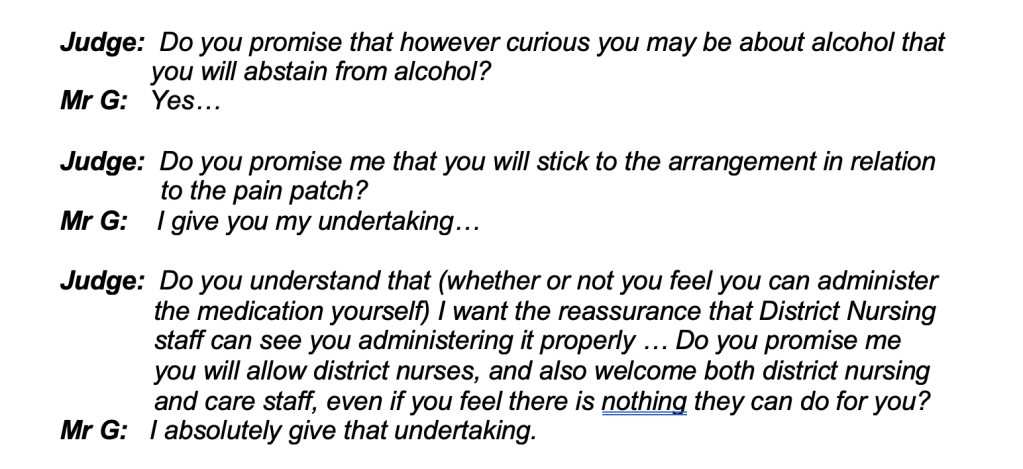
The focus was on the extent to which Mr G was, or was not, abiding by the four key pre-conditions that had enabled the judge to feel he could authorise a safe return to the community. The four pre-conditions were that Mr G would not see Miss F, that he’d manage his pain medication appropriately, abstain from alcohol and permit district nurses to monitor his diabetes management.

The first pre-condition, not seeing Miss F, had obviously not been met but concerns about that were, the judge hoped, resolved at least in the short term. However, there were also question marks around Mr G’s compliance with the other three preconditions – particularly in relation to his use of alcohol and cooperation with district nurses.

After hearing from Mr G’s social worker, all three counsel, and Mr G himself, the judge addressed Mr G directly to ask whether he had acted in good faith when he promised to abide by the pre-conditions. “Absolutely sir” came the reply.

The judge then invited Mr G to explain why he’d not kept his promises – and Mr G offered explanations such as saying he had let Miss F into his flat as it would be “ill-mannered” not to have done so, and that he had drunk alcohol out of “curiosity”.

After being given an opportunity to show his understanding of all the pre-conditions and why they had been put in place, the judge invited Mr G to reiterate his commitment to abiding by them going forward.

The judge underlined the importance of Mr G honouring his undertakings. If he were not returned to the care home immediately today then he might like to think of this as a “suspended sentence’”.

The judge then invited final submissions.

Final submissions and judgment

Counsel for the Local Authority emphasised that “we’ve had promises before” and that “any drift in the perspective of what was required is in his [Mr G’s] own mind” and emphasised the risks of leaving Mr G in his own home. This position was supported by counsel for the NHS Trust: in their view, it was in Mr G’s best interests to be returned to his care home immediately.

The final position statement from the OS, however, supported a short further trial period at home. Although “mindful of the strength of concerns’ in witness statements “the balance comes down in favour of a final effort [to support home living]” given the strength of Mr G’s feelings, the shift in the role of Miss F and the fact that “Mr G has had the opportunity to see how close the possibility has come for return to residential care”.

His Honour Judge Tindal then gave oral judgment. Mapping out the long running chronology and the legal principles he emphasised that “I am on a personal level massively disappointed that Mr G broke his word to me and drank.” And underlined the risks: “If he carries on drinking he could go into hospital and die” . He concluded, however, by ruling that Mr G could stay in his own home, for now, but If he breaches his word to me again, he will be going back to the care home”.

In his judgment the judge acknowledged the stresses on staff (especially during a pandemic) and the difficult situation he was placing them in. He made clear that if Mr G were to suffer a major medical crisis during the continued trial period at home, then ”the person who takes responsibility is none of the professionals, it is me… They will do everything they can. But they can’t do everything. They must not feel they are under any legal pressure regarding risk management. If things go wrong this is on me, not on them”

He concluded by expressing the hope that if things went more smoothly over the next couple of weeks, then “ the legal proceedings might be finished in a few months’ time and it would be possible to see the last week or two as simply teething troubles”.

Postscript – the “candle of optimism” flickers

Since drafting my account of the hearing on the 30th September 2021, the case has returned to court. On 13th October 2021, I observed a hearing that highlighted ongoing concerns from healthcare professionals about alcohol use and a lack of cooperation with the district nurses. 

In court, Mr G responded by accusing the professionals of “duplicity” and “lies” – “I have not drunk a drop”. It was also, he said a “nonsense” to have district nurses visit him, as he could manage his diabetes perfectly well without them.

The position of the Official Solicitor by 13th October 2021 was now to agree with the Local Authority and the NHS Trust that Mr G should be returned to the care home. 

There was, however, no time to hear the evidence – and also some new evidence had yet to be filed due to what the Local Authority referred to as the “rapidly evolving situation”.

The judge emphasised that the information discussed at this point was “information” not “sworn and tested evidence” but expressed his deep disappointment: the “candle of optimism” was flickering.

A further hearing is scheduled for 21st October 2021.

Jenny Kitzinger is a Professor in the School of Journalism, Media and Culture at Cardiff University, where she also co-directs (with Celia Kitzinger) the Coma and Disorders of Consciousness Research Centre.. She tweets @JennyKitzinger

A COVID Vaccination hearing: Observations of an aspiring medical student

By Eloise Crang, 19th October 2021

I’m a medical applicant, currently sitting my last year of A-levels studying Maths, Chemistry, and Biology, so I was delighted at the opportunity to observe a real-life medical ethics case in play. Having mainly read about these sorts of scenarios in medical books, or when revising for the situational judgement test in the UCAT (university clinical aptitude test), I was keen to watch what actually happens in practice.   

The case I observed, COP 13364813 before Sir Jonathan Cohen, concerned issues of capacity and whether or not to administer a COVID-19 vaccination to a woman in her late 80s, GA.      

Even before observing the case, I thought I had already made up my own mind as to what should happen: of course being vaccinated would be the best option for a clinically vulnerable person. However, through hearing the barristers’ different positions, and the arguments of GA’s son, I began to realise how nuanced this case was when you consider all the variables. Through having the opportunity to see it play out in this case, I now also understand what ‘best interests’ means in the Mental Capacity Act 2005.

Prior to this hearing I had never attended court (either virtually or in person), so I was unsure about what to expect. It was fantastic to be supported by Claire Martin, a member of the core group of OJCOP and a family friend, who acted as a mentor to explain legal jargon and summarise what was being said.  She helped me to feel less intimidated. 

I noticed how the judge let GA’s son speak about everything he wanted to, and how important this was as it was clear he felt his voice and opinion had been dismissed previously. (It had been decided that he lacked capacity to litigate.) I had no idea that family members were able to input as much as GA’s son did. Throughout this hearing, he was becoming increasingly distressed at the fact that he no longer held Power of Attorney for his mother, it having been determined at a previous hearing (in February 2018) that his mother “lacked the relevant mental capacity at the time, both in respect of property and affairs, and health and welfare” (para. 16) and it being the court’s responsibility to make these decisions in her best interest. 

If GA had capacity to make her own medical decisions, she would be able to choose for herself whether or not to have the covid jab.  But it was agreed that she did not.  Her severe Alzheimer’s dementia meant that she could not understand the relevant information in order to make a decision. 

The term ‘best interests’ was used a lot, which constantly reminded me of the point of this hearing and forced me to consider GA’s perspective and empathise with GA – despite her not attending. 

Section 4 of the Mental Capacity Act (MCA) 2005 says that acting in someone’s best interests means considering their past and present wishes and feelings (especially from when they had capacity) and also consulting anyone engaged in caring for GA and interested in her welfare, so amalgamating the thoughts of GA’s children, the GP and the parties.

Sir Jonathan Cohen said, “the court must make a decision for what is the appropriate action in GA’s best interests, with a wide and holistic consideration including her children”. From every party there was a shared motive: to act in GA’s best interests. From a medical standpoint, this was to protect GA physically, as she is extremely clinically vulnerable to COVID-19, but also mentally, to protect her from the low mood and depression that shielding and social isolation can cause. 

Once Peter Mant, the barrister and counsel for CHC, had proposed the position that it was in GA’s best interests to administer the Oxford/AstraZeneca vaccination at her home, where she already has 24-hour care, he backed it up with four key pieces of evidence: 

  1. P’s undeniable risk of death if she is not vaccinated
  2. the “clear and unequivocal” scientific evidence supporting the vaccine 
  3. no evidence to point towards GA already having COVID-19 antibodies 
  4. her past history of accepting influenza and other vaccinations. 

The latter was the key piece of evidence I found most interesting. From participating in other clinical work experiences, the value of a patient’s history has consistently been hammered home, so I was surprised to hear its use in another context. I had previously associated a patient’s history with recording past health issues that could be a risk factor for a present illness. I hadn’t considered its application in reconstructing the thought paths, values and prior wishes of a patient. At court, it became apparent that her patient history was essential to inform the best interests decision, since it allows the decision-maker to base the decision on the person’s life’s values, wishes and actions. If she accepted vaccinations before, they assumed it was unlikely she would object to this jab. This problem-solving via piecing together information about GA from her medical records and family to try and extrapolate what her thoughts on the COVID-19 vaccinations would have been from her past decisions was ingenious to me.

Exposure, mostly to doctors, had made me view a patient’s best interests as being the doctor’s final call using purely medical facts. Under s.4 of the Mental Capacity Act 2005, it explicitly states not to make assumptions of what a person’s best interest would be, hence the court proceedings and accumulation of evidence to reflect GA as a person, in all elements of physical, emotional and mental health. Encouragement of GA’s involvement with the decision, despite lacking capacity, is highlighted too and was clear when GA’s interest in going to her local Asian sweet shop was considered. She displayed the desire not to be socially isolated, and so an implication of her receiving the vaccination would be to give her this freedom. Consequently, my idea that if someone lacked capacity, they would be unable to participate at all in decisions made about them was contradicted. I learnt that a person may lack capacity to make healthcare decisions, but have the capacity to choose what activities they do on a day-to-day basis and that communication with a patient in a medical and field setting is key to ensuring you understand their wishes and preferences in making a best interests decision.  The court hearing showed me it’s important to go beyond your own opinions of the best medical option to give the best possible individualised care for them based on their wishes and feelings.

GA’s case reminded me of the four pillars of medical ethics (autonomy, non-maleficence, beneficence, justice) and their role when discussing a patient’s best interests. For example, one possible outcome could have been not administering the vaccine, which could run counter to the principle of  ‘non-maleficence’, as her vulnerability to the virus may cause harm, if no vaccine is administered. Another argument used by the barristers was GA’s need to regain some independence and go out in society again, like going to the shops or meeting her grandchildren, which may only be possible with the protection of a vaccination. This attention to detail enlightened me to how thorough the lawyers are, as well as the system more widely, in trying to ensure the best possible care and lifestyle for GA, something which I previously had thought only healthcare professionals prioritised.

GA’s son did not agree with the judgment, although he stated that he might have made the decision for his mother to have the vaccine himself. I understand that he wanted to retain the right to make that decision for his mother himself, and could see why he was upset about this. 

My overall experience at the hearing was incredible. It made me rethink how I viewed ethics and its involvement in medicine. Now I will embark on my medical career with a better understanding of what ‘best interests’ means in practice. Doctors, much like the judge and barristers I observed, have the responsibly to protect vulnerable people in society, and I learnt that prioritising their wishes, beliefs and values before your own opinion is the only way to ensure this protection. 

Eloise Crang is a year 13 school student planning to apply to medical school.   

Photo by CDC on Unsplash

When another assessment is not needed: Best interests decision-making for a patient with a prolonged disorder of consciousness

By Jenny Kitzinger, 14th October 2021

In September 2019, a young man’s car collided at speed with a stationary lorry – leaving him with severe brain injuries. Two years on he remains in a Prolonged Disorder of Consciousness (an umbrella term that includes states previously known as ‘vegetative’ and ‘minimally conscious’). 

The hearing I observed on 7th October 2021 (Case: COP 13820439 before Sir Jonathan Cohen) was instigated by an application from the Clinical Commissioning Group responsible for commissioning this patient’s care. The CCG (represented by Emma Sutton) believed that it was not in his best interests to continue with clinically assisted nutrition and hydration. Nor did the CCG believe that a further assessment of his level of consciousness was needed. The CCG’s position was that it was in the best interests of this young man (referred to as “ED”) to now be moved to a hospice for end-of-life care.

The first respondent in this case was ED, whose best interests were represented by the Official Solicitor (OS)  (Fiona Patterson). The preliminary position of the OS was to support the CCG’s position, pending hearing oral evidence.

Both his parents (who separated some years ago) were also parties to the case:

  • ED’s mother (a litigant in person) supported the CCG’s application
  • ED’s father (a litigant in person) opposed the application, arguing instead that his son should have further structured assessments, specifically another ’SMART’ test[1]

In addition to the parties, ED’s treating physician and an independent expert in neurological rehabilitation were also in court. 

The hearing was listed to last for one and a half days.

The hearing

A strong sense of ED as an individual was conveyed from the outset of the hearing – not least because of the letters from family members about him which had been submitted to the court. The judge went out of his way to comment on how much he appreciated the thought that had gone into these statements (and in the case of ED’s sisters “the shafts of humour”) that “have helped build a picture of a very impressive young man”.

ED was in his 20s and had, before his injury lived with his mother and stepfather. He was humorous, hard-working, set himself high standards and was very ambitious and successful at work. He was also physically fit and a keen sportsman: we heard that a photograph of him in his rugby kit was included in the court bundle and the judge made a point of noting that he was “not only a big fan but also a proficient player”. 

ED was now fully dependent on others for everyday care, with no ability to communicate and no control over his body and he had various complications (including spasticity and reduced control over basic physiological functions such as temperature and pulse rate.) He’d been extensively assessed by experts and had been looked after in a specialist neurorehabilitation centre since December 2019.

There was, the CCG barrister stated, “no real prospect of recovery to a quality of life that [ED] would have found acceptable”. 

It was clear that extensive work had been done prior to the case getting to court (as per guidelines from the BMA and RCP guidelines that you can find here and here). This preparation work included detailed assessments of his condition, collating clinical evidence, collecting information about ED as an individual and running best interests meetings with family members in order to attempt to resolve the case without  the need for a court hearing. 

It was the fact that the father continued to disagree with the best interests decision that had triggered the court application – and the area of disagreement had been honed down such that it focused on one issue: whether or not another assessment was needed.  

The first witness was Professor Derick Wade. He was one of the two independent experts who had assessed ED and reviewed the conclusions drawn by ED’s clinical team and the evidence they relied on.

The two independent experts (normally only one independent expert is commissioned in these sort of cases) had submitted evidence that ED is in a prolonged disorder of consciousness, with no behavioural evidence of self-awareness ever having been seen since the brain injury. There was a consensus between the two independent experts, and between them and ED’s treating physician, about his prognosis.

Professor Derick Wade was sworn in and asked to explain his qualifications and experience in the area and summarise his basic conclusions. He was then cross-questioned first by the barrister for the CCG and then by the barrister for the OS. A clear focus of the questioning was, as counsel for the OS put it, to test “why we can be confident that, to put it in lay terms, ‘no stone has been left unturned’”.

Professor Wade described his role as an external expert as ensuring that “the totality adds up and there are no unusual features”. He outlined the nature of the original injuries to ED, some of the explorations of treatment and tests done on him, and the nature of the care he’d received over the last two years.

We heard that ED had three ‘insults to the head’ from the high-speed collision: firstly diffuse axonal injury from the deceleration, secondly direct trauma to the brain, and thirdly a reduction in oxygen to his brain because of injuries to his chest. Professor Wade commented that the mechanics of injury “obviously don’t directly determine what his clinical state is afterwards, I don’t make assumptions [that these injuries would have inevitably resulted in his being in a PDoC] but I’d be surprised if he weren’t”.

Professor Wade had also looked at earlier structured assessments that had been conducted (SMART and WHIM) and at reports of CT scans. Again stressing that he would never make a diagnosis on the basis of a CT scan alone, he commented that the “CT scan is totally consistent with the severity of the initial injury and what we see”. He had also examined the patient himself and examined day-to-day nursing notes.

Counsel for the OS then asked whether the way in which the patient presented physically gave a steer to his prognosis and Professor Wade highlighted ED’s “autonomic instability – poor control over temperature, heart rate, and rate of breathing – which, he said, suggested that the hypothalamus (located in a very sheltered part of the brain) had been injured. Close observations of the patient by his family and all the professionals looking after him were also discussed.

This led to a discussion of elements such as startle responses to loud noises or occasional eye-tracking (described by Professor Wade as “when the individual will fixate on something and if you move whatever it is, their eyes will follow it”). Professor Wade commented that eye tracking could be an important prognostic indication early on after injury, for example, “If after 5 weeks they start tracking you can say that this increases the chance they will wake up”. However he stated that brief periods of eye-tracking two years after injury did not substantially alter the situation: it does not indicate presence or absence of awareness, and it is no longer useful prognostically. (Wade referenced his published work on this point which you can read here).

Further cross-questioning explored whether physical disabilities, or depression might significantly inhibit P’s ability to display a higher level of consciousness, and Professor Wade was asked whether pain relief might be artificially suppressing ED’s level of consciousness. He responded:

If he needs the medication to keep him comfortable then assessing his situation when he is not on medication to keep him comfortable is slightly pointless as that is not how he is going to be. If the medication is not needed then he shouldn’t be on it

Pain was obviously a particular concern for ED’s mother. Counsel for the CCG reported that ED’s mother said medication for spasms and pain were reduced for the original SMART (and she was opposed to this being done again). Professor Wade responded by commenting that:

 “Reducing medication that reduces pain or spasms does potentially cause harm to the person. I believe he doesn’t experience anything, I do not know that, and if he looks like he is in pain… the clinical team have to treat that.”

It was clear that the harms of conceding to ED’s father’s request for further testing might include ongoing potentially unwanted treatment, and P’s own clinical team were concerned about the possibility of physical deterioration and increased pain (they had already increased analgesia administration in response to increases in agitation). The question was then: what were the benefits of further testing?

Professor Wade highlighted the value of providing additional systematic information at particular points in time and especially if those looking after the patient were not experienced in PDoC. In this case, however, for this patient, at this point in time, given everything already known, and the fact he’d been cared for in a specialist setting, Professor Wade thought that ““you have got more than enough [information] to make the decision that you have to make”. He did not consider another SMART would add anything useful. He commented: 

The main question is .would knowing the SMART assessment in detail (it’s already been done once) alter the decision? […] What we need to determine is what is ED’s life like now, and that is described in the day-to-day nursing notes and experience that day-to-day clinicians have. Given how ED is and how is life is going to be, what would he have decided? He was not going to decide that on the basis of a SMART score.”

Counsel for the OS asked Professor Wade what the best possible ‘against the odds’ outcome might be for this young man in future. The response was:

“At his best, he wouldn’t be able to undertake any ‘useful’ activities (e.g. chewing, swallowing, interacting with friends/family)….At his best ED might be awake for much longer periods. Localise more consistently, such that he would normally look at someone entering the room. If a conversation going on around him, he might look at the person speaking and then the next person speaking.”

Professor Wade agreed that more time might also mean more deterioration (a major concern for this treating team). He also acknowledged the treating team’s view that ED was needing increasing amounts of more analgesia. He accepted that:

he is showing changes that are indicative of pain in most people – I’m not necessarily agreeing he is experiencing pain, but it looks like pain and we have to treat it”.

It was at this point that the barrister for the OS alerted the court that she had received an email from ED’s father – and asked for a short adjournment. The judge asked a few questions of Professor Wade himself, and then adjourned.

Following the adjournment, the court was informed that, having listened to Professor Wade’s evidence, ED’s father wished to withdraw any opposition to the CCG’s application

The judge then asked, “Would it be helpful if I made a judgment?” and after a brief period of consultation (e.g. the counsel for the OS checked with ED’s mother), it was agreed that would be useful. The judge made a formal oral judgment approving the CCG’s application. (I’ll add a link here to the written judgement once it is published).

Reflections

Two things stood out for me as an observer – the first was the value of a holistic approach to assessing diagnosis and best interests, and the second was the speed with which the case was resolved in court.

The importance of a holistic approach

In this hearing, the expert witness, Professor Wade, offered a considered discussion of the importance of a holistic approach to determining best interests – taking into account information about the patient from those who knew them before their injury, and information about their current condition. This holistic approach was also evident in the discussion between expert witness, the different parties’ barristers, and the judge.

The value of systematic testing was acknowledged, while also emphasising the importance of looking at clinical information ‘in the round’ without fixating on any individual features of the patient’s behaviours and taking them out of context of other clinical information (or of information about the patient’s likely wishes).

This demonstrated positive progress compared to some cases I observed a few years ago. In the past I’ve attended hearings where instead of talking about PDoC there was a forensic focus on the borderline between VS and MCS – and this sometimes seemed to displace addressing what the patient might have wanted. For example, there were often requests for further refinements/repetitions of tests to see if there might be intermittent glimmers of consciousness, even when the patient had been in their current state for many years and when there was evidence that the patient themselves would not have considered MCS to be a ‘better’ diagnosis than VS or mean there was the possibility of a future life they would have wanted. (See, for example, Cumbria NHS Clinical Commissioning Group v Miss S and Ors [2016] EWCOP 32 and the issues about diagnosis discussed here).

The speed with which the case was resolved in court 

This hearing also demonstrated how useful the court can be in resolving a dispute.

It was clear that considerable discussion had taken place with ED’s father before the hearing, and he had met with his son’s clinical team, had talked with Professor Wade and seen his expert report. So it was a surprise that within an hour of the hearing starting (a hearing scheduled to last a day and a half), ED’s father changed his mind and withdrew his opposition to the CCG’s position. 

I think many of us in court were left wondering why this might have happened. Without hearing from ED’s father himself we can only hypothesis about what influenced him.

It is, of course, possible that the father just found the experience of the court overwhelming and perhaps just thought there was no point carrying on objecting given the consensus from the rest of the family, and all the experts present. However there is no suggestion that was the case, his concerns were treated with courtesy and respect throughout the hearing and the possibility of simply feeling ‘out gunned’ is something that no doubt would have been checked during the adjournment.

If ED’s father did genuinely change his mind about the right way forward for his son (as I think is likely to be the case) then this hearing highlights a valuable role that can be played by the courts where resolution cannot be reached in the clinical setting and makes me reflect on what a court hearing can offer in this situation.

Perhaps he changed his mind because of listening to the expert evidence given under oath in a (virtual) courtroom, rather than in the context of a medical consultation? Or was it perhaps because of the skilled cross-questioning from counsel for the OS and the CCG in which the barristers kept asking for a ‘lay version’ of the information and systematically unpicked concerns. Indeed both barrister and the judge asked for clarification of ambiguous medical terminology relating to PDoCs, such as the difference between “responsiveness” and “awareness”, until they were satisfied with the explanation.

Perhaps what made the difference was the gravitas and expertise of the court or the evident experience and empathy of the barristers and the judge. 

It is possible taking the discussion out of the clinical setting (with whatever history there was between the father and those directly involved in his son’s care) may have been crucial.  Perhaps it gave the father reassurance about independent scrutiny over and above that offered by independent medical experts. Or perhaps what was useful was the fact that the legal hearing process created a very formal framework for decision-making with a very set of criteria for evidence, and, of course, a very real deadline?

I also wondered whether the father may have benefitted from the clear message that the judge was responsible for any decisions made in the courtroom – whereas family members sometimes feel they bear more responsibility for a decision made in an everyday clinical best interests meeting. 

Whatever the reasons for withdrawing his opposition to the CCG’s application, I hope that ED’s father, mother, sisters and others who care about ED can find some peace in this tragic situation. 

The three things I hope that clinicians, and indeed family members, reading this account might take away from this blog are: first, that it is possible for further tests and investigations to be contrary to a patient’s best interests; second, that it is important for proper assessment and best interests decision-making processes to be carried out in a timely manner in the clinical setting (following the guidelines from the BMA and RCP referenced above); and third, that if (after following such robust procedures) there remains doubt or dispute about a patient’s best interests then the Court of Protection should be welcomed and sought out, not feared and avoided.

Jenny Kitzinger is Professor of Communications Research at Cardiff School of Journalism, Media and Culture. She also co-directs (with Celia Kitzinger) the Coma and Disorders of Consciousness Research Centre and runs online training for healthcare professionals about law and ethics. She tweets @JennyKitzinger

  1. SMART stands for “Sensory Modality Assessment and Rehabilitation Technique” and is a standardised assessment for PDoC patients.

Photo by Josiah Day on Unsplash

What happens when Lasting Power of Attorney goes wrong?

By Clare Fuller, 7th October 2021

As an advocate for Advance Care Planning and a Lasting Power of Attorney (LPA) Consultant,  I promote the normalising of planning ahead conversations (see Speak for Me LPA).

As a nurse specialising in Palliative and End of Life Care, I have seen first-hand what happens when LPAs are not in place. I have witnessed families in distress when a loved one has deteriorated and, despite having had conversations about end of life wishes, they had not formalised decision making through a Lasting Power of Attorney; families have felt their voice was not heard in decision making.

 A very public example of the challenges faced without an LPA in place is the situation Kate Garraway found herself in when her husband,  Derek, developed COVID-19 and lost capacity to make decisions for himself. Derek did not have a Lasting Power of Attorney in place for the management of Property and Finance, meaning Kate was unable to manage access funds for care or refinance their mortgage, or to manage the family finances, a situation creating enormous additional strain in an already difficult situation. 

From a highly personal perspective I can reflect on the care of my  Uncle as he lost capacity  and the benefits of having both a Health and Welfare and a Property and Finance LPA in place. In my Uncle’s case we were able to make decisions for him, knowing well his wishes, values and beliefs; this meant he was able to spend precious time in a home where he felt safe and happy. 

In the Court of Protection recently, I observed what can happen when a person who has since lost capacity has appointed an LPA (for both Finance and Property and for Health and Welfare) but it’s not working well.

The hearing

The case (COP 13339015) was heard over three days (27-29th September 2021) before District Judge McIlwaine at Lincoln Family Court. It was a ‘hybrid’ hearing, i.e. one of the nine parties to the case was present in person, and the other eight attended remotely (in some cases from overseas).   I was able to observe the final two days of the hearing (via video-link), and received helpful notes from Claire Martin who observed the first day of the hearing.  There had been an earlier ‘directions’ hearing, blogged about by Claire Martin.

This was the third time I’d observed a hearing in the Court of Protection, and I felt more confident in knowing my role as an observer and how best to prepare. I’ve previously watched a hearing focussing on LPAs across borders and  in July 2020 bore witness to a young woman’s application for the court to rule on her capacity to make her own decisions about a feeding tube when she was dying from Anorexia Nervosa. 

Once I received confirmation of attendance I requested a Transparency Order and a Position Statement (from the only represented party), which enabled me to understand the key issues before the court. 

 I’ll refer to the person at the centre of the case as Mrs P.  She has advanced dementia and lives at home with her daughter (and LPA), BR.   The parties were: 

  • the applicant (BR) – Mrs P’s daughter and the person she had appointed as her Attorney both for Property and Finance and for Health and Welfare.  
  • BR’s husband.
  • BR’s five brothers and sisters.
  • Office of the Public Guardian, represented by Alex Cisneros  (the 8th respondent).
  • BR’s son was also in court as a McKenzie Friend.  

The key issues were:

  1. The amount of remuneration for gratuitous care provided by the applicant BR to Mrs P – both the care already given from 2014 until now, and in the future.  “Gratuitous care” refers to the unpaid support BR has given to care for her Mother, Mrs P, this includes helping her with all activities of day to day living.
  2.  Whether to authorise £21,649 from Mrs P’s account to extend the garage at BR’s house to create an additional bedroom for a carer to stay overnight, and to enlarge the existing bathroom area for Mrs P.
  3. Whether to retrospectively approve the £25,490 that BR used to purchase a car using Mrs P’s finances.
  4. Whether to revoke BR’s Property and Finance Lasting Power of Attorney and appoint a panel deputy instead.
  5. Whether to make some form of order or declaration regarding the contact that Mrs P has with her family. 

The case was highly complex and unusually involved eight litigants in person.  Although there was a lot of argument about money, what seemed to lie at the heart of the case was the issue of contact.

 Basically, what had happened was that Mrs P was living with BR and her husband.  BR was caring for her (with some paid assistance), and making all the decisions about Mrs P’s finances and her health and welfare, as she seemed entitled to do by virtue of her role as Lasting Power of Attorney.  The other members of the family (other than her husband, who supported her throughout) felt excluded from involvement in Mrs P’s life.  BR was preventing them from visiting her at her home, and there had been difficulties with arranging to meet her in other locations, and in setting up communication via video-links.  There had been a major family falling out between BR and her siblings.  They saw her as “controlling”, “aggressive” and “paranoid” and said she had imposed unnecessary restrictions on their right to see their mother.  They also said she’d accused them of visiting their mother only because they wanted to “spy” on her – and BR also made this claim at one point in court.  In agreeing that the family had the right to see Mrs P,  BR  explained that they could see Mrs P, but not her:  “I can’t allow you anymore to see me.  I can’t repair any more.  I can’t mend bridges, and I don’t want to”.  it was heart wrenching to see a family so divided.

 DJ McIlwaine demonstrated great skill in managing the case.  He  ensured that everyone had opportunity to express their views and described part of his role as being to  “take some of the energy out of the family dynamic”.  The judge conveyed a great deal of sympathy for all parties but also maintained a clear focus on getting the court process back on track when people raised issues that were not germane to the key business of the court.   “I don’t want to be unsympathetic,” he said (several times), “but I have to get everyone’s evidence before the court.”   He pointed out that if he was not able to do that within the three days assigned to the case, the next slot available was not until February 2022.

By the third day the judge was plainly moved by what he described  as “a  tragic mismatch of communication”. He said, “I appreciate there’s a family dynamic, and it’s tragic to see it play out”.    He wondered aloud: “If she (Mrs P) could sit at the back of this courtroom, with full mental capacity, what she would have made of the last 3 days”.  

In observing, I felt DJ McIlwaine demonstrated patience and compassion by continually checking the understanding of all involved, offering breaks when emotions ran high and taking time to explain what can feel a daunting court process. He offered support to the applicant and respondents throughout.

This divided family was also supported by the efforts Alex Cisneros  made to offer suggestions to resolve the conflict with visiting arrangements, as well as his offer of support with gratuitous care calculations. I understand this was above and beyond the usual role of the OPG.  His input was very much appreciated by DJ McIlwaine who said, “that is a remarkable offer, without the OPG it would be even more complicated”.

The judge said he would hand down a judgment by the end of October 2021, and I’ll link to the judgment when it’s available. But the Lasting Power of Attorney for Property and Finance is no longer part of this judgment – and that’s the focus of this blog post.

Lasting Power of Attorney, Property and Finance

Mrs P had appointed BR as her Attorney for both Property and Finance and for Health and Welfare.

In  an earlier blog, I clarify the two different LPAs and their function. 

Lasting Power of Attorney (LPA)  is a legal document that lets you appoint one or more people to make decisions on your behalf. This gives you more control over what happens to you if you have an accident or an illness and cannot make your own decisions.  The formal requirements, scope and applicability of LPAs are set out in Sections 9-14 of the Mental Capacity Act 2005.  

There are two different kinds of LPA.  A Health and Welfare LPA would be used if you lost capacity to make decisions about issues relating to health (e.g. whether you should have surgery or other medical treatments).   An important element of the Health and Welfare LPA is that it offers the opportunity to give the person or people appointed, (the attorney(s)), authority to make life-sustaining treatment decisions.

A Property and Finance LPA is used for to appoint someone to make decisions about your money – and can take effect, with your consent, as soon as it is registered.

Since making these LPAs, Mrs  P has lost capacity to make her own decisions about her property and finance, and about her health and welfare (due to Alzheimer’s dementia).  Nobody disputed this, and nobody disputed the validity of the LPAs.  

Prior to living with BR and her husband, Mrs P lived in Ireland with her husband who was described as “brain power” to complement Mrs P’s “muscle power” in the relationship.  When he died, Mrs P was unable to care for herself.  (I suspect this picture of co-dependence will be familiar to many families.) BR spoke of discussions prior to her father’s death in which he “asked if we could look after her (Mrs P)….he did not want her to live in a care home” and she moved to live with her daughter in 2014.  

 In order to pay for the  costs of care,  BR has, in her capacity as Property and Finance attorney, drawn from Mrs P’s finances. The costs cited include: 

  • care delivered by BR;
  • the purchase of a car to transport Mrs P;
  • the cost of care payments to agencies and individuals to care for P; and
  • the cost of a proposed extension.

A picture was drawn of the care needs of Mrs P – which demonstrated twenty-four-hour care was required, including an average of two assists per night. Mrs P was described as mobile, but with poor short-term memory. I was interested to note that an up-to-date Care Needs Assessment was not available as part of the evidence and the most recent face to face assessment was in 2019. My impression was that a more recent assessment would have been of value in understanding current care needs, however the consensus was little had changed since the previous assessment.

The question of revocation, one of the key issues of this case, came following concerns by the Office of the Public Guardian. The legal test for decision making about revocation of an attorney and subsequent appointment of a professional deputy is the best interests test (s. 22(3)(b)  Mental Capacity Act 2005).

Mental Capacity Act 2005

In his summary, Counsel for the Office of the Public Guardian provided the following as reasons to revoke BR as an attorney:

  1. management of investments – BR had previously been advised to divide Mrs P’s finances to protect them but had not done so;
  2. the security bond associated with appointment of a professional deputy would protect Mrs P’s finances;
  3. the provision of a mechanism for the Court to review and scrutinise the financial management of Mrs P’s assets (also associated with the appointment of a professional deputy);
  4. a professional deputy would provide an independent and mediatory role within the family;
  5. There are ongoing financial decisions which need to be made for Mrs P regarding costs of care – for which an independent professional financial deputy would be able to provide expert advice.

Attention was drawn to the complex family dynamic and deep mistrust between BR and her siblings. BR no longer had contact with any of her siblings and throughout both days we saw evidence of the pain this caused all parties; in a particularly emotional point BR stated she felt there was “more hate in the statements (from her siblings) than I know existed”. Counsel used the family dynamics as further evidence that best interests decision making was not in place for P, and quoted Senior Judge Lush in Re BM; JV v AG – noting that where there is ongoing family friction, “the court wouldn’t contemplate appointing a particular family member or friend as deputy”.

Although the position of the Office of the Public Guardian was that BR should be removed as LPA for Property and Finance, DJ McIlwaine reiterated several times that there was no question of dishonesty on her part (especially when, at one point, BR argued that the OPG’s calculation of care costs that should be paid to her was too high). I believe this was highly significant. 

One alternative to the LPA being revoked by the court was for BR to rescind it.  (Another of course was that the court could decide – contrary to the position advanced by the OPG, that she should remain as LPA.)

While the outcome reached either by forced revocation or by voluntary rescinding of power of attorney is the same (i.e. BR would no longer be Mrs P’s attorney), there is an emotive component behind the decision. BR presented as being overwhelmed by the care of her mother in addition to managing the finances. Earlier in the proceedings DJ McIlwaine acknowledged this, saying “That’s why I floated whether or not the time has come for a professional deputy who could remove some of the burden in your life – for your wellbeing”.

The question of removing responsibility for Health and Welfare decision making was not before the court, although several family members volunteered the information that they thought BR should also be removed as attorney for Health and Welfare decision making.

Following counsel’s summary, DJ McIlwaine allowed BR time to consider, carefully checking to ensure she felt under no pressure, and invited her thoughts about whether she might want to voluntarily rescind the LPA. Her sister, the replacement attorney for Property and Finance, to whom the LPA would fall if BR were to rescind, had already also agreed to rescind, meaning that there would then be no obstacle to appointing a panel deputy.  Shortly after 5pm on the third day of the hearing,  BR voluntarily rescinded her role as Property and Finance attorney, and this matter was removed from the judgment.

Considerations when making a Lasting Power of Attorney

In making a Lasting Power of Attorney,  it’s important for families to discuss the details of how they hope and expect it will work if and when it becomes effective.  

There is scope in making an LPA for the donor (the person making the LPA) to state specific wishes, but balanced against this is the need to ensure that any written preferences and instructions for attorneys are clear and non-ambiguous – any doubt in wording can result in the OPG rejecting the application (and subsequent reapplication costs). 

In many cases the sections for preferences and instructions are left blank.  This need not be a problem if the family has is agreed and has absolute clarity and understanding of the donor’s wishes. But where there is any suspicion that the family may take different views, or that the person (or people) appointed as attorney(s) might not act in accordance with the person’s best wishes and/or might be challenged (as here), it is important to consider completing them.

There are two sections of relevance in the Property and Finance LPA form (and parallel section in the Health and Welfare LPA form) :  “Preferences” and “Instructions”.

 In drafting preferences, the donor has an opportunity to articulate what they would like their attorneys to consider when making decisions; the attorney is not bound to follow them but should consider in decision making. Wording like “I would like…” and “I would prefer…” should be used in this section. Examples of preferences in the  OPG Guide to making an LPA include:

Instructions explicitly tell attorneys how to act on the donor’s behalf and the OPG advises that legal advice may be appropriate when drafting instructions in a Property and Finance LPA.  Examples of instructions in the OPG Guide to making an LPA include:

 The OPG Guide to making an LPA  identifies “The only circumstances in which you must write an instruction is in a financial LPA if:

  • you have investments managed by a bank and want that to continue
  • you want to allow your attorneys to let a bank manage your investments

When drafting instructions or preferences it can be valuable to include why a particular statement was written and the reasons behind it – this can be of potential use in any later challenge.

Reflecting on Mrs P’s case and OPG advice, what might have helped and how could it be documented? The situation could have been clearer if Mrs P had written any of the following: 

I would prefer my money to be used to enhance my comfort even if it’s not strictly “necessary” OR “I don’t want a lot of money spent on building extensions to house me or expensive cars – I’d rather it went to my children and grandchildren as part of my estate”.

If I am being cared for by my family, please use my funds to pay for additional help to ensure family members have time off and don’t have to spend all their time looking after me.”

If there comes a time when I need a family member to drive me around, please use my money to buy a car for me that you can also use for yourself and enjoy driving.”

I am a naturally risk-averse person and would not want you to take risks with my money. Please divide my funds and investments to protect them and please consult a professional financial adviser.” 

Although the question of revocation of the Health and Welfare LPA was not before the  Court, reflecting on the case makes me wonder what wording when drafting the LPAs could have made a difference.  

There are lessons to be learned on the value of documenting preferences as they make the donor’s wishes explicit, provide guidance for attorneys, and can be referred to should there ever be dispute. With the value of hindsight, preferences and instructions in the Health and Welfare LPA that might have helped in this case could have included: 

  • I prefer to live within 10 miles of XXX
  • My attorneys must ensure I am given only pescatarian food” (we heard in court that Mrs P followed a pescatarian diet) 

The Attorneys appeared unprepared for their role in part because P had not provided instruction and I suspect in part because situations arose that could not have been foreseen by Mrs. P. 

When working with families and drafting LPAs for clients, I encourage open and honest conversations.  LPA documents lack meaning (and legal validity) if there is no understanding of the wishes, values and beliefs of the donor at the heart of all decision making. In many ways, it is these conversations that matter so much rather than documents (however without the LPA documents there is no legal right for next of kin to have decision making responsibility).  There are resources to promote planning ahead, and campaigns such as Dying Matters Awareness Week seek to promote more open conversations.  What Matters Conversations  and the  Marie Curie Talk About Cards offer prompts to consider and discuss.

Final remarks

Attending a hearing in the Court of Protection is an exceptionally valuable learning opportunity. Seeing application of the MCA and discussion of the nuances associated with the Act bring to life principles learned and highlight what must be considered when making best interests decisions. 

This hearing also introduced me to the role of a  McKenzie Friend, something I had not heard of before, and I now understand the role of a McKenzie Fiend is to provide moral support and help for litigants. 

During this long hearing,  DJ McIlwaine stated to the applicant, “I have never met anyone who is perfect at everything”. Neither have I.

My wish for Mrs P and her family is that by removing the burden of financial investment management from BR, they can focus on delivering care and building bridges in the future.  

My wish for us all is that we have conversations that matter.

Clare Fuller RGN MSc is a registered nurse with a career dedicated to Palliative and End of Life Care. She is an advocate for proactive Advance Care Planning and delivers bespoke EoLC education. She is also a Lasting Power of Attorney Consultant and director of Speak for Me LPA. She tweets @ClareFuller17 

A court-authorised hip replacement

By Evelyn Palmer, 5th October 2021

On Friday 10 September 2021 I had my first experience of observing a Court of Protection hearing concerning serious medical treatment. It was an “urgent” hearing that had not made it to the court listings for the day and had no case number.

Having studied medical ethics at master’s degree level, I was interested to see how the court applies the best interests principles embodied in the Mental Capacity Act 2005 in practice.  

The person at the centre of the case was P, a previously fit and healthy 71-year-old woman, who sustained a hip fracture having been knocked off her bicycle three weeks earlier by a car travelling in the wrong direction down a one-way street. She was said to have a long history of mental ill-health including anxiety, somatisation, agoraphobia, and a paranoid personality disorder with schizotypal features. P was withholding consent for hip surgery. 

At the outset of the hearing, the applicant Trust (represented by Pravin Fernando of Serjeants’ Inn Chambers) considered her to lack capacity to make this decision and considered surgery to be in her best interests (with restraint if necessary).

The Official Solicitor (represented by Nageena Khalique QC, also of Serjeants’ Inn Chambers) took the preliminary view that P lacked capacity in relation to the proposed treatment but reserved her position both on capacity and on best interests until after hearing the evidence.

The case was heard by Mrs Justice Judd in the Royal Courts of Justice (via MS Teams).

Background

Since the accident, P, who has a “marked distrust of medical professionals” had requested time to consider surgical treatment (vs “conservative management”) of her fractured neck of femur. Her delayed decision-making seems to have been led by her underlying and core belief that she cannot trust people involved in her care. 

The medical team had acceded to P’s suggested approach and taken the conservative management route up to now.  But P is in pain, and immobile, and has developed chest and urine infections.  The hospital say she is at risk of developing a pulmonary embolism or deep vein thrombosis due to immobility.

The hospital Trust had applied, the previous day, for a declaration that P lacks capacity to make her own decisions; that it would be lawful and in P’s best interests for her to have surgery (either a total or partial hip replacement – to be confirmed during surgery), and that it would be lawful and in P’s best interests to be restrained and/or sedated if necessary for surgery to be undertaken. Without surgery, P, whose condition was said to be rapidly deteriorating, was said to have a high risk of death within days. Surgery was provisionally planned for Monday 13 September 2021, i.e., the next weekday after the hearing.

Initial impressions

I was immediately struck by the transparency of this hearing.  

As a member of the public, with no relationship to P, I was provided access details to join this virtual hearing, much in the same way I could sit in the public gallery of any open court without question.

The hearing also included P herself, who appeared on screen from her hospital bed on the ward, as well as the Trust’s three expert medical witnesses, comprising orthopaedic, geriatric and psychiatric specialists, each of whom gave oral evidence. 

After an initial sense of satisfaction at being able to experience a real-life best interests hearing with no obstacles, my thoughts then shifted to the vulnerability of P, the intrusive and highly sensitive nature of the proceedings, and the apparent power imbalance.

The court seemed sensitive to this too.  On behalf of the Official Solicitor, Nageena Khalique ensured that everyone in court knew that P was present: “She’s here, we’re talking about her, she will have the opportunity to speak, and if at any point she wants to interject, she may”.

The judge replied:  “She’s listening to this but she’s probably not feeling very well.  Has she got someone else with her who can support her?  Is there a direct line of communication with her counsel? Does she know she can put her hand up if she wants to speak?

Some time was spent ensuring that P was able to participate as fully as she wanted to, and a little later the judge pointed out to P that, if she preferred, she could remain in the hearing but with her video turned off so that we were not all watching her.  That’s what she then did.

The judge was very aware, nonetheless, that P was present throughout and several times when the medical experts were talking about the “high risk of death” (via sepsis and pulmonary emboli), the judge commented, “it must be very difficult for P hearing this”.  

The clinicians were also sensitive to P’s presence: one apologised to her for “speaking bluntly”; another apologised for giving evidence (about what surgery would involve) without having previously met P.

Later, P was offered the option of either addressing the court publicly to convey her wishes and feelings, or taking the opportunity to talk to the judge in private – she chose a private conversation.

The key person representing P’s best interests was the Official Solicitor but, in addition, as P has no close family or friends, an Independent Mental Capacity Advocate (IMCA) had been appointed.  The IMCA supported the Trust’s application.  

Despite an overwhelming level of support for P, I felt troubled by the significant ethical issue that surgery could be imposed against her will (notwithstanding its life-saving benefits) and that chemical and/or physical restraint might also be used.  

Legal considerations

The three main issues for consideration were: 

  1. P’s capacity to conduct these proceedings and to make her own decision about whether or not to have the proposed surgery.  The Official Solicitor was acting as P’s litigation friend but noted there did not seem to be any evidence before the court that P lacked litigation capacity. 
  2. The subject-matter decision concerning surgery was, in particular, whether P’s mental health condition and increased anxiety undermined her capacity to properly assess the risks and benefits of undergoing surgery, and crucially, the consequences of not doing so. In line with s. 3 Mental Capacity Act 2005 (MCA), a person is unable to make a decision if she has an impairment or disturbance in the function of the mind of brain that causes her to be unable to understand, retain or use/weigh information relevant to the decision, or if she cannot communicate the decision. 
Mental Capacity Act 2005

3. If P were considered to lack capacity, then a decision had to be made about whether it is in P’s best interests for surgery to proceed. Best interests is determined in line with s.4 MCA, which includes taking account of the person’s past, and present, wishes and feelings (s. 4(a)-(c)).  In addition to the surgical treatment, the Trust sought a declaration that it would be lawful and in P’s best interests to be restrained and/or sedated if this was necessary for the purpose of undertaking surgery.

Capacity

A person must be assumed to have capacity unless it is established that they lack capacity (s. 1(2) MCA).  

The court heard compelling evidence from a Consultant Psychiatrist who had assessed P’s capacity on three separate occasions. The consultant noted that P was not in contact with mental health services, but a review of her GP records indicated a long history of mental ill-health. Following the consultant’s own assessment, the view was formed that P has “all the hallmarks of someone with paranoid personality disorder”, and that there was evidence of “paranoid ideation” regarding neighbours and friends. 

It was the consultant’s view that P presented as very anxious about her situation, and that the accident had destabilised her. When asked by counsel for the OS whether P would agree to having hip surgery, P was found to be distracted during those discussions, deviating from the issue at hand, believing the doctors to be against her, and eventually moving off the subject of surgery. P’s mental health condition was characterised by the consultant psychiatrist as “a paranoid personality disorder with some schizotypal features and a superimposed anxiety disorder”.   

Following each mental capacity assessment, the consultant noted that P had capacity to understand and retain information relevant to her medical condition.  P understands her situation and that it is the shared view of the medical team that she urgently needs surgery. The area where P was said to lack capacity is using and weighing information relevant to the decision that needs to be made, and this lack of ability to weigh the relevant information is caused by her mental health condition. 

P’s counsel questioned in court whether in fact P lacked capacity: “Does she not have the ability to weigh up the pros and cons or is it that she’s making an unwise decision”.  She asked: “You’re saying she has an inability to understand, retain and weigh, as opposed to saying, ‘yes, I know those are the risks, but I don’t care’?

In response, the consultant was clear that “I don’t believe this is just an unwise decision in keeping with her pre-expressed beliefs.  Her mental state is that she’s very distractable, very tangential when you’re talking to her…. It’s not possible to have that conversation with her because she deviates along the way and goes into wanting to go to another hospital because they might have more natural therapies….  I don’t think she can understand the consequences of different actions”.

The consultant’s evidence allayed my own concerns and I felt confident that P’s ability to make her own decision regarding surgical treatment was impaired. But was surgery in P’s best interests?

Best interests

The court also heard oral evidence from a Consultant Orthopaedic Surgeon who considered urgent hip surgery necessary to give P an improved chance of sustaining life. The court was told that surgery within 36 hours of fracture is the established practice because the mortality rate is disproportionately high if a hip fracture is left untreated. Even in the best circumstances, patients have up to a 30% risk of mortality within the first year of hip surgery, increasing to 80% without. 

When asked by P’s counsel why continuing conservative management would not be in P’s best interests, the consultant told the court that P’s general health is deteriorating. She is “on the pathway to mortality” due to blood clots on the lungs (the Trust’s fear of a pulmonary embolism having been confirmed by a CT angiogram the previous day), which is impairing her ability to breathe. Delaying surgery beyond next Monday would exponentially increase P’s risk of death within the next few weeks, meaning that P is unlikely to go home, and even if she does survive, the likelihood of her returning to independent living is very slim.  

Despite an assessment that even with surgery “the road to recovery may be rocky for her…potentially with some unexpected twists and turns” the consultant orthopaedic surgeon formed the view that P’s chance of death would reduce to between 20% and 30%, and that the benefits of surgery greatly outweigh those of conservative management.

A Consultant Geriatrician was the last expert to give evidence, predominantly addressing best interests in the wider sense in terms of P’s post-operative recovery. Asked by counsel for the OS how P’s pain might be managed and whether surgery would increase the possibility of infections improving, the court heard that most patients do not experience severe pain following surgery; improved mobility would assist P’s urinary infection, as she would be better able to physically go to bathroom (eliminating the need for a catheter); and her ability to sit upright would help ventilate the lungs.

P was said to have good prospects of doing well post-operatively, and if she engages in rehabilitation she could expect to be able to engage in independent activities that are important to her, such as using public transport and going to the shops. 

The person’s own wishes and feelings carry significant weight in best interests decision-making (see Wye Valley NHS Trust v B [2015] EWCOP 60) and P is clear that she does not want surgery.  On the morning of the hearing, an agent for the Official Solicitor had discussed with P “how she would feel if the judge decided that she should … have the operation”.  The response was, “Devastated. I would cry my eyes out, like I have for the past 3 weeks”.

But on the other hand,  P values her independence and absolutely hates the idea of going into a care home.  Without surgery, “the likelihood of her returning home is extremely slim”, said the consultant orthopaedic surgeon.  With surgery, returning home might be possible (she lives in sheltered accommodation).  

After meeting with P privately, the judge also confirmed that P did not wish to die. P believes that organic food and natural treatments will enable her condition to improve and had told the judge she wanted to be treated at another hospital that might offer natural treatments.

While the judge could not make a declaration to the effect that P be transferred, she asked the Trust to note P’s wish and to accommodate P if possible post-surgery. It would not be practicable for P to be transferred before next Monday, given that urgent surgery had already been provisionally scheduled at the current hospital. 

Restraint

The Official Solicitor expressed concern that the application of physical or chemical restraint was likely to feed into P’s distrust of healthcare professionals and her paranoid beliefs, and said that this needed to be put into the balance when considering her best interests. She sought assurances from the Trust that any physical and chemical restraint would be the least restrictive option. 

Clinicians hoped that restraint would not be needed and said that chemical restraint in the form of Ketamine (which results in rapid sedation and has minimal side effects if used in appropriate doses) would only be used in order to administer the anaesthetic if P remained non-compliant.

The medical experts confirmed sedation would only be deployed either at the time of transporting P from the ward to the operating theatre in order to minimise her distress. If P was physically resisting, short-term physical restraint remained a further option, involving an intra-muscular injection to sedate her for approximately 15 minutes. 

I was relieved that medical professionals would first try to persuade and encourage P following the least restrictive course, and that physical restraint would be the very last resort. 

Closing submission from the Official Solicitor

After hearing evidence from the medical experts, the OS decided she would consent to the declaration sought by the Trust because, in summary:  

  1. Regarding capacity, P’s mental health condition, i.e., her personality disorder and persecutory beliefs compounded by anxiety, meant she lacked capacity to weigh the consequences of not having surgery.
  2. Regarding best interests, balancing all the medical evidence which pointed very strongly in one direction, the OS accepted that P’s condition was at a critical point. P is not going to get better by conservative management – she is not moving from the bed or accepting interventions from those who are caring for her. Her choices are limited. The benefits of surgery are in stark contrast to no surgery at all. Although there will be some compromise in her functioning in that surgery might not lead to a full recovery or to restoration of P’s pre-injury status, P has a greater possibility of returning home if she has surgery. 

Judgment

Having considered all the evidence and heard directly from P, Mrs Justice Judd decided that P lacked capacity to make her own decision about hip surgery because she was not able – either now or in the near future – to weigh up information or understand the consequences of making the alternative decisions. The judge accepted the medical evidence that with continued conservative management P would likely die within days or weeks; she would remain in considerable pain and her condition would continue to deteriorate. Given that P does not want to die, and has a strong preference for returning home rather than being discharged to a care home, the judge concluded that, notwithstanding P’s stated wish not to have surgery, it was in P’s best interests for surgery to proceed as soon as possible. 

Mrs Justice Judd concluded that although there is still a risk of P dying post-surgery, that risk is considerably lower than if she were not to have surgery. Further, P’s pain and immobility would be much reduced. 

While P may experience a rocky road to recovery post-surgery, there is a greater chance of her returning home sooner and in better health. The judge acknowledged that P is reluctant to undergo the operation and that it was causing her anxiety. However, looking at P’s best interests in the widest possible sense – the options, advantages, disadvantages and prospects of making a reasonable recovery, it was in P’s best interests to make the declaration sought by the applicant Trust, in the terms agreed by counsel. 

Final remarks

By the end of the hearing, I was convinced that P wished to return home to living a fulfilling independent life, to the extent possible following her recovery. The evidence was strong that there was a high rate of mortality should conservative management be maintained although I am slightly doubtful that the risk of death is as imminent as suggested, given that P had already survived three weeks, albeit in considerable pain. That said, I accept that the longer the fracture remained unfixed, the higher the likelihood that P would not make as full a recovery as she would if treated sooner.

I felt that P and her best interests were genuinely at the heart of these proceedings, and that the declaration ordering surgery was the right outcome. I saw a rigorous but caring and collegial environment in court, with a genuine commitment to involving P. Counsel for the parties adopted a clearly non-adversarial approach throughout. The focus for everyone was on making the right decision for P.

Evelyn Palmer holds a master’s degree in Medical Ethics and Law, and has a keen interest in mental capacity, specifically in relation to serious medical treatment and Deprivation of Liberty Safeguards. She is a former mental health policy adviser at the Care Quality Commission, current Trustee of the Medico-Legal Society, and was called to the Bar in 2019. She tweets @MedicoLondon

Photo by Joshua Hoehne on Unsplash

Suppressing transparency: A judge comments on a blog post in court

By Claire Martin, 30 September 2021

I’ve observed 25 Court of Protection (COP) hearings since June 2020 and, almost without exception, I’ve been full of admiration for how judges have managed the cases.

The recent hearing before HHJ Catherine Howells (COP 13575520) about which I blogged herehere and here was no exception. I thought it was expertly handled, both by the judge and by counsel (Emma Sutton) representing P (who I called David in the blogs). 

It was a protracted – and, unusually for the COP cases that I have observed – rather adversarial case. The reason for this was that the legal process to establish David’s best interests had not been followed by the Health Board’s treating team looking after him. David’s parent had been excluded from the considerations and this had caused significant disquiet and a challenge in the COP. 

The second hearing, during which David’s treating consultant gave evidence, was especially revealing. It was quite clear that due process had not been followed before installing a video-monitoring system in David’s bedroom for overnight observation. No best interests process had been followed. Furthermore, previous directions from the judge had not been followed in preparation for the hearing, there were missing documents from the bundle, and a lack of clarity regarding parties’ positions. I called the blog ‘Chaos in court and incompetent decision-making: visual-monitoring part 2’

After giving her oral judgment, and before the formal end of the hearing, I was stunned to hear HHJ Howells refer publicly to my earlier blog post. The judge informed Emma Sutton that she had received the blog and had read it. HHJ Howells said that she wanted to assure the court that she had ‘not taken it into consideration in my judgment. It would not be appropriate to do so’. She then went on to say:  ‘Heading a blog ‘Chaos in court’ is inflammatory … as if the court process itself was not being properly managed. That is all I will say on the matter’. 

HHJ Howells’ second comment surely contradicted her first? She firstly refers to judicial impartiality (a general principle that it is not for judges to engage with and comment on media in relation to their judgments), yet then proceeds to pass comment on my blog. 

Panic!!! 

That was my initial feeling. 

Then the hearing suddenly ended. 

The judge knew I was observing. So did everyone else in the hearing. 

What had I done wrong?

I wondered whether I had somehow breached the transparency order. When I calmed down, I knew that I had not breached any court order. 

HHJ Howells clearly did not approve of the title of the blog – fair enough, the title (as is usual for OJCOP blog posts) aimed to provoke interest and encourage people to read it. The content was very clearly not describing a court process being improperly managed – the opposite in fact. Although she said she had read it, I did wonder whether HHJ Howells had read the title and not the content. If the judge had read the content, I am not sure she would have remained as upset at the title. Further, although HHJ Howells described the title as ‘inflammatory’, it did not inflame anyone or anything – and in fact anyone reading the blog would have been heartened by the account of the court process, if not what happened outside of it. 

I was shocked to hear her refer to my blog post. I didn’t expect a judge to engage with it in any way whatsoever in court – my expectation is that judges are above the fray – totally independent from interference.1

Was it appropriate for HHJ Howells to express her opinion of my blog title during a court hearing for David? 

It is not up to a judge (or anyone other than author and editor) to determine the title (or content) of a blog post. As long as it does not breach any reporting restrictions, this is not something that should concern the court. To use court time to criticise an observer’s piece of writing feels like an inappropriate use of power. It felt personal – because I was there and because the judge knew I was there. Everyone else in the hearing knew I was there too. It felt designed to shame me – and, at first, I did feel ashamed. I had upset a judge enough for her to comment on it from the bench! I felt about 8 years old again.

Then I started to feel upset and annoyed. This just didn’t seem right. I understand that HHJ Howells might not have liked the title, but should she have used her position to comment on it in public, during a hearing? I looked into it further to try to understand what happened. 

I am not familiar with the broad sweep of judicial practice in the UK. I wondered whether commenting on reporting about a case, during a case, was something that judges might reasonably and regularly do. This suggested otherwise:

“All judges should exercise their freedom to talk to the media with caution. Judges should refrain from answering public criticism of a judgment or decision, whether from the bench or otherwise. Judges should not air disagreements over judicial decisions in the press.”

[Guide to Judicial Conduct 2020]

Then I looked at guidance around engaging with media.  Of course, I am not technically “media” – i.e. I am not an accredited journalist but simply a member of the public and one of the core group running OJCOP, supporting judges in their commitment to open justice.  There doesn’t seem to be any (publicly available) guidance for judges about how to deal with members of the public in their courts. Perhaps there should be?

I found Media Guidance for the Judiciary 2012. It covers misreporting and libel – perhaps she thought I had misreported the case? Or written something libellous? I did not do either of those things – the blog accurately describes, in detail, the excellent handling of the case, and does not libel anyone at all. The ‘chaos’ in the title refers to (some) parties being disorganised and unprepared for the hearing, and ‘incompetent decision making’ refers to the lack of best interests process followed by the clinical team (and I stand by that description). This is perfectly clear to anyone who reads the blog post. 

In any case, if misreporting or libel was a concern, the advice for judges seems to be clear in terms of how to handle any such concerns: 

“Misreporting: Judicial office-holders who are factually misreported are sometimes unsure how to redress the situation. Should you need advice the Judicial Press Office can assist you, 24 hours a day, seven days a week.”

“Libel: Media criticism of judicial office-holders – however harsh or misconceived – is a fact of life. Even in the 1930s Lord Atkin of Aberdovey, a Lord of Appeal in Ordinary, was able to surmise that justice “is not a cloistered virtue”; today, even more so, magistrates and judges operate in the public eye and must expect to be subject to comment and scrutiny in the media. And if this comment is sometimes not wholly fair or accurate, it should, nevertheless, be seen as an unavoidable reflection of the judicial role in contemporary society. In normal circumstances, if you believe you have been unfairly criticised in the media or elsewhere, your appropriate recourse – if any – will be to seek the publication or broadcast of a correction and/or an apology. The Judicial Press Office will always be happy to assist you in doing so.”

[Media Guidance for the Judiciary 2012]

The guidance seems straightforward in relation to misreporting or libel concerns. 

The media guidance goes on to address ‘making planned statements in open court’. 

“Making planned statements in open court: Courts and most tribunals operate in public, and any comment made by a judicial office-holder in public session is regarded as open to reporting. This extends to comments made when there’s no reporter in the room, as long as someone has repeated it to them. Judges may occasionally read out statements in open court, for example commenting on misreporting of a case. These can be issued to the wider media by the Press Office. In all such circumstances judicial office-holders are strongly advised to consult with their Bench Chair, Chamber President, Resident Judge, the Chief Magistrate and/or Presiding Judge before making a statement. You may also find it helpful to talk to the Judicial Press Office – it will be able to look at a draft from a lay perspective, and point out how the media might receive or interpret it.”

[Media Guidance for the Judiciary 2012]

So, did HHJ Howells consult with one or more of the people listed above and decide to make a planned statement in open court? This does not seem very likely to me. I would be surprised if the judge had been advised to comment on the title of a blog. Perhaps HHJ Howells was just cross and went ahead without planning to do so.  I don’t know.  I am sorry that the judge did not like the title that I attached to the blog. Whatever led up to her statement, I do not think that HHJ Howells’ displeasure warranted criticism of the blog in open court. It will be on the recording for the hearing for David, and is nothing to do with him or his care. I think judges should be above reacting in this way publicly. 

This 2013 judgment from Sir James Munby (President of the Family Division at the time) discusses the reciprocal relationship between the judiciary and those reporting on court cases. This excerpt from paragraph 26 is especially relevant: 

“So far as concerns the relationship between the media and the court I can only repeat what I said earlier this year in a judgment that was widely reported at the time: Re J (A Child) [2013] EWHC 2694 (Fam). I forbear from extensive citation, merely repeating at this point, so as to emphasise, three key principles (Re J, paras 37-39). First, that “It is not the role of the judge to seek to exercise any kind of editorial control over the manner in which the media reports information which it is entitled to publish”. 

P (A Child) [2013] EWHC 4048 (Fam)

The judgment from which he is quoting himself (in the extract above) elaborates: 

As I explained in Re Roddy (A child) (Identification: Restriction on Publication) [2003] EWHC 2927 (Fam)[2004] 2 FLR 949, para [89]:

“A judge can assess what is lawful or unlawful …. But judges are not arbiters of taste or decency … It is not the function of the judges to legitimise ‘responsible’ reporting whilst censoring what some are pleased to call ‘irresponsible’ reporting … And as the Strasbourg jurisprudence establishes (see Harris v Harris; Attorney-General v Harris [2001] 2 FLR 895, at [373]), the freedom of expression secured by Art 10 is applicable not only to information or ideas that are favourably received, or regarded as inoffensive, but also to those that offend, shock or disturb the state or any section of the community. Article 10 protects not only the substance of the ideas and information expressed, but also the form in which they are conveyed. It is not for the court to substitute its own views for those of the press as to what technique of reporting should be adopted by journalists. Article 10 entitles journalists to adopt a particular form of presentation intended to ensure a particularly telling effect on the average reader. …”

Re J (A Child) [2013] EWHC 2694 (Fam)

A chilling effect

Exposing observers to public criticism from judges about their blog posts can only serve to suppress open justice. I had a physical reaction, my gut dropping like a stone, when HHJ Howells said what she did. Their status and power makes judges intimidating.  Barristers are used to the judge addressing them – and they are part of proceedings and can reply. This is not the situation for observers. I was shocked by what happened and this episode has caused me not a small amount of anxiety. I’m a bit worried about writing this account of what happened and how I felt about it. It’s taken me a long time to feel able to do so.

The episode had a chilling effect for me – and I am (now) a seasoned observer of court hearings and a senior professional in my field. What effect would such an experience have on other blog authors who are students or first-time observers? 

I know that many people are already fearful of observing hearings and writing blogs for our Project. 

We rely on the willingness of members of the public to engage and comment on Court of Protection hearings: without us, transparency is an ideal, not a reality. 

Facilitating and being fully on board with judicial transparency (and the possibility that this will bring unwelcome comment) will perhaps develop over time. I notice that many judges in the Court of Protection sit in other courts – I have spotted in the listings that many sit in the Family Courts, which, I believe, are far less open than the Court of Protection. Perhaps some judges are not as familiar with the transparency that Court of Protection hearings can bring, and are therefore less used to public comment on their work. There might not be any training for judges on handling this aspect of their work – meaning that they can only learn by their mistakes. I hope that HHJ Howells might have reflected further on this afterwards. Of course, it would not have been appropriate for me to attempt to reply to the judge in the hearing (and I would not have been brave enough anyway). I hope that this blog is a fair and helpful way of speaking about my own experience. 

My admiration for judges in the Court of Protection is undiminished – I think they have (often) heart-breaking and very difficult decisions to make on our behalf and they do so with courage and humanity. 

Perhaps what I should take away from this experience is that all judges are human and can make errors of judgment themselves. And that is OK. 

Claire Martin is a Consultant Clinical Psychologist, Cumbria, Northumberland, Tyne and Wear NHS Foundation Trust, Older People’s Clinical Psychology Department, Gateshead. She is a member of the core group of the Open Justice Court of Protection Project and has published several blog posts for the Project about hearings she’s observed (e.g. here and here). She tweets @DocCMartin


1 I thought about HHJ Howells mentioning that the blog had no bearing on her judgment. Is that acceptable? I don’t think so. My direct experience of the judiciary is limited to the hearings I have observed this past year and I have an expectation that judges are above commenting on reports of their judgments – that they must be totally independent from interference from government and press and lobbyists and so on. Recent incidents with our current government and Brexit have cemented that view in my mind, and I have felt dismayed at sections of our press demonising judges for occupying that very position and discharging their responsibilities diligently – with no right of reply. Of course a blog (or any other reporting) of a case would not have any influence on a judgment. That surely does not need to be said.

Home-owning resident of 50 years faces intervention by Council

By Daniel Cloake, 24th September 2021

A man whose identity is protected by court order faces temporary removal from his home of 50 years to enable building work and medical treatment to be carried out.

I observed this attended (in-person) hearing (Case: 12014791 “JD -v- Ealing Council”) before the Senior Judge of the Court of Protection HHJ Carolyn Hilder at First Avenue House in London on 21st September 2021.

There wasn’t an introduction to the background of this case (which I say purely by way of observation and not as a criticism) so the issues were slow to become clear.  The man concerned, known only as Mr JD, appeared unrepresented but came with his (as the Judge described her) “rather wonderful” niece.

It is understood that Mr JD lives in a house under the remit of Ealing Council.  The court was told by counsel representing the Local Authority that a surveyor had attended the property on the morning of the hearing to carry out an inspection.  Entry to the property had been refused by Mr JD who cited a lack of warning and a lack of time to tidy up. (A previous tidy-up to facilitate a visit by a doctor generated 100 bin bags of rubbish, we were told.)

HHJ Hilder read from the “rather serious” surveyor’s external report which, she said, described the property as “unfit for human habitation” and presented a “danger to the owner, neighbours and passing public”.  These claims were described as “grossly exaggerated” by Mr JD.

We were told that at a recent round table meeting Mr JD had agreed to move out of the property into “safe and clean” temporary accommodation, a condition that once met would allow a date for a seemingly-urgent cataract operation to be set.  Given the need for apparent extensive property repairs to be carried out, which we were told would take some 16 weeks, some consideration was given as to whether the operation and the building work should be carried out at the same time. 

The niece had investigated the type of accommodation that might be suitable for Mr JD to move into.  She told the court that finding a lease of less than 6 months was proving difficult, and that bed and breakfast or hotel accommodation might prove more cost-effective.  Asked by the Judge what he would prefer, Mr JD replied that he didn’t know, stating “I’ve been there 50 years, I don’t know anywhere else”. 

As a matter of “practical reality” the Judge declined to grant an immediate injunction to the council preventing Mr JD from returning to the property after the hearing as “I have to ask where will you sleep tonight…you have nowhere to go”. A suggestion made to Mr JD by his neighbour that he could sleep in the front garden of the property was not met with enthusiasm by the court. 

We were told that the available evidence showed Mr JD lacked capacity to conduct these proceedings and also lacked capacity to make decisions about clearing and maintaining his property.  The Judge considered the council’s position statement which suggested inviting the Official Solicitor to act as Mr JD’s litigation friend. Explaining that it was “likely to take a fortnight to get up and running”, she said, “We could potentially list this matter at that point so [Mr JD] is represented and all issues can be dealt with at that point.”

Addressing a concern that Mr JD would lose his voice in court, HHJ Hilder reassured him that the OS “would regard it a very important part of their job to represent what your wishes and feelings are, although it seems you do a pretty good job of that yourself”, before adding “I will always allow you to be present at the hearing and, if the Official Solicitor agrees, I will hear from you.  I have never had an Official Solicitor tell their client to shut up”.

Listing the next hearing for the morning of October 25th 2021, HHJ Hilder explained that she was “a natural optimist. I’m hoping the next time we meet, with your niece’s help, you will have found somewhere to move in to.  It’s sensible when you are out of the house for us to take further steps to make your house safe.

A note about the Transparency Order

Non-parties were given a copy of the transparency order and asked to sign a register at reception. My home address would have been visible to others completing the form as only a single page was used to record all the details. As it transpired, I was the only non-party present and the only person to sign the register.

I was asked at the beginning of the hearing to confirm that not only had I received the transparency order but that I understood it as well.  

The hearing was being held in public to allow “anyone who wants to, to come and keep an eye on how the courts are working”, the Judge explained to the court. Mr JD was reassured that his personal details wouldn’t end up in The Sun!

Daniel Cloake is a blogger and news gatherer with a keen interest in law and the justice system. This post was originally published on his own site, “The Mouse in the Courtroom” (where you can read his many other blog posts).  He tweets @MouseInTheCourt

Photo by Artemis Faul on Unsplash

Challenge to Lasting Powers of Attorney

By Claire Martin, 23rd September 2021

I observed a remote hearing (COP 13339015) at Lincoln Family Court on 6th September 2021. District Judge McIlwaine was presiding. 

The case concerned a challenge to Lasting Powers of Attorney from the Office of the Public Guardian and was preparatory to a final 3-day hearing starting on 27th September 2021. 

The applicant is P’s daughter, who currently has Lasting Powers of Attorney for both health and welfare, and property and finances (i.e. her mother, when she had capacity to do so, chose the applicant to exercise decision-making powers on her behalf).

P is now 96 with a diagnosis of advanced dementia. She lives with her daughter and her daughter’s partner.

The application was originally made in 2018, for approval of payments to P’s daughter from P’s assets for care provided (historically and ongoing) and for renovations to P’s daughter’s home to extend the property to provide more space for P, and to facilitate visits more easily. Some of the money has already been withdrawn from P’s funds, including for a car, so one issue for the court is whether to approve these payments retrospectively. 

Alex Cisneros was counsel for the Office of the Public Guardian, which is one of nine respondents. Six of the other eight are (I believe) P’s other adult children, all as litigants in person. There appears to be concern within the family, and for the Office of the Public Guardian, about whether P’s daughter is managing the role of Lasting Power of Attorney appropriately. There is also disquiet about ease of contact with P for the wider family. Family members will each be preparing position statements for the final hearing. 

The Office of the Public Guardian has stated its position on P’s daughter’s application: it agrees that recompense for caring duties is appropriate, disputes retrospective funding for a car, and advocates for the appointment of a finance deputy. 

Issues to resolve at the final hearing are: 

(a) The amount of remuneration for gratuitous care provided, and to be provided, to P.

(b) Discharge or conduct of the recipient of a Lasting Power of Attorney.

(c) Appointment of a Professional Deputy for property or affairs.

(d) Indication of the level of contact with P by family members.

The remainder of this hearing was focused on how the parties would be attending the hearing (several of them live abroad). 

DJ McIlwaine sought views from all respondents, and from the applicant, regarding the presence of observers at the hearing. He asked each one in turn: “Do you object to the presence of a professional observer?” No one objected to observers attending.

The case will be listed for Monday 27th September – Wednesday 29th September 2021. 

Claire Martin is Consultant Clinical Psychologist, Cumbria, Northumberland, Tyne and Wear NHS Foundation Trust, Older People’s Clinical Psychology Department, Gateshead. She is a member of the core group of the Open Justice Court of Protection Project and has published several blog posts for the Project about hearings she’s observed (e.g. here and here). She tweets @DocCMartin

Photo by Fakurian Design on Unsplash

Refusing blood products during pregnancy and labour

By Celia Kitzinger, 21st September 2021

The right of a competent adult to refuse medical intervention – even when that refusal will be followed by death – is accepted as a fundamental principle in England and Wales (and in many other jurisdictions).  

In theory, this principle applies equally to pregnant women. 

When pregnant women’s wishes have been over-ruled in the Court of Protection, it’s been because they have been deemed not competent to make their own decisions, i.e. to lack the capacity to understand, retain, or (most often) weigh up information relevant to the decision that needs to be made.  

We’ve published blogs about such cases before. In a case this year before Mr Justice Holman (back in May 2021), a woman with agoraphobia who wanted a home birth was deemed not to have capacity to make decisions about the location of the delivery of her baby.  The court ordered that it was in her best interests to be conveyed to hospital (with restraint if necessary) before her due date and to be induced or to have a caesarean section.  This led to some criticism in the media as well as from birth rights activists and some midwives, amongst others.  (See also this blog about a court-authorised caesarean section for a woman with schizophrenia.)

Criticism of these decisions often comes from a suspicion that when pregnant women make “unwise” choices about their pregnancies, or their mode or place of delivery – especially choices that might risk the health or life of their foetus – the finding that they “lack capacity” is a ruse to enable clinicians to override their autonomous choices.

So the case I observed – an urgent application before Mr Justice Moor in the Royal Courts of Justice (via MS Teams) – was interesting since it also concerned court-ordered obstetric intervention, contrary to the stated wishes of a pregnant woman, but in this case she was (eventually) found to have the capacity to make the relevant decisions for herself.

The issues

At the time of the hearing I observed, a woman in her 30s (P) is 37-weeks pregnant and already has two young children, both born in hospital after “normal deliveries”.   

Both her previous labours were induced at 39 weeks following diagnoses of obstetric cholestasis which was confirmed by blood tests during both pregnancies.   It’s pretty likely that she will have this condition again, but she’s refusing to allow health care professionals to take blood samples for testing as this would go against her newly-acquired religious beliefs.

Another reason why health care professionals want to do blood tests is that P has a rhesus negative blood type.  If the baby is rhesus positive, antibodies could pass to the baby and cause Fetal Rhesus disease.  The treatment for this condition is Anti-D (a blood product) which she has also declined.

Doctors are also concerned about the clinical need for administration of blood or blood products during or after labour in the event of a major obstetric haemorrhage.

Although P has consented to a number of obstetric interventions, and the Trust considers that she has capacity to do so, she’s refusing all interventions involving blood products. 

The Trust was applying to court for:

  • declarations that P lacks capacity to consent to medical investigation by blood tests and treatment by means of a blood transfusion and/or use of blood products.
  • declarations and orders that it is lawful and in P’s best interests, if necessary, that she undergoes blood tests and that she is administered a blood transfusion and/or blood products if clinically indicated.

Counsel for the applicant Trust was Francesca Gardner. Counsel for P, via the Official Solicitor, was Sophia Roper – and the pregnant woman at the centre of the case also joined the hearing in person from her hospital ward.

It was clear from the position statements issued by the Trust and by the Official Solicitor before the hearing started that they disagreed on key issues.

The position of the Trust

According to the Trust, P is exhibiting various symptoms of mental disorder, and is diagnosed with “a manic episode with psychotic features”, “hypomania” or “persistent delusional disorder” (although I understand that no supporting evidence of P’s diagnosis was included in the bundle).  She’s currently detained in hospital under the Mental Health Act 1983 and prescribed 12.5 mg of Olanzapine, an antipsychotic medication.  

The treating clinicians considered that P lacks capacity to make decisions about these medical interventions on the grounds that she has “delusional beliefs” that render her “unable to weigh up the risks and benefits of refusing blood tests and blood products because her decision making around this is driven by a delusional belief system and new intense religious beliefs in the context of her mental illness”.  

The Trust added:

During her previous two pregnancies (when capacitous), P consented to the interventions and may well consent in the event that her medication starts taking effect prior to delivery. However, in the event that P was to go into labour whilst still holding delusion (sic) beliefs, the clinicians are of the strong view that it is in her best interests for the necessary medical investigations and interventions relating to the taking of blood and administration of a blood transfusion and/or blood products to take place to ensure the safety of her and her baby.”

The position of the Official Solicitor

The Official Solicitor’s position was that there’s no evidence that P lacks capacity to conduct the proceedings, nor is there sufficient evidence about her capacity to make medical decisions to rebut the presumption of capacity.  

The Official Solicitor accepted appointment as P’s litigation friend on a provisional basis (pending assessment of P’s capacity to conduct her own litigation).

She described P as:

 “… a deeply religious woman who is currently refusing to follow a small number of medical recommendations (she is otherwise accepting of all proposed treatment) because of her religious beliefs; her interpretation of the Bible is that she is not permitted to either accept or give blood; she therefore declines either to have blood tests (should they be required) to accept a blood transfusion or any other blood product.  P’s Article 9 rights under the E[uropean C[onvention] on H[uman] R[ights] are engaged, since the Trust seeks to force treatment on her which is contrary to her religious beliefs.”

Crucially:

The Official Solicitor observes that P is considered capacitous [by her treating clinicians] in all the areas in which she is willing to take that [medical] advice; it is only where she is not willing to follow medical advice that she is considered to lack capacity”. 

And the Official Solicitor quoted from a previous judgment by Peter Jackson J: 

The temptation to base a judgement of a person’s capacity upon whether they seem to have made a good or bad decision, and in particular upon whether they have accepted or rejected medical advice, is absolutely to be avoided. That would be to put the cart before the horse or, expressed another way, to allow the tail of welfare to wag the dog of capacity. Any tendency in this direction risks infringing the rights of that group of persons who, though vulnerable, are capable of making their own decisions. Many who suffer from mental illness are well able to make decisions about their medical treatment, and it is important not to make unjustified assumptions to the contrary.”  (Heart of England NHS Foundation Trust v JB [2014] EWHC 342 (COP) at [7])

This is also P’s own point of view.  She appeared in court and said she does not have a mental illness and that she has capacity to instruct her own legal team and does not need the involvement of the Official Solicitor.  Her beliefs concerning blood are, she says, valid interpretations of the Bible, and she is fully able to understand the decisions she is making.

A solicitor, an agent for the Official Solicitor, had met with P two days before the hearing and submitted a witness statement suggesting that P has both litigation and subject-matter capacity.

The Official Solicitor was therefore asking the court to direct that an independent expert should be instructed to determine whether or not P has capacity to conduct this litigation and  to make her own decisions about blood products (and – if not – where her best interests might lie).  She had urgently enquired as to the availability of a psychiatrist able to carry out a assessment and found one able to do and provide a report within a week.

The Official Solicitor considered it would be “premature and potentially cause significant injustice to proceed with a final hearing” on that day – more than two weeks before P’s due date and that the final hearing should be deferred until the independent report was ready.

The hearing

The hearing started almost half an hour late because, with the judge’s permission, the parties had engaged in “productive discussions” about the way forward, and had drafted an agreed order.  It was also a very short hearing – just 40 minutes.

Instead of a final hearing today, an independent expert would be appointed to assess P’s capacity in two areas: (1) her capacity to conduct this litigation, instructing her own solicitor rather than relying on the Official Solicitor (as she said in court she wanted to do); and (2) her capacity to make her own decisions about interventions involving blood products.

If P has capacity to make her own decisions about blood products, then the court has no jurisdiction.

The judge agreed that there was “insufficient evidence before the court today” to make the declarations and orders requested by the applicant and arranged for another (final) hearing 10 days later.

There was some discussion about what would happen if P went into labour in the next 10 days – but she hadn’t had early labours with the two previous children and there was no reason to think that she would on this occasion either.  If that were to happen, the Trust could make an urgent application to the court.  The judge declined to make the interim declaration the Trust seemed to hope for, to the effect that if P were to go into labour before the final hearing then blood products could be given in her best interests: “the point about the jurisdiction of the court really trumps everything, doesn’t it”, he said.  

I delayed writing about this hearing, hoping to be able to attend the final hearing and report on the outcome of the case.  But that never happened. 

The next hearing was vacated.  

On enquiry, I was told that this was because the proceedings concluded by consent on the basis that P was found to have capacity to make the relevant decisions.

I don’t know what decisions P made – but clearly, they were hers to make.  The Trust had speculated that P might regain capacity to make the relevant decisions before going into labour as she was “fully compliant with her prescribed antipsychotic medication”.  Perhaps by the time she was assessed by the psychiatrist she had agreed to administration of a blood transfusion or blood products if they were medically necessary.  Or perhaps, she continued to refuse blood products and was deemed capacitous nonetheless.  Either way, I hope the labour went well and that mother and baby are flourishing.

Comment

This hearing showed the importance the Official Solicitor attaches to the presumption of capacity, and the danger of treating “unwise” decisions as evidence that a person may lack capacity.  That’s reassuring.  

It was also reassuring to see the Official Solicitor’s commitment to protecting religious freedom.

But it’s quite frightening to see how clinicians can so readily  treat someone refusing treatment as lacking capacity – in the absence of any convincing evidence they were able to present to the court.

Obviously it’s hugely distressing to medical practitioners when a capacitous pregnant patient refuses medical treatment that aims to support her own or her foetus’s well-being – as in this harrowing description of the avoidable death of a pregnant Jehovah’s Witness and her baby.

But compelling treatment of pregnant women and overriding women’s rights is not an option.

Pregnancy does not constitute an exception to the principle that a capacitous adult has the right to refuse medical treatment.

Celia Kitzinger is co-director (with Gill Loomes-Quinn) of the Open Justice Court of Protection Project.  She tweets as @KitzingerCelia

Photo by Tools For Motivation on Unsplash